UCLA
UCLA Previously Published Works
Title
Bayesian Finite Population Modelingfor Spatial Process Settings
Permalink
https://escholarship.org/uc/item/2kv6d64h
Authors
Chan-Golston, Alec M
Banerjee, Sudipto
Handcock, Mark S
Publication Date
2019-06-19
Data Availability
The data associated with this publication are available upon request.
Peer reviewed
Bayesian Finite Population Modeling
for Spatial Process Settings
A
lec
M. C
han
-G
olston
UCLA D
epartment of
B
iostatistics
[email protected]S
udipto
B
anerjee
UCLA D
epartment of
B
iostatistics
[email protected]M
ark
S. H
andcock
UCLA D
epartment of
S
tatistics
June 16, 2019
Abstract
We develop a Bayesian model-based approach to finite population estimation accounting for spatial dependence. Our innovation here is a framework that achieves inference for finite population quantities in spatial process settings. A key distinction from the small area estimation setting is that we analyze finite populations referenced by their geographic coordinates (point-referenced data). Specifically, we consider a two-stage sampling design in which the primary units are geographic regions, the secondary units are point-referenced locations, and the measured values are assumed to be a partial realization of a spatial process. Traditional geostatistical models do not account for variation attributable to finite population sampling designs, which can impair inferential performance. On the other hand, design-based estimates will ignore the spatial dependence in the finite population. This motivates the introduction of geostatistical processes that will enable inference at arbitrary locations in our domain of interest. We demonstrate using simulation experiments that process-based finite population sampling models considerably improve model fit and inference over models that fail to account for spatial correlation. Furthermore, the process based models offer richer inference with spatially interpolated maps over the entire region. We reinforce these improvements and demonstrate scaleable inference for groundwater Nitrate levels in the population of California Central Valley wells by offering estimates of mean Nitrate levels and their spatially interpolated maps.
Key words: Finite population inference; Bayesian modeling; Spatial process; Two-stage sampling; Hierarchical models.
I.
I
ntroduction
Finite population survey sampling concerns statistical modeling and inference on finite populations from sampling designs; see, for example, Cochran (1977), Hartley and Sielken Jr. (1975), Royall (1970), and Horvitz and Thompson (1952). In this article, we will concern ourselves with Bayesian inference for finite populations when the sampling units are spatially oriented. Bayesian inference for finite population survey sampling is discussed in great detail in Gelman (2007), Little (2004), Ghosh and Meeden (1997), and Ericson (1969). In this domain, there is a substantial literature on small area estimation for regionally aggregated data (see, e.g., Rao, 2003; Ghosh et al., 1998; Ghosh and Rao, 1994; Clayton and Kaldor, 1987), where interest lies in modeling dependencies across regions.
Unlike the aforementioned literature on small area estimation, where the sampling units are regions such as counties, states or census-tracts, spatial process models consider quantities that, at least conceptually, exist in continuum over the entire domain. The process assigns a probability law to an uncountable subset within ad-dimensional Euclidean domain. In general, spatial process modeling (Banerjee et al. 2014; Cressie and Wikle 2011; and Ripley 2004) follows the generic paradigm
[data|process]×[process|parameters]×[parameters], (1) which accommodates complex dependencies and multiple sources of variation.
With regard to finite population sampling in spatial process settings, the literature appears to be considerably more scant than small area estimation. Here, Hoef (2002) discuss connections between geostatistical models and classical design-based sampling and develop methods for executing block kriging. Cicchitelli and Montanari (2012) present a spline-based estimator of the mean for use on a random sample from both finite and infinite spatial populations. A linear spatial interpolator is used by Bruno et al. (2013) to create a design-based predictor of values at unobserved locations which outperforms non-spatial predictors. While related to these developments, we pursue a fully model-based approach as in (1) and carry out inference on the finite population quantities and the spatial process.
Bayesian finite population survey sampling is essentially model-based (see, e.g., Little 2004). The population units are themselves assumed to be endowed with a probability distribution. In a Gaussian setting, Scott and Smith (1969) devised Bayesian hierarchical models for inferring with two-stage designs, while Malec and Sedransk (1985) extended this framework to general multi-stage (more than two-stages) models and also discussed handling unknown variances. Our current contribution focuses on incorporating survey sampling designs within (1). We extend this framework to spatial process settings under the context of ignorable sampling designs (Rubin 1976; Sugden and Smith 1984), where the probability of element selection is assumed independent of the measured outcome given the design variables. We specifically develop the distribution theory and algorithms for implementing (1) in the context of two-stage designs that encompass simple random, cluster and stratified sampling (as defined in Cochran, 1977) as special cases. Extension of this work to multi-stage present no new methodological difficulties, building upon Malec and Sedransk (1985).
The remainder of this paper evolves as follows. In Section II, we review a general framework for Bayesian modeling for multi-stage sampling and how simple, two-stage, and stratified random sampling designs arise as special cases. Section III presents modeling strategies for spatially correlated data sampled using a two-stage design, the implementation of which, along with the model proposed by Scott and Smith (1969), is discussed in Section IV using Bayesian exact and Markov chain Monte Carlo (MCMC) sampling. These models are then applied to simulated data in Section V and then used in an analysis of nitrate levels in California groundwater in Section VI.
The paper concludes with a brief discussion of the results in Section VII.
II.
B
ayesian modeling of multi
-
stage sampling
Suppose thatnsamples are randomly drawn from a finite population of size N,n≤Nand for the
i-th sampled unit, the outcomeyi is measured. Without loss of generality, let the set of outcomes from the finite population be stacked into a vectory= [y>s :y>ns]>, whereys = [y1, . . . ,yn]>and
yns = [yn+1, . . . ,yN]> are vectors of outcome values from the sampled and nonsampled units, respectively. This vector has corresponding design matrixX= [X>s :Xns>]>, which observed for the entire finite population.
From a superpopulation perspective, we consider the finite population to be a random sample of size N from an infinitely large population. This superpopulation is assumed to follow a Gaussian distribution with meanνand a covariance function defined by parametersθ. In general,
we can construct the following linear regression model: ys yns = Xs Xns β+ es ens ; es ens ∼N 0 0 , Vs(θ) Vs,ns(θ) Vns,s(θ) Vns(θ) ! . (2)
Bayesian specifications further modelβ∼N(Aν,Vβ), whereAandνare a conformable matrix
and vector, respectively, andVβ is the variance ofβ. The hierarchy continues with probabilistic
specifications onνandθ. Supposeν ∼N(0,γ2). DefineVβ|ys = (γ
2AA>+V
β)
−1+X>
s Vs−1Xs andQ=Xns−Vns,sVs−1Xs. Fixing the variance parameters, the posterior expectation of the finite population quantity is:
E[α>y|ys] ={α>s +α>ns[Vns,s+α>nsQVβ|ysX
>
s ]Vs−1}ys. DefiningBV =Vns,s+QVβ|ysX
>
s , the variance of this expectation is:
Var[E[α>y|ys]] =α>s Vsαs+2αs>B>Vαns+α>nsBVVs−1BV>αns. Additionally, the variance of quantity is:
Var[α>y|ys] =α>ns(QVβ|ysQ
>
+Vns−Vns,sVs−1Vs,ns)αns.
Our goal is to estimate linear finite population quantities of the formα>y, whereαis a given,
fixed vector of weights defined for the entire population. For the special case of a census, in which all members of the population are sampled, e.g. ys=y, the conditional expectation of the finite population quantity is finite population consistent, in the sense that E[α>y|ys] =E[α>y|y] =α>y.
Different sampling designs can incorporated by appropriately structuring the sampled and nonsampled elements. We provide a few examples below. All derivations can be located in Web Appendix A.
Example 1. Simple Random Sampling
In simple random sampling,nunits are randomly drawn from a population of size N, where each unit in the population is independent and identically distributed with meanµand varianceσ2.
To express this as in (2), defineys= [y1, . . . ,yn]>andyns = [yn+1, . . . ,yN]>, with corresponding design matrices Xs = 1n and Xns = 1N−n, respectively, where 1n represents then×1 vector
of ones. Take β to be a scalar µ with mean ν = 0 and variance Vβ = ξ2. Additionally, let
Vs = σ2In, Vns = σ2IN−n, and Vs,ns = Vns,s> =O, where Ois a matrix of zeroes of appropriate order. Define finite population weightsα = [α1, . . . ,αN]>. Fixing the variance parameters, the posterior expectation ofα>yis:
E[α>y|ys] = n
∑
i=1 αi+∑ N i=n+1αi σ2 ξ2 +n ! yi (3)Example 2. Two-Stage Sampling
In a more complex case, suppose that the population is divided into Ndistinct groups defined by geography or other characteristics, with thei-th group of size Mi. Assume that within the
i-th group, each unit is independent and identically distributed with meanµi and varianceσi2.
The group meansµ1, . . . ,µN are independent and follow a normal distribution centered atνwith
a variance ofδ2, henceβ =µ= [µ1, . . . ,µN]>, A=1N andVβ = δ
2I
N. Suppose that onlyn of theNgroups are randomly sampled, wheren≤ N. Without loss of generality, take the first n
groups to be sampled, and then within the choseni-th group,mi units are randomly selected;
mi≤ Mi,i=1, . . . ,n. AsN−ngroups are not sampled, the number of observed units in these groups are zero, e.g. mi = 0, i = n+1, . . . ,N. Hence, we can define the number of sampled units ask=∑Ni=1mi=∑ni=1mi, the number of unsampled units asK=∑Ni=1(Mi−mi), and the population total to beT=K+k=∑i=1N Mi.
To examine (2) in the context of a two-stage design, define outcome vectorsys = [y>1, . . . ,y>n]>
andyns = [y∗>1 , . . . ,yN∗>]>, withith componentsyi = [yi1, . . . ,yimi]>andyi∗= [yimi+1, . . . ,yiMi]>,
respectively. The design matrix for the sampled units can be modified by fixing thek×Nmatrix
Xs = [⊕i=1n 1mi:O], reflecting thatN−n of theNsites are unobserved. Similarly, for the unob-served units, defineXnsas a block diagonal,K×Nmatrix with upper block[⊕i=1n 1(Mi−mi)]and
lower block[⊕N
i=n+11Mi−mi]. For notational convenience, we also define the non-zero component of
Xs asXs1= [⊕ni=11mi]and divide the group mean vectorµinto sampled,µs = [µ1, . . . ,µn]
>, and
nonsampled,µns= [µn+1, . . . ,µN]>, components such thatµ= [µ>s ,µ>ns]>. Note that distributional
mean ofys,Xs1Nµ, can be simplified toXs11nµs, as the mean of the sampled units does not depend
onµns. Define the sampled and nonsampled covariance matrices to beVs =Vs(σ)= [⊕ni=1σi2Imi]
andVns =Vns(σ) = [⊕i=1N σi2IMi−mi], respectively, and setVs,ns = V
> ns,s =O. Additionally, define V(σ)= " Vs(σ) O O V(σ) ns # .
To make this model fully Bayesian, letν ∼ N(0,γ2)and δ2∼ IG(a,b). As our interest lies
in estimatingαTy, we can derive the posterior distributions of p(δ2|ys) and p(ν|ys)for exact sampling of the superpopulation parameters, the details of which are provided in Section II. This approach yields results similar to those derived by Scott and Smith (1969), but has the added strength of including a prior distribution onν, and Ghosh and Meeden (1997), who replaced
distributional assumptions with the assumption of posterior linearity and fixed the variance parameters.
In the two-stage case, for a set of weights α = [α11, . . . ,αN MN]
>, define the group mean
of sampled units as ¯yi = m1i ∑mj=1i yij, i = 1, . . . ,n, and the group weight of nonsampled units as αi = ∑Mj=mi i+1αij, i = 1, . . . ,N. Also, let ˜γ
2 = γ2/δ2 and define λ
i = δ2/(δ2+σi2/mi) if
of the finite population estimate is E[α>y|ys] = n
∑
i=1 mi∑
j=1 αij+ " αi+∑ N i=1αi(1−λi) 1/ ˜γ2+∑ni=1λi # λi mi ! yij (4)Additionally, the two-stage case can be extended to a three-stage case by assuming that the
jth element of the ith group has m∗ij subelements. Malec and Sedransk (1985) derive posterior distributions for the means for a three-stage sampling scheme and provide a framework to extend
this to data withtstages of sampling.
Example 3. Stratified Random Sampling
Stratified sampling is a special case of two-stage sampling where all groups are sampled (e.g. n=Nandmi >0,i=1, . . . ,N) and therefore considering the same population described in Example 2, the number of sampled units isk = ∑i=1N mi, the number of nonsampled units is K = ∑Ni=1(Mi−mi), and the population total is again T = K+k = ∑Ni=1Mi. Thus, to express this design as (2), letys = [y>1, . . . ,y>N]>andyns= [y∗>1 , . . . ,y∗>N ]>, withithcomponents,
yi= [yi1, . . . ,yimi]
> andy∗
i = [yimi+1, . . . ,yiMi]
>, respectively. To reflect a membership to one of
N groups, we take Xs = [⊕Ni=11mi], Xns = [⊕
N
i=11Mi−mi], β = µ = [µ1, . . . ,µN]
>, and A = 1N.
The variance components also reflect this and are defined as Vβ = δ2IN, Vs = [⊕i=1N σi2Imi],
Vns= [⊕i=1N σi2IMi−mi], andVs,ns =V
>
ns,s=O.
The posterior expectation of α>y is given by (4), noting that n = N and λi = δ
2
δ2+σi2/mi,
i=1, ...,N, is well-defined asmi >0 for alli. In fact, if non-informative priors are taken for the means, e.g. γ2 →∞andδ2 →∞, thenλi →1, i= 1, . . . ,nand the stratified finite population mean is E 1 T1 > Ty|ys = N
∑
i=1 MiT y¯i, (see, e.g. Little, 2004).
III.
B
ayesian spatial process modeling for multi
-
stage sampling
Data believed to be correlated as a function of geographic distance is typically described using a spatial process model. The data is assumed to be a partial realization of a Gaussian process with dependencies between elements defined by an isotropic covariance function,C(d), wheredis the distance between any two points. Several choices forC(d)are available (see, e.g. Banerjee et al., 2014), but a versatile family is the Matérn, defined as C(dab) = σ2+τ2 if dab = 0 and
C(dab) =τ2 21 −η Γ(η) p 2ηφdηKη p
2ηφdifdab>0, whereKη(·)is the modified Bessel function,dabis the distance between two locations`aand`b. Hereσ2captures variation due to measurement error
or micro-resolution variation,τ2is the spatial variance,φis a decay parameter which determines
the rate of decline in spatial association, and η is a smoothness parameter. The exponential
covariance function is a special case of Matérn whenη=1/2. In this specific instance, the decay
parameter is used to calculate the effective spatial range, which is the distance where spatial correlation between two points drops below 0.05.
Extending Example 2 to a geographic context, our spatial domain comprisesNregions. Let`ij
denote thej-th location in regioni. The finite population is described by valuesy(`ij),i=1, . . . ,N
andj=1, . . . ,Mi. Letys be thek×1 vector corresponding to measurements from the sampled locations andyns be theK×1 vector of unsampled measurements. Consider the following spatial regression model for the two-stage finite population,
y(`ij) =µ(`ij) +ω(`ij) +e(`ij);
ω∼N(0,Ω); e∼N(0,V(σ)),
where µ(`ij)is the mean of the outcome at `ij,ω = [ω>s :ωns>]> ande = [e>s : e>ns]> areT×1 vectors formed by stacking upω(`ij)’s ande(`ij)’s, respectively (analogous toy in Example 2),
Ω is the T×T spatial covariance matrix constructed with C(dab) and is partitioned as Ω = Ω
s Ωs,ns
Ωns,s Ωns
. Introducing spatial effects in Example 2 yields µ(`ij) = µi, Vs = Ωs+Vs(σ),
Vns =Ωns+Vns(σ), andVs,ns = Vns,s> = Ωs,ns in (2). This also accommodates spatial versions of Examples 1 and 3 by settingN=1 andN=n, respectively.
Analogous to (4), the posterior estimate of a linear function of the population values is E[α>y|ys] = n
∑
i=1 mi∑
j=1 αij+α>ns ( Ωns,sQs+ ×[Xns−Ωns,sQ−s1Xs]× 1 δ2IN+X > s Q−s1Xs −1 × " Xs>Q−s 1+ 1 δ21N1 > NX>s (δ2XsX>s +Qs)−1 1 γ2 +∑ n i=1λ∗i #) qij ! y(`ij), (6)where λ∗> = [λ∗1. . . ,λ∗N] = 1>NX>s (δ2XsXs>+Ωs+Vs(σ))−1Xs, Qs = Ωs+Vs(σ), andqij is a set ofkindicator vectors of lengthk,i =1, . . . ,n,j =1, . . . ,mi. Fori=1, q1j = jand 0 elsewhere, and ifi > 1, qij is 1 at element∑i=1i−1mi+j and 0 elsewhere. This two-stage spatial model, (5), can be written as an intercept-only spatial model by settingµ(`ij) =µandσi2=σ2,i=1, . . . ,N,
i.e., simplifyingV(σ)toσ2I
T. As region is not accounted for, the design matricesXs andXns are replaced with 1kand 1K, respectively.
However, as the size of the finite population,T, grows, the scaleability of (5) diminishes due to an increased computational burden stemming from the inversion of theT×TmatrixΩ. To address this, we also consider a more computationally efficient model which also allows for region specific means, but specifies that each region is defined by its own process parameters and is independent from all other regions. To reflect this regional independence, we specify the covariance function specifying the spatial processω(`)in (5) to be 0 for any two points in different
regions, and equal to the value of the Matérn covariance function for any two points within the same region.
Comparing the finite populations estimates given in (4) and (6), it is evident that accounting for spatial variation results in a more complex equation, as all observed and unobserved observation can no longer be assumed to be independent conditional on the group means. This can also be seen in the calculation of theλ parameters, which in the two-stage model, are a simple ratio
of variances. In the spatial case, however, the complexity of the parameters is increased by the addition of the spatial covariance matrix.
IV.
M
odel
I
mplementation and
A
ssessment
I.
General framework
A Bayesian linear model corresponding to the likelihood of the sampled data in (2) is
p(θ,ν,µs|ys)∝p(θ)×N(ν|0,Vν)×N(µs|Asν,Vµs)
×N(ys|Xs1µs,Vs(θ)). (7)
We use Markov chain Monte Carlo algorithms (see, e.g. Robert and Casella, 2004) for sampling from (7). Bayesian inference for{µns,yns}is available in posterior predictive fashion by drawing
samples from p(µns,yns|ys) = Z p(µns,yns|ys,θ,ν,µs) ×p(θ,ν,µs|ys)dθdνdµs. (8)
Using the conditional independence of parameters in (2), we obtain p(µns,yns|ys,θ,ν,µs) =
N(µns|Ansν,Vµns)×N(yns|µns|s,Vns|s), whereµns|s =Xnsµ+Vns,s(θ)Vs(θ)−1(ys−Xs1µs)and
Vns|s =Vns(θ)−Vns,s(θ)Vs(θ)−1Vs,ns. Therefore, sampling from (8) is achieved by drawing one µns∼N(Ansν,Vµns)followed by oneyns∼ N(Xnsµ,Vns(θ)), for each posterior sample of{θ,ν,µs}.
The resulting samples provide inference on the nonsampled group means µns and Bayesian imputation for the nonsampled population units,yns.
These samples from the posterior predictive distribution can be used to obtain posterior finite population estimates of the formα>y. We consider four models using (7).
Model 1. Two-Stage
For the model provided in Example 2, takeθ= [γ2,δ2,σ12, . . . ,σN2]>,Vν=γ2,Vµs =δ2In,As=1n,
Vs =Vs(σ), and p(θ) =IG(γ2|aγ,bγ)×IG(δ2|aδ,bδ)×∏
N
i=1IG(σi2|aσi,bσi)in (7).
As the priors have been chosen to be fully conjugate, one can derive the full posterior con-ditional distributions for each of the parameters. Specifically, the variance parameters will have posterior distributions of the formIG(a∗,b∗), while the rest of the parameters will have posterior distributions of the form N(Mm,M). However, as only n of the N groups are observed, the variance terms of the unsampled groups, σn+12 , . . . ,σ2N, must either be fixed or given
informa-tive priors. If not, draws from the posterior predicinforma-tive distribution corresponding to units in the nonsampled groups will have arbitrary variability and could spuriously dominate the finite population estimates.
Model 2. Spatial
Under (7), the intercept-only spatial model definesθ= [φ,γ2,σ2,τ2]> with corresponding prior
distribution p(θ) = p(φ)×IG(γ2|aγ,bγ)×IG(σ2|aσ,bσ)×IG(τ2|aτ,bτ). LetVµs = γ2,Vs =
Ωs+σ2Ik, and as there are no group terms, replace Xs1with 1kand takeν=0 with probability 1,
e.g.Vν−1=0.
Unlike model 1, regardless of the prior distribution placed onp(φ), a closed-form posterior
distribution cannot be found forφ. In practice,φis often fixed using an estimate found from a
variogram and then full posterior conditional distributions can be found using the same techniques described for the non-spatial case. However, MCMC can still be implemented by specifying a prior distribution forφ(Banerjee et al. 2014), which is often taken to be a uniform distribution.
Asµs=µin our intercept-only case,µns=∅, and therefore (8) simplifies to
p(yns|ys) =
Z
p(yns|ys,θ,µs)×p(θ,µs|ys)dθdµs.
Therefore a sample of yns is drawn from N(yns|µs,Vns) for each posterior sample of {θ,µs}. Additionally, to recover the spatial effectsωabsorbed into the variance parameter ofy, note that
p(ω|y,θ,µs)∝N(ω|0,Ω)×N(y|1Tµs+ω,σ2IT)∝N(Mωmω,Mω), wheremω = σ12(y−1Tµs)
andMω = (Ω
−1+ 1
σ2IT)
−1. Thus, drawing one
ω∼N(Mωmω,Mω)for each posterior sample of
{θ,µs,yns}will result in a set of posterior samples ofω.
Model 3. Two-Stage + Spatial
The spatial model in (5) can be rewritten using (7) by lettingθ= [φ,γ2,δ2,τ2,σ12, . . . ,σN2]>, with
p(θ) = p(φ)×IG(γ2|aγ,bγ)×IG(δ2|aδ,bδ)×IG(τ2|aτ,bτ)×∏
N
i=1IG(σi2|aσi,bσi), Vν = γ2,
Vµs = δ2In, As = 1n, and Vs = Ωs+V
(σ)
as described in (8), posterior samples of the spatial effects can be recovered by sampling one
ω ∼ N(Mω2mω2,Mω2) for each posterior sample of{θ,µs,yns}, wheremω2 = V(σ)−1(y−Xµ)
andMω2= (Ω
−1+V(σ)−1)−1.
Model 4. Regional Spatial
To rewrite the region-specific spatial model given using (7), let Vν = γ2, Vµs = δ2In, As = 1n,
and Vs = Ωs∗+Vs(σ). Also take θ = [φ1, . . . ,φN,γ2,δ2,τ12, . . . ,τN2,σ12, . . . ,σN2]> with p(θ) =
∏N i=1p(φi)×IG(γ2|aγ,bγ)×IG(δ2|aδ,bδ)×∏ N i=1IG(τi2|aτi,bτi)×∏ N i=1IG(σi2|aσi,bσi).
Simi-lar to model 1, as not all locations are sampled, informative priors must be placed on the
φn+1, . . . ,φNspatial decay parameters. Additionally, to recover posterior samples ofω, sample
one ω ∼ N(Mω3mω3,Mω3) for each posterior sample of {θ,µns,yns} drawn using (8), where
mω3=V(σ)−1(y−Xµ)and Mω3= (Ω−∗1+V(σ)−1)−1.
To achieve computation efficiency, redefiney= [y>1,y∗>1 , . . . ,y>n,y∗>n ,y∗>n+1, . . .y∗>N ]>so that the outcome is organized by region and thenΩ∗becomes aT×Tblock diagonal matrix composed of
Nblocks. This allows us to instead invertNcovariance matrices of sizeM1×M1, . . . ,MN×MN, rather than oneT×Tmatrix, in the estimation ofω.
II.
Exact Monte Carlo Estimation
However, if we are able to provide reasonable fixed values of the parameters, (2) can be simplified into a conjugate Bayesian linear model resembling:
IG(δ2|a,b)×N(ν|0,δ2V˜ν)
×N(µs|Asν,δ2V˜µs)×N(ys|Xs1µs,δ
2V˜ s).
(9) For a model such as this, the componentsa,b, ˜Vν, ˜Vµs, and ˜Vs are fixed, reducing the model to
three unknown parameters,δ2,ν, andµs. Thus, we can avoid MCMC and sample from the joint posterior p(δ2,ν,µs|ys)using the following steps. First sampleδ2from IG(a∗,b∗)and then for
eachδ2drawn, draw a correspondingνfromN(Mνmν,Mν). Next, for each pair of{δ2,ν}, draw
µs fromN(Mµsmµs,Mµs). As an example, we recast each model presented in Section I in the form
of (9) and derive the posterior conditional distributions for model 1 and model 2, details of which are provided in Web Appendix A.
Model 1. Two-Stage
To create a conjugate Bayesian model such as (9) from the non-spatial model, define As =1n, ˜ Vν = γ˜2 = γ2 δ2, ˜Vµs = In, and ˜Vs = V˜ (σ) s = [⊕ni=1 σi2 δ2Imi]. Noting that p(ν|ys) ∝ N(ν|0,δ 2˜ γ2)× N(ys|Xs11nν,δ2[Xs1Xs1>+V˜ (σ)
s ])a little algebra reveals
ν|ys,δ2∼N(ν|c,δ2d), (10) wherec= ∑ni=1λiy¯i 1 ˜ γ2+∑ n i=1λi andd= h 1 ˜ γ2 +∑ n i=1λi i−1
. The mean of the posterior distribution,c, is the weighted average of the sampled group means, where each mean is weighted by a function of each group’s element-wise variance. Integrating outνandµs fromp(δ2,ν,µs|ys)yieldsp(δ2|ys), which is: δ2|ys ∼IG a+k 2,b+ 1 2 h y>s (Xs1Xs1>+V˜ (σ) s )−1ys+c 2 d i ! . (11)
(1969), who assigned p(ν)∝1: lim ˜ γ2→∞ c= ∑ n i=1λiy¯i ∑n i=1λi and lim ˜ γ2→∞ δ2d= δ 2 ∑n i=1λi . Asp(µs|ys,δ2,ν)∝N(µs|ν1n,δ2In)×N(ys|Xs1µs,δ2V˜s(σ))we have that: µs|ys,ν,δ2∼N(µs|c∗,δ2d∗), (12) wherec∗ = (1−λ1)ν+λ1y¯1 .. . (1−λn)ν+λny¯n andd∗ = ⊕n
i=1(1−λi). The posterior mean is appealing for interpretation, as itsi-th element is the weighted average of thei-th group’s sample mean and the superpopulation mean estimate.
Model 2. Spatial
The spatial model can be recast as (9) by defining ˜Vν−1=0 and ˜Vs =Ω˜s= δ12Ωs+Ik, where ˜Vµs is
fixed to 1. DefiningVΩ˜s = (1+1k>Ω˜−s11k)−1, the posterior conditionals are:
δ2|ys ∼IG a+k 2,b+ 1 2y > s ˜ Ω−1 s −Ω˜−s11kVΩ˜s1>k Ω˜−s 1 ys (13) andµs|ys,δ2∼N " VΩ˜s1>kΩ˜s−1ys,δ2VΩ˜s # . (14)
Model 3. Two-Stage + Spatial
The form of (9) is achieved by defining ˜Vν=γ˜2, ˜Vµs =In,As=1n, and ˜Vs= δ12Ωs+V˜
(σ) s . Model 4. Regional Spatial
The form of (9) is achieved by defining ˜Vν=γ˜2, ˜Vµs =In,As=1n, and ˜Vs=
1
δ2Ωs∗+V˜
(σ)
s .
III.
Model Comparison and Assessment
Model fit was evaluated in two ways. In general, consider a sample of size kdrawn from a population of size T with outcome y = [y>s : y>ns]>. Without loss of generality, say yh ∈ ys ifh = 1, . . . ,k and yh ∈ yns if h = k+1, . . . ,T. First we evaluate the predictive accuracy of the models using the Watanabe-Akaike Information Criteria (WAIC), which is expressed as
WAIC=−2el pdd =−2(l pdc +pˆWAIC)in Vehtari et al. (2017), whereel pdd is the estimated expected log pointwise predictive density and is multiplied by−2 to be on the deviance scale. To calculate this, at each iteration,l=1, . . . ,L,p(yh|Θ(l))is computed; the likelihood of each observed value conditional on that iteration’s parameters. The estimated log pointwise predictive density is the sum of the log average likelihood for each observation,l pdc =∑kh=1log
h 1
L∑l=1L p(yh|Θ(l)) i
. The sample variance of the log-likelihood for each observation iss2l p(y
h)= 1 L−1∑Ll=1 h log(p(yh|Θ(l)))− 1 L∑Ll=1log(p(yh|Θ(l))) i2
and the estimated effective number of parameters is the sum of these variances: ˆpWAIC =∑kh=1s2l p(yh). To calculate the standard error of the WAIC, rewrite−2(l pdc +
ˆ pWAIC) = −2∑kh=1el pddh = ∑kh=1 n logh1L∑L l=1p(yh|Θ(l)) i +s2l p(y h) o
. Under the assumption that each el pddh is independent, the sample variance of each individual el pddh is s2el pd,ind =
1 N−1∑kh=1 h d el pdh−1 k∑kh=1el pddh i . ThenSE(WAIC) = q Var(−2∑k h=1el pddh) =2 q nVar(el pddh) = 2sel pd,ind √ n.
Second, for simulated data the true valuesy= [ys:yns]> are known and so we compare these with replicated datasets,yrep(l) = [y(l)rep,1. . .y
(l) rep,k]
>, generated from the pointwise posterior predictive
distribution at each iterationl. These are used to formulate the goodness of fit measurement
D=G+Pdescribed in Gelfand and Ghosh (1998), composed of an error sum of squares term and a penalty term for large predictive variances. ForLiterations,G=∑kh=1(yh−E[yrep,h|ys])2 andP = ∑kh=1var(yrep,h|ys). We approximate E[yrep,h|ys] ≈ 1L∑Ll=1y
(l)
rep,h andvar(yrep,h|ys) ≈ 1
L−1∑Ll=1(y (l)
rep,h−1L∑Ll=1y (l)
rep,h)2. For non-simulated datasets, whereynsis unknown,Dcan still be calculated by restricting the replicate datasets to the observed units,ys, e.g.y(l)rep= [y(l)rep,1. . .y
(l) rep,k]>, at thel-th iteration.
V.
S
imulation
I.
Data Generation
To simulate spatial correlation and allow for cluster random sampling, a unit square was divided into 100 equally sized square regions and 2,500 locations were randomly drawn from the unit square. Data was simulated from the intercept-only spatial model described in Model 2 with
µ=2. A distance matrix for all points was constructed and used to create a covariance matrix that
reflects an exponential covariance function described in Section III, whereφwas assigned a value
of 10, reflecting an effective spatial range of 3/10. The spatial variance,τ2, was fixed at 9, while the
non-spatial variance,σ2, was set to 4. After a dataset was generated, a cluster random sampling
scheme was implemented. 25 regions were randomly selected and then in each cluster, a random number of individuals were selected (the minimum and maximum percent of those selected from a region was set to be 20% and 90%, respectively). 20 datasets containing information of both the sampled and nonsampled units were generated in this way. To examine Models 1 and 4 for larger dataset, this process was then repeated with the same parameters to generate 20 datasets with 8,100 locations from 324 regions, where 81 regions were randomly sampled. All data generation and analyses were performed using R version 3.5.1 R Core Team 2018.
II.
Exact Monte Carlo Simulation
To perform the two-stage procedure using the conditional distributions and methods described in Section II, sample means, ˆµi, and sample variances, ˆσi2, were calculated from each observed cluster,
i =1, . . . ,n. The variance matrix of the sampled units was fixed to beV(σ)
s = h ⊕n i=1 ˆ σi2 Var(ˆµ)Imi i , where Var(µˆ) represents the sample variance of the observed sample means. Similarly, the variance matrix of the nonsampled units was fixed atVns=
h ⊕N i=1 ˜ σi2 Var(ˆµ)IMi−mi i , where ˜σi2=σˆi2
ifi ∈ {1, . . . ,n}and ˜σi2 = 1n∑ni=1σˆi2ifi ∈ {n+1, . . . ,N}. The value ofγ2 was fixed to be half
of the value ofδ2, reflecting the belief that there was less variability in the population mean
than between group means. The prior distribution forδ2was assigned to beIG(3, 5). Sampling
from the posterior was performed using the conditional distributions and methods described in Section II. At each iterationg, the population mean estimate for that iteration was then calculated as ¯y(g)= T1∑ni=1∑mi j=1yij+∑Ni=1∑ Mi j=mi+1y (g) ij
. Details of this iterative procedure can be found in Web Appendix B.
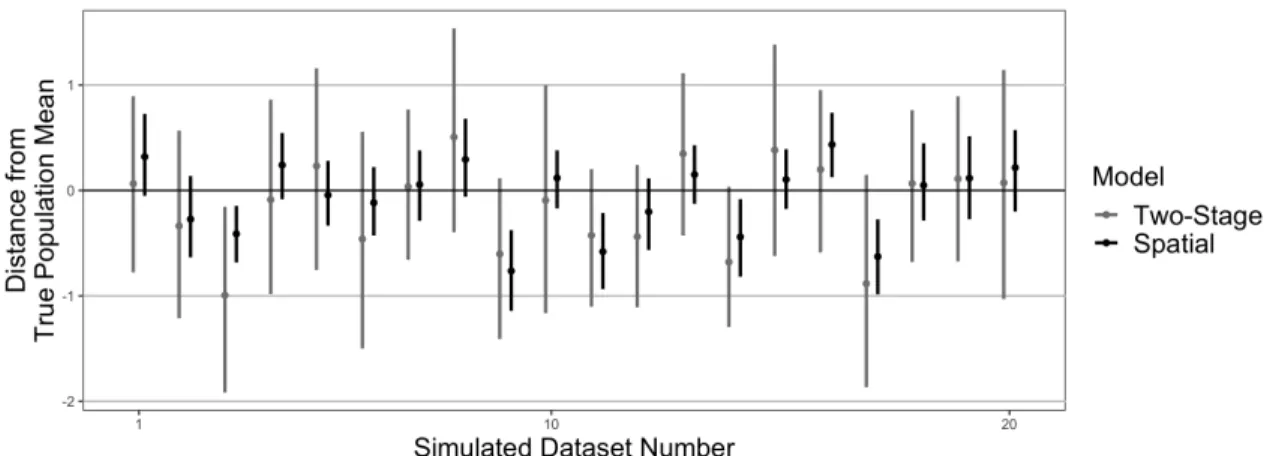
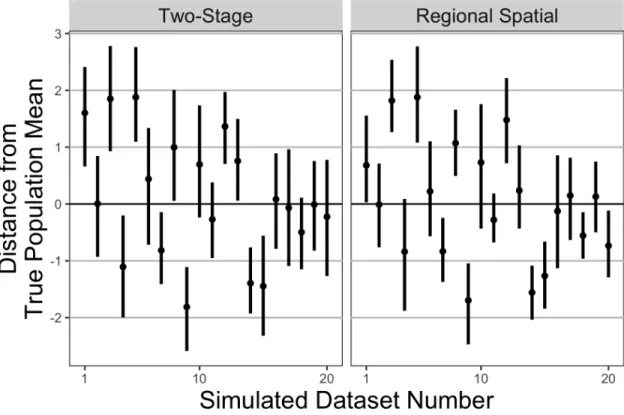
Figure 1: Centered Population Mean Estimates from 2 Exact Models with 95% CI Table 1: Comparison of Parameter Estimation and Model Fit in Two Exact Models
Two-Stage Spatial ν(2) 2.60 (1.55, 3.58) 2.79 (1.36, 4.23) δ2(4) 6.36 (5.47, 7.45) 3.84 (3.35, 4.43) τ2(9) — 8.65 (7.53, 9.96) ¯ y(2.60) 2.66 (7.53, 9.96) 2.92 (7.53, 9.96) WAIC 1803.83 (25.52) 1686.7 (27.6) D = G + P 66100.83=34203.26+31897.56 45335.54=22875.45+22460.08
To perform the spatial random effect procedure,φwas set to its true value of 10 and the ratio
ofδ2/τ2to its true value of 4/9. The posterior conditionals ofδ2|ys andµs|ys,δ2, (13) and (14)
respectively, were sampled as outlined in Section III. This sampling and the prediction ofyns was performed using commands from thespBayesR package (Finley et al., 2015, 2007). The population mean estimate was calculated using the technique described in the non-spatial sampling case above.
Figure 1 plots population average-centered mean estimates and 95% credible intervals from both methods applied to the twenty simulated datasets. While the spatial cases consistently have a smaller credible interval, their point estimates are similar to the two-stage case. However, as the ratio of spatial and non-spatial variance is fixed for this method, this may result in a reduction in the overall variance of the population mean. Posterior mean estimates and their associated 95% credible intervals of the superpopulation parameters and finite population mean, ¯y, from the first generated dataset are given in Table 1, along with the WAIC, its standard error, andDvalues. While both models have similar estimates forν, the two-stage model overestimates the non-spatial
variance. This is expected, as we know that there is additional variance due to spatial correlation that is not being accounted for otherwise in the model. Similarly, both measures of goodness of fit prefer the spatial model.
III.
Markov Chain Monte Carlo Simulation
To explore these findings further, we implemented the four models described in Section IV using the JAGS software in R on the same generated datasets. Models were run for 650 iterations with
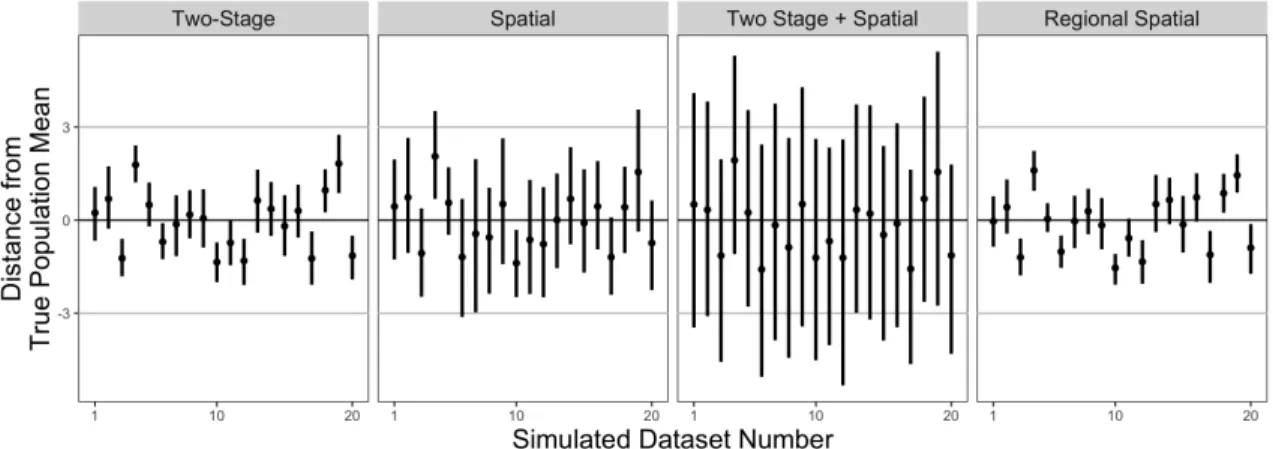
Figure 2: Centered Population Mean Estimates from 4 MCMC Models with 95% CI
50 burn-in. At each iterationg, estimates of the nonsampled units were drawn and estimates for the population mean, ¯y(g)= T1∑ni=1∑mi
j=1yij+∑ N i=1∑ Mi j=mi+1y (g) ij
were calculated. All variance parameters (σ2,τ2, and δ2, as well as site-specific variances such as σi2 andτi2) were given an
inverse-gamma prior with shape 2 and scale 10. In addition,ν was given a flat prior and allφ
parameters were given Uniform(5,15) priors. MCMC sampling was performed using the computer program JAGS (Plummer, 2017) in R.
When assessing model fit in the first realization of the data with WAIC, the spatial model performed slightly worse than the rest of the models with a value of 1,912.70 (SE = 26.36). This may be due to the additional variation which comes from varying the spatial range parameter. This was followed closely by the two-stage model with 1,870.26 (35.00) , which was outperformed by both the regional spatial model with 1,202.08 (38.99) and the two-stage + spatial model with 455.67 (17.03). It is interesting that while the data was generated by the spatial model and sampled by a two-stage framework, neither of these models perform better than the two models which take both the spatial correlation and study design into account.
Figure 2 shows the models’ posterior mean estimates of the finite population mean, which are centered at the true population mean and presented with 95% credible intervals for the 20 simulated datasets. While point estimates remain similar across models, the best fitting model, Model 3, has the widest credible intervals for the population mean. Accounting for only regional effects results in tight credible intervals in Models 1 and 4, which are narrow compared to Model 2, which fails to take into account region specific variability. Similar results were found when applying Models 1 and 4 to the larger simulated datasets and are provided in Web Appendix B.
VI.
D
ata
A
nalysis
: N
itrate in
C
entral
C
alifornia
G
roundwater
In this section, we provide an analysis of groundwater nitrate content of the Tulare Lake Basin (TLB) in Central California from the California Ambient Spatio-Temporal Information on Nitrate in Groundwater (CASTING) Database, which is described in Harter et al. (2017) and Boyle et al. (2012) and is available as the UC Davis Nitrate Data in the data repository of the Groundwater Ambient Monitoring and Assessment Program (accessed June 1, 2019). Interest lies in identifying regions in which ground water nitrate levels exceed 45 mg/L, which is the maximum contaminant level established by the EPA Boyle et al. (2012). At high levels, infants and pregnant women are more susceptible to nitrate poisoning, which makes it more difficult for oxygen to be distributedto body and can be fatal to infants less than six months old. Besides human sources such as sewage disposal, many sources of nitrate are agricultural, such as fertilizer for crops and animal waste (Harter and Lund, 2012). Because of this, regions with high agricultural activity, such as the TLB, have experienced rising levels of nitrate over the past few decades. As groundwater, and therefore nitrate levels in groundwater, can be assumed to be present at all areas of the Central Valley, we can assume that water samples taken from wells come from a spatial field. Therefore, given a sample of readings from various wells, an estimate of the population average of all known wells represents an overall measure of water-health. Additionally, plots of posterior predictive distribution may be useful in identifying high-risk regions which exceed the maximum contaminant level.
The CASTING Database is an extensive collection of nitrate readings from the TLB and Salinas Valley collected by multiple agencies, over 70% of which were collected between 2000 and 2011. Of these, most wells had repeated measurements taken over the time. As the Salinas Valley and the TLB are geographically separate regions of California, only the TLB was included. In order to avoid associations over time, the data was restricted to a single year. The year 2009 was selected as variogram plots suggested nitrate levels followed a roughly exponential distribution. While directional variograms suggested that the measurements may be anisotropic, we continued with the methods presented above, recognizing that a model accounting for directional spatial dependence may provide a better fit to the data.
A map of California zip codes tabulation areas obtained from thetigrisR package (Walker, 2018) was overlaid on the approximate geographic locations of each of the sampled wells, effectively assigning each well to one specific region, defined by a zip code. 1) Only the most recent observation was taken from each well so that each well was only represented once. 2) If unique wells had the same geographic coordinates, one was chosen at random to be removed. 3) Sparse zip codes with less than 10 wells were excluded to ensure that each selected zip code would have a large sample size. These restrictions resulted in a dataset with 6,117 unique wells among 63 zip codes. Nitrate level had a mean of 37.9 mg/L, standard deviation of 52.3 mg/L, and ranged from 0.0 to 903.1 mg/L.
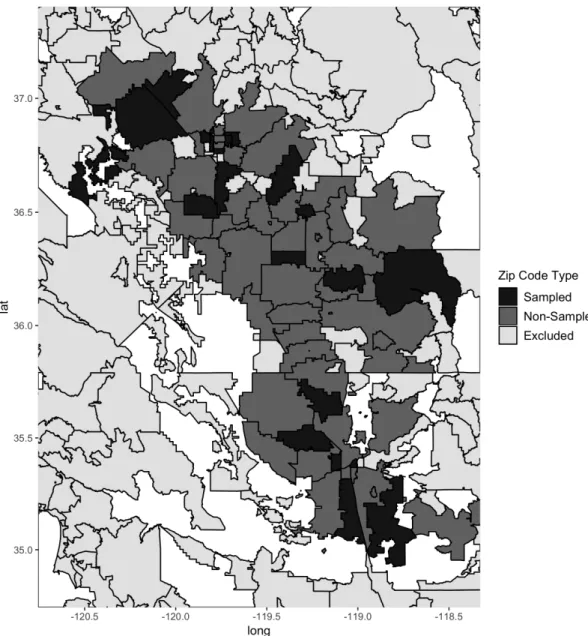
In order to recreate a cluster sampling scenario, 21 of the zip codes were randomly chosen and 50-90% of the population in that zip code was randomly sampled. This resulted in an observed sample size of 489 with a mean nitrate level of 34.2 mg/L and a standard deviation of 40.0 mg/L. The nitrate level ranged from 0.0 to 269.6. This sampling scheme like this could be implemented if there was interest in nitrate levels but financial considerations and time constraints limited the number of zip codes which could be sampled. A plot of these sampled and non-sampled zip codes is available in Web Appendix C. Using this sampled data, all four models in Section III were implemented and the results are shown in Table 2. All variance parameters were given an inverse-gamma prior with shape 2 and scale 10. In addition, ν was given a flat prior and
allφparameters were given Uniform(0,5) priors. MCMC sampling was performed using JAGS
(Plummer, 2017) in R (R Core Team, 2018).
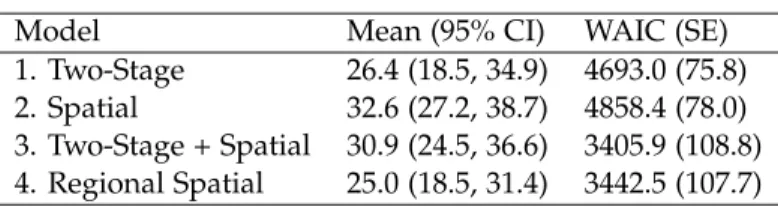
Table 2: Results of Data Analysis
Model Mean (95% CI) WAIC (SE)
1. Two-Stage 26.4 (18.5, 34.9) 4693.0 (75.8) 2. Spatial 32.6 (27.2, 38.7) 4858.4 (78.0) 3. Two-Stage + Spatial 30.9 (24.5, 36.6) 3405.9 (108.8) 4. Regional Spatial 25.0 (18.5, 31.4) 3442.5 (107.7)
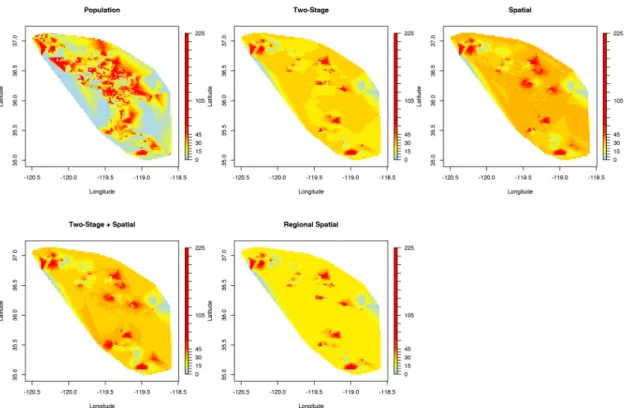
Figure 3: Interpolated surfaces using the population (truth) and posterior predictive samples from the four models. This figure appears in color in the electronic version of this article.
With respect to the estimate of the true mean nitrate level, only the intercept-only spatial model contained the true mean value within its 95% credible intervals. However, as evidenced by the larger mean, standard deviation, and range in the complete dataset, it appears that the sampled units did not capture some of the larger outliers, so it is unsurprising that the estimates of the population mean are lower than the truth. Comparing WAIC, we see results similar to those found in Section III. The spatial models which accounted for regional means had lower WAIC values than the two-stage model, which is evidence that this data is spatially correlated. However, the intercept-only spatial model did not fit the data as well as the two-stage model, which may be due to ignoring the study design. Additionally, the two-stage + spatial model again fits the model the best.
Figure 3 shows the interpolated population surface from the complete sample and the inter-polated surface from posterior predictive samples. While there are common regions at high risk (nitrate level greater than 45 mg/L) in all the posterior predictive maps, the spatial and two-stage + spatial maps predict larger regions. Also seen in Table 2, it is clear that Model 3 estimates a population mean that is larger than Models 1 and 4, but smaller than Model 3. Spatial residual plots for Models 2, 3, and 4 are provided in Web Appendix C.
VII.
D
iscussion
This paper examines the implications of performing two-stage random sampling on point-referenced data which exists in a spatial field. While Scott and Smith (1969) and Malec and
Sedransk (1985) provided a Bayesian model-based framework to account for such a study de-sign, we have demonstrated that an analysis ignoring the underlying spatial correlation between locations or sampling design may lead to spurious inference and poorer model fit.
This work is a first step in developing an overarching framework for Bayesian finite population sampling from spatial process based populations. In our two-stage case, additional work may be done to further improve this model. For instance, CAR priors could be placed on regional parameters such as theµi’s, the regional means, to induce additional spatial correlation in the model. While an exponential covariance function was employed in the analyses in this paper, other spatial covariance functions could be used to create similar simulations and data analyses.
Future work is needed to establish a more general framework that can account for more sophisticated sampling designs in a spatial context. The sampling designs presented in this paper are said to be ignorable (Rubin 1976; Sugden and Smith 1984), which allows us to perform inference on the superpopulation parameters while ignoring the inclusion probability distribution. However, designs in which the data cannot be assumed to be missing at random or parameters defining the outcome and inclusion distributions. One example of this in the spatial context is preferential sampling (Diggle et al. 2010, Gelfand et al. 2012), in which the measurement values and sampling strategy are assumed to stem from the same spatial process. While Pati et al. (2011) have analyzed such data using Bayesian hierarchical models, an overall framework is needed to account for this and other non-ignorable design types.
Additionally, the implications of study design on finite population estimates when sampling from a spatially correlation population over time are unknown. In order to better understand this, these Bayesian models must first be extended to account for both study design and spatio-temporal associations.
Finally, while this paper provided a scaleable model which can account for study design and spatial correlation in massive survey data by assuming regional independence, further work should be done to incorporate recent strategies in modeling large spatial data (Heaton et al., 2018) when analyzing survey data with spatial correlations, such as nearest neighbor processes (Datta et al., 2016), covariance tapering (Furrer et al., 2006), and metakriging (Guhaniyogi and Banerjee, 2018). Finite population models would particularly benefit from such techniques, as computation increases as a function of the population total,T, rather than the sample size,k.
R
eferences
Banerjee, S., Carlin, B. P., and Gelfand, A. E. (2014). Hierarchical Modeling and Analysis for Spatial Data. Boca Raton: CRC Press, 2nd edition.
Boyle, D., King, A., Kourakos, G., Lockhart, K., Mayzelle, M., Fogg, G. E., and Harter, T. (2012). “Groundwater Nitrate Occurrence, Technical Report 4.” Technical report, UC Davis Center for
Watershed Sciences, University of California, Davis.
Bruno, F., Cocchi, D., and Vagheggini, A. (2013). “Finite population properties of individual predictors based on spatial patterns.” Environmental and Ecological Statistics, 20(3): 467–494.
URLhttps://doi.org/10.1007/s10651-012-0229-9
Cicchitelli, G. and Montanari, G. E. (2012). “Model-Assisted Estimation of a Spatial Population Mean.”International Statistical Review, 80(1): 111–126.
URLhttp://www.jstor.org/stable/23257169
Clayton, D. and Kaldor, J. (1987). “Empirical Bayes estimates of age-standardized relative risks for use in disease mapping.”Biometrics, 43(3): 671–681.
Cochran, W. G. (1977). Sampling Techniques. New York: Wiley, 3rd edition.
Cressie, N. and Wikle, C. K. (2011).Statistics for Spatio-Temporal Data. New York: Wiley.
Datta, A., Banerjee, S., Finley, A. O., and Gelfand, A. E. (2016). “Hierarchical Nearest-Neighbor Gaussian Process Models for Large Geostatistical Datasets.”Journal of the American Statistical Association, 111(514): 800–812.
URLhttps://doi.org/10.1080/01621459.2015.1044091
Diggle, P. J., Menezes, R., and Su, T.-L. (2010). “Geostatistical inference under preferential sampling.” Journal of the Royal Statistical Society: Series C, 59(2): 191–232.
Ericson, W. A. (1969). “Subjective Bayesian models in sampling finite populations.” Journal of the Royal Statistical Society, Series B, 31(2): 195–233.
Finley, A. O., Banerjee, S., and Carlin, B. P. (2007). “spBayes: An R Package for Univariate and Multivariate Hierarchical Point-Referenced Spatial Models.” Journal of Statistical Software, 19(4): 1–24.
URLhttp://www.jstatsoft.org/v19/i04/
Finley, A. O., Banerjee, S., and E.Gelfand, A. (2015). “spBayes for Large Univariate and Multivariate Point-Referenced Spatio-Temporal Data Models.”Journal of Statistical Software, 63(13): 1–28.
URLhttp://www.jstatsoft.org/v63/i13/
Furrer, R., Genton, M. G., and Nychka, D. (2006). “Covariance Tapering for Interpolation of Large Spatial Datasets.” Journal of Computational and Graphical Statistics, 15(3): 502–523.
URLhttps://doi.org/10.1198/106186006X132178
Gelfand, A. E. and Ghosh, S. K. (1998). “Model choice: a minimum posterior predictive loss approach.” Biometrika, 85(1): 1–11.
Gelfand, A. E., Sahu, S. K., and Holland, D. M. (2012). “On the effect of preferential sampling in spatial prediction.”Environmetrics, 23(7): 565–578.
Gelman, A. (2007). “Struggles with Survey Weighting and Regression Modeling.”Statistical Science, 22(2): 153–164.
Ghosh, M. and Meeden, G. (1997). Bayesian Methods for Finite Population Sampling. London: Chapman and Hall.
Ghosh, M., Natarajan, K., Stroud, T. W. F., and Carlin, B. P. (1998). “Generalized Linear Models for Small-Area Estimation.” Journal of the American Statistical Association, 93(441): 273–282.
URLhttps://amstat.tandfonline.com/doi/abs/10.1080/01621459.1998.10474108
Ghosh, M. and Rao, J. N. K. (1994). “Small Area Estimation: An Appraisal.” Statistical Science, 9(1): 55–93.
Groundwater Ambient Monitoring and Assessment Program (accessed June 1, 2019). “GAMA Data Download. https://gamagroundwater.waterboards.ca.gov/gama/datadownload.”
URLhttps://gamagroundwater.waterboards.ca.gov/gama/datadownload
Guhaniyogi, R. and Banerjee, S. (2018). “Meta-Kriging: Scalable Bayesian Modeling and Inference for Massive Spatial Datasets.” Technometrics, 60(4): 430–444.
Harter, T., Dzurella, K., Kourakos, G., Hollander, A., Bell, A., Santos, N., Hart, Q., King, A., Quinn, J., Lampinen, G., Liptzin, D., Rosenstock, T., Zhang, M., Pettygrove, G., and Tomich, T. (2017). “Nitrogen Fertilizer Loading to Groundwater in the Central Valley, Final Report to the Fertilizer Research Education Program Projects 11-0301 and 15-0454.” Technical report, California Department of Food and Agriculture and University of California Davis.
Harter, T. and Lund, J. R. (2012). “Addressing Nitrate in California’s Drinking Water with a Focus on Tulare Lake Basin and Salinas Valley Groundwater, Report for the State Water Resources Control Board report to the Legislature ? executive summary.” Technical report, UC Davis Center for Watershed Sciences, University of California, Davis.
Hartley, H. O. and Sielken Jr., R. L. (1975). “A "Super-Population Viewpoint" for Finite Population Sampling.” Biometrics, 31(2): 411–422.
Heaton, M. J., Datta, A., Finley, A. O., Furrer, R., Guinness, J., Guhaniyogi, R., Gerber, F., Gramacy, R. B., Hammerling, D., Katzfuss, M., Lindgren, F., Nychka, D. W., Sun, F., and Zammit-Mangion, A. (2018). “A Case Study Competition Among Methods for Analyzing Large Spatial Data.”
Journal of Agricultural, Biological and Environmental Statistics.
URLhttps://doi.org/10.1007/s13253-018-00348-w
Hoef, J. V. (2002). “Sampling and geostatistics for spatial data.” Écoscience, 9(2): 152–161.
URLhttps://doi.org/10.1080/11956860.2002.11682701
Horvitz, D. G. and Thompson, D. J. (1952). “A Generalization of Sampling Without Replacement From a Finite Universe.” Journal of the American Statistical Association, 47(260): 663–685.
Little, R. J. (2004). “To Model or Not To Model? Competing Modes of Inference for Finite Population Sampling.”Journal of the American Statistical Association, 99(466): 546–556.
Malec, D. and Sedransk, J. (1985). “Bayesian Inference for Finite Population Parameters in Multistage Cluster Sampling.” Journal of the American Statistical Association, 80(392): 897–902. Pati, D., Reich, B. J., and Dunson, D. B. (2011). “Bayesian geostatistical modelling with informative
sampling locations.” Biometrika, 98(1): 35–48.
Plummer, M. (2017). JAGS Version 4.3.0 user manual. International Agency for Research on Cancer, Lyon, France.
R Core Team (2018). R: A Language and Environment for Statistical Computing. R Foundation for Statistical Computing, Vienna, Austria.
URLhttps://www.R-project.org/
Rao, J. N. K. (2003).Small Area Estimation. New York: Wiley. Ripley, B. D. (2004).Spatial Statistics. New York: Wiley.
Robert, C. P. and Casella, G. (2004). Monte Carlo Statistical Methods. Springer Texts in Statistics. New York: Springer, 2nd edition.
Royall, R. M. (1970). “On finite population sampling theory under certain linear regression models.”
Biometrika, 57(2): 377–387.
Scott, A. and Smith, T. M. F. (1969). “Estimation in Multi-Stage Surveys.” Journal of the American Statistical Association, 64(327): 830–840.
Sugden, R. A. and Smith, T. M. F. (1984). “Ignorable and Informative Designs in Survey Sampling Inference.”Biometrika, 71(3): 495–506.
Vehtari, A., Gelman, A., and Gabry, J. (2017). “Practical Bayesian model evaluation using leave-one-out cross-validation and WAIC.” Statistics and Computing, 27(5): 1413–1432.
Walker, K. (2018). tigris: Load Census TIGER/Line Shapefiles. R package version 0.7.
URLhttps://CRAN.R-project.org/package=tigris
A
ppendix
A
This section first provides the derivation of the empirical Bayesian estimators presented in Section II and then the finite population estimates presented in Sections II and III. We first derive (11) and (12). Takees ∼ N(0,δ2V˜s(σ)), ens ∼ N(0,δ2V˜ns(σ)), andν ∼ N(0,δ2γ˜2), where ˜γ2= 1
δ2γ 2, ˜V(σ) s = 1 δ2V (σ) s = h ⊕n i=1 σi2 δ2Imi i , and ˜Vns(σ)= δ12V (σ) ns = h ⊕n i=1 σi2 δ2I(Mi−mi) i
. Since the elements ofyare inde-pendent conditional onµ,Vs,ns =0 andVns,s =0. Define observed group means as ¯yi= m1i ∑nj=1yij and the ratio of variances asλi =δ2/(δ2+σi2/mi)ifi∈(1, . . . ,n)andλi=0 ifi∈(n+1, . . . ,N). Also define the vector of observed group variances to be ˜σ2 = [σ12. . .σn2]>. Recall µs = ν1n+ eµs;eµs ∼ N(0,δ2In), thenys = Xs1µs+es = Xs11nν+e∗s, where e∗s ∼ N(0,δ2[Xs1Xs1>+V˜s(σ)]). Then we have that p(ν|ys) ∝ N(ν|0,δ2γ˜2)×N(ys|Xs11nν,δ2[Xs1Xs1>+V˜
(σ) s ]) ∝ N(ν|Bb,δ2B), where b=1>nXs1>(Xs1Xs1>+V˜ (σ) s )−1ys =1>m1, . . . , 1>mn ⊕n i=1 δ2 σi2 Imi− δ2 σi21mi1 > mi 1+δ2 σi2mi ! ysand B−1= 1 ˜ γ2+1 > nXs1>(Xs1Xs1>+V˜ (σ) s )−1Xs11n= 1 ˜ γ2+ n
∑
i=1 δ2 σi2 1>mi Imi− δ2 σi21mi1 > mi 1+ δ2 σ2i mi ! 1mi . Therefore,B=h˜1 γ2 +∑ n i=1λi i−1 andBb= ∑ni=1λiy¯i 1 ˜ γ2+∑ n i=1λi. To solvep(δ2|ys), split the posterior condi-tional distribution of the superpopulation parameters;p(δ2,ν|ys) =IG(δ2|aδ∗,bδ∗)×N(ν|Bb,δ2B),
where a∗δ = aδ+ k 2 and b∗δ = bδ+ 1 2[y>s (Xs1X>s1+V˜ (σ) s )−1ys+b>Bb]. As p(µns|ys,ν,δ2) =
p(µns|ν,δ2),µns|ν,δ2 ∼ N(1N−nν,δ2IN−n). To solve p(µs|ys,ν,δ2), note that p(µs|ys,ν,δ2) ∝
N(µs|1nν,δ2In)×N(ys|Xs1µs,δ2V˜s(σ))∝N(µs|B∗b∗,δ2B∗), where b∗=ν1n+X>s1(V˜s(σ))−1ys= h ν+ δ2 σ12m1y¯1 · · · ν+ δ2 σ2nmny¯n i> , B−∗1= In+Xs1>(V˜ (σ) s )−1Xs1= ⊕n i=1 σi2+δ2mi σi2 ; B∗= ⊕n i=1 σi2 σi2+δ2mi = ⊕n i=1(1−λi) , and B∗b∗=⊕ni=1(1−λi) h ν+δ2 σ12m1y¯1 · · · ν+ δ2 σn2mny¯n i> = (1−λ1)ν+λ1y¯1 · · · (1−λn)ν+λny¯n > .
To derive (13) and (14) define ˜Vν−1 = 0 and ˜Vs = Ω˜s = δ12Ωs+Ik, and ˜Vµs = 1. Note
that p(µs|ys,δ2) ∝ N(µs|0,δ2)×N(ys|1kµs,δ2Ω˜s) ∝ N(µs|Bµsbµs,δ2Bµs), where Bµs = (1+
1>kΩ˜−s11k)−1andbµs =1>kΩ˜−s1ys. Splitting the posterior conditional distribution of the superpop-ulation parameters,p(δ2,µs|ys) =IG(δ2|a∗∗δ ,bδ∗∗)×N(µs|Bµsbµs,δ2Bµs), wherea∗∗δ =a+
k 2 and b∗∗δ =b+12y>s nΩ˜−1 s −Ω˜−s11k 1+1>kΩ˜−1 s 1k −1 1>k Ω˜−1 s o ys.
We now continue by deriving the general cases presented in Section II. Asβ|ν∼N(Aν,Vβ)
and ν ∼ N(0,γ2), we have that β ∼ N(0,γ2AA>+Vβ). Note that p(β|ys) ∝ N(0,γ2AA>+
Vβ)×N(Xsβ,Vs) ∝ N(Vβ|ysX > s Vs−1ys,Vβ|ys), whereVβ|ys = [(γ 2AA>+V β) −1+X> s Vs−1Xs]−1. DefiningBV =Vns,s+ (Xns−Vns,sVs−1Xs)Vβ|ysX >
s andQ=Xns−Vns,sVs−1Xs, we have that: E[α>y|ys] =α>s ys+αns>E[E[yns|β,ys]|ys] =α>s ys+α>nsE[Xnsβ+Vns,sVs−1(ys−Xsβ)|ys] =α>s ys+α>nsVns,sVs−1ys+QVβ|ysX > s Vs−1ys ={α>s +α>ns[Vns,s+α>nsQVβ|ysX > s ]Vs−1}ys, Var[E[α>y|ys]] =Var[(αs>+α>nsBVVs−1)ys] =α>s Vsαs+2α>nsBVαs+α>nsBVVs−1BVαns , and Var[E[α>y|ys]] =Var[α>nsyns|ys] =Var[E[α>nsyns|β,ys]|ys] +E[Var[α>nsyns|β,ys]|ys] =Var[α>nsQβ|ys] +E[α>ns(Vns−Vns,sVs−1Vs,ns)αns|ys] =α>ns(QVβ|ysQ >+ Vns−Vns,sVs−1Vs,ns)αns.
To derive the estimate given in Example 1, note thatp(µ|ys)∝N(µ|0,ξ2)×N(ys|1nµ,σ2In)∝
N(µ|Bsrsbsrs,Bsrs), whereBsrs= (ξ12 +δn2)−1,bsrs= σ121>nys, andBsrsbsrs= 1 σ21 > nys 1 ξ2+ n σ2 = ∑ni=1yi σ2 ξ2+n . Fixing the variance components, the finite population estimate is
E[α>y|ys] =α>s ys+α>nsE[E[yns|µ,ys]|ys] =α>s ys+α>ns1(N−n)E[µ|ys] = n
∑
i=1 αiyi+∑ N i=n+1αi σ2 ξ2 +n n∑
i=1 yi = n∑
i=1 αi+∑ N i=n+1αi σ2 ξ2 +n ! yi.To derive (4), it is helpful to first make a note regarding Xs1 vs Xs in the calculation of
p(ν|ys) and p(µ|ν,ys). Specifically, p(ν|ys) does not change, since Xs = [Xs1 : 0], b = 1>nXs1>(Xs1Xs1>+V˜ (σ) s )−1ys = 1>NXs>(XsXs>+V˜s(σ))−1ys. Similarly, B−1 = γ˜12 +1>nXs1>(Xs1X>s1+ ˜ Vs(σ))−1Xs11n = γ˜12 +1>NXs>(XsXs>+V˜ (σ)
s )−1Xs1N. However, while computing p(µs|ν,ys) us-ingXs1is computationally convenient for interpretation, employing Xs provides us the poste-rior distribution p(µ|ν,ys). We have that p(µ|ys,ν) ∝ N(µ|ν1N,δ2IN)×N(ys|Xsµ,δ2V˜s(σ)) ∝
conclusions found by derivingp(µs|ν,ys)and p(µns|ν,ys)separately: b∗∗ =ν1N+X>s (V˜ (σ) s )−1ys = h ν+ δ2 σ12m1y¯1, . . . ,ν+ δ2 σn2mny¯n,ν1 > (N−n) i> ; B∗∗−1=IN+Xs>(V˜ (σ) s )−1Xs= ⊕n i=1 σ2i+δ2mi σi2 0 0 I(N−n) ; B∗∗ = ⊕N i=1(1−λi) ; and B∗∗b∗∗ = h (1−λ1)ν+λ1y¯1, . . . ,(1−λn)ν+λny¯n,ν1>(N−n) i> .
Using these derivations, defineλ= [λ1, . . . ,λN]>and ¯y= [y¯1, . . . , ¯yn, 0(N−n)]>.Then fixing the variance components, we have:
E[α>y|ys] =α>s ys+αns>E[E[E[yns|µ,ν,ys]|ν,ys]|ys] =α>s ys+α>nsE[E[Xnsµ|ν,ys]|ys] =α>s ys+α>nsXnsE[[(1−λ1)ν+λ1y¯1, . . . ,(1−λn)ν+λny¯n,ν1>(N−n)]>|ys] =α>s ys+α>nsXns[⊕i=1N (1−λi)]1N ∑ n i=1λiy¯i 1/ ˜γ2+∑ni=1λi +α>nsXns[⊕Ni=1λi]y¯ =α>s ys+ [α1(1−λ1), . . . ,αN(1−λN)]>1N ∑ n i=1λiy¯i 1/ ˜γ2+∑ni=1λi + [α1λ1. . .αNλN]>y¯ = n
∑
i=1 mi∑
j=1 αijyij+ n N∑
i=1 αi(1−λi) o∑ n i=1mλii∑ mi j=1yij 1/ ˜γ2+∑ni=1λi + n∑
i=1 αi λi mi mi∑
j=1 yij = n∑
i=1 mi∑
j=1 αij+ " αi+∑ N i=1αi(1−λi) 1/ ˜γ2+∑ni=1λi # λi mi ! yijNow consider the stratified case for estimating the population mean. Taking non-informative priors for the group means, µ, is equivalent to letting δ2 → ∞and γ2 → ∞. Therefore λi =
δ2
δ2+σ2i/mi →1, for alli=1, . . . ,N. Noteαi =∑
Mi j=mi+1 1 T = Mi−mi T ,i=1, . . . ,n. We have that: lim δ2,γ2→∞ Eh1 T1 > Ty|ys i = n
∑
i=1 mi∑
j=1 1 T+ " Mi−mi T +0 # 1 mi ! yij = n∑
i=1 Mi T y¯i To derive (6), note p(ν|ys,τ2,Ωs,Vs(σ))∝N(ys|Xs1Nν,δ2XsXs>+Ωs+Vs(σ))×N(ν|0,γ2)∝ N(ν|Bsp2bsp2,Bsp2), where Bsp2 = (γ12 +1>NXs>(δ2XsXs>+Ωs+Vs(σ))−1Xs1N)−1 and bsp2 = 1>NX>s (δ2XsXs>+Ωs+Vs(σ))−1ys. Consider the non-spatial case and defineλ>= [λ1. . . ,λN] = 1N>X>s (XsX>s +V˜s(σ))−1Xs, thenB= h 1 ˜ γ2 +1 > NX>s (XsX>s +V˜s(σ))−1Xs1N i−1 =h˜1 γ2 +λ >1Ni−1= h 1 ˜ γ2 +∑ n i=1λi i−1, which agrees with our previous findings.
Similarly, defineλ∗>= [λ∗1. . . ,λN∗] =1>NXs>(δ2XsXs>+Ωs+Vs(σ))−1Xs. ThenBsp2= h 1 ˜ γ2 +λ ∗>1Ni−1=h 1 ˜ γ2 +∑ n i=1λ∗i i−1 . Additionally,p(µ|ys,ν)∝ N(µ|ν1N,δ2IN)×N(ys|Xsµ,Ωs+Vs(σ))∝N(µ|Bsp2∗bsp2∗,Bsp2∗). HereBsp2∗= (1 δ2IN+X > s (Ωs+Vs(σ))−1Xs)−1andbsp2∗ = 1 δ21Nν+X > s (Ωs+Vs(σ))−1ys.
Fixing the variance parameters, we have that: E[α>y|ys] =αs>ys+α>nsE[E[E[yns|µ,ν,ys]|ν,ys]|ys] =α>s ys+α>nsE[E[Xnsµ+Ωns,s(Ωs+Vs(σ))−1(ys−Xsµ)|ν,ys]|ys] =α>s ys+α>nsΩns,s(Ωs+σ2Vs(σ))−1ys+α>ns[Xns−Ωns,s(Ωs+Vs(σ))−1Xs]× Eh(1 δ2IN+X > s (Ωs+Vs(σ))−1Xs)−1(δ121Nν+X>s (Ωs+Vs(σ))−1ys)|ys i =α>s ys+α>nsΩns,s(Ωs+σ2Vs(σ))−1ys+α>ns[Xns−Ωns,s(Ωs+Vs(σ))−1Xs]× 1 δ2IN+X > s (Ωs+Vs(σ))−1Xs −1 Xs>(Ωs+Vs(σ))−1ys+ α>ns[Xns−Ωns,s(Ωs+Vs(σ))−1Xs]× 1 δ2IN+X > s (Ωs+Vs(σ))−1Xs −1 1 δ21N 1>NX>s (δ2XsXs>+Ωs+Vs(σ))−1ys 1 γ2 +∑ n i=1λi∗ = n
∑
i=1 mi∑
j=1 αij+α>ns ( Ωns,s(Ωs+Vs(σ))+ [Xns−Ωns,s(Ωs+Vs(σ))−1Xs] 1 δ2IN+X > s (Ωs+Vs(σ))−1Xs −1 × " Xs>(Ωs+Vs(σ))−1+ 1 δ21N1 > NXs>(δ2XsX>s +Ωs+Vs(σ))−1 1 γ2 +∑ n i=1λ∗i #) qij ! yij.A
ppendix
B
To perform the two-stage procedure, sample means, ˆµi, and sample variances, ˆσi2, were calculated
from each observed region,i=1, . . . , 25. The variance matrix of the sampled units was fixed to be ˜V(σ) s = h ⊕n i=1 ˆ σi2 Var(µˆ)Imi i
where Var(µˆ)represents the sample variance of the observed sample means. Similar to fixingV(σ)
s , the variance matrix of the nonsampled units was fixed atVns = h ⊕N i=1 ˜ σ2i Var(µˆ)IMi−mi i
, where ˜σi2=σˆi2ifi∈ {1, . . . ,n}and ˜σi2= 1n∑i=1n σˆi2ifi∈ {n+1, . . . ,N}. The
value ofγ2was fixed to be half of the value ofδ2, reflecting the belief that there was less variability
in the population mean than between group means. The prior distribution forδ2was assigned to
beIG(3, 5). Sampling from the posterior was performed using the conditional distributions and methods described in Section II. As we have fixed the ratios of all variance components, we have also fixed ˜λi =Var(µˆ)/(Var(µˆ) +σˆi2/mi)ifi∈(1, . . . ,n)and ˜λi =0 ifi∈(n+1, . . . ,N).. Define
c= ∑ni=1λ˜iy¯i 1 2+∑ni=1λ˜i,d =h12+∑ni=1λ˜i i−1 ,c∗(g)= (1−λ˜1)ν(g)+λ˜1y¯1 .. . (1−λ˜n)ν(g)+λ˜ny¯n , andd ∗= ⊕n i=1(1−λ˜i) . The following procedure was implemented to produce posterior estimates of the population mean,