813
F
ISHER
’
S
F
OREWARNING
:
U
SING
D
ATA TO
N
ORMALIZE
C
OLLEGE
A
DMISSIONS
Shakira D. Pleasant
*
A
BSTRACT
This Article presents a nuanced view of Fisher v. University of Texas that has largely been ignored in mainstream discourse in the case. In Fisher, Justice Anthony Kennedy cast the deciding vote to uphold the University of Texas (“UT”) race-conscious admissions policy. This was the first time that Justice Kennedy voted to uphold a race-conscious policy, and many commentators have focused on this aspect of his Fisher majority opinion. However, Justice Kennedy also gave a stern forewarning to UT and other universities: in the future, they better have strong data to show that they need to use race-conscious admissions. Kennedy did not hold UT to a strenuous evidentiary burden because the University did not have incentive to collect certain data up to 2008— the year that Plaintiff Abigail Fisher was denied admission. However, he also made it clear that UT and other universities are now on notice and will need meticulous data for future defense of their policies.
Using UT as a model, this Article shows how universities can use data to defend their race-conscious policies and to ensure that they are attaining student body diversity along racial, socioeconomics, and other lines. First, this Article reviews jurisprudence on race-conscious university admissions, all the way up to Justice Kennedy’s forewarning. Second, it evaluates data that UT has gathered since 2008. It considers admission and enrollment rates for UT’s race-neutral Top Ten Percent Law (“TTPL”) and for its race-conscious holistic admissions policy, and it also examines which secondary schools are the top feeders for minority students at UT. This Article argues that UT needs its race-conscious holistic policy because (1) White American students admitted under TTPL enroll at greater rates than Black and Latina/o TTPL admittees; and (2) Those minority students who are admitted via TTPL come from racially homogeneous schools. Part III of the Article then concludes with proposals for UT to defend its race-conscious policies and to improve enrollment and retention rates for minority students. These proposals also provide models for other universities who may face lawsuits against their affirmative action policies.
*
Professor of Legal Writing and Lecturer in Law, University of Miami School of Law. J.D. 2004, University of the Pacific, McGeorge School of Law. Certified Public Manager (CPM) and Lean Six Sigma Green Belt Certification, 2014, The George Washington University. This Article is dedicated to the late Dean Keith M. Harrison and Savannah Law School (SLS). Special thanks to the University of Pennsylvania Journal of Constitutional Law Editors for your individual and collective efforts preparing this Article for publication, and to my sorority sister whose personal touch facilitated this moment. To my research assistants—Amanda Wydler (‘18), Danielle Ellis (‘18), Raven King (‘18), Stephanie Robin (‘20), and Jordyn Hughes (‘20)—I appreciate your help with putting the finishing touches on this piece. To Professor Vinay Harpalani, Cherrell Holmes, Esq., Rikki Simmons (SLS ‘18), and Angela Middleton (SLS ‘20)—I owe you a debt of gratitude for your time, dedication, and persistent encouragement to complete this Article. Finally, to my Lutie Sisters—participants and organizers of the 12th Annual Lutie A. Lytle Black Women Law Faculty Workshop & Writing Retreat—thank you for input and critique as I revised this accepted draft. Because of your support and feedback, I believe this will reach those with an ear to hear!T
ABLE OF
C
ONTENTS
I
NTRODUCTION
... 815
I.
H
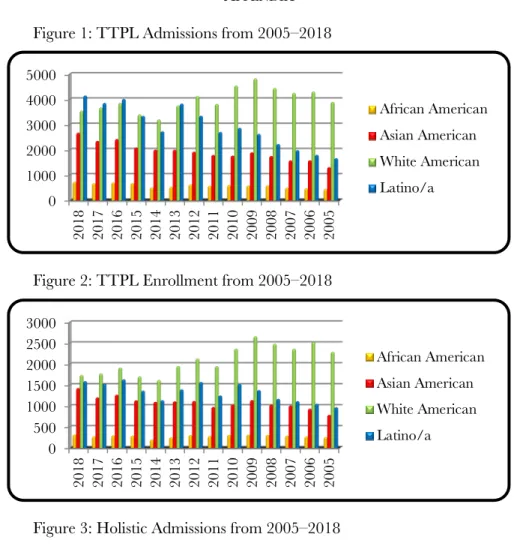
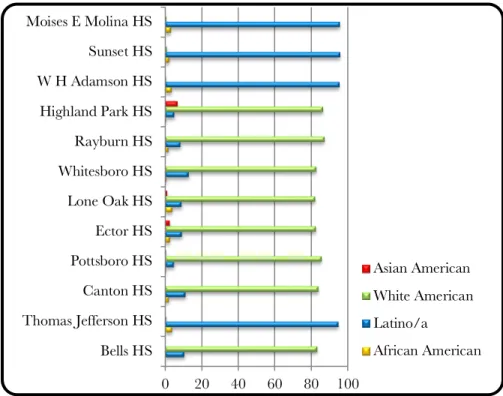
ISTORY
,
R
ACE
,
A
ND
A
DMISSIONS
I
N
H
IGHER
E
DUCATION
... 824
A. History Teaches Us that Racial Diversity Promotes the Promise of
Equal Protection, but Higher Education Admissions Cannot Rely
on Quotas
... 825
B. Stare Decisis and Higher Education Jurisprudence
... 827
C. History is Contextual, but Innovation Is Necessary to Sustain the Use
of Race as a Constitutionally Permissible Factor in Higher Education
Admissions
... 830
II.
D
ATA
D
RIVEN
A
DMISSIONS
... 833
A. DEFINE: Automatic and Race-Conscious Holistic Admissions Process
at UT
... 836
B. MEASURE: Professors Tienda and Montejano’s Prior Data Analysis
Provides Context
... 839
C. MEASURE: Recent Demographic Data Addresses Justice Kennedy’s
Inquiry
... 840
1. A Macro Approach to Texas’ Data—Looking at General
Statewide and School-aged Population Demographics and
TTPL/Holistic Admissions
... 841
2. A Micro Approach to the Data—Looking at the TTPL Pipeline
of Texas Feeder Schools
... 847
C. ANALYZE: Recent Demographic Data Contradicts the Dissent
... 858
III.
S
TRATEGIES TO
C
REATE AN
U
NASSAILABLE
P
OSITION
U
SING
F
OCUS
,
F
ORETHOUGHT
,
AND
O
RGANIZATIONAL
P
ROCESS
I
MPROVEMENT
... 860
A. IMPROVE: Data Collection for TTPL Feeder Schools
... 861
1. Organize and Report Feeder School Data By ESC, ISD, and
Individual School Campus
. ... 862
2. Capture Racial and Economic Data from Feeder Schools
. ... 866
3. Capture Which Schools Have the Postsecondary Readiness
Distinction Designation from the Texas Education Agency
(“TEA”)
... 868
C. IMPROVE: Safe Spaces at UT to Promote Retention
... 870
C
ONCLUSION
... 872
I
NTRODUCTION
One vote underscored the importance of racial diversity in higher
education.
1When Justice Anthony Kennedy wrote the United States
Supreme Court (“U.S. Supreme Court” or “Court”) decision in
Fisher v.
University of Texas
(“
Fisher
II
”), he found that a compelling interest exists in
achieving student body diversity
and
by applying race as one of several
admissions factors, the University of Texas at Austin’s (“UT” or
“University”) means for satisfying that interest were narrowly tailored.
2Yet,
despite its holding,
Fisher II
did not foreclose future challenges to UT’s
race-conscious admissions; in fact, litigation and other undermining acts currently
underway are likely attributed to the narrow scope in which the case was
decided.
3Justice Kennedy’s words were eerily foretelling, but also instructive.
4Writing for the majority, he opined:
[UT’s] examination of the data it has acquired in the years since petitioner’s
[Fisher’s] application . . . must proceed with full respect for the constraints
imposed by the Equal Protection Clause. The type of data collected, and
the manner in which it is considered, will have a significant bearing on how
1 See Fisher v. Univ. of Tex. at Austin (Fisher II), 136 S. Ct. 2198, 2205 (2016).
2 See id. at 2214 (“In short, none of petitioner’s suggested alternatives—nor other proposals considered or discussed in the course of this litigation—have been shown to be ‘available’ and ‘workable’ means through which the University could have met its educational goals, as it understood and defined them in 2008. . . . The University has thus met its burden of showing that the admissions policy it used at the time it rejected petitioner’s application was narrowly tailored.”).
3 The decision in Fisher II exemplifies how evidentiary doctrine intersects with substantive
constitutional law and civil procedure. It is also the first time that Justice Kennedy wrote the majority opinion affirming a race-conscious admissions policy. Substantively, the Court determined that UT complied with constitutional requirements by satisfying strict scrutiny. Id. But, procedurally, it disposed of the case by finding that Fisher had not satisfied the evidentiary burden necessary to overcome summary judgment. Id. at 2209–10. It is the evidentiary burden that is most important to this case and future cases. The timing of the case did not require UT to assess its holistic admissions beyond the work it had done until 2008, but moving forward, data will be a key component to determining if a race-conscious admissions policy meets strict scrutiny. Id. at 2210 (“[T]he Court is necessarily limited to the narrow question before it: whether, drawing all reasonable inferences in her favor, petitioner has shown by a preponderance of the evidence that she was denied equal treatment at the time her application was rejected.”); see also Vinay Harpalani, The Fishing Expedition Is Over: Victory for Affirmative Action in Fisher v. Texas!, AM.CONSTITUTION
SOC’Y BLOG (June 24, 2016), https://www.acslaw.org/?post_type=acsblog&p=11544 .
4 UT’s “combined percentage-plan/holistic-review approach” had existed for only three years when Fisher filed suit. Fisher II, 136 S. Ct. at 2209. Thus, even if Fisher II had been remanded again, there was insufficient evidence to answer the question of whether Fisher received equal treatment under the law when her admissions application was rejected in 2008. Id. at 2209–10. Further, the record was devoid of information for the Court to determine “how students admitted solely based on their class rank differ in their contribution to diversity from students admitted through holistic review.” Id. at 2209.
the University must shape its admissions policy to satisfy strict scrutiny in the
years to come. . . .
. . . .
The Court’s affirmance of [UT’s] admissions policy today does not
necessarily mean the University may rely on that same policy without
refinement. It is the University’s ongoing obligation to engage in constant
deliberation and continued reflection regarding its admissions policies.
5The Court’s opinion was lauded as “built to last,”
6but that did not deter
UT’s race-conscious admissions from being attacked less than one year after
the
Fisher II
decision.
7In March 2017, reports surfaced that a new lawsuit against UT was
afoot.
8Focused squarely on the U.S. Supreme Court’s directive that UT
must “
engage in constant deliberation and continued reflection regarding its admissions
policies
,”
9the litigants claimed that “UT has not met its constitutional
obligations and is vulnerable to a new legal challenge.”
105 Id. at 2210, 2215.
6 Adam Liptak, Ruth Bader Ginsburg, No Fan of Donald Trump, Critiques Latest Term, N.Y.TIMES (July 10, 2016), https://www.nytimes.com/2016/07/11/us/politics/ruth-bader-ginsburg-no-fan-of-donald-trump-critiques-latest-term.html?_r=0.
7 See Students for Fair Admissions, Students for Fair Admissions Launches New Website Targeting University of
Texas-Austin Admissions Policies, PR NEWSWIRE (Mar. 1, 2017, 11:05 PM), http://www.prnewswire.com/news-releases/students-for-fair-admissions-launches-new-website-targeting-university-of-texas-austin-admissions-policies-300416459.html (demonstrating how Edward Blum, the financier of Fisher I and Fisher II, invites people rejected from UT to reach out to Students for Fair Admissions to “end UT’s discriminatory admissions practices and bring fairness and equality back to UT” through litigation); see also Were You Rejected from the University of Texas at Austin?, UNIV. TEX. NOT FAIR, https://utnotfair.com/ (last visited Jan. 19, 2019) [https://web.archive.org/web/20190119063344/https://utnotfair.com/].
8 The pending state lawsuit is not the focus of this Article, but it is worth noting that the state litigation
appears to be a long-term orchestrated strategy against the University. The statute at issue, Texas Education Code § 51.803(k), was amended in June 2009—approximately one year after Fisher sued UT in federal district court and about three years before the U.S. Supreme Court granted certiorari in Fisher I. See Plaintiff’s Original Petition & Application for Permanent Injunction at 9–10, Students for Fair Admissions, Inc. v. Univ. of Tex., No. D-1-GN-17-002930 (Tex. Dist. Ct. June 26, 2017); see also TEX.EDUC.CODE § 51.803(k) (“A general academic teaching institution [UT is defined as such under TEX.EDUC.CODE § 61.003] may not offer admission under Subsection (a−1) for an academic year after the 2017–2018 academic year if . . . (1) a final court order applicable to the institution prohibits the institution from considering an applicant’s race or ethnicity as a factor in the . . . decisions relating to first-time undergraduate admissions . . . .); An Act, S.B. No. 175, 81st Leg., ch. 1342, § 1, eff. June 19, 2009 (amending TEX.EDUC.CODE § 51.803); Motion for Preliminary Injunction, Fisher v. Univ. of Tex. at Austin, 645 F. Supp. 2d 587 (W.D. Tex. 2009) (No. 1:08-cv-00263-SS).
9 Fisher II, 136 S. Ct. at 2215 (emphasis added).
10 Students for Fair Admissions Files Lawsuit Against Univ. of Texas at Austin, PRNEWSWIRE (Mar. 1, 2017, 11:05 PM), https://www.prnewswire.com/news-releases/students-for-fair-admissions-launches-new-website-targeting-university-of-texas-austin-admissions-policies-300416459.html.
One month later, in April 2017, the Texas Legislature once again sought
to restrict how many students could be automatically admitted to UT via
Texas’ Top Ten Percent law (“TTPL”).
11TTPL opponents led the charge
to amend the statute again, but the effort was unsuccessful.
12Even though
their efforts ultimately failed, they alleged two bases to support another
statutory amendment.
13First, they claimed that UT could not be as selective
with its holistic admissions because TTPL admittees comprise about
seventy-five percent of the incoming class.
14Second, they claimed that TTPL
admittees were not more diverse despite the law’s enactment; therefore,
amending the law again would not be detrimental to its purpose.
1511 In 1997, when TTPL was enacted, students graduating in the top ten percent of their class were
eligible for automatic admissions. In 2009, the statute was amended, thereby restricting students’ class rank and access. In a progressive scheme, UT limited its acceptance of TTPL admitted students—only those required to fill seventy-five percent of UT’s freshman enrollment capacity would be automatically admitted. This meant, beginning with the 2011–2012 admissions cycle, students graduating in the top nine to six percent of their class would be eligible for automatic admission. Compare An Act, H.B. No. 588, 75th Leg., ch. 155, § 1, eff. Sept. 1, 1997, with An Act, S.B. No. 175, 81st Leg., ch. 1342, § 1, eff. June 19, 2009, and S.B. No. 2119, 85th Leg., Reg. Sess. (Tex. 2017). Now, the amended legislation caps automatic admissions to seventy-five percent of the incoming class, and, instead of the top ten percent being automatically admitted, it is now the top six percent. Id.; see also Matthew Watkins, Author of Effort to Peel Back Top 10 Percent Rule says His Bill is Dead,TEX.TRIB. (May 19, 2017, 1:00 PM), https://www.texastribune.org/2017/05/19/ author-effort-peel-back-top-10-percent-rule-says-bill-dead/.
12 See Watkins, supra note 11 (noting that a bill author did not have enough support to get the bill to
the floor); see also Matthew Watkins, Texas Senators Mull Eliminating the Top 10 Percent Rule, TEX.TRIB. (Apr. 5, 2017, 6:00 PM), https://www.texastribune.org/2017/04/05/texas-senators-mull-eliminating-top-10-percent-rule/ (discussing lawmakers’ proposal to eliminate the TTPL).
13 See generally Watkins, supra note 11; Watkins, supra note 12. 14 See generally Watkins, supra note 11; Watkins, supra note 12. 15 Proponents claim:
CSHB 588 would establish a fair, race-neutral admissions structure providing students from all backgrounds and parts of the state an opportunity to continue their educations. . . . Many regions of the state, school districts, and high schools in Texas are still predominantly composed of people from a single racial or ethnic group. Because of the persistence of this segregation, admitting the top 10 percent of all high schools would provide a diverse population and ensure that a large, well-qualified pool of minority students was admitted to Texas universities.
HOUSE RESEARCH ORGANIZATION, BILL ANALYSIS HB 588 4–5 (1997), available at
https://hro.house.texas.gov/pdf/ba75r/hb0588.pdf#navpanes=0; see also Matthew Watkins, Abbott: “I Would Like to See” Top 10 Percent Rule Change,TEX.TRIB. (May 19, 2016, 5:00 PM), https://www.texastribune.org/2016/05/19/abbott-top-10-percent-rule-needs-be-changed/ (“If you look back to the university that they had before the automatic admissions compared to what they have now . . . it’s my understanding it was fairly much the same.”).
In addition to the state lawsuit
16and failed legislative reform, the United
States Department of Justice (“Justice Department”) announced in August
2017, that it would direct resources toward “investigating and suing
universities over affirmative action policies deemed to discriminate against
white applicants.”
17For now, the Justice Department’s focus is on Harvard
University.
18However, UT, as well as other colleges and universities should
take heed because they could be next.
19The holding in
Fisher II
unquestionably outlined the Court’s expectation
that UT collect, scrutinize, and utilize data to evaluate and refine its
race-conscious admissions process.
20And, it would be myopic to view this
expectation as only being applicable to UT—other colleges and universities
16 See Matthew Watkins, Man Behind Fisher Affirmative Action Case Files New Lawsuit Against UT-Austin,
TEX.TRIB. (June 27, 2017), https://www.texastribune.org/2017/06/27/man-behind-fisher-case-files-new-lawsuit-challenging-affirmative-actio/ (last updated June 27, 2017, 2:00 PM) (discussing a challenge under the state’s constitution); see also Plaintiff’s Original Petition & Application for Permanent Injunction, supra note 8.
17 Charlie Savage, Justice Dept. to Take on Affirmative Action in College Admissions, N.Y.TIMES (Aug. 1, 2017), https://www.nytimes.com/2017/08/01/us/politics/trump-affirmative-action-universities.html?mcubz=0.
18 During the 2017–2018 academic year, Harvard, for the first time in its history admitted a majority-minority (i.e., less than fifty percent white) entering class. Deirdre Fernandes, The Majority of
Harvard’s Incoming Class Is Nonwhite, BOS. GLOBE (Aug. 3, 2017),
https://www.bostonglobe.com/metro/2017/08/02/harvard-incoming-class-majority-nonwhite/ 5yOoqrsQ4SePRRNFemuQ2M/story.html (last updated Aug. 5, 2017); see also Deirdre Fernandes, Justice Department Investigating Harvard Over its Admissions Policies, BOS.GLOBE (Nov. 21, 2017), https://www.bostonglobe.com/metro/2017/11/21/justice-department-investigating-harvard-over-its-admission-policies/LJL8KmnOZHY3qO0PjCU8LP/story.html (discussing the launch of a civil rights investigation after allegations that Harvard limited admissions of Asian-American students).
19 Harvard is being targeted by both the Justice Department and Students for Fair Admissions
(“SFA”). SFA is an organization led by Edward Blum—the same individual who financed the Fisher litigation. Watkins, supra note 16. SFA also sued the University of North Carolina-Chapel Hill (“UNC”), but unlike Fisher, the plaintiffs’ race in the Harvard and UNC lawsuits is Asian American, not White. See Project on Fair Representation Announces Lawsuits Challenging Admissions Policies at Harvard Univ. and Univ. of North Carolina-Chapel Hill, STUDENTS FOR FAIR ADMISSIONS, https://studentsforfairadmissions.org/project-on-fair-representation-announces-lawsuits-challenging-admissions-policies-at-harvard-univ-and-univ-of-north-carolina-chapel-hill/ (last visited Jan. 5, 2019) (detailing how the suit against Harvard claims the university unequally admits White, African-American, and Hispanic students over Asian-American students who have better SAT scores); see also Students for Fair Admissions, Inc. v. President & Fellows of Harvard Coll., 308 F.R.D. 39, 43, 50–51 (D. Mass 2015) (same systematic effort to dismantle race-conscious admissions, but strategically different tactic as private party action receives backing from government).
20 Fisher II, 136 S. Ct. 2198, 2210 (2016) (“As the University examines this data, it should remain mindful that diversity takes many forms. Formalistic racial classifications may sometimes fail to capture diversity in all of its dimensions and, when used in a divisive manner, could undermine the educational benefits the University values.”).
can also benefit from using data to normalize their admissions.
21Before
Fisher II
, the U.S. Supreme Court had not explicitly held that a
data-driven race-conscious admissions process was required to meet strict
scrutiny, but now it is imperative.
22Justice Kennedy’s retirement in July
2018 and the procedural posture in Harvard University’s lawsuit foreshadow
the Court’s instruction, as well as the likelihood of more legal challenges,
regarding race-conscious admissions.
23In UT’s case, future data collection and assessment must keep TTPL and
its feeder schools as a focal point.
24Similarly, other colleges and universities
should undertake collecting, analyzing, and utilizing feeder school data,
2521 See Mikhail Zinshteyn, University of California President Wants to Offer Guaranteed Admission to Qualified
Community College Students, EDSOURCE (Mar. 7, 2018), https://edsource.org/2018/university-of- california-president-wants-to-offer-path-to-guaranteed-admissions-for-community-college-students/594383 (reporting that a California university system is exploring ways to guarantee admission to academically eligible students); see also Randall Kennedy, Persuasion and Distrust: A Comment on the Affirmative Action Debate, 99 HARV.L.REV. 1327, 1328 (1986) (“[A]ffirmative action should generally be retained as a tool of public policy because, on balance, it is useful in overcoming entrenched racial hierarchy.”).
22 Colleges and universities, such as UT, can also look to Justice Kennedy’s concurrence in Parents
Involved in Community Schools v. Seattle School District No. 1, for guidance:
While [the school district] acknowledges that racial classifications are used to make certain assignment decisions, it fails to make clear, for example, who makes the decisions; what if any oversight is employed; the precise circumstances in which an assignment decision will or will not be made on the basis of race; or how it is determined which of two similarly situated children will be subjected to a given race-based decision.
551 U.S. 701, 785 (2007) (Kennedy, J., concurring).
23 The three more conservative justices on the Court—Chief Justice Roberts, Justice Thomas, and Justice Alito—alleged that the affirmative action practices the Court upheld in Fisher II were inherently discriminatory. See Joseph Milord, Kennedy’s Retirement Affects Affirmative Action Cases in Significant Ways, ELITE DAILY (June 28, 2018), https://www.elitedaily.com/p/kennedys-retirement-affects-affirmative-action-cases-in-significant-ways-9621157 (“The dissenting opinion [in Fisher II] becomes all the more important, considering one major affirmative action case that appears headed from the Supreme Court in the near future. That case argues that Harvard University’s affirmative action practices discriminate against Asian-Americans.”); see also Michael D. Shear, Supreme Court Justice Anthony Kennedy Will Retire, N.Y. TIMES (Jun. 27, 2018), https://www.nytimes.com/2018/06/27/us/politics/anthony-kennedy-retire-supreme-court.html (emphasizing Justice Kennedy’s role as a swing vote and how a conservative justice could “imperil” precedent Justice Kennedy sided with).
24 Fisher II, 136 S. Ct. at 2208–09 (“The University’s program is sui generis. Unlike other approaches to college admissions considered by this Court, it combines holistic review with a percentage plan. This approach gave rise to an unusual consequence in this case: The component of the University’s admissions policy that had the largest impact on petitioner’s chances of admission was not the school’s consideration of race under its holistic-review process but rather the Top Ten Percent Plan.”).
25 See, e.g., Parents Involved in Cmty. Schs. v. Seattle Sch. Dist. No. 1, 551 U.S. 701, 789 (2007) (Kennedy, J. concurring in part and concurring in the judgment) (“School boards may pursue the goal of bringing together students of diverse backgrounds and races through other means, including strategic site selection of new schools; drawing attendance zones with general recognition of the
whether or not they have a state sanctioned race-neutral percentage plan.
26This Article adds to the existing discourse that has been written about
Fisher
and affirmative action in higher education over the years.
27It applies
Lean Six Sigma (i.e., a business concept focused on process improvement) to
assess the data that Justice Kennedy referenced in the
Fisher II
decision.
28demographics of neighborhoods; allocating resources for special programs; recruiting students and faculty in a targeted fashion; and tracking enrollments, performance, and other statistics by race.” (emphasis added)). See generally Students for Fair Admissions, Inc. v. President & Fellows of Harvard Coll., No. 1:14-cv-14176 (D. Mass. Nov. 17, 2014); Students for Fair Admissions, Inc. v. Univ. of N.C., No. 1:14-cv-00954 (M.D.N.C. Nov. 17, 2014).
26 In addition to Texas, California and Florida have race-neutral admissions percentage plans. This
is in contrast to Massachusetts and North Carolina, where no race-neutral admissions percentage plan exists, but higher education institutions in these states are being sued for their race-conscious admissions processes. Compare CALIFORNIA MASTER PLAN FOR HIGHER EDUCATION (2002), available at https://ahed.assembly.ca.gov/sites/ahed.assembly.ca.gov/files/hearings/ master%20plan.pdf (stating that the top one-third and one-eighth of high school graduates will be offered admission to California State University and University of California campuses, respectively), and CAL.CONST. art. I, § 31 (eliminating the use of race in college admissions in California), and Fla. Exec. Order No. 99-281 (Nov. 9, 1999), available at https://www.dms.myflorida.com/content/download/705/3389/file/ExecutiveOrder99-281.pdf (eliminating the use of race in college admissions), and Florida Board of Governors Regulation 6.002(2)(c) (2017), available at https://www.flbog.edu/documents_regulations/regulations/ 6%20002%20FTIC%20Admissions%202_FINAL.pdf (stating that high school seniors graduating in the top twenty percent of their class may be eligible but not guaranteed admission to the State University System), with 50-State Comparison, EDUC. COMMISSION STS. (Feb. 2017), http://ecs.force.com/mbdata/MBquest3RTA?Rep=SA1704 (listing whether each state has a guaranteed college admissions policy for high school students who meet a certain criteria).
27 See generally Tomiko Brown-Nagin, Elites, Social Movements, and the Law: The Case of Affirmative Action, 105 COLUM. L. REV. 1436 (2005) (analyzing social movements after the Grutter and Gratz decisions as they relate to affirmative action); Ward Connerly, It Is Time to End Race-Based “Affirmative Action,”
1 U.ST.THOMAS J.L.&PUB.POL’Y 56 (2007) (explaining dangers of affirmative action policies);
Marvin Lim, Percent Plans: A “Workable, Race-Neutral Alternative” to Affirmative Action, 39 J.C. & U.L. 127 (2013) (providing an overview of percent plans and analyzing their constitutionality); Rachel F. Moran, Diversity and its Discontents: The End of Affirmative Action at Boalt Hall, 88 CALIF.L.REV. 2241 (2000) (analyzing how the state’s prohibition on race-based admissions harmed the educational experience); Daria Roithmayr, Direct Measures: An Alternative Form of Affirmative Action, 7 MICH.J. RACE &L.1 (2001) (suggesting an alternative form of law school affirmative action what the student-applicant can contribute); Kermit Roosevelt III, The Ironies of Affirmative Action, 17 U.PA.J. CONST.L. 729 (2015) (arguing that application of strict scrutiny in affirmative action cases is inconsistent with other doctrinal areas applying strict scrutiny); Joshua P. Thompson & Daniel M. Schiff, Divisive Diversity at the University of Texas: An Opportunity for the Supreme Court to Overturn Its Flawed Decision in Grutter, 15 TEX.REV.L.&POL. 437 (2011) (explaining how Fisher can be distinguished from Grutter or used to overturn it); Linda Wightman, The Consequences of Race-Blindness: Revisiting Prediction Models with Current Law School Data, 53 J. LEGAL EDUC. 229 (2003) (using statistical models to measure the impact on diversity if race is not considered); Danielle Holley & Delia Spencer, Note, The Texas Ten Percent Plan, 34 HARV.C.R.-C.L.L.REV. 245 (1999) (providing historical and legal overviews of the TLLP and explaining why it had minimal success).
28 This Article uses UT as a proxy because its admission process—not other public colleges and universities in Texas—was adjudicated in Fisher I and II. The innovations prescribed herein are
Taking into account UT’s role in
Fisher
, its unique pipeline of students and
the process flow of the admissions cycle, Lean Six Sigma is an
interdisciplinary tool that can be used to demonstrate whether using race in
higher education admissions is narrowly tailored to achieve the college or
university’s compelling interest of achieving student body diversity.
29As background, Part I reviews the jurisprudence on race-conscious
admissions. The precedent cases relied upon are
Sweatt v. Painter
,
Regents of
University of California
v. Bakke
,
Grutter v. Bollinger
,
Hopwood v. Texas
, and
Fisher v.
University of Texas at Austin I
and
II.
30In Part II, the Article evaluates data that UT has gathered since Abigail
Fisher applied for admission in 2008—data referenced by Justice Kennedy
in the
Fisher II
opinion.
31Further, this section reviews historical data and
findings by social scientists, Professors Marta Tienda and David
Montejano.
32These scholars evaluated data regarding UT’s admissions
guided by legal precedent and empirical data, as well as principles of Lean Six Sigma, which is a methodology traditionally used to improve businesses processes. This interdisciplinary approach is used to create solutions that UT and other colleges or universities can use to overcome challenges to their race-conscious admissions. See generally BARBARA WHEAT,CHARLES MILLS &MICHAEL
CARNELL,LEANING INTO SIX SIGMA:THE PATH TO INTEGRATION OF LEAN ENTERPRISE AND
SIX SIGMA (2001).
29 See generally BARBARA WHEAT CHARLES MILLS &MICHAEL CARNELL,LEANING INTO SIX SIGMA:
APARABLE OF THE JOURNEY OF SIX SIGMA AND A LEAN ENTERPRISE (2003) (stating that Lean
Six Sigma has been used in manufacturing).
30 Texas v. Lesage is also a race-conscious admissions case specific to the University of Texas; however, it will not be discussed in this Article. See, e.g., Texas v. Lesage, 528 U.S. 18, 22 (1999).
31 Fisher II, 136 S. Ct. 2198, 2209–10 (2016) (“[UT] had no reason to keep extensive data on the Plan or the students admitted under it—particularly in the years before Fisher I clarified the stringency of the strict-scrutiny burden for a school that employs race-conscious review. . . . Going forward, that assessment [‘of the constitutionality, and efficacy, of its admissions program’] must be undertaken in light of the experience the school has accumulated and the data it has gathered . . . . The University’s examination of the data it has acquired in the years since petitioner’s application . . . must proceed with full respect for the constraints imposed by the Equal Protection Clause.”).
32 The historical social science data analysis (i.e., pre-2008) is included in Part II of this Article. See Marta Tienda et al., Affirmative Action and the Texas Top 10% Percent Admission Law: Balancing Equity and Access to Higher Education, 79 SOCIÉTÉS CONTEMPORAINES 5 (2008), http://people.socsci.tau.ac.il/ mu/salon/files/2010/10/Affirmative-Top-10.pdf (“HB 588 largely transformed a de facto practice of admitting highly ranked students to a de jure guarantee of acceptance”); Marta Tienda & Sunny X. Niu, Texas’ 10-Percent Plan: The Truth Behind the Numbers, 50 CHRON.HIGHER EDUC., Jan. 23, 2004, at B10, available at http://www.texastop10.princeton.edu/publicity/theop/ Chronicle0104.pdf (providing an empirical study that evaluates “whether students from highly competitive high schools have been truly crowded out of the public flagships” because of the TTPL); David Montejano, Access to the University of Texas at Austin and the Ten-Percent Plan: A Three-Year Assessment (2000) (on file with author) (providing a pre-Grutter data analysis evaluating the racial composition of students admitted to UT via TTPL and the impact of (new) high school sending or “feeding” patterns).
from the inception of TTPL until approximately 2010.
33On balance, the
data gathered since Abigail Fisher applied for admission in 2008 shows that
not much has changed since Professors Tienda and Montejano completed
their reviews.
34This post-2008 data analysis reveals:
1.
White Americans are the dominate racial group of admitted and enrolled
students under TTPL and UT’s holistic admissions;
352.
Minority students
36still enroll at UT at lesser rates than White
Americans, therefore, UT’s need to consider race in its admissions
process has not been undermined by Texas’ changing demographics;
37and
3.
UT cannot attain a diverse student population solely through TTPL,
because minority students that are automatically admitted to UT are
graduating from homogenous, in-state high schools.
3833 Tienda et al., supra note 32; Montejano, supra note 32.
34 Over the course of twenty years, the data results are the same. When Professors Tienda and
Montejano conducted their research, White Americans were the dominate racial group being admitted to UT under TTPL and its holistic admissions. This Author’s analysis corroborated Professor Tienda and Montejano’s findings as the results have not changed from 2010–2017/2018. Likewise, the Texas Tribune came to the same conclusion when it analyzed results over a five-year span. See Neena Satija, Race and UT-Austin Admissions: A Snapshot of the Past Five Years, TEX.TRIB. (Jun. 23, 2016, 12:00 PM), https://www.texastribune.org/2016/06/23/race-and-admissions-ut-austin-last-five-years/ (finding that thirty-four percent of TTPL admitted students were White Americans, and forty-nine percent of students admitted via the race-conscious, holistic, admissions were White Americans); see also infra Parts II & III.
35 See infra Figures 1–4
.
36 For purposes of this Article, “minority students” are students from racial or ethnic groups
comprising less than fifty percent of Texas’ statewide population.
37 See Fisher II, 136 S. Ct. at 2214–15; Tienda et al., supra note 32, at 5, Table 2; infra Figures 2 & 4.
38 Although TTPL’s original legislative intent was to utilize the homogenous high school demographics to increase racial diversity, this approach viewed “diversity” too narrowly. See generally Marta Tienda & Sunny Xinchun Niu, Capitalizing on Segregation, Pretending Neutrality: College Admissions and the Texas Top 10% Law, 8 AM.L.&ECON.REV. 312 (2006) (noting that any racial diversity achieved at UT from TTPL is largely the result of high levels of racial segregation among Texas’ high schools). This revelation shows minimal change in pre-2008 and post-2008 data, thereby also implicating a potential lack of diversity with racial groups. See Fisher II, 136 S. Ct. at 2214 (Kennedy, J.) (“[A]lthough it may be true that the Top Ten Percent Plan in some instances may provide a path out of poverty for those who excel at schools lacking in resources, the Plan cannot serve as the admissions solution that petitioner suggests.”); see, e.g., Vinay Harpalani, Diversity Within Racial Groups and the Constitutionality of Race Conscious Admissions, 15 U.PA.J.CONST.L. 463, 477 (2012) (claiming that when diversity within racial groups is present, “racial stereotypes lose their force because nonminority students learn there is no ‘minority viewpoint’ but rather a variety of viewpoints among minority students” (citing Grutter v. Bollinger, 539 U.S. 306, 330 (2003))); Devon W. Carbodo, Interracial Diversity, 60 UCLAL.REV. 1130, 1163 (2013) (asserting the same); Elise Boddie, Commentary on Fisher: The Importance of Diversity Within Diversity, SCOTUSBLOG (Oct. 11, 2012, 10:50 AM), http://www.scotusblog.com/2012/10/commentary-on-fisher-the-importance-of-diversity-within-diversity/ (“UT’s pursuit of the broadest forms of diversity, including diversity within, as well as among, racial groups, shows that its commitment is genuine and not driven simply
Part III of this Article recommends data driven solutions to improve and
defend UT’s race-conscious admissions process.
39The solutions apply the
data from Part II to recommend the following:
401.
Because the data shows that TTPL feeder school graduates are
homogenous with respect to race and socio-economics,
UT must
improve the data collected from TTPL feeder schools to increase the
enrollment rates of minority students who are automatically admitted
under TTPL, and therefore validate how race impacts its holistic
admissions;
412.
During the
Fisher
litigation, UT collected data about racial isolation in
the classroom and its effect on achieving student body diversity.
42Accordingly, UT must promote safe spaces on campus because inclusion
and socio-cultural interaction is anecdotally related to the lack of
enrollment of minority students.
Now more than ever, UT (and other colleges and universities such as
Harvard and the University of North Carolina at Chapel Hill) must use data
to support and ‘refine’ its admissions practices to remain in compliance with
Fisher II’
s holding.
43The book
Art of War
teaches that one should not rely
by “racial balancing.”).
39 The Lean Six Sigma process that will be used in this Article is “DMAIC.” “DMAIC (pronounced “Duh-MAY-ick”) is a structured problem-solving methodology” that “encourages creative thinking within boundaries [of the current] process, product, or service.” MICHAEL L.GEORGE ET AL., THE
LEAN SIX SIGMA POCKET TOOLBOOK 1 (2005). DMAIC stands for: Define (define what is
currently known about the process); Measure (collect the data, decide what to measure, and how to measure it); Analyze (analyze the data collected to determine the cause of problem (i.e., defects) in the process); Improve (identify and implement solutions to address these defects); and Control (monitor the improvements to ensure sustained success). Id. at 1–20; see also Na Li et al., 4th International Conference on Lean Six Sigma for Higher Education, How to Use Lean Six Sigma to Improve Service Processes in Higher Education: A Case Study (May 25–26, 2017), available at https://docs.lib.purdue.edu/cgi/viewcontent.cgi?article=1014&context=iclss.
40 Here, the first four steps of DMAIC are applicable. The Define step begins with asking how the
pipeline of students that are automatically admitted under Texas’ TTPL impact UT’s holistic admissions. The Measure step reviews the data in Part II. The Analyze and Improve steps will be addressed in Parts II and III.
41 Fisher II, 136 S. Ct. 2198, 2209 (2016) (“The Court thus cannot know how students admitted solely based on their class rank differ in their contribution to diversity from students admitted through holistic review.”); id. at 2216 (Alito, J. dissenting) (“When it adopted its race-based plan, UT said that the plan was needed to promote classroom diversity. It pointed to a study showing that African-American, Hispanic, and Asian-American students were underrepresented in many classes. But UT has never shown that its race-conscious plan actually ameliorates this situation.” (internal citations omitted)).
42 See Supplemental Joint Appendix at 24a, 26a Table 8, Fisher II, 136 S. Ct. 2198 (2016) (No. 14-981).
43 “Diversity” is a term used throughout affirmative action jurisprudence, but it seems appropriate to
view “diversity” as a synonymous with “normalization” because of society’s evolving demographics. See Brennan Williams, Shonda Rhimes Says she Isn’t ‘Diversifying’ Television, she’s ‘Normalizing’ It—There’s
“on the likelihood of the enemy’s not coming, but on our own readiness to
receive him; not on the chance of his not attacking, but rather on the facts
that have made our position unassailable.”
44Employing the prescriptive
solutions in this Article, can create an unassailable position and adhere to
Justice Kennedy’s forewarning.
I.
H
ISTORY
,
R
ACE
,
A
ND
A
DMISSIONS
I
N
H
IGHER
E
DUCATION
UT’s present cannot be viewed in isolation from its past if the University
wants to overcome challenges to its race-conscious, holistic, admissions.
45In
an academic setting, the U.S. Supreme Court has posited, “[r]ace may not
be considered [by a university] unless the admissions process can withstand
strict scrutiny.”
46“Strict scrutiny requires [a] university to demonstrate with
clarity that its ‘purpose or interest is both constitutionally permissible and
substantial, and that its use of the classification is necessary . . . to the
accomplishment of its purpose.”
47Because stare decisis dictates that present
and future cases look to the past to determine the best resolution, colleges
and universities facing challenges to race-conscious admissions have a guide
to withstand strict scrutiny, if they use it.
This section focuses on six pivotal cases decided between 1950 and 2016
which provide contextual, historical, information pertaining to race and
higher education admissions in the United States.
48Sweatt v. Painter
,
Hopwood
v. Texas
,
and
Fisher v. Texas
addressed race and admissions at UT,
specifically.
49The other two landmark cases—
Regents of University of California
v. Bakke
and
Grutter v. Bollinger
—addressed the use of race in higher education
a Difference, HUFFINGTON POST (Mar. 16, 2015, 1:47 PM), https://www.huffingtonpost.com/ 2015/03/16/shonda-rhimes-diversity-normalize-television_n_6878842.html (last updated Mar. 20, 2015) (“[T]he word ‘diversity,’ it suggests something . . . other. As if it is something special. Or rare . . . . Women, people of color, LGBTQ people equal WAY more than 50% of the population. Which means it ain’t out of the ordinary.”).
44 SUN TZU,THE ART OF WAR 63 (Lionel Giles trans., 2008) (5th century BC).
45 Here, Grutter v. Bollinger, 539 U.S. 306 (2003), Hopwood v. Texas, 78 F.3d 932 (5th Cir. 1996), Regents of University of California v. Bakke, 438 U.S. 265 (1978), and Sweatt v. Painter, 339 U.S. 629 (1950), provide context for the state of higher education jurisprudence in this country. However, the focal point of this Article, in Parts II and III, will be derived from the opinions in Fisher I and Fisher II.
46 Fisher II, 136 S. Ct. at 2208 (citing Fisher I, 570 U.S. 297, 309 (2013)).
47 Id.
48 Fisher II, 136 S. Ct. at 2198; Fisher I, 570 U.S. at 297; Hopwood, 78 F.3d at 932; Sweatt, 339 U.S. at 629; see also Texas v. Lesage, 528 U.S. 18, 22 (1999). See generally Grutter, 539 U.S. 306; Bakke, 438 U.S. 265.
49 See Fisher II,136 S. Ct. at 2198; Fisher I, 570 U.S. at 297; Hopwood, 78 F.3d at 932; Sweatt, 339 U.S. at 629.
admissions, generally.
50A. History Teaches Us that Racial Diversity Promotes the Promise of Equal Protection,
but Higher Education Admissions Cannot Rely on Quotas
In 1950, Heman Marion Sweatt (“Sweatt”), an African American
applicant sued UT’s School of Law.
51He filed suit to compel the law school
to admit him because his application had been denied solely due to his race.
52Racial segregation was still legal in the United States; however, the U.S.
Supreme Court found in favor of Sweatt, holding “the Equal Protection
Clause of the Fourteenth Amendment requires that [he] be admitted to the
University of Texas Law School.”
53Writing the majority opinion for the
Court, Chief Justice Fred M. Vinson stated:
The law school . . . cannot be effective in isolation from the individuals and
institutions with which the law interacts. . . . The law school to which Texas
is willing to admit petitioner excludes from its student body members of the
racial groups which number 85% of the population of the State and include
most of the lawyers, witnesses, jurors, judges and other officials with whom
petitioner will inevitably be dealing when he becomes a member of the
Texas Bar. . . .
It may be argued that excluding petitioner from [UT] is no different from
excluding white students from the new law school. [But] [t]his contention
overlooks realities.
5450 See generally Grutter, 539 U.S. 306 (reviewing law school admissions); Bakke, 438 U.S. 265 (reviewing medical school admissions).
51 When Sweatt applied for admission to UT’s Law School in 1946, there was no law school for “Negros.” Sweatt, 339 U.S. at 631; see also TEX.CONST. art. 7, § 7, (repealed 1969) (stating “[s]eparate schools shall be provided for the white and colored children, and impartial provision shall be made for both.”).
52 See Sweatt, 339 U.S. at 631.
53 Id. at 636.
54 Id. at 633–34; see also id. (“[W]e cannot find substantial equality in the educational opportunities offered white and Negro law students by the State. In terms of number of the faculty, variety of courses and opportunity for specialization, size of the student body, scope of the library, availability of law review and similar activities, the University of Texas Law School is superior. What is more important, the University of Texas Law School possesses to a far greater degree those qualities which are incapable of objective measurement but which make for greatness in a law school. Such qualities, to name but a few, include reputation of the faculty, experience of the administration, position and influence of the alumni, standing in the community, traditions and prestige. It is difficult to believe that one who had a free choice between these law schools would consider the question close.” (emphasis added)); id. at 635 (stating in conclusion that “[e]qual protection of the laws is not achieved through indiscriminate imposition of inequalities’” (citing Shelley v. Kramer, 334 U.S. 1, 22 (1948))).
Four years before racial segregation was outlawed in the United States
55and nineteen years before it was outlawed in the state of Texas,
56the U.S.
Supreme Court found that UT would be ineffective and isolating as a higher
education institution if its student body was not racially diverse.
57This
decision, albeit fifty-eight years ago, is just as important in the present day.
58The realities of preserving racial equality in education is tantamount to
upholding the promise of the Equal Protection Clause, which endorses
people of all races and ethnicities being educated together.
59The U.S.
Supreme Court upheld this promise when
Sweatt
was decided in 1950, and
the Court has remained steadfast with its subsequent decisions.
When Allan Bakke (“Bakke”), a White applicant, sued the University of
California at Davis Medical School, the U.S. Supreme Court reinforced its
Equal Protection Clause higher education jurisprudence.
60Bakke was
denied admission to the medical school in 1973 and 1974 because it used a
constitutionally impermissible racial quota (i.e., a set aside number of
admissions seats for a specific racial or ethnic group) instead of evaluating all
applicants, from all racial backgrounds, in a collective pool.
6155 See generally Brown v. Bd. of Educ., 347 U.S. 483 (1954) (finding unconstitutional the concept of
separate but equal in education).
56 TEX.CONST. art. 7, § 7 (repealed 1969).
57 Sweatt, 339 U.S. at 850 (“With such a substantial and significant segment of society excluded, we
cannot conclude that the education offered petitioner is substantially equal to that which he would receive if admitted to the University of Texas Law School.”); see also TEX.CONST. art. 7, § 7 (1969); Brown, 347 U.S. at 494 (“To separate them from others of similar age and qualifications solely because of their race generates a feeling of inferiority as to their status in the community that may affect their hearts and minds in a way unlikely ever to be undone.”).
58 The Justice Department’s efforts targeting institutions alleged to “discriminate” against white
applicants is creating a divisive environment. See Savage, supra note 17 (noting that new enforcement could be a “conservative tilt” of civil rights laws designed to help minorities). Contra Jane Elliott, A Class Divided, FRONTLINE (Mar.26,1985), https://www.pbs.org/wgbh/frontline/ film/class-divided/ (examining the impact of racism and its divisive effect on a class of all-white students with different colored eyes); Ruth C. White, ‘A Class Divided’: How we Learn to Discriminate,
PSYCHOL. TODAY (May 16. 2014),
https://www.psychologytoday.com/us/blog/culture-in-mind/201405/class-divided-how-we-learn-discriminate (“In 1968, teacher Jane Elliott divided her all-white rural Iowa 3rd graders into blue-eyed and brown-eyed groups and gave one group ‘superiority’ over the other. This famous, and still relevant, lesson in discrimination changed the lives of her students forever.”).
59 Sweatt, 339 U.S. at 635 (“In accordance with these cases, petitioner may claim his full constitutional right: legal education equivalent to that offered by the State to students of other races. Such education is not available to him in a separate law school as offered by the State.”).
60 Regents of the Univ. of Cal. v. Bakke, 438 U.S. 265, 280–81 (1978).
61 Id. at 272–73, 276–77, 319–20; see also Fisher II, 136 S. Ct. 2198, 2208 (2016) (quoting Fisher I, 570
U.S. 297, 311 (2013) (“A university cannot impose a fixed quota or ‘otherwise define diversity as some specified percentage of a particular group merely because of its race or ethnic origin.’”)).
The U.S. Supreme Court’s plurality opinion upheld (in part) the
California Supreme Court’s holding that Bakke’s Equal Protection rights
were violated; the admissions process undertaken by the University needed
improvement but they could not provide evidence showing how that
occurred.
62Notwithstanding the Court’s decision, Justice Powell wrote in a
separate opinion that “the attainment of a diverse student body . . . clearly is
a constitutionally permissible goal for an institution of higher education.”
63Justice Powell’s declaration was unequivocal—race could be used in higher
education admissions to attain a “diverse” student body, so long as the means
for achieving that goal satisfied strict scrutiny.
64However, because the U.S.
Supreme Court did not issue a majority opinion in
Bakke
, federal appellate
courts were not bound by it.
65B. Stare Decisis and Higher Education Jurisprudence
Almost twenty years after the U.S. Supreme Court issued a plurality
decision in
Bakke
, four White applicants, Cheryl Hopwood and three other
litigants (collectively “Hopwood”), sued the University of Texas School of
62 Bakke, 438 U.S. at 280–81 (plurality opinion). The issue in Bakke was the school’s decision to set aside sixteen out of one-hundred seats for the incoming medical class and to reserve those seats for members of certain minority groups. Id. at 279. The candidates for those sixteen seats were competing against one another (i.e., only other racial minorities), instead of being judged against the other eighty-two applicants from all racial and ethnic backgrounds. Id. Although, the Supreme Court of California afforded the University an opportunity to demonstrate that Bakke would not have been admitted “but for” its special admissions program, the University could not meet its evidentiary burden. Id. at 270.
63 Id. at 311–312. In dicta, Justice Powell quoted Princeton University’s President as he described some of the benefits derived from a diverse student body:
[A] great deal of learning occurs informally. It occurs through interactions among students of both sexes; of different races, religions, and backgrounds; who come from cities and rural areas, from various states and countries; who have a wide variety of interests, talents, and perspectives; and who are able, directly or indirectly, to learn from their differences and to stimulate one another to reexamine even their most deeply held assumptions about themselves and their world. As a wise graduate of ours observed in commenting on this aspect of the educational process, ‘People do not learn very much when they are surrounded only by the likes of themselves.’
Id. at 312–13 n.48.
64 Id. at 312–314 (“Academic freedom, though not a specifically enumerated constitutional right, long has been viewed as a special concern of the First Amendment. The freedom of a university to make its own judgments as to education includes the selection of its student body. . . . Although a university must have wide discretion in making sensitive judgments as to who should be admitted, constitutional limitations protecting individual rights may not be disregarded.”).
65 See, e.g., Hopwood v. Texas, 78 F.3d 932, 934 (5th Cir. 1996) (rejecting University of Texas School
of Law’s admissions program that gave “substantial racial preferences” to certain minority applicants).
Law.
66The litigants alleged that
Hispanic and African American candidates
were
given ‘preferential treatment’ and admitted solely based on their race.
67In
its holding, the United States Court of Appeals for the Fifth Circuit (“Fifth
Circuit”) not only upheld Hopwood’s contention, the court explicitly rejected
Justice Powell’s opinion in
Bakke
that diversity was a compelling interest for
colleges and universities.
68Since
Bakke
was not binding precedent, stare
decisis
did not apply. Accordingly, the Fifth Circuit’s decision in
Hopwood
ended affirmative action in Texas—its impact was swift and lasted seven
years.
69It was not until the U.S. Supreme Court abrogated
Hopwood
with its
holding in
Grutter v. Bollinger
that Justice Powell’s opinion became binding
precedent.
7066 Id. at 938.
67 The Fifth Circuit found “[t]he law school has presented no compelling justification, under the Fourteenth Amendment or Supreme Court precedent, that allows it to continue to elevate some races over others, even for the wholesome purpose of correcting perceived racial imbalance in the student body.” Id. at 934, abrogated by Grutter v. Bollinger, 539 U.S. 306, 322, 325 (2003); see also Osamudia R. James, White Like Me: The Negative Impact of the Diversity Rationale on White Identity Formation, 89 N.Y.U.L.REV. 425, 471 (2014) (citing Peggy McIntosh, White Privilege and Male Privilege: A Personal Account of Coming to See Correspondences Through Work in Women’s Studies, in CRITICAL
WHITE STUDIES:LOOKING BEHIND THE MIRROR 291 (Richard Delgado & Jean Stefancic eds.,
1997) (noting that many white students believe that racism does not affect them)); id. at 475 (“[M]any Whites discount their race-based privilege. . . . This uncritical perception of whiteness and racial inequality only perpetuates ‘culturally sanctioned assumptions, myths, and beliefs that justify the social and economic advantages white people have as a result of subordinating others.’” (quoting Joyce E. King, Dysconscious Racism: Ideology, Identity, and the Miseducation of Teachers, 60 J.
NEGRO EDUC. 133, 135 (1991))).
68 Hopwood, 78 F.3d at 944 (5th Cir. 1996) (“We agree with plaintiffs that any consideration of race or
ethnicity by the law school for the purpose of achieving a diverse student body is not a compelling interest under the Fourteenth Amendment. Justice Powell’s argument in Bakke garnered only his own vote and . . . [his] view in Bakke is not binding precedent on this issue.”).
69 See id. at 962 (holding that the law school may not use race as an admissions factor for any of several reasons, including the achievement of a diverse student body); Hopwood v. Texas, 861 F. Supp. 551, 554–55 (W.D. Tex. 1994) (holding that the law school’s affirmative action program did not pass constitutional muster). For further interpretations of the effect of Hopwood, see Dan Morales, Tex. Atty. Gen., Letter Opinion No. 97-001 (Feb. 5, 1997) (“Effect of Hopwood v. State of Texas on various scholarship programs of the University of Houston”), and John Cornyn, Tex. Atty. Gen., Opinion No. JC-0107 (Sept. 3, 1999) (reconsidering Attorney General Morales’ opinion).
70 Although Hopwood is an outlier in higher education jurisprudence, its historical impact should not be forgotten. See Gerald Torres, Grutter v. Bollinger/Gratz v. Bollinger: View from a Limestone Ledge, 103 COLUM.L.REV. 1596, 1599 (2003) (“Elite public higher education might be at one end, but it is intimately connected with how the state provides education more generally. The permission to use race that the Grutter decision admits should not lead us to forget the lessons Hopwood forced us to learn. Perhaps the most important lesson is that racial, economic, and geographic diversity cannot be achieved without a frank and determined commitment to that goal.”); see also Fisher II, 136 S. Ct. 2198, 2205 (2016) (“In upholding this nuanced use of race, Grutter implicitly overruled Hopwood’s categorical prohibition.”); Grutter v. Bollinger, 539 U.S. 306, 343 (2003) (“In summary, the Equal Protection Clause does not prohibit the Law School’s narrowly tailored use of race in
In 2003, Barbara Grutter (“Grutter”), a White applicant, alleged that the
University of Michigan Law School discriminated against her on the basis of
race, thereby violating the Equal Protection Clause.
71She contended that
her application was denied because race was used as a “‘predominate’ factor,
giving applicants who belong to certain minority groups ‘a significantly
greater chance of admission than students with similar credentials from
disfavored
racial groups.’”
72In
Grutter’
s
case, Justice Powell’s words became the benchmark for using
race as a factor in higher education admissions.
73The U.S. Supreme Court
held “the Equal Protection Clause does not prohibit the . . . narrowly
tailored use of race in admissions decisions to further a compelling interest in
obtaining educational benefits that flow from a diverse student body.”
74In
fact, the Court’s holding affirmed: (1) student body diversity is a compelling
state interest that can justify the use of race in university admissions;
75and
(2) “narrow tailoring does not require exhaustion of every conceivable
race-neutral alternative . . . [n]or does it require a university to choose between
maintaining a reputation for excellence or fulfilling a commitment to provide
educational opportunities to members of
all
racial groups.”
76By affirming
the University of Michigan School of Law’s race-conscious admission in
Grutter
, the U.S. Supreme Court established a constitutionally permissible
framework for UT (and other colleges and universities) to follow.
77admissions decisions to further a compelling interest in obtaining the educational benefits that flow from a diverse student body.”).
71 Grutter, 539 U.S. at 316–17. 72 Id. at 317 (emphasis added).
73 Id. at 322 (“We granted certiorari . . . to resolve the disagreement among the Courts of Appeal on a question of national importance: Whether diversity is a compelling interest that can justify the narrowly tailored use of race in selecting applicants for admission to public universities. Compare Hopwood v. Texas, 78 F.3d 932 (5th Cir. 1996) . . . (holding that diversity is not a compelling interest), with Smith v. University of Washington Law School, 233 F.3d 1188 (9th Cir. 2000) (holding that it is)”).
74 Id. at 343.
75 Id. at 330; see also Stacy Hawkins, Diversity, Democracy, & Pluralism: Confronting the Reality of our Inequality,
66 MERCER L.REV. 577, 642 (2015) (“Racial and ethnic minorities comprise an ever-increasing
share of our citizenry, and their political salience continues to be reinforced through the ongoing legitimation of race and the perpetuation of identity politics. . . . When our democratic leaders, selected ‘by the people,’ fail to be representative of the racial and ethnic diversity ‘of the people,’ it undermines the legitimacy of our claim that government is ‘for the people.’”).
76 Grutter, 539 U.S. at 339 (emphasis added) (citing Wygant v. Jackson Bd. of Educ., 476 U.S. 267, 280 n.6 (1986)).
77 See Grutter, 539 U.S. at 343 (“We expect that 25 years from now, the use of racial preferences will no longer be necessary to further the interest approved today.”). The Grutter decision preceded Fisher II by thirteen years; however, the need to consider race in college admissions did not dissipate. Justice Kennedy said it best in his concurring opinion in Parents Involved:
C. History is Contextual, but Innovation Is Necessary to Sustain the Use of Race as a
Constitutionally Permissible Factor in Higher Education Admissions
The U.S. Supreme Court’s decisions in
Fisher I
and
Fisher II
(the “
Fisher
cases”) provide context for the remainder of this Article, as well as the
innovative solutions in Part III.
78Fisher I
began in 2008 when two White applicants, Abigail Noel Fisher
79and Rachel Multer Michalewicz
80(collectively “Fisher”), sued the state of
Texas, UT, and other state officials (collectively “UT”).
81Fisher alleged that
“UT Austin employed an admissions plan relying on race-based affirmative
action in order to increase the number of
African American and Hispanic students
admitted to UT Austin.”
82The plurality opinion is too dismissive of the legitimate interest government has in ensuring all people have equal opportunity regardless of their race. The plurality’s postulate that ‘[t]he way to stop discrimination on the basis of race is to stop discriminating on the basis of race’ . . . is not sufficient to decide these cases.
Parents Involved in Cmty. Schs. v. Seattle Sch. Dist. No. 1, 551 U.S. 701, 787–88 (2007) (Kennedy, J., concurring in part and concurring in the judgment) (emphasis added). Surely, Justice O’Connor in Grutter had justification for believing that race-neutral approaches could replace the need to consider race in college admissions by 2028, but here we are ten years removed from that idealistic sunset provision faced with the impact of race, perception, and access just as much as we were in the Civil Rights Era (i.e., 1950s and 1960s).
78 See Fisher II, 136 S. Ct. 2198 (2016); Fisher I, 570 U.S. 297 (2013); see also supra note 45 and accompanying text (The opinion in Fisher II, specifically, frames the scope of the analysis in Part II and the solutions in Part III. The other cases noted in Part I are contextual); supra note 39 and accompanying text (application of Lean Six Sigma to defend and improve UT’s race-conscious admissions process).
79 Abigail Fisher graduated in the top twelve percent of her class at Stephen F. Austin High School,
thus she was not eligible for automatic admission to UT under TTPL. Plaintiff’s Memorandum in Support of Motion for Preliminary Injunction at 6, Fisher v. Univ. of Tex. at Austin, 645 F. Supp. 2d 587 (W.D. Tex. 2009) (No. 1:08-cv-00263-SS); see also JOAN BISKUPIC,BREAKING IN:THE RISE
OF SONIA SOTOMAYOR AND THE POLITICS OF JUSTICE 196 (2014) (stating that Abigail Fisher’s
father and older sister were UT-Austin alumni and that once Abigail was denied admission, her father called his “old friend” Edward Blum, who assured the Fisher family that their legal fees would be covered if she sued).
80 Michalewicz graduated in the top 10.1% of her graduating class from Jack C. Hayes High School. Plaintiff’s Memorandum in Support of Motion for Preliminary Injunction, supra note 79, at 7; Supplement to Amended Complaint for Declaratory, Injunctive, & Other Relief, Fisher v. Univ. of Tex. at Austin, 645 F. Supp. 2d 587 (W.D. Tex. 2009) (No. 1:08-cv-00263-SS).
81 Amended Complaint for Declaratory, Injunctive, & Other Relief at 1, Fisher v. Univ. of Tex. at
Austin, 645 F. Supp. 2d 587 (W.D. Tex. 2009) (No. 1:08-cv-00263-SS).
82 Complaint for Declaratory, Injunctive, & Other Relief at 7, 13, Fisher v. Univ. of Tex. at Austin, 645 F. Supp. 2d 587 (W.D. Tex. 2009) (No. 1:08-cv-00263-SS) (emphasis added); see also Amended Complaint for Declaratory, Injunctive, & Other Relief, supra note 81, at 1 (filing suit against defendants for “employing racially discriminatory policies”). Fisher challenged the admissions of African American and Hispanic students, even though UT sought to increase diversity of several racial groups. See Enrollment of First-time Freshman Minority Students Now Higher Than Before Hopwood Court Decision, UTNEWS (Jan. 29, 2003),