Aberystwyth University
Measures for Unsupervised Fuzzy-Rough Feature Selection
MacParthaláin, Neil Seosamh; Jensen, RichardPublished in:
9th International Conference on Intelligent Systems Design and Applications (ISDA'09) Event: Conference DOI:
10.1109/ISDA.2009.45
Publication date: 2009
Citation for published version (APA):
MacParthaláin, N. S., & Jensen, R. (2009). Measures for Unsupervised Fuzzy-Rough Feature Selection. In 9th International Conference on Intelligent Systems Design and Applications (ISDA'09) Event: Conference (4 ed., Vol. 7, pp. 249-259). IEEE Press. https://doi.org/10.1109/ISDA.2009.45
General rights
Copyright and moral rights for the publications made accessible in the Aberystwyth Research Portal (the Institutional Repository) are retained by the authors and/or other copyright owners and it is a condition of accessing publications that users recognise and abide by the legal requirements associated with these rights.
• Users may download and print one copy of any publication from the Aberystwyth Research Portal for the purpose of private study or research.
• You may not further distribute the material or use it for any profit-making activity or commercial gain • You may freely distribute the URL identifying the publication in the Aberystwyth Research Portal Take down policy
If you believe that this document breaches copyright please contact us providing details, and we will remove access to the work immediately and investigate your claim.
tel: +44 1970 62 2400 email: [email protected]
Measures for Unsupervised Fuzzy-Rough Feature Selection
Neil Mac Parthal´ain and Richard Jensen
Department of Computer Science,
Aberystwyth University, Wales, UK
{ncm,rkj}@aber.ac.uk
Abstract
For supervised learning, feature selection algorithms at-tempt to maximise a given function of predictive accuracy. This function usually considers the ability of feature vectors to reflect decision class labels. It is therefore intuitive to re-tain only those features that are related to or lead to these decision classes. However, in unsupervised learning, deci-sion class labels are not provided, which poses questions such as; which features should be retained? and, why not use all of the information? The problem is that not all fea-tures are important. Some of the feafea-tures may be redundant, and others may be irrelevant and noisy. In this paper, some new fuzzy-rough set-based approaches to unsupervised fea-ture selection are proposed. These approaches require no thresholding or domain information, and result in a signifi-cant reduction in dimensionality whilst retaining the seman-tics of the data.
1. Introduction
Large dimensionality presents a problem for handling data due to the fact that the complexity of many commonly used operations are highly dependent (e.g. exponentially) on the level of dimensionality. The problems associated with such large dimensionality mean that any attempt to use machine learning or data-mining tools to extract knowledge, results in very poor performance. Feature selection (FS) [4] is a process which attempts to select features which are information-rich whilst retaining the original meaning of the features following reduction. Most learning algorithms are unable to consider problems of such size, whilst those that are not will usually perform poorly.
Rough set theory (RST) [12] is an approach that can be used for dimensionality reduction, whilst simultaneously preserving the semantics of the features. Also, as RST op-erates only on the data and does not require any external information, it is completely data-driven. RST however has one main disadvantage: its inability to deal with real-valued
data. In order to tackle this problem, methods of discretising the data were employed prior to the application of RST. The use of such methods can result in information loss however, and a number of extensions to RST have emerged [6, 17] which have attempted to address this inability to operate on real-valued domains. One such approach is fuzzy-rough sets (FRS) which have the ability to operate effectively on real-valued (and crisp) data, thus minimising information loss [8].
Conventional supervised FS methods evaluate various feature subsets using an evaluation function or metric to select only those features which are related to, or lead to, the decision classes of the data under consideration. How-ever, for many data mining applications, decision class la-bels are often unknown or incomplete, thus indicating the significance of unsupervised feature selection. In a broad sense, two different types of approach to unsupervised FS have been adopted: Those which maximise clustering per-formance using an index function [5], [11], and those which consider features for selection on the basis of dependency or relevance. The central idea behind the latter, is that any single feature which carries little or no further information than that subsumed by the remaining features is redundant and can therefore be eliminated [7, 10]. The approach de-scribed in this paper is related to these techniques since it involves the removal of features which are considered to be redundant.
The work presented here is based on FRS, employing novel fuzzy-rough measures to examine the level of depen-dency between subsets of features. The remainder of this paper is structured as follows. Section 2 introduces the the-oretical background to RST and FRS and their application to FS. Section 3 presents the new unsupervised fuzzy-rough feature selection method. The proposed approach is com-pared with an advanced supervised FS technique [9] which is also based on FRS, and results are presented in Section 4. The paper is then concluded in Section 5.
2. Supervised rough approaches
There has been great interest in developing methodolo-gies which are capable of dealing with imprecision and un-certainty. The success of rough set theory for this is due in part to the fact that it operates only on the data and does not require any external information. As RST handles only one type of imperfection found in data, it is complementary to other concepts for the purpose, such as fuzzy set theory. The two fields may be considered analogous in the sense that both can tolerate inconsistency and uncertainty - the difference being the type of uncertainty and their approach to it; fuzzy sets are concerned with vagueness, rough sets are concerned with indiscernibility.
2.1. Rough set feature selection
LetI = (U,A)be an information system, whereUis a
non-empty set of finite objects (the universe of discourse) andAis a non-empty finite set of attributes such thata : U → Va for every a ∈ A. Va is the set of values that
attributeamay take. With anyP⊆Athere is an associated equivalence relationIN D(P):
IN D(P) ={(x, y)∈U2|∀a∈P, a(x) =a(y)} (1)
The partition of U, generated by IND(P) is denoted
U/IND(P)(orU/Pfor simplicity) and can be calculated as
follows:
U/IN D(P) =⊗{U/IN D({a})|a∈P}, (2)
where⊗is specifically defined as follows for setsAandB:
A⊗B={X∩Y|X ∈A, Y ∈B, X∩Y 6=∅} (3) If (x, y) ∈ IN D(P), then x and y are indiscernible by attributes from P. The equivalence classes of the P -indiscernibility relation are denoted [x]P.
LetX ⊆U. X can be approximated using only the
in-formation contained withinP by constructing theP-lower andP-upperapproximations ofX:
P X = {x∈U|[x]P ⊆X} (4)
P X = {x∈U|[x]P ∩X 6=∅} (5)
The tuplehP X, P Xiis called a rough set.
LetP andQbe sets of attributes inducing equivalence relations overU, then the positive region can be defined as:
P OSP(Q) =
[
X∈U/Q
P X (6)
The positive region contains all objects of U that can
be classified to classes ofU/Qusing the information in at-tributesP. Based on this definition, dependencies between
attributes can be determined. ForP, Q⊂A, it is said thatQ
depends onPin a degreek(0≤k≤1), denotedP⇒kQ, if
k=γP(Q) =
|P OSP(Q)| |U|
(7) The reduction of attributes is achieved by comparing equivalence relations generated by sets of attributes. At-tributes are removed so that the reduced set provides the same predictive capability of the decision attribute as the original. A reduct Rmin is defined as a minimal subset
R of the initial attribute setCsuch that for a given set of attributes D,γR(D)=γC(D). From the literature,R is a minimal subset ifγR−{a}(D)=6 γR(D)for alla∈R.
The main limitation of crisp rough set-based approaches to feature selection is their reliance on nominal data. For processing real-valued data, a discretization step must first be carried out which may result in information loss. This motivates the use of fuzzy-rough sets for feature selection.
2.2. Fuzzy-rough feature selection
Fuzzy-rough sets [6] encapsulate the related but distinct concepts of vagueness (for fuzzy sets) and indiscernibility (for rough sets), both of which occur as a result of uncer-tainty in knowledge
Definitions for the fuzzy lower and upper approxima-tions can be found in [13], where aT-transitive fuzzy simi-larity relation is used to approximate a fuzzy conceptX:
µRPX(x) = inf y∈U I(µRP(x, y), µX(y)) (8) µRPX(x) = sup y∈U T(µRP(x, y), µX(y)) (9)
Here, I is a fuzzy implicator andT a t-norm. RP is the
fuzzy similarity relation induced by the subset of features
P:
µRP(x, y) =Ta∈P{µRa(x, y)} (10)
µRa(x, y)is the degree to which objectsxandy are
sim-ilar for feature a, and may be defined in many ways, for example: µRa(x, y) = 1− |a(x)−a(y)| |amax−amin| (11) µRa(x, y) = max(min( (a(y)−(a(x)−σa)) σa , ((a(x) +σa)−a(y)) σa ,0) (12)
whereσa2 is the variance of featurea. As these relations
do not necessarily display T-transitivity, the fuzzy transi-tive closure can be computed for each attribute. The choice of relation is largely determined by the intended applica-tion. For feature selection, a relation such as (12) may be
appropriate as this permits only small differences between attribute values of differing objects. For classification tasks, a more gradual and inclusive relation such as (11) should be used.
In a similar way to the original crisp rough set approach, the fuzzy positive region can be defined as [9]:
µP OSP(D)(x) = sup
X∈U/D
µRPX(x) (13)
An important issue in data analysis is discovering de-pendencies between attributes. The fuzzy-rough degree of dependency ofDon the attribute subsetPcan be defined in
the following way:
γ0P(D) =
P
x∈U
µP OSP(D)(x)
|U| (14)
A fuzzy-rough reductRcan be defined as a minimal sub-set of features that preserves the dependency degree of the entire dataset, i.e.γR0 (D) =γC0(D). Based on this, a
fuzzy-rough greedy hill-climbing algorithm can be constructed that uses equation (14) to gauge subset quality. In [9], it has been shown that the dependency function is monotonic and that fuzzy discernibility matrices may also be used to discover reducts.
3. Unsupervised fuzzy-rough feature selection
This section introduces the new unsupervised subset evaluation measures based on fuzzy-rough set theory, and the corresponding reduction algorithm.3.1
Dependency measure
The discovery of dependencies between attributes, is in general, an important issue in data analysis. Intuitively, a set of attributesQdepends totally on a set of attributesP, denotedP →Q, if all attribute values fromQare uniquely determined by values of attributes fromP.
The central idea behind the present work is that, as with supervised fuzzy-rough FS [9], the fuzzy dependency mea-sure can also be used to discover the inter-dependency of features. This can be achieved by substituting the decision feature(s)Dof the supervised approach for any given
fea-ture or group of feafea-turesQsuch that
γP0 (Q) = P x∈U µP OSRP(Q)(x) |U| (15) whereP∩Q=∅and, µP OSRP(Q)(x) = sup z∈U µRPRQz(x) (16)
Here, RQz indicates the fuzzy tolerance class (or fuzzy
equivalence class) for object z. The lower approximation becomes:
µRPRQz(x) = inf y∈U
I(µRP(x, y), µRQ(y, z)) (17)
3.2. Boundary region measure
Most approaches to crisp rough set FS and all approaches to fuzzy-rough FS use only the lower approximation for the evaluation of feature subsets. The lower approxima-tion contains informaapproxima-tion regarding the extent of certainty of object membership to a given concept. However, the up-per approximation contains information regarding the de-gree of uncertainty of objects and hence this information can be used to discriminate between subsets. For exam-ple, two subsets may result in the same lower approximation but one subset may produce a smaller upper approximation. This subset will be more useful as there is less uncertainty concerning objects within the boundary region (the differ-ence between upper and lower approximations). The fuzzy-rough boundary region for a fuzzy tolerance classRQz X
may thus be defined:
µBN DP(RQz)(x) =µRPRQz(x)−µRPRQz(x) (18)
with the upper approximation defined as:
µR
PRQz(x) = sup y∈U
T(µRP(x, y), µRQ(y, z)) (19)
As the search for an optimal subset progresses, the ob-ject memberships to the boundary region diminish until a minimum is achieved. From this, the total certainty degree given a feature subsetP is defined as:
λP(Q) = 1− P z∈U P x∈U µBN DRP(RQz)(x) |U|2 (20)
It is this measure,λ, that can be used to guide an unsuper-vised subset selection process.
3.3. Discernibility measure
There are two main branches of research in crisp rough set-based FS: those based on the dependency degree and those based on discernibility matrices and functions. There-fore, it is natural to extend concepts in the latter branch to the fuzzy-rough domain [3].
The fuzzy tolerance relations that represent objects’ ap-proximate equality can be used to extend the classical dis-cernibility function. For each combination of featuresP, a
value is obtained indicating how well these attributes main-tain the discernibility, relative to another subset of features
Q, between all objects.
f(P, Q) = T(cij(P, Q) | {z } 1≤i<j≤|U| ) (21) with cij(P, Q) =I(T(µRa(xi, xj) | {z } a∈P ), µRQ(xi, xj)) (22)
Alternatively, rather than taking a minimum operation in Eq. (21), one can also consider the average over all object pairs, i.e., g(P, Q) = 2. P 1≤i<j≤|U| cij(P, Q) |U|(|U| −1) (23)
This measure is less rigid than equation (21), which pro-duces the value 0 as soon as one of thecijequals 0.
3.4. Finding reductions
For the supervised approach, search is conducted within
P(C), the set of all possible subsets of the conditional
fea-ture set. However, for the unsupervised approach search is performed withinP(C)× P(C), as to search for reductions any subset can be compared with any other subset. This is a vastly more complex space in which to search. For the pur-poses of this paper, a linear backward search is employed that achieves reasonable reductions in a short space of time. The algorithm (figure 1) starts by considering all of the features contained in the dataset. The removal of each feature is then examined iteratively, and the corresponding measure is calculated. If the measure is unaffected then the feature can be removed. This process continues until all fea-tures have been examined. If no interdependency exists, the algorithm will return the full set of features. The complex-ity for the search in the worst case isO(n), wherenis the number of original features.
Reduction is achieved for the three measures by replac-ingM(T,{x})with eitherγ0
T({x}),λT({x})org(T,{x}).
If a greater reduction in features is required (at the expense of accuracy), line (4) in the algorithm can be replaced by:
ifM(R,{x})< α
withα∈(0,1].
4. Experimentation
Following feature selection, the datasets are reduced ac-cording to the discovered reducts. These reduced datasets
UFRQUICKREDUCT(F)
F, the set of all features. (1) R←C (2) foreachx∈C (3) R←R− {x} (4) ifM(R,{x})<1 (5) R←R∪ {x} (6) returnR
Figure 1. TheUFRQUICKREDUCTAlgorithm
are then evaluated using the relevant classifier learning method (as described below) and evaluated with 10-fold cross validation.
Two learning mechanisms were employed to create clas-sifiers for the purpose of evaluating the resulting subsets from the feature selection phase: JRip [2] and J48 [16]. JRip learns propositional rules by repeatedly growing rules and pruning them. During the growth phase, features are added greedily to fit training samples. Once the ruleset is generated, a further optimisation is performed where rules are evaluated and deleted, based on their performance on randomised data. J48 creates decision trees by choosing the most informative features via an entropy measure, and re-cursively partitions the data into subtables based on their values. Each node in the tree represents a feature with branches from a node representing the alternative values this feature can take according to the current subtable. Par-titioning stops when all data items in the subtable have the same classification.
The feature selection methods employed are: correlation-based (CFS) [7], fuzzy-rough lower approximation-based (FRFS), boundary region-based (B-FRFS), discernibility-based (D-FRFS), unsuper-vised fuzzy-rough lower approximation-based (UFRFS), unsupervised boundary region-based (B-UFRFS) and unsupervised discernibility-based (D-UFRFS). The classi-fication accuracies for the unreduced data is also included for comparison. All of the data used in this experimental investigation is labelled. However, before applying the unsupervised methods, the decision feature is removed from the data, and the approaches operate on the unlabelled data only. When learning classifiers, or applying supervised FRFS, the complete dataset is used.
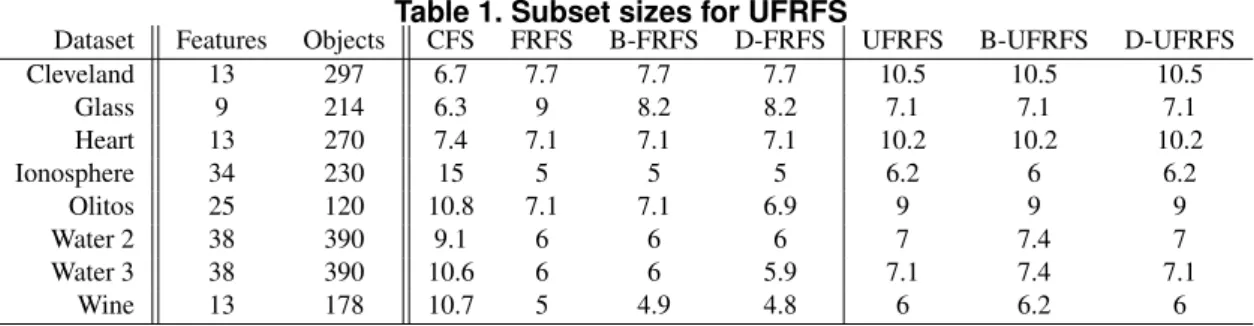
The results presented in Table 1 show the subset sizes discovered by the methods. As feature selection takes place for each fold in the cross-validation, the subset sizes in the table are averages. It can be seen that the proposed methods manage reduction in all cases and return substantial levels of dimensionality reduction for some datasets. These results compare well with the supervised approach and show that the unsupervised approaches may even find smaller subsets
Table 1. Subset sizes for UFRFS
Dataset Features Objects CFS FRFS B-FRFS D-FRFS UFRFS B-UFRFS D-UFRFS
Cleveland 13 297 6.7 7.7 7.7 7.7 10.5 10.5 10.5 Glass 9 214 6.3 9 8.2 8.2 7.1 7.1 7.1 Heart 13 270 7.4 7.1 7.1 7.1 10.2 10.2 10.2 Ionosphere 34 230 15 5 5 5 6.2 6 6.2 Olitos 25 120 10.8 7.1 7.1 6.9 9 9 9 Water 2 38 390 9.1 6 6 6 7 7.4 7 Water 3 38 390 10.6 6 6 5.9 7.1 7.4 7.1 Wine 13 178 10.7 5 4.9 4.8 6 6.2 6 in some cases.
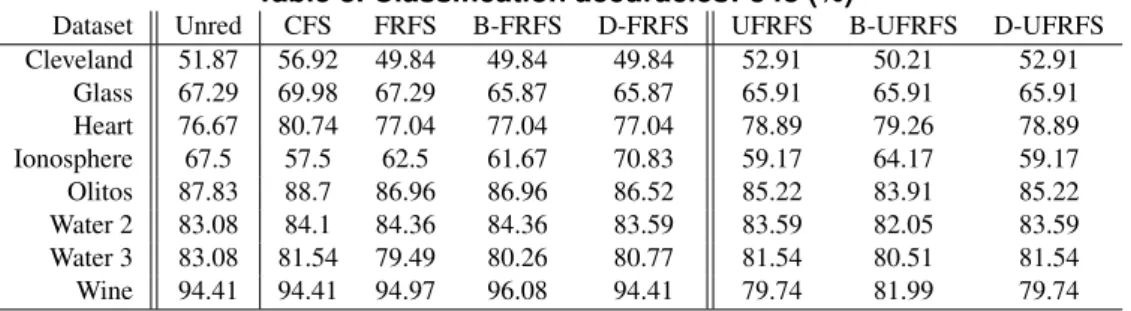
The resulting classification accuracies for the classifiers can be seen in Table 2 and Table 3. These demonstrate that the unsupervised methods retain useful features, with-out considering the decision feature. This is borne with-out by comparison to the classification accuracy of the unreduced data, showing that the greatest decrease amongst all of the reduced data is only in the order of 10% overall. There are also cases where the use of unsupervised-reduced data outperforms the unreduced data and that of the supervised-reduced data.
5. Conclusion
This paper has presented novel techniques for unsuper-vised feature selection, based on the fuzzy-rough depen-dency measure. These approaches are data-driven, and no user-defined thresholds or domain-related information is required, although a choice must be made regarding fuzzy similarity relations and connectives. Note that these choices must also be made for the existing supervised FS approaches that employ the same underlying mathemati-cal theory. The results show that the approach can reduce dataset dimensionality considerably whilst retaining useful features.
At present the unsupervised search algorithm utilises a simple but nevertheless effective backwards elimination method for search. The problem with such search tech-niques is that they often return a result which is sub-optimal. The investigation of other search techniques such as ant colony optimisation [8] and particle swarm optimisation [14], may help in alleviating this problem and thus further improving the efficiency of the approaches. Also, a more complete comparison of UFRFS and other unsupervised FS techniques for clustering performance, would form the ba-sis for a series of topics for future investigation.
As mentioned previously the fuzzy similarity relations and connectives must be chosen for UFRFS. As only one choice of fuzzy connective (Łukasiewicz), and also a sin-gle fuzzy similarity measure(as defined in 11) are explored in this paper, the evaluation of other options in this regard
would form the basis for a further more comprehensive in-vestigation.
A further interesting topic is the use of a method which would combine both the unsupervised, and supervised mea-sures. The supervised measure determines relevance and the unsupervised measure determines redundancy, hence a method that combines these should be particularly powerful for subset evaluation.
References
[1] C.L. Blake, C.J. Merz, UCI Repository of Machine Learning Databases. Irvine, University of California, 1998. http://archive.ics.uci.edu/ml/
[2] W.W. Cohen, “Fast effective rule induction,” In Pro-ceedings of the 12th International Conference on Ma-chine Learning, pp. 115–123, 1995.
[3] C. Cornelis, G. Hurtado Mart´ın, R. Jensen, D. ´Sle¸zak, “Feature Selection with Fuzzy Decision Reducts,” 3rd Int. Conf. on Rough Sets and Knowledge Technology (RSKT’08), pp. 284–291, 2008.
[4] M. Dash and H. Liu, “Feature Selection for Classifica-tion,”Intelligent Data Analysis, vol. 1, no. 3, 1997. [5] M. Dash and H. Liu, “Unsupervised Feature
Selec-tion,” Proceedings of the Pacific and Asia Conference on Knowledge Discovery and Data Mining, pp. 110–121, 2000.
[6] D. Dubois, H. Prade, “Rough fuzzy sets and fuzzy rough sets,” International Journal of General Systems, vol. 17, 91–209, 1990.
[7] M.A. Hall, “Correlation-based Feature Selection for Discrete and Numeric Class Machine Learning,” Pro-ceedings of the 17th International Conference on Ma-chine Learning, pp. 359–366, 2000.
[8] R. Jensen, Q. Shen, Computational Intelligence and Feature Selection: Rough and Fuzzy Approaches, IEEE Press/Wiley & Sons, 2008.
Table 2. Classification accuracies: JRip (%)
Dataset Unred CFS FRFS B-FRFS D-FRFS UFRFS B-UFRFS D-UFRFS Cleveland 52.18 56.93 54.52 54.52 54.52 54.9 53.57 54.9 Glass 71.39 68.23 71.39 66.9 66.9 64.94 64.94 64.94 Heart 77.41 78.89 77.04 77.04 77.04 80 80.74 80 Ionosphere 70.83 71.67 65.83 69.17 63.33 60 67.5 60 Olitos 86.52 90.87 86.52 86.52 85.22 86.09 84.78 86.09 Water 2 82.82 82.31 84.1 84.1 81.28 84.87 82.82 84.87 Water 3 81.79 82.56 78.97 80.26 81.28 80 78.97 80 Wine 95 92.12 88.27 91.57 90.46 74.67 79.9 74.67
Table 3. Classification accuracies: J48 (%)
Dataset Unred CFS FRFS B-FRFS D-FRFS UFRFS B-UFRFS D-UFRFS Cleveland 51.87 56.92 49.84 49.84 49.84 52.91 50.21 52.91 Glass 67.29 69.98 67.29 65.87 65.87 65.91 65.91 65.91 Heart 76.67 80.74 77.04 77.04 77.04 78.89 79.26 78.89 Ionosphere 67.5 57.5 62.5 61.67 70.83 59.17 64.17 59.17 Olitos 87.83 88.7 86.96 86.96 86.52 85.22 83.91 85.22 Water 2 83.08 84.1 84.36 84.36 83.59 83.59 82.05 83.59 Water 3 83.08 81.54 79.49 80.26 80.77 81.54 80.51 81.54 Wine 94.41 94.41 94.97 96.08 94.41 79.74 81.99 79.74
[9] R. Jensen, Q. Shen, “New approaches to fuzzy-rough feature selection,”IEEE Transactions on Fuzzy Systems, in press, 2009.
[10] P. Mitra, C.A. Murthy, and S.K. Pal, “Unsuper-vised Feature Selection Using Feature Similarity,”IEEE Transactions on Pattern Analysis and Machine Intelli-gence, vol. 24, no. 4, pp. 1–13, 2002.
[11] S.K. Pal, R.K. De, and J. Basak, “Unsupervised Fea-ture Evaluation: A Neuro-Fuzzy approach,”IEEE Trans-actions in Neural Networks, vol. 11, pp. 366–376, 2000. [12] Z. Pawlak, “Rough sets,” International Journal of Computing and Information Sciences, vol. 11, pp. 341– 356, 1982.
[13] A.M. Radzikowska and E.E. Kerre, “A comparative study of fuzzy rough sets,”Fuzzy Sets and Systems, vol. 126, no. 2, pp. 137–155, 2002.
[14] X. Wang, J. Yang, X. Teng, W. Xia and R. Jensen, “Feature Selection based on Rough Sets and Particle Swarm Optimization,”Pattern Recognition Letters, vol. 28, no. 4, pp. 459–471, 2007.
[15] I.H. Witten and E. Frank, “Generating Accurate Rule Sets Without Global Optimization,”Proceedings of the 15th International Conference on Machine Learning, Morgan Kaufmann Publishers, San Francisco, 1998.
[16] I.H. Witten and E. Frank,Data Mining: Practical ma-chine learning tools with Java implementations. Morgan Kaufmann, San Francisco, 2000.
[17] W. Ziarko, “Variable Precision Rough Set Model,” Journal of Computer and System Sciences, vol. 46, no. 1, pp. 39–59, 1993.