6
II
February 2018
462
©IJRASET (UGC Approved Journal): All Rights are Reserved
Sparse Residual Learning of Deep Convolution
Network for De-Noising Patch Based Block Match
Three Dimension Algorithm
Kamalakshi N1, M N Shanmukh Swamy2
1
Department of Computer Science & Engg, Sapthagiri College of Engg, Bangalore India, JSSRF, University of Mysore, Mysore India
2
Electronics & Communication, JSSRF, University of Mysore, Mysore, India
Abstract: This paper introduces a unique approach to de-noise an image based on concepts of Deep Convolution Neural
Networks (DCNN) with sparse residual learning sparse reconstruction and batch normalization. The basic concept is modification of existing block match three dimension algorithm in which similar local patches in the input image are integrated into a 3D block. Here first patches are retrieved the features are extracted. The de-noised image is employed as a basic estimate for the block matching, and then de-noising function for the block is learned by a DCNN structure. Most of the residual network has many residual units (i.e., identity shortcuts), our method employs a single scarified residual unit to classify the residual image. Experimental results demonstrate the effectiveness of the sparse residual learning, sparse reconstruction and batch normalization in the tasks of image de-noising. Our experiment results proves that our model provide better efficiency in terms of PSNR.
Keywords: Noise, patch, BM3D, sparse residual, sparse reconstruction batch normalization
I. INTRODUCTION
Recently, image de-noising methods has gained popularity by a method called patch based method or non local means. This approach is measured an incredible in most of current state-of-the-art methods. The concept employed is to find related patterns that occur randomly all across the image and the image patches that have related patterns can be located far from each other. The patch based approach is a determining work that exploit this NSS prior[1]. The employment of patch based approach has boosted the performance of image de-noising significantly. The best example is the Block Matching and 3D Filtering (BM3D) method [2] which is a very good in performance and highly engineered approach that made the state-of-the-art record in image de-noising stay ahead for almost a decade.
In past decade ,Machine learning is gaining popularity and progressively escalating its prominence. Among these deep learning concepts are overtaking shallow learning methods. It is a sort of overhyped. And very potential results have been noticed for image processing applications such as image restoration class. The significant improvement in the performance can be achieved by deep networks is due to their advanced modeling capabilities, deep structure and the adaption of non-linearities that in fact can be combined with qualified learning on large training datasets. Among all the deep learning methods, the convolutional neural networks have shown great performance for image processing tasks because of the reason of its quite easy access to large-scale dataset and the advances in deep learning methods. The proposed work is a modification of BM3D[2][3][4] where CNN with sparse
residual Learning ,sparse reconstruction and batch normalization It also adopts the residual learning formulation .
II. RELATEDWORK
There exists abundant number of approach exists in literature in order to tackle the restoration de-noising problem using convolution neural networks[5][21][22][23][24]. Recently, due to the easy access to large-scale dataset and the advances in deep learning methods, the convolutional neural networks with residual learning have shown abundant accomplishment in handling various low vision tasks.
463
©IJRASET (UGC Approved Journal): All Rights are Reserved
parallel to the ResNet modules with convolution layer introduced. Later Kai Zhang and et.al [12] applied the same for image de-noising for Gaussian noise. Szegedy, Christian and et al. [13] introduced inception v14 for residual learning. Further researcher started applying in deep learning. W. Bae, J. Yoo, and J. C. Ye [14]Proposed homology guided manifold simplification and compared with state of art algorithms. Tianyang Wang, Mingxuan Sun, and Kaoning Hu. Proposed [15] Dilated residual learning in order to de-noise an image. In [16]J. Jiao, W.-C. Tu, S.He, and R. W. Lau. Formresnet: Formatted residual learning for image restoration. In [17] authors proposed convolution Neural Networks for BM3D with residual and batch normalization and obtained promising results. Dong Yang and Jian Sun and et al [18] introduced Convolution network for BM3D and obtained good results.
III.PROPOSEDWORK
This section, provides the overview of the proposed work, results and discussion. The proposed work is a modification of block matching algorithm where CNN with sparse residual Learning ,sparse reconstruction and batch normalization It also adopts the residual learning formulation.
A. Sparse Rectified Linear Unit (SRELU)
This method is replaced by Sparse Rectified Linear Unit (SReLU) instead of conventional ReLU. The SReLU is used to eliminate dead features generates in ReLU by zero gradient vectors. This helps to test parameters of multiple layer networks for different designs to its full capacity. The main reason for using SReLU networks is that comparatively more efficient and stable. This method increases accuracy and speed as well. Also to describe non-linearity
B. Batch Normalization
Batch normalization [20] improves the internal covariate shift by incorporating a normalization step and a scale and shift step before the nonlinearity in each layer. The merits are fast training, better performance, and low sensitivity to initialization. The integration of residual learning and batch normalization can result in fast and stable training and better de-noising performance as demonstrated by various researchers
C. SPARSE CODING BASED IMAGE RECONSTRUCTION
The final part of the image reconstruction is sparse coding based image reconstruction which used to reform a high quality image by eliminating the error produced. Then the outcome (weight parameter) is directly a reformed image with high quality.
D. The various steps are
1) Pre-processing Step: Input noisy image to BM3D de-noising method [2]
2) Extract patches using BM3D[2]
3) Construct the CNN network layer by layers..It is composed of three layer. And there are total 18 stages overall.
Patches -Extraction of features: The first stage consist of layer 1 to layer 7,Here the features of the patches are extracted. Show the
function of the stage. The first layer transforms the input patches into the low-level feature maps including the edges and then the following layers generate gradually higher-level features. The output of this stage contains complicated features and some features about the noise components.
Feature Processing: The stage two consisting of layer 8 ∼12) processes the feature maps to construct the target feature maps. In the
existing networks the refinement stage filters the noise component out because the main objective is to acquire a clean image.
Aggregation Layer: The last stage (layer 13 ∼18) makes the residual patch from the noise feature maps. The stage can be considered
an inverse of the feature extraction stage in that the layers in the reconstruction stage gradually constructs lower-level features from high level feature maps. Despite all the layers share the similar form, they contribute different operations throughout the network. Finally, the de-noised patches are aggregated to form the output image. The final part of the image reconstruction is sparse coding based image reconstruction which used to reform a high quality image by eliminating the error produced. It is used to provides better performance and increases high amount of accuracy. The use of deep Convolution Neural Networks with Sparse coding reduces high amount of computational cost and enhances efficiency with a large extent.
464
©IJRASET (UGC Approved Journal): All Rights are Reserved
TABLEI
VARIOUSPARAMETERS FOR NETWORK STRUCTURE FOR PROPOSED METHOD
Patch Size Filter Size Depth Size Network layer Layer1 Layer2-17 Layer 18
32x32 3x3 18 3 64-3x3x2k
SReLU 64 -3x3x2k 2k-patch size Batch Normalization-SReLU 64-3x3 64 Convolution layer
IV.MATHEMATICALMODEL
The gaussian noise present in an image is additive noise which is nothing but an unwanted random signal which gets added with some significant signal in the image capturing, transmission or processing. Mathematically Gaussian noise can be represented as follows
G(m,n)=H(m,n)+I(m,n) . (1)
Where Gm, n is the noisy pixel, Hm, n is the noise free pixel, Im,n is the Additive noise m,n are spatial locations
Similar patchs of n pcan be determined on dissimilarity measure defined as
d(np,nq)=||np-nq||2 (2)
Specifically, the k patches nearest to npincluding itself are selected and stacked, which forms a 3D block {Np} of size N patch ×
Npatch × k. Then the block is denoised in the 3D transform domain. However, it is also shown in [2] that the noise affects the block matching performance too much.
Residual units can be of the form
Ni=p(ni)+R(ni,wi ) (3) Where p(ni) is identity mapping denoted by
p(ni)=ni (4)
R(ni)=max(ni 0) + bjmin (0 ni) (5)
Here, njis the input for the activation function R,j represents the index and bj represents the coefficient of negative phase
The simplest method for the aggregation is simply taking the mean value of the estimates as
N(i,j)==Σ( , )ε ( , )
Σ( , )ε (6)
Formally, the averaged mean squared error between the desired residual images and estimated ones from noisy input
Q(Θ)= ∑ ||R(yi; Θ)-(Ni-Hi)||2F (7)
can be adopted as the loss function to learn the network.
V. RESULTS
This section provides the glimpses of the results obtained on the still images for the proposed approach. The results are tested on 3 images of size256 × 256 (Cameraman, Peppers and Montage), and 7 images of size 512 × 512 (Lena, Barbara, Boat, fingerprint, Man, Couple, Hill. Here, the performance of the proposed approach is evaluated and compared it with the existing denoising methods, including NL Means based methods (BM3D [2], and WNNM [7] and training based methods DCNN[12],BMCNN [17].
Training and Testing Data:, Two noise levels, i.e., σ = 25 and 50 are considered to train model for Gaussian denoising with with a
standard square patch size of 32.
In order to evaluate the performance the following metric is used
PSNR is termed as Peak signal to Noise ratio which evaluates quality of a processed image with reference to original image and it is derived by using logarithmic scale and represented in dB (decibels). Mean square Error(MSE) of image indicates how noise ratio and peak ratio is associated .
= 10 (8)
465
©IJRASET (UGC Approved Journal): All Rights are Reserved
TABLE IIPSNR (DB)RESULTS FOR SIGMA=25
Images BM3
D WN NN DnC NN BMC NN Proposed Method
Barbara 30.64 31.16 29.94 30.58 30.41
Boat 29.86 30.00 30.21 30.25 30.87
CameraMa n
29.44 29.64 30.11 30.20 30.52
Couple 29.69 29.78 30.21 30.12 30.54
FingerPrint 27.71 27.96 27.66 28.01 28.67
Hill 29.82 29.96 29.99 30.00 30.71
Lena 32.06 32.27 32.48 32.53 33.25
Man 29.56 29.73 32.42 30.06 30.72
Montage 32.34 32.47 32.97 33.47 32.71
Peppers 30.21 30.45 30.80 30.93 31.23
[image:5.612.181.431.84.280.2].
TABLE III
[image:5.612.159.453.338.505.2]PSNR (dB) RESULTS FOR sigma= 50
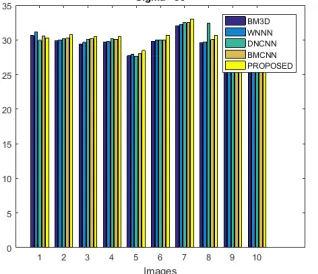
Table II and III shows the PSNR values in dB BM3D[2] ,WNNN[7], DCNN[12], BMCNN[17], Proposed for sigma value 25 and 50.The proposed method performs well for the images cameraman, couple, fingerprint, Lena, Hill, Man and Peppers.
Table 4.Denoised Images boat for σ = 50
Sigma Original BM3D WNNN
50
DnCNN BMCNN Proposed
Images BM3D WNNN DnCNN BM3CNN Proposed
Method
Barbara 27.08 27.70 26.13 26.84 26.05
Boat 26.72 26.89 27.17 27.19 27.21
CameraMan 26.18 26.47 26.99 27.02 27.11
Couple 26.42 26.59 26.68 26.91 27.42
FingerPrint 24.55 24.79 24.14 24.65 25.02
Hill 27.05 27.12 27.31 27.33 28.23
Lena 29.05 29.32 29.42 29.56 30.14
Man 26.73 26.91 27.18 27.18 27.83
Montage 27.65 27.97 29.03 29.50 28.97
[image:5.612.110.501.564.718.2]466
©IJRASET (UGC Approved Journal): All Rights are Reserved
Table 4 shows the visual results. The patch based methods rather blurs and removing off repetitive parts can be observed in the learning based methods. In contrast, the proposed approach recovers clear texture in both repetitive and non repetitive regions.
Fig 1 PSNR values in dB for image dataset for BM3D ,WNNN, DCNN, BMCNN, Proposed for sigma value 50
Figure 1 shows the PSNR values in dB for image dataset as in table 8.3 for BM3D[2] ,WNNN[7], DCNN[12], BMCNN[17], Proposed for sigma value 50.The proposed method performs well for the images cameraman, couple, fingerprint, Lena, Hill, Man and Peppers.
VI.CONCLUSION
This paper incorporates Deep Convolution network with sparse residual, batch normalization and sparse coding for a patch based BM3D algorithm, here noise is estimated to be in a group as similar patches. De noiser is trained to learn an optimal mapping function and hence achieve better performance. The results also shows that proposed approach is better than that of the existing in terms of PSNR and subjective visualization compared to other state of art algorithms
REFERENCES
[1] Buades, A., Coll, B. and Morel, J.M. , Image Denoising Methods. A New Nonlocal Principle. SIAM Review, 52, 113-147. 2010
[2] K. Dabov, A. Foi, V. Katkovnik, and K. Egiazarian, “Image denoising by sparse 3D transform-domain collaborative filtering,” IEEE Transactions on Image Processing, vol. 16, no. 8, pp. 2080–2095, August 2007
[3] Kamalakshi N ShanmukhaSwamy “An efficient denoising using BM3D algorithm” International Journal of Computer Applications in Engineering Sciences Volume III, Issue ISSN 2231-4946, pp 45-48, 2012.
[4] Kamalakshi, N., H. Naganna, and M. N. Shanmukhaswamy. "Modification of BM3D Algorithm for Representing Volumetric Data on Medical Images." 11-17. Volume 01, Issue-04, Page No (11-17), Dec -2013, E-ISSN: 2347-2693,2013
[5] Burger H. C., Schuler C. J., and HarmelingS,Imagedenoising: Can plain neural networks compete with Bm3d?, in Proc. of Computer Vision and Pattern Recognition (CVPR), 2392–2399, 2012
[6] A. L. Maas, A. Y. Hannun, and A. Y. Ng. Rectifier nonlinearities improve neural network acoustic models. In Proc. ICML, volume 30, 2013.
[7] Gu S, Zhang. L, Zuo.W, and Feng .X, Weighted nuclear norm minimization with application to image denoising, in Proc. of Computer Vision and Pattern Recognition (CVPR), 2862–2869,2014
[8] K. He, X. Zhang, S. Ren, and J. Sun, (2016) Deep residual learning for image recognition,” in IEEE Conference on Computer Vision and Pattern Recognition, 770–778,2016
[9] MatusTelgarsky,” Benefits of depth in neural networks”, in JMLR: Workshop and Conference Proceedings vol 49:1–23, 2016
K. He, X. Zhang, S. Ren, and J. Sun. Identity mappings in deep residual networks. In European Conference on Computer Vision, pages 630–645. Springer, 2016.
[10] Sasha Targ_, Diogo Almeida_, Kevin Lyman ,Resnet in resnet:Generalizing residual, Workshop track - ICLR 2016
[image:6.612.114.497.76.181.2] [image:6.612.229.388.230.367.2]467
©IJRASET (UGC Approved Journal): All Rights are Reserved
IEEE Trans. Image Process., vol. 26, no. 7, pp. 3142–3155, 2016
[12] Szegedy, Christian, Sergey Ioffe, and Vincent Vanhoucke. “Inception-v4, inception-resnet and the impact of residual connections on learning.” arXiv preprint arXiv:1602.07261 ,2016.
[13] W. Bae, J. Yoo, and J. C. Ye. “Beyond deep residual learning for image restoration: Persistent homology-guided manifold simplification”, arXiv preprint arXiv:1611.06345, 2016
[14] Tianyang Wang, Mingxuan Sun, and Kaoning Hu. “Dilated residual network for image denoising. “arXiv preprint arXiv:1708.05473, 2017
[15] J. Jiao, W.-C. Tu, S. He, and R. W. Lau. Formresnet: Formatted residual learning for image restoration. In Computer Vision and Pattern Recognition Workshops (CVPRW), 2017,IEEE Conference on, pages 1034–1042. IEEE, 2017
[16] Ahn N,B , Cho, N. I. “Block-matching convolutional neural network for image denoising. Available at CoRR abs/1704.00524”, 2017 accesssed on july 2017 [17] Dong Yang and Jian Sun “BM3D-Net: A Convolutional Neural Network for Transform-Domain Collaborative Filtering”,IEEE SIGNAL PROCESSING
LETTERS, Vol. 25, NO. 1, Accepted to be published in 2018
[18] Xavier Glorot, Antoine Bordes, YoshuaBengio “Deep sparse rectifier neural networks”, Proceedings of the Fourteenth International Conference on Artificial Intelligence and Statistics, 315-323,2011
[19] S. Ioffe and C. Szegedy, “Batch normalization: Accelerating deep network training by reducing internal covariate shift,” in International Conference on Machine Learning, 448–456 ,2015
[20] T. Remez, O. Litany, R. Giryes, and A. M. Bronstein. Deep class aware denoising. arXiv preprint arXiv:1701.01698,2017
[21] K. Zhang, W. Zuo, S. Gu, and L. Zhang. Learning deep cnndenoiser prior for image restoration. arXiv preprint arXiv:1704.03264, 2017.
[22] NitishSrivastava, Geoffrey E Hinton, Alex Krizhevsky, IlyaSutskever, and RuslanSalakhutdinov. Dropout: a simple way to prevent neural networks from overfitting. Journal of Machine Learning Research, 15(1):1929–1958, 2014.
![Table II and III shows the PSNR values in dB BM3D[2] ,WNNN[7], DCNN[12], BMCNN[17], Proposed for sigma value 25 and 50.The proposed method performs well for the images cameraman, couple, fingerprint, Lena, Hill, Man and Peppers](https://thumb-us.123doks.com/thumbv2/123dok_us/8293031.851888/5.612.159.453.338.505/bmcnn-proposed-proposed-performs-cameraman-couple-fingerprint-peppers.webp)