International Journal for Research in Applied Science & Engineering Technology (IJRASET)
ISSN: 2321-9653; IC Value: 45.98; SJ Impact Factor: 6.887 Volume 6 Issue II, February 2018- Available at www.ijraset.com
1769
©IJRASET (UGC Approved Journal): All Rights are Reserved
A Statistical Based Comparative Study of
Environmental Awareness among the Male and
Female Students of Assam
N. Barman1
1
Assistant professor, Bholanath College, Dhubri, Assam
Abstract: ‘Environment’ constitutes a very important part of our life. Protection of environment is everyone's duty. Over recent decades, global problems relating to degradation of natural resources and pollution have increased dramatically. Environmental awareness implies information and understanding of the environment, its creatures and simultaneously to solve the related environmental problems. For awareness, environmental education plays an important role. The main aim of the study is to know the level of the environmental awareness among the students who are given education on environmental issues designed as a subject, better known as “Environmental Studies” particularly at the secondary level. We observed males of rural area, private school and English medium school were found to be more aware about their environmental problems as compared to female. On the other hand female students of urban area, Government school and Assamese medium have higher environmental awareness than male students. Environmental awareness is the integral part of a healthy environment and plays vital role for creating a pollution free environment. So the whole society can work to revive and rejuvenate our environment for better future of our coming generations.
Keywords: Environment, Awareness, Pollution, Male, Female
I. INTRODUCTION
‘Environment’ constitutes a very important part of our life. Broadly speaking, environment is defined as the sum total of all conditions and influences which effect the development and life of all organism on earth. The living organisms vary from the lowest microorganisms such as bacteria, fungi etc. to the highest including man.
Today environmental problems are a matter of concern. Over recent decades, global problems relating to degradation of natural
resources and pollution have increased dramatically. Polluted environment endangers the human race by threatening its survival in the World. Protection of the environment is one of the major challenges. Hence human beings are asks to reduces, reused and recycle their resources.
This words if followed each and every person would be helpful to protect our environment. In present situation man and environment are considered interrelated and there is interdependence in term. Protection of environment is everyone's duty. So environment education is needed.
In order to protect and conserve the environment, enabling people to lead quality life, emphasis has been given to environmental education in both formal and nonformal system of education. In formal system of education, teachers can play an important role in educating their students about environment related issues, which is possible only when the teachers themselves have mastery over environmental awareness [1]. Environmental awareness implies information and understanding of the environment, its creatures and simultaneously to solve the related environmental problems [2].
For awareness, environmental education plays an important role. The main aim of environmental education is to make students to be aware, knowledgeable and inculcate positive attitudes towards protection of environment and make them skilled to solve environmental problems so as to enable them to participate in the activities undertaken for the protection of environment [3]. Environmental awareness is an approach towards learning environmental issues.
II. MATERIALS AND METHODS A. Study area
For the present study 40 (forty) different schools of Secondary level (Govt. and private) located in both rural and urban areas of Kamrup (both rural and urban) district of Assam were taken into account.
B. Duration of study
The study has completed within the stipulated time period that is 2 years (2014-2016)
C. Subjects of study
The study was conducted on 997 (Nine hundred and ninety seven) high school students (Class IX and X) irrespective of their sex selected from different High/Higher Secondary Schools situated in concerned areas of Kamrup (both rural and urban) districts of Assam. Out of 997 students 547 were male and 450 were female. Random sampling technique was used to select the sample. Forty secondary schools were selected at random basis of which 17 were government secondary school and 23 were private secondary school. Among the 17 government schools, 8 were urban government and 9 were rural government secondary schools. Again among the 23 private schools, 12 were urban private secondary school and 11 were rural private secondary school.
D. Collection of Data
A questionnaire was used to collect the data on the role responses of students which constructed by the investigator himself. The final draft of questionnaire contained a total of 36 questions in the form of objective (yes/no) type questions. One mark was given to each of the correctly answered question. Therefore the maximum score was 36 and the minimum score was zero. Random sampling technique was used to collect the data through questionnaire by visiting the respective school.
E. Data analysis
In the present study, each item has given ‘1’ point for correct answer and ‘0’ for wrong answer. Then the scoring of data were used for the calculation of Mean (M), Standard deviation (SD), z-value in each case of the study. Analyses have done separately for different categories based on gender.
III. RESULTS
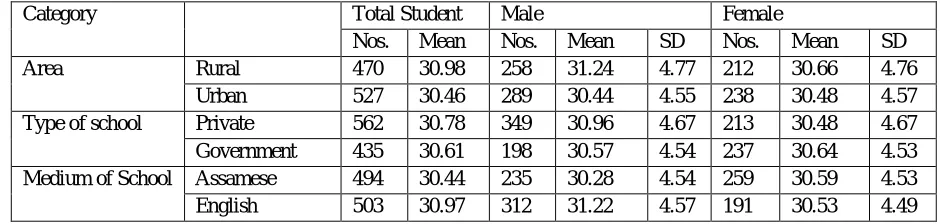
[image:3.612.106.502.544.703.2]When we compared the level of environmental awareness between male and female students with respect to the area they belongs to, type of school and medium of school, we observed that male students of rural area, private school and English medium school are more environmentally aware in comparison to female students of rural area, private school and English medium school as their mean values are found to be higher (Figure 1). On the other hand, the mean value of female students belonging to urban area, Government and Assamese medium school was found to be higher than that of the male students of urban area, Government school and Assamese medium school which reveals that female students of urban area, Government school and Assamese medium school are more aware to the environmental pollution than respective male students (Figure 1).
International Journal for Research in Applied Science & Engineering Technology (IJRASET)
ISSN: 2321-9653; IC Value: 45.98; SJ Impact Factor: 6.887 Volume 6 Issue II, February 2018- Available at www.ijraset.com
1771
©IJRASET (UGC Approved Journal): All Rights are Reserved
[image:4.612.69.539.175.287.2]It is observed that the SD value of female student (4.76) is found to be smaller than that of male student (4.77) in rural area which indicates that the environmental awareness in case of female student is more uniform (Table 2). On the other hand in urban area the environmental awareness of male student is more uniform as compared to the female student as the SD value of male student (4.55) is smaller than female student (4.57). In case of private school both male and female student have same uniformity in environmental awareness as the SD value in both cases are found to be similar. In case of Government school, female student have more uniformity in environmental awareness than that of male student as the SD value of female student (4.53) is less than that of male student (4.54). Similar conclusion may be drawn in case of both Assamese and English medium school (Table I).
Table I Mean and standard deviation scores of male and female students regarding their belonging area, type of school and medium of education
IV. DISCUSSION
Thus, it is very much evident from the present study that secondary level students have fairly good awareness about the environmental problems. Based on the analyses of the data obtained in the present study, it can be revealed that males of rural area, private school and English medium school were found to be more aware about their environmental problems as compared to female. On the other hand female students of urban area, Government school and Assamese medium have higher environmental awareness than male students. Kumar & Patil (2007) [7] also found no significant difference between male & female on environment awareness. However Sharma (1999) found that girls students attitude towards environment was more favorable than their counterpart boy students [8]. Dixit and Agarwal, 2009 [9] studied on environmental awareness of students of three DIETS of U.P. state and concluded that there is no significant difference on environmental awareness in relation to sex. Dubey et al., 1995 [10] found from their research that educational status produced significant differential effects on overall environmental awareness of women. Environmental awareness is the integral part of a healthy environment and plays vital role for creating a pollution free environment. Considerable work is to be done incorporating environmental concepts into existing curriculum, development of new strategies, preparation of instructional material to protect and conserve the environment. Compulsory environmental education at all level in the education system may be most appropriate strategy towards environmental protection leading to decrease pollution in society. Teachers and parents should try to inculcate knowledge about environment among students and develop positive and healthy attitude towards environment from the very beginning of their childhood.
This is the crucial time that environmental awareness and environmental sensitivity should be cultivated among the masses particularly among youths. For the awareness of society it is essential to work at a grass root level. So the whole society can work to revive and rejuvenate our environment for better future of our coming generations.
REFERENCES
[1] Gupta, A Study of Attitude of Teachers towards Environmental Education, Nehru Memorial Junior College. Pune, 1996.
[2] D. Bandhu and N. L. Ramanathan, 1982 D. “Education for environment planning and conservation”, I.E.S., Natrajan Publisher, Dehradun, 1982.
[3] P. W. Schultz andL. Zelenzy, “ Values as predictors of environmental attitudes : Evidence for consistency across 14 countries”, J. Environ.Psychol,vol. 19, pp 55-265, 1999
[4] G.C. Pradhan, “Environmental Awareness among Secondary School Teachers:A Study, The Educational Review”, Vol. 45, Issue. 2), pp.25-27, 2002. [5] K. Vijayan, “Environmental Awareness among Secondary School Children:A Survey’, The CTE National Journal, vol. 4, issue 2, pp.48-50, 2006. [6] S. K. Pande, “ Awareness of Environmental Education among Students”, University News, vol. 27, Issue 42, pp. 89-95, 1998
[7] S. Kumar and M.S. Patil, “Influence of environmental education on Environmental Attitude of the students”: Edutracks, Vol. 6, Issue 8, pp 23-24, 2007 [8]R. C. Sharma, Attitude of high school students towards environmental education.M.Ed. dissertation Submitted to Himachal Pradesh University Summer Hill Simla, 1999.
[8] S, Dixit and & V.P. Agrawal, “Environmental awareness among prospective elementary teachers”, Edutracks, vol. 8, Issue 5, pp 30-34, 2009. [9] A. Dubey, S. Mishra, and K. Nagmani, “environmental awareness among women”, Indian Psychological Review, vol. 50, Issue 1, pp 50-56, 1995.
Category Total Student Male Female
Nos. Mean Nos. Mean SD Nos. Mean SD
Area Rural 470 30.98 258 31.24 4.77 212 30.66 4.76
Urban 527 30.46 289 30.44 4.55 238 30.48 4.57
Type of school Private 562 30.78 349 30.96 4.67 213 30.48 4.67
Government 435 30.61 198 30.57 4.54 237 30.64 4.53
Medium of School Assamese 494 30.44 235 30.28 4.54 259 30.59 4.53