Technology (IJRASET)
Hand Gesture Recognition Using Operating System
Mr. Anap Avinash1 Bhalerao Sushmita2, Lambrud Aishwarya3, Shelke Priyanka4, Nirmal Mohini512345
Computer Department, P.Dr.V.V.P. Polytechnic, Loni
Abstract: - Gestures are important for communicating information among the human. Nowadays new technologies of Human
Computer Interaction (HCI) are being developed to deliver user's command to the robots. Users can interact with machines through hand, head, facial expressions, voice and touch. The objective of this paper is to use one of the important modes of interaction i.e. hand gestures to control the robot or for offices and household applications. Hand gesture detection algorithms are based on various machine learning methods such as neural networks, support vector machine, and Adaptive Boosting. Among these methods, Adaptive Boost based hand-pose detectors are trained with a reduced Haar-like featureset to make the detector robust. Today in the information age computer has become a integral part of every body’s life. We use a computer to hear songs, read something, accessing information from the internet. We use computer everywhere. the computer and information age is not hardware independent. It cannot be accessed by cameras i.e using the system. Everything has to be told to it by using keyboard and mouse which makes the information access part a tedious one and a lot of time is wasted on just telling it how a information can be retrieved if it is retrieved daily which it tiresome and boring. Today hand gestures or any gesture used in information access can make a system intelligent enough to perform the task given to it by just a gesture and not by using keyboard and mouse.
Keywords: - Hand gesture, convex hull algorithm, human computer interaction (HCI), Hand Tracking.
I. INTRODUCTION
In recent years, computer vision development has great advancements and our day to day life tasks are incompletewithout using computers. The major input devices likeKeyboard and mouse are used to interacting with computers.Among the various interaction techniques use of hands as aninput is an attractive method for establishing natural HumanComputer Interaction. By using Hand gestures user cancommunicate more information in less time period. So forimproving the interface between users and computers humancomputers interaction (HCI) technology has great utilizationThe primary goal of proposed system is to identify specifichuman gestures and we can use it to convey information or wecan control any device or robot for offices and householdapplication. The static pose of hand configuration may bedefined as a posture. And a dynamic pose may be defined as agesture that means .physical movement of body organs such ashands, arms, face to convey meaningful information. There are two approaches which are commonly used tointerpret gestures for Human Computer Interaction, which are specified as below:
Data Gloves based Method: Vision based Method
The present research effort has a goal of developing an application using vision based hand gestures for manipulation of objects in virtual environment. Our application presents a more effective and user friendly methods of human computer interaction intelligently with the usage of hand gestures. Functions of mouse like controlling of movement of virtual object have been replaced by hand gestures. The complexity involved is with the detection and recognition phases of the simulated virtual application. The challenges encountered are noisy environment which creates a big impingement on the detection and recognition performance of human hand gestures. The application has been designed to be cost effective and uses low cost input tools like webcam for capturing hand as input. Manipulation of virtual objects has been done through modeling of some predefined comm. and based hand gestures.
II. LITERATURESURVEY
Technology (IJRASET)
but it can't detect the object of skin color with similar color background. The third approach is learning based gesture recognition in Adaptive Boosting algorithm that can integrate the information of same category of objects. It trains the network by combining all weak classifiers into one strong classifier. The AdaBoost learning algorithm elects the best weak classifier from a set of positive and negative image samples. This algorithm provides result with better accuracy and fast speed but sometimes training period is more to train the network. Another approach is for finding convex hulls. There are so many algorithms available for palm detection. In this section some of existing algorithms will be discussed which are used in our proposed technique. Graham’s Scan Algorithm, Divide and Conquer algorithm, Jarvis’s March or Gift wrapping Algorithm, Quick hull algorithm and Chan’s algorithm. Graham Scan computes the convex hull of any given set of points. To implement the system for hand tracking and simple gesture recognition in real time, there is no need to touch or carry a peripheral device by user. By comparative analysis, we can conclude that only one detection technique not enough because different kind of methods can deal with different problem during detection & recognition. There are various available machine learning algorithms that are AdaBoost, support vector machine technique, hidden markov model, & principle component analysis for training classifiers. There may also have different convex hull and contour detection of boundary of hand region. Based on all these methods, we are going to implement the system by using the Adaptive boosting for hand detection and haar classifier algorithm to train the classifier. Here we also use HSV color model for background subtraction & noise removal, convex hull algorithm for drawing contour around palm and finger tip detection.
III. METHODOLOGY
The Adaptive Boost learning algorithm initially assigns an equal weight to each training sample. We start with the selection of a Haar-like feature based classifier for the first stage and got better than 50% classification accuracy. In next step this classifier is added to the linear combination with the strength that is proportional to the resulting accuracy. So the training samples weights are updated i.e. training samples that are missed by the previous classifier are boosted in accordance. The next classification stage must achieve better accuracy for these misclassified training samples so that the error can be reduced. By this procedure we can improve the overall classification accuracy at further stage. The iteration goes on by adding new classifiers to the linear combination until the overall accuracy meets to the required level. At the final level the result is a strong classifier composed of a cascade of the selected week classifiers.
Technology (IJRASET)
In convex hull implementation firstly calculate the points with minimum and maximum x and y-coordinates and by joinin these points a bounding rectangle is defined, within which the hull is contained. There will be other points of convexity too; we find the convex defects i.e. between each arm of hull. The defect points are most likely to be the center of the finger valleys. Then find out the average of all these defects which is definitely bound to be in the center of palm, but it is very rough estimate so average out and finds this rough palm center. Thus the radius of palm is an indication of depth of the palm using radius. The ratio of palm radius to the length of the finger triangle should be more or less same, thus we can find out number of location of tip of finger. Here Adaptive Boost algorithm and Haar like feature set algorithm are adopted for hand detection and recognition. But when we combine every gesture in same program, it get mixed and create confusion for real world hardware. So we have changed the representation way of rectangle & do it with fingertip by connecting lines for clear visibility. This experiment we developed on open source library for computer vision application called Open Computer Vision Library (OpenCV).
IV. DATAFLOWDIAGRAM
Technology (IJRASET)
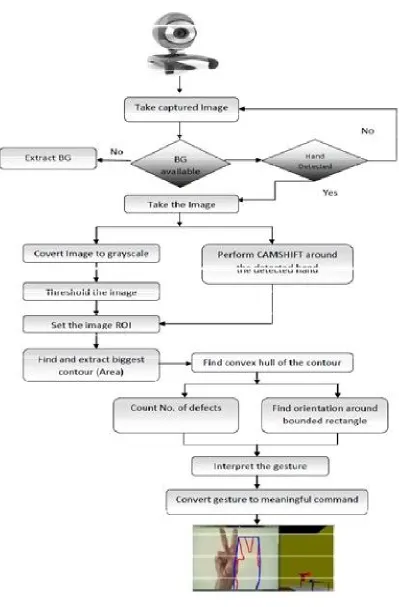
[image:5.612.116.515.94.701.2]V. FLOWCHART
Technology (IJRASET)
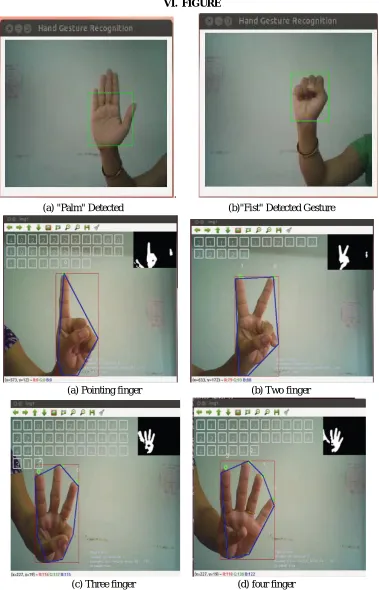
VI. FIGURE
.
(a) "Palm" Detected (b)"Fist" Detected Gesture
(a) Pointing finger (b) Two finger
[image:6.612.123.502.79.669.2]
Technology (IJRASET)
VII.RESULTS
Figure: System’s performance evaluation results
In the experiments, the subject, who uses a single hand to make hand gesture, is standing before any stationary background with normal lighting. The proposed real-time tracking system can track and identify the moving objects in front of a stationary background. We may allow some small objects moving in the background which will not be extracted and mistreated as a moving hand. We have tested twenty different hand gestures selected from TSL. Each hand gesture consists of a sequence of image frames capturing a single hand moving in different directions with constant or time-varying hand shape. Each hand gesture is performed 3 times by 20 different individuals. There are 60 different image sequences captured for each hand gesture. There are twenty different gestures, and 1200 image sequences are used for training. The size of each gray-level image frame is 256 £ 256, its frame rate is 30 frames/sec, and each gesture-making takes about one second. The input image sequence is divided into three different time intervals: in the first (begin) period, the sign language speaker remains silent (no gesture), then in the second (action) period, the speaker starts making one simple hand gesture, and finally, in the last (end) period, the speaker remains silent again.
VIII. CONCLUSION
As a first step we try the face detection based on available database of Open CV. Then for capturing live streaming of camera the initialization has been done. The two gesture detection like palm and fist by green rectangle which is trained by integral images. The second step is the extracted image gestures which are compared with stored positive-negative integral image dataset and perform fingertip tracking by contour detection. All this requires analyzing the entire image with all present grammar. Using a 2.40 GHz intel® core processor Linux based OpenCV image processing software & Qt Creator IDE is used to analyze a 640 ˣ 480 image size,
a frame rate of 30 frames per second has achieved.
REFERENCES
[1] Marcel, S., Bernier, O., Viallet, J. E., & Collobert, D (2000), “Hand Gesture Recognition using Input- Output Hidden Markov Models.” In Proc. of the FG’2000 Conference on Automatic Face and Gesture Recognition
[2] Rautaray, S.S., & Agrawal, A. (2010), “A Novel Human Computer Interface Based On Hand Gesture Recognition Using Computer Vision Techniques”, In
Proceedings of ACM IITM’10, pp.292-296.
[3] Pavlovic. V., Sharma, R., & Huang, T.S. (1997), “Visual interpretation of hand gestures for humancomputer interaction: A review.” IEEE Trans. on Pattern
Analysis and Machine Intelligence (PAMI),7(19):pp. 677–695.
[4] F. Chen, C. Fu, & C. Huang, 2003 , “Hand gesture recognition using a real-time tracking method and hidden Markov models” Image and Vision Computing, pp.
Technology (IJRASET)
[6] V.I. Pavlovic, R. Sharma, T.S. Huang, Visual interpretation of hand gestures for human-computer interaction, A Review, IEEE Transactions on Pattern
Analysis and Machine Intelligence 19 (7) (1997)677–695.
[7] T. Baudel, M. Baudouin-Lafon, Charade: remote control of objects using free-hand gestures, Comm. ACM 36 (7) (1993) 28–35.
[8] R.H. Liang, M. Ouhyoung, a real-time continuous gesture recognition system for sign language, Proceedings IEEE Second International Conference on
Automatic Face and Gesture Recognition, 1998, pp.558–565.
[9] Radhika Bhatt, Nikita Fernandes, Archana Dhage "Vision Based Hand Gesture Recognition for Human Computer Interaction" University Of Mumbai (IJESIT)
Volume 2, Issue 3, May 2013
[10] G. R. S. Murthy & R. S. Jadon "A Review Of Vision Based Hand Gestures Recognition" International Journal of Information Technology and Knowledge Management, July-December 2009, Volume 2, No. 2, pp. 405-410.
[11] Nasser H. Dardas And Nicolas D. Georganas "Real-Time Hand Gesture Detection And Recognition Using Bag-Of-Features And Support Vector Machine
Techniques", IEEE Vol. 60, No. 11, November 2011.