Technology (IJRASET)
©IJRASET 2015: All Rights are Reserved
23
A Study on the Review Classification Technique
Using Micro Reviews
Dr.Anna Saro Vijendran1, Miss. A. Jenifaasheer2
1
Director Department of Computer Application, 2Research Scholar, Department Of Computer Science
SNR Sons College (Autonomous)
Abstract-Information mining in micro-blogging sites has been studied extensively; micro-reviews are a source of content that has been largely overlooked in the literature. In this paper micro-reviews, and can be used for the problem of review selection. To the best of our knowledge this is the first examine the micro reviews such as foursquare tips and combine them with full-text reviews such as Yelp reviews. Proposed work analyse the formulation of review selection, where the goal is to maximize coverage while ensuring efficiency, leading to coverage problems. The coverage problems are considered as broader interest, and they could find applications to different domains. The Proposed work consider approximation and heuristic algorithms, and study them experimentally, demonstrating quantitatively and qualitatively the benefits of the proposed approach. An Integer Linear Programming (ILP) formulation is also proposed, with provide an optimal algorithm. This allows us to quantify the approximation quality of the greedy heuristics. Experimental results explains the performance of the system against the State of art approach in terms of precision and Recall.
Keywords : Data Classification , Review Selection , Micro Reviews
I. INTRODUCTION
Technology (IJRASET)
©IJRASET 2015: All Rights are Reserved
24
selection, where the goal is to maximize coverage while ensuring efficiency, leading to novel coverage problems. The coverage problems consider are of broader interest, and they could find applications to different domains. To consider approximation and heuristic algorithms, and study them experimentally, demonstrating quantitatively and qualitatively the benefits of our approach. The proposed Integer Linear Programming (ILP) formulation [13], and provide an optimal algorithm. This allows us to quantify the approximation quality of the greedy heuristics. To investigate the number of reviews needed to obtain perfect coverage through an alternative formulation inspired by set cover. The rest of the paper is organized as section 2 explains the background knowledge regarding the related work. Section 3 explains and formulates the proposed System. To conclude the work in section 4.
II. REVIEW OF LITERATURES
A. Minimum Redundancy Feature Selection
Minimum Redundancy Maximum Relevance Feature Selection (mRMR) model is to minimize the redundancy between sequentially selected features. In the product review using a bag of words .However, this method used the greedy search, thus the global feature redundancy was considered and the results are optimal[14][15]. In this work, feature selection framework to globally minimize the feature redundancy with maximizing the given feature ranking scores, which can come from any supervised or unsupervised methods. The model has no parameter so that it is especially suitable for data mining process and review selection process in online social networks and product reviews.
B. Feature Selection Using Rough Set Method
Rough set is a tool with a mathematical foundation to deal with imprecise and imperfect knowledge. It has been widely applied in machine learning, data mining and knowledge discovery. One of the applications of Rough set theory in machine learning is the so-called feature selection especially for classification problems. This is performed by means of finding a reduct set of attributes[16]. Reduct set is a subset of all features which retains classification accuracy as original attributes. Finding a reduct set in decision systems is NP-hard problem which has attracted many researchers to combine different methods with rough set.
C. Micro Opinion Generation
A new unsupervised approach is analysed to generate ultra-concise summaries of opinions. To generate such a micro opinion summary as an optimization problem, and a set of concise and non-redundant phrases that are readable and represent key opinions in text are analysed. The modified mutual information function and model readability with an n-gram language model are used to measure representativeness heuristic algorithms to efficiently solve this optimization problem.
D. Temporal Effects for Location Recommendation
Location-based social networks (LBSNs) have attracted an inordinate number of users and greatly enriched the User experience. The availability of spatial, temporal and social information in online LBSNs offers an unprecedented opportunity to study various aspects of human behavior, and enable a variety of location-based services such as location recommendation. Previous work studied spatial and social influences on location recommendation in LBSNs. Due to the strong correlations between a user's check-in time and the corresponding check-in location, recommender systems designed for location recommendation inevitably need to consider temporal effects. In this work, To analyse a location recommendation framework, based on the temporal properties of user movement observed from a real-world LBSN dataset.
III. ABSTRACTIVE SUMMARIZATION OF HIGHLY REDUNDANT OPINIONS
Graph-based summarization framework (Opinosis) is used to generates concise abstractive summaries of highly redundant opinions. Opinosis assumes no domain knowledge and uses shallow NLP, leveraging mostly the word order in the existing text and its inherent redundancies to generate informative abstractive summaries. The key idea of Opinosis is to first construct a textual graph that represents the text to be summarized. Then, three unique properties of this graph are used to explore and score various sub paths that help in generating candidate abstractive summaries.
A. Geographic User Activity Patterns
Technology (IJRASET)
©IJRASET 2015: All Rights are Reserved
25
more than 100 days. The user check in dynamics, demonstrating to analyse how it reveals meaningful spatio-temporal patterns and offers the opportunity to study both user mobility and urban spaces. System is utilise data generated in Location-based Social Networks to attain a deeper understanding of human mobility and how developers may take advantage of such systems to enhance applications such as recommender systems.
B. Exploiting Social Context For Review Quality Prediction
Online reviews in which users publish detailed commentary about their experiences and opinions with products, services, or events are extremely valuable to users who rely on them to make informed decisions. However, reviews vary greatly in quality and are constantly increasing in number, therefore, automatic assessment of review helpfulness is of growing importance. Previous work has addressed the problem by treating a review as a stand-alone document, extracting features from the review text, and learning a function based on these features for predicting the review quality. In this work, The exploit contextual information about authors’ identities and social networks for improving review quality prediction. To analyse a generic framework for incorporating social context information by adding regularization constraints to the text-based predictor. The approach can effectively use the social context information available for large quantities of unlabeled reviews. It also has the advantage that the resulting predictor is usable even when social context is unavailable.
IV. OVERVIEW OF THE WORK
A. Bag Of Words Construction From Set Of Micro Reviews
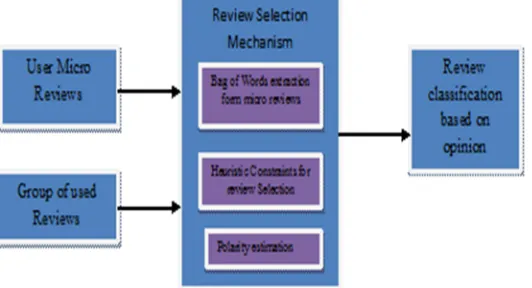
The important sentence and the tip as bags of words are extracted from the Reviews of the products using parts of speech tagging or stop word removal and sentence splitting mechanism .The data extracted shares a substantial subset of textual content then the data can be assume that they convey a similar meaning.
B. Concept And Opinion Generation For Micro-Reviews
Sentence and a tip may discuss the same concept (e.g., a menu dish), but use different words (e.g., soup vs. broth).In this process, it is must to determine an approximation bound for the two variants of the efficiency function in the micro review and review . Against the review selection, there exist a important aspect to determine positively and negatively opinionated sentences which are often the to extract comparable sentences from each set of opinions and generate a comparative summary containing a set of contrastive sentence pairs.
C. Selecting Of Subset Of Reviews For Set Of Micro-Review (Selection Coverage)
[image:4.612.174.440.539.683.2]Some reviews may have high coverage, but at the same time they are too verbose, containing many sentences that are not relevant to any tip at all. They would like to avoid such reviews in our selection, so introduce the concept of efficiency. If a sentence s and a tip t are matched, then say that s covers t. A review R covers a tip t if there is a sentence s 2 R that is matched to the tip t. Given the collection of reviews R and the collection of tips T , and the matching function F, They define for each review R the set of tips T R that are covered by at least one sentence of review R.
Technology (IJRASET)
©IJRASET 2015: All Rights are Reserved
26
D. Generate The Set Of The Reviews As Heuristics For Micro Reviews
It is well known that due to the sub modularity property of the coverage function, the greedy algorithm that always selects the review whose addition maximizes the coverage produces a solution with approximation ratio . The intuition is that reviews with high gain-to-cost ratio cover many additional tips, while introducing little irrelevant content, and thus they should be added to the collection. Values in-between regulate the effect of efficiency in our selection. The higher the value of b, the higher the value of coverage that is needed for a low efficiency review to be included in the set.
E. Applying Greedy Algorithm For Selecting The Review For Local Optimum Using Selection Efficiency
Greedy algorithm is applied for making the locally optimal choice at each stage. With the hope of finding a global optimum. A greedy strategy does not in general produce an optimal solution, but nonetheless a greedy heuristic may yield locally optimal solutions that approximate a global optimal solution in a reasonable time.
Greedy algorithms have five components:
A candidate set, from which a solution is created
A selection function, which chooses the best candidate to be added to the solution
A feasibility function, that is used to determine if a candidate can be used to contribute to a solution
An objective function, which assigns a value to a solution, or a partial solution, and A solution function, which will indicate to have discovered a complete solution
Calculate the group of Reviews interface with Tip (feature Extracted or Feature selected) using seed based review discovery (multi review selection )
In review selection from the group of reviews, micro review data consists of entities to classify or group relevant reviews. Thus seed review selection and classification is used to identify the feature selection to a group of review which matches significantly on these micro review entities. The relationship can be evaluated using the affinity between two items in the same type of entity (same dimension) or different types of entities (different dimensions) from the network. The high quality of generated reviews by the proposed algorithm will lead to efficient review selection using tip.
V. CONCLUSION
In this paper, the classification technique to analysed using micro-reviews for finding an informative and efficient set of reviews. This selection criterion is for micro review is utilized to extraction of the bag of words, as well as in the efficiency constraint. The selection problem is shown to be NP-hard, and design a heuristic algorithm EffMaxCover, which lends itself to several definitions of aggregate efficiency. The results are evaluated over corpora of restaurants’ reviews and micro reviews. Experiments analysis show that proposed classification discovers review sets consisting of reviews that are compact, yet informative. Such reviews are highly valuable, as they lend themselves to quick viewing over mobile devices, which are increasingly the predominant way to consume Web content
REFERENCES
[1] Blei.D.M, Ng A.Y, and Jordan.M.I, “LatentDirichlet allocation,”Mach.J. Learn. Res., vol. 3, pp. 993–1022, 2003.
[2] Carr .R. D, Doddi.S, Konjevod.G, and Marathe.G.V, “On the red-blue set cover problem,” in Proc. 11th Annu. ACM-SIAM Symp. Discrete Algorithm, 2000,
pp. 345–353
[3] Cheng.C, Yang.H, King.I, and Lyu.M.R, “Fused matrix factorization with geographical and social influence in location based social networks,” in Proc. 26th
AAAI Conf. Artif. Intell., 2012, p. 1.
[4] Ganesan.K, Zhai.C, and Han.J, “Opinosis: A graph-based approach to abstractive summarization of highly redundant opinions,” in Proc. 23rd Int. Conf.
Comput. Linguistics, 2010, pp. 340–348.
Technology (IJRASET)
©IJRASET 2015: All Rights are Reserved
27
Conf. World Wide Web, 2012, pp. 869–878
[6] Gao.H, Tang.J, Hu.X, and Liu.H, “Exploring temporal effects for location recommendation on location-based social networks,” in Proc. 7th ACM Conf.
Recommender Syst., 2013, pp. 93–100.
[7] Ghose.A, and Ipeirotis.P.G, “Designing novel review ranking systems: Predicting the usefulness and impact of reviews,” in Proc. 9th Int. Conf. Electron.
Commerce, 2007, pp. 303–310.
[8] Hu.M, and Liu.B, “Mining and summarizing customer reviews,” in Proc. 10th ACM SIGKDD Int. Conf. Knowl. Discov. Data Mining, 2004, pp. 168–177.
[9] Jansen.B.J, Zhang.M, Sobel.K, and Chowdury.A, “Twitter power: Tweets as electronic word of mouth,” J. Amer. Soc. Inf. Sci. Technol., vol. 60, no. 11, pp.
2169–2188, 2009.
[10] Khuller.S, Moss.A, and Naor.J.S, “The budgeted maximum coverage problem,” Inf. Process. Lett., vol. 70, no. 1, pp. 39–45, 1999.
[11] Kim.S,M, Pantel.P, Chklovski.T, andPennacchiotti.M, Automatically assessing review helpfulness,” in Proc. Conf. Empirical Methods Natural Lang. Process.,
2006, pp. 423–430.
[12] Kouloumpis.E, Wilson.T, and Moore.J, “Twitter sentiment analysis: The good the bad and the omg,” in Proc. 5th Int. Conf. Weblogs Social Media, 2011, pp.
538–541.
[13] Lappas.T, Crovella.M, and Terzi.E, “Selecting a characteristic set of reviews,” in Proc. 18th ACM SIGKDD Int. Conf. Knowl. Discov.Data Mining, 2012, pp.
832–840.
[14] Lappas.T and Gunopulos.D, “Efficient confident search in large review corpora,” in Proc. Eur. Conf. Mach. Learn. knowl. Discovery Databases: Part II, 2010,
pp. 195–210.
[15] Lin.D and Bilmes.J, “Multi-document summarization via budgeted maximization of submodular functions,” in Proc. Human Lang. Technol.: Annu. Conf.
North Amer. Chapter Assoc. Comput. Linguistics, 2010, pp. 912–920.