Technology (IJRASET)
Decontamination of Lead Polluted Soil Using
Pseudomonas Aeruginosa Bacteria: A Biosorption
Study
Nandini M. R1, Udayashankara T. H2, Madhukar M3
1
M.Tech. Scholar, 2Professor, 3Research Scholar Department of Environmental Engineering Sri Jayachamarajendra College of Engineering, Mysore- 570006, Karnataka, India
Abstract- The Soil may become contaminated with heavy metals and metalloids accumulation due to atmospheric deposition from natural (volcanoes, earthquakes etc.) and anthropogenic (Industrial and vehicular) emissions. Soil is the ultimate sink of any contaminant released to environment due to aforementioned activities. Heavy metals are known to have potential to pose serious risks and hazards to humans and the ecosystem. Lead accumulation in human body affects the neurological, hematological, gastrointestinal, cardiovascular and renal systems. The children (<5years) are more vulnerable to the neurotoxin effects. There are various in situ and ex situ remediation methods adopted to remove or reduce or extract the Lead from the soils. Among those bio remediation or bio sorption is found to be more advantageous. Hence, the present study is contemplated to determine the adsorption capacity of lead by the soil and bio remediating lead content using Pseudomonas bacteria and also to study the kinetics. The site soil is a well graded clayey soil with great affinity to lead ions. It is evident from the adsorption study that >95% of lead is adsorbed by the soil easily within 7.5h if the lead concentration is within 750mg/L in similar type of soil. Nutrient media is said to be best suited as supporting media for the bio sorption of lead using Pseudomonas bacteria. From model study it is clear that the adsorption is purely single layered chemo sorption. Hence, from this study it can be concluded that bio sorption using Pseudomonas with nutrient media is a promising bio remediation method for decontamination of sites with lead.
Keywords- Contamination, Heavy metals, Microorganisms, Bioremediation, Soil residue.
I. INTRODUCTION
The Soil may become contaminated with heavy metals and metalloids accumulation due to atmospheric deposition from natural (volcanoes, earthquakes etc.) and anthropogenic (Industrial and vehicular) emissions. Other anthropogenic activities which significantly contribute for heavy metal accumulation in soil includes: mine drains, spillage of paints and petrochemicals, fertilizers, animal manures, sewage sludge, pesticides, wastewater irrigation, fossil fuels, scrap metal and e-waste disposal etc. Heavy metals
most commonly found at contaminated sites are lead (Ρb), chromium (Cr), arsenic (As), zinc (Zn), cadmium (Cd), copper (Cu), mercury (Hg), and nickel (Ni) [1]. Soil is the ultimate sink of any contaminant released to environment due to aforementioned activities. Unlike organic contaminants most of these heavy metals do not undergo microbial or chemical degradation which accumulates to unsafe levels [2]. These heavy metals are known to have potential to pose serious risks and hazards to humans and the ecosystem, which may be through direct ingestion or contact, enter Food Chain leading to bio accumulation and magnification, drinking of contaminated ground water, low food quality, reduced crop yield leading to food insecurity etc.[3-5]. Lead is one such heavy metal which occurs as compound of sulfide at very low level in Earth’s crust. Lead accumulation in human body affects the neurological, hematological, gastrointestinal, cardiovascular and renal systems. The children (<5years) are more vulnerable to the neurotoxic effects of lead even at relatively low levels of exposure leading to irreversible damage. This is because children absorb 4-5 times of lead ingested than adults. Even at blood lead levels less than 4-50 µg/L, the Intelligence Quotient of child is affected. Pregnant women when exposed to high levels of lead through inhalation or ingestion can cause miscarriage, abortion, untimely birth and underweight birth, as well as insignificant abnormalities.
Technology (IJRASET)
Among those bio remediation or bio sorption is found to be more advantageous than any other methods because it is reliable, feasible, highly efficient, less chemical usage and sludge generation, regeneration of Biosorbent, and ease in process optimization, doesn’t require any skilled labors, mechanical equipment and continuous monitoring [6]. Recently, many microbial species of fungus (Aureobasidium pullanans, Cladosporium resinae, Penicillium lanosa-coeruleum, A. niger, , A. versicolor, Rhizopus nigricans, Metarrhizium anisopliae var. Anisopliae and Penicillium verrucosum, Hirsutellah), bacteria (Bacillus, Pseudomonas, Zoogloea manigera, Streptomyces, Staphylococcus), algae (Chlorella vulgaris, Ascophyllum nodosum, Spirogyra, Lyngbya putealis, Sargassum sp.) and Yeast (S. cerevisiae, S. Rimosus, P. Chrysogenum, F. vesiculosus, A. nodosum, Kluyceromyces) have been successfully used as agents for cleaning of heavy metals from soils, water and wastewaters [7].
Keeping all the above facts in view, the present study was contemplated in studying the soil characteristics of contaminated site, to determine the adsorption capacity of lead in soil, bioremediating lead content using Pseudomonas bacteria and also to study the kinetics.
II. MATERIAL AND METHODOLOGY
A. Soil Sampling And Analysis
The analysis of soil characteristics is an important task to be carried out to know its properties as it effects the growth of bacteria. Soil characterization is carried out to determine the various properties that can affect the growth of bacteria. The soil used for batch biosorption studies were collected from Sri Jayachamarajendra College of Engineering campus, near dump yard, Mysore. The Top layer of soil was initially scrapped to remove debris after which it was dug up to a depth of 15cms. The stones were parted from soil and a mass of 10kg was collected in a polythene bag. The soil sample was sieved through 2mm IS sieve to remove the coarse debris and dust particles. The soil samples were tested for pH, moisture content, porosity, specific gravity, particle size distribution and organic content, according to standard procedure given in IS: 2720. After characterization, the soil was thermally treated in hot air oven for 24hrs at 180 0C to kill the indigenous microorganisms and stored in polythene bags for further study.
B. Bacterial Culture
[image:3.612.234.381.467.556.2]The Pseudomonas Bacteria which is employed in the present study is first cultured in lab using Sterilized petri plates with Nutrient Agar as the growth supporting media. Streak plate method was implemented in culturing the bacteria (Figure 1). In order to increase the bacterial density, the plate culture is inoculated to nutrient broth and incubated for 24hrs at 37oC. After anticipated incubation period the broth is centrifuged at 8000rpm for 15min to collect the bacterial cells. The collected bacterial cells were stored at 40C and used for batch experiments.
Fig. 1 Colonies of Pseudomonas Bacteria obtained after 24h incubation period
C. Bacterial Density
Microbial parameters often need to be defined as mass rather than colony forming unit (CFU) or optical density (OD) which is easily measurable using plate counting method or UV-Vis spectrophotometer, especially for any attempt in modeling of contaminant transport and biological growth or degradation within the system. The Optical Density method is used in the present study to determine the biomass of Pseudomonas and converted to required unit (mg/mL) using the equation (1). The OD is measured at wave length of 600nm.
Y (mg/mL) =2.0087 × (OD600) + 0.0764 (1)
Technology (IJRASET)
D. Synthesis Of Minimal And Nutrient Media
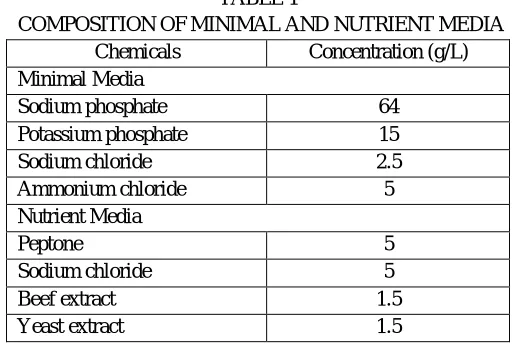
[image:4.612.177.433.133.306.2]In order to support the bacterial growth in the batch studies two media were selected. The effectiveness of these media, in the progress of bacteria was examined by varying the dosage of media. The composition of the media is furnished in Table 1.
TABLE 1
COMPOSITION OF MINIMAL AND NUTRIENT MEDIA Chemicals Concentration (g/L) Minimal Media
Sodium phosphate 64 Potassium phosphate 15 Sodium chloride 2.5 Ammonium chloride 5 Nutrient Media
Peptone 5
Sodium chloride 5
Beef extract 1.5
Yeast extract 1.5
E. Synthetic Sample Of Lead
Analytical grade Lead Nitrate Ρb(NO3)2 of 0.159, 0.319, 0479, 0.799 and 1.199g was dissolved in deionized water to fetch 100, 200,
300, 500 and 750mg/L concentrations lead solution. After it completely dissolves, the solution is charged with 10 mL HNO3 and
made up to 1L with deionized water.
F. Adsorption And Biosorption Study
Pretreated soil of 100g and 100mL of different concentrations (100, 200, 300, 500 and 750mg/L) is taken in a conical flasks. The mixture was agitated in a rotatory shaker at 150rpm. The samples were collected for every 1.5h from the startup of the experiment till 7.5h. The supernatant was filtered using whatman filter paper and analyzed for lead concentration remaining in the solution. The bacterial cultures (0.1ml, 0.3ml and 0.5ml) as well as bacterial growth supporting media (minimal media and nutrient media) of different dosages (4, 6, 8 and 10ml) were added to the conical flasks with 100mL lead solution having 100mg/L concentration. The uptake of metal ions from bacteria Pseudomonas was analyzed for 5th day. Based on the results obtained from the initial batch studies, optimal biomass concentration and media dosages were determined. Further batch studies were continued by using the optimum biomass concentration and media dosage with varying metal concentrations. Here, the samples were drawn every 24h, (till 120h) analyzed for growth of bacteria and Lead content remaining in the soil. Meanwhile, 1g of soil was taken from the flask and 0.05M acetic acid (extractant solution) of 10ml in the ratio 1:10 (W/V) was added, stirred well and allowed to rest for about 15min. These supernatant was filtered using whatman filter paper and the sample was taken for the analysis of lead remaining in the soil. The analysis of Lead was done using the inductively coupled plasma mass spectrometry (ICP-MS). All the experiment and analysis of the present study was carried out in Environmental Engineering Laboratory at Sri Jayachamarajendra College of Engineering, Mysore.
III. RESULTS
A. Soil Characteristics
Technology (IJRASET)
TABLE 2
SITE SOIL PROPERTIES
Sl.No Properties Results
1 Moisture Content 28%
2 Porosity 0.264
3 pH 7.56
4 Temperature 27.7oC
5 Specific Gravity 3.55
6 Grain Size analysis Well graded clayey soil
7 Organic Matter Content 4%
8 Void ratio 0.358
B. Soil Adsorption
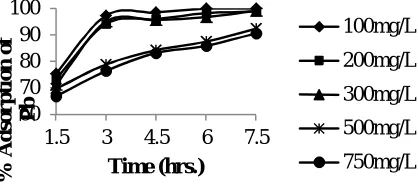
Initially, the effect of varying Lead concentration on the adsorption capacity of the soil is studied. For which Lead concentration of 100, 200, 300, 500 and 750mg/L is used. The samples drawn at equal intervals and corresponding percentage of Lead removed from the solution is presented in the Figure 2. At initial stage of sampling (at 1.5h) the lead removal was almost ranged from 76% (100mg/L) to 70% (750mg/L). A significant rise in the Adsorption of lead (>95%) is observed at 3rd hour of sampling with respect to 100, 200 and 300mg/L. whereas, with respect to 500 and 700mg/L the adsorption increase was 10%. Therefore, the adsorption of lead was found to be increasing with increase in contact time with all the initial concentrations. Conversely, there was decrease in the amount of adsorption when the concentration was spiked form 300 to 500mg/L. The adsorption pattern was found to similar with 100, 200 and 300mg/L, likewise adsorption trend is observed to be similar with 500 and 750mg/L. As forementioned the pH of the soil and type of soil has favored the adsorption of lead.
Fig. 2 Effect of different initial Pb concentrations in soil adsorption
C. Effect Of Biomass And Media
The effect of biomass and minimal media dosage is presented in the Figure 3. It was observed that with increase in dosage of biomass and minimal media there was increase in removal of lead. Similar trend was observed when the Nutrient media was used (Figure 4). However, the removal efficiency was observed to be more with the use nutrient media than minimal media. Maximum removal was observed to be with the 0.5 and 10mL of biomass and minimal/nutrient media respectively. Hence, it is considered as optimum dosage which is used in further studies.
60 70 80 90 100
1.5 3 4.5 6 7.5
%
A
d
so
r
p
ti
o
n
o
f
P
b
Time (hrs.)
100mg/L
200mg/L
300mg/L
500mg/L
Technology (IJRASET)
[image:6.612.183.421.220.319.2]Fig. 3 Effect of different biomass concentration and media dosage in the removal of Pb
Fig. 4 Effect of different biomass concentration and media dosage in the removal of Pb
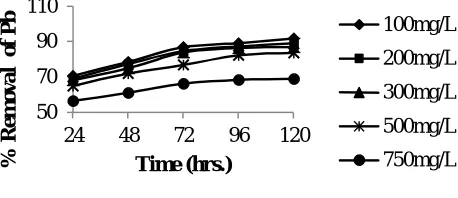
With the results, the best process conditions (biomass concentration and media dosages) were fixed for further studies. Next, the batch studies were conducted by varying initial lead concentrations for the optimum biomass and media dosages. The effects observed due to increase in concentration on optimum dosages of biomass with minimal and nutrient media are presented in fig.5 and fig.6. At initial 24h the removal of lead using Medias was similar. However, at the end of 120h the removal efficiency was found to be more with nutrient media compared to minimal media.
Fig. 5 Effect of different initial concentrations on the biosorption of Pb ions in Minimal Media
Fig. 6 Effect of different initial concentrations on the biosorption of Pb ions in Nutrient Media
The effect of varying concentration on biomass was also monitored. It was observed that with lead concentration of 100mg/L the 65
75 85
4 6 8 10
% R e m o v al o f P b
Minimal Media (ml)
0.1ml 0.3ml 0.5ml 65 75 85 95
4 6 8 10
% R e m o v al o f P b
Nutrient Media (ml)
0.1ml 0.3ml 0.5ml 50 60 70 80 90
24 48 72 96 120
% R e m o v al o f P b Time (hrs.) 100mg/L 200mg/L 300mg/L 500mg/L 750mg/L 50 70 90 110
24 48 72 96 120
[image:6.612.194.425.439.527.2] [image:6.612.194.423.572.671.2]Technology (IJRASET)
[image:7.612.191.425.174.267.2]biomass remained constant till 48hours and declined significantly thereafter when minimal media was used (fig 7). Whereas, in case of nutrient media similar trend was observed for both 100 and 200mg/L lead concentration (fig 8). With respect to other concentration the biomass concentration found to deteriorate with time. This may be due to exhaustion of the growth supporting media and also the growth inhibition action posed by lead. From the study it can be observed that the bacterial growth is supported well Nutrient media than Minimal media. Therefore, Nutrient media is said to be best suited as supporting for the bio sorption of lead using Pseudomonas bacteria.
[image:7.612.191.425.316.415.2]Fig. 7 Growth patterns of bacteria Psedomonas with different concentrations of Pb ions in Minimal Media
Fig. 8 Growth patterns of bacteria Psedomonas with different concentrations of Pb ions in Nutrient Media
D. Biosorption Isotherms Models
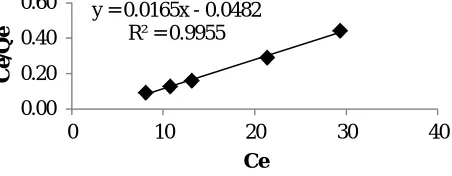
The various model parameters and constants computed using the data obtained from batch study is presented in Table 3. The Langmuir RL value is slightly above 0 and very much less than 1 which indicate that the sorption condition merely favorable. The R2
value obtained is 0.9955 which means the model is well fitted with the sorption data. From the Freundlich isotherm it can be observed that 1/n and n value indicates that the sorption is normal. And the R2 is 0.9895 indicates the Freundlich model also is not well fitted with the sorption data. The linear plot fitted with both isotherm for sorption data is as given in figure 9 and 10. Isotherm and Kinetics study was done for the only the optimum biomass concentration with nutrient media and Lead concentration of 100mg/L. From the isotherm study it is clear that the sorption of lead is purely single layered adsorption.
Fig. 9 Langmuir isotherm model for biosorption of Pb 0
0.5 1 1.5 2
0 24 48 72 96 120
B ac te r ia l G r o w th (m g/ m l) Time (hrs.) 100mg/L 200mg/L 300mg/L 500mg/L 750mg/L 0 0.5 1 1.5 2
0 24 48 72 96 120
B ac te r ia l G r o w th (m g/ m l) Time (hrs.) 100mg/L 200mg/L 300mg/L 500mg/L 750mg/L
y = 0.0165x - 0.0482 R² = 0.9955
0.00 0.20 0.40 0.60
0 10 20 30 40
C
e
/Q
e
[image:7.612.197.423.577.665.2]Technology (IJRASET)
Fig. 10 Freundlich isotherm model for biosorption of Pb
TABLE 3: LANGMUIR AND FREUNDLICH ISOTHERM CONSTANTS FOR Pb BIOSORPTION Metal
Conc. (mg/L)
Langmuir isotherm model
m(slope) b C(intercept) Qo R2 RL
100
0.0165 0.342 0.0482 60.606 0.9955 0.028 Freundlich isotherm model
m(slope) n C(intercept) kf R2
0.2077 - 4.8146 2.1275 134.121 0.9606
E. Biosorption Kinetic Studies
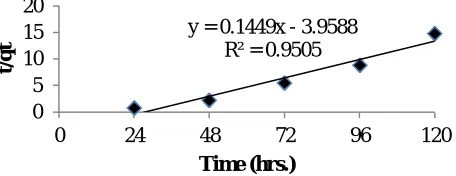
The Kinetic models were applied to understand the order of lead adsorption taking place in the system. The batch biosorption study data was modeled using pseudo first order and pseudo second order kinetics. The plot of first and second order kinetics with 100mg/L lead concentration is shown in the Figure 11 and 12 respectively. From Table 4 it can be observed that correlation coefficient R2 for pseudo second order kinetics is much higher than pseudo first order kinetics. This indicates the adsorption data are better represented by second order kinetic model, which was based on the assumption that rate of adsorption is due to chemosorption involving valence forces through sharing or exchange of electrons between adsorbent and adsorbate. Therefore, form the model study it is clear that the adsorption is purely single layered chemo sorption.
Fig. 11 Pseudo first order plot for biosorption of Pb
Fig. 12 Pseudo second order plot for biosorption of Pb y = -0.2027x + 2.1275
R² = 0.9606 1.8
1.9 2
0 0.5 1 1.5 2
lo
gQ
e
logCe
y = 0.0033x + 1.5356 R² = 0.8837 0
1 2 3
0 24 48 72 96 120
lo
g(q
e
-q
t)
Time(hrs.)
y = 0.1449x - 3.9588 R² = 0.9505
0 5 10 15 20
0 24 48 72 96 120
t/
q
t
[image:8.612.196.424.593.681.2]Technology (IJRASET)
TABLE 4
FIRSTORDER AND SECOND ORDER SORPTION RATE CONSTANTS FOR Pb ADSORPTION
Metal Conc. (mg/L)
Pseudo first order Pseudo second order
k1 qe R2 k2 qe R2
100 0.0076 34.324 0.8837 0.0057 6.6711 0.9505
IV. CONCLUSIONS
From the present Study following conclusions are drawn: The site soil is a well graded clayey soil with great affinity to lead ions. It is evident from the adsorption study that >95% of lead is adsorbed by the soil easily within 7.5h if the lead concentration is within 750mg/L in similar type of soil. The optimum dosage of biomass (Pseudomonas) is found to be 0.5mL (1.472mg/mL) with minimal or nutrient media of 10mL. Effects of initial concentration on removal efficiency of Lead using optimum dosage of biomass and media are observed to decrease with increase in lead concentration. When lead concentration is 100mg/L the biomass remained constant till 48hours and declined significantly thereafter when minimal media is used. Whereas, in case of nutrient media similar trend was observed with both 100 and 200mg/L. Nutrient media is said to be best suited as supporting media for the bio sorption of lead using Pseudomonas bacteria. From kinetics study it is observed that correlation coefficient R2 indicates that the adsorption data are better represented by second order kinetic model. Therefore, form the model study it is clear that the adsorption is purely single layered chemo sorption. Hence, form this study it can be concluded that bio sorption using Pseudomonas with nutrient media is a promising bio remediation method for decontamination of sites with lead.
V. ACKNOWLEDGMENT
I would take this opportunity to express my sincere thanks to my guide Dr. Udayashankara T. H. Professor and also to all the faculty members, Department of Environmental Engineering for their warm support and guidance. I would also like to thank Department of Environmental Engineering, Sri Jayachamarajendra College of Engineering for providing the laboratory facilities in successful completion of the project work.
REFERENCES
[1] GWRTAC, “Remediation of metals-contaminated soils and groundwater,” Tech. Rep. TE-97-01, GWRTAC, Pittsburgh, Pa, USA, 1997, GWRTAC-E Series. [2] Kirpichtchikova, T. A., Manceau, A., Spadini, L., Panfili, F., Marcus, M. A., and Jacquet, T. 2006 Speciation and solubility of heavy metals in contaminated
soil using X-ray microfluorescence, EXAFS spectroscopy, chemical extraction, and thermodynamic modeling, Geochimica et Cosmochimica Acta, vol. 70, no. 9, pp. 2163–2190.
[3] McLaughlin, M. J., Zarcinas, B. A., Stevens, D. P., and Cook, N. 2000 Soil testing for heavy metals, Communications in Soil Science and Plant Analysis, vol. 31, no. 11–14, pp. 1661–1700.
[4] McLaughlin, M. J., Hamon, R. E., McLaren, R. G., Speir, T. W., and Rogers, S. L. 2000 Review: a bioavailability-based rationale for controlling metal and metalloid contamination of agricultural land in Australia and New Zealand,” Australian Journal of Soil Research, vol. 38, no. 6, pp. 1037–1086.
[5] Ling, W., Shen, Q., Gao, Y., Gu, X., and Yang, Z. 2007 Use of bentonite to control the release of copper from contaminated soils,” Australian Journal of Soil Research, vol. 45, no. 8, pp. 618–623.
[6] Kratchovil, D., and Volesky, B. 1998 Advances in the biosorption of heavy metals, Trends Biotechnol, 16, pp. 291-300.