
Vertical Handover Optimization in LTE System
Indrajeet Singh1, Prof. Gaurav Aggarwal2
1
M.Tech (CSE), 2Associate Prof. HOD, Deptt. Of CSE, Jagannath University, Bahadurgarh, Haryana.
Abstract: In recent times, the mobile relay technique has been debated to sustenance the communication facilities for Long-Term Evolution Advanced (LTE-A) high-speed rail networks. In this network, there are no of node mobile relays and tower in the network. Handoff LTE module is described that minimum energy level then it doesn’t transmit the packets so the new node will become interacted with the tower node, because the new node has a maximum level of energy. So the proposed algorithm is increased the throughput and decrease the delay that is better than the existing work.
Here showed the graphical and numerical value of these work comparison is clearly seemed that proposed work having the best performance as compared to existing.
Keywords : LTE; handover optimization;
I. INTRODUCTION
The swift growth in wireless communication technology has changed human living standards. This effect is visible with the exponential increase in mobile users. To match with the rising demand, there is a very fast evolution in communication standards. This results in rapid movement of standards from one generation to other.
The evolution of wireless communication technologies are represented by their generations. The mobile wireless industry started way back in 1970’s with the first generation of mobile communication technology called 1G [1]. The mobile 1G was Nordic Mobile Communication (NMT) and Total Access Communication Systems (TACS) operates on analog technology [2]. The technology was primarily designed to provide voice services. Large size phone, frequent call drops and a limited mobility were the main drawbacks of this generation systems [3].
In early 90’s the popular Global System for Mobile Communication (GSM) designated as second generation (2G) was introduced. This had the innovative evolution in the digital technology. The second generation supported data and voice mobility. Later the General Packet Radio Service (GPRS) (2.5G) and Enhanced Data Rates for Global Evolution (EDGE)(2.75G) came into the scenario for better data support and mobility across the network.
Due to higher demand for data services on wireless communication, the evolution led to third generation (3G) wireless communication technologies, Universal Mobile Telecommunications System (UMTS) and Wideband Code Division Multiple Access (WCDMA). These technologies provide integrated packet high quality audio video and data services with mobility support. The fourth generation (4G) Long Term Evolution (LTE) is the advancement of 3G technology. In addition to the usual voice and other services of 3G, 4G provides mobile broadband internet access, through smart phones, and other mobile devices [4]. Potential and current applications of 4G include amended mobile web access, IP telephony, gaming services, high-definition mobile TV, video conferencing, 3D television and cloud computing. Table 1 presents a comparative overview of the major wireless communication evolutions with their technology features [4].
The change of technology from the end user’s perspective is deliberate and the new generation technology overlaps with the existing technology [5]. Hence for certain period of time both the technologies co-exist and hence forms heterogeneous wireless networks. Table 1.1 also compares differences in different generations [6].
A. Heterogeneous Wireless Networks
Handoff: An oversight The process of transfer of an ongoing connection from the serving base station to the adjacent base station without interruption is known as handoff.
Figure 1.1: Handoff
B. Vertical Handoff in Heterogeneous Wireless Network
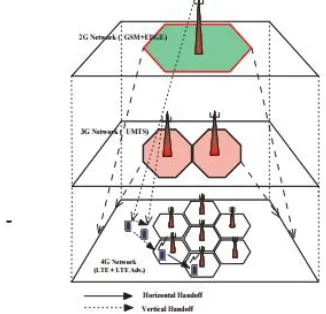
The prime objective of VHO is to achieve mobility within heterogeneous wireless networks. The heterogeneous wireless network consists of multiple wireless technologies to provide diversified services to the mobile users. Mobility management addresses the key issues of location management and handoff management. Location management tracks the UE for successful information delivery. Handoff management maintains the active connections to provide seamless connectivity with the UE, as they change their point of attachment to the network. In the converged HWN’s, both intra technology handoff and inter-technology handoff co-exist. Intra-technology handoff is the traditional horizontal handoff process in which the UE handoff between two Access Points (AP) or base stations using the same access technology. On the other hand, inter-technology handoff, or vertical handoff, occurs when the UE roams between different accesses technologies,
Figure 1.2: Vertical handoff in K-tier heterogeneous wireless network
It is the traditional horizontal handoff process in which the UE handoff between two Access Points (AP) or base stations using the same access technology. On the other hand, inter-technology handoff, or vertical handoff, occurs when the UE roams between different accesses technologies, Figure 2.1 represents a case of HHO and VHO.
[image:3.612.229.392.410.567.2]heterogeneous network architectures revolve around the notion of the heterogeneous wireless Network to provide ‘Multiple tier’, ‘Multi-technology’ and ‘Multiple services’.
C. Possible Architectures for 4g Networks
Accessing different mobile and wireless networks is one of the most challenging problems to be faced in the deployment of 4G technology [8].
1) Using a multimode device
2) An overlay network
[image:4.612.195.423.191.409.2]3) A common access protocol
Figure 1.3 Possible Architectures for 4G Networks [8]
4) Multimode Devices
5) Overlay Network
6) Common Access Protocol
7) Mobility Management Issues in 4G Networks
II. REVIEWOFRESEARCH
Since the beginning of wireless communication evolution, the wireless network always emerged with mess of current and next generation of wireless communication archetypes. Different network archetypes envisioned to provide different kinds of services like voice, video streaming, web browsing, telemetry and the like. The network archetypes also aim to provide ubiquitous network coverage with mobility. So there is a requirement of inter and intra network mobility for all kinds of services through VHO. So the VHO plays the key role for providing mobility across multiple network archetypes. Several approaches were proposed by different authors to get the optimum solution for finding out the VHO algorithms for multi-tier, multiple service environments.
Lu &Bharghavan (1996) [9], proposed an adaptive QOS management system in wireless multimedia networks. The system proposed was based on a service model designed for both connection- and application level QOS. Wireless multimedia applications are classified into different service classes in the service model by their application profiles.
Fang (2005) [10] was presented “An analytical approach for performance evaluation of wireless cellular networks. The analytical approach demonstrated how simple mathematical techniques can be applied to obtain outstanding analytical results for many performance metrics including call blocking and dropping probabilities.
III. PROPOSEDWORK
A seamless vertical handoff procedure [12] between IEEE802.11 WLAN and CDMA2000 cellular network that overlays the WLAN and also covers a larger area is discussed in this chapter. The traffic is classified into real-time and non-real-time services in this algorithm. The architecture adopts the mobility management concept through the Mobile Agent and the Subnet Agent functions to minimize the delay during vertical handoff. MD Handoff involves the process in which mobile host leaves the WLAN service area and connects to the CDMA cellular network. The strength of the beacon signal weakens as the Mobile Host moves away from the WLAN access point. The signal strength is compared with the threshold value and if the signal strength value goes below the threshold value, then the CDMA Cellular card is activated and the MH moves into the CDMA from WLAN resulting in the handoff
When an Agent Advertisement message is received from the Cellular subnet agent, the MH sends a Handoff Ready Request message to the MA through the required access point. A subnet agent of the cellular network is configured with the overlay network that buffers the received packets. The MA sends incoming packets to the subnet agent. The subnet agent in turn receives a Registration message and will start sending the buffered packets. Buffering is done in order to save the inbound packets during the handoff period.
A. Handoff Algorithm and Analysis
There are many differences between the radio link characteristics of the WLAN and the CDMA Cellular networks. Hot spot areas, such as campuses, hotels, and restaurants are covered by WLAN at low cost and high data rate. However, CDMA cellular networks serve a wider area than WLAN at a higher cost and lower data rate. The following tables show the coverage, cost and data rate of WLAN and CDMA.
Table 2.1 Specifications of AP and BSS
RA Coverage Data Rate Cost
AP Limited 1-11 MBPS Low
BSS Unlimited 9.6-300Kbps High
In the case of delay sensitive real-time services, handoff should be performed as rapid as possible in order to minimize the delay due to frequent handoffs. For non-real-time service, the amount of transmission data is more important than the delay, and therefore, the connection to the WLAN should be maintained as long as possible. The proposed Vertical handoff algorithm between WLAN and CDMA cellular networks
The following variables are used to determine the vertical handoff [13]: λ thresh: Predefined threshold value when the handoff
transition region begins
λ : The number of continuous beacon signals that are received from the WLAN with the below
λ thresh
λr : λ for real time service
λu: λ for mobile upward
Λr<<λn<<λu--- (1)
B. Control Mechanism of Handoff
In real-time service, the handoff delay must be short in the handoff transition region; therefore the number of continuous beacon signal should be lower than that of the non-real- time service in order to reduce handoff delay. Since the CDMA cellular network
covers a wide area and the handoff time is not critical for the MU, the value of λn should be higher than other values. To reduce overall handoff delay, the in-bound packets are multicoated to the SA of the target network by mobility management. They are multicoated
when the beacon signal strength in the MD falls below the λ thresh or rises higher than the λthresh in MU. The multicoated data are
buffered in the SA. These buffered data will be transmitted to the BS if the MH is handed off to the target network before the timer expires. Otherwise, those data will be discarded. During the periodic the MH checks of the RSS of the received beacon signals, if the
Figure 3.2 Control Mechanism of Handoff
First, the service classifier classifies the traffic as either real-time service, and then it sends the control signal to the handoff decision block and the measurement block.
Below plots are showing the packet delivery ratio for proposed work with respect to simulation time. The simulation result shows that proposed taking less delay while for existing work taking high delay. When the simulation times of the network are increasing the packet delivery ratio is also high and constant.
The simulation effect shows that proposed work taking the less energy consumption with time for a selected network size whereas for existing having the next. Once the simulation time will increase within the network the energy consumption will increase. Within the case of existing, the message slide will increase with a rise within the variety of nodes deployed within the network.
IV. CONCLUSIONANDFUTUREWORK
An implementation of a continuous vertical handoff procedure and the effective handoff algorithm for the handoff transition region among the WLAN and CDMA cellular network is presented. Here, we have gone expansively about the various parameters that govern the smooth operative of the algorithm and how they affect the time spent in WLAN and CDMA networks. We generate the simulation result and vertical handover scenario between the WLAN and CDMA networks and hence would provide quite a useful tool for the device in real time functioning.
Handoff LTE module is described that minimum energy level then it doesn’t transmit the packets so the new node will become interacted with the tower node, because the new node has a maximum level of energy. So the proposed algorithm is increased the throughput and decrease the delay that is better than the existing work.
showed the graphical and numerical value of these work comparison is clearly seemed that proposed work having the best performance as compared to existing.
REFERENCES
[1] Ajay R Mishra. Fundamentals of cellular network planning and optimisation: 2G/2.5 G/3G. evolution to 4G. John Wiley & Sons, 2004.
[2] Christopher Cox. Inter-operation with umts and gsm. Introduction to LTE, An: LTE, LTEAdvanced, SAE, VoLTE and 4G Mobile Communications, pages 255–269, 2014.
[3] A Jayanthila Devi and GM Kadhar Nawaz. Minimum Utilization of Electromagnetic (2G, 3G, 4G) Spectrum in Seamless Mobility Based on Various Estimation Methods. Journal of Applied Computer Science Methods, 6(1):5–26.
[4] Steven Cherry. Forecast for cloud computing: up, up, and away. Spectrum, IEEE, 46(10):68– 68, 2009.
[5] ShengdongXie. Vertical handoff decision algorithm based on optimal grade of service. IETE Journal of Research (Medknow Publications & Media Pvt. Ltd.), 56(1), 2010.
[6] Yung-Fa Huang, Hsing-Chung Chen, Hung-Chi Chu, Jiun-JianLiaw, and Fu-Bin Gao. Performance of Adaptive Hysteresis Vertical Handoff Scheme for Heterogeneous Mobile Communication Networks. Journal of Networks, 5(8):977–983, 2010.
[7] Abdul Hasib and Abraham O Fapojuwo. Mobility model for heterogeneous wireless networks and its application in common radio resource management. IET communications, 2(9):1186– 1195, 2008.
[8] UpkarVarshney and RadhikaJain,”Issues in Emerging 4G Wireless Networks”, 2001.
[9] Lu, S. &Bharghavan, V. (1996), “Adaptive Resource Management Algorithms for Indoor Mobile ComputingEnvironments”, In ACM SIGCOMM’96 Proceeding, 231-242.
[10] Fang, Y. (2005), “Performance evaluation of wireless cellular networks under more realistic assumptions”, Wireless Communications and Mobile Computing Wirel. Commun. Mob. Comput.; 5:867–885 Published online in Wiley Interscience (www.Interscience.Wiley.Com).DOI:10.1002/ Wcm.352.
[11] Akpan, U., Kalu, C., Ozuomba, S. &Obot, A. (2013), “Development of an Improved Scheme for Minimizing Handoff Failure due to Poor Signal Quality”, International Journal of Engineering Research and Technology 2(10), 2764-2771.
[12] StenioFernandes and Ahmed Karmouch. Design and analysis of an IEEE 802.21-based mobility management architecture: a context-aware approach. Springer, 19(7):187–205, 2012.
[13] Xiaohuan Yan, Y AhmetS¸ekercio˘glu, and Sathya Narayanan. A survey of vertical handover decision algorithms in fourth generation heterogeneous wireless networks.
![Figure 1.3 Possible Architectures for 4G Networks [8]](https://thumb-us.123doks.com/thumbv2/123dok_us/8308050.856954/4.612.195.423.191.409/figure-possible-architectures-g-networks.webp)
