APPLICATION OF SHARIAH PRINCIPLES
IN ISLAMIC FOREIGN EXCHANGE OPTIONS
Nor Fahimah Mohd Razif
1, and Ahmad Sufian bin Che Abdullah
21 Department of Fiqh and Usul, Academy of Islamic Studies, University Malaya, 50603 Kuala Lumpur, Malaysia, E-mail: [email protected]
2 Department of Syariah and Management, Academy of Islamic Studies, University Malaya, 50603 Kuala Lumpur, Malaysia, E-mail: [email protected]
ABSTRACT
In accordance with the dire need for derivative-like products, Islamic financial institutions eventually initiated their efforts to design a product with suitable contracts. Option-like Islamic products began to be offered by Islamic financial institutions a few years ago. Today, the products have proven to gain wider recognition, and several contracts are being used to construct an option-like effect and outcome. This study aims to evaluate the compliance of Islamic foreign exchange options with shariah principles. This study involves the collection and analysis of primary and secondary data from various sources. It also undertakes content analysis of the rulings of jurisprudence scholars on several shariah principles. This study found that this Islamic FX option is still debatable on its permissibility from shariah perspective.
Key Words: forex, option, Islamic FX option,
INTRODUCTION
In accordance with the dire need for derivative-like products, Islamic financial institutions eventually initiated their efforts to design a product with suitable contracts. Option-like Islamic products began to be offered by Islamic financial institutions a few years ago. Today, the products have proven to gain wider recognition, and several contracts are being used to construct an option-like effect and outcome. In this part, we will divulge the underlying shariah principles that are currently being used in Shariah-compliant FX Option. Of course, a hybrid process is involved to create quite a similar effect at the same time, complying with Islamic commercial law.
The Shariah-compliant FX Option is the product replicating the effect of the FX options, where the product gives the owner (writer) the right to buy or purchase the indicated amount of foreign currency at a specified price before a specific date. That is the intended effect of the IFIs; hence, they have initiated the so-called Sharīʿah-approved ‘option-like’ products.
There are three common methods of doing a Shariah-compliant FX Option:
Using Urbun
Using Commodity Murabaha
Using Wa’d
Structure One: Bay’ al-`Urbun
al-Muwatta’ as cited by al-Baji, "It is when a person buys a slave or rents an animal and says to the seller or the owner; of the animal," "I will give you one dinar or one dirham or more or less and if I ratify the sale or the rent contract, the amount I gave will be part of the total price. And if I cancel the deal, then what I gave-will be for you without any exchange." The above definition of Imam Malik shows that 'urbun is not only possible in a sale contract but also in a rent or leasing contract (al-Baji, 1914).
Two traditions of the holy prophet have been reported in this regard. A hadith quoted by Imam Malik says that the holy Prophet forbade `urbun sale (Abu Dawud, t.t). According to another hadith, Zaid Ibn Aslam asked the holy Prophet about `urbun as a part of a sale; the Prophet permitted it (al-San’ani, 1972).
The majority of traditional jurists were of the opinion that bay` `urbun is not permissible as it contained elements of gharar, gambling and unlawful acquisition of property. However, Some
tabi`in, among them, Mujahid, Ibnu Sirin, Nafi’ b. Haris, Zaid b. Aslam and the Hanbali Mazhab
considered it permissible based on the practices of Saidina `Umar Al-Khattab. He once appointed Nafi’ to be his representative to buy a house from Safwan b. Umaiyyah in Mecca to be converted into a prison. Safwan asked `Umar for a deposit and laid down the condition that the deposit would be his if `Umar terminated the contract. `Umar agreed to the condition (Ibn Qudamah, 1997). This opinion was strengthened by Qadhi Shuraih who said that whoever caused ta`attul (delay) and
intizar (waiting) had to pay compensation to the party affected by the termination of the contract (al-Zarqa, 2004). Qaradawi also observes that “the issue should consequently be determined on rational grounds... This ruling (of Ibn Hanbal) is more suitable to our own times and in greater harmony with the spirit of shari’ah, which seeks to remove hardship and facilitate convenience of the people (al-Qaradawi, 1973).
Some scholars have attempted to justify the permissibility of options by drawing a parallel with bay’ al-`urbun (Obaidullah, 2000; Kamali, 2002; al-Amine, 2008; Kotby, 1996). AAOIFI also recognizes the need for shariah-compliant substitutes for conventional options and permits partial payment through `urbun (Hay’ah al-Muhasabah, 2010). In fact, `urbun does provide risk management. Without ‘urbun, an investor in stocks or commodity, must have agreed to pay a certain fixed price to the seller to have an ownership right. Should the market price decrease, the investor’s loss could be excessive. The OIC Academy under Resolution No: 72 (3/8) [1] at its eighth session in Brunei in 1993, has also endorsed the opinion of the Hanbali school. The OIC Fiqh Academy decided that bay’ al-‘urbun is permitted if a time limit is specified for exercising the option (International Islamic Fiqh Academy, http://www.fiqhacademy.org.sa/qrarat/8-3.htm.). With regard to the deposit paid by the buyer to the seller in a buying and selling contract, the OIC Fiqh Academy decided that it is considered a part of the purchase price already negotiated if the sale proceeds. Otherwise, the earnest money will be forfeited as a gift (hibah) from the buyer to the seller if the buyer defaults or decides not to proceed.
However, `urbun differs from conventional option contract in that the partial payment paid is considered as earnest money; as such, if the buyer does not revoke the contract and continues, the earnest money would form part of the purchase price. However, if the contract is revoked within the specified time, the partial payment will be forfeited to the seller. Thus the partial payment is not a fee or premium, as in an option contract, but more of deposit. As can be seen, `urbun is similar to a call option, except that in the call option the down payment is not subtracted from the contract price.
Example: Investor has purchased a basket of compliant shares at USD1,000,000 in anticipation the market will increase. However, the market price of shares decreases to USD900,000. The investor would have suffered USD100,000 for this scenario.
market goes up, the investor can ‘exercise’ the right to purchase by paying the remaining USD980,000 and may subsequently sell the shares to the market at e.g. USD1,200,000.
Though the use of ‘urbun to replace a conventional option seems easily implementable, there are some shariah issues that need to be addresses carefully. First, in a conventional option, during the call’s option holding period, the securities still belong to the securities seller, hence entitling him to the dividend generated from the securities during the period. In an ‘urbun transaction, by virtue of ‘urbun contract, the ‘urbun holder is in fact the owner of the securities. He is entitled to all the dividends gained during that period.
One may answer to this query by highlighting that the issue of dividend is not important, since the seller of the securities may not own the securities when he contracted to sell the securities using the ‘urbun concept. Though this answer solves the problem of ownership over the dividend gained during the period, it creates a more complicated issue on selling something that one does not own (ISRA, 2015).
As a matter of fact, once the ‘urbun contracts is concluded, the rights and liabilities of the subject matter are deemed to have been transferred to the buyer. The parties may agree on who will keep the subject matter during the ‘urbun period, but the rights and liabilities attached to the subject matter are vested with the buyer already. If the subject matter needs to be taken care of, like feeding and so forth, the expenses will be incurred for his account. When it comes to shares, the right to benefit from the dividend cannot be ignored simply by saying that the ownership of the shares will not be transferred to the buyer because the seller would not own the securities yet when contracting the option; rather he will only buy to deliver the shares when the option holder decides to exercise the option, so no dividends have to be passed to the buyer when contracting. This argument is unacceptable if the opinion of the majority of scholars and that of AAOIFI- which requires ownership of the subject matter before it can be sold to somebody else- is to be applied. Because of this reason and others, it is argued that the structuring of ‘urbun to replicate the conventional call option is complicated, and if not considered carefully, will violate various shariah principles relating to ownership and liability in contract.
Structure Two: Hybrid of `Urbun and Commodity Murabahah
In the present day, we are seeing a growing number of Islamic financial institutions utilizing the concept of `urbun and commodity murabahah to replicate the conventional plain-vanilla options product. Under the `urbūn concept, a prospective buyer will make a deposit payment for the subject matter, which he may purchase at a later time. Should the buyer not complete the purchase, the deposit will be forfeited. This contract has been used as a justification for Islamic options by some writers who argue that the deposit can be seen as the premium paid by the buyer of a call option.
To illustrate the plain-vanilla structure, let us say that Setia Company, which is a Malaysian company, concludes a future purchase with Maju (an American company) on 1 March 2014, the payment for which needs to be settled at a future date, say 31 May 2014. By executing the contract, Setia Company has an obligation to pay Maju Company the price of $1,000,000 on 31 May 2014. However, the company is looking to protect itself from the currency rate volatility. To formulate the contract in a Sharīʿah-compliant manner, both parties will have to buy and sell a commodity from an independent broker or seller in the desired currencies. In order to seek the protection, Maju Company will approach Islamic bank Q, asking for an Islamic option instrument. The product could be transacted as follows:
1. Both parties will agree on the rate of exchange, say USD1/RM 3.20.
3. Maju will purchase the commodity from the bank with the ʿurbun payment of RM 10,000. The commodity will remain in the bank’s ownership during the period.
4. During the tenor, Maju will have the option either to conclude the purchase by paying the rest of the price or to retreat from the purchase and lose its ʿurbun payment money.
5. If at the exercise date, which is 31 May 2014, the exchange rate is confirmed to be higher than the exercise price, assumed USD 1 to MYR 3.40, Maju will be in an in-the-money (ITM) position and will definitely conclude the purchase contract. Consequently, Maju will pay the balance of the purchase price less the ʿurbun amount.
6. However, if the market rate is below the agreed rate, Maju will retreat and lose the ʿurbun
payment.
7. In the event that Maju decides to withdraw from the contract, it will sell the asset to a third party, employing it’s pre-organized and separate hedging arrangement with the other institution.
At the end of the transaction, Maju Company will be able to pay the seller in USD currency notes; additionally, it will be able to hedge from the fluctuation of the exchange rate between the US dollar (USD) and the Malaysian ringgit (RM). Although the structure may comply with the shariah requirements, it might not be achievable as the risks exposed to the bank will be intensely increased. The biggest problem for the bank in this transaction is to keep the asset safe for a period of time. Basically, the Islamic financial institution tries to replicate the conventional derivatives nature, which is off-balance-sheet transactions; hence, the above structure might not be suitable as it will be an on-balance sheet transaction. It may fully comply with the shariah but would definitely be discarded by the bank’s management (Zaharuddin. 2011). That is probably one of the most significant constraints in theʿurbun concept, because the nature of the ʿurbun (deposit) is that the sale and purchase contract must already have been executed and theʿurbun payment must be part of the price.
Structure Three: Wa`d
Apart from above structures, the other shariah principle that can be adopted in structuring Islamic FX option is wa’d which is also known as undertaking. Wa’d in the context of commercial dealings, is generally accepted to mean that of a unilateral promise as it occurs when only one party gives a promise to the other party that he will perform a certain action in the future (al-Masri, 2002). The acceptance of the promise is merely an approval to benefit from the promise but not a promise to do something in exchange for it. The difference is obvious between the contract, which is initiation, and the promise, which is information. While contract is a legally binding upon the contractual party once it fulfills all the requirements needed, promise on the other hand depends on the acceptance of its applicability and to the opinion of jurists whether they are legally or religiously binding or both or it is a mere a question of morality. The scholars are in agreement on this point (Khorafa, 2002).
SAC–CBM approves foreign currency option. In its 79th meeting dated 29 October 2008, it resolved that the structure of the proposed foreign currency option product based on waʿd and two independent tawarruq transactions is permissible, provided that the following conditions are satisfied:
i. The option product shall only be undertaken for hedging purpose;
ii. Waʿd shall be made independently from the tawarruq transaction and shall not form part of the condition to perform the tawarruq transaction;
iii.The Islamic financial institution shall ensure that every transaction is conducted independently from each other in terms of documentation and sequence of transactions; and
iv. The underlying asset used in the tawarruq transactions shall be Sharīʿah compliant.
the other with direct payment of fees (ISRA, 2015). The second structure where a fee is imposed on wa’d is prohibited by SAC-SBM.
Wa’d in the context of commercial dealings, is generally accepted to mean that of a unilateral promise as it occurs when only one party gives a promise to the other party that he will perform a certain action in the future (Rafiq, 2002). The acceptance of the promise is merely an approval to benefit from the promise but not a promise to do something in exchange for it. The difference is obvious between the contract, which is initiation, and the promise, which is information. While contract is a legally binding upon the contractual party once it fulfills all the requirements needed, promise on the other hand depends on the acceptance of its applicability and to the opinion of jurists whether they are legally or religiously binding or both or it is a mere a question of morality. The scholars are in agreement on this point (Kharofa, 2002).
The OIC Islamic Fiqh Academy has ruled that a promise may be binding in its Resolution No. 40-41 (2/5 & 3/5): According to the Shariah, a promise (made unilaterally by the purchase orderer or the seller), is morally binding on the promisor, unless there is a valid excuse. It is, however, legally binding if made conditional upon the fulfilment of an obligation, and the promisee has already incurred expenses on the basis of such a promise. The binding nature of the promise means that it should be either fulfilled or compensation be paid for damages caused due to the unjustifiable breach of the promise. Thus the OIC Fiqh Academy has stipulated the following requirements for a wa’d to be binding:
a) It must be unilateral.
b) It must have caused the promisee to have incurred some costs/liabilities.
c) If the promise is to purchase something, then the actual sale must take place at the appointed time by the exchange of offer and acceptance. A mere promise should not be considered a concluded sale.
d) If the promisor reneges, the court may force him to either purchase the commodity or pay actual damages to the seller. The actual damages will include the actual losses suffered by the promise and will not include the opportunity lost.
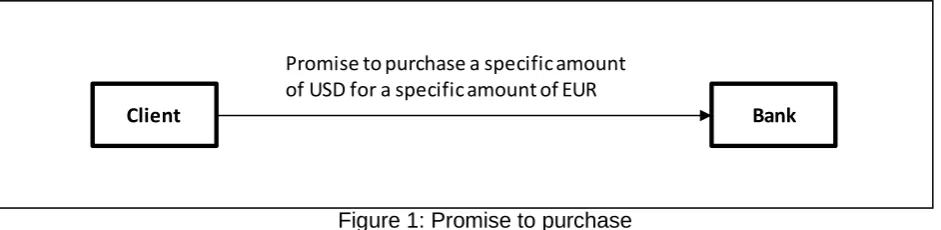
[image:5.595.69.540.562.677.2]Since the wa’d is a unilateral promise, it does not have to satisfy the requirements of a bilateral contract (aq’d) under Sharia (i.e. (i) knowledge of the price and (ii) possession or ownership of the subject matter of the contract). To illustrate the Islamic FX option -like instrument, which uses the wa’d principle, say that US-based clients are seeking protection from the currency exchange rate fluctuation, as they will have the obligation to pay for goods purchased from the European seller on a future date. In ensuring that their exposure to the exchange rate risk is reduced, they execute an undertaking to purchase and the further processes will be as below (Priya et.al):
Figure 1: Promise to purchase
a. The client promises the bank to sell a particular amount of a currency (say USD) against another currency (say the euro) on a pre-determined date (settlement date) and at a predetermined rate.
b. The bank accepts the client’s promise but makes no promise to the client so as to avoid the bilateral promise
Client Bank
c. The customer pays a non-refundable fee (like a premium) to the bank to acquire the right to exercise the promise to sell or not to sell dependent upon whether the option is in the money when the maturity date arrives. The customer, therefore, has the right either to execute the promise or to cancel it by sending a cancellation note.
Scenario A: If the customer exercises the option (by purchasing the EUR at the agreed exchange rate and settlement date):
Figure 2: Customer exercises the option
Scenario B: If the customer sends a cancellation notice to the bank and therefore does not exercise the option:
Figure 3: Customer does not exercise the option
From these scenarios, we can see that almost every single feature of the conventional option is present in this structure. As a result of the transaction, the US-based clients would have the ability to settle the purchased price in Euros without a single anxiety about the currency exchange rate, as they have been protected. Furthermore, they also have the opportunity to make a profit, if the market rate of the EUR is higher than the agreed exercise price, meaning that the client could easily obtain the same amount of Eurodollars at a lower cost. Concurrently, the bank may suffer a loss as it has to purchase the USD at a higher rate or sell its USD notes at a lower price. Notwithstanding this fact, the determination of a loss amount still depends on the premium amount, as it would provide a cushion to the bank to compensate for any potential loss. For that reason, the longer the tenor of the option, the more expensive the option fee will be.
In the event that charging a fee is unfavourable, there are several other means to formulate the intended effect for Islamic financial institutions. Among others is the usage of a hybrid wa’d and commodity murabahah concept.
To illustrate the Islamic FX option-like instrument, which uses the wa’d and commodity
murabahah concept, say that:
Strike: USD1.00 = RM3.10 (the prevailing exchange rate is RM3.15) Premium: US$5000
Based on Shariah principles which are applicable in the structuring of the Islamic FX options, here are the steps to be followed:
1. A customer will appoint bank as agent for any future trades (Bank will continue acting as an agent without having to enter into this agreement each time a new trade is executed). 2. A customer will make wa`d that it shall purchase a specific amount of commodity from the
bank and pay the relevant deferred sale price on the premium payment date. The reason for this undertaking is to ensure that the customer agrees to make a payment to the bank which is effectively the premium that the bank charges for offering the Islamic option. 3. A bank undertakes that it shall purchase the underlying commodity and pay the relevant
sale price arising from a murabahah transaction on the option maturity date. The exercise of this undertaking is at the sole right of the customer and will only be exercised if the customer is ‘in the money’. If the customer is ‘out of the money’, customer will waives their right.
4. At the initiation date of the option contract, the customer and the bank will conduct the first
tawarruq transaction to receive profit from the sale of which is equivalent to the amount of premium in a conventional option transaction.
5. On the maturity date, if customer is ‘in the money’ i.e the US Dollar has depreciated against the Ringgit and the prevailing exchange rate is lower than the strike price of RM3.10, it is economical for customer to exercise their put option of selling their proceeds of their US Dollar receivables. Customer notifies the bank of their intention to proceed in exercising the option, following which the bank will provide an Offer to Purchase US Dollars on spot basis at the strike price.
6. Following the acceptance by the customer of the Offer to Purchase by the bank, the second
tawarruq transaction will be conducted. The customer purchases commodities from Broker 1 via bank as an agent. The purchase is denominated in US Dollars, which is the currency which the customer wish to exchange in return for their base currency, Ringgit.
7. The customer enters in to a murabahah sale of the same commodities at the sale price which is denominated in Ringgit at the strike price that was pre-agreed in the terms of the option agreement.
8. The bank makes a spot payment of the sale price in Ringgit.
Figure 4: Diagram of Islamic option contract
The other structure is FXOP-i. In 2008, CIMB Islamic Bank Berhad launched the Islamic Foreign Exchange with Shari’a-Compliant Option Features or FXOP-i. The FXOP-i by way of wa’d
enables customers to lock in a foreign exchange rate in advance by engaging in a shariah-compliant financial transaction with CIMB Islamic. The net proceeds from this transaction which is similar to the premium paid for option instruments in conventional finance grants customers the right, but not the obligation, to exercise the option at the agreed rate on the maturity date. Hence, customers can protect the value of their future foreign currency proceeds, fix their hedging cost at premium even earn a profit if foreign exchange rates move in their favour (https://islamicfinanceupdates.wordpress.com/2008/10/13/cimb-islamic-offers-syariah-compliant-forex-product/ 1 July 2015).
FXOP-i is based on several Islamic finance concepts namely tawarruq by way of
commodity murabahah, bay’ al-‘inah, wa’d and bay’ al-sarf. An exciting feature of FXOP-i is that customers can choose to undertake the transaction using either the commodity murabahah or
bay’-al’inah concepts, thus making it an attractive solution to a wider range of customers.
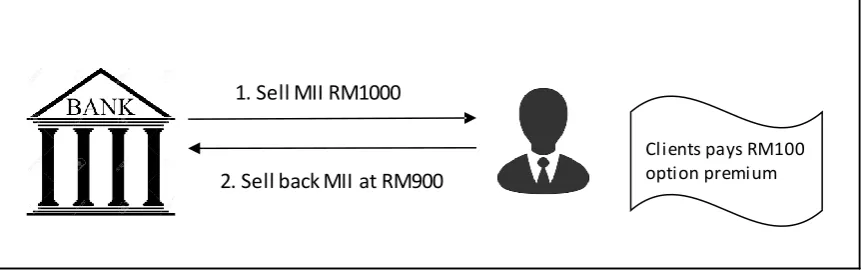
FXOP-i which is offered by CIMB Islamic in Malaysia consists of two different transactions and legs. The transactions are done by promisor who sell the option and promisee who buy the option. At the first stage, both buyer and seller will exercise al-‘inah or commodity murabahah contract in order to get option premium. For al-‘inah contract, the Mudarabah Interbank Investment
(MII) or any other suitable asset is used. On the other hand, commodity murabahah contract uses commodity such as crude palm oil (CPO) or London Metal Exchange (LME).
1. Sell MII RM1000
2. Sell back MII at RM900
[image:9.595.95.526.58.193.2]Clients pays RM100 option premium
Figure 5: al-‘Inah contract to get option premium
The other way to get option premium is by doing commodity murabahah contract. At second stage, after getting option premium, the client will gives wa’d to exchange currency on a future date by way of sarf. The undertaking is done separately with ‘inah/ commodity murabahah, so wa’d is independent with premium payment. This transaction is in accordance with resolution by SAC-SBM which states that no fees for wa’d currency hedging. The SAC warns that no consideration (or fee) is allowed to be charged on the promisee in view of the fact that upfront cash payment for forward currency transactions would lead to a bilateral wa'd which is not allowed by the Shariah. Only wa'd without any consideration is permissible in a forward currency transaction (Arab News, 2010).
At the maturity date, the exchange of currency contract is done by spot basis (sarf). The price, depending on which position is in-the-money. This transaction allows client to enter into option contract in order to manage currency risk associated with investment. This contract allows client (investor) who hold currency 1 and need to invest in currency 2 in shariah compliance.
Although the above arrangement seems to be feasible for the bank, the shariah issue still surfaces, and that is fee payment. In fact, majority of scholars do not allow the charging of a fee for giving a wa’d. An option is a promise, and such a promise is itself permissible and normally binding on the promisor (the person who makes the promise). However, shariah principles do not allow for such promise to be charged or bear any transaction fees. Thus, using commodity murabahah to permit the fee in exchange of wa`d is deem as hiyal (trick).
CONCLUSION
To conclude, it cannot be denied that option contract plays an important role in risk management as it can provides a flexible hedging tool to hedge risk. As Islamic finance exposed to the risk of market volatility and fluctuation in the currency rate market, thus FX option contract is a dire need in order to hedge against risk of fluctuation in currency exchange rate risk. Because of its flexibility, the contract has given many benefits to some particular group of people. However, Islamic financial transaction is bound by strict rules and regulation of Islamic Law. Any Islamic financial transaction must be free from riba, no gharar involved, no gambling features and must be fair and just to the parties to the contract. In contrast, conventional FX option is impermissible as it involves the element of leverage, gambling, trading of right and riba. All these elements are totally prohibitted in Islam. Therefore, altering and modifying conventional product is required in the current market in order to fulfil the need of hedging.
approved Islamic FX structures. This initiative will indeed give confidence in the islamic financial industry thus giving assurance that adequate and effective resolutions are produced.
REFERENCES
Abu Bakr ‘Abd al-Razzaq b. Hammam al-San’ani, 1972, al-Musannaf, Beirut: Majlis ‘Ilmi, vol. 8.
Abu Dawud Sulayman b. al-Ash`ath al-Sajastani, Sunan Abi Dawud. t.t. Riyad: Maktabah al-Ma`arif li al-Nashr wa al-Tawzi`.
Al-Amine, Muhammad al-Bashir Muhammad. 2008. Risk Management in Islamic Finance: an Analysis of Derivative Instrument in Commodity Markets, Netherlands: Brill.
Al-Baji, Abu al-Walid. 1914. al-Muntaqa Sharh al-Muwatta’, Egypt: Mathba’ah al-Sa’adah, vol. 4.
Al-Qaradawi, Yusuf 1973, Shariah al-Islam Salihah lil-Tatbiq fi Kulli Zaman wa Makan, Cairo: Dar al-Sahwah.
Al-Zarqa, Mustafa Ahmad. 2004. al-Madkhal al-Fiqh al-`Am. Damshiq: Dar al-Qalam, vol. 1.
Al-Zuhayli, Wahbah. 1985. al-Fiqh al-Islami wa Adillatuh. Damshiq: Dar al-Fikr, vol. 4.
Hammad, Nazih. 2008. Mu`jam al-Mustalahat al-Iqtisadiyyah fi Lughah al-Fuqaha’. Damshiq: Dar al-Qalam.
Hay’ah al-Muhasabah wa al-Muraja`ah li al-Muassasat al-Maliyyah al-Islamiyyah, 2010. al-Ma`ayir al-Shar`iyyah, Bahrayn: Hay‟ah Muhasabah wa Muraja`ah li Muassasat Maliyyah
al-Islamiyyah.
Ibn Qudamah, Abu Muhammad `Abd Allah b. Ahmad b. Muhammad. 1997. Al-Mughni.. Al-Riyad: Dar `Alim al-Kutub,. vol. 6.
International Shari’ah Research Academy for Islamic Finance. 2015. Islamic Capital Markets: Principles and Practices, Kuala Lumpur: ISRA.
Kamali, Mohammad Hashim. 2002. Islamic Commercial Law; an Analysis of Futures and Options. Selangor: Ilmiah Publisher.
Kharofa, Ala’ Eddin, 2002. The Loan Contract In Islamic Law (Shariah), A Comparison with Positive Law, International Islamic University Malaysia, Kuala Lumpur
Kotby, Hussein. 1996. Financial Engineering for Islamic Banks: The Option Approach, J.KAU: Islamic Econ, vol. 8, pp: 63-71.
Obaidullah, Mohamed 2000. Islamic Risk Management: Towards Greater Ethics and Efficiency,
International Journal of Islamic Financial Services, vol. 3, no. 4, pp. 1-18.
Rafic Yunus Al-Masri, 2002. The binding unilateral promise (wa’d) in Islamic Banking operations: Is it possible for a Unilateral Promise to be binding as an Alternative to a Proscribed Contract?, J.KAU: Islamic Econ., Vol. 15, p.29.
Priya Uberoi, Rahul Chatterji and Dany Bidar, ‘The Wa'ad: a promise or a contract?’, Allen and
Overy Areas of Expertise Page,
http://www.allenovery.com/AOWEB/AreasOfExpertise/Editorial.aspx?contentTypeID=1&contentSu bType
ID=7944&itemID=52775&aofeID=304&practiceID=30727&prefLangID=410 , pp 3-4, [ Accessed at : 26
July 2010]