
Thulium-Doped Fiber Laser With
Low Threshold Pump Power and
Tunable Operating Wavelength
Volume 7, Number 1, February 2015
M. C. Paul
A. Dhar
S. Das
A. A. Latiff
M. T. Ahmad
S. W. Harun
Development of Nanoengineered
Thulium-Doped Fiber Laser With
Low Threshold Pump Power and
Tunable Operating Wavelength
M. C. Paul,1A. Dhar,1S. Das,1 A. A. Latiff,2,3 M. T. Ahmad,3and S. W. Harun2,4
1Fiber Optics and Photonics Division, CSIR-Central Glass and Ceramic Research Institute,
Kolkatta 700032, India
2Photonics Research Center, University of Malaya, 50603 Kuala Lumpur, Malaysia 3
Faculty of Electronic and Computer Engineering, Universiti Teknikal Malaysia Melaka, 76100 Melaka, Malaysia
4
Department of Electrical Engineering, Faculty of Engineering, University of Malaya, 50603 Kuala Lumpur, Malaysia
DOI: 10.1109/JPHOT.2015.2399357
1943-0655Ó2015 IEEE. Translations and content mining are permitted for academic research only. Personal use is also permitted, but republication/redistribution requires IEEE permission. See http://www.ieee.org/publications_standards/publications/rights/index.html for more information.
Manuscript received December 25, 2014; revised January 25, 2015; accepted January 28, 2015. Date of publication February 2, 2015; date of current version February 19, 2015. This work was sup-ported by Ministry of Education High Impact Research under Grant D000009-16001. Corresponding authors: S. W. Harun and M. C. Paul (e-mail: [email protected]; [email protected]).
Abstract: A tunable and low-threshold thulium (Tm)-doped fiber (TDF) laser is demon-strated using a new silica-based nanoengineered TDF in a linear configuration, in con-junction with 1552-nm pumping. The TDF used in these experiments had a Tm-doped nanoengineering yttrium–alumina–silica glass core with a diameter of 13.43
m and 0. 21 NA, which is surrounded by a pure silica inner cladding with normal acrylate polymer resin coating. The nanoengineered TDF was fabricated using a modified chemical vapor deposition (MCVD) process, in conjunction with a solution-doping technique. The fabricated fiber shows an absorption loss of 165 dB/m at 793 nm. A maximum lasing slope efficiency of 26.2% was obtained at a 1910-nm wavelength using the fabricated fiber with an optimum length of 5 m. The maximum output power of 138 mW was achieved at the maximum pump power of 1100 mW. The lowest pump power threshold of 693 mW for a 1552-nm wave-length was obtained at a TDF wave-length of 7 m. The operating wavewave-length of the laser could be continuously tuned from 1890 to 1910 nm with an optical signal-to-noise ratio better than 43 dB, whereas the slope efficiency of the laser varies from 16.4% to 19.7%.Index Terms: Nano-engineered glass, Thulium-doped fiber, tunable (Tm)-doped fiber laser (TDFL), silica based TDFL.
1. Introduction
of magnitude greater than at 1
m. Military deployment of laser weapon systems could certainly find wider acceptance if the systems operate at eye-safer wavelengths. Pulsed laser systems may be used either for direct applications such as light detection and ranging (LIDAR) and range finding or for conversion into the mid- and far-IR for military countermeasures, remote sensing, and spectroscopy [6]. Single-frequency systems at 2-m are of interest for wind shear and turbulence mapping as well as coherent detection. In the medical market, Tm-doped fiber lasers offer a potential alternative to current-generation CW solid-state 2-m lasers.To date, many different glass host materials have been used to fabricate Tm3+-doped optical fibers for 2-
m laser operation, including silica and nonsilica glass fibers such as germanate-and tellurite-based types [7], [8]. It is well known that the doping concentration of rare-earth ions in silica fiber is limited due to the intrinsic glass network structure. Various approaches have been developed to increase the ion-doping concentration including co-doping with such oxides as Al2O3, B2O3, and P2O5 and by using nanoparticle technology. The highest doping level insilica glass is limited to approximately 2wt%. Due to the limited Tm3+-doping concentration, the efficiency of Tm3+-doped silica fiber lasers is also limited. Fortunately, the less defined glass network of multicomponent nonsilica glasses permit a higher doping concentration of Tm3+ions, which in turn permits high pump absorption over a relatively short length of active fiber.
In this paper, an efficient and low threshold TDFL is demonstrated using a newly developed Thu-lium doped fiber (TDF) in conjunction with 1552 nm pumping. In this work, the pumping is imple-mented using Erbium Ytterbium co-doped fiber laser (EYDFL). It is expected that the lower quantum defect associated with pumping at1.5
m would yield a much higher conversion effi-ciency than pumping at 0.8m. Since the main glass network is silicon dioxide (SiO2)Vthe samematerial as standard silica glass fiberVthe doped fiber improves in mechanical strength and shows better compatibility with silica fiber than any other multicomponent glass fibers. This property allows more robust fusion splicing between the active fibers and the standard passive silica fibers.
2. Fabrication and Characterization of Thulium-Doped Nano-Engineering
Glass Based Fiber
Doping of Tm2O3 into thermally induced phase-separated host of Y2O3 within SiO2-Al2O3 with
the addition of P2O5 was done by the solution doping (SD) technique in combination with
modi-fied chemical vapor deposition (MCVD) process. This was followed by a suitable thermal anneal-ing of the fabricated preform. Then, P2O5was incorporated from the vapor phase deposition and
other dopants were incorporated by soaking of the phospho silica layer into an alcoholic solution of suitable strength of TmCl3 6H2O, AlCl36H2O, and YCl36H2O. In the experiment, the
deposi-tion of single porous phospho silica layer was done at a temperature of 1500C. Then the tem-perature was lowered to 1450C for the pre-sintering process. All the co-dopants in the solution went into the silica glass matrix during sintering stage after solution soaking process. Next, dur-ing collapsdur-ing process, the core glass became phase-separated into silica rich and deficient re-gions that form a glass matrix. After fabricating the fiber preform, thermal annealing was done at 1450–1500C for 3 hours at the heating and cooling rates of 20C/min. During this step, Tm2O3
doped phase-separated nano-particles were created within the core glass matrix. Finally, the structure and composition of nano-particles were evaluated by the electron diffraction and energy dispersive X-ray (EDX) analyses.
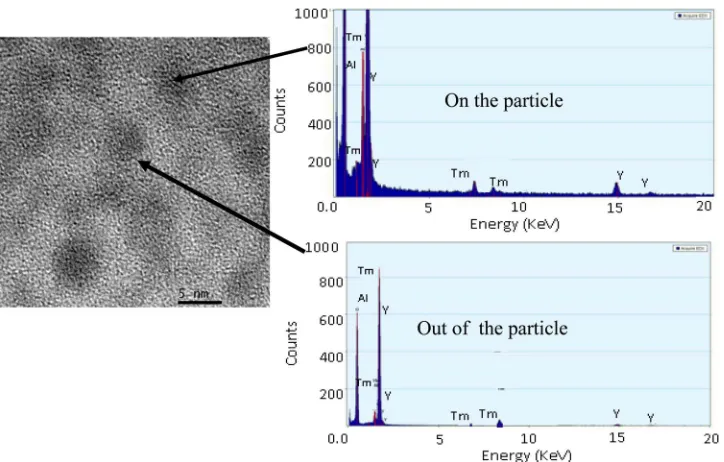
Fig. 1 shows the transmission electron microscopy (TEM) image of the core glass matrix to-gether with electron diffraction measurement results on and out of the particles. The EDX spectra show that the phase-separated particles are Tm2O3 doped yttria-alumina rich particles
located in the phase-separated yttria-alumina rich region rather than in non-phase-separated areas. The nature of phase-separated particles was found to be non-crystalline, confirmed by their electron diffraction pattern, shown in the inset of Fig. 1. Diffused scattering in the electron diffraction pattern reveals the amorphous nature of the particles (see a “halo pattern”), since there is no diffraction spot in it.
Here P2O5content in glass accelerates the growth of phase separated particles by heating or
thermal perturbation, where P2O5serves as a nucleating agent owing to the higher field strength
difference (90:31) between Si4+and P5+[9]. The formation of phase-separated nano-particles starts when the ratio of Al:Y reaches 1.70–1.75 under suitable doping levels of Y2O3 and
Al2O3[10]. One of the reasons is possibly due to YAS glass undergoing phase-separation once
it“enters”the immiscible region.
The average dopant percentages were measured by an electron probe micro analyzer (EPMA) and the distribution profile of different dopants along the diameter of fiber core is shown in Fig. 2. It can be seen that all dopants are distributed uniformly along the entire core where the concentrations of Al2O3, Y2O3, and Tm2O3 are 1.2, 0.4 and 0.4 wt. %, respectively. The
amount of P2O5 doping is very small. The core and cladding geometry of the fiber was
in-spected by optical microscope (Olympus BX51) and its cross-section view is shown in the inset of Fig. 2. The measured core and cladding diameters of the fiber are 13.43
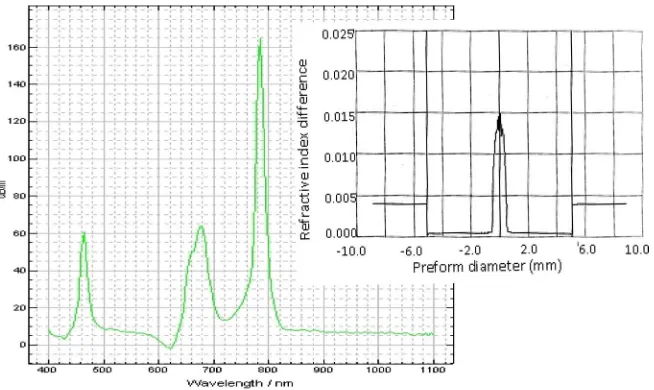
m and 130.70m, respectively. Fig. 3 shows the absorption loss curve of the fiber which peaks at around 462 nm, 680 and 793 nm. As shown in the figure, the absorption loss of the fiber at 793 nm wavelength is around 165 dB/m. The refractive index (RI) profile of the fiber preform was measured by pre-form analyzer as shown in the inset of Fig. 3. It shows an index difference of 0.015 between the core and cladding and thus the numerical aperture of the fiber is estimated to be around 0.21.3. ASE Characteristics and Laser Configuration
[image:4.594.118.480.57.288.2]The ASE characteristics of the fabricated TDF is investigated by forward pumping the fiber with a 1552 nm Erbium-Ytterbium co-doped fiber laser (EYDFL) at the maximum output power of 950 mW. This pump wavelength is chosen because it operates at near peak absorption wave-length of Tm ions and high-powered 1.5
m laser diodes are still relatively new. The ASEemission was investigated for four different fiber lengths ranging from 3 to 8 m using an optical spectrum analyzer (OSA). The output ASE is shown in Fig. 4. As seen in the figure, all spectra show a broadband ASE at 1900-nm region. This is attributed to the 1552 nm pumping, which excites the Tm ion from the ground state to the higher energy levels of3F4. Then, the Tm ions
decay to create a population inversion between3F4and3H4levels of the Tm ions, which
gener-ates spontaneous emission at around 1900-nm region. The ASE power increases with the pump power due to the population inversion, which increases with the rise in pump power. How-ever, the population inversion saturates at the TDF length of around 8 m due to limitation of the available pump power, which is not sufficient to support the excitation of more ions.
[image:5.594.172.420.57.235.2]The configuration of the proposed TDFL with the fabricated TDF as the gain medium is shown in Fig. 5. A piece of the newly developed silica TDF was pumped by a 1552 nm Erbium-Ytterbium fiber laser via 1550/2000 nm wavelength division multiplexer (WDM). To form a cavity, a tunable fiber Bragg grating (FBG) is used in conjunction with the Fresnel reflection at the output end of the fiber laser. The FBG operates within 1890 nm to 1910 nm with reflectivities of about 90% and
[image:5.594.136.463.284.479.2]Fig. 3. Spectral attenuation curve of the fabricated TDF. (Inset) Refractive index profile of fiber preform.
the corresponding 3 dB spectral width of 0.4 nm. The output spectrum and power of the tunable laser are measured by an OSA and power meter, respectively.
4. Lasing Performances
[image:6.594.172.416.58.213.2]The lasing performance of the newly developed TDFL is first investigated at FBG wavelength of 1910 nm. Fig. 6 shows the output spectrum of the proposed laser at 1552 nm pump power of 950 mW. As shown in the figure, the laser operates at 1910 nm, which coincides with the FBG's wavelength. The separation between the peak laser power and the residual pump is more than 11 dB. It is also observed that the noise level of the laser drops as the TDF length reduces from
[image:6.594.189.405.251.343.2]Fig. 4. ASE spectra from the forward pumped TDF at various fiber lengths.
Fig. 5. Configuration of the proposed tunable TDFL.
[image:6.594.174.421.382.537.2]8 m to 5 m as shown in the inset of Fig. 6. At TDF length of 5 m, the signal-to-noise ratio is mea-sured at 60 dB. The laser operation was also investigated at TDF lengths of 2 and 3 m, but the pump power threshold needed for lasing was higher than 1100 mW.
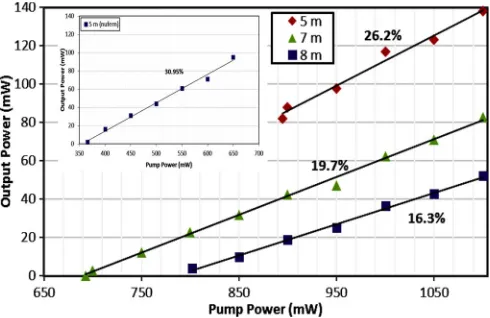
Fig. 7 shows the lasing characteristic of the TDFL at three different gain medium lengths. As shown in the figure, the slope efficiencies of the proposed TDFL are 26.2%, 19.7%, and 16.3% at TDF lengths of 5 m, 7 m, and 8 m, respectively. The maximum slope efficiency of 26.2% is ob-tained at the TDF length of 5 m. The maximum output power of 138 mW is achieved at the pump power of 1100 mW with the optimum length of 5 m. The slope efficiency of the laser drastically decrease as the TBF length decreases to 4 m and below. In addition, both lasing threshold and residual pump will also increase with further reduction of the gain medium length. On the other hand, the pump power threshold for the proposed laser is obtained at around 875 mW, 693 mW, and 802 mW with fiber lengths of 5 m, 7 m, and 8 m, respectively. This is attributed to the popula-tion inversion, which is efficient at the optimum TDF length of 7 m and thus a required pump power to initiate lasing is lower. The inset of Fig. 7 shows the lasing characteristic of a TDFL con-figured with a 5 m long commercial TDF (Nufern) based on the similar setup. This TDFL pro-duces a lasing at 1910 nm with slope efficiency of 31% with a threshold pump power of 365 mW. This shows that our homemade TDFL produces comparable results with the commercial fiber.
[image:7.594.175.420.59.218.2]A TDFL with a widely tunable output wavelength is important for applications. Here, the wave-length tunability of the proposed TDFL is demonstrated by using spectral controlling of FBG, which is realized by stretching technique. Fig. 8 shows the output spectra measured by an OSA with a spectral resolution of 0.05 nm. In the experiment, the TDF length was fixed at 7 m as this
[image:7.594.174.422.268.404.2]Fig. 7. Lasing characteristic of the fabricated TDFL at three different TDF lengths. (Inset) Lasing characteristic with the commercial TDF.
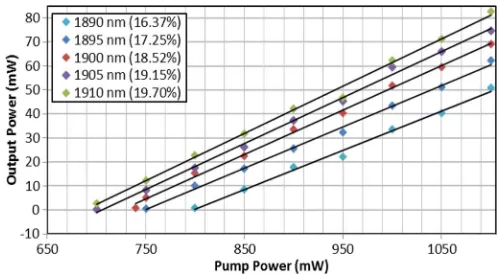
length requires the lowest threshold pump power for lasing. As shown in the figure, the operat-ing wavelength of the laser could be continuously tuned from 1890 nm to 1910 nm. The optical signal-to-noise ratio for each spectrum is better than 43 dB. The measured output power char-acteristic with respect to the operating pump power is shown in Fig. 9 for various operating wavelengths. The slope efficiency of the laser varies from 16.4 to 19.7% as the operating wave-length is tuned from 1890 to 1910 nm. The highest slope efficiency of 19.7% is obtained at 1910 nm with 82.8 mW output power at 1100 mW pump power. The tunability of the laser could be extended to a wider range should another tunable FBG with a wider range is used. The slope efficiency of the tunable laser can also be improved by reducing the insertion loss of the tunable filter. The modal properties of the TDF will be investigated in future work since the multimode character of lasing should affect its the laser performances in term of efficiency, stability, etc. The further optimization of the TDF structure and doped ion compositions are also expected to improve the slope efficiency of the laser.
5. Conclusion
A silica-based nano-engineered TDFL with a low pump power threshold and tunable operating wavelength is demonstrated using a newly fabricated TDF as a gain medium. Doping of Tm2O3
into thermally induced phase-separated host was done by the SD technique. The fabricated TDF has a core diameter of 13.43
m, NA of 0.21 and an absorption loss of 165 dB/m at 793 nm. The laser employs a linear configuration with a tunable grating to generate laser with a maximum slope efficiency of 26.2% and TDF length of 5 m. With 7 m long TDF, the laser was achieved at the lowest 1552 nm pump power threshold of 693 mW, while the operating wave-length could be continuously tuned from 1890 nm to 1910 nm. The optical signal-to-noise ratio for each spectrum is better than 43 dB. The slope efficiency of the tunable laser varies from 16.4 to 19.7% at TDF length of 7 m.Acknowledgement
The authors are thankful to the Director, CGCRI, for his continuous encouragement, guidance, and support in this work.
References
[1] S. D. Jackson and T. A. King,“Theoretical modelling of Tm-doped silica fiber lasers,”J. Lightw. Technol., vol. 17, no. 5, pp. 948–956, May 1999.
[2] P. F. Moultonet al.,“Tm-doped fiber lasers: Fundamentals and power scaling,”IEEE Sel. Topics Quantum Electron., vol. 15, no. 1, pp. 85–92, Jan. 2009.
[3] S. W. Harunet al.,“Self-starting harmonic mode-locked thulium-doped fiber laser with carbon nanotubes saturable absorber,”Chin. Phys. Lett., vol. 30, no. 9, Sep. 2013, Art. ID. 094204.
[image:8.594.172.421.58.195.2][4] N. M. Fried, G. A. Lagoda, N. J. Scott, L.-M. Su, and A. L. Burnett,“Noncontact stimulation of the cavernous nerves in the rat prostate using a tunable wavelength thulium fiber laser,”J. Endourol., vol. 22, no. 3, pp. 409–13, Mar. 2008.
tion,”J. Biomed. Opt., vol. 17, no. 2, Feb. 2012, Art. ID. 028002.
[6] R. J. De Young and N. P. Barnes, “Profiling atmospheric water vapor using a fiber laser lidar system,”Appl. Opt., vol. 49, no. 4, 562–567, Feb. 2010.
[7] X. Fanet al.,“A 2m continuous wave and passively Q-switched fiber laser in thulium-doped germanate glass fibers,”
Laser Phys., vol. 24, no. 8, Aug. 2014, Art. ID. 085107.
[8] Z.-X. Jiaet al.,“Supercontinuum generation and lasing in thulium doped tellurite microstructured fibers,”J. Appl. Phys., vol. 115, no. 6, Feb. 2014, Art. ID. 063106.
[9] M. C. Paulet al.,“Yb2O3doped YAG nano-crystallites in silica based core glass matrix of optical fiber preform,”Mater.
Sci. Eng. B, vol. 175, no. 2, 108–119, 2010.

![Di μ azido κ4N1:N1′ bis({1 [(E) phenyl(pyridin 2 yl κN)methylidene]thiosemicarbazidato κ2N1,S}copper(II))](data:image/gif;base64,R0lGODlhAQABAIAAAP///wAAACH5BAEAAAAALAAAAAABAAEAAAICRAEAOw==)