Span: An Energy Efficient Coordination Algorithm
for Topology Maintenance in Ad Hoc Wireless
Network
Ms. P.Nandhini1, Dr.V.Radhika, M.C.A., M.Phil., PhD2
1Research Scholar, 2HOD, Department of Computer Science,
Sri Krishna Arts & Science College, Coimbatore,
Abstract: This paper presents Span, a power saving technique for multi-hop ad hoc wireless networks that reduces energy consumption without significantly diminishing the capacity or connectivity of the network. Span build son the observation that when a region of a shared channel wireless network has a sufficient density of nodes, only a small number of them need be on at any time to forward traffic for active connections. Span is a distributed, randomized algorithm where nodes make local decisions
on whether to sleep, or to join a forwarding
backboneasacoordinator.Wegiverandomizedalgorithmwherecoordinatorsrotatewithtime, demonstrating how localized node decisions lead to a connected, capacity-preserving global topology. Improvement insystemlifetimedue to Span increases as the ratio of idle-to-sleep energy consumption increases. Our simulations show that with a practical energy model, system lifetime of an 802.11network in power saving mode with Span is a factor of two better than without. Additionally, Span also improves communication latency and capacity.
Keywords: energy, routing, topology-formation, wireless
1. INTRODUCTION
Minimizing energy consumption is an important challenge in mobile networking. hardware design for mobile devices that the wireless network interface is often a device’s single largest consumer of power. Since the network interface may often be idle, this power could be saved by turning the radio off when not in use. In practice, however, this approach is not straightforward: a node must arrange to turn its radio on not just to send packets, but also to receive packets addressed to it and to participate in any higher-level routing and control protocols. The requirement of cooperation between power saving and routing protocols is particularly acute in the case of multi-hop ad hoc wireless networks, where nodes must forward packets for each other. Coordination of power saving with routing in ad hoc wireless networks is the subject of this paper. A good power-saving coordination technique for wireless ad-hoc networks ought to have the following characteristics. It should allow as
Figure 1. A connected backbone does not necessarily preserve capacity. In this connected topology, black nodes are coordinators.
The algorithm presented in this paper, Span, fulfills the above requirements. Each node in the network running Span makes periodic, local decisions on whether to sleep or stay wake as a coordinator and participate in the forwarding backbone topology. To preserve capacity, a node volunteers to be a coordinator if it discovers, using information it gathered from local broadcast messages, that two of its neighbors cannot communicate with each other directly or through one or two existing coordinators. To keep the number of redundant coordinators low and rotate this role amongst all nodes, each node delays announcing its willingness by a random time interval that takes two factors into account: the amount of remaining battery energy, and the number of pairs of neighbors it can connect together. This combination ensures, with high probability, a capacity-preserving connected backbone at any point in time, where nodes tend to consume energy at about the same rate. Span does all this using only local information, and consequently scales well with the number of nodes. simulation results, with energy parameters from measurements of today’s 802.11 wireless interfaces, show that system lifetime with Span is more than a factor of two better than without Span, for a range of node densities, without much reduction in overall forwarding capacity. The rest of the paper describes and evaluates Span. Section2 reviews related work.
2. RELATED WORK
The set of coordinators elected by Span at any time is a connected dominating set of the graph formed by the nodes of thread hoc network. A connected dominating set S of a graph a connected sub graph of G such that every vertex u in either in S or adjacent to some v in Dominating set. For example, the black nodes in figure1 form a minimal connected dominating set. Because it actively prevents redundant coordinators by using randomized slotting and damping Nodes with in a grid switch between sleeping and listening, with the guarantee that one node in each grid stays up to route packets. Span differs from GAF in two important ways. A node switches between sleeping and listening, with randomized sleep times proportional to the number of nearby nodes. The net effect is that the number of listening nodes is roughly constant, regardless of node density;
as the density increases, more energy can be saved.AFECA’s constants are chosen so that there is a high probability that the listening nodes form a connected graph, so that ad hoc forwarding works. An AFECA node does not know whether it is required to listen in order to maintain connectivity, so to be conservative AFECA tends to make nodes listen even when they could be asleep. Span differs from AFECA in that, with high likelihood, Span never keeps anode awake unless it is absolutely essential for connecting two of its neighbors.
3. SPAN DESIGN
Span adaptively elects “coordinators” from all nodes in the
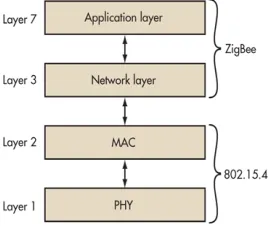
[image:3.612.354.491.526.639.2]network. Span coordinators stay awake continuously and performmulti-hop packet routing within the ad hoc network, while other nodes remain in power-saving mode and periodically check if they should wake up and become a coordinator. Span achieves four goals. First, it ensures that enough coordinators are elected so that every node is in radio range of at least one coordinator. Second, it rotates the coordinators in order to ensure that all nodes share the task of providing global connectivity roughly equally. Third, it attempts to minimize the number of nodes elected as coordinators, thereby increasing network lifetime, but without suffering a significant loss of capacity or an increase in latency. HELLO messages, each node constructs a list of the node’s neighbors and coordinators, and for each neighbor, a list of its neighbors and coordinators. As shown in figure 2, Span runs above the link and MAC layers and interacts with the routing protocol. This structuring allows Span to take advantage of power-saving features of the link layer protocol, while still being able to affect the routing.
.
Span leverages a feature of modern power-saving MAC layers, in which if a node has been asleep for a while, packets destined for it are not lost but are buffered at a neighbor. When the node awakens, it can retrieve these packets from the buffering node, typically a coordinator. Span also requires a modification to the route lookup process at each node – at any time, only those entries in a node’s routing table that correspond to currently active coordinators can be used as valid next-hops(unless the next hop is the destination itself).A Span node switches state from time to time between being coordinator and being a non-coordinator. A node includes its current state in its HELLO messages. The following sections describe how a node decides that it should announce that it is a coordinator, and how it decides that it should withdraw from being coordinator.
3.1. Coordinator announcement
Periodically, a non-coordinator node determines if it should become a coordinator or not. The following coordinator eligibility rule in Span ensures that the entire network is covered with enough coordinators: Coordinator eligibility rule. A non-coordinator node should become a non-coordinator if it discovers, using only information gathered from local broadcast messages that two of its neighbors cannot reach each other either directly or via one or two coordinators. This election algorithm does not yield the minimum number of coordinators required to merely maintain connectedness. However, it roughly ensures that every populated radio range in the entire network contains at least one coordinator. Because packets are routed through coordinators, the resulting coordinator topology should yield good capacity. 3.2. Coordinator withdrawal
Each coordinator periodically checks if it should withdraw as a coordinator. A node should withdraw if every pair of its neighbors can reach each other either directly or via one or two other coordinators. In order to also rotate the coordinators among all nodes fairly, after a node has been a coordinator foursome period of time, it marks itself as a tentative coordinator if every pair of neighbor nodes can reach each other via one or two other neighbors, even if those neighbors are not currently coordinators. A tentative coordinator can still be used to forward packets.
4. SIMULATOR IMPLEMENTATION
This section describes the implementation of Span, geographic forwarding, the 802.11 power saving mode (with our own
improvements), and the energy model we used in our simulations. We ran our Span implementation in the ns-2 network simulator environment.
4.1. Span and geographic forwarding
The implementation uses a geographic forwarding algorithm. We chose to implement geographic forwarding primarily because of its simplicity. Each node enters all the information it receives in broadcast updates into a neighbor table. Consequently, this neighbor table contains a list of neighbors and coordinators, and for each neighbor, a list of its neighbors and coordinators. Geographic forwarding forwards packets using a greedy algorithm. The source node annotates each packet with the geographic location of the destination node. 4.2. Coordinator election
A node uses information from its neighbor table to determine if it should announce or withdraw itself as a coordinator. Figure4 shows the coordinator announcement algorithm. A similar routine exists for checking if every pair of neighbor nodes can reach each other via one or two other neighbors. That routine is used by the withdraw algorithm.
// a non-coordinator node periodically calls this routine to see if it should become a coordinator
Check-announce-coordinator () C = connect-pairs( )
if > 0 {
calculate delay using equation (2), using C as Ci wait delay
if connect-pairs( ) > 0 {
announce itself as a coordinator }
}
// returns number of neighbor pairs a node can connect if it becomes a coordinator
connect-pairs( ) n = 0
for each neighbor a in neighbor table { for each neighbor b,b > a, in neighbor table { if share-other-coordinators(a, b) == false { n ←n + 1
// returns true if neighbors a and b are connected by one or two other coordinators
share-other-coordinators(a, b)
// coordinator lists are kept in the neighbor table for each coordinator c_a in a’s coordinator list { if c_a equals self {
continue }
else if c_a in b’scoordinator list { return true
}
// try to see if we know a path from a to b via two coordinators else if c_a in neighbor table {
for each coordinator c_c_a in c_a’s coordinator list { if c_c_a equals self {
continue }
else if c_c_a in b’s coordinator list { return true } } } } return false
Figure 3. Coordinator announcement algorithm.
4.3. 802.11 ad hoc power-saving mode
Span determines when to turn a node’s radio on or off, but depends on the low level MAC layer to support power saving, such as buffering packets for sleeping nodes. A beacon period starts with an ad hoc traffic indication message window (ATIM window), during which all nodes are listening, and pending traffic transmissions are advertised. A node that receives and acknowledges an advertisement for unicast or broadcast traffic directed to itself must stay on for the rest of the beacon period. Otherwise, it can turn itself off at the end of the ATIM window, until the beginning of the next beacon period. After the ATIM window, advertised traffic is transmitted. Since traffic cannot be transmitted during the ATIMwindow, the available channel capacity is reduced.
4.4. Improving 802.11 using Span
Using Span on top of 802.11 ad hoc power saving mode can improve routing throughput and packet delivery latency. Because coordinators do not operate in power saving mode,
packets routed between coordinators do not need to be advertised or delayed. To further take advantage of the synergy between Span and 802.11 power saving mode, we have made the following modifications to our simulation of 802.11 power saving mode.
• No advertisements for packets between coordinators:
Packets routed between coordinators are marked by Span. While the MAC layer still needs to buffer these packets if they arrive during the ATIM window, it does not send traffic advertisements for them. To ensure that Span does not provide incorrect information due to topology changes, the MAC maintains a separate neighbor table. The MAC layer uses a bit in the MAC header of each packet it sends to notify neighbors of its power saving status. Since the MAC layer can sniff the header of every packet, including RTS packets, this neighbor table is likely to be correct. When anode withdraws as a coordinator, advertisements for traffic to that node will be sent during the next ATIM window. This optimization allows the ATIM window to be reduced without hurting throughput.
• Individually advertise each broadcast message:
With unmodified802.11 power saving mode, a node only needs to send one broadcast advertisement even if it has more than one broadcast message to send. This is because once a node hears an advertisement for a broadcast message, it stays up for the entire duration of the beacon period. Since most traffic to non-coordinator nodes in our network would be broadcast messages sent by Span and the geographic routing protocol, we modified the MAC so each broadcast message must be explicitly advertised.
• New advertised traffic window:
With unmodified 802.11power saving mode, if a node receives a unicast advertisement, it must remain on for the rest of the beacon period. In a Span network, packets routed via non-coordinator nodes are rare. To take advantage of this, we introduced new advertised traffic window in the MAC. The advertised traffic window is smaller than the beacon period. It starts at the beginning of the beacon period, and extends beyond the end of the ATIM window. Outside the ATIMwindow but inside the advertised traffic window, advertised packets and packets to coordinators can be transmitted. Outside the advertised traffic window, however, only packets between coordinators can be transmitted.
4.5. Energy model
Rate network interface card (NIC) operating at 2 Mbps in base station mode. To measure power consumed by the card, we powered portable computer solely with its AC adapter (without the battery), and measured the voltage across a resistor placed in series with the card on the computer to obtain the instantaneous current through the NIC. The voltage across the NICremained constant at all times, thus from the instantaneous current measurement, we calculated the instantaneous power consumed by the card.
5. PERFORMANCE EVALUATION
Span, we simulated Span, with geographic forwarding, on several static and mobile topologies. Simulation results show that Span not only performs well by extending network lifetime, it out-performs unmodified 802.11 power saving network in handling heavy load, per-packet delivery latency, and network lifetime.
5.1. Simulation environment
We simulated Span in the ns-2 network simulator using the CMU wireless extensions [5]. The geographic forwarding algorithm, as described in section 4.1, routes packets from source to destination. Span runs on top of the 802.11 MAC layer with power saving support and modifications described in section 4.3. In this section, we compare performance of Span against both unmodified 802.11 MAC in power saving mode and unmodified 802.11 MAC not in power saving mode. A source must send packets to a destination node on the other strip. The initial positions of the remaining 100 nodes are chosen uniformly at random in the entire simulated region. Thus, the square root of the area of the simulated region and the number of hops needed by each packet are approximately proportional. Source and destination nodes never move. They stay awake at all times so they can send and receive packets at higher throughputs. However, they do not participate in coordinator elections. Thus, only 100 nodes can become coordinators. In mobile experiments, the motion of the remaining100 nodes follows the random waypoint model [2]: initially, each node chooses a destination uniformly at random in the simulated region, chooses a speed uniformly at random between0 and 20 m/s, and moves there with the chosen speed. The node then pauses for an adjustable period of time before repeating the same process. The degree of mobility is reflected in the pause time.
5.2. Capacity preservation
[image:6.612.318.568.227.417.2]One of Span’s goals is to preserve total network capacity, by making sure that if there are non-conflicting paths in the underlying network, there are similar non-conflicting paths in the coordinator backbone. We measure capacity by the number of packets the network can successfully deliver per unit time; capacity is inversely proportional to the network’s packet loss rate. Additionally, we show that despite using fewer nodes to forward packets, Span does not significantly increase delivery latency and number of hops each packet traverses.
Figure 4 shows packet delivery rate as the bit rate of each CBR flow increases.
5.3. Effects of mobility
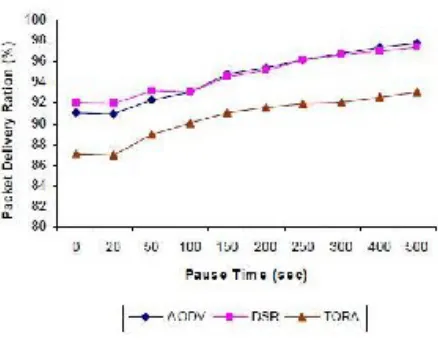
The degree of mobility does not significantly affect routing with Span coordinators. Span consistently performs better than both 802.11 PSM and 802.11. Most packet drops in these simulations are caused by temporary voids created by mobility. Because geographic forwarding with Span encounters fewer voids, its loss rate is lower.
5.4. Coordinator election
Figure 5. Packet loss rate as a function of pause time.
5.5. Energy consumption
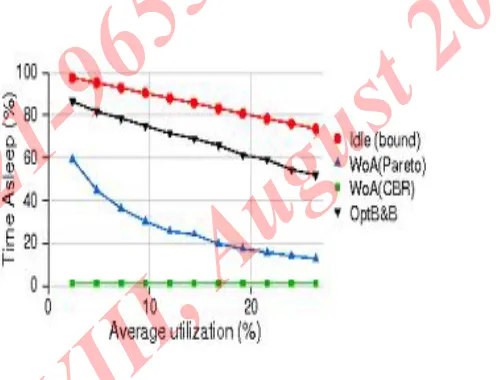
This section evaluates Span’s ability to save energy. The potential for savings depends on node density, since the fraction of sleeping nodes depends on the number of nodes per radio coverage area. The energy savings also depend on a radio’s power consumption in sleep mode and the amount of time that sleeping nodes must turn on their receivers to listen for802.11 beacons.
5.6. Node lifetime
This section shows that Span distributes the costs of being coordinator in a way that extends the useful lifetime of every node in the network. Span curves represent results over several node densities. Without Span, nodes critical to multihop routing die around the same time, 335 s into the simulation. With Span, the first node failure occurs 505 s into the simulation when node density is 19.6 nodes per radio range,556 s into the simulation when node density is 34.9, 574 into the simulation when node density is 54.5, and 692 s into the simulation when node density is 78.5. The packet delivery rate does not drop below 90% until 681 s into the simulation when node density is 19.6, 887 s into the simulation when node density is 34.9, 912 s into the simulation when node density is 54.5, and 962 s into the simulation when node density is 78.5.
6. Conclusion
This paper presents Span, a distributed coordination technique for multi-hop ad hoc wireless networks that reduces energy consumption without significantly diminishing the capacitor connectivity of the network. Span adaptively elects coordinators from all nodes in the network, and rotates them in time. Span
coordinators stay awake and perform multi-hop packet routing within the ad hoc network, while other nodes remain in power-saving mode and periodically check if they should awaken and become a coordinator. With Span, each node uses a random back off delay to decide whether to become a coordinator. This delay is a function of the number of other nodes in the neighborhood that can be bridged using this node, and the amount of energy it has remaining. Our results show that Span not only preserves network connectivity, it also preserves capacity, decreases latency, and provides significant energy savings This is largely due to the fact that the current implementation of Span uses the power saving features of 802.11, in which nodes periodically wake up and listen for traffic advertisements. Section 5.5 shows that this approach can be extremely expensive. This warrants investigation into a more robust and efficient power saving MAC layer, one that minimizes the amount of time each node in power saving mode must stay up.
REFERENCES
[1] J. Broch, D. Johnson and D. Maltz, The dynamic source routing protocolfor mobile ad hoc networks, Internet draft, IETF Mobile Ad HocNetworking Working Group (December 1998). [2] J. Broch, D. Maltz, D. Johnson, Y. Hu and J. Jetcheva, A performancecomparison of multi-hop wireless ad hoc network routing protocols, in: Proceedings of the Fifth Annual ACM/IEEE International Conference
on Mobile Computing and Networking (MobiCom), Dallas, TX (August1998).
[3] J. Chang and L. Tassiulas, Energy conserving routing in wireless ad hocnetworks, in: Proceedings of the Fifth Annual ACM/IEEE InternationalConference on Mobile Computing and Network (MobiCom), Dallas,TX (August 1998).
[4] G. Chesson, XTP/protocol engine design, in: Proceedings of the IFIPWG6.1/6.4 Workshop, Rüschlikon (May 1989).
[5]CMUMonarchextensionstons,http://www.monarcs.cmu.edu/ [6] B. Das and V. Bharghavan, Routing in ad-hoc networks using minimumconnected dominating sets, in: Proceedings of the IEEE InternationalConference on Communications (ICC’97) (June 1997).
[8] W. Fenner, Internet Group Management Protocol, Version 2, RFC-2236(November 1997).
[9] S. Floyd, V. Jacobson, S. McCanne, C.G. Liu and L. Zhang, A reliablemulticast framework for lightweight sessions and application levelframing, in: Proceedings of the ACM SIGCOMM, Boston, MA (September1995) pp. 342–356.
[10] W.R. Heinzelman, A. Chandrakasan and H. Balakrishnan,Energyefficientcommunicationprotocos for wireless micro sensor networks, in: Proceedings of the Hawaaian International Conference on SystemsScience (January 2000).
[11] IEEE,Wireless LANMedium Access Control and Physical Layer specifications,IEEE 802.11 Standard, IEEE Computer Society LAN MANStandards Committee (August 1999).
[12] C. Intanagonwiwat, R. Govindan and D. Estrin, Directed diffusion:A scalable and robust communication paradigm for sensor networks,in: Proceedings of the Sixth Annual ACM/IEEE International Conferenceon Mobile Computing and Networking (MobiCom), Boston, MA(August 2000).
[13] B. Karp and H.T. Kung, GPSR: Greedy Perimeter Stateless Routing for wireless networks, in: ProceedingsoftheSixthAnnualACM/IEEEInternationl
Conference on Mobile Computing and Networking (MobiCom), Boston, MA (August 2000).
[14] R. Kravets and P. Krishnan, Application-driven power managementfor mobile communication, in: Proceedings of the Fourth AnnualACM/IEEE International Conference on Mobile Computing and Networking (MobiCom), Dallas, TX (October 1998).
[15] J. Li, J. Jannotti, D.D. Couto, D. Karger and R. Morris, A scalable locationservice for geographic ad-hoc routing, in: Proceedings of theSixth Annual ACM/IEEE International Conference on Mobile Computingand Networking (MobiCom) (August 2000).
AUTHORS
Miss. P.Nandhini received her B.Sc (CT) Anna University Coimbatore in 2010 from Karpagam College Of Engineering, MCA degree from Anna University Chennai in, 2013 from Nehru Institute
Of Information Technology And Management. Currently she is pursuing her Mphil(cs) at SriKrishna Arts And Science College,Coimbatore.