R E S E A R C H
Open Access
Manipulating plant RNA-silencing pathways
to improve the gene editing efficiency of
CRISPR/Cas9 systems
Yanfei Mao
1, Xiaoxuan Yang
1,2, Yiting Zhou
1,2, Zhengjing Zhang
1,2, Jose Ramon Botella
3and Jian-Kang Zhu
1,4*Abstract
Background:The CRISPR/Cas9 system, composed of a single-guide RNA for target recognition and a Cas9 protein for DNA cleavage, has the potential to revolutionize agriculture as well as medicine. Even though extensive work has been done to improve the gene editing activity of CRISPR/Cas9, little is known about the regulation of this bacterial system in eukaryotic host cells, especially at the post-transcriptional level.
Results:Here, we evaluate the expression levels of the two CRISPR/Cas9 components and the gene editing efficiency in a set of Arabidopsis mutants involved in RNA silencing. We find that mutants defective in the post-transcriptional gene-silencing pathway display significantly higher Cas9 and sgRNA transcript levels, resulting in higher mutagenesis frequencies than wild-type controls. Accordingly, silencing of AGO1 by introduction of an AGO1-RNAi cassette into the CRISPR/Cas9 vector provides an increase in gene editing efficiency. Co-expression of the viral suppressor p19 from the tomato bushy stunt virus to suppress the plant RNA-silencing pathway shows a strong correlation between the severity of the phenotypic effects caused by p19 and the gene editing efficiency of the CRISPR/Cas9 system for two different target genes, AP1 and TT4.
Conclusions:This system has useful practical applications in facilitating the detection of CRISPR/Cas9-induced mutations in T1 plants as well as the identification of transgene-free T2 plants by simple visual observation of the symptom severity caused by p19. Our study shows that CRISPR/Cas9 gene editing efficiency can be improved by reducing RNA silencing in plants.
Keywords:CRISPR, Cas9, Genome editing, Viral suppressor, RNA silencing, TBSV p19
Background
The recent development of the CRISPSR/Cas9 system has revolutionized genetic research, and its practical ap-plications are emerging in multiple fields, from agricul-ture to human health. The best known CRISPR/Cas9 system is derived from the Streptococcus pyogenes adap-tive immune system where it is used to silence invasive DNA molecules [1]. This RNA-directed gene editing sys-tem is composed of a Cas9 nuclease and two bound RNAs, which form a partially paired duplex after process-ing of their primary transcripts by bacterial RNase III [2].
For practical applications, the RNA duplex has been shortened and linked together to create a single-guide RNA (sgRNA) with a stem-loop structure at the fusion site, resulting in higher gene editing efficiencies in vivo and in vitro compared to the natural version [3, 4]. A number of vectors have been developed to deliver the simplified CRISPR/Cas9 system into host cells, most of which use strong constitutive promoters to drive a high expression of both components, sgRNA and Cas9 [4–6]. Although many of these vectors can induce efficient tar-geted gene editing in plants, high transgene expression levels carry the risk of activating “transgene-silencing” mechanisms in the host cells.
The evolutionarily conserved transgene silencing process is a manifestation of the RNA-silencing pathway [7]. This pathway is used as defense against viral and sub-viral pathogens, which can produce dsRNAs as
* Correspondence:[email protected]
1Shanghai Center for Plant Stress Biology, CAS Center of Excellence in
Molecular Plant Sciences, Chinese Academy of Sciences, Shanghai 200032, People’s Republic of China
4Department of Horticulture and Landscape Architecture, Purdue University,
West Lafayette, IN 47907, USA
Full list of author information is available at the end of the article
© The Author(s). 2018Open AccessThis article is distributed under the terms of the Creative Commons Attribution 4.0 International License (http://creativecommons.org/licenses/by/4.0/), which permits unrestricted use, distribution, and reproduction in any medium, provided you give appropriate credit to the original author(s) and the source, provide a link to the Creative Commons license, and indicate if changes were made. The Creative Commons Public Domain Dedication waiver (http://creativecommons.org/publicdomain/zero/1.0/) applies to the data made available in this article, unless otherwise stated. Maoet al. Genome Biology (2018) 19:149
replication intermediates or single-stranded RNAs with secondary structures [8]. In addition to viral transcripts, dsRNAs can also be formed by the annealing of overlap-ping complementary transcripts or from hairpin precur-sors [7]. At the initial stage of RNA-silencing, dsRNAs are processed into 21–24-nt small interfering RNAs (siRNAs), by the DICER RNase III enzyme [9]. Arabi-dopsis thalianaencodes four DICER-like (DCL) proteins (DCL1-4) [10]. DCL1 primarily functions in the biosyn-thesis of microRNAs to silence endogenous messenger RNAs while DCL3 contributes to the defense against vi-ruses by producing 24-nt viral-derived siRNAs [11, 12]. DCL2 and DCL4 have partially redundant roles in RNA silencing, producing 21–22-nt small RNAs upon viral at-tack although DCL4 seems to contribute more than DCL2 in the defense hierarchy [13].
The siRNA duplexes are incorporated into RNA-in-duced silencing complexes (RISCs) to direct the silen-cing of both coding and non-coding RNAs by sequence complementarity [14–16]. ARGONAUTE proteins are core components of the RISC complex, many of which have partially overlapping roles in antiviral defense and in the endogenous silencing pathways [17, 18]. For ex-ample, the AGO1 and AGO2 proteins can bind en-dogenous miRNAs as well as virus-derived 21–22-nt siRNAs in Arabidopsis and tobacco [19, 20]. AGO4 has a crucial role in the RNA-directed DNA methylation pathway and participates in the transcriptional suppres-sion of some viral chromatin [21,22].
While plants developed RNA-silencing pathways to fight viral infections, viruses also evolved strategies to counter-act this defense mechanism [23]. The primary counter strategy involves the production of silencing suppressor proteins by RNA and DNA viruses [24]. Viral suppressors of RNA silencing (VSRs) have been extensively studied, and even though they all aim to suppress the plant RNA-silencing machinery, they can use very different strategies including inhibition of DICER and RISC activ-ities, dsRNA/siRNA-sequestration, and destabilization of AGO proteins [24]. One of the best characterized VSRs is the p19 protein from the tomato bushy stunt virus (TBSV) [25,26]. This protein has been widely used to enhance the transient expression of transgenes in many plant species [27–29], although its use in stable transformation has been limited by the developmental alterations caused by its ectopic expression [29–31].
With the broad adoption of the CRISPR/Cas9 system, many studies have focused at the transcriptional level in order to improve editing efficiency; however, little atten-tion has been devoted to potential post-transcripatten-tional regulation. In this work, we evaluated the gene editing activity of a previously characterized CRISPR/Cas9 sys-tem in a set of Arabidopsis mutants involved in different steps of the RNA-silencing pathway. Some of the tested
mutants show higher mutagenesis frequency than wild type, coinciding with higher levels of sgRNA and Cas9 transcripts. A similar improvement in CRISPR/Cas9-me-diated gene editing efficiency was obtained by silencing of AGO1 using RNA interference in transgenic plants. Based on these observations, we tested the effect of ex-pressing the viral suppressor p19 to counteract the plant RNA-silencing pathway in stably transformed Arabidop-sis. A significant improvement in mutagenesis efficiency was observed in plants exhibiting strong p19-induced leaf developmental phenotypes together with a dramatic increase in the sgRNA and Cas9 transcript levels. As an additional benefit, the abnormal leaf phenotype induced by p19 expression or AGO1 silencing can be used as a visual indicator to facilitate the screening of gene-edited plants in the T1 generation. We propose that the exist-ing CRISPR/Cas9 systems can be optimized by reducexist-ing RNA silencing in plants.
Results
Analysis of CRISPR/Cas9-targeted gene editing efficiency in RNA-silencing pathway mutants
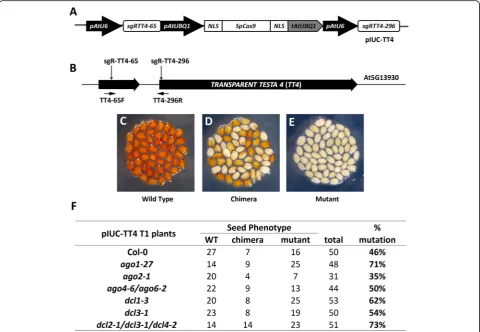
Plant CRISPR/Cas9 expression cassettes usually contain strong constitutive promoters to drive sgRNA and Cas9 ex-pression at high levels in order to achieve efficient gene editing [32]. High transgene expression may trigger the cellular-silencing machinery, which may limit the efficiency of CRISPR-induced gene editing. To test this hypothesis, we used a previously reported CRISPR/Cas9 vector (Fig.1a) to transform a set of Arabidopsis mutants involved in RNA silencing, includingago1-27,ago2-1,ago4-6/ago6-2, dcl1-3, and dcl2-1/dcl3-1/dcl4-2. The TRANSPARENT TESTA 4 (TT4) gene was selected as the CRISPR target (Fig. 1b). Mutations in this gene stop the production of brown pig-ment in Arabidopsis seeds providing an easily observable phenotype to determine the extent of gene editing in T1 and T2 plants. Three different types of visual phenotypes were expected in the seeds from the T1 population. “Wild--type” plants should produce completely normal brown seeds while “mutant” plants should produce entirely pale yellow seeds (Fig. 1c, e). In contrast, “chimera” plants should produce seeds with a mixed phenotype showing pale and dark sectors (Fig.1d).
The mutation frequencies in the TT4 gene in each mutant background were calculated by adding up the number of “mutant” and “chimera” plants (Fig. 1f). Compared to Col-0 plants (46%), mutagenesis frequency was increased to 71% inago1-27, 62% indcl1-3, and 73% indcl2-1/dcl3-1/dcl4-2 triple mutants. However, slight changes were observed inago4-6/ago6-2double mutants (50%) and dcl3-1 (54%), and a decrease was evident in ago2-1mutants (35%).
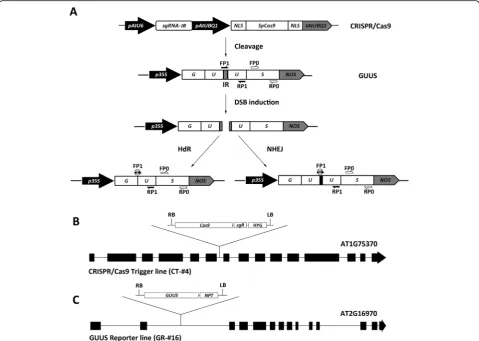
system, we used a previously constructed CRISPR/Cas9 expression vector targeting an intergenic region (IR) be-tween a partially duplicated GUUS reporter gene (Fig.2a). CRISPR/Cas9-mediated double strand breaks in the IR can be repaired either via the homology-dependent re-combination (HdR) pathway to restore a functional GUS gene or via the error-prone non-homologous end joining (NHEJ) pathway that can introduce mutations at the tar-get site. A PCR primer (FP1) designed for the tartar-get site will have its PCR amplification efficiency reduced by the presence of NHEJ-induced mutations, or completely elim-inated in the case of HdR-mediated recombination when used in combination with a reverse PCR primer in the U fragment (Fig.2a, Additional file1: Figure S1) [33]. A sec-ond pair of primers was designed for the non-targeted“S” fragment that should not be affected by CRISPR/Cas9-in-duced modifications. In this way, the CRISPR/Cas9 gene editing efficiency can be estimated by comparing the
GUUS gene relative integrity (RI) as a ratio between the amplification efficiency of the U fragment versus the S fragment (RI = U/S) in different samples [34] .
To enable comparative analysis of targeted gene edit-ing efficiency in different mutants, the CRISPR/Cas9 construct and the GUUS reporter construct were first introduced separately into Arabidopsis. Several T2 lines showing a Mendelian 3:1 segregation ratio were selected and their T-DNA insertion sites determined to ensure that no RNA-silencing pathway genes had been inadvert-ently affected. Two homozygous transgenic T3 lines were finally selected for further work, one carrying the CRISPR/Cas9 construct (CT-#4) and the other carrying the GUUS reporter construct (GR-#16) (Fig.2b, c). These two lines were then crossed with different post-transcrip-tional gene-silencing (PTGS) pathway mutants respect-ively to obtain homozygous CT-#4 and GR-#16 lines in mutant backgrounds in the F2 generation. As an example,
Fig. 1Analysis of CRISPR/Cas9-induced targeted gene mutations in Arabidopsis RNA-silencing pathway mutants.aAn ectopically expressed CRISPR/Cas9 system (pIUC-TT4) designed for targeted gene mutagenesis in Arabidopsis.pAtU6, Arabidopsis U6-26 promoter; sgRNA, single guide RNA; pAtUBQ1, ArabidopsisUBIQUITIN 1promoter;NLS, SV40 nuclear localization signal;SpCas9,Streptococcus pyogenesCas9 gene;tAtUBQ1, Arabidopsis UBIQUITIN 1terminator.bSchematic diagram of theTT4gene. The vertical arrows indicate the positions of the sgRNA target sites. The horizontal arrows indicate the position of primers used for analyzing the relative integrity (RI) ofTT4gene.c–eT1 seeds obtained from pIUC-TT4 transgenic lines exhibited different severities of seed coat phenotypes.cWild-type seeds.dChimeric seeds.eMutated seeds.fPhenotype analysis of CRISRP/Cas9-induced mutations in different silencing pathway mutants. % of mutation = (chimera + mutant)/total
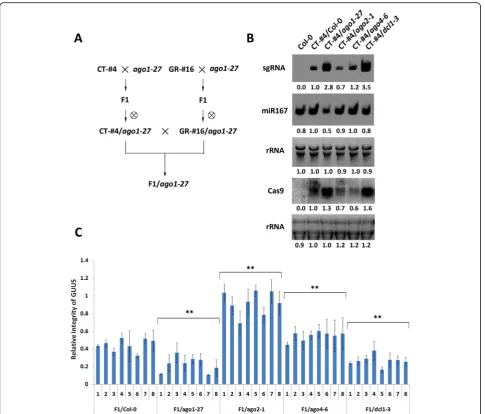
[image:3.595.58.539.88.420.2]theago1-27mutant was crossed with homozygous CT-#4 and GR-#16 lines to generate homozygous CT-#4/ago1-27 and GR-#16/ago1-27 individuals in F2 generation. For mutagenesis analysis, the homozygous CT-#4/ago1-27and GR-#16/ago1-27individuals were cross-pollinated to pro-duce the heterozygous CT-#4 and GR-#16 transgenes in homozygous ago1-27 mutant plants (Fig. 3a). Although time consuming, this strategy was essential to discard ef-fects caused by integration of the T-DNAs in different genomic loci for each mutant background.
RI values for the GUUS reporter gene were deter-mined in theago1-27,ago2-1,ago4-6, anddcl1-3mutant backgrounds as well as in a wild-type Col-0 line as
control. Due to the complexity of the approach, we did not use it for the ago4-6/ago6-2 double and dcl2-1/ dcl3-1/dcl4-2 triple mutants (analyzed in Fig. 1f ). Com-pared to the Col-0 background, the RI values for the GUUS reporter gene were significantly reduced in the ago1-27 and dcl1-3 mutant backgrounds (Fig. 3c), reflecting higher mutagenesis efficiencies in agreement with our above results using the TT4 gene (Fig.1f ). The ago2-1mutant produced the highest RI values, also con-sistent with the low mutation efficiency observed for the TT4 gene (Figs. 3c and 1f). Finally, while the ago4-6/ ago6-2mutants showed similar mutagenesis efficiency to Col-0 in the TT4 assays, the single ago4-6 showed
[image:4.595.58.538.88.429.2]increased GUUS RI values, indicating reduced mutation efficiency.
Quantification of the transcript levels for both elements of the CRISPR/Cas9 system, sgRNA and Cas9, revealed a strong correlation between expres-sion levels and mutation efficiency (Fig. 3b, c). The CT-#4/ago1-27 and CT-#4/dcl1-3 transgenic lines showed elevated levels of Cas9 and sgRNA compared to the CT-#4/Col-0 control, while CT-#4/ago2-1
displayed lower Cas9 and sgRNA levels than
CT-#4/Col-0 (Fig. 3b). Interestingly, CT-#4/ago4-6 showed a reduction in Cas9 levels but not in sgRNA
levels, possibly indicating that the AGO4-mediated RNA-silencing pathway does not affect the relatively small sgRNA transcript.
Interference with the PTGS pathway leads to
improvements in CRISPR/Cas9 gene editing efficiency in Arabidopsis
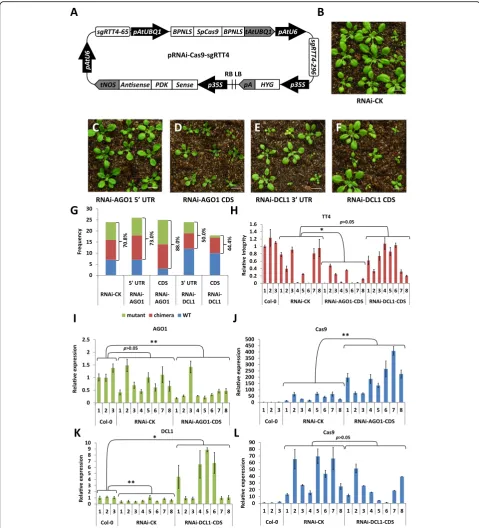
Given that ago1 and dcl1 mutants show increased gene editing efficiency, we designed a strategy to couple CRISPR/Cas9 with silencing of the AGO1 and DCL1 genes. For this purpose, we introduced additional ele-ments into a nuclear localization signal optimized
Fig. 3Gene expression levels and editing activity of CRISPR/Cas9 in RNA-silencing pathway mutants.aA pipeline used to generate F1 hybrids of CRISPR/Cas9 and GUUS lines in different mutant backgrounds,ago1-27is shown as an example.bNorthern blot showing sgRNA, miR167, and Cas9 transcript levels in RNA-silencing pathway mutants.cRelative integrity (RI) of the GUUS reporter gene in different samples was detected by real-time PCR. Each column indicates means ± SD of three technical replicates. For each mutant background, eight individuals were analyzed as biological replicates. **Indicates significant difference atp< 0.01 under two-tailed Student’sttest
[image:5.595.57.543.86.500.2]pIUC-TT4 CRISPR/Cas9 vector to trigger the RNA interference (RNAi) response in plant cells by producing hairpin RNA molecules (Fig. 4a, Additional file 1: Note S). Since the silencing efficiency of RNAi is dependent on the sequences of hairpin RNAs, we produced two CRISPR/RNAi constructs for AGO1 using fragments from the 5′untranslated region (UTR) and the coding region (CDS), while forDCL1we used the coding region and the 3’UTR. Characteristic developmental de-fects were observed in the T1 transgenic population [35] with lines containing the CDS AGO1 RNAi construct showing the highest phenotype frequency and severity (Fig.4b–d). To evaluate the CRISPR/Cas9-mediated gene editing efficiency in the RNAi populations, we calculated the mutagenesis frequency in theTT4gene by adding up the number of“mutant”and“chimera”plants. Compared to the control containing an empty RNAi cassette (RNAi-CK), mutagenesis frequency was increased in the RNAi-AGO1-CDS lines (88.0% vs 70.8%), while no sub-stantial difference was observed for the RNAi-AGO1-5′ UTR lines (73.0% vs 70.8%). Surprisingly, lines harboring both DCL RNAi constructs showed reduced frequency of CRISPR/Cas9-induced mutations (50.0% vs 70.8%, 44.4% vs 70.8%) (Fig.4g).
To validate these results, we quantified Cas9 transcript levels and targeted gene mutation frequency in eight in-dividuals randomly selected from the RNAi-AGO1-CDS and RNAi-DCL1-CDS populations. Analyses of the RNAi-AGO1-CDS samples showed efficient silencing of the AGO1 gene in most tested seedlings (Fig. 4i), which coincided with a significant increase in Cas9 transcript levels compared to control samples (Fig.4j). The relative integrity (RI) of theTT4 gene was calculated as a ratio between the amplification efficiency of the targeted TT4 region versus the non-targeted ACTIN region using primer pairs shown in Fig. 1b and Additional file 1: Table S1. The overall RI value of TT4 gene in RNAi-AGO1-CDS plants was significantly lower than controls, suggesting that successful RNAi-mediated si-lencing ofAGO1can improve the gene editing efficiency of CRISPR/Cas9 (Fig. 4h). In contrast, instead of silen-cing, half of the tested RNAi-DCL1-CDS samples showed higher DCL1 expression levels (line #1, #4, #5 and #6) (Fig. 4k), suggesting the existence of some kind of feedback regulation. Although there was no signifi-cant difference in Cas9 expression and overall TT4 RI value between the RNAi-DCL1-CDS samples and con-trol samples, the four RNAi-DCL1-CDS lines with in-creased DCL1 expression exhibited relatively lower Cas9 levels compared to the other RNAi-DCL1-CDS lines (Fig. 4l, h). These results further supported our initial observations that manipulation of the AGO1-directed RNA-silencing pathway can lead to improved CRISPR/ Cas9 efficiency.
Expression of the viral p19-silencing suppressor increases CRISPR/Cas9-mediated gene editing efficiency in
Arabidopsis transgenic plants
Fig. 4Improving CRISPR/Cas9 gene editing efficiency by interference with RNA-silencing pathway gene expression.aA schematic diagram of the CRISPR/Cas9 system containing an RNA interference construct.BPNLS, bipartite nuclear localization signal; Sense, sense fragment of targeted gene; PDK, PDK intron from pHellsgate; Antisense, antisense fragment of targeted gene.b–fT1 transgenic plants transformed with pRNAi-Cas9-sgRTT4 containing an empty RNA interference construct (RNAi-CK) (b), an AGO1 5′UTR RNAi construct (c), an AGO1 CDS RNAi construct (d), a DCL1 3′UTR RNAi construct (e) and a DCL1 CDS RNAi construct (f). Bar = 1 cm.gHistogram showing the frequency of WT, chimeras, and mutants in T1 populations transformed with different pRNAi-Cas9-sgRTT4 constructs. The numbers indicates % of mutation = (chimera + mutant)/total (h). Relative integrity of theTT4gene in RNAi-CK, RNAi-AGO1 CDS and RNAi-DCL1 CDST1 plants. Eight individual T1 plants were analyzed for each construct by real-time PCR.i,jRelative expression ofAGO1(i) andCas9(j) in Col-0, RNAi-CK, and RNAi-AGO1 CDS T1 plants determined by quantitative RT-PCR.k,l Relative expression ofDCL1(k) andCas9(l) in Col-0, RNAi-CK, and RNAi-DCL1 CDS T1 plants determined by quantitative RT-PCR. Each column in (h–l) indicates means ± SD of three technical replicates. The values of Col-0 samples were arbitrarily designated as 1. *Significant difference atp< 0.05 under two-tailed Student’st-test. **Significant difference atp< 0.01 under two-tailed Student’sttest.“p> 0.05”indicates no significant difference
[image:7.595.57.537.87.616.2]The viral p19-silencing suppressor improves the gene editing efficiency of CRISPR/Cas9 by interfering with the plant RNA-silencing pathway
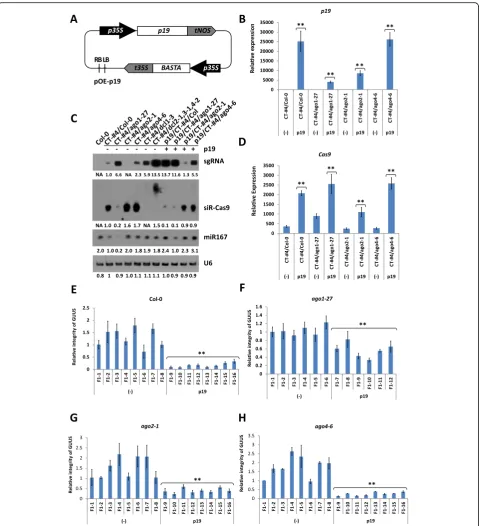
To validate the positive effect of p19 in CRISPR/Cas9-mediated gene editing efficiency, we used the GUUS sys-tem described earlier. We first transformed CT-#4 lines containing a CRISPR/Cas9 cassette in the ago1-27, ago2-1, andago4-6 mutant backgrounds with a p19 ec-topic expression vector (Fig. 6a). Mendelian segregation ratios were determined in T2 lines, and those showing single transgene integration were used for phenotypic observations. The expression levels of p19 were deter-mined in the transgenic lines (Fig. 6b), and we noticed that homozygous p19 transgenic plants were usually sterile and exhibited stronger leaf developmental defects than heterozygotes (Additional file 1: Figure S2, S3). Therefore, only heterozygous T2 lines were subsequently used for hybridization with GR-#16 lines of the corre-sponding mutant backgrounds.
Analysis of the p19/CT-#4 lines showed that ectopic expression of p19 can further increase accumulation of the sgRNA and Cas9 transcripts in all of the tested mu-tant backgrounds (Fig.6c, d). It has been proposed that p19 can protect viral genes from degradation by compet-ing with the RISC complex for bindcompet-ing to siRNA du-plexes [36]. To test this hypothesis, we determined the abundance of Cas9-derived siRNAs (siR-Cas9) in CT-#4 and p19/CT-#4 lines in different mutant backgrounds (Fig.6c). The effect of p19 on siR-Cas9 was the opposite of that observed for Cas9 transcripts, with all p19/CT-#4 lines showing reduced siR-Cas9 levels. Interestingly, the size of siR-Cas9 transcripts was increased in dcl2-1/ dcl3-1/dcl4-2 mutants, suggesting that siR-Cas9 are processed to a final 20-22-nt size by one or more of the three DICER proteins. As mentioned above, expression of p19 resulted in a decrease in siR-Cas9 abundance in all tested samples, especially for Col-0; however, the small effect observed in the ago1-27 background sug-gests that p19 acts by hampering the AGO1-directed degradation of Cas9 mRNA. Unlike siRNAs, endogenous miR167 levels were increased in the presence of p19 as previously reported (Fig.6c) [30].
We subsequently tested the CRISPR/Cas9-mediated gene editing efficiency in p19/CE-#4 and GR-#16 F1 hy-brids in different mutant backgrounds using the GUUS system (Fig. 6e–h). As expected, each F1 population showed an equal segregation ratio for plants containing or lacking the p19 expression cassette. The RI values for the GUUS gene were determined in both types of hybrids, and plants expressing p19 consistently showed lower RI values than their “non-p19” counterparts, consistent with our above results that p19 expression could improve the gene editing efficiency of the CRISPR/Cas9 system.
Discussion
The engineered CRISPR/Cas9 system is under negative regulation of the plant PTGS pathway
We hypothesized that ectopic expression of transcripts from the bacterial CRISPR/Cas9 system, especially the secondary structure-rich sgRNAs, may activate the plant RNA-silencing pathway. To test our hypothesis, we deter-mined the mutagenesis efficiency of a previously opti-mized CRISPR/Cas9 system in Arabidopsis mutants for several genes involved in the two known plant RNA-silen-cing pathways: the post-transcriptional gene-silenRNA-silen-cing pathway (PTGS) and the transcriptional gene-silencing (TGS) pathway, also known as the RNA-directed DNA methylation (RdDM) pathway. Many important elements of the PTGS pathway are shared with the plant endogen-ous miRNA and siRNA pathways due to the requirement of 21–22-nt small RNA molecules to direct RNA cleavage. The TGS pathway is relatively distinct from the PTGS pathway, producing 24-nt small RNAs to direct transcrip-tional silencing through DNA methylation. Our results showed an increase in CRISPR/Cas9-mediated gene edit-ing efficiency in PTGS pathway mutants, such asago1-27, dcl1-3, anddcl2-1/dcl3-1/dcl4-2, but only a slight change in TGS pathway mutants, such as dcl3-1 and ago4-6ago6-4, suggesting that the plant PTGS pathway is the major determinant limiting CRISPR/Cas9 efficiency (Fig.1f). Consistent with this notion, we observed a mod-erate expression change of sgRNA and Cas9 transcripts in CT-#4/ago4-6 compared to CT-#4/ago1-27 and CT-#4/ dcl1-3(Fig.3b).
As a practical application of the observations from the PTGS mutants, we devised a practical approach includ-ing RNAi-based silencinclud-ing modules forAGO1 and DCL1 in the CRISPR/Cas9 cassette. Although we obtained positive results with both genes using loss-of-function mutants, RNA interfering of AGO1 proved to be more effective than DCL1 mostly due to the unexpected ob-servation that expression of double-strandedDCL1RNA molecules resulted in a strong increase in DCL1 tran-script levels in many transgenic lines.
The viral silencing suppressor p19 can enhance the gene editing activity of CRISPR/Cas9 in stable transgenic lines in a dosage-dependent manner
The TBSV p19 forms a tail-to-tail homo-dimer preferen-tially binding 20-22-nt siRNA duplexes in a sequence-in-dependent manner and prevents the assembly of the RISC complex [37]. The p19-mediated sequestration of siRNAs in virus-infected cells also blocks the spread of the mobile, systemic silencing signals by binding 21– 25-nt siRNAs [25]. Although p19 has been widely adopted in transient expression systems to promote high levels of foreign gene expression, the developmental al-terations caused by the ectopic expression of the protein
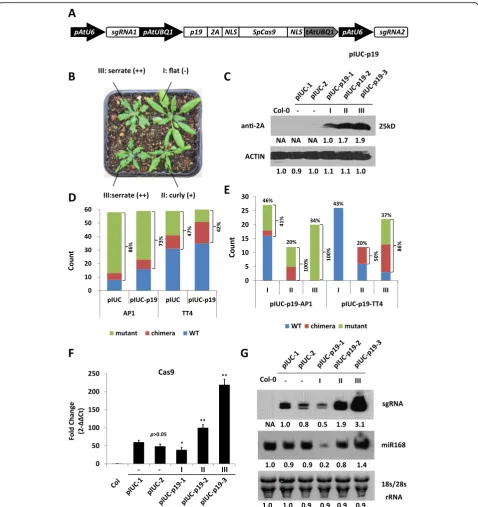
have limited its application in stable transgenic plants. The p19-induced leaf alterations are probably caused by its interference with the plant endogenous siRNA and miRNA pathways [30,38]. While p19 can bind many miR-NAs, it does not bind miR168 that targetsAGO1mRNA, thus reducing the accumulation of AGO1 [30,39]. In this study, we observed reduced miR168 levels in type I trans-genic plants expressing p19 together with the CRISPR/ Cas9 cassette, but the expression levels recovered in type II and type III plants (Fig. 5g), suggesting a dosage-dependent regulation of miR168 by p19 during the interaction between virus and host. The two CRISPR ele-ments, sgRNA and Cas9, were also regulated by p19 in a dosage-dependent manner. In type I transgenic plants with low p19 expression, showing a WT leaf phenotype, sgRNA and Cas9 transcript levels were lower than in plants transformed with the same CRISPR/Cas9 con-structs without p19 (Fig.5f, g). As the expression of p19 increased, the leaf phenotype became more accentuated (types II & III) and the transcript levels of sgRNA and Cas9 became higher (Fig.3c). Considering that plants are continuously evolving counter measures to fight against viral suppressors by producing endogenous VSR recogni-tion receptors [23], we think that the downregularecogni-tion of miR168 and CRISPR/Cas9 transcripts observed in p19-low-expressing plants may be due to the triggering of the plant defense machinery while high p19 expression even-tually overwhelms the defense response resulting in re-duced transgene silencing.
Practical applications of the p19-CRISPR/Cas9 and RNAi-AGO1-CRISPR/Cas9 systems for the identification of gene-edited plants
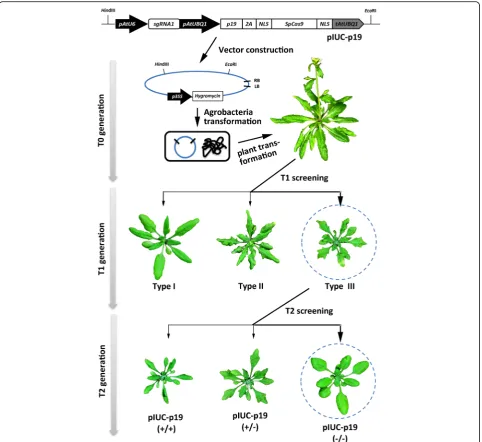
The observations linking phenotype severity in the p19/ CRISPR/Cas9 transgenic lines can have a very practical application to simplify the process of identifying CRISPR/ Cas9-induced mutations in Arabidopsis, and perhaps other plant species (Fig. 7). Screening of T1 transgenic lines for mutations is arguably the most technically de-manding and labor-intensive part in the production of CRISPR/Cas9-induced mutants and although a number of methods have been devised to screen T1 transgenic lines [40], they are technically demanding and costly. We have shown that T1 lines produced using our p19/CRISPR/ Cas9 system have similar overall mutation frequencies to the non-p19 lines with no apparent benefits associated with the use of p19. Nevertheless, analysis of the data in conjunction with the observed developmental defects, showed extraordinarily high mutation rates on those lines showing strong phenotypes, increasing from 73% overall to 100% in type III plants for theAP1gene and from 42% overall to 86% in type III plants forTT4. Therefore, simple visual observation of T1 lines containing p19/CRISPR/ Cas9 cassettes will provide two important benefits, (a)
assurance that the lines are transgenic avoiding analysis of transformation escapes and (b) a vastly increased prob-ability of finding CRISPR/Cas9 mutations on those lines. Although strong expression of p19 has important pheno-typic effects on the T1 lines, this is not necessarily a disad-vantage as phenotypic observations are usually performed on T1 plants. In fact, the strong p19-induced phenotype adds a third benefit to our approach since individuals with “non-serrated” leaves in the T2 generation will indicate that the p19 and CRISPR/Cas9-containing T-DNA has been segregated away. A similar strategy is possible in-corporating the RNAi-AGO1-silencing module in the CRISPR/Cas9 cassette with AGO1-silencing phenotype severity being associated with CRISPR/Cas9 improved efficiency.
Conclusion
In conclusion, we have shown for the first time that ma-nipulation of the plant RNA-silencing pathway can lead to significant improvements in the gene editing effi-ciency of the bacterial-derived CRISRP/Cas system. In addition, we have developed two novel constructs to optimize the expression of CRISPR/Cas system in stable transgenic plants. Significant improvements in gene edit-ing efficiency can be made by co-expressedit-ing either the viral-suppressor p19 or an AGO1 RNA hairpin with CRISPR/Cas9. Our systems also provide a very easy method to identify plants with high frequency of gene mutations, thus simplifying the screening process. Con-sidering that the RNA-silencing pathways are conserved in eukaryotes, we suggest that a similar strategy could be adopted in other species to simplify the identification of plants with CRISPR/Cas9-induced mutations.
Methods
Plant materials
Arabidopsis thaliana mutant lines in Columbia-0 (Col-0) ecotype for ago1-27, ago2-1 (SALK_003380), ago4-6/ago6-2 (SALK_071772/SALK_031553), dcl1-3 (CS3176), dcl2-1/dcl3-1/dcl4-2 (CS16391), and dcl3-1 (SALK_005512) mutants were described previously [10, 12, 35, 41–43].
Vector construction
The pTOE, pIUC-TT4, pIUC-AP1, CRISPR trigger, and GUUS reporter vector was constructed as described be-fore [33, 44]. DNA fragments of TBSV p19 fused with 2A peptide were synthesized by GENEWIZ, China (Additional file 1: Note S). To produce the pIUC-p19 vectors, the synthesized p19-2A fragment was cloned into the NcoI site of pIUC-TT4 and pIUC-AP1 vectors to generate the pIUC-p19-TT4 and pIUC-p19-AP1 vec-tor respectively. To allow the co-expression of an RNA interfering construct with the CRISPR/Cas9 systems, a
gene fragment containing aCaMV 35Spromoter, a mul-tiple cloning site, and a NOS terminator in sequential
was first amplified from the pTOE vector and
subsequently inserted into theHindIII site of pIUC-TT4 to give an intermediate vector. Sense and antisense gene fragments of AGO1, DCL1, and the PDK intron were amplified separately using primer pairs listed in Additional file 1: Table S1. To generate the final
pRNAi-Cas9-TT4 vectors, the paired sense and
antisense gene fragments were then cloned into the SalI and KpnI site of the intermediate vector with a PDK intron in between using the Seamless Cloning and Assembly Kit (TransGen Biotech, China). To overexpress the p19 gene in CT-#4 lines, the coding sequences of p19 were first cloned into the SalI and XbaI site of pTOE and subsequently introduced into the pCAMBIA3300 vector using HindIII and EcoRI (NEB, USA).
[image:12.595.58.541.87.529.2]Plant transformation and growth conditions
Agrobacterium-mediated transformation of Arabidopsis thalianaColumbia-0 (Col-0) with the binary vectors was performed using the floral dipping method as previously described [45]. Seed collected from the Agrobacterium-infected plants was sterilized with 2% sodium hypochlor-ite for 15 min and plated on Murashige and Skoog (MS0) medium containing 30 mg/L hygromycin or 25 mg/L phosphinothricin plus 50 mg/L carbenicillin to inhibit Agrobacterium growth. The resulting T1 plants were transplanted to soil after growing under long-day conditions (16-h light/8-h dark) at 22 °C for 2 weeks.
Phenotype analysis for transgenic plants of the p19-coepressed CRISPR/Cas9 systems
For phenotype analysis of the tt4mutants, mature seeds of T1 plants were collected and registered according to the coloration of seed coats. Plant developed uniformly brown-colored seeds were designated as wild type, those grew uniformly yellow-colored seeds were designated as mutant, and those produced seed of both colors are des-ignated as chimera. For phenotype analysis of the ap1 mutants, phenotype analysis was performed during the flowering times. Compared to wild-type plants,ap1 mu-tants developed uniformly petal-less flowers, while the chimera produce partially petal-less flowers and partially wild-type flowers. For phenotype analysis of p19 trans-genic lines, the p19-induced leaf phenotypes were also classified into three types according to the severity. Type I plants have normal wild-type leaves, type II plants de-velop curly leaves, and type III plants grow curly and serrated leaves.
Northern blot for sgRNA, miRNAs, and Cas9 gene in transgenic plants
RNA samples were extracted from the transgenic plants using the Trizol® reagents (Invitrogen, USA). For small RNA detection, 20 μg of total RNAs or 10 μg small RNAs was resolved by 15% PAGE in 1×Tris-bora-te-EDTA. The 3′biotin-labeled DNA oligos, anti-sgRNA, anti-miR167, and anti-miR168, were synthesized by Invi-trogen, USA. Hybridization and membrane wash were performed under 42 °C. Blot signals were detected using the Chemiluminescent Nucleic Acid Detection Module Kit (Thermo Fisher, USA). For Cas9 detection, 30 μg total RNA was resolved by 1% Formaldehyde-agarose gel. Biotin-labeled probes used for Cas9 detection were synthesized by in vitro transcription of a 286 bp Cas9 fragment using the North2South™Complete Biotin Ran-dom Prime Labeling and Detection Kit (Thermo Fisher, USA). Gel transfer, hybridization, and membrane wash were performed as described before. The blot signals were detected using the Chemiluminescent Nucleic Acid Detection Module Kit (Thermo Fisher, USA).
Real-time PCR
For quantitative real-time PCR, total RNA was treated with DNase I (TaKaRa, Japan) followed by phenol/ chloroform extraction to remove DNA contamination. Approximately 1 μg of purified RNAs was used for first-strand complementary DNA synthesis using Prime-Script Reverse Transcriptase (TaKaRa, Japan) with oli-go(dT) primers. Real-time PCR was performed using iQSYBR Green Supermix (Bio-Rad) with primer pairs listed in Additional file 1: Table S1. Relative transcript levels were determined for each sample by normalizing them toACTINaccording to theΔΔCt method [46].
For calculating the relative integrity (RI) value of GUUS and TT4 gene, DNA samples were prepared using CTAB methods. Approximately 50 ng DNA was used for PCR amplification. Real-time PCR was per-formed using iQSYBR Green Supermix (Bio-Rad, USA) with primer pairs listed in Additional file 1: Table S1. The RI value of GUUS gene were determined by nor-malizing the Ct Value of U fragment to S fragment ac-cording to the ΔΔCt method and the RI value of TT4 gene were calculated similarly by normalizing the Ct Value of sgRNA-targeted regions to non-targeted regions using primer pairs listed in Additional file1: Table S1.
Western blot
Total protein were extracted from 150-mg floral tissue
of the transgenic plants and resolved on 12%
SDS-PAGE. Immunoblot was performed using anti-2A antibody at a dilution of 1/1000 (Merck, Germany). The blot signals were detected using Pierce™ ECL Western Blotting Substrate (Thermo Fisher, USA).
Additional file
Additional file 1:Figure S1.A schematics showing the sequences of the sgRNA targeting site and FP1 in GUUS reporter gene.Figure S2. Phenotypes of the pOE-p19 T2 lines in CT-#4 of mutant backgrounds. Figure S3.Segregation of pOE-p19 transgenic plants in T2 generation. Table S1. Primers used in this study. Note S. Sequences of the TBSV p19-2A, pRNAi-Cas9 cassettes, the pIUC-p19 cassettes, and the GUUS cassette. (PDF 570 kb)
Acknowledgements
We thank Prof. Shou-Wei Ding and members of Zhu lab for helpful comments and suggestions on the manuscript.
Funding
This work was supported by the Chinese Academy of Sciences and Youth Innovation Promotion Association, CAS.
Availability of data and materials
The sequences of expression cassettes used in this paper are listed in Note S. All materials described in this study are freely available upon request.
Authors’contributions
YM and J-KZ designed the research; YM, XY, YZ, and ZZ performed the research; YM, JB, and J-KZ analyzed the data; YM, JB, and J-KZ wrote the paper. All au-thors read and approved the final manuscript.
Ethics approval and consent to participate Not applicable
Consent for publication Not applicable
Competing interests
The authors declare that they have no competing interests.
Publisher’s Note
Springer Nature remains neutral with regard to jurisdictional claims in published maps and institutional affiliations.
Author details
1Shanghai Center for Plant Stress Biology, CAS Center of Excellence in
Molecular Plant Sciences, Chinese Academy of Sciences, Shanghai 200032, People’s Republic of China.2University of Chinese Academy of Sciences
(CAS), Beijing 100049, People’s Republic of China.3School of Agriculture and
Food Sciences, University of Queensland, Brisbane, QLD 4072, Australia.
4
Department of Horticulture and Landscape Architecture, Purdue University, West Lafayette, IN 47907, USA.
Received: 5 July 2018 Accepted: 7 September 2018
References
1. Jiang W, Marraffini LA. CRISPR-Cas: new tools for genetic manipulations from bacterial immunity systems. Annu Rev Microbiol. 2015;69:209–28. 2. Deltcheva E, Chylinski K, Sharma CM, Gonzales K, Chao Y, Pirzada ZA, Eckert
MR, Vogel J, Charpentier E. CRISPR RNA maturation by trans-encoded small RNA and host factor RNase III. Nature. 2011;471:602–7.
3. Jinek M, Chylinski K, Fonfara I, Hauer M, Doudna JA, Charpentier E. A programmable dual-RNA-guided DNA endonuclease in adaptive bacterial immunity. Science. 2012;337:816–21.
4. Cong L, Ran FA, Cox D, Lin S, Barretto R, Habib N, Hsu PD, Wu X, Jiang W, Marraffini LA, Zhang F. Multiplex genome engineering using CRISPR/Cas systems. Science. 2013;339:819–23.
5. Ma X, Zhu Q, Chen Y, Liu YG. CRISPR/Cas9 platforms for genome editing in plants: developments and applications. Mol Plant. 2016;9:961–74. 6. Mali P, Yang L, Esvelt KM, Aach J, Guell M, DiCarlo JE, Norville JE, Church GM.
RNA-guided human genome engineering via Cas9. Science. 2013;339:823–6. 7. Bosher JM, Labouesse M. RNA interference: genetic wand and genetic
watchdog. Nat Cell Biol. 2000;2:E31–6.
8. Brodersen P, Voinnet O. The diversity of RNA silencing pathways in plants. Trends Genet. 2006;22:268–80.
9. Bernstein E, Caudy AA, Hammond SM, Hannon GJ. Role for a bidentate ribonuclease in the initiation step of RNA interference. Nature. 2001;409:363–6. 10. Schauer SE, Jacobsen SE, Meinke DW, Ray A. DICER-LIKE1: blind men and
elephants in Arabidopsis development. Trends Plant Sci. 2002;7:487–91. 11. Reinhart BJ, Weinstein EG, Rhoades MW, Bartel B, Bartel DP. MicroRNAs in
plants. Genes Dev. 2002;16:1616–26.
12. Xie Z, Johansen LK, Gustafson AM, Kasschau KD, Lellis AD, Zilberman D, Jacobsen SE, Carrington JC. Genetic and functional diversification of small RNA pathways in plants. PLoS Biol. 2004;2:E104.
13. Deleris A, Gallego-Bartolome J, Bao J, Kasschau KD, Carrington JC, Voinnet O. Hierarchical action and inhibition of plant Dicer-like proteins in antiviral defense. Science. 2006;313:68–71.
14. Hutvagner G, Simard MJ. Argonaute proteins: key players in RNA silencing. Nat Rev Mol Cell Biol. 2008;9:22–32.
15. Hammond SM, Bernstein E, Beach D, Hannon GJ. An RNA-directed nuclease mediates post-transcriptional gene silencing in Drosophila cells. Nature. 2000;404:293–6.
16. Mi S, Cai T, Hu Y, Chen Y, Hodges E, Ni F, Wu L, Li S, Zhou H, Long C, et al. Sorting of small RNAs into Arabidopsis argonaute complexes is directed by the 5′terminal nucleotide. Cell. 2008;133:116–27.
17. Singh RK, Pandey SP. Evolution of structural and functional diversification among plant Argonautes. Plant Signal Behav. 2015;10:e1069455. 18. Carbonell A, Carrington JC. Antiviral roles of plant ARGONAUTES. Curr Opin
Plant Biol. 2015;27:111–7.
19. Scholthof HB, Alvarado VY, Vega-Arreguin JC, Ciomperlik J, Odokonyero D, Brosseau C, Jaubert M, Zamora A, Moffett P. Identification of an
ARGONAUTE for antiviral RNA silencing in Nicotiana benthamiana. Plant Physiol. 2011;156:1548–55.
20. Wang XB, Jovel J, Udomporn P, Wang Y, Wu Q, Li WX, Gasciolli V, Vaucheret H, Ding SW. The 21-nucleotide, but not 22-nucleotide, viral secondary small interfering RNAs direct potent antiviral defense by two cooperative argonautes in Arabidopsis thaliana. Plant Cell. 2011;23:1625–38.
21. Zilberman D, Cao X, Jacobsen SE. ARGONAUTE4 control of locus-specific siRNA accumulation and DNA and histone methylation. Science. 2003;299:716–9. 22. Raja P, Sanville BC, Buchmann RC, Bisaro DM. Viral genome methylation as
an epigenetic defense against geminiviruses. J Virol. 2008;82:8997–9007. 23. Pumplin N, Voinnet O. RNA silencing suppression by plant pathogens:
defence, counter-defence and counter-counter-defence. Nat Rev Microbiol. 2013;11:745–60.
24. Csorba T, Kontra L, Burgyan J. Viral silencing suppressors: tools forged to fine-tune host-pathogen coexistence. Virology. 2015;479-480:85–103. 25. Silhavy D, Molnar A, Lucioli A, Szittya G, Hornyik C, Tavazza M, Burgyan J.
A viral protein suppresses RNA silencing and binds silencing-generated, 21- to 25-nucleotide double-stranded RNAs. EMBO J. 2002;21:3070–80. 26. Roth BM, Pruss GJ, Vance VB. Plant viral suppressors of RNA silencing. Virus
Res. 2004;102:97–108.
27. Gao SJ, Damaj MB, Park JW, Beyene G, Buenrostro-Nava MT, Molina J, Wang X, Ciomperlik JJ, Manabayeva SA, Alvarado VY, et al. Enhanced transgene expression in sugarcane by co-expression of virus-encoded RNA silencing suppressors. PLoS One. 2013;8:e66046.
28. Senthil-Kumar M, Mysore KS. Virus-induced gene silencing can persist for more than 2 years and also be transmitted to progeny seedlings in Nicotiana benthamiana and tomato. Plant Biotechnol J. 2011;9:797–806. 29. Saxena P, Hsieh YC, Alvarado VY, Sainsbury F, Saunders K, Lomonossoff GP,
Scholthof HB. Improved foreign gene expression in plants using a virus-encoded suppressor of RNA silencing modified to be developmentally harmless. Plant Biotechnol J. 2010;9:703–12.
30. Chapman EJ, Prokhnevsky AI, Gopinath K, Dolja VV, Carrington JC. Viral RNA silencing suppressors inhibit the microRNA pathway at an intermediate step. Genes Dev. 2004;18:1179–86.
31. Chen J, Li WX, Xie D, Peng JR, Ding SW. Viral virulence protein suppresses RNA silencing-mediated defense but upregulates the role of microrna in host gene expression. Plant Cell. 2004;16:1302–13.
32. Mao Y, Botella JR, Zhu JK. Heritability of targeted gene modifications induced by plant-optimized CRISPR systems. Cell Mol Life Sci. 2016;74:1075–93. 33. Mao Y, Zhang H, Xu N, Zhang B, Gou F, Zhu JK. Application of the CRISPR-Cas
system for efficient genome engineering in plants. Mol Plant. 2013;6:2008–11. 34. Miki D, Zhu P, Zhang W, Mao Y, Feng Z, Huang H, Zhang H, Li Y, Liu R, Qi Y,
Zhu JK. Efficient generation of diRNAs requires components in the posttranscriptional gene silencing pathway. Sci Rep. 2017;7:301. 35. Morel JB, Godon C, Mourrain P, Beclin C, Boutet S, Feuerbach F, Proux F,
Vaucheret H. Fertile hypomorphic ARGONAUTE (ago1) mutants impaired in post-transcriptional gene silencing and virus resistance. Plant Cell. 2002;14:629–39. 36. Schott G, Mari-Ordonez A, Himber C, Alioua A, Voinnet O, Dunoyer P.
Differential effects of viral silencing suppressors on siRNA and miRNA loading support the existence of two distinct cellular pools of ARGONAUTE1. EMBO J. 2015;34:2593–4.
37. Vargason JM, Szittya G, Burgyan J, Hall TM. Size selective recognition of siRNA by an RNA silencing suppressor. Cell. 2003;115:799–811.
38. Danielson DC, Pezacki JP. Studying the RNA silencing pathway with the p19 protein. FEBS Lett. 2013;587:1198–205.
39. Varallyay E, Valoczi A, Agyi A, Burgyan J, Havelda Z. Plant virus-mediated induction of miR168 is associated with repression of ARGONAUTE1 accumulation. EMBO J. 2010;29:3507–19.
40. Liu W, Zhu X, Lei M, Xia Q, Botella JR, Zhu J-K, Mao Y. A detailed procedure for CRISPR/Cas9-mediated gene editing in Arabidopsis thaliana. Science Bulletin. 2015;60:1332–47.
41. Lobbes D, Rallapalli G, Schmidt DD, Martin C, Clarke J. SERRATE: a new player on the plant microRNA scene. EMBO Rep. 2006;7:1052–8. 42. Duan CG, Zhang H, Tang K, Zhu X, Qian W, Hou YJ, Wang B, Lang Z, Zhao Y,
Wang X, et al. Specific but interdependent functions for Arabidopsis AGO4 and AGO6 in RNA-directed DNA methylation. EMBO J. 2014;34:581–92.
43. Henderson IR, Zhang X, Lu C, Johnson L, Meyers BC, Green PJ, Jacobsen SE. Dissecting Arabidopsis thaliana DICER function in small RNA processing, gene silencing and DNA methylation patterning. Nat Genet. 2006;38:721–5. 44. Mao Y, Zhang Z, Feng Z, Wei P, Zhang H, Botella JR, Zhu JK. Development
heritable gene modifications in Arabidopsis. Plant Biotechnol J. 2015;14: 519–32.
45. Zhang X, Henriques R, Lin SS, Niu QW, Chua NH. Agrobacterium-mediated transformation of Arabidopsis thaliana using the floral dip method. Nat Protoc. 2006;1:641–6.
46. Schmittgen TD, Livak KJ. Analyzing real-time PCR data by the comparative C(T) method. Nat Protoc. 2008;3:1101–8.