Summary and Trends of the Russian Gonococcal Antimicrobial
Surveillance Programme, 2005 to 2016
Alexey Kubanov,aViktoria Solomka,aXenia Plakhova,aAleksandr Chestkov,aNatalya Petrova,aBoris Shaskolskiy,b Ekaterina Dementieva,bArvo Leinsoo,bDmitry Gryadunov,bDmitry Deryabina
aState Research Center of Dermatovenerology and Cosmetology, Moscow, Russia bEngelhardt Institute of Molecular Biology, Russian Academy of Sciences, Moscow, Russia
ABSTRACT The Russian Gonococcal Antimicrobial Surveillance Programme (RU-GASP) was established in 2004 and operated continuously during the years from 2005 to 2016. The aims of this study were to summarize the RU-GASP results over this 12-year period and evaluate the trends inNeisseria gonorrhoeaeantimicrobial re-sistance in Russia. In total, 5,038 verified N. gonorrhoeae isolates from 40 participat-ing regions were tested for susceptibility to six antimicrobials via an agar dilution method. DNA loci involved in antimicrobial resistance were identified via minise-quencing or DNA microarray techniques. From 2005 to 2016, increasing susceptibil-ity to penicillin G (from 22.6% to 63.0%), tetracycline (from 34.8% to 53.0%), and ciprofloxacin (from 50.6% to 68.6%) was observed, but resistance to these drugs remained high. The proportions of isolates nonsusceptible to azithromycin and spec-tinomycin peaked in 2011 and decreased thereafter. Of the isolates, only 6 and 23 were identified as nonsusceptible to ceftriaxone according to the CLSI definitions and EUCAST breakpoint (0.57% of the total population), respectively. Comparison of
N. gonorrhoeaeantimicrobial resistance genetic determinants in 2005 versus those in
2016 showed a significant decrease in the number of isolates carrying chromosomal mutations. The proportion of isolates with wild-type genotypes increased from 11.7% in 2005 to 30.3% in 2016. Thus, the RU-GASP can be considered a successful gonorrhea surveillance program, and the current state of N. gonorrhoeae antimicro-bial resistance in Russia is less serious than that in other WHO GASP regions.
KEYWORDS Neisseria gonorrhoeae, Russian Federation, antimicrobial resistance, drug susceptibility testing, gonorrhea morbidity, surveillance program
D
ue to widespread antimicrobial resistance (AMR) inNeisseria gonorrhoeae, a bac-terial pathogen of global priority (1), management and control of gonococcal infection remain problematic.N. gonorrhoeaeresistance has developed over the past 70 years since the advent of antibiotics, and resistance to penicillins, tetracyclines, and fluoroquinolones successively emerged following the introduction of these antimicro-bials into clinical practice (2). The rapid decrease in antimicrobial susceptibility of N.gonorrhoeae to macrolides (azithromycin), aminocyclitols (spectinomycin), and
espe-cially extended-spectrum cephalosporins is an important modern public health prob-lem associated with the risk of untreatable gonorrhea (3).
The notable ability ofN. gonorrhoeaeto develop AMR is determined by the acqui-sition of numerous chromosomal mutations and internal recombinations or the hori-zontal transfer of external AMR determinants using transformation and plasmid-mediated mechanisms (4). For example, mutations in the chromosomalpenAandponA
genes result in the decreased affinity of penicillin-binding proteins (5), while horizontal transfer of theblaTEMplasmid increases resistance to penicillins through the acquisition
of beta-lactamase activity (6). Resistance to tetracyclines involves V57M or V57L amino
CitationKubanov A, Solomka V, Plakhova X, Chestkov A, Petrova N, Shaskolskiy B, Dementieva E, Leinsoo A, Gryadunov D, Deryabin D. 2019. Summary and trends of the Russian Gonococcal Antimicrobial Surveillance Programme, 2005 to 2016. J Clin Microbiol
57:e02024-18.https://doi.org/10.1128/JCM
.02024-18.
EditorErik Munson, Marquette University
Copyright© 2019 American Society for
Microbiology.All Rights Reserved.
Address correspondence to Dmitry Deryabin, [email protected].
Received18 December 2018
Returned for modification16 January 2019
Accepted13 March 2019
Accepted manuscript posted online20 March 2019
Published
crossm
24 May 2019
on May 17, 2020 by guest
http://jcm.asm.org/
acid substitutions in ribosomal protein S10 (therpsJgene product) (7) and the plasmid-mediatedtetMdeterminant (8). Resistance to fluoroquinolones is caused by mutations in thegyrAandparCgenes encoding the gyrase and topoisomerase proteins that form a “quinolone pocket” (quinolone-resistantN. gonorrhoeae[QRNG] region) (9). Acquired resistance to spectinomycin and azithromycin is determined by mutations of therrs
(16S RNA) and rrl (23S RNA) genes, respectively (10, 11), which is accompanied by deletions or amino acid alterations in some ribosomal proteins. Nonspecific AMR mechanisms include mutations in amino acids 120 and 121 ofporB1b(12) that decrease cell wall permeability as well as mutations in the promoter or coding region of themtrR
repressor that result in overexpression of the MtrCDE efflux pump (13); together, these mutations decrease the antibiotic concentration in the bacterial cell and contribute significantly to multidrug resistance.
Because commonly used molecular diagnostic tests for N. gonorrhoeae do not provide AMR results at the time of treatment and rapid AMR genetic kits (microarray-based assays [14] and multiplex bead suspension arrays [15]) are still commercially unavailable, clinical practitioners are required to treat gonococcal infection accord-ing to global and local treatment guidelines. The World Health Organization (WHO) recommends the use of an antimicrobial for gonococcal infection treatment when more than 95% of circulatingN. gonorrhoeae isolates are susceptible to the drug (16). This approach requires continuous AMR monitoring with a standardized laboratory protocol.
Accordingly, the Gonococcal Antimicrobial Surveillance Programme (GASP) was initiated in 1992 to monitor gonococcal AMR in the Southeast Asia region, and GASP activities were subsequently extended to other WHO regions (17). The Russian Gono-coccal Antimicrobial Surveillance Programme (RU-GASP) was established in 2004 fol-lowing the establishment of the Euro-GASP (18). The RU-GASP is part of a worldwide laboratory network coordinated by the European WHO Collaborating Centre for Gon-orrhoea and Other Sexually Transmitted Infections (19).
The main RU-GASP targets were as follows: (i) annual control of the emergence and spread of AMR inN. gonorrhoeae, i.e., trend analysis of AMR; (ii) the development of new molecular technologies for AMR genetic determinants to improve AMR surveillance data; and (iii) the presentation of AMR data for the revision of national gonorrhea treatment guidelines. Previous RU-GASP data have been presented in numerous inter-national publications (20–23).
The aims of this study were to summarize the RU-GASP results over a 12-year period and to evaluate the trends inN. gonorrhoeaeAMR in Russia in the context of changes in the recommended antimicrobial therapy regimes.
MATERIALS AND METHODS
Collection ofN. gonorrhoeaeisolates.In total, 5,038N. gonorrhoeaeisolates collected from January 2005 to December 2016 were included in this study. For each sample (one isolate from one patient), the following data were available: the patient’s sex, age, and sexual orientation; the specimen collection date and site; and concurrent sexually transmitted infections (STIs) diagnosed during that episode. The isolates were obtained from 4,096 males (81.3%) and 994 females (19.7%), reflecting the sex distribution of the gonococcal infection incidence in Russia. The median age of the patients was 29 years (range, 12 to 64 years); 47% were aged 25 years or younger and 53% were older than 25 years. One characteristic of the RU-GASP was the lack of information on high-risk status, which patients did not indicate or withheld in their personal information, and we could not clarify this parameter by other approaches. Moreover, although the RU-GASP protocol allowsN. gonorrhoeaeisolation from several sites (urethra, cervix, pharynx, rectum, and other anogenital sites), only urethral specimens from males and cervical/ urethral specimens from females were provided by the participating regional clinics.
Clinical specimens were cultured on GC-based agar supplemented with 1% IsoVitaleX enrichment and 1% vancomycin, colistin, amphotericin, and trimethoprim (VCAT) selective supplement (bioMérieux, Marcy l’Etoile, France). The primary identification of N. gonorrhoeaewas performed at participating regions and included Gram staining and rapid oxidase reaction. For centralized testing, Gram-negative, oxidase-positive diplococcal cultures 18 to 24 h old were frozen in cryomedium-Trypticase soy broth with 20% glycerol (Becton, Dickinson BBL, Sparks, MD, USA) and transported on dry ice to the RU-GASP laboratory center at the State Research Center of Dermatovenerology and Cosmetology in Moscow, Russia. Furthermore, all isolates were analyzed via a sugar utilization test with aNeisseria/Haemophilus (NH) ID card for the Vitek 2 compact analyzer (bioMérieux, Marcy l’Etoile, France), and the samples with
on May 17, 2020 by guest
http://jcm.asm.org/
“excellent” (96 to 99%) and “very good” (93 to 95%) results were verified asN. gonorrhoeae. Biochemically atypical isolates with “low discrimination” results were further checked via matrix-assisted laser desorp-tion ionizadesorp-tion–time of flight mass spectrometry (MALDI-TOF MS) analysis using a MALDI Biotyper system (Bruker Daltonics, Bremen, Germany).
During the study period, the number of isolates obtained per year varied from 622 to 268, corresponding to the decreased dynamics of gonorrhea incidence in Russia and representing approxi-mately 1% of the total number of gonococcal infection cases.
All collectedN. gonorrhoeaeisolates were preserved at⫺70°C and were then used for DNA extraction and antimicrobial susceptibility testing.
N. gonorrhoeaeantimicrobial susceptibility testing.Centralized susceptibility testing was per-formed using an agar dilution method that allows isolates to be categorized as susceptible (S), intermediate resistant (I), or resistant (R) based on the MIC value for each antimicrobial (all antimicrobials were purchased from Sigma-Aldrich, St. Louis, MO, USA). During 2005 through 2016, the tested antimicrobials included those previously used for gonorrhea treatment (penicillin G, tetracycline, and ciprofloxacin) and those currently recommended in Russia (ceftriaxone and spectinomycin). The break-points for these antimicrobials were interpreted using the recommendations of the U.S. Clinical and Laboratory Standards Institute (CLSI) (24). Considering the international guideline recommendations for dual therapy with ceftriaxone and azithromycin for gonorrhea, susceptibility testing to azithromycin began in 2007, and MIC breakpoints were interpreted according to the European Committee on Antimicrobial Susceptibility Testing (EUCAST;www.eucast.org).
The MICs (mg/liter) of the antimicrobials were determined on GC-based agar enriched with 1% IsoVitaleX (Becton, Dickinson, Sparks, MD, USA) according to CLSI recommendations (24). Since 2005, two replicates of the CLSI-recommendedN. gonorrhoeaeСС49226 reference strain were included for quality assurance and quality control. Moreover, since 2009, the WHON. gonorrhoeaereference strains (25) have been included in the quality control program for gonococcal AMR surveillance.
Detection of AMR genetic determinants inN. gonorrhoeae.For the 414N. gonorrhoeaeisolates obtained in 2005, the nucleotide polymorphisms in the chromosomalpenA,ponA,rpsJ,gyrA,parC,rrl, and rrs genes and the mtrR gene promoter were detected by minisequencing reactions followed by MALDI-TOF MS analysis using a Reflex IV MALDI-TOF mass spectrometer (Bruker Daltonics, Germany) as described previously (26). Targeted sequencing of internal regions of the porB gene (490 bp) was performed with the Sanger method using an ABI Prism 3100 genetic analyzer (Hitachi High-Technologies Corporation, Tokyo, Japan). The presence of the plasmid-mediatedblaTEMandtetMgenes was deter-mined by PCR.
For the 268N. gonorrhoeaeisolates collected in 2016, detection of the DNA loci involved in AMR was performed via hybridization on a low-density oligonucleotide hydrogel microarray (biochip), which was developed by the authors (14) and has been included in the RU-GASP protocol since 2015 (23). Briefly, the procedure comprised three steps: (i) multiplex PCR to amplify the target DNA loci in thepenA,ponA, blaTEM,rpsJ,tetM,gyrA,parC,rrl,rrs, andmtrRgene segments; (ii) hybridization of the fluorescently labeled single-stranded PCR products with immobilized specific oligonucleotides corresponding to wild type or AMR determinants inN. gonorrhoeae; and (iii) analysis of fluorescence signals of biochip elements to define the presence or absence of AMR determinants inN. gonorrhoeae.
Sequencing of theporBgene was performed according to a conventional protocol (27) using a 3730xl genetic analyzer (Applied Biosystems, Foster City, CA, USA).
Statistical analysis.The trend analysis to estimate changes inN. gonorrhoeaeAMR during the study period used the regression method, and the standard deviation of the regression was calculated. Trends with aPof⬍0.05 were defined as statistically significant. The distribution of ceftriaxone MICs againstN. gonorrhoeaein 2005 versus that in 2016 was analyzed by analysis of variance (ANOVA). The data on AMR genetic determinants were analyzed for two different years—2005 and 2016 — using the two-tailed Fisher’s exact test.
RESULTS
Changes inN. gonorrhoeaesusceptibility during the years 2005 through 2016.
The 2005 analysis ofN. gonorrhoeaesusceptibility revealed an extremely high resistance level for three antimicrobials previously recommended for gonorrhea treatment (Fig. 1). Of the total 444 isolates, 287 (64.6%) showed intermediate resistance to penicillin G and 60 (13.5%) were resistant; in summary, less than one-quarter of theN. gonorrhoeae
population showed susceptibility to this antibiotic. Only one-third of the isolates were susceptible to tetracycline, whereas 154 (34.7%) were evaluated as intermediate resis-tant and 111 (25%) as resisresis-tant. Approximately one-half of the isolates (218 of 444; 49%) were resistant to ciprofloxacin. Based on initial AMR surveillance results, national guideline revisions in the following year stated that penicillins, tetracyclines, and fluoroquinolones, used frequently since the 1990s, should no longer be recommended for empirical gonorrhea treatment; however, the monitoring of susceptibility to these antimicrobials was continued.
During the study period, the proportion of nonsusceptible isolates to penicillin G and tetracycline increased until 2008, whereas resistance to ciprofloxacin peaked in
on May 17, 2020 by guest
http://jcm.asm.org/
2010 (Fig. 1). In recent years, partial recovery of penicillin G, tetracycline, and cipro-floxacin susceptibility was observed; by 2016, the proportions of nonsusceptible iso-lates to these antimicrobials decreased approximately 2-fold from those in 2005, when the RU-GASP was initiated. Among the 268 tested isolates, only 21 (7.8%) were resistant and 78 (29.1%) were intermediate resistant to penicillin G. The prevailing change in susceptibility to tetracycline decreased the number of resistant isolates to 51 (19%), whereas 75 isolates (28%) showed intermediate susceptibility. Furthermore, resistance to ciprofloxacin was detected in 83 of the 268 isolates (31%), whereas only two isolates (0.74%) showed intermediate susceptibility to this antimicrobial. Moreover, the isolates displayed trends toward decreased resistance to penicillin G (P⫽0.0008), tetracycline (P⫽0.0093), and ciprofloxacin (P⫽0.0057) (Fig. 1). The long-term trend analysis pre-dicted the continuation of this tendency; however, full recovery of susceptibility to penicillin G, tetracycline, and ciprofloxacin cannot be accurately predicted.
Analysis ofN. gonorrhoeaesusceptibility to azithromycin started in 2007, when only 1.3% of isolates were found to be resistant (Fig. 1). However, during the next 4 years, the proportions of nonsusceptible isolates changed very rapidly. By 2011, 14.4% of the isolates were resistant, and 10.9% showed intermediate resistance, perhaps due to the massive use of azithromycin in urology and gynecology, although national guidelines did not recommend this antimicrobial for the treatment of gonococcal infection. In turn, by 2016, azithromycin susceptibility was partially recovered in theN. gonorrhoeae
0 10 20 30 40 50 60 70 80 90 100
2005 2006 2007 2008 2009 2010 2011 2012 2013 2015 2016
PEN
P e rc en ta g e o f non-suscepbl e is o la te s Years 0 10 20 30 40 50 60 70 80 90 1002005 2006 2007 2008 2009 2010 2011 2012 2013 2015 2016
CIP
P e rc en ta g e o f n on-suscepbl e is o la te s Years 0 10 20 30 40 50 60 70 80 90 1002005 2006 2007 2008 2009 2010 2011 2012 2013 2015 2016
TET
P e rc en ta g e o f n on-suscepbl e is o la tes Years 0 5 10 15 20 25 302005 2006 2007 2008 2009 2010 2011 2012 2013 2015 2016
Years P e rcen tage o f n on-sus ce pbl e is o la te s
AZM
No longer recommended No longer recommended No longer recommended
0 5 10 15 20 25 30
2005 2006 2007 2008 2009 2010 2011 2012 2013 2015 2016
Years P e rcen tage o f n on-sus ce pbl e is o la te s
SPT
Recommended for alternative gonorrhea treatment 2g; 1 x intramuscularly
Recommended only in RU-GASP parcipang regions with proven 95 % suscepbility
Recommended for all regions
2g; 1 x intramuscularly
FIG 1Proportions of nonsusceptibleN. gonorrhoeaeisolates (intermediate resistant, yellow sections of the bars; resistant, blue sections of the bars) to penicillin G (PEN), tetracycline (TET), ciprofloxacin (CIP), azithromycin (AZM), and spectinomycin (SPT) in Russia from 2005 to 2016. For PEN, TET, and CIP, statistically significant (P⬍0.05) trends and standard deviations are indicated. The banners in the upper row indicate the year (2006) of PEN, TET, and CIP exclusion from the gonorrhea treatment recommendations. The banners on the SPT histogram show the year (2006) of SPT introduction for alternative gonorrhea treatment and the years (2012, 2015) of treatment recommendation changes according to the RU-GASP results.
on May 17, 2020 by guest
http://jcm.asm.org/
[image:4.585.45.543.70.430.2]population, to 91.4% (245 of 268 total isolates). The reasons for this decrease in resistance are less clear, however, as the use of azithromycin continued in related fields, a complete reversion did not occur, and susceptibility to this antimicrobial is still below the 95% threshold.
Very similar changes to those described above were found in the proportion ofN.
gonorrhoeaeisolates susceptible to spectinomycin (Fig. 1). In 2005, only 6 of 444 total
isolates (1.4%) showed intermediate resistance to this antimicrobial. Hence, in 2006, the national guidelines recommended spectinomycin (2 g, 1⫻, intramuscularly) as an al-ternative for gonorrhea treatment in patients without access to ceftriaxone or with a severe allergy to beta-lactam antimicrobials. Subsequently, the proportion of nonsus-ceptible isolates increased more than 10-fold relative to that in 2005. In 2011, 10% of isolates were already resistant and 8.8% were intermediate resistant. According to these data, the national guidelines were revised in 2012, and spectinomycin was recom-mended only in the RU-GASP participating regions with a proven 95% susceptibility rate. Thereafter, the high level of AMR was reduced very rapidly. Since 2013, more than 95% of isolates have been found to be susceptible to spectinomycin, and since 2015, this antimicrobial has again been recommended for use throughout Russia.
Ceftriaxone (250 mg, 1⫻, intramuscularly) has been recommended as a first-line antimicrobial for gonococcal infection treatment since 2006. According to CLSI defini-tions, sporadicN. gonorrhoeaenonsusceptibility to ceftriaxone was detected in Russia within the study period as follows: 1 isolate in 2005, 4 isolates in 2007, and 1 isolate in 2008. According to the EUCAST breakpoint, we further analyzed the isolates with MICs of ⬎0.125 mg/liter as N. gonorrhoeae isolates with signs of emerging resistance to ceftriaxone. We identified 23 such isolates as follows: 2 in 2005, 2 in 2007, 13 in 2009, 3 in 2010, 2 in 2011, and 1 in 2015. In summary, the proportion of nonsusceptible isolates to ceftriaxone was only 0.57% (29 of 5,038), and no noticeable changes were observed during the study period. Thus, we compared the individual MICs of ceftriax-one inN. gonorrhoeaepopulations isolated in 2005 versus those isolated in 2016 (Fig. 2). This analysis identified a small proportion of nonsusceptible isolates (0.2% according to CLSI guidelines and 0.4% according to the EUCAST breakpoints) in 2005; however, in 2016, no nonsusceptible isolates were identified. In addition, the proportion of highly susceptible isolates with MICs of ⱕ0.002 mg/liter doubled during the study period,
0 10 20 30 40 50 60 70
≤0,002 0,004 0,008 0,015 0,03 0,06 0,12 0,25 0,5
Is
ol
at
es
(
per
ce
nt
ag
e)
E
UCA
S
T
CL
S
I
FIG 2Distribution of the ceftriaxone MIC againstN. gonorrhoeaeisolates in Russia: 2005 (green bars) versus 2016 (purple bars).
on May 17, 2020 by guest
http://jcm.asm.org/
[image:5.585.45.368.68.303.2]increasing from 34.7% to 65.4%. However, ANOVA showed no significant differences in the ceftriaxone MIC distribution in 2005 versus that in 2016 (P⬎0.05). Although the RU-GASP results indicated no emerging resistance to ceftriaxone, based on interna-tional data, the recommended dose for empirical gonorrhea treatment was doubled (500 mg, 1⫻, intramuscularly) in the 2015 national guideline revision, and ceftriaxone remains the first-line antimicrobial for gonorrhea treatment. The administration of cefixime (400 mg, 1⫻,per os) is also acceptable, but this antimicrobial has not extended to routine clinical practice in Russia.
Thus, the RU-GASP data from 2005 to 2016 showed partial recovery ofN.
gonor-rhoeaesusceptibility to antimicrobials previously used for gonococcal infection therapy
(penicillin G, tetracycline, and ciprofloxacin). Similarly, the data indicated an absence of emerging AMR to the currently recommended agents ceftriaxone and spectinomycin. In summary, in 2005, 82.2% ofN. gonorrhoeaeisolates were nonsusceptible or resistant to one or more antimicrobials, whereas in 2016, the proportion of nonsusceptible isolates decreased significantly to 57.5% (P⬍0.001). Correspondingly, the proportion of isolates that showed susceptibility to all tested antimicrobials increased from 17.8% in 2005 to 42.5% in 2016 (P⬍0.001).
Comparison ofN. gonorrhoeaeAMR genetic determinants: 2005 versus 2016.
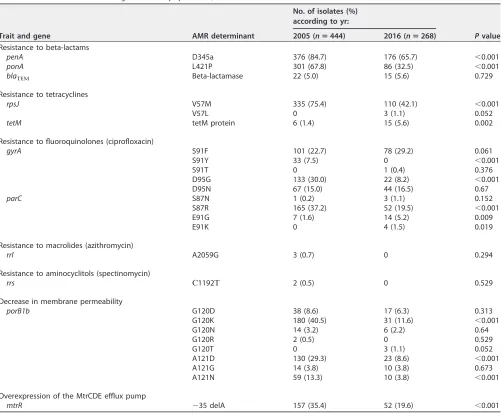
To compare AMR genetic determinants from 2005 and 2016, corresponding genomic loci related to resistance were analyzed in every isolate obtained in 2005 and 2016. The frequencies of resistance-associated determinants in the 2005 and 2016 isolates are summarized in Table 1.
In the isolates included in the study in 2005, the D345A insertion in thepenAgene was the most predominant determinant, followed by theponAL421P mutation. Double mutations in these loci were found in 298 isolates (67.1%). In contrast, 79 isolates (17.8%) carried a single resistance determinant, and 68 isolates (15.3%) were wild type onponAandpenAgenes. In 2016,penAandponAmutant alleles were less common than in 2005, andponAmutations always occurred in combination withpenA muta-tions. Hence, the percentage of wild-type isolates increased proportionally (67.9%;
P⬍0.001). This finding agrees with the trend of decreasing resistance to penicillin G in
theN. gonorrhoeae population and the changes in the ceftriaxone MIC distribution.
However, the proportion of isolates harboring theblaTEMplasmid-borne gene did not
significantly change, and these isolates were highly resistant to penicillin G.
Concerning the tetracycline-resistant isolates, the V57M substitution in therpsJgene was the sole mutation detected in 2005, whereas in 2016, the proportion of V57M mutants was decreased and few isolates with the V57L mutation were first identified. Moreover, an increase in the proportion oftetM-positive isolates with high-level resis-tance to tetracyclines was observed in 2016.
Eight different combinations of determinants associated with fluoroquinolone re-sistance were identified. In 2005, mutations in thegyrAandparCgenes were identified in 334 (75.2%) and 173 (40%) isolates, respectively. Isolates with high-level resistance typically bore the double mutation S91F/D95G in gyrA, complemented by the S87R substitution in parC. The wild-type genotype was detected in 222 (50.0%) of theN.
gonorrhoeaeisolates. In 2016, the predominant high-level resistance genotype was the
combination of S91F/D95N ingyrAand S87R inparC(this triple mutation was found in 23 of the 268 isolates [8.6%]). Comparison of the 2005 and 2016 data showed a significant decrease in the proportions of isolates harboring the S91Y, D95G, and S87R mutations, whereas other mutations persisted or were initially identified (e.g., E91K in theparCgene). The wild-type target genes were found in 163 (60.8%;P⫽0.005) of the 2016 modernN. gonorrhoeaeisolates.
Among the 2005 isolates, the A2059G mutation in the rrl gene responsible for resistance to macrolides and therrsС1192mutation associated with aminocyclitol resistance were detected sporadically in 3 and 2 isolates (0.7% and 0.5%), respectively. However, in 2016, these AMR determinants were not found.
Finally, we analyzed mutations in theporB1bandmtrR genes that led to reduced susceptibility to multiple antimicrobials. In 2005, either the G120K or A121D
on May 17, 2020 by guest
http://jcm.asm.org/
tion was found in 110 (24.8%) isolates, and the G120K and A121N substitutions were found together in 56 (12.6%) isolates. The ⫺35 delA alteration in the mtrR gene promoter was found in 157 of the 444 isolates (35.4%), and the simultaneous presence
ofporB1bandmtrRmutant alleles was detected in 128 (28.8%) isolates. In 2016, the
combination of G120K and A121D substitutions remained prevalent (17 isolates; 6.3%). A significant decrease in the proportions of G120D, G120K, A121D, and A121N substi-tutions was identified in the 2016N. gonorrhoeaepopulation relative to these propor-tions in the 2005 population. Moreover, the proportion of isolates carrying the ⫺35 delA mutation in themtrRgene promoter was decreased 2-fold in 2016, and only 27 isolates (10.0%;P⬍0.001) carried theporB1bandmtrRmutations simultaneously.
In summary, from 2005 to 2016, the proportion of isolates with a wild-type genotype increased more than 2-fold (11.7% to 30.3%;P⬍0.001), complementary to the increas-ing trend in the proportion of susceptible isolates among the modernN. gonorrhoeae
population in Russia.
DISCUSSION
[image:7.585.43.545.79.495.2]Since the RU-GASP was established in 2004, gonorrhea susceptibility testing results and epidemiological surveillance data have been published regularly in a timely TABLE 1AMR determinants inN. gonorrhoeaepopulations, 2005 versus 2016
Trait and gene AMR determinant
No. of isolates (%) according to yr:
Pvalue 2005 (nⴝ444) 2016 (nⴝ268)
Resistance to beta-lactams
penA D345a 376 (84.7) 176 (65.7) ⬍0.001
ponA L421P 301 (67.8) 86 (32.5) ⬍0.001
blaЕ Beta-lactamase 22 (5.0) 15 (5.6) 0.729
Resistance to tetracyclines
rpsJ V57M 335 (75.4) 110 (42.1) ⬍0.001
V57L 0 3 (1.1) 0.052
tetM tetM protein 6 (1.4) 15 (5.6) 0.002
Resistance to fluoroquinolones (ciprofloxacin)
gyrA S91F 101 (22.7) 78 (29.2) 0.061
S91Y 33 (7.5) 0 ⬍0.001
S91T 0 1 (0.4) 0.376
D95G 133 (30.0) 22 (8.2) ⬍0.001 D95N 67 (15.0) 44 (16.5) 0.67
parC S87N 1 (0.2) 3 (1.1) 0.152
S87R 165 (37.2) 52 (19.5) ⬍0.001
E91G 7 (1.6) 14 (5.2) 0.009
E91K 0 4 (1.5) 0.019
Resistance to macrolides (azithromycin)
rrl A2059G 3 (0.7) 0 0.294
Resistance to aminocyclitols (spectinomycin)
rrs С1192 2 (0.5) 0 0.529
Decrease in membrane permeability
porB1b G120D 38 (8.6) 17 (6.3) 0.313 G120K 180 (40.5) 31 (11.6) ⬍0.001
G120N 14 (3.2) 6 (2.2) 0.64
G120R 2 (0.5) 0 0.529
G120T 0 3 (1.1) 0.052
A121D 130 (29.3) 23 (8.6) ⬍0.001
A121G 14 (3.8) 10 (3.8) 0.673
A121N 59 (13.3) 10 (3.8) ⬍0.001
Overexpression of the MtrCDE efflux pump
mtrR ⫺35 delA 157 (35.4) 52 (19.6) ⬍0.001
on May 17, 2020 by guest
http://jcm.asm.org/
manner (20–23). In this article, we summarize the RU-GASP results over a 12-year period and reveal long-term changes inN. gonorrhoeaeAMR occurring during this period.
Based on data for 5,038 isolates identified and tested at our institution between 2005 and 2016, we report the decreasing trend in AMR to agents used in traditional gonorrhea treatment (penicillin G, tetracycline, and ciprofloxacin), which had been extremely high in previous years. Moreover, we found significant changes in theN.
gonorrhoeae genotypes because of the decreasing frequency of chromosomal AMR
determinants (including single-nucleotide polymorphisms or deletions in the penA,
ponA, rpsJ, gyrA, and parC genes) accompanied by the increasing frequency of the wild-typeporB1bgene andmtrRpromoter recovery. Currently, whether reverse muta-tions in theN. gonorrhoeaegenome or intensive distribution of the wild-type genotype caused these changes is unclear. Moreover, in the absence of selection due to the action of antimicrobial agents, these mutations harm bacterial fitness (28), thus leading to the elimination of these mutations from theN. gonorrhoeaepopulation. Surprisingly, the blaЕ and tetM determinant proportions did not change from 2005 to 2016,
indicating that plasmids inN. gonorrhoeae play a more diverse role than horizontal transfer of AMR determinants and, therefore, persist in N. gonorrhoeaeeven when selective antimicrobial pressure is relieved (29).
Emerging resistance to spectinomycin was described during the study period, with maximum resistance noted in 2011. To prevent further increases in resistance to this important antimicrobial, spectinomycin was recommended for alternative gonorrhea treatment only in regions with provenN. gonorrhoeaesusceptibility. As shown by the current results, this crisis has been overcome, and susceptibility to spectinomycin recovered to a minimum of 95%. Indeed, in 2016, we found no mutation profiles in the
rrsgene that determine high-level resistance to this antimicrobial.
Similar dynamics were found for azithromycin resistance, although complete rever-sion did not occur, and these changes cannot be explained by national guideline revisions.
During the study period, only a fewN. gonorrhoeaeisolates resistant to ceftriaxone were detected, and a comparison of the MIC distributions in 2005 and 2016 did not show emerging resistance to this antimicrobial. Moreover, the comparison of the MIC distribution in the 2005 and 2016 populations indicated increased susceptibility to ceftriaxone. Thus, our data, in agreement with recently published Euro-GASP results, show that the resistance levels to the first-line antimicrobials used to treat gonorrhea infection are, encouragingly, decreasing (30).
The incoming surveillance results show that the current AMR status in Russia is less serious than that in other WHO GASP regions and that several national features are important. First, intramuscularly administered ceftriaxone was widely used for empirical gonorrhea therapy, whereas orally administered cefixime was not introduced in med-ical practice. Perhaps this pattern prohibited the formation of resistance to third-generation cephalosporins because cefixime usage was associated with unsuccessful gonorrhea treatment cases worldwide (2, 31). Second, azithromycin has never been recommended for empirical gonorrhea treatment in Russia (except for cases with proven chlamydiosis). Simultaneous administration of azithromycin and ceftriaxone is usually justified by the slowed development of N. gonorrhoeae resistance, but no evidence-based arguments have been made. Moreover, bacterial biofilm overgrowth occurred with sub-MIC azithromycin concentrations (32), which may be a condition for AMR development in pharyngeal or rectal gonorrhea cases. Thus, the nonuse of azithromycin in Russia could also prevent the development and dissemination of N.
gonorrhoeaeresistant to first-line antimicrobials. Third, limited cross-border migration
determines the geographically restricted gonorrhea epidemiology, where some se-quence types autochthonous for Russia and susceptible to all antimicrobials (807, 1544, 1993 et al.) dominate while the international spread of multidrug-resistant genotypes (1407 et al.) is detected only sporadically (23).
The limiting factor of the RU-GASP from 2005 to 2016 was the impossibility of selective analyses of N. gonorrhoeae isolates from high-risk groups, which perhaps
on May 17, 2020 by guest
http://jcm.asm.org/
develop AMR most readily (33, 34). The current aim is to improve the program protocol in accordance with WHO standards, although data from the total population also reflect the situation in risk groups to a certain extent. Another limitation was the testing of approximately 1% of the totalN. gonorrhoeaepopulation in Russia, which is compara-ble to the coverage in the United Kingdom and France, according to the 2016 Euro-GASP report (30), but requires a coverage increase of at least 5%. Improvement of these parameters and continuation of the annual control of N. gonorrhoeae AMR emergence and spread will provide efficient gonococcal infection control in Russia and minimize the risk of untreatable cases of this disease.
ACKNOWLEDGMENTS
This study was supported by a government contract of the Ministry of Health of the Russian Federation (project no. 056-00015-18-00) and Russian Science Foundation grant no. 17-75-20039 (analysis of resistance determinants using microarrays).
REFERENCES
1. World Health Organization. 2017. Global priority list of antibiotic-resistant bacteria to guide research, discovery, and development of new antibiotics. World Health Organization, Geneva, Switzerland.
2. Unemo M, Shafer WM. 2014. Antimicrobial resistance in Neisseria gon-orrhoeae in the 21st century: past, evolution, and future. Clin Microbiol Rev 27:587– 613.https://doi.org/10.1128/CMR.00010-14.
3. Unemo M, Nicholas RA. 2012. Emergence of multidrug-resistant, exten-sively drug-resistant and untreatable gonorrhea. Future Microbiol 7:1401–1422.https://doi.org/10.2217/fmb.12.117.
4. Shaskolskiy B, Dementieva E, Leinsoo A, Runina A, Vorobyev D, Plakhova X, Kubanov A, Deryabin D, Gryadunov D. 2016. Drug resis-tance mechanisms in bacteria causing sexually transmitted diseases and associated with vaginosis. Front Microbiol 7:747.https://doi.org/ 10.3389/fmicb.2016.00747.
5. Lindberg R, Fredlund H, Nicholas R, Unemo M. 2007. Neisseria gonor-rhoeae isolates with reduced susceptibility to cefixime and ceftriaxone: association with genetic polymorphisms in penA, mtrR, porB1b, and ponA. Antimicrob Agents Chemother 51:2117–2122.https://doi.org/10 .1128/AAC.01604-06.
6. Muhammad I, Golparian D, Dillon JA, Johansson A, Ohnishi M, Sethi S, Chen SC, Nakayama S, Sundqvist M, Bala M, Unemo M. 2014. Character-isation of blaTEMgenes and types of beta-lactamase plasmids in Neisseria gonorrhoeae—the prevalent and conserved blaTEM-135has not recently evolved and existed in the Toronto plasmid from the origin. BMC Infect Dis 14:454.https://doi.org/10.1186/1471-2334-14-454.
7. Hu M, Nandi S, Davies C, Nicholas RA. 2005. High-level chromosomally mediated tetracycline resistance in Neisseria gonorrhoeae results from a point mutation in the rpsJ gene encoding ribosomal protein S10 in combination with the mtrR and penB resistance determinants. Antimi-crob Agents Chemother 49:4327– 4334.https://doi.org/10.1128/AAC.49 .10.4327-4334.2005.
8. Turner A, Gough KR, Leeming JP. 1999. Molecular epidemiology of tetM genes in Neisseria gonorrhoeae. Sex Transm Infect 75:60 – 66.https://doi .org/10.1136/sti.75.1.60.
9. Vernel-Pauillac F, Hogan TR, Tapsall JW, Goarant C. 2009. Quinolone resistance in Neisseria gonorrhoeae: rapid genotyping of quinolone resistance-determining regions in gyrA and parC genes by melting curve analysis predicts susceptibility. Antimicrob Agents Chemother 53: 1264 –1267.https://doi.org/10.1128/AAC.01104-08.
10. Galimand M, Gerbaud G, Courvalin P. 2000. Spectinomycin resistance in Neisseria spp. due to mutations in 16S rRNA. Antimicrob Agents Chemother 44:1365–1366.https://doi.org/10.1128/AAC.44.5.1365-1366.2000. 11. Jacobsson S, Golparian D, Cole M, Spiteri G, Martin I, Bergheim T, Borrego
MJ, Crowley B, Crucitti T, Van Dam AP, Hoffmann S, Jeverica S, Kohl P, Mlynarczyk-Bonikowska B, Pakarna G, Stary A, Stefanelli P, Pavlik P, Tzelepi E, Abad R, Harris SR, Unemo M. 2016. WGS analysis and molecular resistance mechanisms of azithromycin-resistant (MIC ⬎2 mg/L) Neisseria gonor-rhoeae isolates in Europe from 2009 to 2014. J Antimicrob Chemother 71:3109 –3116.https://doi.org/10.1093/jac/dkw279.
12. Olesky M, Zhao S, Rosenberg RL, Nicholas RA. 2006. Porin-mediated antibiotic resistance in Neisseria gonorrhoeae: ion, solute, and antibiotic
permeation through PIB proteins with penB mutations. J Bacteriol 188: 2300 –2308.https://doi.org/10.1128/JB.188.7.2300-2308.2006.
13. Veal WL, Nicholas RA, Shafer WM. 2002. Overexpression of the MtrC-MtrD-MtrE efflux pump due to an mtrR mutation is required for chromosomally mediated penicillin resistance in Neisseria gonor-rhoeae. J Bacteriol 184:5619 –5624.https://doi.org/10.1128/JB.184.20 .5619-5624.2002.
14. Kubanov AA, Leinsoo AT, Chestkov AV, Dementieva EI, Shaskolskiy BL, Solomka VS, Gryadunov DA, Deryabin DG. 2017. Drug resistance muta-tions and susceptibility phenotypes of Neisseria gonorrhoeae isolates in Russia. Mol Biol (Mosk) 51:431– 441. (In Russian.)https://doi.org/10.7868/ S0026898417030119.
15. Balashov S, Mordechai E, Adelson ME, Gygax SE. 2013. Multiplex bead suspension array for screening Neisseria gonorrhoeae antibiotic resis-tance genetic determinants in noncultured clinical samples. J Mol Diagn 15:116 –129.https://doi.org/10.1016/j.jmoldx.2012.08.005.
16. World Health Organization. 2012. Global action plan to control the spread and impact of antimicrobial resistance in Neisseria gonorrhoeae. World Health Organization, Geneva, Switzerland.
17. Tapsall J, World Health Organization. 2001. Antimicrobial resistance in Neisseria gonorrhoeae. World Health Organization, Geneva, Switzerland. 18. Cole MJ, Unemo M, Hoffmann S, Chisholm SA, Ison CA, van de Laar MJ. 2011. The European gonococcal antimicrobial surveillance programme, 2009. Euro Surveill 16:pii⫽19995.
19. Unemo M, Ison CA, Cole M, Spiteri G, van de Laar M, Khotenashvili L. 2013. Gonorrhoea and gonococcal antimicrobial resistance surveillance networks in the WHO European region, including the independent countries of the former Soviet Union. Sex Transm Infect 89:iv42–iv46.
https://doi.org/10.1136/sextrans-2012-050909.
20. Kubanova A, Frigo N, Kubanov A, Sidorenko S, Priputnevich T, Vachnina T, Al-Khafaji N, Polevshikova S, Solomka V, Domeika M, Unemo M. 2008. National surveillance of antimicrobial susceptibility in Neisseria gonor-rhoeae in 2005–2006 and recommendations of first-line antimicrobial drugs for gonorrhoea treatment in Russia. Sex Transm Infect 84:285–289.
https://doi.org/10.1136/sti.2007.029033.
21. Kubanova A, Frigo N, Kubanov A, Sidorenko S, Lesnaya I, Polevshikova S, Solomka V, Bukanov N, Domeika M, Unemo M. 2010. The Russian gonococcal antimicrobial susceptibility programme (RU-GASP)— national resistance prevalence in 2007 and 2008, and trends during 2005–2008. Euro Surveill 15:pii⫽19533.
22. Kubanova A, Kubanov A, Frigo N, Solomka V, Semina V, Vorobyev D, Khairullin R, Unemo M. 2014. Russian gonococcal antimicrobial suscep-tibility programme (RU-GASP)–resistance in Neisseria gonorrhoeae dur-ing 2009-2012 and NG-MAST genotypes in 2011 and 2012. BMC Infect Dis 14:342.https://doi.org/10.1186/1471-2334-14-342.
23. Kubanov A, Vorobyev D, Chestkov A, Leinsoo A, Shaskolskiy B, Demen-tieva E, Solomka V, Plakhova X, Gryadunov D, Deryabin D. 2016. Molec-ular epidemiology of drug-resistant Neisseria gonorrhoeae in Russia (current status, 2015). BMC Infect Dis 16:389.https://doi.org/10.1186/ s12879-016-1688-7.
on May 17, 2020 by guest
http://jcm.asm.org/
24. Clinical and Laboratory Standards Institute. 2018. Performance standards for antimicrobial susceptibility testing; 28th informational supplement. CLSI M100. Clinical and Laboratory Standards Institute, Wayne, PA. 25. Unemo M, Fasth O, Fredlund H, Limnios A, Tapsall J. 2009. Phenotypic
and genetic characterization of the 2008 WHO Neisseria gonorrhoeae reference strain panel intended for global quality assurance and quality control of gonococcal antimicrobial resistance surveillance for public health purposes. J Antimicrob Chemother 63:1142–1151. https://doi .org/10.1093/jac/dkp098.
26. Ilina EN, Vereshchagin VA, Borovskaya AD, Malakhova MV, Sidorenko SV, Al-Khafaji NC, Kubanova AA, Govorun VM. 2008. Relation between ge-netic markers of drug resistance and susceptibility profile of clinical Neisseria gonorrhoeae strains. Antimicrob Agents Chemother 52: 2175–2182.https://doi.org/10.1128/AAC.01420-07.
27. ECDC. 2012. Molecular typing of Neisseria gonorrhoeae—results from a pilot study 2010 –2011. ECDC, Stockholm, Sweden.
28. Unemo M, Althaus CL. 2017. Fitness cost and benefit of antimicrobial resis-tance in Neisseria gonorrhoeae: multidisciplinary approaches are needed. PLoS Med 14:e1002423.https://doi.org/10.1371/journal.pmed.1002423.
29. Juhas M, van der Meer JR, Gaillard M, Harding RM, Hood DW, Crook DW. 2009. Genomic islands: tools of bacterial horizontal gene transfer and
evolution. FEMS Microbiol Rev 33:376 –393. https://doi.org/10.1111/j .1574-6976.2008.00136.x.
30. ECDC. 2018. Gonococcal antimicrobial susceptibility surveillance in Eu-rope, 2016. ECDC, Stockholm, Sweden.
31. Lewis DA. 2014. Global resistance of Neisseria gonorrhoeae: when theory becomes reality. Curr Opin Infect Dis 27:62– 67.https://doi.org/10.1097/ QCO.0000000000000025.
32. Mart’ianov SV, Zhurina MV, El’-Registan GI, Plakunov VK. 2015. Activation of formation of bacterial biofilms by azithromycin and prevention of this effect. Mikrobiologiia 84:27–36. (In Russian.)
33. Mason PR, Gwanzura L, Latif AS, Marowa E, Ray S, Katzenstein DA. 1997. Antimicrobial resistance in gonococci isolated from patients and from commercial sex workers in Harare, Zimbabwe. Int J Antimicrob Agents 9:175–179.
34. Kirkcaldy RD, Zaidi A, Hook EW, 3rd, Holmes KK, Soge O, del Rio C, Hall G, Papp J, Bolan G, Weinstock HS. 2013. Neisseria gonorrhoeae antimi-crobial resistance among men who have sex with men and men who have sex exclusively with women: the gonococcal isolate surveillance project, 2005–2010. Ann Intern Med 158:321–328. https://doi.org/10 .7326/0003-4819-158-5-201303050-00004.