http://dx.doi.org/10.4236/am.2015.614207
How to cite this paper: Han, H.S. and Li, Y. (2015) A Singular Values Based Newton Method for Linear Complementarity Problems. Applied Mathematics, 6, 2354-2359. http://dx.doi.org/10.4236/am.2015.614207
A Singular Values Based Newton Method for
Linear Complementarity Problems
*
Haishan Han, Yuan Li
College of Mathematics, Inner Mongolia University for the Nationalities, Tongliao, China
Received 3 November 2015; accepted 28 December 2015; published 31 December 2015
Copyright © 2015 by authors and Scientific Research Publishing Inc.
This work is licensed under the Creative Commons Attribution International License (CC BY).
http://creativecommons.org/licenses/by/4.0/
Abstract
The existence condition of the solution of special nonlinear penalized equation of the linear com-plementarity problems is obtained by the relationship between penalized equations and an abso-lute value equation. Newton method is used to solve penalized equation, and then the solution of the linear complementarity problems is obtained. We show that the proposed method is globally and superlinearly convergent when the matrix of complementarity problems of its singular values exceeds 0; numerical results show that our proposed method is very effective and efficient.
Keywords
Linear Complementarity Problem, Nonlinear Penalized Equation, Newton Method, Singular Values
1. Introduction
Given a matrix A∈Rn n× and a vector n
b∈R , the problem of finding vectors n
x∈R such that
(
)
T
0, 0, 0
x≤ Ax b− ≤ x Ax b− = (1.1)
is called the linear complementarity problem (LCP). We call the problem the LCP (A, b). It is well known that several problems in optimization and engineering can be expressed as LCPs. Cottle, Pang, and Stone [1] [2]
provide a thorough discussion of the problem and its applications, as well as providing solution techniques. There are a large number of general purpose methods for solving linear complementarity problems. We can divide these methods into essentially two categories: direct methods, such as pivoting techniques [1][2], and iterative methods, such as Newton iteration [2][3] and interior point algorithms [4].
The penalty method has been used an LCP (or, equivalently, a variational inequality) [5][6]. The paper [7][8]
constructed a nonlinear penalized Equation (1.2) corresponding to variational inequality.
Find x Rn
λ∈ such that
[ ]
Axλ+λ xλ +=b (1.2) where
λ
>1 is the penalized parameter,[ ]
u +=max{ }
u, 0 .The nonlinear penalized problems (1.2) corresponding to the linear complementarity problem (1.1), which its research has achieved good results. Wang [9][10], Yang [11] and Li [12][13] was extended to a general form of (1.2) to present a power penalty function
[ ]
1k
Axλ+λ xλ + =b (1.3) approach to the linear complementarity problem. For the penalty Equation (1.2) Li [14] proved the solution to this equation converges to that of the linear complementarity problem when the singular values of A exceed 1 and Han [15] the interval matrix
[
A A, +λkI]
is regular. It is worth mentioning that the penalty technique has been widely used solving nonlinear programming, but it seems that there is a limited study for LCP.Some words about our notation: I refers to the identity matrix, and y∈Rn are column vectors, yT refers to
the transpose of the y, we denote by y the Euclidian norm.
[ ]
y +=max{ }
y, 0 , that generalized Jacobian[ ]
y + D y( )
∂ = , where D y
( )
denotes diagonal matrix, On the diagonal elements with component 1, 0 or[ ]
0,1σ∈ corresponding to the component of y which is positive , negative or zero, respectively.
2. Generalized Newton Method
In this section, we will propose that a new generalized Newton method based on the nonlinear penalized Equa-tion (1.2) for solving the linear complementarity problem.
Proposition 1 [15]. Axλ+λ
[ ]
xλ +=b equivalent to 0≤ ⊥z Mz+ ≥q 0, where(
)
1 1, ,
z=Axλ−b M= A+λI A− q=λA b−
Proposition 2. Axλ+λ
[ ]
xλ +=b has a unique solution if the singular values of A exceed 0.Proof: Since the singular values of A exceed 0, then A is a positive definite matrix,and A+
λ
I is positive definite, then M=(
A+λI A)
−1 is positive definite, then 0≤ ⊥z Mz+ ≥q 0 has a unique solution. □Let us note
( )
[ ]
, 1F xλ =Axλ+λ xλ +−b λ> (2.1) Thus, nonlinear penalized Equation (1.2) is equivalent to the equation F x
( )
λ =0.A generalized Jacobian ∂F x
( )
λ of F x( )
λ is given by( )
( )
F xλ A λD xλ
∂ = + .
where D x
( )
λ = ∂[ ]
xλ + is a diagonal matrix whose diagonal entries are equal 1, 0 or a real number σ∈[ ]
0,1 depending on whether the corresponding component of xλ is positive, negative, or zero. The generalizedNewton method for finding a solution of the equation F x
( )
λ =0 consists of the following iteration:( )
i( )(
i i1 i)
0F xλ + ∂F xλ xλ+ −xλ = equavelently
( )
i i1k
A λ D xλ xλ+ q
+ =
(2.2) Algorithm 1
Step 1: Choose an arbitrary initial point
0
0 n
xλ ∈R ,
ε
>0 and given λ >0 1, µ >1, σ∈[ ]
0,1 , let k: 0= ; Step 2: for the λk, computer 1k i
xλ+ by solving (2.2). Step 3: If
( ) ( )
1k k
i i
D xλ+ =D xλ , terminate. Otherwise, i= +i 1 go to step 2. Step4: If 1
k i
xλ+ <ε , terminate, x=xλi+k1 is solution of LCP. Otherwise let λk+1=µλk, 1
0
k k xλ+ =x let
: 1
3. The Convergence of the Algorithm
We will show that the sequence
{ }
1
k i
i
xλ ∞
= generated by generalized Newton iteration (2.2) converges to an ac-
cumulation point xk associated with λk. First, we establish boundness of the sequence
{ }
k ixλ for any
0
k
λ > generated by the Newton iterates (2.2) and hence the existence of accumulation point at each genera-lized Newton iteration.
Theorem 1: Suppose the singular values of M exceed 0. Then, the sequence
{ }
k ixλ generated by Algorithm 1 is bounded. Consequently, there exits an accumulation points xk such that A+λkD x
( )
k xk =b.Proof. Suppose that sequence
{ }
k ixλ is unbounded, Thus, there exists an infinite nonzero subsequence
{ }
j{ }
k k
i i
xλ ⊂ xλ such that
{ }
j k ixλ → ∞,
( )
j k iD xλ =D and D∈
[ ]
0,I where D is main diagonal element of diagonal matrix which is 1, 0,σ∈[ ]
0,1 .We know subsequence j k j k i i x x λ λ
is bounded. Hence, exists convergence subsequence and assume that
con-vergence point is x, and satisfy
(
)
jk j j k k i
k i i
x b A D x x λ λ λ λ + = .
Letting j→ ∞ yields
(
A+λkD x )
=0, x =1.Since the singular values of A exceed 0, then A is regular, and A+
λ
I is regular, we know that(
A+λkD)
−1 is exists and hence x=0, contradicting to the fact that x =1. Consequently, the sequence{ }
k i
xλ is bounded and there exists an accumulation point xk of
{ }
k i
xλ such that
( )
(
)
1k k k
x = M+λ D x − b. □
Under a somewhat restrictive assumption we can establish finite termination of the generalized Newton itera-tion at a penalized equaitera-tion soluitera-tion as follows.
Theorem 2: Suppose the singular values of A exceed 0 and
(
( )
)
1 1 2 k i k k
A λ D xλ λ −
+ < holds for all suffi-
ciently large λk, then the generalized Newton iteration (2.2) linearly converges from any starting point 0 k xλ to
a solution xk of the nonlinear penalized Equation (1.2).
Proof. Similar to the proof of Theorem 4 in [15]. □
Theorem 3: Suppose the singular values of A exceed 0 and
(
( )
)
1 1 2 k i k k
A λ D xλ λ −
+ < holds, then Algorithm
1 linearly converges from any starting point
0
0
xλ to a solution x∗ of the LCP M q
(
,)
(1.1).Proof. Similar to the proof of Theorem 5 in [15]. □
4. Numerical Experiments
In this section, we give some numerical results in order to show the practical performance of Algorithm 2.1 Numerical results were obtained by using Matlab R2007(b) on a 1G RAM, 1.86 Ghz Intel Core 2 processor. Throughout the computational experiments, the parameters were set as ε=10−8, λ =0 10,
µ
=2.Example 1: The matrix A of linear complementarity problem LCP A b
(
,)
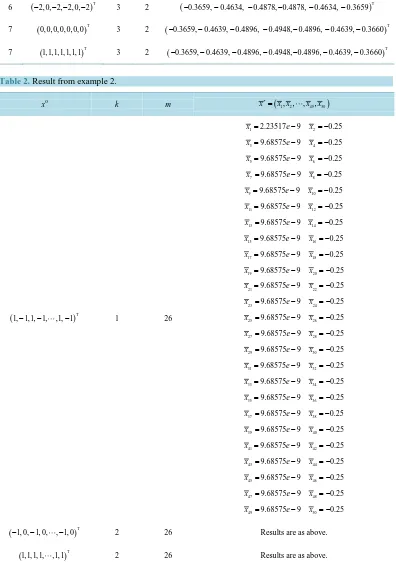
of as follows (This example ap-pears in the Geiger and Kanzow [16], Jiang and Qi [17], YONG Long-quan, DENG Fang-an, CHEN Tao [18]Table 1. Result from example 1.
n x0 k m * ( )T
1, 2, , n
x = x x x
6 (0, 0, 0, 0, 0, 0)T 3 2 (−0.3659,−0.4634,−0.4878, 0.4878, 0.4634, 0.3659− − − )T
6 (−2, 0, 2, 2, 0, 2− − − )T 3 2 (−0.3659,−0.4634,−0.4878, 0.4878,− −0.4634,−0.3659)T
7 (0, 0, 0, 0, 0, 0, 0)T 3 2 (−0.3659,−0.4639,−0.4896,−0.4948, 0.4896,− −0.4639,−0.3660)T
7 (1,1,1,1,1,1,1)T 3 2 (−0.3659,−0.4639,−0.4896,−0.4948, 0.4896,− −0.4639,−0.3660)T
Table 2. Result from example 2.
x0 k m * ( )
1, 2, , 49, 50
x = x x x x
( )T
1, 1,1, 1,− − ,1, 1− 1 26
1 2.23517 9
x = e− x2= −0.25
3 9.68575 9
x = e− x4= −0.25
5 9.68575 9
x = e− x6= −0.25
7 9.68575 9
x = e− x8= −0.25
9 9.68575 9
x = e− x10= −0.25
11 9.68575 9
x = e− x12= −0.25
13 9.68575 9
x = e− x14= −0.25
15 9.68575 9
x = e− x16= −0.25
17 9.68575 9
x = e− x18= −0.25
19 9.68575 9
x = e− x20= −0.25
21 9.68575 9
x = e− x22= −0.25
23 9.68575 9
x = e− x24= −0.25
25 9.68575 9
x = e− x26= −0.25
27 9.68575 9
x = e− x28= −0.25
29 9.68575 9
x = e− x30= −0.25
31 9.68575 9
x = e− x32= −0.25
33 9.68575 9
x = e− x34= −0.25
35 9.68575 9
x = e− x36= −0.25
37 9.68575 9
x = e− x38= −0.25
39 9.68575 9
x = e− x40= −0.25
41 9.68575 9
x = e− x42= −0.25
43 9.68575 9
x = e− x44= −0.25
45 9.68575 9
x = e− x46= −0.25
47 9.68575 9
x = e− x48= −0.25
49 9.68575 9
x = e− x50= −0.25
( )T
1, 0, 1, 0, , 1, 0
− − − 2 26 Results are as above.
( )T
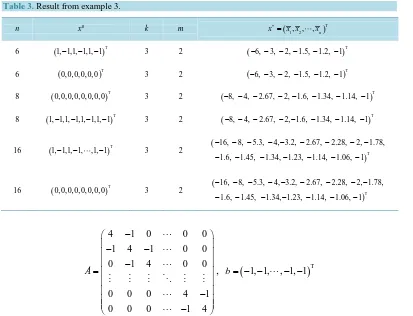
[image:4.595.117.513.151.714.2]Table 3. Result from example 3.
n x0 k m * ( )T
1, 2, , n
x = x x x
6 (1, 1,1, 1,1, 1− − −)T 3 2 (− −6, 3,−2,−1.5,−1.2,−1)T
6 (0, 0, 0, 0, 0, 0)T 3 2 (− −6, 3,−2,−1.5,−1.2,−1)T
8 (0, 0, 0, 0, 0, 0, 0, 0)T 3 2 (− −8, 4,−2.67,− −2, 1.6,−1.34,−1.14,−1)T
8 (1, 1,1, 1,1, 1,1, 1− − − −)T 3 2 (− −8, 4,−2.67,− −2, 1.6,−1.34,−1.14,−1)T
16 (1, 1,1, 1,− − ,1, 1− )T 3 2 (
)T 16, 8, 5.3, 4, 3.2, 2.67, 2.28, 2, 1.78, 1.6, 1.45, 1.34, 1.23, 1.14, 1.06, 1 − − − − − − − − −
− − − − − − −
16 (0, 0, 0, 0, 0, 0, 0, 0)T 3 2 (
)T 16, 8, 5.3, 4, 3.2, 2.67, 2.28, 2, 1.78, 1.6, 1.45, 1.34, 1.23, 1.14, 1.06, 1 − − − − − − − − −
− − − − − − −
4 1 0 0 0
1 4 1 0 0
0 1 4 0 0
0 0 0 4 1
0 0 0 1 4
A
−
− −
−
=
−
−
, b= − −
(
1, 1,, 1, 1− −)
TThe computational results are shown inTable 1. This 0
x is initial point, k is number of inner iterations, the outer iteration number is m, x∗ is iteration results.
Example 2: The matrix A of linear complementarity problem LCP A b
(
,)
of as follows:4, 1, 2, 3, , 50
1, 1, 1, 2, , 49
10, 1, 2, 3, , 50 ij
i j
a j i i
j i i
= =
= − = + =
= − =
, b=
(
1, 1,1, 1,− − ,1, 1−)
Optimal solution of this problem is x∗=
(
2.23517e− −9, 0.25, 9.68575e−9,, 0.25, 9.68575− e− −9, 0.25)
T. The computational results are shown inTable 2. This x0 is initial point, k is number of inner iterations, the outer iteration number is m, x∗ is iteration results.Example 3: The matrix A of linear complementarity problem LCP A b
(
,)
of as follows (This example ap-pears in the Geiger and Kanzow [16], Jiang and Qi [17], YONG Long-quan, DENG Fang-an, CHEN Tao [18]and Han [15]):
1 2
diag , , ,1
A
n n
=
,
(
)
T
1, 1, 1, ,1, 1 b= − − − −
The computational results are shown inTable 3. This x0 is initial point, k is number of inner iterations, the outer iteration number is m, x∗ is iteration results.
References
[1] Cottle, R.W., Pang, J.-S. and Stone, R.E. (1992) The Linear Complementarity Problem. Academic, Boston.
[2] Han, J.Y., Xiu, N.H. and Qi, H.D. (2006) Nonlinear Complementarity Theory and Algorithms (in Chinese). Shanghai Science and Technology Publishing House, Shanghai.
http://dx.doi.org/10.1007/978-1-4757-2825-5
[4] Kojima, M., Megiddo, N., Noma, T. and Yoshise, A. (1991) A Unified Approach to Interior Point Algorithms for Li-near Complementarity Problems. Lecture Notes in Computer Science, Springer-Verlag, New York, Berlin.
http://dx.doi.org/10.1007/3-540-54509-3
[5] Friedman, A. (1982) Variational Principles and Free-Boundary Problems. Wiley, New York.
[6] Elliott, C.M. and Ockendon, J.R. (1982) Weak and Variational Methods for Moving Boun-dary Problems. Pitman Pub-lishing, London.
[7] Glowinski, R. (1984) Numerical Methods for Nonlinear Variational Problems. Springer-Verlag, New York, Berlin, Heideberg, Tokyo.
[8] Bensoussan, A. and Lions, J.L. (1982) Applications of Variational Inequalities in Stochastic Control. North-Holland, Amsterdam.
[9] Wang, S., Yang, X.Q. and Teo, K.L. (2006) Power Penalty Method for a Linear Complementarity Problems Arising from American Option Valuation. Journal of Optimization Theory and Applications, 129, 227-254.
http://dx.doi.org/10.1007/s10957-006-9062-3
[10] Wang, S. and Huang, C.S. (2008) A Power Penalty Method for Solving a Nonlinear Parabolic Complementarity Prob-lem. Nonlinear Analysis, 69, 1125-1137. http://dx.doi.org/10.1016/j.na.2007.06.014
[11] Wang, S. and Yang, X.Q. (2008) Power Penalty Method for Linear Complementarity Problems. Operations Research Letters, 36, 211-214.http://dx.doi.org/10.1016/j.orl.2007.06.006
[12] Li, Y., Han, H.S., Li, Y.M. and Wu, M.H. (2009) Convergence Analysis of Power Penalty Method for Three Dimen-sional Linear Complementarity Problem. Intelligent Information Management Systems and Technologies, 5, 191-198.
[13] Li, Y., Yang, D.D. and Han, H.S. (2012) Analysis to the Convergence of the Penalty Method for Linear Complemen-tarity Problems. Operations Research and Management Science, 21, 129-134. (In Chinese)
[14] Li, Y., Han, H.S. and Yang, D.D. (2015) A Penalized Equation Based Generalized Newton Method for Solving Linear Complementarity Problems. Numerical Mathematics: A Journal of Chinese Universities, 37, 53-70. (In Chinese)
[15] Han, H.S. and Lan-Ying (2015) An Interval Matrix Based Generalized Newton Method for Linear Complementarity Problems. Open Journal of Applied Sciences, 5, 443-449. http://dx.doi.org/10.4236/ojapps.2015.58044
[16] Geiger, C. and Kanzow, C. (1996) On the Resolution of Monotone Complementarity Problems. Computational Opti-mization and Applications, 5, 155-173. http://dx.doi.org/10.1007/BF00249054
[17] Jiang, H.Y. and Qi, L.Q. (1997) A New Nonsmooth Equations Approach to Nonlinear Complementarity Problems.
SIAM Journal on Control and Optimization, 35, 178-193. http://dx.doi.org/10.1137/S0363012994276494