An enquiry into the value of programmed learning in the
teaching of reading to slow-learning children
MARSHALL, Arthur E.
Available from Sheffield Hallam University Research Archive (SHURA) at:
http://shura.shu.ac.uk/20018/
This document is the author deposited version. You are advised to consult the
publisher's version if you wish to cite from it.
Published version
MARSHALL, Arthur E. (1973). An enquiry into the value of programmed learning in
the teaching of reading to slow-learning children. Masters, Sheffield Hallam
University (United Kingdom)..
Copyright and re-use policy
See
http://shura.shu.ac.uk/information.html
LIBRARY
F o r re fe re n c e use o n lyT h is b o o k m u s t n o t be re m o v e d fr o m th e L ib r a r y
ProQuest N um ber: 10702852
All rights reserved
INFORMATION TO ALL USERS
The q u a lity of this re p ro d u c tio n is d e p e n d e n t u p o n the q u a lity of the c o p y s u b m itte d .
In the unlikely e v e n t that the a u th o r did not send a c o m p le te m a n u s c rip t and there are missing p a g e s , these will be n o te d . Also, if m a te ria l had to be re m o v e d ,
a n o te will in d ic a te the d e le tio n .
uest
P roQ uest 10702852
Published by ProQuest LLC(2017). C o p y rig h t of the Dissertation is held by the A u tho r.
All rights reserved.
This work is p ro te c te d a g a in s t u n a u th o riz e d c o p y in g under Title 17, United States C o d e M icro fo rm Edition © ProQuest LLC.
ProQuest LLC.
789 East Eisenhower Parkway P.O. Box 1346
AN ENQUIRY INTO THE YALUE OP
PROGRAMMED LEARNING IN THE
TEACHING OF READING TO
SLOW-LEARNING CHILDREN
by
ARTHUR E MARSHALL
A thesis submitted to the Council for
National Academic Awards for the degree of
Master of Philosophy
A CICHOV/LED GEHENT S
I would like to express my thanks and gratitude to all of the
many people who have assisted me in various ways in carrying
out and bringing this study to a conclusion#
In particular I should like to thank Dr, M.F.Cleugh,
header in Education at the University of London, who so
obligingly undertook to direct my studies, a task which
necessitated that, apart from .other things, she had to make
some long and no doubt tiresome .journeys to Yorkshire to
see my research in progress. Also to Hr, J.Salt, E.A., Head
of the Department of Modern Arts at Sheffield Polytechnic, who
assisted Dr,Cleugh and who went to great pains to get the
C.Ii.A.A, to accept my thesis as a suitable one for a higher
degree study.
Next I should like to thank Mr, J.Payne, M.A. Headmaster
of the Rossington Special School who welcomed me when I asked
his permission to carry out the research for my main study
in his school and who did all in his power to facilitate my
research. To Mrs 11
.Purdy of Rossington School and the seventeen
children of her class, the latter being the willing subjects
of my study, I would also express my thanks.
To Mr,J.T.Buist,
B.Sc., Principal Of the Mexborough
College of Further Education, who permitted me to carry out
some of my subsidiary studies in the college and allowed me
access to the college records, I would record my thanks.
Lastly and especially I would record my gratitude to
to my wife■who assisted me at the Rossington School in the
testing and recording, who typed and re-typed not only this
thesis but also the numerous short programs used in the
study, and who, above all, supported me in my purpose through
P R E F A C E .
This thesis was conceived as the result of the impression made on
me, on my staff at the Milton E.S.II. Special School, and to some extent
on the hundreds of visitors who came to the school, following the
introduction of programmed instruction in the teaching of reading.
Our pragmatic approach to this, then novel technique, -proved so
effective that I felt that I should like to see it experimented with more
widely in the field of special education for the educationally sub-normal,
and with slow learners generally.
I sought to further this in a limited way by supplying local
teachers, who were interested, with photo-copies of my programs, by
describing my methods in articles in educational journals, by lecturing to
teachers and to teachers in training, and in organising courses for teachers.
In the last I was assisted by the Education Department of the West Riding.
Later, under the auspiles of the Rational Association of Remedial Teachers,
I
was. enabled to publiJjh a short book describing my methods andexperiments in some detail. (1)
I
The thesis is arranged in three parts; Fart 3- is the basis upon
which the study is founded and seeks to outline the work at the Milton
E.S.K. School which led to the two evaluation studies with which this
part concludes. Both studies are described in detail with some
supporting statistics. The first is vis a vis a teacher and the second,
along term comparison with our normal teaching methods.
Part 2, is a review of some of the theories which underlie
programmed instruction. It also considers in some detail some of the
recent research into programming variables,'particularly research
Part 3, covers all the original research carried out by me since
May 1970, commencing with my main-study at the Rossington S.S.IT.
Special School. This is followed by a further ” rate of learning”
study at Mcxborough College of Further Education and then a series
CONTENTS OF THESIS.
PREFACE.
ACiQTOVJLEDGEI-IENTS,
PART 3:. BASIS OF STUDY e
1. Introduction
2. Traditional Teaching Methods with Slow Learners*
3# First Evaluation Study at the Milton School.
A. Appendices 1 and 2.
3. Second Evaluation Study at the Milton School.
6
* Appendices 3 ^ , 3 ~md
6.
PART LI., PREPARATORY AND BACKGROUND BE
SEAR
CII.
(Learning theories and programed learning together with the
consideration of some programing variables as related bo
the teaching of slow learners)
1. Introduction. P.esearch in the Classroom.
2.Learning Theories and Programed Learning.
3. Motivation A and B.
A. Stimulus Control.
3. Re-inforcement.
6
. Schedules of Re-inforcement
7* Response Modes.
8
. Density of Responses.
9. Overt and Covert Responding.
PART ill. ORIGINAL STUDY.
I. Introduction.
MAIN STUDY Carried out at
the
Rossington
School*
3. Appendices 7jS, and 9*
h.
Subsidiary Study (i) Prompting and Confirming,
3. Appendices 10 and 11.
6
.Subsidiary Study (ii)
Group Programs. Rossington.
7. Appendices 12 and 13*
8
. Subsidiary Study (iii) Rate of Learning. Mexborough.
9* Appendices 14 and 13*
10 Subsidiary Study (iv) Spelling. Mexborough.
II. Appendices 16 and 17*
12. Subsidiary Study, (v)
Overt and Covert
Responding. Mexborough.
13. Concluding Dissertation.
INTRUDU CTIQIT
BASIS OF STUDY
" We believe in these methods,
but whether they are good or bad need not
be loft to any pedagogue’s opinion: they are open to scrutiny and
amendment. If they do not work they must be rejected or modified,
and
one thing is definite - the objects of the procedure can be specified
and we can find out if they hare been achieved.”
( Teaching Machines and Programmed Instruction." H. Kay. Pelican, 19^8.)
This inquiry into the effectiveness of programmed
learning in the teaching of reading to slow learning children will
stem from the experience I gained in The Milton- (Special 2.3.N,)-
School, from the study of records gathered during the period 195^-66
and to certain experiments and studies I made during
that period and •
during which I was the Ilead-teacher of that school.
In my book, "An Experiment in Programmed Learning
with E.'S.N. Children,"(l) I briefly described how we literally stumbled
on the technique of linear programming during the course of an intense
and protracted effort to remedy a weariness in the teaching of reading
in the school curriculum; how we studied this technique and applied it
in a controlled and systematic manner and wTith what success. V/ithin
a year of adopting the technique we managed to create a graduated
series of programmed texts aimed at teaching the beginnings of reading
and developing the skills up to a reading age of ?+.
All the children in the school, with the exception
of the reception class, who scored a reading age on the Schonell
Standardised Tests
below the age of seven were submitted to a
daily period of study with these programmed texts. Each child was
tested to find ^ut at what point in the series it should commence,
this included completing the criterion test for its initial program.
YJhen it had completed the program it was again tested. Records were
kept on wall charts (renewed terminally) showing the date on which
each program was satisfactorily completed. This visual recording, we
found.,'
tended to increase the motivation of the programs. It did not
seem to introduce an;y competitive element;
but kept before both
pupil and teacher an easily understood graphical record of the progress
of each child and it enable the teacher to set each child to the
correct point in its individual study in a matter of moments at the
commencement of each daily period.
When we had established our library of programs
and completed the building of six teaching machines, wc instituted
certain rules concerning their usage. These were conformed to
reasonably well by both teachers and pupils throughout the time
under review. The rules were
1,
That programmed study be limited to one thirty-five minute
period for any child in one day.
2.
That programs were not to be used by any child outside its
3. That only teachers would issue and replace programs.
A. That on completion of a. program the child must be tested.
3. That on the satisfactory completion of a test the teacher marked
and initialled the record.
After a settling down period the rules worked very.well with
possibly the exception of number
; here the children in their eagerness
to start work at the beginning of a session would seek to take their
own programs from the shelves. This we checked but did not entirely
eliminate.
When a pupil fai3.ed to make an acceptable attempt to read
the test after finishing a program, it was sometimes difficult to
induce him to re-work the program again. After a time we solved this
problem by making an approximately parallel.series of programs which
enabled us to switch the child who failed a test to a comparable program
in the parallel series. Still'later we introduced a third series aimed
at helping children v;ith individual problems at varying levels of
attainment. Eventually we had some five hundred or so short programs,
varying in length from ninety-six frames to twelve;., frames, in the
library.
During this period the school had a hundred children on roll,
aged from seven to fifteen, of both sexes in the proportion of approximate!
sixty boys to forty girls. The upper three-fifths of the school followed
this pattern of programmed reading study through-out the period. The
lower two-fifths, consisting of the reception class ajid class
1»followed
a somewhat different curriculum. Class 1 had its own series of programs
and used them daily, the reception class did use programmed material
but not in the regular periodic manner of the remainder of the school
so that in the statistical studies I shall put forward, they are not
included.
The pragmatic response to the question whether any new
technique for learning has virtue is ’Suck it and see
. 1When
B.F. Skinner decided to submit his psychology students to the learning
methods he had used successfully with rats and pigeons, he did just that.
At the Milton School we were not quite so drastic because we had used
linear programming methods quite unaware that Professor Skinner and
others were using similar techniques to teach animals. When we became
aware of the enormous amount of research that had been done we sought
to find out all we could about the subject and applied our learning in
the classroom.
It cannot be repeated too often that Programmed Learning is
not a subject but a technique that can be employed for the teaching of
any subject. Further, and more important, it is a technique that can
be employed to apply, more efficiently, other teaching techniques. This
was our main line of approach at Milton and before going on to exemplify
the effectiveness of programmed learning as such, I will considdr a
Programmed Learning and Traditional Teaching 'Methods.
An original and effective method of teaching reading to slow learning
children was devised by Fernald (2). The essentials of the technique are
3..
The discovery of some means by which the child can learn to write
correctly.
2.
The motivating of such writing.
3*
The reading of the printed copy of what he has
written.
4.
Extensive reading of other material.
When Fernald wrote this she might have been about to introduce
the P.L. methods and library scheme we employed a.t the Hilton school.
However, she was in fact presenting her own very individual ways of
teaching reading but she was also outlining the problem of all teachers
of reading to slow learning-children.
From 194-7 to 194-9* with a class of 9 - llyear old E.S.N.
children in a special school in London, I employed Fernald’s
techniques
daily in the teaching of reading. Many years later
when writing reading
programs I consciously and probably unconsciously incorporated some
of the subtleties of her teaching methods therein.
Teachers always have, and human nature being what it is
probab3.y always will, motivate their teaching on the ’carrot’ and
the ’stick’. Enlightened opinion and the lengthy and profound
studies on which these opinions are based have lead teachers to stress
the carrot at the expense of the stick, nevertheless we shall never
eliminate all aversive stimuli from teaching method.
Hi3.gard, commenting on Thorndike’s ‘’Law of Effect" says:
"that rewards or successes further the learning of rewarded behaviour
while punishment or failures reduce the tendency to repeat the
behaviour leading to the punishment." (3) Holland Sc Skinner’s
extended research in animal behaviour, related in some detail in
"Analysis of Behaviour" (4) confirm this.
Whatever a ’teacher may do to motivate learning in her
pupils, the environment will always provide a plethora of carrots
and sticks. We live in an authoritarian system and school often
provides an even more intensely authoritarian venue.
Social and scholastic rewards go almost entirely to the
clever and successful. The strongest argument for the existence
of special schools is probably that they can provide opportunity
for success and the consequential rewards within the school
environment. This success, it is hoped, will help to balance or offset
the continuous, though often unintended punishment, which is experienced
by slov; learners in the environment outsid: school.
In the process of learning to read the slov; learning
child needs almost continuous success reinforcement of the kind
that can be given by individual attention. Wo teacher of fifteen
or twenty slow learning children can give each of his pupils a
k
into suitable linear programs, v/hether using books, machine programs
or any
other method of presentation, he can ensure that every child
in the
class will get all the effective individual tuition he needs
in regular daily sessions. Once such a regimen is established the
teacher is freed to apply his attentions where they are most needed.
That such a learning regimen is a necessity for slov;
learners is advocated by widely separated educationists, separated
both in time and philosophy . Ingham says: "The learning process for a
child at school age may be stated:- the individual first realises
need for adjustment to the elements present in the environment, (there
is a condition of awareness.) This need directs him or guides him as
he makes responses. Second, as the individual progresses, consciousness
of success, or recognition of the right response, makes him more
definitely and understandably aware of his goal. Third, there iausl; be
sufficient recurrence for the learner to become at ease in his new form
of behaviour." (
5)
Over a quarter of a century later, the behavourist and advocate
of programmed learning, Broadbent suggests : "First emphasise
the
particular behaviour that is wanted by praising and approving every
instance of it which appears. Once the general connection has been
established, make the praise infrequent and irregular. It must not be
given at a constant average interval of time but ought to be responsive
to the child’s own actions so that the more frequent occurrence of the
behaviour will obtain more frequent reward." (
6)
Ingham from her study of the slov; learning child
defines its learning needs. Broadbent, in his exposition of behavioural
psychology applied to learningjoutlines a process through which the
child's needs can be met.
Teachers of reading to slow learning children are
faced with wide ranging problems, but the primary.and basic one is
lack of intelligence. Disputation as to whether intelligence is
mainly a genetic inheritance, or arises as a result of environmental
interaction following birth or maybe conception, will do littHe to
further the objects of teachers of the slov; learning child. The tea.ch.er
can only apply his methods v;it/iin the environment,
he can do little
or nothing to change the child’s physical or mental equipment and
his task is to help the child to make the most of that with which
he has been endowed.
Schonell (
8) describes the physical, psychological and
intellectual deficiencies to be found in the slow learning child;
but again it is obvious that there are considerable limits as to
what a teacher in a c3.assroom situation can do to remedy these.
Nevertheless, the more aware he, the teacher, is of his pupils
defects, the better he can create lessons to offset them. To
know that a child has a weakness in one or more aspects of his make-up
such as his span of perception, span of recognition, perceptual
maturity, auditory analysis, reversed laterality or far point fusion
of vision^are in varying degrees important to the teacher.
Schonell asserts that " to teach a child to read requires
a pedagogical skill of much greater degree than need to establish
the groundwork of number.” (
8) It is, therefore, fair to say that
to teach reading skills to a slov; learning child, who for various
reasons has become resistant to the subject, must call for even
greater pedagogical skills. It is my purpose here, not so much to
demonstrate new teaching skills for the teacher to learn, or even
to improve on such skills as he may possess, but to show how he can
apply his own skills more effectively and also to show how he can
apply the multitude of skills and techniques that teachers in this
field have recorded.
Schonell (
8) outlines his pattern for teaching slow learners
to read as follows
1.
Detailed diagnostic information.
2.
Types of error etc.
3.
The nature of past teaching.
*f.
Direction of present interests, educational and private.
3. ,
Inhibitions and conflicts to be dispersed.
This is, of course, good diagnostic technique*, However,
from experience I would assert that it is never possible to disperse
a child's conflicts and inhibitions
both the teacher and the
child have to learn to accomodate them. It is in this important
aspect of remedial teaching that I hope to demonstrate how P.L. can
assist by enabling the pupil to learn by evading the discriminative
stimuli which elicit the activation of these inhibitions and conflicts.
Schonell (
8) says that psychological failure can be caused
by reading failure but I would suggest that inherent psychological
weakness precedes the 3.earning failure and failure to learn to read
reinforces it. However, whatever the order of the causes, when the
child reaches a special school or a remedial centre its inability
to make any progress will arise from previous painful failures,
failures which are recalled by the very tools (books, paper, pencils
etcebera) which the teacher employs. Indeed, the very teacher, himself,
may well be an 'S '
for the painful response of his pupil. Through the
medium of P.L. the teacher can, to a considerable extent, even
eliminate himself from the pupil's learning processes.
One objection to P.L. that has been put forward is that
it is a return to 'rote learning.'
This is despite the fact that
there are few, if any, schools at any level which do not employ rote
learning in some..form hpv/ever disguised. Morris (11) remarks on the
excessive use of 'drill and rote' learning made by teachers of slov; .
■
reliance on drill and devised learning situations to let the dull child
organise insight." This is, of course, what a conscientious and
enlightened teacher is constantly doing, unfortunately the demands
,on the teacher in schools or classes for slov; learning children are
such that unless teachers do employ some kind of rote learning or
other educationally non-productive occupation, they are unable to keep
up with these demands either mentally or physically.
tyhen slow learning children have learned to copy
script of one form or another, and with them this skill invariably
comes before any purposeful skill in reading is achieved,'they seem
willing to do it for long periods of time without showing any objection
to it or making complaint. That they gain some'reward, satisfaction
or re-inforcement from it must be accepted. That it is probably a
specious reward does not detract from its effectiveness. It is probably
no more or less valuable than the diligent copying of the teacher's
notes by the student in the grammar school.
It is quite possible to insert learning situations
into copy writing or note taking for that matter, by using programmed
learning techniques. If a child is presented with a copying task of
short duration and in the course of performing it is asked to make a
response calling for an intellectual effort or decision, however simple,
then having made the response is rewarded by knowing that he has mr.de
a correct one, a learning sequence has been achieved. This is, of
course, over-sir.iplified and needs some qualification, a matter I will
deal with at some length. It does, however, exemplify my point that
rote learning, so useful to teachers in relieving them of class pressures,
can be employed to give a child, or rather help a child to achieve
'insight.* Properly prepared copy-writing can effect learning,
purposeful learning.
"If the teacher is successful in presenting problems
in so simple a way that the relatione involved are not beyond the
learner’s powers of mental organisation then the learner will be able
to exhibit direct insight and his behaviour will be recognised as
intelligent learning." (11) One linear program frame can obtain just
such a prepared learning situation in any subject or at any level of
attainment the creator may desire. A connected series of such frames
can provide a self-motivating lesson which will meet the requirements
of any individual.
Considerable research has been and is being done
in the field of 'attention' but it is mainly concerned with the
nature of attention, its span in time and space and whether we' can
attend to one , two or more things at a time. Out of such research
may come, in the future, new ways or new understandings of how we, as
teachers, can capture and contain attention in our pupils. Simone Weil
defines attention thus : "Most often attention is confused with a kind
of muscular effort. If one says to ones pupils: 'Now you must pay
attention,’
one sees them contracting'their brows, holding their breath,
stiffening their muscles. If after two minutes they are asked what they
are paying attention to, they cannot reply. They have been concentrating
on nothing. They have not been paying attention. They have been
contracting their muscles.
J
to do with work. Work itself is the useful effort, whether it is tiring
or not, this Jd.nd of muscular war effort in work is usually barren,
even if it is made with the best of intentions. Good intentions
in such cases are among those which pave the way to Hell. Studies
conducted in such a way can sometimes succeed academically from the
point of view of gaining marks and passing examinations, but that
is in spite of the effort and thanks to natural, gifts; moreover such
studies are never of any use.
Will power, the kind that, if need be, makes us set our teeth
and endure suffering, is the principal weapon of the apprentice engaged
in manual work. But, contrary to the usual belief, it has practically
no place in study. The intelligence can only be led by desire. For
there to be desire there must be joy and pleasure in the work. The
intelligence only grows and bears fruit in joy. The joy of learning
is as indispensable in study as breathing is in running. Where it is
lacliing there are no real students, but only poor caricatures of
apprentices who, at the end of their apprenticeship, will not even
have a trade." (
1 2)
If one has stood daily over a period of many years,
as I have, before assemblies of slov; learning children, observing
their behaviour, it becomes patently obvious that a common feature of
all these children is their inability to give attention to any matter
for more than the briefest period of time, unless they are strongly
and continuously motivated. It is, of course, understood by all
teachers with experience in this field of education that in their
teaching they employ all the subjects, methods and techniques which
they find do capture and hold the minds of their pupils. Like the
employment of copying, many methods used are self-defeating in that
they seem to have the power of holding attention but no purposeful
learning is contained within them. I have in mind a conscientious
teacher of many years experience who found that 'centre cane v/ork'
achieved attentive effort on the part of his pupils. Having taught
them a simple pattern they wovild go on producing table-mats or
baskets ad infinitum, hut it was not learning, it was not education.
In the course of this study I shall be continually
using the term 'learning'. I have already seated that a child
employed in copying (happily, if not purposefully employed) must
receive some reward to motivate him to continue. The teacher is
not, however, concerned with just re-inforcing this copying behaviour,
he wishes to impart in his pupils continual new behavioural changes.
He is concerned that the pupils engage in purposeful, beneficial
learning and must arrange their activities to that end. Copying
may be used to further beneficial learning and this is in itself
beneficial, it is a function of that learning process. Copying
for copying sake is, however, a time wasting process and a slov/
learner, above all, has little time to waste. Therefore, when I
use the terra 'learning' unless I explicitly indicate otherwise,
I mean the beneficial learning that a child is expected to acquire
in school not the Behaviourists' 'Acquired change in behaviour.’
Frazer outlines the units on which the beginnings
of reading may be based: (
1 3)
a. The Letter
b. The V7ord
c. The Syllable
•
There are many methods of teaching reading bat all of them must
be founded on one of the above. I-Iost teachers use combinations of methods
though they tend to stress the phonic or look.and say approach. Despite
the advocates of particular methods all children do not succeed more
easily with any particular one, therefore, a rigidly applied classroom
technique will ensure that a proportion of children will fail to learn
just because the approach does not meet with their needs. An obvious
example are those children who register at the extremes of the Au&ile-
Visile scale. The best method for any given child at any given stage
in their development can only be decided at that moment by the teacher
concerned. It must be a clinical decision.
A teacher x-;ho has created and accumulated a carefully organised
and graded collection of prepared programmed texts, such as were contained
in our program library at Kilton, is in the happy position of being able
to ensure that every single pupil in the class, no matter how varied their
attainment or ability, can be simultaneously engaged in a purposeful
learning situation appropriate to that particular child. In our programs
we covered a variety of teaching techniques and I am convinced that any
approach to reading can be embodied in a program.
Kirk and Johnson (1^) offer long lists of activities to
initiate the beginnings of reading and to improve reading at both primary
and secondary levels:
"Excursions, labelling collections, centres of interest, story
telling by both teacher and by children, story reading, discussions,
word associations with pictures, drama, booklets and scrap books, care of
books, reports on activities, making stop and go signs, playing language
games and preparing for birthday parties."
They go on to advise in some detail how to approach the
teaching of the beginning of reading;
"The children tell a story. One day it is dictated by the
children and the teacher writes on the blackboard. Next day in chart
form, the children read from the chart."
This is offered as one specific method of teaching slov;
learning or retarded children. Unfortunately neither this nor the
above mentioned activities are enough. By the time most children
reach the special school or remedial class, at the age of seven to nine,
they have experienced two to four years of such teaching and have still
failed to learn to read. There is nothing wrong with the foregoing
but it must be supported or backed up with carefully prepared follow-
up lessons ,
lessons which offer suitable individual studies to meet
each child's needs at its particular level. In short, each child
must receive individual attention from some source at regular daily
periods. This is not a requirement that can be met by putting a. child'
r-in a spec5.al group, a group small Enough for r-individual attention
y
for a natter of a few weeks or even a year; the slov; learning child
/needs this kind of tuition throughout its school years but the normal'
staffing in special schools or special classes does not and cannot provide
it.
children’s language and the program is s.lso based on it. With regard
to the later activities, programs can be created to provide follow-up
studies and I will later describe and demonstrate how this can be
done and, indeed, was done.
Gates, using a word based approach, offers this advice:(15)
’’
The setting for each new word should be carefully worked out
so •■•that the word is surrounded by such an abundance of contextual clues
that the child will figure it out easily and correctly.”
Here Gates stresses the basic requirements in preparing
learning situations for slow learners.’to achieve relatively easy
success to offset their excessive experience of failure.’
It is
also a feature of SIdLnner's
(k)linear programming technique.
Incidentally Gates goes one step further towards linear programming by
suggesting multi-choice question reading units, e.g:
This is a house
This is a hat
s~(.. —
This is a hut.
•
Had he further proposed putting such units into graduated series,
each unit followed with the correct answer, they would ha.ve been
complete teaching programs. Teaching programs are like a series of
»
carefully arranged pussies but, like puzzles, unless the puzzler
receives a reasonable amount of reward for his efforts in the form of
successful elucidation, little effort will be made in pursuing them.
The programmer, like the puzzler, must know immediately after making
his effort, the result and the program must be so prepared that
there is a high proportion of successful results. It is the reward of
knowing which leads him on to make further intellectual effort, xdiether
it is to solve another clue in a crossword puzzle or complete the
response >
demanded in the next program frame.
The basis of all teaching is a one to one situation - I
know so I teach (tell, demonstrate) that which I know, to you. This
is the ideal and this is what is meant by individual teaching. The
multitude of pupils and the scarcity of teachers negate any possibility
of achieving this in ’public’ education. Individual attention, or
rather individual teaching,cannot be provided in schools, except for
extremely short periods or else by teachers neglecting the few for
the many. Attempts are being made by using what is called 'group
teaching’
and the greater use of audio visual aids to release teachers
from the chore of class teaching and enable them to give more personal
attention to individuals. Hy experience leads me to question whether
these methods do achieve much real learning on the part of the
students. In any case, vast sums of money are being expended on these
approaches and their necessary equipment but very little is being
done to ascertain their relative efficiency.
Despite th^iear impossibility of giving all pupils
individual teaching, even in the snail classes customary in special
schools and classes, most of the advice given by writers on the
subject of teaching slov; learning children, advocate individual
attention.. The methods they suggest are excellent but because
of what I have said their application is dependent on the teacher
personally and physically applying then to each child in a class
medium.
Consider the logic of the situation. A teacher with a class of
twenty slov; learning children, teaching them reading throughout the
period.of an hour. Supposing that by some extraordinary feat of
organisation she could give each child its fair share of three, minutes
of her timev, there would still be the need to contain each child in
fifty-seven minutes of self-tuition. The sheer impossibi3.ity of it
becomes apparent when one considers it in this way and it is little
v;onder that these unfortunate children, despite the time and enthusiasm
expended by thousands of conscientious teachers, make so little progress.
Nevertheless, only an individual approach can succeed if diagnosis
as suggested by Schonell (
8) is to be the basis of a remedial method.
He re-iterates what others in this field of'remedial education are
repeatedly
saying:-11
Thus progress in reading in the infant and junior classes
becomes a basic intellectual and emotional failure... resulting
frequently in general scholastic backwardness and emotional maladjustment.” (
8)
Like Burt, Schonell advises the teacher to look for* what are
psychological and physical failures such as 'span of perception',
'span of recognition' and disproportionate right and left eye movement.
Like Fernald he confirms the need to impress word patterns.
"The first obvious factor in the reading of a word is its total
pattern. Early words should have variety of structure.” (
8) My own
experience is that early words should be derived from the verbal
language of the child itself. In creating my early reading programs I
found that the most effective beginning words were those nouns which
could be presented with a simple line picture. Names of very familiar
objects, particularly toys, probably because of their emotional content.
One had to be very careful to use the name the picture wovild elicit when
ithe child looked at it and responded. Word shape patterns can be used
to assist slov; learning children to differentiate easily but they are
essentially subordinate to word fami3J_arity and usage • What is of
primary importance is that teachers must know and understand the childrens'
basic speech language and found his teaching of reading on this.
Schonell makes this point: (
8)
"It is safe to say that unless the printed word is linked with
the sound which finds place in the speech experience of the child, then
it will not be retained.” 'With the slov; learning child of seven, eight,
nine or upwards,
it is past the time when it is advisable to v:ait until
a wider' speech vocabulary has been acquired. The teacher must use
what the child already has, no majgter hov; meagre, and employ it.
"The short cut betv:een visual symbols and meaning does not
■really develop until reading experience is considerable.” (
8) This
may be so for all children as Schonell's statement- implies; it is
certainly the case with slov; learning children. There are at least two
v;ays in which this development can be assisted and possibly accelerated.
First, there must be much repetitive reading, much more than is usually
considered necessary. As soon as a child has achieved a little reading
ability he must be given plenty; of opportunity to enjoy the skill.
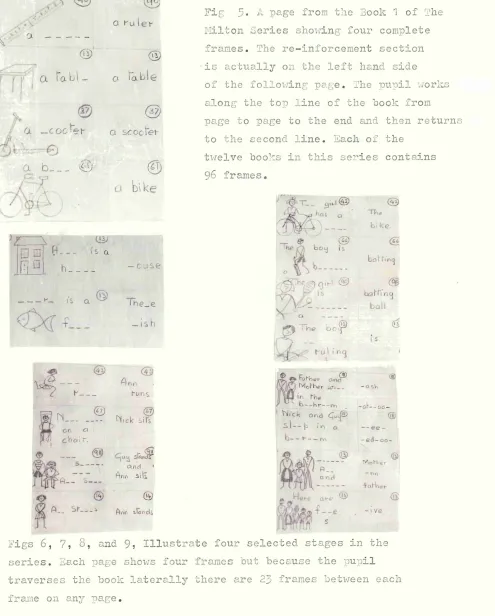
In creating the first series of 'Milton Programmed Headers' (16)
we employed some twenty nouns, (names of toys mainly) and presented
(
15
)
The second process which we found helped the child in this
aspect of its development can be best grasped if one. considers the
way in which a child learns to
respond to an object with its name, as
when it names a ball or
a dog. The second step, so often in the case
of deprived children, is when the mother, usually, shows the child
pictures and asks it to name them. At this point we found that it was better
to associate the word not with a realistic picture or whotograph but
•with
v.very simple line drawing, something very similar to that which
the child might try to draw. These drawings should be such that they
can easily be copied by
the child.
This need to
help a slov; learning child to express itself,
to put its conceptual ideas on paper by giving it pictorial symbols
which it can recognise and copy long before.they can be expected to
understandably copy script, became evident to me in the course of
studying E.S.il. children’s art in some London schools, during 195& “57* (2?)
I found that where a. normal child in the primary schoo3. e.sked, say,
to draw a horse will produce an easily recognisable drawing, few children
under the age of ten in E.S.N, schools could do so.
Earlier in this introduction I outlined the organisation
of our programmed reading scheme at Hilton School. I have stressed
that P.L. is not a subject or an educational philosophy, but a tool.
Taking our methods, together with some of those proffered by A.I. Gates
it might seem that we were applying his methods via the medium of
P.L. ,
and to some extent I suppose we were. "We learn by means of
re-acting; we learn the re-actions we exercise.” Here is the very
behaviour of a student applying himself to a program frame. But Gates
goes on to suggest some card activities, the weaknesses of which are
exemplified in that they fail to meet Grates' next dictum... "The
need of definite, refined, foolproof guidance of the young learner
in such complex and subtle skills as reading.” Any card system by
yj
its very nature fails to be foolproof - too much is demanded of the
teacher in ensuring that the right card or set of cards in the correct
sequence is presented to each individual child at the moment it is
required. If a system is not foolproof then it can be neither definite
or refined because both these qualities are lost if the system does
not ensure absolute orderly rjresentation at the right moment.
Gates advocates "graphic progress charts," he asserts
that nothing succeeds like observed success. We certainly found
that graphic wall charts recording progress had considerable
motivating effect and used them, but the real evidence that "nothing
succeeds like observed success" was the inherent motivation of the
programs, wherein the children felt and enjoyed their success at almost
every step.
has achieved mastery of each step (each frame). Host teaching
machines provide this by one method or another*, in the case of
book programs we found it necessary to insist that the pupil
recorded its response, checked it with the answer and corrected
it when wrong.
"Provision for individual differences - reserve
material for slov; readers." (15)
Our carefully organised library
of programs was designed to cater for individual differences and
supplementary programs together with alternative series provided
forthose who could not adjust to the pace of our basic graduation.
There were occasions when we found it necessary to write a special
program to meet the needs of a.n individual. These sometimes
provided points of growth in our series.
"Provision for development for all phases of silent
reading without oral directions and without phonetic or other
auditory or other oral methods."
This was fundamental tc our
scheme and had much to do with our success. Each program was
written and illustrated in such a manner that a child could read
and respond to its demand with practically no assistance from the
teacher. The small steps which led one frame to the next were such
that it was,almost impossible for the pupil to fail. The non-reading
child was enabled to read and to know that' it was reading. It was
led to acquire a reading skill matching a substantial portion of
its speaking vocabulary. Later, by means of illustrations, it
was possible to introduce words which were known to the pupil but
seldom, if ever used. It was also possible to extend the child’s
vocabulary but here, because we were unable to afford to purchase
the expensive audio teaching machines which were coming onto the
market at that time, it was necessary to integrate the programming
with orthodox teaching rather more closely then usual. In
adapting one series of my programs for publication to.make them
suitable for remedial teaching in normal schools I solved the
problem in the following manner. The series comprised six books.
Each book was sub-divided into seven sets or short programs of
twenty-four frames. At the commencement of each ’set’
any new
words introduced in that set which could not be clearly illustrated,
were listed. A symbol of a hand directed the child to seek the
assistance of the teacher who would then teach the nhild verbally
the one or two non-illustratable words before he essayed the set.
Today, student teachers are instructed, even
exhorted, to allow children to learn at their own-pace.
On the
J
other hand the amount of knowledge necessary to become viable in
society and to maintain onete place therein, becomes greater daily.
This leads even teachers of slov; learning children to seek-ways
to accelerate the speed of their pupils’
learning. In this,
paradoxical situation Levinson (17) sounds a note of warning.
" The child should not be forced beyond his capabilities or
absorbtive powers. Too much pressure may produce an emotional block
that will interfere with mental development."
A linear program with a slew rate of introduction of •
new v/ords and concepts, its long repetitive seqii.ences and
continuous re-inforcement,
frame by frame,
is an ideal medium or
than sufficient,
indeed, in some cases children had to be restrained
from giving more than the allotted time to programmed material.
"The principle of self-activity - to act for oneself and
to find out for oneself, is in the lower stages of special teaching
the sole means of mailing children educable." (lo) To present a
child with a short series of.
dens.nds, each of which requires the child
to. look at a picture, a picture which-will surely elicit the word
subscribed to it, is to provide the child with a series of
opportunities of acting for itself. By confirming each act as it is
completed makes each a learning situation.
" The feeble minded child re-acts but slightly to
external stimuli, stores up few images and lacks sufficient power
of attention to create them clearly and vividly." (18) Bescoudres
defines in one sentence, a fundamental deficiency to be found in all
slov; learning children, in varying degrees. A deficiency of which
all teachers of these children soon become aware but one which they
do not find it easy to remedy.
If one takes a group of normal, lively chi.ldren on
a learning expedition, say, into a park for tree recognition, one
can return to the classroom with a few leaves and fruits and be sure
of a lively discussion. Enough will have been learned to ensure this
fruitful consequence. Such is not the case with slov; learning
children. To achieve a comparable amount of learning the expedition
would have to be repeated many times. This, in effect, deprives the
dull child of learning experience because of the time element.
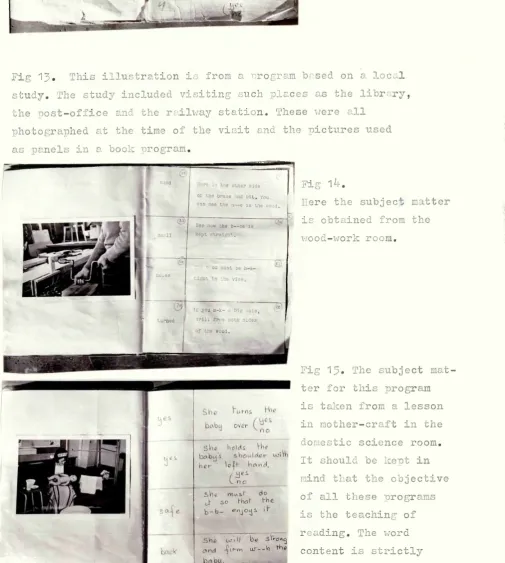
However, the expedition photographed and turned into a simple linear
program can repeat the experience as often as the child can accept it.
At Milton we found that such programs, especially where the photograph
inclvided the children, were highly motivated.
"We act as masters and lead the child, whereas it is he
ought to lead us. We set up methods we desire to remain fixed and
immutable end we forget that it is impossible since there is no
single type of intelligence and capacity. Teaching methods, ought
on the contrary, to be elastic, to submit to modifications, to
adapt themselves to all kinds of mentality, but especially to the
least fortunate - those who are afflicted with some defect or
deficiency - with more consideration and more careful handling. We
are clumsy, therefore, we are on the wrong track. If we are to
reach our goal we must take another road: we must study the child
systematically; we must find out the mechanism by which he acquires
■knowledge; we must track down the difficulties he experiences, we
must search for the causes and try what remedies will cure them."
Dr. Decroly. Pedagogy de la Lecture. (Quoted.)
(lo)
This unquestionable advice is impossible to follow
in the educational situation of slov; learning children as it is
to be found in present day organisations. If one visits a
special school or class for slov; learners, one sees much the same
£oing on as one would find in a normal school. Teachers standing
before their classes talking and demonstrating or trying to keep
each of the pupils in an active learning situation by going from
one to another. With such children the first method is very
inefficient and can .only maintain even a low standard for very
short periods. The second, as I have already shown, is a near
It has been asserted by many educationists that in learning
the child should follow its own path and that the teacher should co-ordinate
his efforts to enable the child to achieve his, the child’s, often unknown
goal. Decroly says as much. However, if the teacher is to help the
slow learner to find a way through the dense jungle of learning then
he must be prepared to cut paths so that his pupils can advance fast
enough to reach some sort of social viability by the time that their
formal education ceases.
In the field of reading each suitable pro^rnm ^il^ provide
a short pathway for some child. To pursue the analogy steps' onto the
pathway at frame one, and even though it is a so-called non-reader,
finds out that it can read. It is led from one frame to the next by
its curiosity and success. The first step rewarded leads to the next
and so on,and providing that the steps are suitably arranged, there are
no limits to the success.
Of course, because no program can be perfect
gor every child, things do not follow quite such a smooth course as this,
nevertheless, I have established the effectiveness of this approach
over and over again.
With a variety of programs available, a teacher can provide
a path to follow for each
child, at its own speed, can observe the
child systematically as it learns, can see when it fails and track
down its difficulties and put them right. This the teacher can do for
every child in the class, neglecting no-one.
In creating programs a teacher must not only consider the
content, the matter to be learned; the mechanics of reading must be
considered too. Harrison defines such things as: "narrow view,
recognition of printed and written word, accuracy, rate and span of
recognition, rhythmical eye movement and sweep of eys to the next
line.” (19) The teacher relieved of class attention can give attention
to individuals and can, in a detached manner, see where failures occur
and prepare programs to correct them.
”It is not open to the teacher to take his choice and say
either ’my pupil will learn by association of ideas' or ’my pupil will
learn by perceiving relations.’
In the last resort any learning will
be done by the pupil... by gaining some insight into the
situation." Morris (11)
Just so, but if one considers the slow
learner at the beginnings of reading, presented with two pictures, it
is possible that he will perceive relationships or find associations
between them and hence gain insight but it does not follow that learning
will take place. He still needs to be rewarded by .knowing that he is
right. If insight is to be followed or accompanied by learning, then
the child must be-aware that insight is a rewarded activity. Further,
in a school situation such rewarded activity must occur with unfailing
regularity. This can only be done if the teacher has access to a. great
deal of prepared material of considerable variety. Its preparation,
maintenance and organisation is a considerable task, as any teacher of
slow learning children is well aware. The use of P.L. can reduce this
problem to manageable proportions.
Morris says, ’’
the teacher is too active and the child
too passive... provide the situation, stimulate with questions." (
1 1)
Decroly, quoted by Descoudres preceededhim with "present eaclichild with
a situation, stimulate each child with a question, and follow each
child in its insightfulness." (18) To complete either of these learning
advices we need Skinners' dictum, "reward each child for its particular
In an attempt to justify rote learning and drills for teaching the
slov; .learning child, Burt and Lev;is assert : "Repetition changes the
•tyro’to the old hand." and advise "keep drill separate from reading."
and further "to distinguish between repetition as an improvement
process in learning and repetition as part of the achievement process." (
2 1)
I have already explained hov; it is possible to ensure that
copying and repetition can be prepared so that real learning can
take place and I cannot think hov: activities as suggested here can
be separated. As a learning process, repetition without the possibility
of improvement (which is achievement)} and awareness of improvement (
which is reward and the source of motivation) are really inseparable.
A golfer who feels that he is not making improvement
under instruction from the professional, is unlikely to persist.
The child set to study the piano becomes unwilling to practise
when he gains no reward from experienced success. Good teaching, of
any subject, aims to provide a schedule of study whereby the student
is ensured of progress and aware when it takes place.
"Enumeration, description and the interpretation is the
sequence of responses made to a picture by a young child." (
2 0)
The slov: learning child's response is unlikely to follow this pattern,
it will probably not proceed beyond enumeration. However,-the
sequence is commonly used by teachers, they lead children through by
question and answer. In a class situation where it is most commonly
used, the lesson will tend to follow the responses of the most
intelligent children. Here again we see the need for the progressive,
individual .presentation to which the pupil can make its response and know
of the result at once; a need which a program can provide better* than
anything else, excepting, of course, continuous attention from a
teacher. Even here the teaching program has advantages, it does not
tire and it will not be interrupted.
"It is cleaj? that when an individual is about to construct
or invent something, he cannot work entirely in the void. His
constructions will be determined by certain pro-formed cognitive
’schemata1. The particular 'schemata' utilised he may select at his
own whim: or more commonly he will employ those he ma.de use of
previously in similar situations. Thus he must combine perceptual
awareness and cognitive understanding of the present situation and
its requirements with the production of certain features-which
cannot be immediately cognised; they may be supplied rather slavishly
from his recollections of previous experiences which were found to
be appropriate, or they may involve a re-combination of parts, of
previous responses with new material reconstructed in a new and more
or less integrated whole." (
1 5)
To write a simple sentence will often demand 'imaginative
construction' of a very high order from a slow learning child.
How can one lead such a child into acquiring the ability of
Id
17
FIRST EVALUATION STUDY.