A Resource Reuse Scheme of D2D Communication
Underlaying LTE Network with Intercell Interference
*
Jia Liu1, Bingbing Li1, Bing Lan1, Junren Chang2
1
National key lab of ISN. Xi’an, China
2
Huawei Technol. Co., Ltd., Beijing, China Email: [email protected], [email protected]
Received June, 2013
ABSTRACT
With the growing concern on data rates and resource utilization, Device-to-Device (D2D) communication has been raised in 3GPP Long-Term Evolution (LTE) networks. In order to limit severe interference, previous studies mainly focus on intra-cell interference that between cellular links and local D2D links. In this paper, we consider both intra-cell interference and inter-cell interference between D2D and cellular links. We propose a new resource reuse algorithm that D2D users reuse the minimum interference uplink (UL) Semi-Persistent Scheduling (SPS) resources to reach the high-est throughput. The simulation results show that this scheme reduces interference as well as improves throughput.
Keywords: Device-to-device; Inter-cell Interference; Interference Reduction; Semi-Persistent Scheduling; Resource Sharing
1. Introduction
Device-to-device (D2D) communication as an underlay coexisting with cellular networks has been proposed in order to improve the utilization of the spectrum [1-4]. There are four resource allocation methods in D2D communication underlaying cellular networks: cellular mode, dedicated resource mode, reusing the resource of only one cellular user, and reusing the resources of more than one cellular user [4]. The first two modes bring no interference to system because they use orthogonal re-source. In the last two modes which belong to reuse mode, D2D users share the same resource with cellular users, so they interfere each other. The interference in-cludes intra-cell interference (the interference between attached cellular users and D2D users) and inter-cell in-terference (the inin-terference between neighbor cellular users and attached cellular users; the interference be-tween neighbor cellular users and attached D2D users; the interference between neighbor D2D users and at-tached cellular users; the interference between neighbor D2D users and attached D2D users). However, the net-work may achieve maximum resource utilization in reuse mode.
When D2D users share the downlink (DL) resource with cellular user, cellular users and neighbor cellular users may suffer from interference by D2D users, and
D2D receiver may suffer from interference by eNodeB (eNB). On the other hand, when D2D users share the uplink (UL) resource with cellular, the eNodeB is the victim of interference by D2D users, and D2D receiver may suffer from interference by cellular users and neighbor cellular users.
In order to reduce these interferences, a lot of work have been done [5-11]. In [5], Xiao xiao proposes a power optimization scheme with joint resource allocation and mode selection in an OFDM system with integrated D2D communications, aiming at optimizing downlink power consumption. In [6], Yu considers rate splitting and in-terference cancelation in D2D communication underlay-ing a cellular network. They assume that a transmitted message is split into a private and a public part, using fractions i and 1i of the total transmit power,
respectively. They also derive the optimal rate splitting factors for most of the categorized channel conditions in a two-link scenario. In [7], Janis, P. Koivunen proposes a practical and efficient scheme where the D2D terminals make power measurements during the uplink (UL) phase of the cellular network in normal operation. In [8], H. Wang and X. Chu propose a distance-constrained re-source-sharing criterion for the base station to select a cellular user for a D2D link, with the cellular-to-D2D interference controlled by keeping a minimum distance between them. In [9], the joint mode selection and power allocation scheme is proposed to maximize the utility function. In [10], Zulhasnine, M. formulates the problem
*This work was supported by the Huawei Innovation Research
of RB allocation to the D2D communication as a mixed integer nonlinear programming (MINLP), and proposes an alternative greedy heuristic algorithm to solve it. In [11], Interference Alignment (IA) is used in a D2D un-derlay network to enhance spectral efficiency. But in these papers, authors do not consider inter-cell interfer-ence to D2D users.
In this paper, we consider both intra-cell interference and inter-cell interference between D2D and cellular links in D2D reuse mode. A new resource reuse algo-rithm that D2D user reuse the UL SPS resource is pro-posed. We choose the minimum interference resource to reach high throughput. It’s shown that our algorithm can bring less interference and higher throughput.
The rest of this paper is organized as follows. In Sec-tion 2 we give the system model of D2D communicaSec-tion underlay LTE network. In Section 3, we formulate our resource algorithm and mechanism. In Section 4, some numerical results are given. Finally, some concluding remarks are drawn in Section 5.
2. System Model
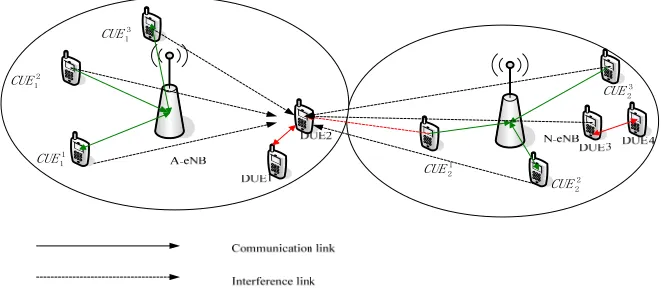
In this paper, we assume D2D users reuse LTE UL SPS (Semi-Persistent Scheduling) resource. When D2D users reuse UL resource, D2D receiver may suffer from inter-ference by attached cellular users, neighbor cellular users, and neighbor D2D users. An example of interference scenario in the uplink is given in Figure 1. CUE denotes cellular users and DUE denotes D2D users. D2D users are in anchored eNB (A-eNB) and its neighbor eNB is N- eNB. Communication links are indicated by the solid line while interference links are indicated by the dotted line. DUE2 may suffer from interference by , ,
, , , and . And when
transmit to A-eNB, A-eNB may suffer from inter-ference by , and DU . As in Figure 1 the interference of in N-eNB to D2D link is strong, so we should avoid choosing the same resource of
for D2D link.
1 1 CUE
E3
2 1 CUE 3
1 CUE
1 1 CUE
1 2 CUE
1 2 CUE
DU 2 2 CUE
E1 CU
CU 3 2 CUE
1 2 E
1 2 E
DU
E3
Some useful symbols are defined as:
,
d c
P P The transmission power of D2D user and cel-lular user
dd
G A channel gain of D2D link
cB
G A channel gain of cellular link
j i
y A binary variable which satisfies 1
j i
y if user
i and user j use the same resource
o
N Noise power at the receiver
i User device index in attached cell
User device index in neighbor cell j
Considering intra-cell interference and cell inter-ference, the UL SINR of D2D link and cellular link can be expressed by:
0
UL d dd
d d d D
i i id j j jd d d dd
i j d
P G
N y PG y P G y P G
(1)0
c c cB
eNB c d c
i i iB i d dd j j jB
i d j
P G
N y PG y P G y P G
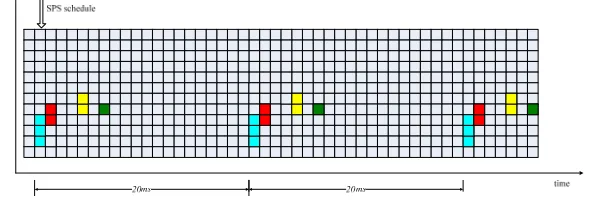
(2)Because SPS resource has its own regularity, we choose it to reuse. SPS is a feature that significantly duces control channel overhead for applications that re-quire persistent radio resource allocations such as VoIP. It means that the size of packets and the arriving time intervals are constant over a period of time, and users are allocated with resource periodically. The period length is the time that a traffic occupies resource periodically. Usually, the algorithm of resource selection might take some time. The most likely scenario is that we compute RB (i) of user A is reasonable to reuse, but cannot reuse RB (i) because this RB is not assigned to user A when starting the step of sharing resource. Using SPS resource can solve this problem due to its fixed resource assign-ment in a period of time.
1 1
CUE
2 1
CUE
3 1
CUE
1 2
CUE
2 2
CUE
3 2
[image:2.595.133.465.576.721.2]CUE
Taking typically VoIP as an example, the packets ar-riving time interval is 20 ms. eNB gives SPS scheduling indication to users through PDCCH, then users can transmit or receive data in this schedule and transmit or receive new VoIP data on the same resource after every 20 ms. The SPS resource schedule is given in Figure 2.
In this paper, we assume eNBs can exchange SPS re-source allocation information through X2 interface. A-eNB controls D2D pairs reuse SPS resource, consults with N-eNBs, and measures correlates, then selects the most appropriate SPS resource to reuse.
3. Resource Reuse Algorithm Considering
Inter-cell Interference
In this section, we will describe the SPS resource reuse algorithm in details. and define D2D users. The proposed scheme is presented as follows.
DUE1 DUE2
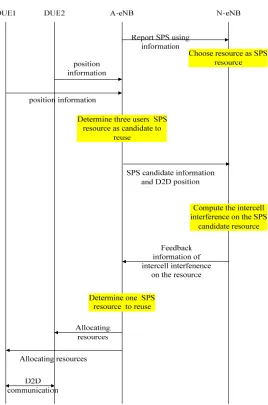
Step 1: All cellular users and D2D users register to its anchored eNB (A-eNB) and A-eNB reports its SPS re- source using information to its neighbor eNBs (N-eNBs) by interface X2.
Step 2: According to the information obtained from interface X2, N-eNBs decide which resource can be used as SPS resource. In this way, A-eNB and N-eNBs would use the same SPS resource.
Step 3: D2D users ( and ) report their position information to A-eNB.
DUE1 DUE2
The position information can be obtained from GPS (Global Position System) or A-GPS (Assisted GPS). For example, the coordinates of DUE1 and DUE2 are ( ,x y1 1),
2 2
(x y, )
d d
. If the distance between and
1,2 0 (d0 is the threshold), and the channel condi-
tion is good (we can use a detecting signal, and judge if the block error rate (BLER) is less than a threshold), they can form a D2D pair, and then go to next Step. As what is said above,
DUE1 DUE2
2
1,2 ( 2 1) ( 2 1
d x x y y)2
pairs is
(3)
Step 4: A-eNB computes the distance between cellular users and D2D users, choose n (e.g. three) maximum distance, and takes their corresponding SPS resource as candidates. The distance between cellular users and D2D
2 2
1 2 1 2
, ( ) ( )
x x y y
d x y (4)
e n SPS resource groups an
terference to neighbor D2D users on the SP
chosen users in step6 and gives feedback to A
its corresponding resource as the SPS resource to re
-eNB allocates the SPS resource group to D
: D2D ling and data can be transmitted be
of our proposed algorithm can be
l ne
as an a
2 2
c d c c
Step 5: A-eNB reports thes d D2D positions to N-eNB.
Step 6: N-eNB searches its cell for users who use the same resource, and then orders the corresponding users compute the in
S resource.
Step 7: N-eNB receives the interference information from the
-eNB.
Step 8: A-eNB searches the smallest interference and choose
use. Step 9: A 2D users.
Step 10 signa tween DUE1 and DUE2. The complete procedure illustrated in Figure 3.
It should be pointed out that, A-eNB may have severa ighbors, and we should consider several N-eNBs reality.
Taking Figure 1 ex mple. If the distance be- tween two users di j, d0 (d0 dis thre ,
an a D2D pair (DUE1, DUE2). CUE11, 2
1
CUE , CUE31 are three cellular users in A-eNB, which
are farthest to the D2D pairs. The RB groups (RBG) as- signed to them are RBG (1), RBG (3 spectively. In the neighbor cell, (CUE12,
2 2
CUE , CUE32)
use this three RB groups. A-eNB and N-eNB exchange their SPS resource allocation information through X2
erface. Assuming the transmitting power of user i is
i
P, and pathloss between c user is PLdi . Then compute
2
2 2
min{Pti /PLdi,i1, 2, 3}
and find i. So RBG (i) can be assigned to D2D p is a tance shold) they c form
G
Then D2D users can communication on this RBG.
te the performance of a hybrid system by using our idea.
(2),
ellular and RB
user i
),
and D2D
airs. int
the
4. Simulation and Performance Analysis
In this section, simulation results are shown to evalua
[image:3.595.154.451.620.722.2]Figure 3. The proposed SPS resource reuse scheme.
.1. Simulation Parameters
p-around-cell layout.
(5
where,
is the configured maximum UE transmitted powe
4
We consider a 7 hexagonal wra
Cellular users are randomly located in cells and D2D users are located in cells’ edge. When computing the inter-cell interference to D2D link, the 6 cells around should be considered. The distance between D2D users is less than 50m and the distance between two eNBs is 500m. There are 30 cellular users and 6 D2D pairs in each cell. In this simulation, the 3-sector antenna is used for each eNB. LTE power control scheme [13] is utilized by controling the power of cellular users and a constant is used to express the power of D2D users. The setting of the UE transmit power for the physical uplink shared channel (PUSCH) transmission in subframe i is defined by
PUSCH CMAX 10 PUSCH
O_PUSCH TF
( ) min{ ,10 log ( ( ))
( ) ( ) ( ) ( )}
P i P M i
P j j PL i f i
)
CMAX
P
r. ( )
PUSCH
M i
as
is the bandwidth of the PUSCH re-signment expressed in number of resource
j is a parameter composed of the sum source
blocks valid for subframe i. PO_P ( )
ell specific
USCH
of a c nominal component.
For j =0 or 1, {0, 0.4, 0.5, 0.6, 0.7, 0.8, 0.9,1} is a 3-bit cell specific parameter provided by higher layers.
e downlink pathloss estimate calculated in the UE in dB.
PL is th
( ) 10 log((2MPR K S1)PUSCH)
TF i offset
for KS 1.25
an 0d for KS0 where KS is given by the UE spe-
cific parameter deltaMCS-Enabled provided by higher layers.
PUSCH is a UE specific correction value, f i( ) ( 1) PUSCH( PUSCH)
There ar kind of th loss in a D2D scenario [12]. The path loss model between cellular users and eNB is C
e three pa
OST 231 Hata model, giving
( ) 36.7 35 lg( )
pathloss dB d (6)
The path loss between cellular users and D2D users is Xia model, giving
66.5 40 lg( ), 50
{
100.7 20 lg( ),
d d pathloss
d d 50
(7)
And the path loss between two D2D users is free space model, giving
38.4 20 lg( )
pathloss d
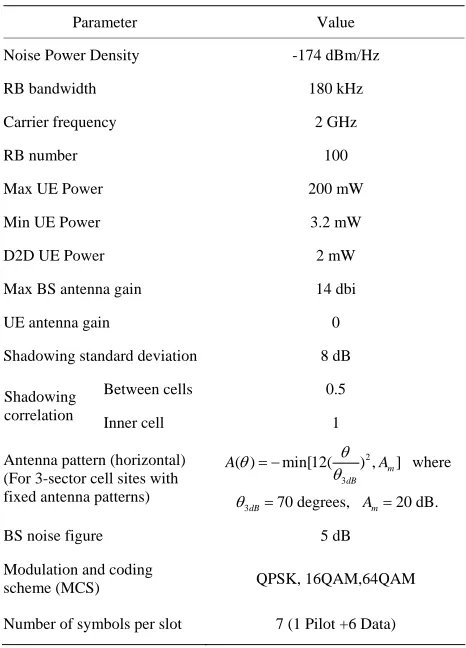
d is link distance in meter. The left parameters are pre- se
4.2. Simulation Results and Discussion
es the sum throughput of system only users and e, and the
he system throughput (8)
nted in Table 1.
s
[image:5.595.313.533.312.483.2] [image:5.595.55.288.413.737.2]We will show some simulation results to confirm our method’s advantages in this part.
Figure 4 compar
with cellular users, the system with cellular D2D users that not handle inter-cell interferenc
system with cellular users and D2D users using the proposed method. We observe that t
Table 1. System parameters.
Parameter Value
Noise Power Density -174 dBm/Hz
RB bandwidth
Carrier frequency 2 GHz
RB number
ain 14 dbi
d deviation
Antenna pattern (horizontal)
fixed antenna p
180 kHz
100
Max UE Power 200 mW
Min UE Power 3.2 mW
D2D UE Power 2 mW
Max BS antenna g
UE antenna gain 0
Shadowing standar 8 dB
Between cells 0.5 Shadowing
correlation Inner cell 1
(For 3-sector cell sites with atterns)
2 3
(
dB
( ) min[12 ) , m]
A A where
degr dB.
ure 5 dB
QPSK, 16QAM,64QA
7 ( Data)
3dB 70
ees, 20Am
BS noise fig
Modulation and coding
scheme (MCS) M
1 Pilot +6 Number of symbols per slot
can be significantly improved by usin D communi- cation. When using our resourse reuse algorithm con-
ell interfe ut is
itional algorithm.
dy is that to D2D g D2
sidering nei higher than trad
ghbor c rence, the throughp
The focus of our stu the interference
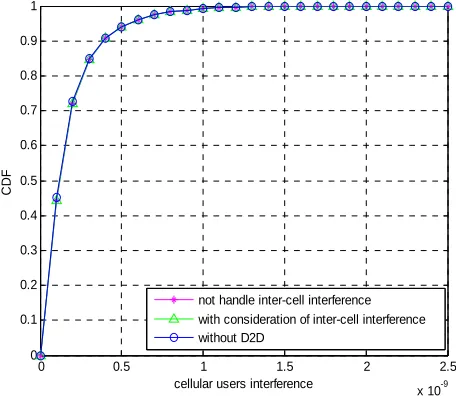
users can be reduced and the throughput of cellular do not be significantly reduced. This can be validated in Figure 5 and Figure 6. Because D2D users are distrib-uted in each cell edge and they share the same reuse with cellular users which are far from them, the interference to from D2D users to cellular users is small. Figure 7 shows the throughput per cellular user in the three cases above. It can be seen that no matter handle neighbor cell interference or not, cellular users’ throughput changes little. Figure 8 shows the interference received by cellu- lar users in the three cases above. The cellular users’ in- terference stays the same. So we can conclude that our algorithm has little effect on cellular users.
10 15 20 25 30 35 40 45
0 0.1 0.2 0.3 0.4 0.5 0.6 0.7 0.8 0.9 1
Without D2D
not handle inter-cell interference with consideration of inter-cell interference
throughput:Mbps
CD
[image:5.595.310.533.545.716.2]F
Figure 4. The sum throughput of system only with cellular users, the system with cellular users and D2D users that not handle inter-cell interference, and the system with cellular users and D2D users using the proposed method.
0 0.5 1 1.5 2 2.5
0 0.1 0.2 0.3 0.4 0.5 0.6 1
0.7 0.8 0.9
cellular users throughput:Mbps
CDF
Without D2D
not handle inter-cell interference with consideration of inter-cell interference
1
0 0.5 1 1.5 2
0.9
0.8
0.7
0.6
0.5
0.4
0.3
0.2
2.5
x 10-9 0
0.1
CD
F
not handle inter-cell interference with consideration of inter-cell interference without D2D
cellular users interference
Figure 6. The interference of cellular users.
1 2 3 4 5 6 7 8 9 10
0 5 10 15 20 25
D2D pairs number
D
2
D
us
er
s
t
hr
ou
ghput
(
M
b
ps
)
without consideration of inter-cell interference
with consideration of inter-cell interference
igure 7. The D2D throughput with D2D number changed. F
1 2 3 4 5 6 7 8 9 10
0 0.5 1 1.5 2 2.5x 10
-13
D2D pairs number
D
2D
us
er
s
i
nt
er
fer
e
nc
e
[image:6.595.58.286.87.285.2]not handle inter-cell interference with consideration of inter-cell interference
Figure 8. The interference of D2D users with D2D number changed.
To investigate the interference D2D users received, we change D2D pairs’ number from 1 to 10, and plot the D2D users’ interference (Figure 8). When D2D pairs’ number is small, the interference to D2D users is small, too. But when the number increases, D2D users may suffer from high interference by cellular users and neighbor cellular users. It’s shown that our algorithm greatly reduced the interference to D2D users.
5. Conclusions
In this paper, we proposed a new resource reuse algorithm that D2D user reuse the UL SPS resource. We consider both intra-cell interference and inter-cell interference between D2D and cellular links, and it’s more closely to practical conditions. By choosing the reasonable resource to
onal Pros-Advanced Networks,” ICC Workshops,
.
for Device-to-Device Communication Underlaying Cellular Networks,” Ve-hicular Technology Conference ), 15-18 May 2011.
s, V. Koivunen, Ribeiro, etc. “Interference-aware
reuse, the systerm throughput grows higher. Simulation results show that the proposed algorithm significantly improves systerm throughput but causes little effect to the cellular users’ throughput. When we use the proposed algorithm, the D2D throughput can be increased and the interference to D2D links is reduced.
REFERENCES
[1] K. Doppler, M. P. Rinne, P. Janis, C. Ribeiro and K. Hugl, “Device-to-Device Communications; Functi
pects for LTE-14-18 June 2009
[2] S. Hakola, T. Chen, J. Lehtomaki and T. Koskela, “De-vice-to-Device (D2D) Communication in Cellular Net-work-Performance Analysis of Optimum and Practical Communication Mode Selection,” Wireless Communica-tions and Networking Conference (WCNC), 18-21 April 2010.
[3] G. Fodor and N. Reider, “A Distributed Power Control Scheme for Cellular Network Assisted D2D Communica-tions,” Global Telecommunications Conference
(GLOBECOM 2011), 5-9 Dec. 2011.
[4] B. Wang, L. Chen, X. H. Chen, X. Zhang and D. C. Yang, “Resource Allocation Optimization
(VTC Spring
[5] X. Xiao, X. M. Tao and J. H. Lu, “A QoS-Aware Power Optimization Scheme in OFDMA Systems with Inte-grated Device-to-Device (D2D) Communications,” Ve-hicular Technology Conference (VTC Fall), 5-8 Sept. 2011.
[6] C.-H. Yu and O. Tirkkonen, “Device-to-Device Underlay Cellular Network Based on Rate Splitting,” Wireless Communications and Networking Conference (WCNC), 1-4 April 2012.
[7] P. Jani
e-constrained
Re-wer Allocation Scheme for PoRe-wer-Efficient
De-nderlaying LTE Network,” Wireless and Mobile
elecommunications (ICT), [8] H. Wang and X. Chu, “Distanc
source-sharing Criteria for Device-to-device Communica-tions Underlaying Cellular Networks,” Electronics Let-ters , Vol. 48, No. 9, 2012, pp. 528-530.
[9] M. Jung, K. Hwang and S. Choi, “Joint Mode Selection and Po
vice-to-Device (D2D) Communication,” Vehicular Tech-nology Conference (VTC Spring), 6-9 May, 2012. [10] M. Zulhasnine, C. C. Huang and A. Srinivasan, “Efficient
Resource Allocation for Device-to-Device Communica-tion U
Computing, Networking and Communications (WiMob), 11-13 Oct. 2010, pp. 368-375.
[11] Elkotby, H. E. Elsayed, Ismail and M.H., “Exploiting Interference Alignment for Sum Rate Enhancement in D2D-Enabled Cellular Networks,” Wireless Communica-tions and Networking Conference (WCNC), 1-4 April 2012, pp. 1624 -1629.
[12] X. Y. Zhu, S. Wen, etc., “A Cross-layer Study: Informa-tion CorrelaInforma-tion Based Scheduling Scheme for De-vice-to-Device Radio Underlaying Cellular Networks,” International Conference on T
23-25 April 2012.