http://dx.doi.org/10.4236/ojgen.2016.62005
How to cite this paper: Bibinu, B.S., Yakubu, A., Ugbo, S.B. and Dim, N.I. (2016) Computational Molecular Analysis of the Sequences of BMP15 Gene of Ruminants and Non-Ruminants. Open Journal of Genetics, 6, 39-50.
http://dx.doi.org/10.4236/ojgen.2016.62005
Computational Molecular Analysis
of the Sequences of BMP15
Gene of Ruminants
and Non-Ruminants
Bwaseh S. Bibinu1*, Abdulmojeed Yakubu2*, Steven B. Ugbo1, Ndu I. Dim1
1Department of Animal Breeding and Physiology, University of Agriculture Makurdi, Makurdi, Nigeria
2Department of Animal Science, Faculty of Agriculture, Nasarawa State University, Keffi, Shabu-Lafia Campus,
Lafia, Nigeria
Received 26 January 2016; accepted 3 June 2016; published 6 June 2016
Copyright © 2016 by authors and Scientific Research Publishing Inc.
This work is licensed under the Creative Commons Attribution International License (CC BY).
http://creativecommons.org/licenses/by/4.0/
Abstract
Bone morphogenetic protein 15 (BMP15) is a member of the transforming growth factor β (TGFβ) super family that is expressed by oocytes and plays key roles in granulosa cell development and fertility in animal. This study investigated the molecular genetic variation of BMP15 gene of some selected mammalian species with a view to providing relevant genetic information for breeding and selection programmes in the studied species using computational methods. A total of thirty seven (37) BMP15 nucleotide sequences comprising goats (18), sheep (6), cattle (6), swine (4) and chicken (3) were retrieved from the GenBank. Sequence alignment, translation and comparison of the BMP15 gene of the various species were done with ClustalW. High degree of polymorphism of BMP15 gene was observed among the studied species. The significant value (P < 0.01) for relative proportions of non-synonymous substitutions per non-synonymous site (dN) and the number of synonymous substitutions per synonymous site (dS) symbolized that non-synonymous sites evolved faster than the synonymous sites and positive selection effect over shadowed purifying selection. Functional analysis of missense mutations using PROVEAN showed that twelve amino acid substi-tutions (L10S, W13A, E20L, V28S, P31R, P31G, P40Q, L42W, Q46N, A52V, R58C and G64T) in goats, nine in sheep (H21R, S32R, I33A, A39W, Q46W, E51A, G54S, R61D and E72A), six in cattle (Q30M, T41W, E50R, I62R, H65E, and E72S), seven in swine (I7L, T9I, V33I, L35H, C40P, R46P and Q61R) and five in chickens (A20H, L27H, W43L, A47P and G50Y) appeared beneficial. The phylogenetic trees from nucleotide and amino acid sequences revealed the close relatedness of members of the bo-vidae family (goat, sheep and cattle). The present information could guide future efforts involving
selection of markers of fecundity to improve genetically livestock species in Nigeria.
Keywords
BMP15, Sequences, SNPs, Phylogeny, Ruminants, Non-Ruminants
1. Introduction
One of the strides towards increased productivity of protein of animal origin is to have an in-depth knowledge of the genes associated with reproduction especially those related to ovulation and litter size. Identifying genes of major effect is also a prerequisite which offers the opportunity to improve production efficiency, product quality and product diversity in livestock industry, through utilizing them in breeding programs [1]. Most mutations in proteins are associated with diseases; only a small number of examples show the heterozygote advantage. A good example is the Bone morphogenetic protein 15 (BMP15)gene, which is identified to be related with fe-male fecundity in several animals [2]. BMP15 is a member of the transforming growth factor β (TGFβ) super-family that is expressed by oocytes and play key roles in granulosa cell development and fertility in animal models along with growth differentiation factor 9 (GDF9). It is one of the major causal mechanisms underlying either the highly prolific or infertile phenotypes of several sheep breeds [3] or other mammalian species includ-ing man [4]. Since BMP15 plays important role in prolificacy and fertility, it therefore means that attention should be paid to the sequences of the gene (using both dry and wet lab approaches) which are usually responsi-ble for the observed phenotypic differences. A good knowledge of the sequences of this gene will help in iden-tifying the variants responsible for various factors attributed to the gene. The objective of this study, therefore, was to investigate using in-silico method, the molecular genetic variation of BMP15 gene of some ruminants (cattle, sheep and goats) and non-ruminants species (swine and chicken) with a view to providing relevant ge-netic information for marker assisted selection in the studied species.
2. Materials and Methods
2.1. Sequences of Species
A total of thirty seven (37) BMP15 nucleotide sequences comprising goats (18), sheep (6), cattle (6), swine (4) and chicken (3) were retrieved from the GenBank (NCBI) (www.ncbi.nlm.nih.gov). The Genbank accession numbers of the sequences are JF824149.1, JF824148.1, NM001285588.1, JQ350892.1, JQ350891.1, JQ350090.1, HM462258.1, HM462255.1, HM462254.1, FJ429281.1, GU732196.1, EU743938.1, JX860305, JX860304, JN655670.1, JN655669.1, EU095935.1 and EU888137.1 (Goat); KF644561.1, NM001114767.1, EU402923.1, FJ600405.1, JN655672.1 and JN655671.1 (Sheep); DQ463368.1, NM001031752.1, EU712722.1, AY572412.1, DQ489533.1 and AY304484.1 (cattle); NM,001005155.1, AY295074.1, AH012830.1, and AY295073.1 (swine); AY725199.1, NM001006589.2 and AY729025 (chicken).
2.2. Sequence Alignment and Translation
Sequence alignment, translation and comparison of the BMP15 gene of the various species were done with ClustalW as described by Larkin et al. [5] using IUB substitution matrix, gap open penalty of 15 and gap exten-sion penalty of 6.66.
2.3. Substitution Analysis
2.4. Functional Analysis
In silico functional analysis of missense mutations was obtained using PROVEAN with threshold value of −2.5.
PROVEAN collects a set of homologous and distantly related sequences from the NCBI NR protein database (released August 2011) using BLASTP (ver.2.2.25) with an E-value threshold of 0.1. The sequences are clus-tered based on a sequence identity of 80% to remove redundancy using the CD-HIT program (ver.4.5.5) [7]. If the PROVEAN score is smaller than or equal to a given threshold, the variation is predicted as deleterious [8].
2.5. Phylogenetic Trees Analysis
Neighbor-Joining (NJ) trees were constructed using maximum composite likelihood method and pairwise dele-tion gap/missing data treatment as described by Saitou and Nei [9] and Tamura et al. [10]. The construction was done on the basis of genetic distances, depicting phylogenetic relationships among the BMP15 nucleotide and amino acid sequences of the investigated species. The reliability of the trees was calculated by bootstrap confi-dence values [11], with 1000 bootstrap iterations using MEGA 6.0 software [12]. However, the P-distance me-thod of Nei and Kumar [13] was used for the amino acid sequences in place of maximum composite likelihood method. Similarly, UPGMA trees for the BMP15 gene were constructed with consensus nucleotide and amino acid sequences; using same models as those of the NJ trees. All the nucleotide sequences were trimmed to equal length of 222 bp corresponding to same region of the gene before generating the trees.
3. Results
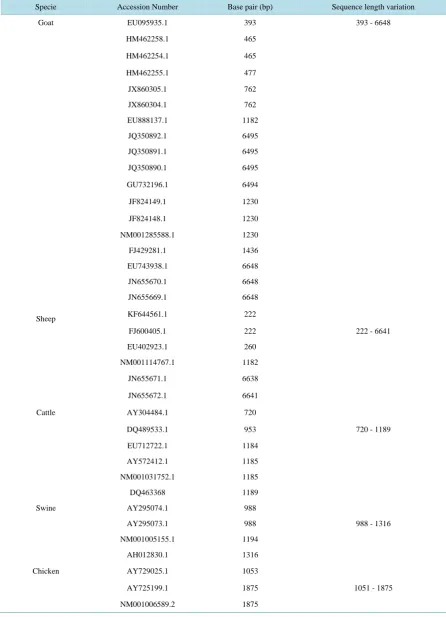
The variation in sequence length in base pair (bp) of BMP15 gene within and among species ranges between 222 bp and 6648 bp (Table 1). Across the species, five sequences (3 from goats and 2 from cattle) have 1185 bp, while two sequences each from goat and sheep have 1182 bp. Within species, 2, 3, 3 and 3 sequences have the same bp of 465, 1185, 1230 and 6648 respectively in goats, while 2 sequences each from sheep, cattle, swine and chicken have the same bp of 222, 1185, 988 and 1875. However, the rest of the sequences do not share the same bp within various species. In goats, the sequences JQ350892.1, JQ350891.1, JQ350890.1, GU732196.1, JN860304.1 and JN655670.1 are complete coding sequences (CDS) from DNA and had sequence length that are greater than six thousand base pair (>6000 bp) while the sequences HM462258.1, HM462254.1, HM462255, JX860305.1, JX860304.1 and EU 095935.1 are partial coding sequences (partial CDS) whose length were less than one thousand base pair (<1000 bp). In sheep, cattle, swine and chicken the same reason holds
The predicted amino acid sequences of goat, sheep, cattle, swine and chicken BMP15 showed varying degree of amino acid substitutions in the studied species (Figure 1).
Means of dS, dN and dN/dS with their corresponding Z-scores and P-values are presented in Table 2. Swine has the highest dN/dS value of 1.20 while sheep has the least value of 0.97. The Dn/dS pattern revealed positive selection for all species except sheep which has a dN/dS value that is less than one.
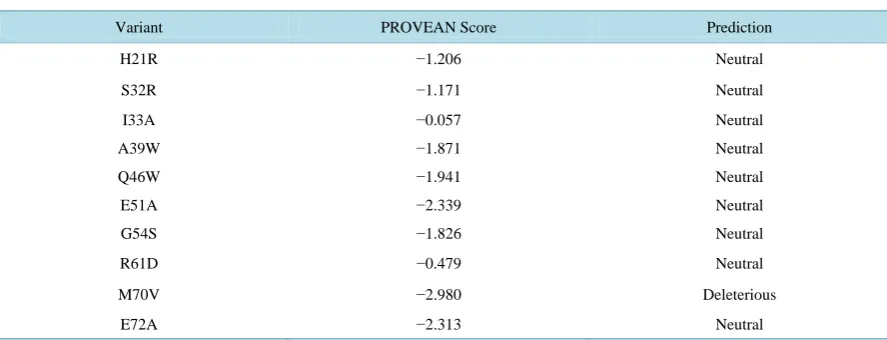
The results of functional analysis of coding nonsynonymous single nucleotide polymorphism (nsSNP) of BMP15 gene for goats, sheep, cattle, swine and chicken are presented in Tables 3-7, respectively. Fourteen amino acid substitutions of the wild type alleles located in the putative peptide coding region of goats were ob-tained from the alignment of deduced amino acid sequences of goats. Out of these, twelve amino acid substitu-tions (L10S, W13A, E20L, V28S, P31R, P31G, P40Q, L42W, Q46N, A52V, R58C, G64T) were returned neu-tral indicating that the substitutions did not impair protein function, while the remaining two amino acid substi-tutions (M70F and Y74M) were returned as deleterious, an indication that the substisubsti-tutions were harmful. In sheep, nine amino acid substitutions (H21R, S32R, I33A, A39W, Q46W, E51A, G54S, R61D and E72A) were returned neutral; an indication that they did not impair protein function while the remaining amino acid substitu-tion (M70V) was predicted to be harmful. Out of the seven amino acid substitusubstitu-tions in cattle, six (Q30M, T41W, E50R, I62R, H65E, and E72S) appeared beneficial while the remaining one (Y74Q) appeared harmful.
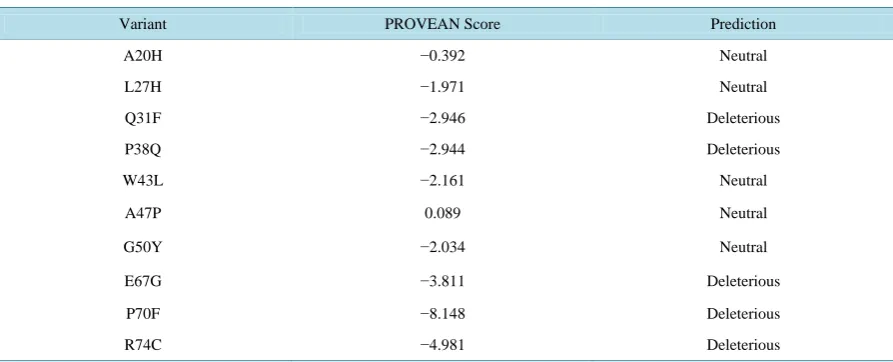
For swine, seven amino acid substitutions (I7L, T9I, V33I, L35H, C40P, R46P and Q61R) were obtained and they all appeared beneficial (Table 6). Similarly, ten amino acid mutations were obtained from the deduced amino acid sequences of chicken, out of which, five (A20H, L27H, W43L, A47P and G50Y) appeared benefi-cial while the remaining five (Q31F, P38Q, E67G, P70F and R74C) appeared harmful.
Table 1.Accession number and sequence length variation of BMP15 gene of goats, sheep, cattle, swine and chicken.
Specie Accession Number Base pair (bp) Sequence length variation
Goat EU095935.1 393 393 - 6648
HM462258.1 465
HM462254.1 465
HM462255.1 477
JX860305.1 762
JX860304.1 762
EU888137.1 1182
JQ350892.1 6495
JQ350891.1 6495
JQ350890.1 6495
GU732196.1 6494
JF824149.1 1230
JF824148.1 1230
NM001285588.1 1230
FJ429281.1 1436
EU743938.1 6648
JN655670.1 6648
JN655669.1 6648
Sheep KF644561.1 222
FJ600405.1 222 222 - 6641
EU402923.1 260
NM001114767.1 1182
JN655671.1 6638
JN655672.1 6641
Cattle AY304484.1 720
DQ489533.1 953 720 - 1189
EU712722.1 1184
AY572412.1 1185
NM001031752.1 1185
DQ463368 1189
Swine AY295074.1 988
AY295073.1 988 988 - 1316
NM001005155.1 1194
AH012830.1 1316
Chicken AY729025.1 1053
AY725199.1 1875 1051 - 1875
Table 2. Mean number of nucleotide substitutions per synonymous site (dS) and per nonsynonymous site (dN) with their
ra-tio among goats, sheep, cattle, swine and chicken.
Specie No. of codons dS dN dN/dS Z-score P-value
Goat 340 2.28 2.42 1.06 10.77 0.00
Sheep 353 1.46 1.41 0.97 −1.232 1.00
Cattle 226 2.53 2.62 1.04 11.83 0.00
Swine 310 1.13 1.36 1.20 6.39 0.00
Chicken 347 0.70 0.77 1.10 7.85 0.00
dN/dS = ratio of nonsynonymous to synonymous divergence.
Table 3. Functional analysis of coding nsSNP of the BMP15 gene of goats using PROVEAN.
Variant PROVEAN Score Prediction
L10S W13A
−0.947 Neutral
−0.722 Neutral
E20L −0.959 Neutral
V28S 0.681 Neutral
P31R −1.217 Neutral
P31G −1.044 Neutral
P40Q −2.283 Neutral
L42W −2.283 Neutral
Q46N −1.158 Neutral
A52V −1.495 Neutral
R58C −2.302 Neutral
G64T −2.116 Neutral
M70F −3.944 Deleterious
Y74M −6.544 Deleterious
Default threshold is −2.5, that is; Variants with a PROVEAN score equal to or below −2.5 are considered “deleterious” while Variants with PROVEAN score above −2.5 are considered “neutral”. G = glycine, A = Alanine, L = leucine, M = methionine, F = phenylalanine, W = trypto-phan, Q = glutamine, E = glutamic acid, S = serine, P = proline, V = valine, Y = tyrosine, R = arginine, N = asparagine, T = threonine, C = cysteine.
Table 4. Functional analysis of coding nsSNP of the BMP15 gene of sheep using PROVEAN.
Variant PROVEAN Score Prediction
H21R −1.206 Neutral
S32R −1.171 Neutral
I33A −0.057 Neutral
A39W −1.871 Neutral
Q46W −1.941 Neutral
E51A −2.339 Neutral
G54S −1.826 Neutral
R61D −0.479 Neutral
M70V −2.980 Deleterious
E72A −2.313 Neutral
Table 5. Functional analysis of coding nsSNP of the BMP15 gene of cattle using PROVEAN.
Variant PROVEAN Score Prediction
Q30M −1.170 Neutral
T41W −1.491 Neutral
E50R −0.829 Neutral
I62R −0.835 Neutral
H65E −0.220 Neutral
E72S −1.476 Neutral
Y74Q −6.669 Deleterious
[image:6.595.89.537.283.419.2]Default threshold is −2.5, that is; Variants with a PROVEAN score equal to or below −2.5 are considered “deleterious” while Variants with PROVEAN score above −2.5 are considered “neutral”. M = methionine, Q = glutamine, T = threonine W = tryptophan, E = glutamic acid, R = argi-nine, I = isoleucine, H = histidine, S = serine, Y = tyrosine.
Table 6. Functional analysis of coding nsSNP of the BMP15 gene of swine using PROVEAN.
Variant PROVEAN Score Prediction
I7L 0.433 Neutral
T9I 0.329 Neutral
V33I 0.101 Neutral
L35H −1.309 Neutral
C40P 3.229 Neutral
R46P −1.053 Neutral
Q61R 0.187 Neutral
Default threshold is −2.5, that is; Variants with a PROVEAN score equal to or below −2.5 are considered “deleterious” while Variants with PROVEAN score above −2.5 are considered “neutral”. I = isoleucine, L = leucine, T = threonine, V = valine, H = histidine, C = cysteine, P = proline, Q = glutamine, Y = tyrosine, R = arginine.
Table 7. Functional analysis of coding nsSNP of the BMP15 gene of chicken using PROVEAN.
Variant PROVEAN Score Prediction
A20H −0.392 Neutral
L27H −1.971 Neutral
Q31F −2.946 Deleterious
P38Q −2.944 Deleterious
W43L −2.161 Neutral
A47P 0.089 Neutral
G50Y −2.034 Neutral
E67G −3.811 Deleterious
P70F −8.148 Deleterious
R74C −4.981 Deleterious
Default threshold is −2.5, that is; Variants with a PROVEAN score equal to or below −2.5 are considered “deleterious” while Variants with PROVEAN score above −2.5 are considered “neutral”. A = Alanine, H = histidine, L = leucine, Q = glutamine, F = phenylalanine, P = proline, W = tryptophan, G = glycine, Y = tyrosine, E = glutamic acid, R = arginine, C = cysteine.
[image:6.595.90.537.473.654.2]Figure 1. Amino acid prediction of goat, sheep, cattle, swine and chicken BMP15 using ClustalW. Dots indicated identical
amino acids and numbers on the right hand side represent site number and asterisks indicate indels.
4. Discussion
BMP15, also known as GDF9B, is an X-linked gene in nature that is expressed in the oocyte and plays a key role in ovarian folliculogenesis. It is a polymorphic gene whose polymorphism has been proven to be associated with increased ovulation rate, sterility and litter size of farm animals [14][15]. The length variation observed within and across species in this study might be due to differences in the genomic region where the sequences were obtained from and differences due to complete coding sequences (CDS) or partial CDS. The variation in sequence length within and among species might result from evolution and differentiation [16]. There are cases where variability might result from DNA duplication, DNA rearrangement, short tandem repeat (STR), inser-tions or deletion of sequences [17]. This frameshift mutation often results in a completely different translation from the original protein and is also likely to cause a stop codon to be read which truncates further synthesis of protein [18]. This variability might initiate unique structures between individual members in conferring different biological activities [19].
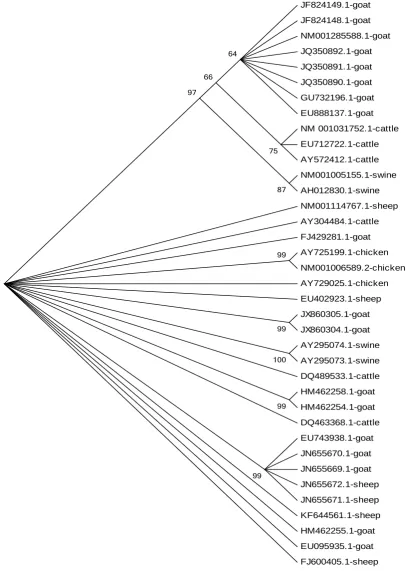
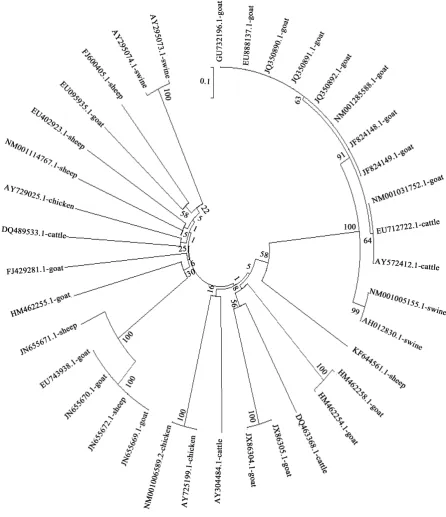
Figure 2. Phylogenetic relationships of goast, sheep, cattle, swine and chicken BMP15 nucleotide sequences.
nucleotide substitutions over the entire sequences across the species excluding sheep. This symbolizes that non-synonymous sites evolved faster than the synonymous sites and positive selection effect over-shadows pu-rifying selection. It is an implication that balancing selection (or positive Darwinian section) favoured new variants
JF824149.1-goat JF824148.1-goat NM001285588.1-goat JQ350892.1-goat JQ350891.1-goat JQ350890.1-goat GU732196.1-goat EU888137.1-goat NM 001031752.1-cattle EU712722.1-cattle AY572412.1-cattle NM001005155.1-swine AH012830.1-swine NM001114767.1-sheep AY304484.1-cattle FJ429281.1-goat AY725199.1-chicken NM001006589.2-chicken AY729025.1-chicken EU402923.1-sheep JX860305.1-goat JX860304.1-goat AY295074.1-swine AY295073.1-swine DQ489533.1-cattle HM462258.1-goat HM462254.1-goat DQ463368.1-cattle EU743938.1-goat JN655670.1-goat JN655669.1-goat JN655672.1-sheep JN655671.1-sheep KF644561.1-sheep HM462255.1-goat EU095935.1-goat FJ600405.1-sheep
99
99 99
100 99 87 97
75 66
Figure 3. Phylogenetic relationships of goat, sheep, cattle, swine and chicken BMP15 amino acid sequences.
and increased allelic polymorphism [22] which in turn might induce a change in the conformation of protein structure, thereby affecting the signaling pathway during follicle differentiation and ovulation [23]. The 0.97 omega value of sheep observed in this study, signifies purifying selection i.e. selection against non-synonymous mutations because of their deleterious effect.
Figure 4.Phylogenetic tree of goat, sheep, cattle, swine and chicken BMP15 consensus nucleotide
[image:10.595.138.494.232.348.2]sequences using UPGMA.
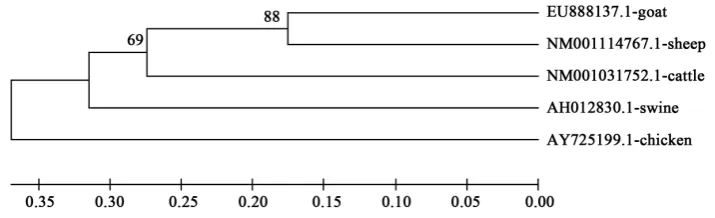
Figure 5. Phylogenetic tree of goat, sheep, cattle, swine and chicken BMP15 consensus amino acid
sequences using UPGMA.
[20][25] that as orthologs diverge from their most recent common ancestor, their different evolutionary trajec-tories lead to divergence in the selective constraints on homologous sites. This information may aid selection of superior animals within and between breeds for genetic improvement of desired traits.
The main goal in animal breeding is to select individuals that have high breeding values for traits of interest as parents to produce the next generation and to do so as quickly as possible. To date, most programs rely on statis-tical analysis of large data bases with phenotypes on breeding populations by linear mixed model methodology to estimate breeding values on selection candidates. However, there is a long history of research on the use of genetic markers to identify quantitative trait loci and their use in marker-assisted selection but with limited im-plementation in practical breeding programs [26].
The neutral or beneficial amino acid substitutions are those substitutions that help in maintaining the structur-al integrity of cells and tissues. Also, they affect positively the functionstructur-al roles of proteins involved in signstructur-al transduction of visual, hormonal, and other stimulants. However, the harmful amino acid substitutions could cause amino acid change further altering protein function which may lead to susceptibility to disease. They may modify enzyme activity, destabilize protein structures or disrupt protein interactions. The beneficial nsSNPs ob-tained in the present study, therefore, offer hope for future genetic improvement of goats, sheep, cattle, swine and chicken at the BMP15 locus. This is due to the fact that nsSNPs have been reported to be linked to econom-ically important traits and disease development [17]. Some nsSNP are beneficial because the altered proteins result in increased sensitivity of granulosa cells to follicle stimulating hormone (FSH), which leads to accele-rated follicular development and precocious ovulation of small follicles [27] while the reverse is the case for harmful or deleterious amino acid mutations [28]. According to Tariq et al. [29], the prediction of SNPs status is promising in modern genetics analysis and breeding programmes as they have been used to identify those ani-mals with higher breeding value. Gene polymorphism between and among species in the present study appeared to be diverse because BMP15 is a fecundity gene [14] with a very strong divergence and a rapid evolution [30] [31]. Therefore, BMP-15 gene as a genetic marker closely linked to the litter size trait can be used in marker- assisted selection (MAS) for high litter size production and productivity in ruminants and non-ruminants.
sequences. The UPGMA consensus trees based on nucleotide and amino acid sequences revealed that goat, sheep and cattle were closer followed by swine while chicken was farther apart. This is in accordance with clas-sical classification as goat, sheep and cattle are members of the bovidae family, and swine shares the order arti-odactyla with the ruminants. The findings of this study also agrees with the submissions of Misra et al. [32] and Ugbo et al. [33] who observed similar clustering of members of the bovidae family and order artiodactyla[2].
5. Conclusion
The study revealed that the gene BMP15 is a polymorphic gene that has numerous mutations which can be beneficial or harmful. However, the beneficial ones were more than the deleterious ones in the present study. The omega values obtained symbolized that non-synonymous sites evolved faster than the synonymous sites and positive selection effect over-shadowed purifying selection. Also, the phylogeny based on nucleotide and amino acid sequences revealed the close relatedness of members of the bovidae family (goat, sheep and cattle), an in-dication of their closeness in the evolutionary timescale. The information emanating from this study would be relevant in performing further genotype-phenotype research especially the selection of markers of fecundity to improve genetically livestock species in Nigeria, Sub-Saharan Africa.
References
[1] Moradband, F., Rahimi, G. and Gholizadeh, M. (2011) Association of Polymorphisms in Fecundity Genes of GDF9, BMP15 and BMP15-1B with Litter Size in Iranian Baluchi Sheep. Asian-Australasian Journal of Animal Science, 24, 1179-1183. http://dx.doi.org/10.5713/ajas.2011.10453
[2] Ran, X., Lin, J.-B., Du, Z.-Y., Qing, C. and Wang, J.-F. (2009) Diversity of BMP15 and GDF9 Genes in White Goat of Guizhou Province and Evolution of the Encoded Proteins. Zoological Research, 30, 593-602.
http://dx.doi.org/10.3724/SP.J.1141.2009.06593
[3] Demars, J., Fabre, S., Sarry, J., Rossetti, R., Gilbert, H., Persani, L., Tosser-Klopp, G., Mulsant, P., Nowak, Z., Drobik, W., Martyniuk, E. and Bodin, L. (2013) Genome Wide Association Studies Identify Two Novel BMP15 Mutations Responsible for an Atypical Hyperprolificacy Phenotype in Sheep. PLOS Genetics, 9, e1003482.
http://dx.doi.org/10.1371/journal.pgen.1003482
[4] Palmer, J.S., Zhao, Z.Z., Hoekstra, C., Hayward, N.K., Webb, P.M., Whiteman, D.C., Martins, N.G., Boomsma, D.I., Duffy, D.L. and Montgomery, G.W. (2006) Novel Variants in Growth Differentiation Factor 9 in Mothers of Dizygotic Twins. Journal of Clinical Endocrinology and Metabolism, 91, 4713-4716. http://dx.doi.org/10.1210/jc.2006-0970
[5] Larkin, M.A., Blackshields G., Brown, N.P., Chenna, R., McGettigan, P.A., McWilliam, H., Valentin, F., Wallace, I.M., Wilm, A., Lopez, R., Thompson, J.D., Gibson, T.J. and Higgins, D.G. (2007) Clustal W and Clustal X Version 2.0. Bioinformatics, 23, 2947-2948. http://dx.doi.org/10.1093/bioinformatics/btm404
[6] Zhang, J., Rosenberg, H.F. and Nei, M. (1998).Positive Darwinian Selection after Gene Duplication in Primate Ribo-nuclease Genes. Proceedings of the National Academy of Sciences of the United States of America, 95, 3708-3713.
http://dx.doi.org/10.1073/pnas.95.7.3708
[7] Li, W. and Godzik, A. (2006) Cd-Hit: A Fast Program for Clustering and Comparing Large Protein or Nucleotide Se-quences. Bioinformatics, 22, 1658-1659. http://dx.doi.org/10.1093/bioinformatics/btl158
[8] Choi, Y., Sims, G.E., Murphy, S., Miller, J.R. and Chan, A.P. (2012) Predicting the Functional Effect of Amino Acid Substitutions and Indels. PLoS ONE, 7, e46688. http://dx.doi.org/10.1371/journal.pone.0046688
[9] Saitou, N. and Nei, M. (1987) The Neighbor-Joining Method: A New Method for Reconstructing Phylogenetic Trees.
Molecular Biology and Evolution, 4, 406-425.
[10] Tamura, K., Nei, M. and Kumar, S. (2004) Prospects for Inferring Very Large Phylogenies by Using the Neighbor- Joining Method. Proceedings of the National Academy of Sciences of the United States of America, 101, 11030-11035.
http://dx.doi.org/10.1073/pnas.0404206101
[11] Felsenstein, J. (1985) Confidence Limits on Phylogenies: An Approach Using the Bootstrap. Evolution, 39, 783-791.
http://dx.doi.org/10.2307/2408678
[12] Tamura , K., Stecher, G., Peterson, D., Filipski, A. and Kumar, S. (2013) MEGA6: Molecular Evolutionary Genetics Analysis Version 6.0. Molecular Biology and Evolution, 30, 2725-2729. http://dx.doi.org/10.1093/molbev/mst197
[13] Nei, M. and Kumar S. (2000) Molecular Evolution and Phylogenetics. Oxford University Press, New York.
[15] Hanrahan, J.P., Gregan, S.M., Mulsant, P., Mullen, M. and Davis, G.H. (2004) Mutations in the Genes for Oocyte- Derived Growth Factors GDF9 and BMP15 Are Associated with Both Increased Ovulation Rate and Sterility in Cam-bridge and Belclare Sheep (Ovisaries). Biology of Reproduction, 70, 900-909.
http://dx.doi.org/10.1095/biolreprod.103.023093
[16] Yakubu, A., Alade, E.D. and Dim, N.I. (2014) Molecular Analysis of Solute Carrier Family 11 a1 (Slc11a1) Gene in Ruminants and Non-Ruminants Using Computational Method. Genetika, 46, 925-934.
http://dx.doi.org/10.2298/GENSR1403925Y
[17] Vincent, S.T., Momoh, O.M. and Yakubu, A. (2014) Bioinformatics Analysis of Beta Casein Gene in Some Selected Mammalian Species. Research Opinions in Animal and Veterinary Sciences, 4, 564-570.
[18] Williams, L.E. and Eernegreen, J.J. (2013) Sequence Context of Indel Mutations and Their Effect on Protein Evolution in a Bacterial Endosymbiont. Genome Biology and Evolution, 5, 599-605.http://dx.doi.org/10.1093/gbe/evt033
[19] Bhattacharya, T., Kumar, P. and Sharma, A. (2008) Molecular Cloning and Characterization of CSN2 in Indian Rive-rine Buffalo (Bubalus bubalis). Buffalo Bulletin, 27, 222-230.
[20] Yakubu, A., Salako, A.E., De Donato, M., Takeet, M.I., Peters, S.O., Adefenwa, M.A., Okpeku, M., Wheto, M., Aga-viezor, B.O., Sanni, T.M., Ajayi, O.O., Onasanya, G.O., Ekundayo, O.J., Ilori, B.M., Amusan, S.A. and Imumorin, I.G. (2013) Genetic Diversity in Exon 2 at the Major Histocompatibility Complex DQB1 Locus in Nigerian Indigenous Goats. Biochemical Genetics, 51, 954-966. http://dx.doi.org/10.1007/s10528-013-9620-y
[21] Zhang, J., Nielsen, R. and Yang, Z. (2005) Evaluation of an Improved Branch-Site Likelihood Method for Detecting Positive Selection at the Molecular Level. Molecular Biology and Evolution, 22, 2472-2479.
http://dx.doi.org/10.1093/molbev/msi237
[22] Bergstrom, T. and Gyllensten, U. (1995) Evolution of the Mhc Class II Polymorphism: The Rise and Fall of Class II Gene Function in Primates. Immunological Reviews, 143, 13-31.
http://dx.doi.org/10.1111/j.1600-065X.1995.tb00668.x
[23] Cui, H.X., Zhao, S.M., Cheng, M.L., Guo, L., Ye, R.Q., Liu, W.Q. and Gao, S.Z. (2009) Cloning and Expression Le-vels of Genes Relating to the Ovulation Rate of Yunling Black Goat. Biology of Reproduction, 80, 219-226.
http://dx.doi.org/10.1095/biolreprod.108.069021
[24] Toll-Riera, M., Laurie, S. and Alba, M.M. (2011) Lineage-Specific Variation in Intensity of Natural Selection in Mammals. Molecular Biology and Evolution, 28, 383-398. http://dx.doi.org/10.1093/molbev/msq206
[25] Marini, N.J., Thomas, P.D. and Rine, J. (2010) The Use of Orthologous Sequences to Predict the Impact of Amino Acid Substitutions on Protein Function. PLoS Genetics, 6, e1000968. http://dx.doi.org/10.1371/journal.pgen.1000968
[26] Dekkers, J.C.M. (2012) Application of Genomics Tools to Animal Breeding. Current Genomics, 13, 207-212.
http://dx.doi.org/10.2174/138920212800543057
[27] Moore, R.K. and Shimasaki, S. (2005) Molecular Biology and Physiological Role of the Oocyte Factor, BMP-15.
Mo-lecular and Cellular Endocrinology, 234, 67-73. http://dx.doi.org/10.1016/j.mce.2004.10.012
[28] Rossetti, R., Di Pasquale, E., Marozzi, A., Bione, S., Toniolo, D., Grammatico, P., Nelson, L.M., Beck-Peccoz, P. and Persani, L. (2009) BMP15 Mutations Associated with Primary Ovarian Insufficiency Cause a Defective Production of Bioactive Protein. Human Mutation, 30, 804-810. http://dx.doi.org/10.1002/humu.20961
[29] Tariq, A.M., Al-Shammari, A.S., Al-Muammar, M.N. and Alhamdan, A.A. (2013) Evaluation and Identification of Damaged SNPs in COL1A1 Gene Involved in Osteoporosis. Archives of Medical Science, 9, 899-905.
[30] Auclair, S., Rossetti, R., Meslin, C., Monestier, O. and Di Pasquale, E. (2013) Positive Selection in Bone Morphoge-netic Protein 15 Targets a Natural Mutation Associated with Primary Ovarian Insufficiency in Human. PLoS ONE, 8, e78199. http://dx.doi.org/10.1371/journal.pone.0078199
[31] Monestier, O., Servin, B., Auclair, S., Bourquard, T., Poupon, A., Pascal, G. and Fabre, S. (2014) Evolutionary Origin of Bone Morphogenetic Protein 15 and Growth and Differentiation Factor 9 and Differential Selective Pressure be-tween Mono- and Polyovulating Species. Biology of Reproduction, 91, Article 83.
http://dx.doi.org/10.1095/biolreprod.114.119735
[32] Misra, S.S., Ganai, T.A.S., Mir, S.A. and Kirmani, M.A. (2011) Molecular Characterization of Partial Exon-2 of the Bone Morphogenetic Protein 15 (BMP15) Gene in Indian Buffalo (Bubalus bubalis): Its Contrast with Other Species.
Buffalo Bulletin, 30, 24-54.
[33] Ugbo, S.B., Yakubu, A.,Omeje, J.N., Bibinu, B.S., Musa, I.S., Egahi, J.O. and Dim, N.I. (2015) Assessment of Genet-ic Relationship and ApplGenet-ication of Computational Algorithm to Assess Functionality of Non-Synonymous Substitu-tions in DQA2 Gene of Cattle, Sheep and Goats. Open Journal of Genetics, 5, 145-158.