Wireless Network Security: The Mobile Agent Approach
Olatunde Abiona1, Adeniran Oluwaranti2, Ayodeji Oluwatope2, Surura Bello2, Clement Onime3, Mistura Sanni2, Lawrence Kehinde4
1
Department of Computer Information Systems, Indiana University Northwest, Garry, USA
2
Department of Computer Science and Engineering, Obafemi Awolowo University, Ile-Ife, Nigeria
3
Information and Communication Technology Section, Abdus Salam International Centre for Theoretical Physics, Trieste, Italy
4
Department of Electrical and Electronic Engineering, Obafemi Awolowo University, Ile-Ife, Nigeria Email: [email protected], [email protected], [email protected], [email protected],
[email protected], [email protected], [email protected]
Received August 12,2013; revised September 14, 2013; accepted September 21, 2013
Copyright © 2013 Olatunde Abiona et al. This is an open access article distributed under the Creative Commons Attribution License, which permits unrestricted use, distribution, and reproduction in any medium, provided the original work is properly cited.
ABSTRACT
The broadcast nature of wireless network makes traditional link-layer attacks readily available to anyone within the range of the network. User authentication is best safeguard against the risk of unauthorized access to the wireless net-works. The present 802.1× authentication scheme has some flaws, making mutual authentication impossible and open to man-in-the-middle attacks. These characteristics make traditional cryptographic mechanism provide weak security for the wireless environment. We have proposed the use of mobile agents to provide dependable Internet services delivery to users, this will guarantee secure authentication in wireless networks and we examine the feasibility of our solution and propose a model for wireless network security.
Keywords: Wireless Network Security; Mobile Agent; Authentication
1. Introduction
Wireless networks has been experiencing an explosive growth similar to the Internet, this is due largely to the attractive flexibility enjoyed by both users and service provider. Some of the benefits are: network coverage without the cost of deploying and maintaining wires, mobility support and roaming which grant the users “anytime”, anywhere access to network. While the emer- gence of these new technologies can enable truly ubiqui- tous Internet access, it also raises issues with the de- pendability of the Internet service delivered to users. Ba- sically Wireless Local Area Network (WLAN) can oper- ate in two modes, the infrastructure based and the ad hoc networks. Many organizations are deploying the infra-structure based wireless network to provide connectivity to places difficult to reach by cabling, to complement the existing wired networks. A lot of attention has been given to the provision of these wireless network solutions, but little attention has been given to the provision of adequate security for the emerging wireless networks making these networks prone to traditional link-layer attacks readily available to anyone within the range of the wireless network.
Wireless network security is more concentrated and complex than security of wired networks because wire- less is broadcast in nature, making it possible for anyone within the range of a wireless device to intercept the packets sent without interrupting the flow of data be- tween the wireless device and the access point. User au- thentication is the best safeguard against the risk of un- authorized access to the wireless network. The security features for mobile communication system include: con- fidentiality on the air interface, anonymity of the user and, most importantly, authentication of the user to the system in order to prevent fraudulent use of the system [1]. Wireless network security is different from wired network security primarily because it gives potential at- tackers easy transport medium access. This access sig- nificantly increases the threat that any security architect- ture must address. Unfortunately, the early IEEE 802.11 standards failed to account for it [2]. Hence the security schemes in wired network can not be used directly in wireless network.
over a wireless channel. Security threats against the wired network are equally applicable to the wireless net- works, but the wireless networks suffer a number of ad- ditional vulnerabilities that make it more challenging to secure [3].
Open wireless medium: The security threats of mes- sage eavesdropping and injection are universal in any network; however, they are more severe in wireless networks due to open wireless medium.
Limited bandwidth: Wireless networks are particu- larly vulnerable to denial-of-service (DoS) attacks and in-band signaling.
System Complexity: Wireless networks are far more complex than the wired networks due to the special needs for mobility support and efficient channel uti- lization.
Mobile Agent (MA) is an effective paradigm for dis- tributed applications and is particularly attractive in a dynamic network environment involving partially con- nected computing elements. MA is defined as a software component which is either a thread or a code carrying its execution state to perform the network function or an application [4]. MA can act as a middleware and perform network and other application related functions based on the underlying infrastructure: fixed wired networks, wireless cellular network or mobile ad hoc network [4]. MA paradigm is an emerging technology for developing applications in open, distributed and heterogeneous en- vironment like the Internet. Agents have the ability to decide autonomously where to migrate to after they are dispatched. MA technology offers several advantages in many application areas, such as e-commerce, mobile computing, network management and information re- trieval [4]. MAs are designed to execute locally on data at their destination, thus reducing network traffic and latency. Furthermore, MA asynchronous interaction can provide efficient solution in the case of unreliable and low bandwidth connection, to support mobile users that could disconnect while their agent still roam in the net- work. However, security is a major technical obstacle to wider acceptance and is of fundamental concern for mo- bile agent based system [4]. We explore the possibilities of using MAs for the provisioning of dependable Internet services delivery that meets the user’s requirement in terms of security, by providing secure authentication in wireless networks.
The rest of the paper is organized as follows: Section 2 presents security challenges in wireless network. Sec- tion 3 presents wireless network security approaches. In Section 4, mobile agents and wireless network were dis-cussed. In Section 5, mobile agents and security were dis- cussed. In Section 6, mobile agent authentication scheme was discussed and the paper finally concluded in Section 7.
2. Security Challenges in Wireless Networks
Securing wireless networks posses unique challenges compared to a wired network due to the open nature of the access medium. In general, wireless networks suffer from security threats of wired networks and additional vulnerabilities making it more challenging to secure. Wireless network security is different from wired net-work security primarily because it gives potential attack-ers easy transport medium access. Hence the security schemes in wired network can not be used directly in wireless network. The fact that data are being broadcast via radio waves rather than transmitted over a wire in-troduces security challenges namely:
How can you prevent user credentials from being hijacked during authentication negotiation?
Once authentication is complete, how can you protect the privacy of the data being transmitted between cli-ent and access point? And finally,
How can you make sure the authorized user connects to the right network?
The concerns are that of authentication, data confiden-tiality and privacy, data integrity, availability and rogue access point.
Authentication-Most password-based protocols in use today rely on a hash of the password with a random chal-lenge. The server issues a challenge, the client hashes that challenge with the password and forwards a response to the server, and the server validates that response against the user’s password retrieved from its database. Legacy password protocols are easily subjected to eaves- dropping and man-in-the-middle attacks. An eavesdrop-ping attacker can easily mount a dictionary attack against such password protocols. A man-in-the-middle attacker can pass through the entire authentication, and then hi-jack the connection and act as the user.
Data Privacy-Another concern is the security of the wireless data connection between the client and access point subsequent to authentication. While client and ac- cess point could easily negotiate keys subsequent to au- thentication, if the keys are not cryptographically related prior to the authentication, the data session would be subject to a man-in-the-middle attack. Therefore it is incumbent upon the authentication negotiation to result in keys that may be distributed to both client and access point to allow the subsequent data connection to be en- crypted.
Limited Bandwidth—The networks that connect hand-held wireless devices such as phones and Personal Digi-tal Assistants (PDAs) suffer from low bandwidth and high incidence of network errors. Mobility can also result in the loss or degradation of wireless connections [5]. Limited communication bandwidth may also be a target for malicious attacks such as DoS attack. To implement such attack, the malicious node may send vicious queries flooding to target nodes to consume the bandwidth and occupy the shared wireless media, making the network services unavailable to other nodes [4]. Apart from the limitation in bandwidth constraint, each node in a wire-less communication and mobile computing has limited transmission range and limited power supply.
System Complexity-Wireless networks are far more complex than the wired networks due to the special needs for mobility support and efficient channel utilization. It should be noted that each complexity in the system, adds additional security vulnerability to the wireless networks especially for systems with large user population and complex infrastructure [3].
3. Wireless Network Security Approaches
The Wireless Equivalent Privacy (WEP) protocol [3] was the first link-layer security mechanism introduced in 802.11 to provide a security level compared to that of with a physical wire. Unfortunately it is also fairly inse-cure. Hackers can easily find out the password and then do anything they want with your network. The software for doing this is widely available. Unfortunately, several security flaws in WEP were soon identified, which can be exploited to defeat its security goals [6].
The Wi-Fi alliance, a non-profit international associa-tion formed in 1999 to certify interoperability of WLANs, developed the Wi-Fi protected access (WPA) to enhance security level [7]. WPA addressed most of the security threats not resolved by WEP. WPA applies stronger network access control, supports better security technol-ogy, and enforces data integrity. However, WPA has some security flaws similar to WEP which poses addi-tional threat and concerns namely:
Encryption weakness—WPA suffer from encryption weakness making it possible for data tampering and masquerading attacks.
Poor performance—Due to intensive computation of authentication and encryption, data transfer and com- munication speeds drops.
The IEEE 802.11i provides the highest level of secu-rity for the wireless networks by eliminating most of the security flaws in WEP and WPA and providing 128bit encryption security for wireless networks. However there is deterioration in performance as the network runs scripts to perform security checks and encryption. The
major difference between WPA and IEEE 802.11i (also known as WPA2) is that WPA uses the temporal key integrity for confidentiality and MICHAEL for data in-tegrity [3]. One major concern in the design of Michael is to reduce the computation overhead which resulted in its weak defense against message forgery. The IEEE 802.11i wireless security standards consist of three major com-ponents namely:
Temporal Key Integrity (TKIP)
Counter mode Cipher Block Chaining with Message Authentication Code (counter mode CBC-MAC) and 802.1× port based authentication for wireless client
access control.
The IEEE 802.1× employs the Extensible Authentica-tion Protocol EAP [8] over Local Area Network (LAN) called the EAPoL. The EAP is a transport framework that runs over link layer protocol and also has support for multiple authentication mechanism. The EAP framework is based on request and response. The IEEE 802.1× has three majorcomponents namely:
Supplicant–client card, Authenticator–access point and Authentication server.
The supplicant is a station wishing to have access to the network, an authenticator, acting as a bridge between the supplicant and the authentication server. The Remote Authentication Dial in Service (RADIUS) protocol con-tains mechanism for per packet authenticity and integrity verification between AP and the RADIUS server [8]. EAP authentication begins with the authenticator sending an identity request to the supplicant. The identity re-sponse provided by the supplicant is sent from the au-thenticator to the authentication server. The authentica-tion server determines the success or failure of the sup-plicant’s request for authentication. Although the use of 802.1× is recommended for authentication, neither WPA nor WPA2 provided mutual authentication. Secondly the EAP is susceptible to Man-in-the-middle attack, since an attacker could forge success message from authenticator to supplicant [8]. The use of MA technology could pro- vide a solution for mutual authentication and man-in- the-middle attack through the use of certificates and en- cryption of the MA.
4. Mobile Agents and Wireless Network
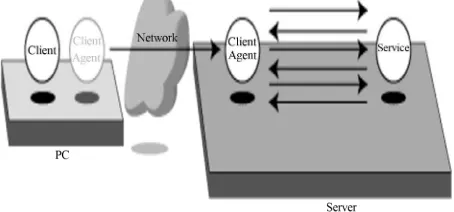
its results. Figure 1 shows the RPC concept.
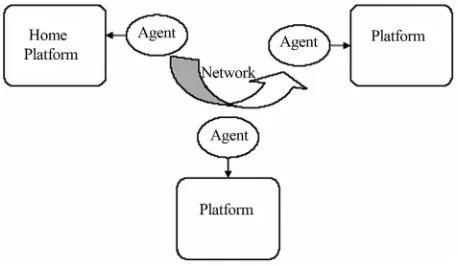
An alternative to remote procedure calling is Remote Programming (RP). The RP paradigm views computer- to-computer communication as enabling one computer not only to call procedures in another computer, but also to supply the procedure to be performed [9]. The only message that the network transport is composed of, a procedure that the receiving computer is to perform and the data that are its arguments. Such procedure calls are local rather than remote. The procedure and the state are termed a mobile agent. Figure 2 shows the Remote Pro-gramming paradigm.
The advantage of remote programming is that a user computer and a server can interact without using the network once the network has transported an agent be-tween them. Thus ongoing interaction does not require ongoing communication, leading to improved perform-ance and better customization of functionality. MAs are programs that can migrate from one host to another in a network or at times to any host of their choice making them autonomous.
[image:4.595.61.287.463.574.2]Wireless networks are characterized by the ability of the client or station to move freely at will, this movement has impact on the security of the network. The security implementation based on trust is confronted with great challenges and the static security mechanisms are not applicable in a dynamic environment. The mobility of clients may cause frequent breaks in the link resulting in data loss since the station can join and leave the network without prior notice. This implies that the connections
Figure 1. Remote procedure calling paradigm.
Figure 2. Remote programming or mobile agent paradigm.
between the client and the server may not be guaranteed at all times in the communication. This intermittent transmission has great impact on the information com- munication in wireless networks which may affect appli- cations and security implementation. The mobile nodes in a wireless network could range from laptops, PDA to cellular phones. These devices are battery powered and the battery life time becomes crucial for wireless com- munication and mobile computing. Wireless networks also suffer from limited communication bandwidth; this may be a target for malicious attacks such as DoS at- tacks.
Several benefits and advantages of using mobile code and mobile agent computing paradigms have been out- lined in [10]. These include:
Overcoming network latency Reduced network load
Asynchronous and autonomous execution Adapting dynamically
Encapsulating protocols
Operation in heterogeneous environment Secure brokering
Robust and fault-tolerant Well suited for e-commerce Can operate as personal assistant Distributed information retrieval Telecommunication network services Monitoring and notification
Information dissemination and Parallel processing.
Considering the many advantages offered by MA, a major technical obstacle to a wider acceptance of the MA paradigm is security. Both agents and execution envi-ronments are prone to unwanted attacks and require ap-propriate protection mechanism. Some efforts at im-proving MA security include: Java sandboxes, type safe languages, software fault isolation and secure and open mobile agent (SOMA) [11].
By employing mobile agents, such mobile devices could provide a reliable technology for message transport over the wireless link. MAs are inherently distributed software entities that reduce the load on the network when they move. In addition they support disconnected operations since they continue to execute after they move, even if they lose network connectivity with their dis- patcher [5]. MAs can be employed in wireless mobile devices in two ways: An agent platform could be in- stalled on the devices, enabling MAs to run directly on them, or mobile devices could access and use remote MAs running on a wired network.
5. Mobile Agents and Security
[image:4.595.59.286.611.717.2]consisting of an agent and the agent platform. An agent is comprised of the code and the state information for car-rying out some computation, mobility enables the agent to move among agent platform and the agent platform provides the computational environment for the agent to operate. The platform from which the agent was dis- patched is known as the home platform, this is the most trusted environment for an agent. An agent system model is shown in Figure 3. One or more hosts may comprise an agent platform, and an agent platform may support multiple computational environments or meeting places, where agents can interact.
Mobile agents moving around the network are not safe. There are four known threat MA, namely: The Agent- to-Host, Agent-to-Agent, Host-to-Agent, Other-to-Agent Host attacks are the kinds of security attacks that are possible in a Mobile Agent System [12].
5.1. Protecting the Agent Platform
A major concern with agent system implementation is to ensure that agents are not able to interfere with one an-other or with the agent platform. Some techniques used for protecting agent platforms are described in detail in [12]. This includes:
Software-based fault isolation (sandboxes) Safe code interpretation
Signed code State appraisal Path Histories and Proof Carrying code
[image:5.595.58.287.588.721.2]Another technique proposed in [13] replaced the Trusted Processing Environment (TPE) by a software machine called Secure Virtual Machine (SVM). The SVM is a software layer installed between the operating system and the agent environments. The platforms to be visited by the agent must have a certified SVM. On a platform, SVM receive an agent and creates an instance of SVM to execute only this agent in an allocated mem-ory space called closed environment. Finally, before mi-gration, the agent will be associated with a signed stamp
Figure 3. Agent system model.
that contains the actual platform time and the next plat-form time.
5.2. Protecting Agents
While countermeasures directed towards platform pro- tection emphasizes active preventive measures, counter- measures directed towards agent protection tend towards detection measures as a deterrent. Once an agent arrives at a platform, little can be done to stop the platform from treating the agent in any manner. The problem is usually referred to as the malicious platform problem. Some techniques used for protecting agents are described in detail in [12]. This includes:
Contractual agreements Trusted hardware Trusted nodes
Mutual itinerary recording Execution Tracing
Environment key generation Co-operating agents Encrypted payload
Computing with encrypted functions Undetachable signatures
Obfuscated code
So far, there are no known techniques for an attacker to reverse engineer an agent’s code.
6. Mobile Agent Athentication Scheme
The provisioning of dependable Internet service delivery that meets the user’s requirement in terms of security requires strong access control. In order to protect the wireless networks from parking lot attackers, strong ac-cess control ideally on per packet basis must be enforced. Furthermore, mutual authentication should also be per-formed, since access points are untrusted entities from the supplicant’s point of view. User authentication is best safeguard against the risk of unauthorized access to the wireless networks. However, one emerging technology could be much more adaptive than others in such envi-ronment. This technology is the mobile agent. We ex-plore the feasibility of the Mobile Agent approach in our solution to the security problem inherent in IEEE 802.1× authentication and key management.
Reactive Autonomous Object-oriented Mobile
Learning Believable
Some examples of mobile agents are; Aglets, Voyager, Odyssey, Concordia, ARA, Mole, Agent TCL, TA-COMA and SHIP-MAI. The four commonly used appli-cation environment for MAs are Aglets, Voyager, Odys-sey, and Concordia [14].
MAs are small in size, they do not constitute a com-plete application by themselves, but rather they form an application by working in conjunction with an agent platform and other agents. Areas of concern in wireless network security include:
Authentication Integrity and Confidentiality
Our focus is on authentication in wireless infrastruc-ture network and we explore the feasibility of mobile agents as a solution to the inherent security problem of IEEE 802.1× authentication and key management. The following describe in detail Mobile Agent Wireless Au-thentication Architecture (MAWAA).
6.1. Security Model for the Scheme
The proposed security model is based on the IEEE 802.1× authentication protocol setup, involving the fol-lowing three components [15]:
Supplicant Authenticator and Authentication server.
Below we describe some of the abbreviations used in this paper. The security framework comprises of the fol-lowing:
Supplicant Platform
Supplicant Mobile Agent (SMA)
Supplicant Mobile Agent with Certificate (SMA Cert) Authenticator (Access Point)
Authentication Server Platform
Authentication Server Static Agent with certificate (ASSA Cert)
Mobile Agent Wireless Authentication Architecture (MAWAA)
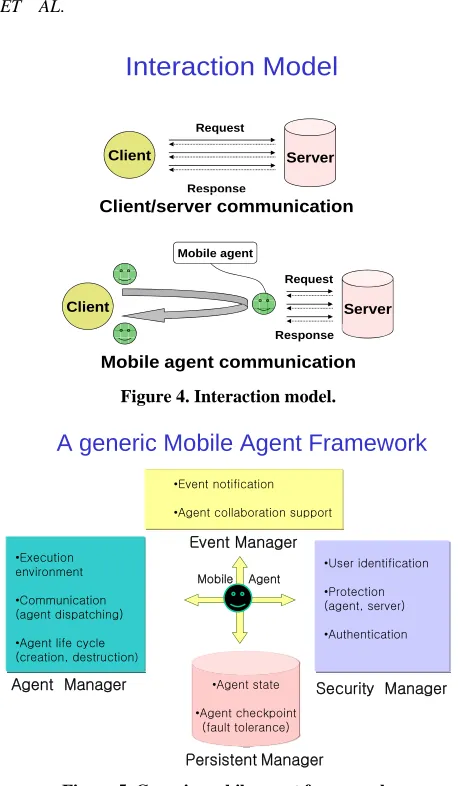
The mobile agent interaction model is shown in Fig- ure 4. This model shows client/server communication and mobile agent communication. The mobile agent rep- resent the client, carrying authentication details of the client and using this detail to authenticate the client to the server by exchanging request and response with the server. Figure 5 shows a generic mobile agent frame- work, with agent manager, event manager, security manager and persistent manager.
Interaction Model
Client Server
Request
Response
Client/server communication
Client Server
Request
Response
Mobile agent communication
Mobile agent
Figure 4. Interaction model.
A generic Mobile Agent Framework
•Agent state •Agent checkpoint
(fault tolerance) •Execution
environment •Communication (agent dispatching) •Agent life cycle (creation, destruction)
•Event notification •Agent collaboration support
•User identification •Protection (agent, server) •Authentication
Persistent Manager Agent Manager
Event Manager
[image:6.595.309.538.59.452.2]Security Manager Mobile Agent
Figure 5. Generic mobile agent framework.
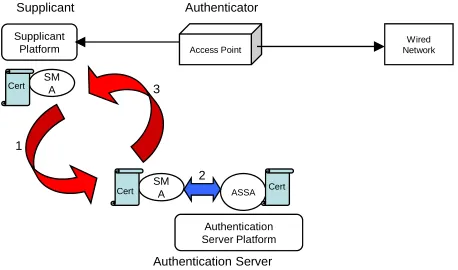
The proposed mobile agent wireless authentication Architecture is shown in Figure 6. Agent platforms are installed on both the supplicant and the authentication server; this will enable MA to run directly on them. When a supplicant come within the range of an authenti-cator, the authenticator sends a request for identification of the supplicant, the supplicant will then dispatch the SMA carrying all the required authentication information for the supplicant i.e. username, password and platform details for that particular user to the authentication server platform.
The Authentication Server Static Agent (ASSA) Cert is a static agent residing on the authentication server platform; the ASSA Cert combines two functions: Certificate Authority—in charge of the issuing and
the management of certificates
Authentication server—for authenticating users, agent, and platforms.
Supplicant Platform
Authentication Server Platform
Access Point
Wired Network SMA
ASSA SMA
Cert SMA
Cert
Supplicant Authenticator
Authentication Server
1
2
[image:7.595.308.537.85.275.2]3
Figure 6. MAWAA authentication model.
work port on the authenticator closes and the supplicant will now have access to the network. The SMA will now be issued a certificate to become SMA Cert before re-turning to the supplicant platform.
6.2. Re-Authentication and Roaming MA
In order to increase security, re-authentication of users is done in some interval of time during the connection; this will ensure that a user cannot change his identity during a session. Re-authentication is achieved using the SMA Cert. After authentication, the SMA is issued a certificate to become SMA Cert, this new MA will then be used for re-authentication with ASSA Cert. As long as the certifi-cate of SMA Cert is valid, the supplicant will continue to have access to the network. If for any reason the certifi-cate of SMA Cert becomes invalid, the network port on the authenticator opens and the supplicant is discon-nected from the network. A similar scenario exists for roaming clients or supplicant. When a supplicant roams from one access point to another, the SMA Cert carries out re-authentication of the supplicant on the new au-thenticator. If the certificate of the SMA Cert is valid, the supplicant continues to have network access otherwise the network is disconnected Figures 7 and 8 shows the re-authentication process and agent migration process during roaming.
6.3. Security Issues in MA Scheme
A lot of research efforts have been devoted to the secu-rity of MA and platforms with a view to making agent based solution attractive. In order to provide adequate security for the gents and platforms, the Secure and Open Mobile Agent was considered. SOMA architecture pro-tects both the execution sites and the agents [11]. SOMA addresses the problem of protecting MA while executing in malicious sites. To grant the agent integrity, several solutions are fully integrated in SOMA, aimed at detect-ing any attacks targeted to modify or delete the agent state.
Access Point
Access Point
Supplicant Authenticator
Authentication Server
Access Point Wired
Network
Supplicant Platform
Cert
cert Cert
Supplicant Platform
SMA
SMA ASSA
Authentication Server Platform
1
2
[image:7.595.58.291.85.235.2]3
Figure 7. MAWAA migration process during roaming.
Supplicant Platform
Authentication Server Platform
Access Point
Wired Network
SM A
ASSA
SM A
Supplicant Authenticator
Authentication Server
Cert
Cert Cert
1
2 3
Figure 8. MAWAA re-authentication process.
6.4. Proposed Mobile Agent Platform
The Aglets Software Development Kit is an environment for programming MA in Java. The aglet is able to exe-cute, halt its execution on one host, dispatch itself to an-other host, and resume execution there. The aglet is ca-pable of moving both the code as well as the data. The aglet is well suited for the internet environment. The proposed mobile agent platform is listed below.
ASDK free software by IBM Latest version is 2.0.2 Good GUI
Very accessible Good documentation
Implemented standards; MASIF, and CORBA
Communication; Message passing between agent, socket
Mobility; Java serialization
Security policy; built in security mechanism
7. Conclusion and Future Work
[image:7.595.309.538.305.440.2]in wireless network. We proposed the use of mobile agents to provide dependable Internet services delivery to users. The importance of security in a wireless network environment cannot be over emphasized. This is due to the fact that the transport medium is shared, making it difficult to provide effective physical security controls to restrict access to the network. As a result, strong access control and authentication become necessary to provide adequate security.
Unfortunately, 802.1× authentication and key man- agement have some flaws in the composition of the pro- tocol. We have proposed the mobile agent approach to solve the inherent security flaws in 802.1× authentica- tion protocol. Hence we have designed the Mobile Agent Wireless Authentication Architecture (MAWAA) as a solution to some security issues in wireless networks. Future research will focus on the following security is- sues relating to MA which includes:
Confidentiality Integrity Availability and Anonymity
REFERENCES
[1] J. Zhu and J. Ma, “A New Authentication Scheme with Anonymity for Wireless Environments,” IEEE Transac- tions on Consumer Electronics, Vol. 50, No. 1, 2004, pp. 231-235.
[2] W. A. Arbaugh, “Wireless Security Is Different,” Maga- zine of IEEE Computer Society, Computer, Vol. 36, No. 8, 2003, pp. 99-101.
http://dx.doi.org/10.1109/MC.2003.1220591
[3] H. Yang, F. Ricciato, L. Songwu and L. Zhang, “Securing a wireless world,” The Proceedings of IEEE, Vol. 94, No. 2, 2006, pp. 442-454.
http://dx.doi.org/10.1109/JPROC.2005.862321
[4] S. P. Alampalayam and A. Kumar, “An Adaptive Secu- rity Model for Mobile Agents in Wireless Networks,”
IEEE Global Telecommunications Conference, Newark, 1-5 December 2003, pp. 1516-1521.
[5] L. Vasiu and Q. H. Mahmoud, “Mobile agents in Wire- less Devices,” Magazine of IEEE Computer Society,
Computer, 2004, Vol. 37, No. 2, pp. 104-105.
http://dx.doi.org/10.1109/MC.2004.1266304
[6] W. Arbaugh, N. Shankar, Y. Wan and K. Zhang, “Your 802.11 Wireless Network Has No Clothes,” IEEE Wire- less Communication,Vol. 9, No. 6, 2002, pp. 44-51.
http://dx.doi.org/10.1109/MWC.2002.1160080
[7] A. Karnik and K. Passerini, “Wireless Network Secu- rity—A Discussion from a Business Perspective,” Pro-ceedings of IEEE Wireless Telecommunications Sympo-sium, Nicosia, April 2005, pp. 261-267.
[8] A. Mishra and W. A. Arbaugh, “An Initial Security Analysis of the IEEE 802.1× Standard,” Report No CS- TR-4328, 2002.
http://www.cs.umd.edu/~waa/1x.pdf
[9] J. White, “Mobile Agents White Paper,” General Magic, Inc., 1996.
http://citeseer.ist.psu.edu/white96mobile.html
[10] D. Lange and M. Oshima, “Seven Good Reasons for Mo- bile Agents,” Communications of ACM, 1999, Vol. 42, No. 3, pp. 88-89.
http://dx.doi.org/10.1145/295685.298136
[11] A. Corradi, R. Montanari and C. Stefanelli, “Security No.s in Mobile Agent Technology,” Proceedings of 7th IEEE Workshop on Future Trends of Distributed Com- puting Systems (FTDCS’99), Cape Town, December 1999, pp. 3-8.
[12] N. Borselius, “Mobile Agent Security”, Electronics and Communication Engineering Journal, Vol. 4, No. 5, 2002, pp. 211-218.http://dx.doi.org/10.1049/ecej:20020504
[13] H. Aouadi and M. B. Ahamed, “Modile Agents Security,”
2nd International Conference on Mobile Technology, Ap-plications and Systems, Guangzhou, November 2005, pp. 1-6.
[14] Y. Wang, C. Wang and L. Cheng-Horng, “Mobile Agent Protection and Verification in the Internet Environment,”
Proceedings of 4th International Conference on Com- puter and Information Technology, Wuhan, September 2004, pp. 482-487,