http://dx.doi.org/10.4236/am.2016.711111
How to cite this paper: Sidi, A. (2016) SVD-MPE: An SVD-Based Vector Extrapolation Method of Polynomial Type. Applied Mathematics, 7, 1260-1278. http://dx.doi.org/10.4236/am.2016.711111
SVD-MPE: An SVD-Based Vector
Extrapolation Method of Polynomial Type
Avram Sidi
Computer Science Department, Technion-Israel Institute of Technology, Haifa, Israel
Received 10 May 2016; accepted 18 July 2016; published 21 July 2016
Copyright © 2016 by author and Scientific Research Publishing Inc.
This work is licensed under the Creative Commons Attribution International License (CC BY).
http://creativecommons.org/licenses/by/4.0/
Abstract
An important problem that arises in different areas of science and engineering is that of computing the limits of sequences of vectors
{ }
xm , where xm∈N, N being very large. Such sequences arise, for example, in the solution of systems of linear or nonlinear equations by fixed-point iterative me-thods, and limm→∞xm are simply the required solutions. In most cases of interest, however, these sequences converge to their limits extremely slowly. One practical way to make the sequences{ }
xm converge more quickly is to apply to them vector extrapolation methods. Two types of methods exist in the literature: polynomial type methods and epsilon algorithms. In most applications, the poly-nomial type methods have proved to be superior convergence accelerators. Three polypoly-nomial type methods are known, and these are the minimal polynomial extrapolation (MPE), the reduced rank extrapolation (RRE), and the modified minimal polynomial extrapolation (MMPE). In this work, we develop yet another polynomial type method, which is based on the singular value decomposition, as well as the ideas that lead to MPE. We denote this new method by SVD-MPE. We also design a nu-merically stable algorithm for its implementation, whose computational cost and storage require-ments are minimal. Finally, we illustrate the use of SVD-MPE with numerical examples.Keywords
Vector Extrapolation, Minimal Polynomial Extrapolation, Singular Value Decomposition, Krylov Subspace Methods
1. Introduction and Background
1261
sequences of vectors
{ }
xm 1, where xm∈N, the dimension N being very large in many applications. Such vector sequences arise, for example, in the numerical solution of very large systems of linear or nonlinear equations by fixed-point iterative methods, and limm→∞ xm are simply the required solutions to these systems. One common source of such systems is the finite-difference or finite-element discretization of continuum problems.In most cases of interest, however, the sequences
{ }
xm converge to their limits extremely slowly. That is, to approximate s=limm→∞xm, with a reasonable prescribed level of accuracy, by xm, we need to consider very large values of m. Since the vectors xm are normally computed in the order m=0,1, 2, , it is clear that we have to compute many such vectors until we reach one that has acceptable accuracy. Thus, this way of app- roximatings
via the xm becomes very expensive computationally.Nevertheless, we may ask whether we can do something with those xm that are already available, to somehow obtain new approximations to
s
that are better than each individual available xm. The answer to this question is in the affirmative for at least a large class of sequences that arise from fixed-point iteration of linear and nonlinear systems of equations. One practical way of achieving this is by applying to the sequence{ }
xm a suitable convergence acceleration method (or extrapolation method).Of course, in case limm→∞ xm does not exist, it seems that no use could be made of the xm. Now, if the sequence
{ }
xm is generated by an iterative solution of a linear or nonlinear system of equations, it can be thought of as “diverging from” the solutions
of this system. We calls
the antilimit of{ }
xm in such a case. It turns out that vector extrapolation methods can be applied to such divergent sequences{ }
xm to obtain good approximations to the relevant antilimits, at least in some cases.Two different types of vector extrapolation methods exist in the literature:
1) Polynomial type methods: The minimal polynomial extrapolation (MPE) of Cabay and Jackson [1], the
reduced rank extrapolation (RRE) of Kaniel and Stein [2], Eddy [3], and Mešina [4], and the modified minimal polynomial extrapolation (MMPE) of Brezinski [5], Pugachev [6] and Sidi, Ford, and Smith [7].
2) Epsilon algorithms: The scalar epsilon algorithm (SEA) of Wynn [8] (which is actually a recursive procedure for implementing the transformation of Shanks [9]), the vector epsilon algorithm (VEA) of Wynn [10], and the topological epsilon algorithm (TEA) of Brezinski [5].
The paper by Smith, Ford, and Sidi [11] gives a review of all these methods (except MMPE) that covers the developments in vector extrapolation methods until the end of the 1970s. For up-to-date reviews of MPE and RRE, see Sidi [12] and [13]. Numerically stable algorithms for implementing MPE and RRE are given in Sidi [14], these algorithms being also economical both computationally and storagewise. Jbilou and Sadok [15] have developed an analogous algorithm for MMPE along the lines suggested in Sidi, Ford, and Smith [7] and Sidi [14]. For the convergence properties and error analyses of MPE, RRE, MMPE, and TEA, as these are applied to vector sequences generated by fixed-point iterative methods from linear systems, see the works by Sidi [16]-[18], Sidi, Ford, and Smith [7], Sidi and Bridger [19], and Sidi and Shapira [20] [21]. VEA has been studied by Brezinski [22] [23], Gekeler [24], Wynn [25] [26], and Graves-Morris [27] [28].
Vector extrapolation methods are used effectively in various branches of science and engineering in acceler- ating the convergence of iterative methods that result from large sparse systems of equations.
All of these methods have the useful feature that their only input is the vector sequence
{ }
xm whose convergence is to be accelerated, nothing else being needed. In most applications, however, the polynomial type methods, especially MPE and RRE, have proved to be superior convergence accelerators; they require much less computation than, and half as much storage as, the epsilon algorithms for the same accuracy.In this work, we develop yet another polynomial type method, which is based on the singular value decompo-sition (SVD), as well as some ideas that lead to MPE. We denote this new method by SVD-MPE. We also de-sign a numerically stable algorithm for its implementation, whose computational cost and storage requirements are minimal. The new method is described in the next section. In Section 3, we show how the error in the ap-proximation produced by SVD-MPE can be estimated at zero cost in terms of the quantities already used in the construction of the approximation. In Section 4, we give a very efficient algorithm for implementing SVD-MPE. In Section 5, we derive determinant representations for the approximations produced by SVD-MPE, while in Section 6, we show that this method is a Krylov subspace method when applied to vector sequences that result from the solution of linear systems via fixed-point iterative schemes. Finally, in Section 7, we illustrate its use
1Unless otherwise stated,
{ }
m
c will mean { }cm m0
∞
1262
with two numerical examples.
Before closing, we state the (reduced version of) the well known singular value decomposition (SVD) theorem. For different proofs, we refer the reader to Golub and Van Loan [29], Horn and Johnson [30], Stoer and Bulirsch [31], and Trefethen and Bau [32], for example.
Theorem 1.1 Let A∈r s×
, r s≥ . Then there exist unitary matrices U∈r s× , V∈s s× , and a diagonal
matrix diag
(
1, ,)
s s sσ σ ×
= ∈
Σ , with σ1≥σ2 ≥≥σs ≥0, such that
*.
= A U VΣ Furthermore, if U=
[
u1| | us]
and V =[
v1| | vs]
, then*
, , 1, , .
i =σi i i =σi i i= s
Av u A u v
In case rank
( )
A =t, there holds σ >i 0, i=1, , , t and the rest of the σi are zero.Remark: The σi are called the singular values of A and the vi and ui are called the corresponding
right and leftsingular vectors of A, respectively. We also have
* 2 , * 2 , 1, , .
i =σi i i =σi i i= s
A Av v AA u u
2. Development of SVD-MPE
In what follows, we use boldface lower case letters for vectors and boldface upper case letters for matrices. In addition, we will be working with general inner products
( )
⋅ ⋅, and the l2 norms ⋅ induced by them: Theseare defined as follows:
• In N, with M∈N N× hermitian positive definite,
( )
, = * , =(
,)
.M M M
a b a Mb a a a (2.1)
• In k+1, k=1,2, , with (k1) (k 1)
k∈ + × +
L hermitian positive definite,
( )
, * ,(
,)
.k = k k = k
L L L
a b a L b a a a (2.2)
Of course, the standard Euclidean inner product a b* and the 2
l norm a a* induced by it are obtained by letting M I= in (2.1) and Lk =I in (2.2); we will denote these norms by ⋅ 2 (we will denote by I the identity matrix in every dimension).
2.1. Summary of MPE
We begin with a brief summary of minimal polynomial extrapolation (MPE). We use the ideas that follow to develop our new method.
Given the vector sequence
{ }
xm in N, we define1 , 0,1, ,
m= m+ − m m=
u x x (2.3)
and, for some fixed n, define the matrices Uk via
[
]
( 1)1
| | | N k .
k = n n+ n k+ ∈ × +
U u u u (2.4)
Clearly, there is an integer k0≤N, such that the matrices Uk, k=0,1, , k0−1, are of full rank, but Uk0
is not; that is,
( )
0( )
0 0rank Uk = +k 1, k=0,1, , k −1; rank Uk =k. (2.5) (Of course, this is the same as saying that
{
u un, n+1, , un k+ −01}
is a linearly independent set, but{
u un, n+1, , un k+0}
is not.) Following this, we pick a positive integer k k< 0 and let the vector[
]
T0, , ,1 k1 k
c c c−
′ = ∈
0 1 1
1
, , ,mink 0 .
k
i n i n k c c c− i c
−
+ +
= +
∑
M
u u
(2.6)
This minimization problem can also be expressed as in
1
minc′ U c uk− ′ + n k+ M, (2.7)
and, as is easily seen, c′ is the standard least-squares solution to the linear system U ck−1 ′ = −un k+ , which, when k N< , is overdetermined, and generally inconsistent. With c c0, , ,1 ck−1 determined, set ck =1, and compute the scalars γ γ0, , ,1 γk via
0
, 0,1, , ,
i i k
j j
c i k
c
γ
=
= =
∑
(2.8)provided
∑
kj=0cj≠0. Note that0 1.
k i i
γ
=
=
∑
(2.9)Finally, set
, 0 k
n k i n i
i
γ +
=
=
∑
s x (2.10)
as the approximation to
s
, whethers
is the limit or antilimit of{ }
xm .What we have so far is only the definition (or the theoretical development) of MPE as a method. It should not be taken as an efficient computational procedure (algorithm), however. For this topic, see [14], where numeri-cally stable and computationally and storagewise economical algorithms for MPE and RRE are designed for the case in which M I= . A well documented FORTRAN 77 code for implementing MPE and RRE in a unified manner is also provided in [14], Appendix B.
2.2. Development of SVD-MPE
We start by observing that the unconstrained minimization problem for MPE given in (2.7) can also be expressed as a superficially “constrained” minimization problem as in
[
]
T0 1
minc U ck M, subject to ck =1; c= c c, , , ck . (2.11) For the SVD-MPE method, we replace this “constrained” minimization problem by the following actual con-strained minimization problem:
[
]
T0 1
min , subject to 1; , , , .
k
k M L = = c c ck
c U c c c (2.12)
With c c0, , ,1 ck determined, we again compute γ γ0, , ,1 γk via
0
, 0,1, , ,
i i k
j j
c i k
c
γ
=
= =
∑
(2.13)provided
∑
kj=0cj≠0, noting again that0 1.
k i i
γ
=
=
∑
(2.14)Finally, we set
, 0 k
n k i n i
i
γ +
=
=
∑
1264
as the SVD-MPE approximation to
s
, whethers
is the limit or antilimit of{ }
xm . Of course, the minimization problem in (2.12) has a solution for[
]
T0, , ,1 k
c c c =
c . Let σmin = U ck M
for this (optimal)
c
. Lemma 2.1 that follows next gives a complete characterization of σmin and the(optimal)
c
.Lemma 2.1Let σ σk0, k1, ,σkk be the singular values of the N×
(
k+1)
matrix 1 2 1 2,k = k k−
U M U L (2.16) ordered as in
0 1 ,
k k kk
σ ≥σ ≥≥σ (2.17)
and let hki be the corresponding right singular vectors of Uk, that is,
* 2
2
, 1, 0,1, , .
k k ki =σki ki ki = i= k
U U h h h (2.18)
Assuming that σkk, the smallest singular value of Uk, is simple, the (optimal) solution
c
to the minimi-zation problem in (2.12) is unique (up to a multiplicative constant
τ
, τ =1), and is given as in 1 2min
; .
k kk σ k σkk
−
= = M =
c L h U c (2.19)
Proof. The proof is achieved by observing that, with 1 2 k
= c L c ,
2
2 and k ,
k M = k L =
U c U c c c (2.20)
so that the problem in (2.12) becomes
2 2
min k , subject to =1.
c U c c (2.21)
The (optimal) solution to this problem is c h= kk and minc U ck 2 =σkk. We leave the details to the reader. □
In view of the nature of the solution for the (optimal)
c
involving singular values and vectors, as described in Lemma 2.1, we call this new method SVD-MPE.Remarks:
1) Recall that there exists a positive integer k0≤N, such that rank
( )
Uk = +k 1, for k k< 0, but( )
0 0rank Uk =k . Therefore, we have σ >kk 0 for all k k≤ 0.
2) Of course, sn k, exists if and only if the (optimal)
[
]
T 0, , ,1 kc c c =
c satisfies
∑
kj=0cj ≠0. In addition, by (2.13), the γi are unique when σkk is simple.Before we go on to the development of our algorithm in the next section, we state the following result concerning the finite termination property of SVD-MPE, whose proof is very similar to that pertaining to MPE and RRE given in [13]:
Theorem 2.2Let
s
be the solution to the nonsingular linear system x Tx d= + , and let{ }
xm be the se-quence obtained via the fixed-point iterative scheme xm+1=Txm+d, m=0,1, , with x0 chosen arbitrarily.
If k is the degree of the minimal polynomial of T with respect to n =xn−s (equivalently, with respect to n
u )2, then
, n k
s produced by SVD-MPE satisfies sn k, =s.
3. Error Estimation
We now turn to the problem of estimating at zero cost the error sn k, −s, whether
s
is the limit or antilimit of{ }
xm . Here we assume thats
is the solution to the system of equations2Given a matrix B∈r r× and a nonzero vector a∈r, the monic polynomial P
( )
λ is said to be a minimal polynomial of B withrespect to a if P
( )
B a= 0 and if P( )
λ has smallest degree. It is easy to show that the minimal polynomial P( )
λ of B with re-spect to a exists, is unique, and divides the minimal polynomial of B, which in turn divides the characteristic polynomial of B. [Thus, the degree of P( )
λ is at most r, and its zeros are some or all of the eigenvalues of B.] Moreover, if Q( )
B a=0 for some polynomial( )
( )
; : N N, N,= → ∈
x f x f x
and that the vector sequence
{ }
xm is obtained via the fixed-point iterative scheme( )
1 , 0,1, ,
m+ = m m=
x f x
0
x being the initial approximation to the solution
s
.Now, if
x
is some approximation tos
, then a good measure of the errorx s
−
inx
is the residual vector r x( )
ofx
, namely,( )
=( )
− .r x f x x
This is justified since limx s→ r x
( )
=r s( )
=0. We consider two cases:1) f x
( )
is linear; that is, f x( )
=Tx d+ , where T∈N N× and I T− is nonsingular. In this case, we have( )
= + − =(
−)(
−)
,r x Tx d x T I x s
and, therefore, by
∑
ki=0γi =1, , 0 k n k =∑
i=γi n i+s x satisfies
( )
,(
)
(
1)
0 0 0 ,
k k k
n k i n i n i i n i n i i n i
i i i
γ + + γ + + + γ +
= = =
=
∑
+ − =∑
− =∑
r s Tx d x x x u
and thus
( )
[
]
T, , 0, , ,1 .
n k = k = γ γ γk
r s U γ γ (3.1)
2) f x
( )
is nonlinear.In this case, assuming that limm→∞ xm=s and expanding f x
( )
m abouts
, we have( )
( )(
)
(
2)
1 as ,
m+ = + m− +O m− m→ ∞
x f s F s x s x s
where F x
( )
is the Jacobian matrix of the vector-valued function f x( )
evaluated atx
. Recalling that( )
=
s f s , we rewrite this in the form
( )(
)
(
2)
1 as ,
m+ = + m− +O m− m→ ∞
x s F s x s x s
from which, we conclude that the vectors xm and xm+1 satisfy the approximate equality
( )(
)
1 for all large .
m+ ≈ + m− m
x s F s x s
That is, for all large m, the sequence
{ }
xm behaves as if it were being generated by an N-dimensional approximate linear system of the form(
I T x d−)
≈ through1 , 0,1, ,
m+ ≈ m+ m=
x Tx d
where T F s=
( )
and d=I F s s−( )
. In view of what we already know about r s( )
n k, for linear systems [from (3.1)], for nonlinear systems, close to convergence, we have( )
[
]
T, , 0, , ,1 .
n k ≈ k = γ γ γk
r s U γ γ (3.2)
Remark: That the vector Ukγ is the exact residual vector for sn k, from linear systems and a true app-
1266
Now, we can compute Ukγ M at no cost in terms of the quantities that result from our algorithm, without having to actually compute Ukγ itself. Indeed, we have the following result on Ukγ M, which can be incor- porated in the algorithm for SVD-MPE that we discuss in the next section:
Theorem 3.1 Let σkk be the smallest singular value of Uk and let hkk be the corresponding right
singular vector. Then the vector Ukγ resulting from sn k, satisfies
0
.
kk
k k
j j c σ
= =
∑
MU γ (3.3)
Proof. First, the solution to (2.12) is 1 2 kk
−
=
c L h by (2.19). Next, letting α =
∑
kj=0cj, we have γ =c α by (2.13). Consequently,. k k =U cα
U γ
Thus, by Lemma 2.1, we have
,
k kk
k
σ
α α
= M =
M U c U γ
which is the required result. □
4. Algorithm for SVD-MPE
We now turn to the design of a good algorithm for constructing numerically the approximation sn k, that results from SVD-MPE. We note that matrix computations in floating-point arithmetic must be done with care, and this is what we would like to achieve here.
In this section, we let M I= and Lk =I for simplicity. Thus, Uk =Uk. Since there is no room for confu- sion, we will also use σi, hi, and gi to denote σki, hki, and gki, respectively.
As we have seen in Section 2, to determine sn k, , we need hk, the right singular vector of Uk corresponding to its smallest singular value σk. Now, σk and hk can be obtained from the singular value decomposition
(SVD) of N k( 1)
k∈ × +
U . Of course, the SVD of Uk can be computed by applying directly to Uk the algori- thm of Golub and Kahan [34], for example. Here we choose to apply SVD to Uk in an indirect way, which will result in a very efficient algorithm for SVD-MPE that is economical both computationally and storagewise in an optimal way. Here are the details of the computation of the SVD of Uk, assuming that rank
( )
Uk = +k 1:1) We first compute the QR factorization of Uk in the form
( 1) ( 1) ( 1)
; N k , k k ,
k = k k k∈ × + k∈ + × +
U Q R Q R (4.1)
where Qk is unitary (that is, Q Qk k* =I) and Rk is upper triangular with positive diagonal elements, that is,
[
]
00 01 0
11 1
0| | |1 , ,
k
k
k k k
kk
r r r
r r
r
= =
Q q q q R
(4.2)
* , ; * ; 0 .
i j=δij ∀i j rij = i j ∀ ≤i j rii > ∀i
q q q u (4.3)
Of course, we can carry out the QR factorizations in different ways. Here we do this by the modified Gram- Schmidt process (MGS) in a numerically stable way as follows:
1. Compute r00= un 2 and q0=un r00 .
2. For j=1, , k do Set ( )0
j = n j+
For i=0,1, , j−1 do
( )
* i
ij i j
r =q u and ( )i1 ( )i j+ = j −rij i
u u q
end do (i)
Compute ( )
2 j
jj j
r = u and ( )j
j = j rjj
q u .
end do (j)
Note that the matrices Qk and Rk are obtained from Qk−1 and Rk−1, respectively, as follows:
[
]
0 1 1 1, | , . 0 0 k kk k k k
k k kk r r r − − − = = R
Q Q q R
(4.4)
For MGS, see [29], for example.
2) We next compute the SVD of Rk: By Theorem 1.1, there exist unitary matrices Y H, ∈(k+ × +1) (k1),
[
]
[
]
* *0| | |1 , 0| | |1 ; , .
= k = k = =
Y y y y H h h h Y Y I H H I (4.5)
and a square diagonal matrix Σ∈ ( ) ( )k+ × +1 k 1
,
(
0 1)
0 1diag σ σ, , ,σk ; σ σ σk 0,
= ≥ ≥≥ ≥
Σ (4.6)
such that
*. k =
R Y HΣ (4.7)
In addition, since Rk is nonsingular by our assumption that rank
( )
Uk = +k 1, we have that σ >i 0 for alli. Consequently, σ >k 0.
3) Substituting (4.7) in (4.1), we obtain the following true singular value decomposition of Uk:
( )
[
]
1 * * * 0 1; unitary, ;
| | | , .
N k
k k
k i j δij × +
= = ∈ =
= =
U G H G Q Y G G I
G g g g g g
Σ
(4.8)
Thus, σi, the singular values of Rk, are also the singular values of Uk, and hi, the corresponding right singular vectors of Rk, are also the corresponding right singular vectors of Uk. (Of course, the gi are corres- ponding left singular vectors of Uk. Note that, unlike Y , H, and Σ, which we must compute for our alg- orithm, we do not need to actually compute G because we do not need G in our computations. The mere knowledge that the SVD of Uk is as given in (4.8) suffices to conclude that c h= k is the required optimal solution to (2.12); we continue with the development of our algorithm from this point.)
Remark: Computing the SVD of a matrix A by first forming its QR factorization A QR= , next com- puting the SVD of R as R Y H= Σ *, and finally setting A G H= Σ *, with G QY= was first suggested by
Chan [35].
With c h= k already determined, we next compute the γi as in (2.13); that is,
0
,
k j j=c =
∑
cγ (4.9)
provided
∑
kj=0cj≠0. Next, by the fact that1
0
i
n i n n j
j −
+ +
=
= +
∑
x x u
1268
[
]
1 T
, 1 0 1 1
0 ; , , , ,
k
n k n j n j n k k
j
ξ ξ ξ ξ
−
+ − −
=
= +
∑
= + =s x u x U ξ ξ (4.10)
where the ξi are computed from the γj as in
1 1
1
1; j k i j j, 0,1, , 1.
i j j k
ξ− ξ γ ξ− γ
= +
= =
∑
= − = − (4.11)Making use of the fact that Uk−1 =Q Rk−1 k−1, with
[
]
00 01 0, 1
11 1, 1
1 0 1 1 1
1, 1
| | | , ,
k
k
k k k
k k
r r r
r r r − − − − − − − = =
Q q q q R
(4.12)
where the qi and the rij are exactly those that feature in (4.2) and (4.3), we next rewrite (4.10) as in
(
)
, 1 1 .
n k = n+ k− k−
s x Q R ξ (4.13)
Thus, the computation of sn k, can be carried out economically as in
[
]
T, 1 ; 1 , 0, , ,1 1 .
n k = n+ k− = k− = η η ηk−
s x Q η η R ξ η (4.14)
Of course, Qk−1η is best computed as a linear combination of the columns of Qk−1, hence (4.14) is
computed as in
1 ,
0 .
k
n k n i i
i η
−
=
= +
∑
s x q (4.15)
It is clear that, for the computation in (4.14) and (4.15), we need to save both Qk and Rk.
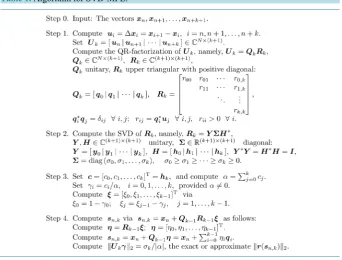
This completes the design of our algorithm for implementing SVD-MPE. For convenience, we provide a systematic description of this algorithm in Table 1, where we also include the computation of the l2 norm of
the exact or approximate residual vector r s
( )
n k, , namely, 2 0k k =
σ
k∑
j=cjU
γ
, which is given in Theorem 3.1.Note that the input vectors xn i+ , i=1, , k+1, need not be saved; actually, they are overwritten by un i+ ,
0,1, , ,
i= k as the latter are being computed. As is clear from the description of MGS given above, we can overwrite the matrix Uk simultaneously with the computation of Qk and Rk, the vector qn j+ overwriting
n j+
u as soon as it is computed, j=0,1, , ; k that is, at any stage of the QR factorization, we store k+2
N-dimensional vectors in the memory. Since Nk in our applications, the storage requirement of the
(
k+ ×1) (
k+1)
matrix Rk is negligible. So is the cost of computing the SVD of Rk, and so is the cost of computing the(
k+1)
-dimensional vector η. Thus, for all practical purposes, the computational and storage requirements of SVD-MPE are the same as those of MPE.Remark: If we were to compute the SVD of Uk, namely, Uk =G HΣ *, directly- and not by 1) first carrying out the QR factorization of Uk as Uk =Q Rk k, and 2) next computing the SVD of Rk as Rk =Y HΣ *, and 3) noting that G Q Y= k without actually computing G—then we would need to waste extra resources in
carrying out the computation of , 0 1 .
k
n k =
∑
i= γi n i+ = n+ k−s x x U ξ This direct strategy will have either of the following consequences:
1) If we have storage limitations, then we would have to overwrite Uk with G. (Recall that both of these matrices are N×
(
k+1)
and hence they are large.) As a result, we would have to compute the xi,1, , ,
i n= + n k+ a second time in order to compute sn k, .
2) If we do not want to compute the vectors xi, i n= +1, , n k+ , a second time, then we would have to save Uk, while computing the matrix G in its singular value decomposition. Thus, we would need to save two
(
1)
N× k+ matrices, namely, Uk and G in the core memory simultaneously. Clearly, this limits the size of
k, the order of extrapolation hence the rate of acceleration, severely.
Table 1. Algorithm for SVD-MPE.
enables us to save extra computing and storage very conveniently when N is very large.
5. Determinant Representations for SVD-MPE
In [7] and [16], determinant representations were derived for the vectors sn k, that are produced by the vector
extrapolation methods MPE, RRE, MMPE, and TEA. These representations have turned out to be very useful in the analysis of the algebraic and analytic properties of these methods. In particular, they were used for obtaining interesting recursion relations among the sn k, and in proving sharp convergence and stability theorems for
them. We now derive two analogous determinant representations for sn k, produced by SVD-MPE.
The following lemma, whose proof can be found in [7], Section 3, will be used in this derivation in Theorem 5.2.
Lemma 5.1Let ui j, and γj be scalars and let the γj satisfy the linear system
, 0
0
0, 0,1, , 1,
1. k
i j j j
k j j
u γ i k
γ
=
=
= = −
=
∑
∑
(5.1)
Then, whether vj are scalars or vectors, there holds
(
)
(
0 1)
0
, , , ,
1,1, ,1 k
k j j
j
D v v v v
D
γ
=
=
∑
(5.2)where
(
)
0 1
0,0 0,1 0,
1,0 1,1 1,
0 1
1,0 1,1 1,
, , , ,
k
k
k k
k k k k
v v v
u u u
u u u
D v v v
u− u− u−
=
1270
provided D
(
1,1, ,1)
≠0. In case the vi are vectors, the determinant D v v(
0, , ,1 vk)
is defined via its ex-pansion with respect to its first row.
For convenience of notation, we will write
( )
00 01 0
10 11 1
0 1
, , , 0,1, .
k
k
k k ij ij
k k kk
l l l
l l l
l i j
l l l
= = =
L L
Then Lk−1 is the principal submatrix of Lk obtained by deleting the last row and the last column of Lk. In addition, Lk−1 is hermitian positive definite just like Lk.
Theorem 5.2 that follows gives our first determinant representation for sn k, resulting from SVD-MPE and is
based only on the smallest singular value σkk of Uk and the corresponding right singular vector hkk.
Theorem 5.2Define
(
)
2( )
, , , , 0,1, , ,
i j n i n j kk k ij
u = u+ u+ M −σ L i j= k (5.4)
and assume that
1, 1.
kk k k
σ <σ − − 3 (5.5)
Then, provided D
(
1,1, ,1)
≠0, sn k, exists and has the determinant representation(
)
(
1)
,
, , , ,
1,1, ,1
n n n k
n k
D D
+ +
= x x x
s
(5.6)
where D v v
(
0, , ,1 vk)
is the(
k+ ×1) (
k+1)
determinant defined as in (5.3) in Lemma 5.1 with the ui j, asin (5.4).
Proof. With Uk as in (2.16), we start by rewriting (2.18) in the form
(
* 2)
0.k k −σkk kk =
U U I h (5.7)
Invoking here 1 2
kk = k
h L c, which follows from (2.19), and multiplying the resulting equality on the left by 1 2
k
L , we obtain
(
* 2)
0.k k−σkk k =
U MU L c (5.8)
Dividing both sides of this equality by k 0 j j=c
∑
, and invoking (2.13), we have(
* 2)
0,k k−σkk k =
U MU L γ (5.9)
which, by the fact that
(
*)
*(
,)
,k k ij = n i+ n j+ = n i+ n j+ M
U MU u Mu u u
is the same as
(
)
2( )
,
0 , 0 0 0, 0,1, , ,
k k
n i n j kk k ij j i j j
j j u i k
σ γ γ
+ +
= =
− = ⇒ = =
∑
u u M L∑
(5.10)where we have invoked (5.4). We will be able to apply Lemma 5.1 to prove the validity of (5.6) if we show that, in (5.10), the equations with i=0,1, , k−1, are linearly independent, or, equivalently, the first k rows of the matrix
* 2
k = k k−σkk k
B U MU L
3From the Cauchy interlace theorem, we already know that
1, 1
kk k k
are linearly independent. By the fact that
[
]
1 T*
1| and , 0 , , ,1 1, ,
k k
k k n k k k k k k k
k lkk l l l
− − + − = = = L l
U U u L l l
we have 1 * , k k
β
− ′ = B p B p where * 21 1 1 1,
k− k− k− σkk k−
′ = −
B U MU L
and
* 2 * 2
1 , .
k− n k+ σkk k β n k+ n k+ σkk kkl
= − = −
p U Mu l u Mu
Invoking 1 2 1 2
1 1 1
k− = − k− k−
U M U L , we obtain
(
)
1 2 * 2 1 2
1 1 1 1 1.
k′ =− k− k− k− −σkk k−
B L U U I L
Since 2 1, 1
k k
σ − − is the smallest eigenvalue of *
1 1
k− k−
U U and since
σ
k k− −1, 1>σ
kk, it turns out that1
k−′ B is positive definite, which guarantees that the first k rows of Bk are linearly independent. This completes the proof. □
Remark: We note that the condition that D
(
1,1, ,1)
≠0 in Theorem 5.2 is equivalent to the condition that0 0
k j j=c ≠
∑
, which we have already met in Section 2.The determinant representation given in Theorem 5.3 that follows is based on the complete singular value decomposition of Uk, hence is different from that given in Theorem 5.2. Since there is no room for confusion, we will denote the singular values σki and right and left singular vectors hki and gki of Uk by σi, hi and gi, respectively.
Theorem 5.3Let Uk be as in (2.16), and let
( )1 ( ) ( )1 1 ( ) ( )1 1
*, N k , k k , k k
k = ∈ × + ∈ + × + ∈ + × +
U G HΣ G H Σ
be the singular value decomposition of Uk; that is,
[
]
*[
]
*0| | |1 k , i j δij; 0| | |1 k , i j δij,
= = = =
G g g g g g H h h h h h
and
(
0 1)
0 1diagσ σ, , ,σk , σ σ σk.
= ≥ ≥≥
Σ Define
(
1 2)
* * 1 2, , 0,1, , 1, 0,1, , ,
i j i n j i n j
u = M g u+ =g M u+ i= k− j= k (5.11) Then, sn k, has the determinant representation
(
)
(
1)
,
, , , ,
1,1, ,1
n n n k
n k
D D
+ +
= x x x
s
(5.12)
where D v v
(
0, , ,1 vk)
is the(
k+ ×1) (
k+1)
determinant defined as in (5.3) in Lemma 5.1 with the ui j, asin (5.11).
Proof. By Theorem 1.1,
*
and 0, 0,1, , 1.
k k =σk k i k = i= k−
U h g g g (5.13)
Therefore,
* 0, 0,1, , 1.
i k k = i= k−
1272
By (2.16) and by the fact that 1 2
k k
−
=
c L h , which follows from (2.19), and by the fact that γ =cα, 0
k j j c
α=
∑
= , which follows from (2.13), and by (5.14), we then have(
)
(
)
* 1 2 1 * 1 2 1 * 0, 0,1, , 1.
i k =α− i k =α− i k k = i= k−
g M U γ g M U c g U h (5.15)
But, by (5.11), (5.15) is the same as
,
0 0, 0,1, , 1.
k i j j j
u γ i k
=
= = −
∑
Therefore, Lemma 5.1 applies with ui j, as in (5.11), and the result follows. □
6. SVD-MPE as a Krylov Subspace Method
In Sidi [17], we discussed the connection of the extrapolation methods MPE, RRE, and TEA with Krylov subspace methods for linear systems. We now want to extend the treatment of [17] to SVD-MPE. Here we recall that a Krylov subspace method is also a projection method and that a projection method is defined uniquely by its right and left subspaces4. In the next theorem, we show that SVD-MPE is a bona fide Krylov subspace
method and we identify its right and left subspaces.
Since there is no room for confusion, we will use the notation of Theorem 5.3.
Theorem 6.1Let s be the unique solution to the linear system Cx d= , which we express in the form
(
I T x d−)
= ⇒ =x Tx d T I C+ ; = − ,and let the vector sequence
{ }
xm be produced by the fixed-point iterative scheme1 , 0,1, .
m+ = m+ m=
x Tx d
Define the residual vector of x via r x
( )
= −d Cx. Let also sk ≡s0,k be the approximation to s prod-uced by SVD-MPE. Then the following are true: 1) sk is of the form
( )
( )
1
0 0 0 0 0
0 for some ; .
k i
k i i
i
δ δ
−
=
= +
∑
= = −s x C r r r x d Cx (6.1)
2) The residual vector of sk, namely, r s
( )
k , is orthogonal to the subspace{
1 2 1 2 1 2}
0 1 1
span , , , .
k k
L = M g M g M g−
Thus,
(
1 2)
*( )
0, 0,1, , 1.
i k = i= k−
M g r s (6.2)
Consequently, SVD-MPE is a Krylov subspace method for the linear system Cx d= , with the Krylov
subspace
(
)
{
1}
0 0 0 0
; span , , , k
k
K C r = r Cr C r−
as its right subspace and
{
1 2 1 2 1 2}
0 1 1
span , , ,
k k
L = M g M g M g − as its left subspace.
Proof. With the xm generated as above, we have
1 m 0, 0,1, .
m+ = m⇒ m= m=
u Tu u T u
Therefore,
( )
0= 1− 0= 0+ − 0= − 0= 0
u x x Tx d x d Cx r x
4A projection method for the solution of the linear system Cx d= , where C∈N N× , is defined as follows: Let Y and Z be k-dimensional subspaces of N and let
0
x be a given vector in N. Then the projection method produces an approximation
k
s to the solution of
=
Cx d as follows: 1) sk=x0+y, y∈Y, 2)
( )
* 0
k =
h r s for every h∈Z. Y and Z are called, respectively, the right and left subspaces
of the method. If Y is the Krylov subspace ( )
{
1}
0 0 0 0
; span , , , k
k
K C r = r Cr C r− , where
0= − 0
and
1 1 1
0 0 0 0 0
0 0 0 .
k k k
i i
k i i i i
i i i
ξ ξ ξ
− − −
= = =
= +
∑
= +∑
= +∑
s x u x T u x T r
Upon substituting T I C= − in this equality, we obtain (6.1).
To prove (6.2), we first recall that Ukγ =r s
( )
k by (3.1). By this and by (5.15), the result in (6.2) follows. □ Remark: We recall that (see [17]), when applied to linearly generated sequences{ }
xm as in Theorem 6.1, MPE, RRE, and TEA are mathematically equivalent to, respectively, the full orthogonalization method (FOM) of Arnoldi [36], the generalized minimum residual method (GMR), the best implementation of it being GMRES by Saad and Schultz [37], and the method of Lanczos [38]. In all these methods the right subspace is thek-dimensional Krylov subspace Kk
(
C r; 0)
. The left subspaces are also Krylov subspaces, with 1) Kk(
C r; 0)
for FOM, 2) Kk(
C Cr; 0)
for GMR, and 3) Kk(
C r*; 0)
for the method of Lanczos. One important point about the left subspaces of these three methods is that they expand as k increases, that is, the left subspace of dimension k+1 contains the left subspace of dimension k. As for SVD-MPE, its right subspace is also thek-dimensional Krylov subspace Kk
(
C r; 0)
, which makes SVD-MPE a bona fide Krylov subspace method, andthe left subspace is
{
1 2 1 2 1 2}
0 1 , 1
span , , ,
k k k k k
L = M g M g M g − . Thus, the k-dimensional left subspace is not a
Krylov subspace, since it is not contained in the left subspace of dimension k+1, as the left singular vectors ki
g of Uk are different from the left singular vectors gk i+1, of Uk+1.
7. Numerical Examples
We now provide two examples that show the performance of SVD-MPE and compare SVD-MPE with MPE. In both examples, SVD-MPE and MPE are implemented with the standard Euclidean inner product and the norm induced by it. Thus, M I= and Lk =I throughout.
As we have already mentioned, a major application area of vector extrapolation methods is that of numerical solution of large systems of linear or nonlinear equations ψ x
( )
=0 by fixed-point iterations xm+1= f x( )
m . [Here x f x=( )
is a possibly preconditioned form of ψ x( )
=0.] For SVD-MPE, as well as all other poly- nomial methods discussed in the literature, the computation of the approximation sn k, to s, the solution of( )
=0ψ x , requires k+1 of the vectors xm to be stored in the computer memory. For systems of very large dimension N, this means that we should keep k at a moderate size. In view of this limitation, a practical strategy for systems of equations is cycling, for which n and k are fixed. Here are the steps of cycling:
C0) Choose integers n≥0, and k≥1, and an initial vector x0.
C1) Compute the vectors x x1, , ,2 xn k+ +1 [via xm+1= f x
( )
m ].C2) Apply SVD-MPE (or MPE) to the vectors x xn, n+1, , xn k+ +1, with end result sn k, .
C3) If sn k, satisfies accuracy test, stop.
Otherwise, set x0=sn k, , and go to Step C1.
We will call each application of steps C1 - C3 a cycle, and denote by ( )
, r n k
s the sn k, that is computed in the
rth cycle. We will also denote the initial vector x0 in step C0 by sn k( )0, . Numerical examples suggest that the se- quence
{ }
n k r( ),r 0∞
=
s has very good convergence properties. (A detailed study of errors and convergence properties for MPE and RRE in the cycling mode is given in [20] and [21].)
Note that the remark at the end of Section 4 is relevant to the implementation of SVD-MPE in the cycling mode when N, the dimension of the xm, is very large and storage is limited and, therefore, the size of k is limited as well.
Example 7.1 Consider the vector sequence
{ }
xm obtained from xm+1=Txm+d, m=0,1, , where 5 2 1 12 6 3 1 1 1 3 6 3 1 1
0.06 ,
1 1 3 6 3 1 1 1 1 3 6 3 1 1
= ×
T
1274
and is symmetric with respect to both main diagonals, and T∈N N× and is hermitian. Therefore, T is diago- nalizable with real eigenvalues. The vector d is such that the exact solution to x Tx d= + is s=
[
1,1, ,1]
T.
We have ρ
( )
T <1, so that{ }
xm converges to s.Figure 1 shows the l2 norms of the errors in sn k, , n=0,1, , with k=5 fixed. Here N=100. Note
that all of the approximations sn,5 make use of the same (infinite) vector sequence
{ }
xm , and, practically speaking, we are looking at how the methods behave as n→ ∞. It is interesting to see that SVD-MPE and MPE behave almost the same. Although we have a rigorous asymptotic theory confirming the behavior of MPE in this mode as observed in Figure 1 (see [16] [18] and [19]), we do not have any such theory for SVD-MPE at the present5.Figure 2 shows the l2 norm of the error in sn k, in the cycling mode with n=0 and k=20. Now
1000
N= , a relatively large dimension.
Example 7.2 We now apply SVD-MPE and MPE to the nonlinear system that arises from finite-difference approximation of the two-dimensional convection-diffusion equation considered in Kelley ([39], pp. 108-109), namely,
(
)
(
)
( ) ( )
2 , , 0,1 0,1 ,
x y
u Cu u u f x y
−∇ + + = ∈ Ω = ×
where u x y
(
,)
satisfies homogeneous boundary conditions. f x y(
,)
is constructed by setting C=20 in the differential equation and by taking(
,)
10(
1)(
1)
exp( )
4.5u x y = xy −x −y x
as the exact solution.
The equation is discretized on a square grid by approximating uxx, uyy, ux, and uy by centered differe- nces with truncation errors O h
( )
2 . Thus, letting h=1ν, and(
x yi, j)
=(
ih jh,)
, ,i j=0,1, , ,νFigure 1. l2 norm of error in sn k, , n=0,1, , with k=5, from MPE and SVD-MPE, for
Example 7.1 with N=100.
5As proved in [7] and [16], if we order the distinct eigenvalues
i
λ of T as λ1≥λ2 ≥, then with fixed k, we have ,
( )
1n n k− =O λk+ s s
as n→ ∞ for MPE, RRE, MMPE, and TEA, if T is diagonalizable and λk >λk+1 . (This result explains the straight line behavior of
[image:15.595.129.491.366.671.2]Figure 2. l2 norm of error in s0,20 in the cycling mode, from SVD-MPE, for Example 7.1
with N=1000.
and
(
) (
1,) (
1,)
(
) (
, 1) (
, 1)
, , , ,
2 2
i j i j i j i j
x i j y i j
u x y u x y u x y u x y
u x y u x y
h h
+ − − + − −
≈ ≈
and
(
)
(
) (
1) (
1) (
1) (
1)
22
4 , , , , ,
, i j i j i j i j i j ,
i j
u x y u x y u x y u x y u x y u x y
h
+ − + −
− − − −
−∇ ≈
we replace the differential equation by the finite difference equations
(
)
1, 1, , 1 , 1 2
1, 1, , 1 , 1
4
, , 1 , 1,
2
ij i j i j i j i j
i j i j i j i j
ij i j
u u u u u
h
u u u u
Cu f x y i j
h ν
+ − + −
+ − + −
− − − −
− + −
+ = ≤ ≤ −
with
0,j i,0 ,j i, 0 , .
u =u =uν =uν = ∀i j
Here uij is the approximation to u x y
(
i, j)
, as usual.We first write the finite difference equations in a way that is analogous to the PDE written in the form
(
)
2 ,
x y
u f Cu u u
−∇ = − +
and split the matrix representing −∇2 to enable the use of the Jacobi and Gauss-Seidel methods as the iterative
[image:16.595.74.491.15.644.2]procedures to generate the sequences
{ }
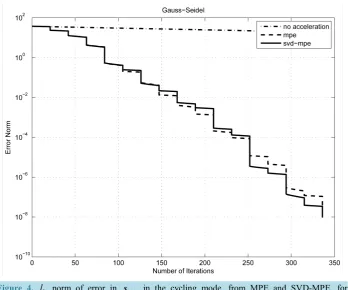
xm .Figure 3 and Figure 4 show the l2 norms of the errors in sn k, from SVD-MPE and MPE in the cycling
mode with n=0 and k=20, the iterative procedures being, respectively, that of Jacobi and that of Gauss- Seidel for the linear part −∇2u of the PDE. Here ν =100, so that the number of unknowns (the dimension) is
2
99 9801
[image:16.595.83.511.82.390.2]1276
Figure 3. l2 norm of error in s0,20 in the cycling mode, from MPE and SVD-MPE, for
Example 7.2 with ν =100 hence N=992. The underlying iteration method is that of Jacobi.
Figure 4. l2 norm of error in s0,20 in the cycling mode, from MPE and SVD-MPE, for
Example 7.2 with ν =100 hence N=992. The underlying iteration method is that of Gauss-
[image:17.595.130.488.83.364.2] [image:17.595.140.489.402.692.2]