BIROn - Birkbeck Institutional Research Online
Chen, S. and Muller, Hermann J. and Conci, M. (2016) Amodal completion
in visual working memory. Journal of Experimental Psychology: Human
Perception and Performance 42 (9), pp. 1344-1353. ISSN 0096-1523.
Downloaded from:
Usage Guidelines:
Please refer to usage guidelines at or alternatively
Amodal completion in visual working memory
Siyi Chen, Hermann J. Müller, and Markus Conci
Ludwig-Maximilians-Universität München, Germany
Running Head: Amodal completion in visual working memory
Word count: 7896 + abstract 243
Correspondence: Siyi Chen
Department of Psychology,
Ludwig-Maximilians-Universität München, 80802 Munich,
Germany
Abstract
Amodal completion refers to the perceptual ‘filling-in’ of partly occluded object fragments.
Previous work has shown that object completion occurs efficiently, at early perceptual stages of
processing. However, despite efficient early completion, at a later stage, the maintenance of
complete-object representations in visual working memory (VWM) may be severely restricted due to
limited mnemonic resources being available. To examine for such a limitation, we investigated whether
the structure of to-be-remembered objects influences what is encoded and maintained in VWM using a
change detection paradigm. Participants were presented with a memory display that contained either
‘composite’ objects, i.e., notched shapes abutting an occluding square, or equivalent unoccluded,
‘simple’ objects. The results showed overall increased memory performance for simple relative to
composite objects. Moreover, evidence for completion in VWM was found for composite objects that
were interpreted as globally completed wholes, relative to local completions or an uncompleted mosaic
(baseline) condition. This global completion advantage was obtained only when the ‘context’ of simple
objects also supported a global object interpretation. Finally, with an increase in memory set size, the
global object advantage decreased substantially. These findings indicate that processes of amodal
completion influence VWM performance until some overall-capacity limitation prevents completion.
VWM completion processes do not operate automatically; rather, the representation format is
determined top-down based on the simple object context provided. Overall, these findings support the
notion of VWM as a capacity-limited resource, with storage capacity depending on the structured
representation of to-be-remembered objects.
Visual environments provide a cluttered and complex input to the visual system, which must be
structured, that is, perceptually grouped into coherent patterns or wholes to support object recognition
and visually guided actions. Under natural viewing conditions, many objects in our ambient array are
partly occluded by other objects. These occlusion relationships, however, do not result in a percept of
fragmented objects; instead, we usually perceive a world that is made out of coherent wholes. For
example, in a visual scene, flowers may be hidden behind trees, while a house may in turn occlude
parts of the trees. Despite these partial occlusions, we do not perceive the flowers as floating in the air
or the trees as having house-shaped holes. Instead, the environment appears to consist of complete
objects, and we do almost never experience any ambiguities. The phenomenon that occluded parts are
perceptually ‘filled in’ has been referred to as amodal completion (Michotte, Thines, & Crabbe,
1964/1991), that is, completion in face of the partial absence of physical stimulation.
Two different types of completion have been proposed to account for how people complete partly
occluded objects. In global completion, the symmetry of a completed shape is maximized (Sekuler,
Palmer, & Flynn, 1994; Van Lier, Leeuwenberg, & Van der Helm, 1995); local completion, by contrast,
comprises a ‘good’ (e.g., linear) interpolation of the occluded contours, yielding an integrated object
based on the shape’s boundaries (Kellman & Shipley, 1991; Fantoni & Gerbino, 2003). Previous
studies have shown that global completion is usually the predominant mode for partly occluded objects
(e.g., Sekuler, 1994; Sekuler et al., 1994; Van Lier, 1999, 2001; Van Lier & Wagemans, 1999; De Wit &
Van Lier, 2002). However, in addition to global and local completion interpretations, partly occluded
objects could also be interpreted as an uncompleted two-dimensional ‘mosaic’ figure. That is, a mosaic
interpretation would be the most basic one, simply taking the visible input as a default: the figure is
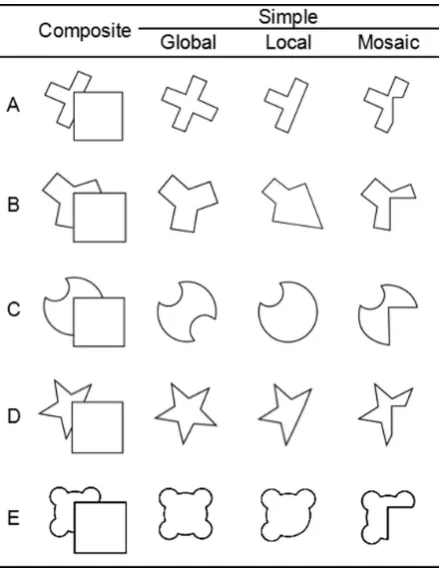
considering that parts of the object may be occluded. Figure 1 provides several examples of global,
local, and mosaic completions, illustrating that every partly occluded figure may give rise to different
complete-object or corresponding mosaic interpretations.
A number of studies employed visual search paradigms to investigate whether integrated object
representations are available pre-attentively. For instance, it has been shown that visual search for a
partly occluded target is guided by a complete-object representation (He & Nakayama, 1992; Rensink
& Enns, 1998; Davis & Driver, 1998). For example, in Rensink and Enns (1998), participants searched
for a notched disk target among complete disks and squares. In a condition in which the notched target
disk abutted a square (adjacent condition), the search turned out inefficient – because, so the
explanation, the notched target is rendered similar to the complete distractor disks by amodal
completion. In contrast, search was efficient when the target was spatially separated from the
neighboring square; in this (separate) condition, completion does not occur – thus supporting more
efficient search. Results such as these have been taken to indicate that visual search relies on
complete-object representations (see also Conci, Müller, & Elliott, 2007a; 2007b; 2009), with (amodal)
completion occurring rather automatically, that is, prior to the engagement of attention (Mattingley,
Davis & Driver, 1997; Conci et al., 2009). However, Rauschenberger and Yantis (2001), in a follow-on
study, combined a search task with a masking procedure to interrupt visual processing. Given sufficient
time prior to masking, the previous results were replicated, that is: there was evidence of amodal
completion in the adjacent condition, but not in the separate condition. By contrast, when the masks
were presented relatively early (< 200 ms), search was comparable in efficiency between the separate
and adjacent conditions, indicating that, under these conditions, amodal completion was prevented with
an initial, “mosaic” stage may precede completion (see also Sekuler & Palmer, 1992; Plomp, Liu, Van
Leeuwen, & Ioannides, 2006).
Taken together, these findings indicate that completed objects are processed rather efficiently, with
sequential perceptual stages rendering completed objects starting from a simple, default ‘mosaic’
interpretation. However, at an even later stage of processing, the encoding and maintenance of object
representations in visual working memory (VWM) may be tightly restricted due to the limited
availability of mnemonic resources (Jolicoeur & Dell’ Acqua, 1998; Thorpe, Fize, & Marlot, 1996;
Vogel, Luck, & Shapiro, 1998; Woodman, Vogel, & Luck, 2001). Here, we investigated whether the
structure of to-be-remembered objects influences what is encoded and maintained in VWM.
Specifically, in this study, we were interested in whether completion is reflected in memory
capacity. Luck and Vogel (1997) showed that VWM can roughly store about four items, irrespective of
the number of features that the objects are composed of; restated, VWM may be conceived of as
providing about four “slots”, permitting up to four complete objects to be represented irrespective of
their complexity. However, subsequent evidence indicated that VWM capacity in fact also depends on
visual information load, rather than reflecting just the number of objects currently held in VWM. For
example, Alvarez and Cavanagh (2004) attempted to characterize the visual information load of
different objects categories (such as shaded cubes, Chinese characters, and colored squares) in terms of
the search efficiency afforded by each object category in a simple visual search task (under conditions
of varying search display sizes). The assumption was that search efficiency (i.e., the slope of the
function relating display size to response latency) would reflect the perceptual complexity of a given
object category. In a subsequent experiment, the same objects were presented in a change detection task,
a brief delay, a test display was presented which required participants to determine whether one of the
presented objects, which were all of the same category, had changed. The results revealed a strong
linear relation between the number of items that can be stored in VWM (as assessed in the change
detection task) and the visual information load of these items (as determined by the slope of the search
function). According to this logic, if a completed object is represented in VWM, memory capacity
should be affected, because post-completion representations give rise to a greater visual information
load (as evidenced by steeper slopes) in visual search studies compared to uncompleted objects (He &
Nakayama, 1992; Rensink & Enns, 1998; Davis & Driver, 1998). Following this line of reasoning, we
hypothesized that completion requires mnemonic resources, that is: completed objects require more
VWM capacity to be maintained, leading to reduced memory performance if capacity is exceeded.
To test this idea, we employed a change detection paradigm (Luck & Vogel, 1997) in which
participants were presented with a memory display that contained composite objects (i.e., a
notched-figure adjacent to a square) or simple objects (i.e., possible interpretations of the composite
objects without the adjacent square, see Figure 1). After a brief delay, a simple object probe appeared,
presenting one possible interpretation at one of the locations that had previously been occupied by an
item in the memory display. The task was to decide whether the probe item was the same as or different
from the object presented beforehand at the same location in the memory display (see Figure 2 for an
example). This variant of the change detection task with composite objects as to-be-remembered items
was intended to permit assessment of whether or not the mechanisms of (amodal) object completion
require resources in VWM beyond those needed to represent objects that are not completed behind an
occluder.
Experiment 1 was performed to investigate the role of object completion in VWM, by assessing
memory capacity for composite and simple objects, with the former giving rise to amodal completion.
We employed a change detection paradigm (Luck & Vogel, 1997). Participants were randomly
presented with a memory display of simple or composite objects for 300 ms, and after a brief delay, a
probe item appeared (see Figure 2). The task was to decide whether the probe was the same or different
relative to the object presented previously at the same location in the memory display. The presentation
time of the memory display was set in accordance with previous studies (Sekuler et al., 1994), to
ensure that completion could take place within the time allowed. If completion occurs and requires
mnemonic resources, then performance was expected to differ for completed relative to uncompleted
objects.
Method
Participants. 16 right-handed volunteers (9 female, 7 male) with normal or corrected-to-normal
vision participated in Experiment 1. Their ages ranged from 18 to 30 years (M= 25.25 years,SD= 2.97
years). All participants were naive as to the purpose of the study. They participated in the experiment
for payment of €8.00 per hour. All participants provided written informed consent, and the
experimental procedure was approved by the ethics committee of the Department of Psychology,
Ludwig-Maximilians-University, Munich.
Apparatus and Stimuli. The experiment was controlled by an IBM-PC compatible computer,
running Matlab routines and Psychophysics Toolbox extensions (Brainard, 1997; Pelli, 1997). The
stimuli were black line drawings (0.2 cd/m2) against a gray background (178 cd/m2), presented on a
17-inch computer monitor (1024×768 pixel screen resolution, 85-Hz refresh rate). The experiment was
The complete stimulus set is shown in Figure 1. The stimuli used in Experiment 1 were adapted
from previous studies (Van Lier, Van der Helm, & Leeuwenberg, 1995; Plomp & Van Leeuwen, 2006);
they are depicted in Figure 1A-D. As can be seen, they consisted of composite and simple objects. Each
composite figure included a square with a second shape positioned partly occluded next to the square
(Figure 1, Composite). The average amount of occlusion was 30% across all occlusion interpretations.
Every simple figure was presented in three variants, corresponding to the three possible alternative
interpretations of the composite object: global completion, local completion, and mosaic (Figure 1,
Simple - Global, Local, Mosaic, respectively). Global completions presented a symmetrical shape
interpretation of the occluded object, whereas a local completion was based on the linear continuation
(interpolation) of the visible parts of the occluded shape. A mosaic figure simply presented a 2-D
cut-out outline shape identical to the visible part of the partly occluded figure. The widest aspect of
each simple object touched the borders of a circular region with a diameter of 2.4° of visual angle. The
square of the occluded objects subtended 2.1° × 2.1° of visual angle. For each memory display, three
distinct objects (from the same completion condition) were presented randomly at six positions within
a circular region subtending 12.4° of visual angle.
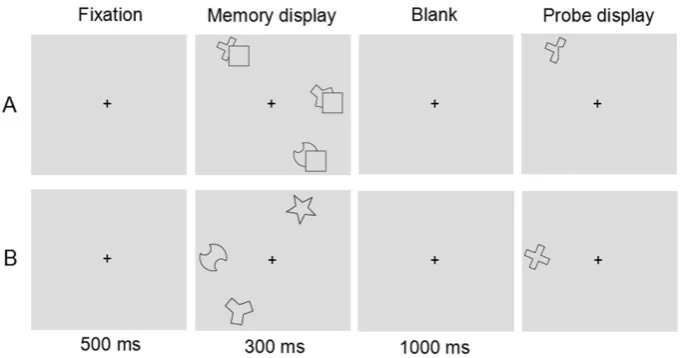
Procedure and Design.Each trial started with the presentation of a central fixation cross for 500
ms. Next, participants were randomly presented with a memory display of simple or composite objects
for 300 ms. Following a blank screen of 1000 ms, a simple figure probe (global, local, or mosaic)
appeared at one of the locations that had previously been occupied by an item in the memory display.
The probe display remained visible until participants responded. Participants responded with the left
and, respectively, right mouse keys to indicate whether the probe object was the same as or different
this experiment refers to object identity, rather than to the completion type. For example, the occluded
cross in Figure 1A (Composite) would be considered the same object in relation to all other simple
objects that present a cross-shaped item (Figure 1A, Simple). The objects in a given memory display
were randomly selected from the available set of stimuli, with the constraint that all objects were of the
same completion type (i.e., global, local, or mosaic, respectively) and no object repeated in the same
display. It should be noted that different completion types were presented in separate parts of the
experiment, such that, for a given experimental part, all simple objects in the memory and probe
displays would coherently support the same (global, local, or mosaic) object interpretation. Thus,
blocking by completion type ensured that observers could generate a coherent interpretation in a
consistent manner, potentially maximizing effects of amodal completion in the current experiment (see
Albright & Stoner, 2002; Rauschenberger, Peterson, Mosca, & Bruno, 2004; Plomp & Van Leeuwen,
2006; Liu, Plomp, Van Leeuwen, & Ioannides, 2006; Plomp et al., 2006). Observers were asked to
respond as accurately as possible; there was no stress on response speed. In case of an erroneous
response, feedback was provided in the form of an ‘alerting’ sign (“–”) presented for 1000 ms at the
center of the screen. Trials were separated from each other by an interval of 1000 ms. Figure 2
illustrates typical examples of a trial sequence.
A within-subjects design was used. The independent variables were object configuration (simple
or composite objects in the memory display), interpretation (global completion, local completion, or
mosaic interpretation), and change in the probe display (yes, no). The experiment was subdivided into
three parts, with each part displaying one type of possible interpretation. Thus, each part of the
experiment presented only one type of (simple) object (i.e., global, local, or mosaic figure) in the
objects within a given experimental part (e.g. Albright & Stoner, 2002). The three parts were presented
in random order. Within each part, the different configurations (simple, composite) and change and
no-change trials were presented in randomized order across trials. There was one initial block of 12
practice trials, followed by 4 experimental blocks of 42 trials per part, yielding 504 experimental trials
[image:11.595.189.410.233.518.2]in total.
Figure 1. Illustration of experimental stimuli with their respective composite and simple versions
(global, local completion, and mosaic interpretation), adapted from Van Lier et al. (1995), Plomp and
Figure 2. Experimental procedure. Panel A shows an example trial presenting a composite-object
memory display followed by a probe supporting a mosaic interpretation. The correct response would be
“same”. Panel B depicts an example trial with a simple-object memory display, presenting global
completions. The correct response would be “different”.
Results
The primary dependent variable was d’, to examine participants’ ability to distinguish
change-from no-change trials regardless of any bias to respond “change” or “no change” within the Signal
Detection Theory framework (Green & Swets, 1966)1. The sensitivity index d’is calculated as z
(proportion hits) – z (proportion false alarms), with a hit defined as correct detection of a change and a
false alarm as a “change” response in the absence of an actual change. Extreme, “perfect” scores were
adjusted using the following formulas: 1 − 1/(2n) for hit rates of 100%, and 1/(2n) for zero false alarms,
wherenrefers to the number of total hits or false alarms (Macmillan & Creelman, 1991).
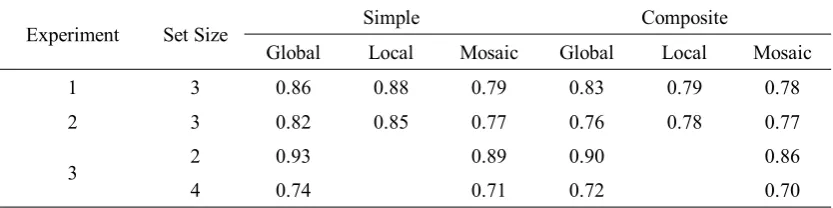
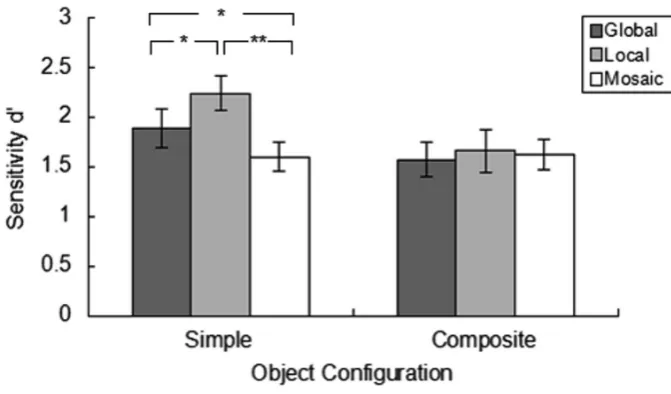
Figure 3 presents the meand’scores as a function of simple and composite object configurations
in the memory display, separately for different interpretations. In addition, mean accuracy scores are
scores, with object configuration (simple, composite) and interpretation (global, local or mosaic) as
within-participants factors, revealed a main effect of object configuration,F(1, 15) = 29.25,p <.0001,
ηp2= .66, with higher sensitivity for simple (d’= 2.30) than for composite (d’= 1.90) objects, and a
main effect of interpretation,F(2, 30) = 9.92, p <.0001,ηp2= .40, with higher sensitivity for global
and local completion as compared to the mosaic interpretation (2.28, 2.25, and 1.76 for the global, local,
and mosaic interpretations, respectively; all ps < .01). Importantly, there was also a significant
interaction between object configuration and interpretation, F (2, 30) = 18.57, p <.0001, ηp2= .55,
owing to the fact that sensitivity was highest for local, intermediate for global, and lowest for mosaic
variants of simple objects (allps < .05). By contrast, for composite objects,d’was higher for global as
[image:13.595.90.507.416.520.2]compared to both local and mosaic interpretations (allps < .05).
Table 1. Mean Accuracies (proportion correct) in Experiments 1–3 for All Stimulus Conditions
Experiment Set Size Simple Composite
Global Local Mosaic Global Local Mosaic
1 3 0.86 0.88 0.79 0.83 0.79 0.78
2 3 0.82 0.85 0.77 0.76 0.78 0.77
3 2 0.93 0.89 0.90 0.86
Figure 3. Mean change detection sensitivity, d’, as a function of the object configuration (simple,
composite) in the memory display, separately for the different interpretations (global, local, mosaic) in
Experiment 1. Error bars denote 95% (within-subject) confidence intervals. Significant differences
revealed by pairwise comparisons are indicated by asterisks. *p< .05, **p< .001.
Discussion
The results of Experiment 1 demonstrate that performance was overall lower for composite
relative to simple objects. Moreover, the different variants of each stimulus also affected performance:
Simple objects were associated with an increase in performance (i.e., in sensitivity) from mosaic
through global to local objects. By contrast, for composite objects, the global completion interpretation
exhibited the highest sensitivity score compared to the local completion and mosaic interpretations.
Note that, when comparing the various interpretations of composite with the corresponding simple
objects, for the mosaic interpretation, sensitivity for the visible parts in composite (mosaic) objects was
essentially equivalent to that with (physically identical) cutout segments in simple objects (p= .52) –
indicating that the encoding of the (task-irrelevant) square occluder in composite objects did not affect
task performance. By contrast, global and local completion interpretations were associated with
reduced sensitivity for composite relative to simple objects (ps < .05) – presumably attributable to
amodal completion, which requires additional VWM resources beyond the ‘basic’ representation of
simple objects. It cannot be ruled out, though, that it also reflects differential shape discriminability
amongst the to-be-remembered objects (see Awh, Barton & Vogel, 2007).
The effect of shape discriminability is most obvious when considering the pattern of results for
simple objects: Mosaic shapes are the most complex ones of the set of stimuli presented, arguably
change detection performance. Moreover, global shapes are presumably harder to memorize than local
shapes, because global shapes are (by definition) more symmetric and overall less variable in their
outline shapes, (see Figure 1), thus making it harder to maintain distinct representations of the
presented objects. For instance, a local-object change (e.g., of the local “arrow” in Figure 1B into the
local “T” shape in Figure 1A) might be more conspicuous than the very same change for the global set
of objects (e.g., of the global “cross” in Figure 1A into the global “wind wheel” in Figure 1B), simply
because the local changes on average involve a larger change in the size of the object compared to
global changes. In this view, the differences in performance among the various simple objects can be
taken to reflect the ease with which a given shape can be discriminated from other to-be-remembered
shapes.
Direct evidence of amodal completion in VWM is revealed when comparing the various
interpretations of the composite objects: the depicted shapes (for the various interpretations) are all
physically identical and therefore are equally difficult to discriminate from each other. Despite identical
shapes for each of the possible composite object interpretations, sensitivity was nevertheless
substantially higher for global completions compared to all other object types sensitivity – indicating
that observers were more sensitive to detect a change when a given shape could be amodally completed
to form a global object, as compared to an identical, uncompleted mosaic shape. At the same time,
however, the amodally completed shape required more VWM capacity than a comparable simple
global shape that does not require to be completed behind the occluding square (p< .05, see above). In
contrast, no benefit of amodal completion was evident when comparing composite local with
composite mosaic objects. This pattern of results is essentially in line with findings from other
VWM resources (e.g. Sekuler, 1994; Sekuler et al., 1994; Van Lier, 1999, 2001; Van Lier & Wagemans,
1999; De Wit & Van Lier, 2002). Taken together, these studies suggest that global completion is the
default, or preferred, mode of interpretation by which partly occluded objects are completed. Thus,
both perceptual analysis and mnemonic processing are governed by a tendency to maximize the
symmetry of an occluded object (in the global completion interpretation), while completion on the
basis of good continuity (in the local completion interpretation) is less likely to be employed.
It should be noted that our experiment presented simple and composite object displays blocked by
object interpretation, that is, with separate experimental parts for global, local, and mosaic
interpretations, respectively. Thus, in each part, the presented simple object shapes may have primed
the processing of composite objects, and in fact it has been shown that the type of occlusion depends on
the presented context (Rauschenberger et al., 2004; Plomp & Van Leeuwen, 2006; Plomp et al., 2006;
Liu et al., 2006; Peterson & Hochberg, 1983). Thus, contextual information (i.e., the prevailing
interpretation as afforded by the simple objects in a given part of the experiment) may be used to guide
the encoding of the composite objects in VWM. In other words, the context provided by simple objects
throughout a given part of the experiment might be regarded as ‘priming’ an interpretation of the
presented composite objects (Plomp & Van Leeuwen, 2006). As described above, such priming by the
simple object context was particularly effective for global completions, while there was no comparable
priming of local completions. – Next, in Experiment 2, we set out to examine whether a global
completion benefit in VWM would be replicable without an influence of context.
Experiment 2
Experiment 1 revealed evidence for an effect of global object completion in VWM. Importantly, in
in the memory and probe displays were presented in separate parts of the experiment. Accordingly,
these simple objects provided some kind of consistent context within which the composite objects were
interpreted. In Experiment 2, we investigated whether evidence for object completion in VWM would
also be obtained in the absence of such a consistent context favoring a given interpretation throughout a
block of trials. To this end, memory displays with simple and, respectively, composite objects were
presented separately in different blocks (and interpretations, for composite objects now enforced only
by the probe display, were presented in randomized order). That is, simple memory display objects
were no longer available to support a consistent interpretation of the composite objects. If the
interpretation of a given composite object is determined mainly by the context prevailing throughout a
block of trials (as was the case in Experiment 1), then we would expect that, without such a consistent
context, change detection for composite objects is comparable across the global, local, and mosaic
interpretations.
Method
Experiment 2 was largely identical to Experiment 1, with the following exceptions. We tested a
new group of 16 right-handed paid volunteers (10 female, 6 male; mean age = 23.8 years; normal or
corrected-to-normal vision). Simple and composite memory display objects were presented in different
experimental blocks, whereas the different interpretations (which, for composite objects, were provided
solely by the single simple object shown in the probe display) and change and no-change trials were
presented in random order within each block. The experiment started with two blocks of 12 practice
trials (presenting either simple or composite memory displays), followed by 20 experimental blocks of
24 trials each, amounting to 480 experimental trials in total. Participants were presented with the
Results
A repeated-measures ANOVA with main terms for object configuration (simple, composite) and
interpretation (global, local, or mosaic) revealed both main effects to be significant: object
configuration,F(1, 15) = 6.32,p < .05,ηp2= .30; and interpretation, F(2, 30) = 9.76,p <.001,ηp2
= .39. Sensitivity was significantly higher for simple (d’= 1.92) than for composite (d’= 1.62) objects,
and higher for local than for global and mosaic interpretations (d’= 1.96, 1.73, and 1.62, respectively;
allps < .05). The interaction between object configuration and interpretation was also significant,F(2,
30) = 5.33,p <.01,ηp2= .26, but it showed a different pattern to that in Experiment 1. As can be seen
in Figure 4, for simple objects, sensitivity increased from the mosaic through the global to the local
interpretation (allps < .05) – a near-identical pattern to that obtained in Experiment 1. For composite
objects, by contrast, there were no significant differences among all three possible interpretations (all
ps > .5).
Further analyses were conducted to compare the simple and composite object conditions in
Experiments 1 and 2. First, an analysis of the simple objects revealed a main effect of interpretation,F
(2, 60) = 35.60,p <.0001,ηp2= .54, with the highest sensitivity for local and the lowest sensitivity for
mosaic figures (all ps < .001), without a significant difference between experiments (p= .089) and
without a corresponding interaction (p= .19). This suggests that VWM for simple objects was overall
comparable across the two experiments. Second, for the composite objects, there was a significant
interaction between experiment and interpretation,F(2, 60) = 3.58,p <.05,ηp2= .11. In Experiment 1,
there was a significant advantage for detecting a change for the global interpretation of composite
objects, while no comparable effect was evident in Experiment 2. There were no differences in
Figure 4. Mean change detection sensitivity, d’, as a function of the object configuration (simple,
composite) in the memory display, separately for different interpretations (global, local, mosaic) in
Experiment 2. Error bars denote 95% (within-subject) confidence intervals. Significant differences
revealed by pairwise comparisons are indicated by asterisks. *p< .05, **p< .001.
Discussion
The results of Experiment 2 directly replicated the pattern of results for simple objects in
Experiment 1, but revealed no evidence of object completion for composite figures. In fact, both global
and local completion interpretations for composite objects yielded a level of performance that was the
same (i.e., as low) as that for the mosaic baseline – suggesting that without the ‘priming’ provided by
the simple-object context, no particular grouping emerges. The combined results of Experiments 1 and
2 thus support previous findings showing that a given context can determine how composite objects are
interpreted (see also Rauschenberger et al., 2004; Plomp & Van Leeuwen, 2006; Liu et al., 2006;
Plomp et al., 2006). In fact, object representations in VWM may be constructed based on
context-activated top-down knowledge. This knowledge frames how objects are represented, in turn
derived from the visual input is constrained by the context within which an occluded object is
presented.
Experiment 3
The two experiments reported thus far demonstrate that, when presented within an appropriate
context, objects are stored as (globally) completed representations in VWM, where the storage or
maintenance of completed wholes draws on limited-capacity VWM resources. If this ‘resource’ notion
is correct, then varying the set size of the memory display such that it either stays within (2 items) or
exceeds (say 4 items) the available capacity for representing objects should have an influence on object
completion in VWM. This idea was tested in Experiment 3.
Method
Experiment 3 was basically identical to Experiment 1, with the following differences. 16
right-handed paid volunteers (8 female, 8 male; mean age = 24.25 years; normal or corrected-to-normal
vision) participated in the experiment. The memory display presented two possible set sizes: two or
four objects. The stimulus set was based on five different shapes (adapted from Van Lier et al., 1995;
Plomp & Van Leeuwen, 2006; Sekuler et al., 1994; see Experiment 1, Figure 1A–E) and consisted of
composite and simple objects. As Experiment 1 had shown that global completion leads to superior
VWM performance relative to local completion, in Experiment 3, only global completions were
presented and compared to (baseline) mosaic interpretations. Thus, every simple figure could be one of
two possible interpretations: global completion and mosaic (see Figure 1). A within-subjects design
was used. The independent variables were set size (2, 4), object configuration (simple, composite),
interpretation (global, mosaic), and change (yes, no). The experiment was subdivided into two parts,
procedure in Experiment 1. Participants were presented with the global and mosaic interpretation
(experimental) parts in counterbalanced order (i.e., one half starting with the global and the other with
the mosaic part). Within each part, different set sizes, object configurations, and change and no-change
trials were presented in random order. There was one block with 16 practice trials and 7 experimental
blocks of 48 trials in each part, yielding 672 experimental trials in total.
Results
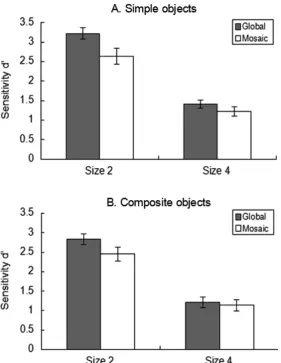
Figure 5 displays the sensitivity d’ as a function of set size, separately for different object
configurations and interpretations. A repeated-measures ANOVA with main terms for set size, object
configuration, and interpretation revealed the main effects of set size,F(1, 15) = 506.11,p <.0001,ηp2
= .97, object configuration,F(1, 15) = 13.78,p <.01,ηp2= .48, and interpretation,F(1, 15) = 27.75,p
<.0001,ηp2= .65, to be significant. Sensitivity was higher for set size 2 (d’= 2.79) than for set size 4
(d’= 1.25), higher for simple (d’= 2.12) than for composite (d’= 1.91) objects, and higher for global
completion (d’= 2.17) than for mosaic interpretations (d’= 1.86). Most importantly, the interaction
between set size and interpretation was significant,F(1, 15) = 12.65,p <.01,ηp2= .46: as the set size
increased from 2 to 4 objects, the difference between global completion and mosaic interpretations
Figure 5. Mean change detection sensitivity,d’, as a function of memory display set size, separately for
different interpretations (global, mosaic) and object configurations (A. simple objects; B. composite
objects) in Experiment 3. Error bars denote 95% (within-subject) confidence intervals.
Discussion
Experiment 3 was performed to examine how object completion in VWM is affected by memory
capacity, as tested by means of a set size manipulation. The results replicated the findings from
Experiment 1, with higher performance for the global completion than for the mosaic interpretation for
both simple and composite objects. Note that completion also interacted with set size: the benefit for
global (relative to mosaic) configurations largely decreased when set size increased from 2 to 4 items.
there is an increase in storage demands; as a result, less processing resources are available for each
individual object, leading to a decline of change detection performance overall. However, in addition to
this overall decline, the performance difference between global and mosaic configurations is reduced,
which may be taken to indicate that completion occurs only when sufficient mnemonic resources are
available.
General Discussion
The present study investigated VWM for composite objects using a change detection paradigm
and measuring performance in terms of (change detection) sensitivityd’, that is, how well a participant
was able to distinguish between trials on which the probe changed as compared to staying the same.
The results from three experiments consistently showed that participants performed overall better with
simple than with composite objects. Moreover, Experiment 1 revealed better performance for global
completion as compared to local completion and mosaic interpretations. This global completion
advantage was obtained only when the simple-object context supported a global object interpretation of
the amodal stimuli. By contrast, without an appropriate context (in Experiment 2), no such benefit for
global completions was found. Experiment 3 further showed that, even with an appropriate context, the
difference between global completion and mosaic interpretations reduced as the memory display set
size increased to (or beyond) the maximum of VWM capacity.
Taken together, these results indicate that amodal completion occurs for objects represented in
VWM and this completion process is significantly affected by the context of simple objects (presented
together with the amodal stimuli): completion occurs only when the context supports a given
interpretation of the completed object. Without corresponding context, change detection for the various
types being similar to VWM performance with mosaic configurations. Previous studies have already
shown that context affects how a given composite object is perceived (Rauschenberger et al., 2004;
Plomp & Van Leeuwen, 2006; Plomp et al., 2006; Liu et al., 2006). While our results are in line with
these findings, they extend them by showing that the influence of context on processes of amodal
completion continues from basic perceptual analysis to subsequent stages related to the short-term
retention of the presented stimuli in VWM. This influence of object completion on VWM may be due
to a top-down facilitation mechanism as demonstrated by Bar (2003). On this view, recognition of a
visual image would activate concurrent expectations about likely interpretations associated with the
specific image. Via such top-down expectancies, contextual knowledge or prior expectations might
influence the interpretation of an object in VWM (see also Conci & Müller, 2014). Thus, for our
paradigm, a consistent context would activate a specific interpretation of a given composite object,
consequently biasing the completion type that determines a given VWM representation.
Our results reveal that composite objects tend to be represented as globally completed wholes in
VWM, suggesting that memory-related processing is determined preferentially by global object
structure – in line with several previous studies that found global (but not local) completion was the
dominant interpretation of an occluded object (Sekuler, 1994; Sekuler et al., 1994; Van Lier, 1999,
2001; Van Lier & Wagemans, 1999; De Wit & Van Lier, 2002). There is some evidence suggesting that
initial stimulus processing may represent occluded objects in terms of a mosaic interpretation (e.g., in a
visual search task, see Rauschenberger & Yantis, 2001; Plomp et al., 2006). However, as processing
time increases, this interpretation is superseded by complete-object representations (Plomp & Van
Leeuwen, 2006; Plomp et al., 2006).
Experiments 1 and 3 used comparable experimental manipulations, presenting a consistent stimulus
context to facilitate (global) completion. In Experiment 1, detection of the change was somewhat more
difficult for globally completed composite as compared to simple objects. By contrast, performance
with mosaic configurations was comparable for composite and simple objects (while being overall
reduced relative to performance for composite and simple global objects). This pattern of results
indicates that the storage of a completed whole requires additional mnemonic resources, over and
above those required for the representation of the very same unoccluded object. That is, the demands
associated with completion directly impact memory capacity: a complete-object representation in
VWM affects storage in that it occupies more capacity. This is consistent with previous visual search
studies showing that search efficiency is reduced for complete-object representations relative to
comparable uncompleted objects (He & Nakayama, 1992; Rensink & Enns, 1998; Davis & Driver,
1998).
On the other hand, although the composite objects were more likely to be represented in VWM as
completed wholes compared to other interpretations, when there was a concurrent increase in storage
demands (i.e., when the memory display set size increased in Experiment 3), the advantage for the
global completion condition greatly reduced. As suggested by Alvarez and Cavanagh (2004), the
number of items stored in VWM depends on the visual information load of the individual items.
Processing of completed objects presumably poses higher demands on the available (limited) resources.
When the number of the composite objects exceeds the available VWM capacity, it appears that
completed objects are simply represented in terms of their corresponding visible fragments (i.e., in
terms of a mosaic interpretation), thus consuming fewer resources.
number of objects, but also limited by completion processes, which requires resources. This is in line
with Alvarez and Cavanagh’s (2008) suggestion that VWM may involve two dissociable stages: In the
first stage, low-resolution “boundary features” are extracted by means of parallel perceptual processing,
whereas in the second stage, more detailed, high-resolution features are extracted via serial, attentive
perceptual processing. Thus, different representations of the same composite stimuli stored in VWM
may be extracted at different stages of perceptual processing. Once the completed representations are
available, they are represented preferentially as global wholes compared to other interpretations – at
least as long as enough resources are available.
Implications for limitation of VWM capacity
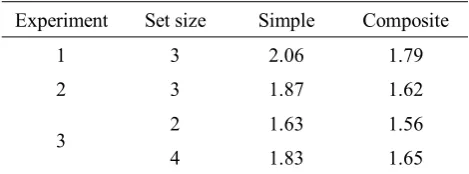
In the present study, VWM capacity for simple or composite objects was limited to about 2 items,
as indicated by estimations of the capacity estimateK(see Table 2). Thus, compared to Luck and Vogel
(1997), who report aKvalue of about 4 objects, our rather complex shape stimuli yielded a relatively
low capacity estimate. Nevertheless, our estimates are in accordance with other studies that presented
relatively complex items, such as Snodgrass line drawings or random polygons (see Alvarez &
Cavanagh, 2004). According to our current results, completion resulted in reduced change detection
performance and was more likely to be compromised as the number of stored items increased. This
presumably indicates that VWM can represent visual information until some maximum is reached, but
the number of items represented is crucially determined by completion and complexity. This is
consistent with the notion of VWM as a system with a storage capacity that varies as function of object
complexity (Alvarez & Cavanagh, 2004; Xu, 2002). Interpreted within this perspective, our results
would indicate that the encoding of items into VWM draws on a more continuous resource, instead of
a fixed number of items regardless of complexity (Luck & Vogel, 1997; Awh et al., 2007; Rouder et al.,
[image:27.595.180.415.165.252.2]2008).
Table 2. Capacity EstimatesK
Experiment Set size Simple Composite
1 3 2.06 1.79
2 3 1.87 1.62
3 2 1.63 1.56
4 1.83 1.65
Previous formal models of change detection to estimate VWM capacity assume that observers
encode only a simple memory representation that includes no higher-order information (e.g., Luck &
Vogel, 1997; Zhang & Luck, 2008). However, real-world scenes are typically complex and present
structure that provides higher-order constraints on to-be-remembered items (for a review, see Brady,
Konkle, & Alvarez, 2011; Brady & Tenenbaum, 2013; Conci & Müller, 2014). Our study supports the
view that contextual information and prior knowledge are utilized to perform working memory tasks.
The same composite objects were represented differently depending on the contextual information, and
each representation requires varying amounts of mnemonic resources. Moreover, while existing formal
models of VWM treat all items independently of each other (e.g., Luck & Vogel, 1997; Zhang & Luck,
2008), the present findings suggest that VWM encodes grouped items. In light of the current results,
approaches taking higher-order (context) information and relational structures between items into
consideration might be better suited to account for human change detection performance.
Conclusion
Previous studies have shown that completed objects are processed rather efficiently, in sequential
the maintenance of composite object representations in VWM is influenced by contextual information
and VWM capacity limits. Composite objects are preferentially stored as globally completed wholes
when primed by concurrent simple global objects, but completion only occurs with sufficient available
mnemonic resources. These findings support the view of VWM as reflecting a continuous resource,
Acknowledgements
This work was supported by project grants from the German Research Foundation (DFG; CO
1002/1-1; FOR 2293/1), and from the ‘LMUexcellent’ Junior Researcher Fund. Siyi Chen received a
References
Albright, T. D., & Stoner, G. R. (2002). Contextual influences on visual processing.Annual Review of
Neuroscience,25(1), 339-379.
Alvarez, G. A., & Cavanagh, P. (2004). The capacity of visual short-term memory is set both by visual
information load and by number of objects.Psychological Science,15(2), 106-111.
Alvarez, G. A., & Cavanagh, P. (2008). Visual short-term memory operates more efficiently on
boundary features than on surface features.Perception & Psychophysics, 70(2), 346-364.
Awh, E., Barton, B., & Vogel, E. K. (2007). Visual working memory represents a fixed number of items
regardless of complexity.Psychological Science, 18,622–628.
Bar, M. (2003). A cortical mechanism for triggering top-down facilitation in visual object
recognition.Journal of Cognitive Neuroscience,15(4), 600-609.
Brady, T. F., Konkle, T., & Alvarez, G. A. (2011). A review of visual memory capacity: Beyond
individual items and towards structured representations.Journal of Vision, 11(5):4, 1-34.
Brady, T. F., & Tenenbaum, J. B. (2013). A probabilistic model of visual working memory:
Incorporating higher order regularities into working memory capacity estimates.Psychological
Review, 120(1), 85-109.
Brainard, D. H. (1997). The psychophysics toolbox.Spatial Vision, 10, 433-436.
Conci, M., Böbel, E., Matthias, E., Keller, I., Müller, H. J., & Finke, K. (2009). Preattentive surface and
contour grouping in Kanizsa figures: Evidence from parietal extinction.Neuropsychologia,47,
726–732.
Conci, M., & Müller, H. J. (2014). Global scene layout modulates contextual learning in change
Conci, M., Müller, H. J., & Elliott, M. A. (2007a). Closure of salient regions determines search for a
collinear target configuration.Perception & Psychophysics,69(1), 32-47.
Conci, M., Müller, H. J., & Elliott, M. A. (2007b). The contrasting impact of global and local object
attributes on Kanizsa figure detection.Perception & Psychophysics,69(8), 1278-1294.
Conci, M., Müller, H. J., & Elliott, M.A. (2009). The computation of shape orientation in search for
Kanizsa figures.Perception,38(2), 173-185.
Cowan, N. (2001). The magical number 4 in short-term memory: A reconsideration of mental storage
capacity.Behavioral and Brain Sciences, 24,87–114.
Davis, G., & Driver, J. (1998). Kanizsa subjective figures can act as occluding surfaces at parallel
stages of visual search.Journal of Experimental Psychology: Human Perception and
Performance,24(1), 169-184.
De Wit, T. C., & Van Lier, R. J. (2002). Global visual completion of quasi-regular shapes.Perception,
31, 969– 984.
Fantoni, C., & Gerbino, W. (2003). Contour interpolation by vector-field combination.Journal of
Vision, 3(4), 281-303.
Green, D.M., & Swets, J.A. (1966).Signal detection theory and psychophysics. New York: Wiley.
He, Z. J., & Nakayama, K. (1992). Surfaces versus features in visual search.Nature,359(6392),
231-233.
Jolicœur, P., & Dell'Acqua, R. (1998). The demonstration of short-term consolidation.Cognitive
Psychology, 36(2), 138-202.
Kellman, P. J., & Shipley, T. F. (1991). A theory of visual interpolation in object perception.Cognitive
Liu, L. C., Plomp, G., Van Leeuwen, C., & Ioannides, A. A. (2006). Neural correlates of priming on
occluded figure interpretation in human fusiform cortex.Neuroscience, 141,1585-1597.
Luck, S. J., & Vogel, E. K. (1997). The capacity of visual working memory for features and
conjunctions.Nature,390(6657), 279-281.
Macmillan, N. A., & Creelman, C. D. (1991).Detection Theory: A User’s Guide.Cambridge:
Cambridge University Press.
Mattingley, J. B., Davis, G., & Driver, J. (1997). Preattentive filling-in of visual surfaces in parietal
extinction.Science,275, 671–674.
Michotte, A., Thines, G., & Crabbe, G. (1991). Amodal completion of perceptual structures. In G.
Thines, A. Costall, & G. Butterworth (Eds.),Michotte’s experimental phenomenology of perception
(pp. 140–167). Hillsdale, NJ: Erlbaum. (Original work published 1964)
Pelli, D. G. (1997). The VideoToolbox software for visual psychophysics: Transforming numbers into
movies.Spatial Vision, 10(4), 437-442.
Peterson, M.A., & Hochberg, J. (1983). Opposed-set measurement procedure: A quantitative analysis
of the role of local cues and intention in form perception.Journal of Experimental Psychology:
Human Perception and Performance,9, 183–193.
Plomp, G., Liu, L., Van Leeuwen, C., & Ioannides, A. (2006). The “mosaic stage” in amodal
completion as characterized by magnetoencephalography responses.Journal of Cognitive
Neuroscience, 18(8), 1394-1405.
Plomp, G., & Van Leeuwen, C. (2006). Asymmetric priming effects in visual processing of occlusion
Rauschenberger, R., Peterson, M. A., Mosca, F., & Bruno, N. (2004). Amodal completion in visual
search: Preemption or context effects?Psychological Science,15(5), 351–355.
Rauschenberger, R., & Yantis, S. (2001). Masking unveils pre-amodal completion representation in
visual search.Nature,410(6826), 369-372.
Rensink, R. A., & Enns, J. T. (1998). Early completion of occluded objects.Vision Research,38(15),
2489-2505.
Rouder, J. N., Morey, R. D., Cowan, N., Zwilling, C. E., Morey, C. C., & Pratte, M. S. (2008). An
assessment of fixed capacity models of visual working memory.Proceedings of the National
Academy of Sciences, 105,5975–5979.
Sekuler, A. B. (1994). Local and global minima in visual completion: effects of symmetry and
orientation.Perception, 23,529– 545.
Sekuler, A. B., & Palmer, S. E. (1992). Perception of partly occluded objects: A microgenetic
analysis.Journal of Experimental Psychology: General,121(1), 95–111.
Sekuler, A. B., Palmer, S. E., & Flynn, C. (1994). Local and global processes in visual completion.
Psychological Science,5, 260–267.
Thorpe, S., Fize, D., & Marlot, C. (1996). Speed of processing in the human visual
system.Nature,381(6582), 520-522.
Van Lier, R. (1999). Investigating global effects in visual occlusion: from a partly occluded square to
the back of a tree-trunk.Acta Psychologica,102(2), 203-220.
Van Lier, R. (2001). Visuo-cognitive disambiguation of occluded shapes.Behavioral and Brain
Van Lier, R. J., Leeuwenberg, E. L. J., & Van der Helm, P. A. (1995). Multiple completions primed by
occlusion patterns.Perception,24, 727-740.
Van Lier, R. J., Van der Helm, P. A., & Leeuwenberg, E. L. J. (1995). Competing global and local
completions in visual occlusion. Journal of Experimental Psychology: Human Perception and
Performance,21(3), 571-583.
Van Lier, R., & Wagemans, J. (1999). From images to objects: Global and local completions of
self-occluded parts.Journal of Experimental Psychology: Human Perception and
Performance,25(6), 1721.
Vogel, E. K., Luck, S. J., & Shapiro, K. L. (1998). Electrophysiological evidence for a postperceptual
locus of suppression during the attentional blink.Journal of Experimental Psychology: Human
Perception and Performance,24(6), 1656-1674.
Woodman, G. F., Vogel, E. K., & Luck, S. J. (2001). Visual search remains efficient when visual
working memory is full.Psychological Science,12(3), 219-224.
Xu, Y. (2002). Encoding color and shape from different parts of an object in visual short-term
memory.Perception & Psychophysics, 64(8), 1260-1280.
Zhang, W. W., & Luck, S. J. (2008). Discrete fixed-resolution representations in visual working