BIROn - Birkbeck Institutional Research Online
Thackeray, Lisa and Eatough, Virginia (2018) ‘Shutting the world out’: an
Interpretative Phenomenological Analysis exploring the paternal experience
of parenting a young adult with a developmental disability. Journal of Applied
Research in Intellectual Disabilities 31 (S2), pp. 179-190. ISSN 1360-2322.
Downloaded from:
Usage Guidelines:
Please refer to usage guidelines at or alternatively
1
‘Shutting the world out’: An Interpretative
Phenomenological Analysis exploring the paternal experience of parenting a young adult with a developmental disability
Abstract
Background: An in-depth exploration of the
experience of midlife fathers of developmentally
disabled young adults (aged 19-32 years) was
motivated by a dearth of research in this area
(McKnight, 2015).
Method: Five fathers participated in semi-structured
interviews which were subjected to interpretative
phenomenological analysis (Smith, Flowers and
Larkin, 2009).
Results: The final thematic structure comprises four
inter-related themes. They demonstrate a high degree
of concern for children’s well-being; the joy adult
children confer on their father’s lives as well as the
difficulties men experience in response to the limited
opportunities available to their offspring. Importantly
findings also illustrate the way in which men struggle
2
Conclusions: Societal conceptions of masculinity,
fatherhood and disability necessarily influence the
way fathers experience the world (Yarwood, 2011). It
is imperative that service providers recognise the
particular challenges faced by fathers, seeking ways to
better engage and support them.
Keywords: developmental disability, IPA, fathers,
young adults.
Introduction
For researchers investigating parents of children with
a developmental disability the dominant focus has
been the maternal experience (see McKnight, 2015;
Hartley, Seltzer, Head and Abbeduto, 2012). When
researchers have employed a participant group of
‘parents’ they have typically recruited a
predominantly female cohort with the result that the
paternal experience is under-researched and poorly
understood. Importantly existing research has
demonstrated that mothers’ and fathers’ experiences
are qualitatively different (see Gray, 2003; Keller and
3
the paternal perspective needs to be independently
explored in order to enhance both knowledge and
understanding.
From a quantitative perspective the focus has
typically been stress, well-being, adaptation and
coping effectiveness. Further Keller and Honig (2004)
argued that findings are inconsistent, with fathers
most often appearing in studies comparing their
experiences with those of mothers. In a large project
exploring factors associated with stress in 120 mothers
and 116 fathers of children with intellectual
disabilities (age 1-10 years), Salovita, Italinna &
Leinonen (2003) reported that the single most
important predictor were parents’ negative definitions
of their situation. For mothers this was associated
with the child’s behavioural problems while for
fathers it was linked to experienced social acceptance
of the child, a finding supported by Olsson and
Hwang (2001).
Seltzer et al (2009) compared psychosocial and
biological markers of stress in midlife parents of
4
that the experience was qualitatively different. Parents
of disabled children experienced more negative affect,
physical symptoms and higher stress levels. For both
mothers and fathers more time spent with the adult
child resulted in more psychological distress.
Rowbotham, Caroll & Cuskelly (2011) assessed 12
couples, parents of young adult children with
intellectual disabilities (ID). Similarly, both partners
experienced symptoms associated with stress, anxiety
and psychological ill-health with the majority scoring
at a clinically significant level. Ha, Hong, Seltzer &
Greenberg (2008) examined age and gender
differences in aging and midlife parents whose
children had either developmental or mental health
problems. They experienced significantly higher levels
of negative affect, more somatic symptoms and
marginally poorer psychological well-being.
A study focusing exclusively on men measured the
psychological well-being of fathers (n=240) of
adolescents and young adults with Down syndrome,
Fragile X syndrome and Autism (Hartley, Seltzer,
5
et al (2011), they identified symptoms of depression,
attributing group differences to fathers’ age, maternal
depressive symptoms, the child’s behaviour and the
risk of having additional disabled children. Ultimately
they concluded that only a ‘modest’ portion of the
observed difference relates to the child’s diagnosis
highlighting the need to explore the contribution of
contextual factors. In sum, these studies are
heterogeneous in approach, report contradictory
findings and neglect contextual and environmental
factors (Olsson et al., 2001; Pousada et al., 2013).
In contrast qualitative research typically involves
fine-grained analysis capable of providing more nuanced
and contextual insight. To this end Gray (2003)
compared the coping strategies of 21 fathers and 32
mothers of children (aged 5 to 26 years) with
high-functioning autism and identified a qualitatively
different experience. Findings demonstrated that
responsibilities for domestic tasks were allocated
according to traditional gender roles such that women
6
and fathers typically employed different coping
strategies with women relying more on social support.
Mothers and fathers of children with cerebral palsy
viewed their situation differently and employed
different coping strategies (Pelchat, Levert and
Bourgeois-Guerin, 2009). While both parents loved
their children unconditionally, sharing a common
objective, there was a marked difference in the way
they pursued and experienced parenting. For
example, both parents experienced grief for the
‘expected’ child along with concomitant feelings of
guilt. However for fathers this was experienced on an
individual level as a sense of failure. Men also
repressed as opposed to expressing emotions and
mothers reported that fathers were more likely to use
avoidance tactics such as spending more time at work
or in leisure activities to avoid being at home. A lack
of openness and communication created feelings of
isolation for their partners.
Finally, Bostrӧm and Broberg’s longitudinal study
7
focusing solely on fathers (2014). Exploring the
experiences of fathers of children with ID (age 6
months to 10 years) they suggested that, in terms of
actual involvement in delivering child care, mothers
and fathers are becoming increasingly equal. When
fathers assumed the main responsibility for childcare
some experienced it as extremely stressful. The
researchers thus contend that as the pattern of
parenting evolves, more research will be needed to
illuminate the paternal experience, particularly in
light of the likely need for ongoing support.
Ryan and Runswick-Cole (2008) problematised the
fact that mothers are the predominant focus of interest
in this context. They pointed to the fact that while all
mothers typically assume the overwhelming
responsibility for child care, for mothers of disabled
children this commitment is often expanded,
extending over a longer period. Mothers also tend to
be the parent who monitors and takes responsibility
for engaging with outside agencies. Thus in light of
8
fathers’ parenting skills and abilities are most
vulnerable to criticism; as a result they are the
‘subjects of scrutiny and surveillance, both by
professionals, academics and the wider public more
generally’ (p.206). Importantly the researchers offer
their interpretation not as a derogation of the role of
fathers; rather they suggest this imbalance should be
redressed. To this end they call for more research
exploring the paternal experience.
In light of the established paucity and the heterogeneous
nature of the literature it is difficult to garner a
comprehensive and coherent understanding of the
paternal experience. This is an important issue which,
given fathers’ integral role in the life of the family needs
to be addressed. Effective support should be informed by
evidence based research (McKnight, 2015) allowing a
systemic approach to supporting families living with
disability (Hartley et al, 2012). This necessitates greater
inclusivity in terms of the foci of researchers for although
the reported findings are divergent, they demonstrate
9
pervades both mothers’ and fathers’ lives, shared facets
are lived differently (Pelchat et al, 2009). Therefore in
response to the identified gap, this study focused on lived
experience by adopting an inductive qualitative
approach. To this end interpretative phenomenological
analysis (IPA) was employed to explore contextual
experience and the meaning it has in the lives of fathers
(Smith et al, 2009).
IPA is interested in garnering a fine-grained and
contextual perspective on a particular phenomenon as
opposed to representing a population. Smith et al (2009)
thus advocate recruiting a homogenous sample. A dearth
of literature led us to focus on the experience of English
fathers of young adults with developmental disabilities
(age 19-31 years). This is the stage at which adult children
typically assume independence (Arnett, 1987). However
parents of children with disabilities typically continue to
be intimately involved in ensuring offspring’s needs are
met (Jennings, 1987). This represents the second of three
related studies exploring the perspectives of mothers
10 Method
Participants
Once ethical approval was received fathers were
recruited through a contact with significant involvement
in a number of disability support and advocacy groups.
IPA advocates a homogenous sample. Given that we
were interested in the phenomenon of fathering a child
whose disability precludes a typical developmental
trajectory, we took the decision to include conditions
defined as developmental disabilities. Five men were
interviewed, each the father of a developmentally
disabled adult with four of the five also having at least
one non-disabled adult child. Participants were given
pseudonyms and identifying features recounted during
their interviews were changed in order to maintain
anonymity (see Table 1).
It is worth noting that in terms of homogeneity the
phenomenon we were interested in is parenting an adult
child in England. Therefore although Scott is Canadian,
he fulfils this criteria as his his children were born and
11
us to consider the contribution of his Canadian
upbringing on his experience.
Data Collection
Interviews were arranged at the participants’
convenience and took place between July and October of
2013. They lasted between sixty and ninety minutes.
After collecting demographic information and reiterating
the participant’s right to withdraw for up to a month
following the interview, a semi-structured interview
schedule was used to guide the exchange. Interviews
were largely participant led so that salient topics
introduced by the interviewees could be pursued and
further elucidated. Questions included; ‘Tell me about a
typical day with your daughter/son? ; How does your
involvement compare with that of your wife/partner? ;
What is your experience of support now that your child is
an adult? ; What have you learnt from the experience that
you would not have otherwise known? And how do you
see the future? Interviews were recorded on a digital
12 Analysis
IPA advocates an idiographic approach whereby the
participant is positioned as the experiential expert and
transcripts are analysed individually (Smith et al, 2009).
The first author began this process by reading the first
interview whilst concurrently listening to the recording.
This facilitated immersion in the data such that the
participant became the focus of analytic interest. A
commitment to the hermeneutic tradition means that IPA
fully embraces the role of interpretation in the analytic
process, recognising that both researcher and participant
are engaged in this activity as they attempt to make
meaning of a given phenomenon (Smith et al, 2009).
Thus descriptive notes were made and salient words and
phrases highlighted. Next analysis shifted to a more
conceptual level. Conceptual coding is both interpretative
and interrogative and involves asking questions of the
data in an attempt to identify more abstract and
psychological concepts. Smith et al (2009) advocate
13
meaning of a particular section of transcript. It should
capture the psychological essence whilst retaining
something of the particular, with the aim of being both
grounded and conceptual.
Codes were clustered into associative groups and these
become sub-themes which acted to establish patterns of
meaning. At this stage of analysis themes were iteratively
revised and discussed with the second author as a means
of confirming that interpretations were firmly grounded
in the data. It was also important to remain mindful of
the need to provide a representation which did justice to
the data set as a whole. The established sub-themes were
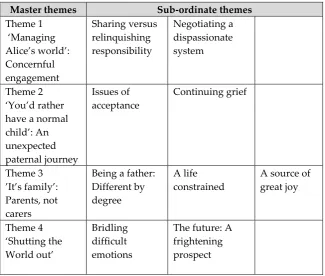
then organised into super-ordinate themes (see Table 2).
Results
This study set out to provide a nuanced and contextual
account of fathers’ experience of parenting an adult child
with a developmental disability. The four analytic themes
derived from the analysis are illustrated in Table 2
reported in detail below.
(Table 2 here)
14
There is considerable diversity in the degree to which
individual fathers are involved in parenting their child,
though all take a very real interest in the intricacies of
daily life, maintaining close and loving relationships and
experiencing the frustrations of an often unhelpful
system. Each asserts his contribution in terms of the tasks
he experiences as most important. Two participants see
themselves predominantly as breadwinners as
exemplified by Alan:
My involvement, cos of her early years cos she had a lot of
illnesses, primary care fell to my wife. Still had to work, still
had to support.
As the provider Alan asserts a traditional masculine
identity predicated on the belief that, as a man, it is his
duty to maintain a regular job as a means of providing
financial security for his dependents.
In contrast Scott and his partner adapted their lives to
allow the flexibility to respond to the individual needs
15
And I still do things with the guys and I’ve always taken
them swimming or doing physical things with them. We
have this balance like if it’s a lot of things like dealing with
applications or forms because Laura had that experience…
But if it’s something where physically I have to go and pick
them up from school or take them this place or get the girls
something or sort them out we kind of have a balance.
Interestingly although the couple share responsibilities,
they have developed a way of organising their lives
whereby Scott’s main involvement is with his sons.
Further in concentrating on physical tasks he enacts the
paternal role in a normatively masculine way.
Managing the often extensive needs of adult children
necessarily means interacting with providers of health
and social care. For Peter, Rufus and Ben this is
experienced as harrowing, with providers perceived as
intransigent, making an already difficult situation
considerably worse. Alan, who by virtue of his mother’s
mental health problems has a long association with
16
positive change over time. As a native Canadian, Scott
recognises a less than perfect system:
…okay even though the NHS isn’t what it used to be but our
bodies aren’t what they used to be. Nothing’s what it used to be
but you moan, you don’t appreciate it.
Scott is appreciative of NHS and social care provision
and expresses frustration with British people who decry
it.
Peter is vitriolic in his condemnation of social care
providers; here he struggles to find the words to convey
his palpable rage:
They should be making it easier for you because you’ve got a
problem but they don’t. They do exactly the opposite and it’s a
disaster, it’s appalling and you have to be strong in order to
fight it and parents of autistic children are prone to divorce and
you can understand why because the country gives them more
problems. ‘You’ve already got a problem so let’s make it worse
for you.’ Okay that is exactly how they deal with you. It is just
so it’s a nightmare, it’s disgusting, immoral actually is what it
17
Instead of easing a challenging situation providers serve
to exacerbate it, adding an additional layer of difficulty to
family life. The words Peter chooses powerfully express
his feelings conveying the calamitous nature of his
situation; it caught him unawares, subsumes him in its
horror and worse, he is unable to escape. He finds it
difficult to accept that this is the way things are; in
contravention of his world view he has learnt that the
only way to attain the support his son needs is to adopt
an adversarial approach and this is something he
experiences as abhorrent.
Similarly Rufus experiences a social care system
predicated on the need to minimise expenditure as
opposed to responding to the diverse needs of vulnerable
members of society. He refers to employees as ‘sleek PR
men’ conveying the notion that they operate on the same
terms as commercial businessmen, attempting to
hoodwink unsuspecting parents into believing their
rhetoric:
…they occasionally go for the cheapest option … They had that
18
you into their clutches and they were building a place for both
disabled children of Amy’s kind but also for autistic children.
Now Amy can’t resist pressure, autistic children can be quite
violent so it was the worst possible option but the council kind
of found it convenient because it was a nice easy money saving
exercise.
He perceives the system as uncaring and he feels
threatened by a local authority which has no interest in
Amy as a unique human being, a system whose primary
aim is to save money. Ultimately the notion that support
services cannot be trusted means that participants
maintain a state of vigilance and are prepared to fight in
order to ensure that their children’s best interests and
well-being remain the issue of central concern.
’You’d rather have a normal child’: An unexpected
paternal journey
Recognition of the limitations conferred by disability
represent a source of ongoing grief, a process intimately
19
life serves to reiterate what is lost in terms of
opportunities to reach typical milestones; leaving home,
starting a career, achieving independence. For these
fathers the expected order was disrupted and they have
had to come to terms with an unanticipated reality.
Acceptance is experienced at both a personal and societal
level with Rufus, Scott and Ben referring to acceptance in
terms of personal experience while Alan and Peter invoke
societal attitudes and response to disability.
Ben and his partner were not aware of Alice’s difficulties
until a friend pointed out that her development was slow.
Consultation with paediatricians confirmed this and for
Ben it seemed as if the daughter with whom he had
‘fallen in love’ was snatched away:
…what it seemed like to me is that she actually spent many of
her early years not having a clue what the world was or who
was in it or had no understanding of it at all. She obviously had
some but that’s the way it seemed like she didn’t know what she
was looking at. You didn’t even know if she was looking cos
you weren’t sure what she could see properly or focus but then
20
feel safe in the world and then of course she then started to
interact with it and interact with people so she grew and it was
so but it was, in the early years it was like nothing, she was
nothing, nothing…
There is dreamlike quality to this extract as if Alice were
no longer fully present as a sentient human being and for
Ben she seemingly ceased to exist. One possible
interpretation is that he was so traumatised by the
diagnosis that he dissociated from his daughter as a
means of containing overwhelming grief. However with
time he came to see that all was not lost and his reference
to Alice’s increasing sense of security and sense-making
may also reflect his own psychological adjustment.
Peter finds the way in which other people respond to his
son deeply problematic. Throughout the interview he
reiterates the fact that British people are particularly inept
when faced with disability:
In London they stare or they look away, okay. They are not, in
other words people in the UK are just not as receptive to people
21
People’s attitudes are reflected in their faces; when they
stare it highlights the fact that there is something
different about Toby; when they purposefully look away
it suggests his presence is in some way disturbing. This
serves as permanent reinforcement of the stigma
associated with disability, and as a father Peter is
affronted. Further in tarnishing his son they threaten his
sense of self-esteem.
For Alan, Patricia’s arrival threw the expected order into
a state of flux. The birth of a baby is typically a cause for
celebration but the arrival of a baby with a disability is
generally regarded as a tragedy. The effects of societal
hostility are myriad and Alan asserts “I mean you’d rather
have a normal child”. Acknowledging the desire for a
‘normal’ child does not mean that Alan does not value
Patricia as a unique human being. He is simply
expressing the parental desire for one’s child to enjoy a
healthy and ultimately independent life.
Grief is closely aligned to acceptance, although it has a
more visceral quality, evoking feelings of sorrow and
22
aspects of their lives and their adult children’s. It is not
always to the fore but in different ways Peter, Scott and
Alan live with a sense of loss for the life that might have
been.
For Peter there is grief for the typical father/son
relationship he and Toby will never share; grief for lost
opportunities and sorrow in recognising that he will not
always be able to keep his safe. He contrasts his feelings
about his daughter leaving home with the way he feels
about Toby:
…the girls can fend for themselves. They’re able-bodied,
common sense. I mean they’re great. The only help Emma
needed was putting stuff in her car. Toby wouldn’t be like that,
okay.
It is the mundane, everyday activities which throw his
loss into sharp relief so that helping his daughter load the
car as she prepares to leave home highlights his son’s
limitations. Toby’s life will always be compromised and
23
As children become adults, fathers continue to find
themselves challenged. As life unfolds they are
confronted anew with the opportunities which are not
available to their sons and daughters. Although many
issues are resolved, acceptance, particularly in relation to
societal attitudes and behaviours, continues to be
something participants grapple with.
‘It’s family’: Parents, not carers
Despite the difficulties these fathers face, they are at their
most animated when talking about the happiness their
children bring into their lives.
Alan is offended by those who refer to him as a carer,
contending that the parent/child relationship does not
end once your child reaches adulthood:
… as a father you’re a father for life regardless of the condition
of the child so I’m still a father to my oldest daughter. I still
help her … so it’s not that you stop being it after a certain age.
So it’s the same for any parent that you ask that cares for a
learning difficulty will tell you they’re a parent first. The
tendency is for people to put carer. I’m not struck by that word.
24
In describing him as Patricia’s carer, Alan feels that
people diminish the relationship by suggesting it is
unequal, predicated on obligation. He does not recognise
a differentiated experience; it is simply that Alan
responds to Patricia’s greater need, something he
characterises as a fundamental and inherent feature of
being a father.
During the week Scott’s sons attend educational
provisions. However at the weekend the boys cannot be
left unsupervised and as a result their parents are
responsible for keeping them occupied:
And on a Saturday I’ll have the boys so she can do whatever
she wants, take time off, and on a Sunday she has the boys. So
on a Saturday I tend to have them here. They have this thing
called (name) at (name) Park where they go bike riding so I
tend to take them and (name) is between twelve and four so I
tend to take them about two and we go bike riding for about an
hour then I come back home, I give them a bite to eat and then
we go swimming and then I come back home and then we chill
25
Scott refers to his wife taking ‘time off’, a term usually
employed when referring to breaks from paid work. Its
use is illustrative of the incessant demands made on the
couple in caring for their sons. They have agreed a
system whereby they spend one day at the weekend with
Courtney and Idris allowing each to experience personal
time and space. Their situation necessitates this
structured approach and whereas for most parents this
level of involvement is transitory, for Scott it endures.
With Toby’s diagnosis Peter, experienced himself as ‘a
rudderless ship’, metaphorically adrift. The world had
shifted on its axis and he was no longer able to orient
himself to the future. At a young adult Toby continues to
need a high level of care with the result that Peter’s life is
limited:
We have found a carer who will babysit. I hate calling it
babysitting because it’s not babysitting is it? Minding, right.
So but that’s expensive. You know going out to the cinema will
cost thirty odd pounds before we’ve bought the cinema tickets
so it makes an expensive evening right so that’s another
26
He is frustrated that the English language does not
provide an appropriate word to describe care delivered
to a young adult in these circumstances. ‘Babysitting’
diminishes Toby’s adult status, infantilises him, and
perhaps most importantly, points to the enduring nature
of the situation. The impact is manifold and cumulative
and such are the implications that the opportunity to be
spontaneous is stifled.
For three participants the effects of supporting their
families had serious implications for their careers and in
this respect it changed the course of their lives. For
example, Ben and his partner found continuing in their
chosen careers impossible:
What happened was we both in fact gave up work, we were
both teachers in one form or another and we both ended up in
careers in which we were more able to control our time. I ended
up as a plumber and she ended up as a reflexologist but it
wasn’t possible to be brutally honest to do any kind of, to look
after Alice and work in any conventional sense.
‘(E)nded up’ suggests that being a plumber is not an
27
diagnosis shifted Ben’s experiential horizon such that she
became the focal point, the controlling factor and he was
no longer the arbiter of his own time. He was unable to
commit to work in the way that a ‘career’ demands and
this had important implications in terms of his ability to
generate income.
In the beginning fathers’ expectations were coloured by
fear of the unknown, and now that their children are
adults other people are inclined to perceive their
continuing involvement as a burden. However it is
apparent that their children bring immense happiness.
When asked about the best aspects of parenting all were
effusive in expressing the pleasure they experience. Peter
describes Toby as ‘wonderful’, ‘fantastic’, ‘lovely’ and
‘adorable’ while for Alan, Patricia has always been a ‘joy’.
Here Rufus describes the enormous pleasure he derives
as the recipient of his daughter’s unconditional love:
… and you’ve learnt that there are rewards in doing it in terms
of the affection that Amy and dare I say complete passion, for
28
His efforts are rewarded with gratifying shows of love
and appreciation. Rufus’ greatest pleasure and surprise
relates to the fact that Amy is indiscriminate in
demonstrating affection for all the members of her
immediate family. This is something special, a unifying
experience which transcends expectation.
The data demonstrates that fathers continue to respond to
the particular needs of their children and this makes
significant demands with the result that in different ways
lives are constrained. However, paternal support is
typically delivered with acquiescence and viewed as a
natural response to additional need. Importantly given
the prevailing negative conceptions, fathers were at their
most animated when talking about the happiness
children bring into their lives.
‘Shutting the world out’
Bridling difficult emotions is a strategy employed by all
five fathers, though for each it is lived differently. The
29
about Toby’s future make it extremely difficult for him to
contemplate the prospect of his son leaving home:
I view it personally as a disaster cos I will miss him terribly. I
cannot stand the thought of it. I cannot, and I have my friends
saying to me, ‘You’ve gotta get your head round this. They all
move out at some stage or another and Toby’s got to’. And
Jenny has always said to me ‘You don’t wanna be in your
seventies, if you’re still alive and have your 40 year old living
here and then he can’t fend for himself’. And you know he has
to have his own life and you’ve got to bite the bullet, well I have
to bite the bullet. Certainly I am going to find it horrific.
Peter is explicit in conveying how he is terrified of
relinquishing his son to the care of others; the prospect is
so painful that he simply cannot entertain it. ‘Biting the
bullet’, isa metaphor derived from the practice employed
by soldiers of holding a bullet between their teeth during
surgery in the absence of anaesthesia. It perfectly
encapsulates Peter’s experience whereby extreme pain
must be endured and nothing can ameliorate his
30
Anxiety is a pervasive aspect of Alan’s parenting
experience, fearing that he may lose Patricia at any time:
You’re always waiting for something to go wrong. So every
illness was heart failure or I mean she didn’t get colds she got
hospitalised every time. She still does occasionally so there is a
fear that once you’ve got that in the back of your head there’s a
fear that every time, I mean from my point of view. I can’t
speak for my wife. It’s the same fear all the time. You live with
that.
Living in a continual state of anxiety means that Alan
remains alert and once he perceives potential threat his
mind races ahead, imagining the worse. He feels unable
to escape these painful emotions, and having never felt
able to share them he negotiates them alone.
Conversely Scott is proactive in his approach to
managing his feelings:
t’s just you can look and it looks all rosy but it’s just not that.
And I think I’m old enough to realise that as I said to my
daughters, life isn’tfair. If you understand that you will get on
31
‘Scott, okay come on, you don’t deserve a pat on the back, just
get on with it.’
Key to Scott’s approach is recognition of his agency and
acceptance that life simply ‘isn’t fair’. Observing other
people’s lives from the outside can create the impression
that all is perfect. However, Scott understands that things
are not always what they seem and that making
assumptions serves to increase his own feelings of
injustice.
Fathers typically find it difficult to fully engage with
issues which induce painful emotions and thus Rufus’
concern for Amy’s safety and well-being is tacit:
I’ll tell you what there is, there’s also the worry. I don’t think
this is Amy so much because she’s not mobile, she might put
herself in a dangerous position. She might be taken advantage
of. I don’t think she has been. I don’t think she will be but it’s a
thought at the back of your mind…
This statement is contradictory, reflecting the difficulty
Rufus experiences when contemplating the possibility
32
painful thoughts by attempting to reassure himself that
abuse has not and will not occur. However, by
articulating his fears Rufus reveals his anxieties about the
future which is perceived as a precarious and terrifying
prospect.
In contrast Ben is candid in expressing the anxiety he
experiences when thinking about Alice’s future:
The future, that’s a thing that always is scary. There’s a lovely
poem written by a friend of mine, Emma, who has a learning
disabled daughter and it goes something along the lines of you
know, what do I leave her and she looks round the house she
sees all these things that she’s got that have belonged to her
parents which are no good to her and then she ends up saying
something like a big dog to care for her and guard her. Well
that’s it.
Ben asserts the futility of passing on material possessions
when they have no intrinsic value and the dog metaphor
is extremely powerful. Dogs are construed as devoted
companions whose love and commitment is
unconditional: a relationship analogous to that of parent
33
felt, and unrealisable longing to live secure in the
knowledge that his child will always be protected by a
fierce and devoted guardian.
Discussion
The participants’ adult children had a variety of
diagnoses, the consequences of which varied in terms of
severity and this may have impacted individual’s
experiences. Analysis thus illustrated how, to varying
degrees, fathers struggle to accept the implications of
their child’s disability, particularly in light of negative
societal conceptions. However, providing ongoing
support is typically construed as a natural paternal
response to meeting individual need. While sons and
daughters represent a source of joy, participants are
confronted with the difficulties and limitations faced by
their vulnerable adult children. As a result fathers are
subject to painful emotions. The data suggests that the
men in this cohort typically resist fully engaging with
thoughts and feelings which evoke anxiety. In situations
where they are not able to protect sons and daughters
34
means of protecting themselves they adopt different
coping strategies, fearful of being subsumed. In light of
this the future represents a particularly difficult prospect
and is anticipated with apprehension.
Given societal conceptions of masculinity and fatherhood, it is
inevitable that pre-existing ideals and stereotypes colour
participants’ engagement with the world. They are committed
to caring for and caring about their disabled child and yet they
must do so in an often hostile environment. Circumstances
have thrown the masculine roles they anticipated for
themselves into disarray. They must reconcile their sense of
themselves as men, and what that means in terms of their own
and others’ expectations, at the same time responding to their
need to fulfil existential commitments. Thus we propose that a
thread of masculinity runs through the themes, facilitating
understanding of how fathers both live and make meaning of
their very particular situation.
Harré and Gillet (1994) point to the pervasive influence of
social discourse and context in shaping behaviour and
facilitating certain experiences, whilst simultaneously
35
the role gender plays in regulating ways of being a
woman or a man:
‘Genders, then, can be neither true nor false, neither real nor
apparent. And yet, one is compelled to live in a world in which
genders constitute univocal signifiers, in which gender is
stabilized, polarized, rendered discrete and intractable. In effect,
gender is made to comply with a model of truth and falsity
which not only contradicts its own performative fluidity, but
serves a social policy of gender regulation and control’ (Butler,
1988, p. 528).
Butler acknowledges the constitutive nature of gender
formation and enactment, while eloquently conveying
the inherent contradictions in implying stability when in
reality the way in which gender is enacted is fluid.
Similarly, Yarwood (2011) argues that while the reality of
men’s lives are both more fluid and complex than the
predominant discourse suggests, the breadwinner father
continues to be an enduring dominant construct which is
linked to conceptions of what it means to be a good
father. A corollary of a hegemonic masculinity is that
men typically have greater earning potential than women
36
mothers assume the main responsibility for familial care.
This further informs the way in which men perceive their
roles; the ways of being and doing fathering that are
available to them:
Whilst patriarchy has been brutalising to both men and
women, it has sustained its hegemony by emphasising the right
way to be a man and by the suppression of other forms of
masculinity. (Nunkoosing, 2002, p.36).
Against this backdrop it is not surprising that
participants’ experiences are imbued with conceptions of
the right way to be a father. Nunkoosing (2002) suggests
that resisting the cultural control of hegemonic
masculinity is risky, while Butler (1988) argues that the
‘performative accomplishment’ of gender identity is
compelled by social sanction and taboo (p.520). Like the
men in Yarwood’s cohort, these fathers are expected to be
more than financial providers, indeed in light of their
children’s additional needs they are subject to increased
demands in terms of providing support. They must find a
way of negotiating the many roles they fulfil, at the same
37
reflect the fact that while there is nothing inherent in
disability which discredits the individual, it is devalued
by society. Children with disabilities are thus born into a
hostile world and this makes life difficult for families
(Nunkoosing, 2002). This is exemplified by an incident
recounted by Rufus whereby a man said, “It must be
difficult having a dud child”
It was this distressing revelation that facilitated an
understanding of fathers in terms of what it means for
their sense of themselves as men. The statement implies
that in fathering Amy, Rufus failed, he produced a ‘dud’.
Dud is defined as a ‘thing that fails to work; a useless
thing’ (OED). This represents a serious threat to his
masculinity, besmirching his ability to successfully father
a healthy child. Importantly it is a threat experienced by
all these fathers. They embarked upon the paternal
journey assuming they would be raising a ‘normal’ child.
The arrival of a son or daughter whose development
transcends the typical pattern threw them into a world
they never anticipated and given negative stereotypes the
38
(2003) finding that social acceptance of their child is a
predictor of fathers’ stress and Pelchat et al’s (2009)
contention that men experience guilt and personal failure
about fathering a disabled child.
How participants perceive the paternal role affects their
engagement as fathers, the ways in which they provide
care and support, and the way they experience self and
relationships. For example, fathers typically have lesser
involvement with service providers which may in part be
explained by the assumption of providers that fathers do
not wish to be involved (Nunkoosing, 2002).This is a
corollary of the fact that in a society which conceptualises
mothers as bearing the main responsibility for familial
care, fathers are afforded greater opportunity to absent
themselves. Most have positioned themselves as the
family’s main financial provider, a role which typically
necessitates going out to work. This reflects Pelchat et al’s
(2009) finding that men are more likely to use avoidance
tactics such as spending time at work. Scott represents an
exception here in that he has adapted his working life in
39
involved in supporting his adult children in equal
measure with his wife. However, he still assumes
responsibility for securing the financial future of his
family. He also places high value on his ability to provide
a masculine perspective in determining issues relating to
the ways in which his sons are treated:
I see a lot of mothers, especially when they have the boys they’ll
be doing certain things that if the boys were normal they
wouldn’t do where I try to keep the balance. Even sometimes
I’ll say ’Come on, they’re young men. You can’t do that.’
Here Scott illustrates his belief that there is a specifically
gendered component to parenting such that fathering a
son is qualitatively different to fathering a daughter. The
contribution of a male role model is deemed crucial in
responding to the particular needs of young men.
The fact that men absent themselves, physically and
emotionally, may represent an attempt (either conscious
or unconscious) to protect themselves from being
subsumed in a potentially painful and anxiety provoking
response. This is a finding reflected in a number of
40
found that fathers have a tendency to repress rather than
express emotions and to avoid situations they find
difficult by spending additional time in work or leisure
activities. Mahalik et al (2005) suggest that in conforming
to masculine norms including self-reliance, emotional
control and primacy of work, other people, particularly
family members, may perceive men as emotionally
distant. This suggests a complex interplay between felt
emotion and the ability to express the accompanying
feelings in a society where people react negatively to
those who transgress gender role norms. This
phenomenon is more marked in relation to men’s
transgressions than women’s (Mahalik et al, 2005)
suggesting that men are under greater pressure to
conform and thus contain their emotions.
In conclusion we contend that societal conceptions of
masculinity and fatherhood imbue the paternal experience
and are key to understanding this particular phenomenon.
Illustrating how this operates in practise helps us to think
41
providers to the ways in which their approach typically
marginalises fathers.
Limitations and Future Research
This study is limited in that it employed a small
homogenous sample of midlife English men. However
we concur with the view expounded by Haug that if ‘a
given experience is possible it is also subject to
universalisation’ (1987, p.44). On this basis an in-depth
approach facilitated careful engagement with fathers’
accounts illustrating the ways in which societal
discourse imbues paternal experience. Given the fact
that we are all subject to the influence of our cultural
and historical environment this suggests that other
fathers of disabled adult children may share similar
experiences. Further while not seeking to make formal
generalizations, IPA studies allow us to think about
transferability and re-contextualisation, moving
beyond the sample. Thus the findings may also be
42
whose children experience, for example, chronic
illness.
It is apparent that the failure of researchers to explore
the paternal experience reflects a broader issue in that
their perspective is often neglected by those working
with families of disabled children. This study has
shown that avoidance and eschewing painful
emotions are not indicative of a dearth of concern.
Rather it is a response which in many ways conforms
to societal expectations. Current service provision
typically seeks to engage with and support mothers
rather than fathers and this has serious implications
for the well-being of men. This is a matter which
demands serious attention.
References
Bostrӧm, P.K. & Broberg, M. (2014). Openness and Avoidance: A longitudinal study of fathers of children with intellectual disability. Journal of Intellectual Disability Research, 58 (9), 810-821.
43
Gray, D.E. (2003).Gender and coping: the parents of children with high functioning autism. Social Science and Medicine. 56 (3), 631-642.
Harré, R. & Gillet, G. (1994). The Discursive Mind. London: Sage.
Hartley, S.L., Seltzer, M.M., Head, L. & Abbeduto, L. (2012). Psychological well-being in fathers of adolescents and young adults with Down syndrome, Fragile X
syndrome, and autism. Family Relations, 61 (2), 327-342. Hartley, S.L., Seltzer, M.M., Head, L. & Abbeduto, L. (2012). Psychological well-being in fathers of adolescents and young adults with Down syndrome, Fragile X
syndrome, and autism. Family Relations, 61 (2), 327-342. Haug, F. (Ed.) (1987). Female Sexualisation. London: Verso.
Keller, D. & Honig, A. (2004). Maternal and paternal stress in families with school-aged children with disabilities. American Journal of Orthopsychiatry, 74 (3), 337-348.
Mahalik, J.R., Talmadge, W.T., Locke, B.D. & Scott, R.P.J. (2005). Using the Conformity to Masculine Norms
Inventory to Work with Men in a Clinical Setting. Journal of Clinical Psychology, 61:6, 661-674.
McKnight, J. (2015). Exploring the experiences of parents who have a child with autism spectrum disorders: The need for more father-focused, qualitative research.
PsyPAG Quarterly, 94, 10-12.
Nunkoosing, K. (2002) Constructing fatherhood: A 'bricolage' about the experiences of fathers of disabled sons and daughters.
http://ethos.bl.uk/OrderDetails.do?did=1&uin=uk.bl.etho s.246632#sthash.m8l8Vezp.dpuf 13/5/2015
44
disability. Journal of Intellectual Disability Research, 45 (6), 535-543.
Pelchat, D., Levert, M. & Bourgeois-Guerin, V. (2009). How do mothers and fathers who have a child with a disability describe their adaptation/ transformation process?
Journal of Child Health Care, 13(3), 239-259.
Pousada, M., Guillamon, N., Hernandez-Encuentra, E., Munoz, E., Redolar, D., Boixados, M. & Gomez-Zuniga, B. (2013). Impact of caring for a child with cerebral palsy on the quality of life of parents: A systematic review of the literature. Journal of Developmental and Physical Disabilities, 25, 545-577.
Rowbotham, M., Carroll, A. & Cuskelly, M.
(2011).Mothers’ and Fathers’ Roles in Caring for an Adult Child with an Intellectual Disability. International Journal of Disability, Development and Education, 58 (3), 223-240.
Ryan, S. & Runswick-Cole, K. (20008). Repositioning mothers: mothers, disabled children and disability studies. Disability and Society, 23 (3), 199-210.
Saloviita, T., Italinna, M. & Leinonen, E. (2003). Explaining the parental stress of fathers and mothers caring for a child with intellectual disability: A double ABCX model. Journal of Intellectual Disability Research. 47(4-5), 300-312.
Seltzer, M.M., Almeida, D.M., Greenberg, J.S., Savla, J., Slawski, R.S., Hong, J. & Taylor, L.J. (2009). Psychosocial and biological markers of daily lives of midlife parents of children with disabilities. Journal of health and Social Behaviour, 50 (1), 1-15.
Smith, J.A., Flowers, P. & Larkin, P. (2009) Interpretative phenomenological analysis: Theory, method, and research.
45
Soanes C., Hawker S. & Elliott J. (eds.) (2005) Pocket Oxford English Dictionary. 10th edn. Oxford University Press, Oxford.
46 Participan t Participan t Age Participan t nationalit y Adult child / children Child’ s age Diagnosi s
Alan 63 English Patricia 31 Down syndrome Ben 61 English Alice 27 Severe
learning difficultie s with autistic features Peter 59 English Toby 19 Autism Rufus 70 English Amy 29 Abnorma
l Rhett’s syndrome Scott 58 Canadian Courtne
y
32 Autism
[image:47.595.132.459.97.369.2]Idris 21 Autism
Table 1: Participant information.
Master themes Sub-ordinate themes
Theme 1 ‘Managing Alice’s world’: Concernful engagement Sharing versus relinquishing responsibility Negotiating a dispassionate system Theme 2 ‘You’d rather have a normal child’: An unexpected paternal journey Issues of acceptance Continuing grief Theme 3 ’It’s family’: Parents, not carers
Being a father: Different by degree
A life constrained
A source of great joy Theme 4 ‘Shutting the World out’ Bridling difficult emotions
The future: A frightening prospect
[image:47.595.133.459.428.704.2]