N A N O E X P R E S S
Open Access
Double-donor complex in vertically coupled
quantum dots in a threading magnetic field
Ramón Manjarres-García
1, Gene Elizabeth Escorcia-Salas
1, Javier Manjarres-Torres
1, Ilia D Mikhailov
2and José Sierra-Ortega
1*Abstract
We consider a model of hydrogen-like artificial molecule formed by two vertically coupled quantum dots in the shape of axially symmetrical thin layers with on-axis single donor impurity in each of them and with the magnetic field directed along the symmetry axis. We present numerical results for energies of some low-lying levels as functions of the magnetic field applied along the symmetry axis for different quantum dot heights, radii, and separations between them. The evolution of the Aharonov-Bohm oscillations of the energy levels with the increase of the separation between dots is analyzed.
Keywords:Quantum dots, Adiabatic approximation, Artificial molecule
PACS:78.67.-n, 78.67.Hc, 73.21.-b
Background
An important feature in low-dimensional systems is the electron-electron interaction because it plays a crucial role in understanding the electrical transport properties of quantum dots (QDs) at low temperatures [1]. Such sys-tems may involve small or large numbers of electrons as well as being confined in one or more dimensions. The number of electrons in a QD can be varied over a consid-erable range. It is possible to control the size and the number of electrons and to observe their spatial distribu-tions in QDs. Energy spectrum of two-electron QD with a parabolic confinement, for which two-particle wave equa-tion can be separated completely, has been analyzed previ-ously by using different methods [2-5].
In the present work, we propose another exactly solv-able two-electron heterostructure in which two sepa-rated electrons are confined in vertically coupled QDs with a special lens-like morphology. Together with two on-axis donors, these two electrons generate an artificial hydrogen-like molecule whose properties can be con-trolled by varying the geometric parameters and the
strength of the magnetic field applied along the sym-metry axis.
Methods
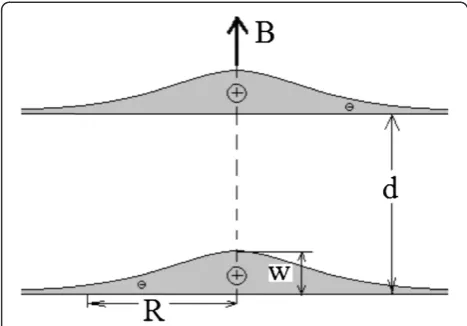
The model which we analyze below consists of two identical, axially symmetrical and vertically coupled QDs with the on-axis donor located in each one of them (see Figure 1). The dimension of the heterostructure is defined by the QDs' radiiR, height W, and the separation d
be-tween them along the z-axis. We assume that the QDs
have a shape of very thin layers whose profiles are given by the following dependence of the thickness of the layers won the distanceρfrom the axis:
wð Þ ¼ρ W=
ffiffiffiffiffiffiffiffiffiffiffiffiffiffiffiffiffiffiffiffiffiffi
1þðρ=RÞ2
q
ð1Þ
Besides, for the sake of simplicity, we consider a model with infinite barrier confinement, which is defined in cy-lindrical coordinates as Vð Þ ¼r 0 if 0<z<wð Þρ , and Vð Þ ¼ 1r otherwise.
Given that the thicknesses of the layers are much smaller than their lateral dimensions, one can take ad-vantage of the adiabatic approximation in order to ex-clude from consideration the rapid particle motions
along the z-axis [6,7] and obtain the following
* Correspondence:[email protected] 1
Group of Investigation in Condensed Matter Theory, Universidad del Magdalena, Santa Marta, Colombia
Full list of author information is available at the end of the article
expression for effective Hamiltonian in polar coordi-nates:
H¼ X
i¼1;2
H0ð Þ þρi Vðρ1;ρ2Þ þ2
π2
W2;H0ð Þρi
¼ Δð Þ2D
i þiγ
@ @ϑiþ
ω2ρ2 i
4 ;ω
2
¼ð2π=W⋅RÞ2þγ2
Vðρ1;ρ2Þ
¼ ffiffiffiffiffiffiffiffiffiffiffiffiffiffiffiffiffiffiffiffiffiffiffiffiffiffiffiffiffiffiffi2
d2þ ρ 1ρ2
j j2
q
X
i¼1;2
2
ffiffiffiffiffiffiffiffiffiffiffiffiffiffiffiffiffiffiffiffi
d2þ ρ i
j j2
q þ ρ2
i j j 2 6 4 3 7 5 ð2Þ
The effective Bohr radius a∗0 ¼ℏ2E=me2 as the unit
of length, the effective Rydberg Ry ¼e2=2Ea∗ 0 ¼
ℏ2=2
ma∗02 as the energy unit, andγ¼eℏB=2mc Ry
as the unit of the magnetic field strength have been used in Hamiltonian (Equation 2), withmbeing the electron effective mass and E, the dielectric constant. The polar coordinatesρk¼ ρk;ϑk
labeled byk¼1;2 correspond to the first and the second electrons, respectively. It is seen that for the selected particular profile given by Equation 1, the Hamiltonian (Equation 2) coincides with one which describes two particles in 2D quantum dot with parabolic confinement and renormalized inter-action. It is well known that such Hamiltonian may be separated by using the center of mass, R¼ðρ1þρ2Þ=2, and the relative,ρ¼ρ1ρ2coordinates [8]:
H¼HRþ2Hρ; HR¼ Δ 2D ð Þ R 2 þ 1 2ω 2
R2;
Hρ¼ Δð Þρ2D þω 2ρ2
16
3 ρ
4
ffiffiffiffiffiffiffiffiffiffiffiffiffiffiffiffiffiffi
ρ2þ4d2
p ð3Þ
The wave function is factorized into two parts, ψðR;ρÞ ¼Φð ÞφR ð Þ, describing the center of mass andρ
the relative motions, respectively. Meanwhile, the total energy splits into two terms depending on two radial NR;nρand two azimuthalLR;lρquantum numbers:
E N R;LR;nρ;lρ¼ERðNR;LRÞ þ2Eρnρ;lρ
¼ð2NRþLRÞωþ2Eρnρ;lρ ð4Þ
where the first term represents the well-known expression for the exact energy levels of a two-dimensional harmonic oscillator, labeled by the radial ðNR¼0; 1; 2; . . .Þand
azimuthal ðLR¼0 1 2; . . .Þquantum numbers
for the center of mass motion and the relative motion energy 2Eρnρ;lρ must be found solving the following
one-dimensional Schrödinger equation:
u00ðρÞ þ
VðρÞuðρÞ ¼Eρðnρ;lρÞuðρÞ;VðρÞ
¼ω2ρ2=4þ
l2ρ1=4
=ρ2
3=ρ4=pffiffiffiffiffiffiffiffiffiffiffiffiffiffiffiffiffiffiρ2þ4d2 ð5Þ
In our numerical, work the trigonometric sweep method [8] is used to solve this equation.
Results and discussion
Before the results are shown and discussed, it is useful to specify the labeling of quantum levels of the two-electron molecular complex. According to Equation 4, the energy levels E NR;LR;nρ;lρ
can be labeled by four symbolsNR;LR;nρ;lρ.Even and oddlpcorrespond to the spin singlet and triplet states, respectively, consistent with the Pauli Exclusion Principle.
We have performed numerical calculations of energy levels of complexes with radiiRbetween 20 and 100 nm for different separations between layers. In all presented
calculation results, the top thickness W is taken as
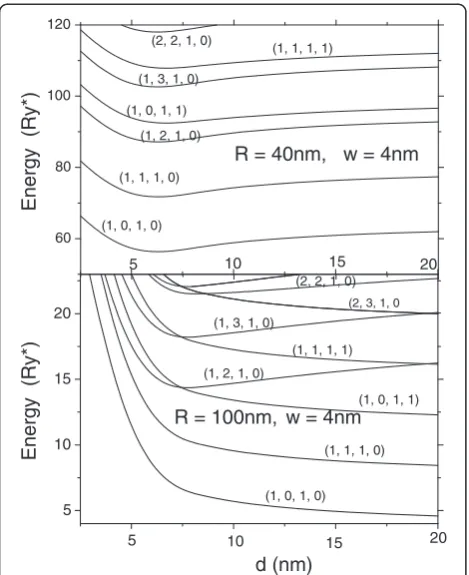
0.4 nm. In order to highlight the role of the interplay be-tween the quantum size and correlation effects in the formation of the energy spectrum of our artificial system different from the natural hydrogen molecular complex, we have plotted in Figure 2 the potential curves E d~ð Þ ¼ E NR;LR;nρ;lρ
þ2=d, similar to those of the hydrogen molecule in which the complex energies with the elec-trostatic repulsion between donors included as functions
of the separationdbetween QDs are shown. Comparing
them with the corresponding potential curves of the hydrogen molecule, one can to take into account that in analyzing the structure here, the electron motion in con-trast to hydrogen molecule is restricted inside two sepa-rated thin layers. The energy dependencies of different levels(labeled by four quantum numbers, NR;LR;nρ;lρ
[image:2.595.56.290.89.252.2]
are shown in Figure 2 for QDs with two different radii, R= 40 nm and R= 100 nm. A clear difference in the be-havior of the potential curves is readily seen. If the curves are smooth without any crossovers for QDs of
small radius, the corresponding potential curves suffer a drastic change as the QD radius becomes large. In the last case, the energy levels become very sensitive to the variation of the separation between QDs, and the quantum size effect becomes essential, providing alter-ation of the energy gaps, multiple crossovers of levels with the same or different spins, and the level reorder-ing, as the distance between QDs increases from 5 to 20 nm.
We ascribe a dramatic alteration of the potential curves with the increase of the separation between QDs from 5 to 20 nm observed in Figure 2 to the interplay between the structural confinement and the electron-electron repulsion. As the QDs' radii are small(R!0), the confinement is strong, and the kinetic energy (~1/ R2) is larger than the electron-electron repulsion energy (~1/R), vice versa for QDs with large radii. Therefore, as the QDs' radii increase, the arrangement of the elec-tronic structure for different energy levels changes from typical for the gas-like system to crystal-like one, accom-panied by the crossovers of the curves and reordering of the levels. As the two-electron structure arrangement for large separation between electrons becomes almost rigid, the relative motion of electrons is frozen out, and the two-electron structure transforms into a rigid rotator
with practically fixed separation between electrons. The electrons' motion in this case becomes similar to one in 1D ring, and therefore, the energy dependencies on the external magnetic field applied along the symmetry axis should be similar to those which exhibit the Aharonov-Bohm effect.
0,0 0,2 0,4 0,6 0,8 1,0
60 80 100 120
R = 40nm w = 4nm d = 6nm
Energy (Ry*)
0,0 0,2 0,4 0,6 0,8 1,0
0 5 10
Energy (Ry*)
γ
[image:3.595.309.540.86.371.2]R = 100nm w = 4nm d = 6nm
Figure 3Energies E N R;LR;nρ;lρof some low-lying levels of
the double-donor complex in vertically coupled QDs.As functions of the magnetic field.
0 5 10 15 20
0 5 10 15 20
Density of States
Energies (Ry)* γ = 0
γ = 0.5
w = 4nm R = 100nm d = 6nm
Figure 4Density of states for two different values of the magnetic field.Corresponding to low-lying levels of the double-donor complex in vertically coupled QDs.
5 10 15 20
20 15
10
(2, 3, 1, 0
(1, 1, 1, 1) (1, 3, 1, 0)
(1, 0, 1, 1) (1, 2, 1, 0)
(1, 1, 1, 0)
(1, 0, 1, 0) (2, 2, 1, 0)
R = 100nm, w = 4nm
Energy (Ry*)
d (nm) 5
60 80 100 120
20 15
10 5
(2, 2, 1, 0) (1, 1, 1, 1)
(1, 3, 1, 0)
(1, 0, 1, 1)
(1, 2, 1, 0)
(1, 1, 1, 0)
(1, 0, 1, 0)
R = 40nm, w = 4nm
[image:3.595.57.292.88.376.2]Energy (Ry*)
[image:3.595.306.539.524.693.2]In order to verify this hypothesis, we present in Figure 3 the calculated molecular complex energiesE N R;LR;nρ;lρ
of some lower levels as functions of the magnetic field strength for QDs with smallR= 40 nm (upper curves) and largeR= 100 nm radii (lower curves).
It is seen that for QD of small radius, the energies are increased smoothly with very few intersections. Such de-pendence is typical for gas-like systems where the para-magnetic term contribution is depreciable in comparison with the diamagnetic one. On the contrary, the energy de-pendency curves for QD of large radius present multiple crossovers and level-ordering inversion as the magnetic field strength increases from 0 to 1. It is due to a competi-tion between diamagnetic (positive) and paramagnetic (negative) terms of the Hamiltonian whose contributions in total two-electron energy in QDs of large radii are of the same order while the electron arrangement is similar to a rigid rotator. In other words, the correlation in this case becomes as strong as the electrons are mainly located on the opposite sides within a narrow ring-like region.
Finally, in Figures 4 and 5, we present results of the calculation of the density of electronic states for double-donor molecular complex confined in vertically coupled QDs. It is clear from the discussion above that the pres-ence of the magnetic field should provide a significant change of the density of the electronic states as the QDs' radii are sufficiently large. Indeed, it is seen from Figure 4 that under relatively weak magnetic field (γ= 0.5), as the molecular complex is confined in QDs of 100-nm with 6-nm separation between them, the density of states becomes essentially more homogeneous since the widths of individual lines are broadened and the gaps between them are reduced. Such change of the density of states is observed due to a splitting and displacement of the indi-vidual lines accompanied by their crossovers and the reordering of the energy levels.
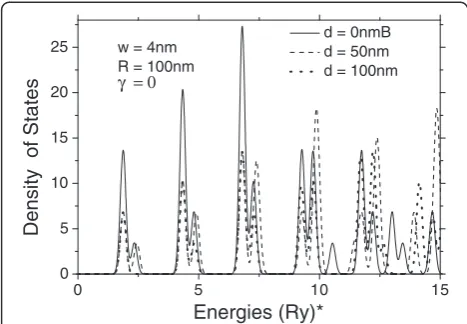
In Figure 5, we present similar curves of the molecular complex density of states for three different separations between QDs. It is seen that the curves of the density of states are modified only slightly, essentially less than under variation of the magnetic field. Particularly, the lower energy peak positions are almost insensitive to any change of the distance between dots, while the upper en-ergy peaks are noticeably displaced toward higher enen-ergy regions.
Conclusions
In short, we propose a simple numerical procedure for calculating the energies and wave functions of a molecu-lar complex formed by two separated on-axis donors located at vertically coupled quantum dots with a par-ticular lens-type morphology which produces in-plane parabolic confinement. We show that in the adiabatic approximation, the Hamiltonian of this two-electron sys-tem included in the presence of the external magnetic field is separable. The curves of the energy dependencies on the external magnetic field and the separation be-tween quantum dots are presented. Analyzing the curves of the low-lying energies as functions of the magnetic field applied along the symmetry axis, we find that the two-electron configuration evolves from one similar to a rigid rotator to gas-like as the dot radii decrease. This quantum size effect is accompanied by a significant modification of the density of the energy states and the energy dependencies on the external magnetic field and geometric parameters of the structure.
Competing interests
The authors declare that they have no competing interests
Authors' contributions
All authors contributed equally to this work. JSO created the analytic model with contributions from IM, RMG, and JMT. GES performed the numerical calculations and wrote the manuscript. All authors discussed the results and implications, commented on the manuscript at all stages, and read and approved the final manuscript.
Acknowledgments
This work was financed by the Universidad del Magdalena through the Vicerrectoría de Investigaciones (Código 01).
Author details
1
Group of Investigation in Condensed Matter Theory, Universidad del Magdalena, Santa Marta, Colombia.2Universidad Industrial de Santander, A. A. 678, Bucaramanga, Colombia.
Received: 10 July 2012 Accepted: 29 August 2012 Published: 26 September 2012
References
1. Kramer B:Proceedings of a NATO Advanced Study Institute on Quantum Coherence in Mesoscopic System: 1990 April 2-13; Les Arcs, France. New York: Plenum; 1991.
2. Maksym PA, Chakraborty T:Quantum dots in a magnetic field: role of electron–electron interactions.Phys Rev Lett1990,65:108–111. 3. Pfannkuche D, Gudmundsson V, Maksym P:Comparison of a Hartree, a
Hartree-Fock, and an exact treatment of quantum-dot helium.Phys Rev B 1993,47:2244–2250.
0 5 10 15
0 5 10 15 20 25
Density of
States
Energies (Ry)*
d = 0nmB d = 50nm d = 100nm w = 4nm
R = 100nm
[image:4.595.56.290.89.251.2]γ = 0
4. Zhu JL, Yu JZ, Li ZQ, Kawasoe Y:Exact solutions of two electrons in a quantum dot.J Phys Condens Matter1996,8:7857.
5. Mikhailov ID, Betancur FJ:Energy spectra of two particles in a parabolic quantum dot: numerical sweep method.Phys stat sol (b)1999,
213:325–332.
6. Peeters FM, Schweigert VA:Two-electron quantum disks.Phys Rev B1996,
53:1468–1474.
7. Mikhailov ID, Marín JH, García F:Off-axis donors in quasi-two-dimensional quantum dots with cylindrical symmetry.Phys stat sol (b)2005,
242(8):1636–1649.
8. Betancur FJ, Mikhailov ID, Oliveira LE:Shallow donor states in GaAs-(Ga, Al) As quantum dots with different potential shapes.J Appl Phys D1998,
31:3391.
doi:10.1186/1556-276X-7-531
Cite this article as:Manjarres-Garcíaet al.:Double-donor complex in vertically coupled quantum dots in a threading magnetic field. Nanoscale Research Letters20127:531.
Submit your manuscript to a
journal and benefi t from:
7Convenient online submission 7Rigorous peer review
7Immediate publication on acceptance 7Open access: articles freely available online 7High visibility within the fi eld
7Retaining the copyright to your article