IJPSR (2018), Volume 9, Issue 6 (Research Article)
Received on 14 September, 2017; received in revised form, 21 March, 2018; accepted, 13 May, 2018; published 01 June, 2018
METHOD DEVELOPMENT AND VALIDATION OF CEFEPIME BY USING RP-HPLC ALONG WITH ITS POTENCY
S. Joshna Rani * and N. Mounika
Department of Pharmaceutical Analysis, Sri Padmavathi Mahila Visvavidyalayam, Tirupati - 517502, Andhra Pradesh, India.
ABSTRACT: Cefepime is a broad - spectrum new parenteral cephalosporin used to treat moderate to severe nosocomial pneumonia, empirical treatment of febrile neutropenia and infections of the skin and urinary tract. In this present study a simple, accurate and precise reverse phase high performance liquid chromatographic method was developed and validated for analysis of cefepime powder for injectable solutions along with its potency by using microbiological bioassay by four different microorganisms. A YMC C 18 (4.6 × 150 mm, 5.0 m)
column was used for cefepime separation, using isocratic elution with acetonitrile: water (70:30, v/v) and UV detection at 235 nm. Microbiological assay (bioassay) was performed using the agar diffusion method. The validation performed yielded good results in terms of linearity, precision, accuracy, and robustness. The retention time obtained for cefepime was 1.77 min and % potency of the marketed dosage form was found to be 147.9%, 100%, 83.17% and 125.8% respectively.
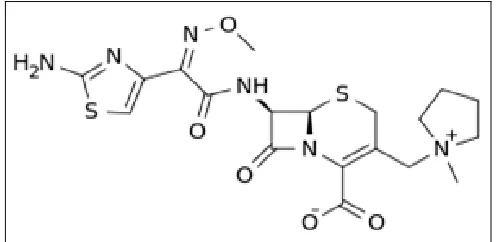
INTRODUCTION: Cefepime is a broad-spectrum antibiotic of cephalosporin used to treat bacteria responsible for causing pneumonia and infections of the skin and urinary tract 1. Cefepime is chemically(S) 1- {[(6R, 7R)- 7-[(2Z)-2-(2-amino-1, 3-thiazol-4-yl)- (methoxyimino) acetamido]- 2-carboxylato- 8- oxo- 5- thia-1-azabicyclo[4.2.0]oct-2-en-3-yl]methyl}-1-methylpyrrolidin-1-ium 2 Fig. 1 with molecular formula C19H24N6O5S2 3 and a
molecular weight of 480.56 g/mol 4. It is a white to yellow powder 5. Cefepime is active against both Gram-positive and Gram- negative bacteria 6.
QUICK RESPONSE CODE
DOI:
10.13040/IJPSR.0975-8232.9(6).2530-34
Article can be accessed online on:
www.ijpsr.com
DOI link: http://dx.doi.org/10.13040/IJPSR.0975-8232.9(6).2530-34
[image:1.612.315.563.610.731.2]Cefepime inhibits the third and final stage of bacterial cell wall synthesis by preferentially binding to specific penicillin-binding proteins (PBPs) that are located inside the bacterial cell wall. Penicillin-binding proteins are responsible for several steps in the synthesis of the cell wall. Like all β-lactam antibiotics, cefepime's ability to interfere with PBP-mediated cell wall synthesis ultimately leads to cell lysis 5.
FIG. 1: STRUCTURE OF CEFEPIME Keywords:
Cefepime, Microbiological assay,
HPLC, Validation Correspondence to Author: S. Joshna Rani
Department of Pharmaceutical Analysis, Sri Padmavathi Mahila Visvavidyalayam, Tirupati - 517502, Andhra Pradesh, India.
Antibiotics are used in the treatment of bacterial infections, but on prolong use of these products may lead to drug resistance or these products due to the demand in the market are been faked easily 7. The cefepime has a broad spectrum activity against gram positive and gram negative microorganisms it is necessary to quantify and identify the product 8. In this present study quantification of cefepime is done by the microbiological assay which is simple, accurate and low cost bioassay and High performance liquid chromatographic technique which is simple, sensitive, and reproducible for cefepime determination in marketed formulation. In this paper, a simple, rapid and economical HPLC method and a new microbiological assay have been developed and validated for quantitative deter-mination of cefepime in pharmaceutical powder for injectable preparations.
MATERIALS AND METHODS: Microbiological Assay:
Chemicals: Chemicals and reagents used were of analytical grade. Milli-Q water (Millipore) was used to prepare solutions. United States Pharmacopoeia (USP) reference standard of cefepime was used for standard solution preparation. Commercial sample novapime powder for injection containing cefepime 1 gm was obtained from the local pharmacy.
Microorganisms: E. coli, Staphylococcus aureus, Bacillus subtilis and Pseudomonas aeruginosa.
Method:
Antibacterial Activity: Nutrient agar was prepared according to the manufacturer’s instructions. The medium Muller Milton was sterilized by autoclaving at 121 °C for 15 min at 15 psi pressure and was used to determine the antibacterial activity of standard and test drugs. Sterile molten cool (45 °C) agar was poured aseptically into sterile petri plates (15 ml each) and the plates were allowed to solidify at room temperature in sterile condition. After solidification 4 holes were made using sterile borer of 5 to 8 mm in diameter. The holes were marked as SH, SL, TH, TL. 0.1 ml of the standard and test sample solution was poured in their respective holes. The plates were left for 1 - 4 at room temperature as a period of pre incubation diffusion. Incubate the plates incubated for about 18 h at 35 to 37 °C.
After incubation, the diameter of zone of inhibition was measured using antibiotic zone reader or by Veriner Caliper. The potency of marketed formulation of cefepime was calculated by using following formula 8.
% Potency = Antilog (2.0 + a log I) a = (U1 +U2) – (S1 + S2)
(U1 -U2) + (S1 - S2)
I = Ratio of dilutions;
U1 and U2 = Zone of diameter of highest and lowest concentration of marketed formulation; S1 and S2 = Zone of diameter of highest and lowest concentration of standard drug.
HPLC Method:
Preparation of Mobile Phase: Mix a mixture of water 300 ml (30%) and 700 ml acetonitrile HPLC (70%) and degas in ultrasonic water bath for 5 minutes. Filter through 0.45 µ filter under vacuum filtration.
Preparation of Standard Solution: Accurately weigh and transfer 10 mg of cefepime into a 10 ml clean dry volumetric flask add diluent and sonicate to dissolve it completely and make volume up to the mark with the diluent. (Stock solution) further pipette 0.6 ml of cefepime of the above stock solution into a 10 ml volumetric flask and dilute up to the mark with diluent.
Preparation of Sample Solution: Accurately weigh and transfer equivalent to 10 mg of cefepime sample is taken into a 10 ml clean dry volumetric flask add diluents and sonicate to dissolve it completely and make volume up to the mark with the diluent. (Stock solution) further pipette 0.6 ml of cefepime of the above stock solution into a 10 ml volumetric flask and dilute up to the mark with diluent.
Method Validation:
Precision: The standard solution was injected for six times and measured the area for all five injections in HPLC. The % RSD for the area of six replicate injections should not be more than 2.
Repeatability: Six preparations were prepared individually using single batch of drug as per test method and injected each solution.
Intermediate Precision: The standard solution was injected for six times and measured the area for all six injections in HPLC. The % RSD for the area of six replicate injections was found to be within the specified limits.
Accuracy: Inject the standard solution, accuracy -50%, accuracy -100% and accuracy -150% solutions. Calculate the amount found and amount added for cefepime and calculate the individual recovery and mean recovery values. % assay recovery should be between 98% - 102%.
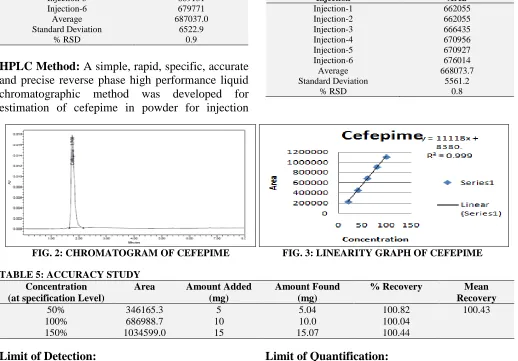
Linearity: The mean peak areas were noted from the chromatograms and a plot of concentrations over the peak areas was constructed at 245 nm. The regression of the plot was computed by least square method.
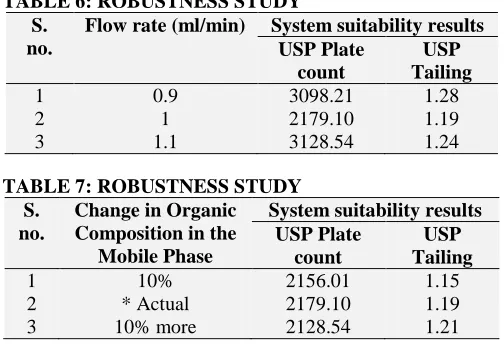
Robustness: A study was conducted to determine the effect of deliberate variations in the optimized chromatographic condition of the mobile phase, flow rate, and the pH of the mobile phase. A single condition was carried at a time keeping all other parameters constant.
Limit of Detection and Limit of Quantification: In this study the analyte response is 10 times greater than the noise response. For this study six replicates of the analyte at lowest concentration in the calibration range were measured and quantified.
Degradation Studies:
Preparation of Stock: Accurately weigh and transfer 10 mg of cefepime working standard into a 10 ml clean dry volumetric flask add about 7 mL of diluent and sonicate to dissolve it completely and make volume up to the mark with the same solvent. (Stock solution).
Hydrolytic Degradation under Acidic Condition: Pipette 0.6 ml of above solution into a
10 ml volumetric flask and 3 ml of 0.1N HCl was added. Then, the volumetric flask was kept at 60 ºC for 6 h and then neutralized with 0.1 N NaOH and make up to 10 ml with diluent. Filter the solution with 0.22 microns syringe filters and place in vials.
Hydrolytic Degradation under Alkaline Condition: Pipette 0.6 ml of above solution into a 10 ml volumetric and add 3 ml of 0.1N NaOH was added in 10 ml of volumetric flask. Then, the volumetric flask was kept at 60 ºC for 6 h and then neutralized with 0.1N HCl and make up to 10 ml with diluent. Filter the solution with 0.22 microns syringe filters and place in vials.
Thermal Induced Degradation: Cefepime and melatonine sample was taken in petridish and kept in Hot air oven at 110 ºC for 24 h. Then the sample was taken and diluted with diluents and injected into HPLC and analysed.
Oxidative Degradation: Pipette 0.6 ml above stock solution into a 10 ml volumetric flask and 1 ml of 3% w/v of hydrogen peroxide added in 10 ml of volumetric flask and the volume was made up to the mark with diluent. The volumetric flask was then kept at room temperature for 15 min. Filter the solution with 0.45 microns syringe filters and place in vials.
Photo Degradation: Pipette 0.6ml above stock solution into a 10 ml volumetric flask and expose to sunlight for 24 h and the volume was made up to the mark with diluent. Filter the solution with 0.45 microns syringe filters and place in vials.
RESULTS AND DISCUSSION: Microbiological Assay:
TABLE 1: ZONE OF DIAMETER
Zone of inhibition (mm) Sample E.
coli
Pseudomonas aeruginosa
Staphylococcus aureus
Bacillus subtilis
UL 28 29 27 28
UH 33 31 31 32
SL 27 28 28 26
SH 31 32 31 32
The potency of marketed formulation of cefepime was calculated by using following formula.
% Potency = Antilog (2.0 + a log I)
a = (U1 +U2) – (S1 + S2)
I = Ratio of dilutions;
U1 and U2 = Zone of diameter of highest and lowest concentration of marketed formulation; S1 and S2 = Zone of diameter of highest and lowest concentration of standard drug.
[image:4.612.46.299.170.371.2]By the above substitution the % potency was found to be:
TABLE 2: % POTENCY
S. no. Microorganism % Potency 1. Escherichia coli 147.9%
2. Staphylococcus aureus 100%
3. Pseudomonas aeruginosa 83%
4. Bacillus subtilis 125.8%
TABLE 3: SYSTEM PRECISION
Injection Area
Injection-1 697409
Injection-2 690348
Injection-3 683414
Injection-4 682149
Injection-5 689131
Injection-6 679771
Average 687037.0
Standard Deviation 6522.9
% RSD 0.9
HPLC Method: A simple, rapid, specific, accurate and precise reverse phase high performance liquid chromatographic method was developed for estimation of cefepime in powder for injection
dosage form. A YMC C 18 column having 4.6 × 150 mm id in Isocratic mode with mobile phase containing acetonitrile HPLC and water (70:30) was used. The flow rate was 1.0 ml/min and effluents were monitored at 235 nm. The cefepime has been eluted at 1.77 min as shown in below chromatograph.
Method Validation: The % RSD for system and method precision was less than 2, it indicates the method is precise. The average recoveries of the cefepime was 100.3%, it indicates the method is accurate. The LOD and LOQ S/N value was found to be >2 and >10 respectively it indicates the method is sensitive. In stress degradation studies, it was observed the response of peak area and retention time of cefepime was stable.
TABLE 4: METHOD PRECISION
Injection Area
Injection-1 662055
Injection-2 662055
Injection-3 666435
Injection-4 670956
Injection-5 670927
Injection-6 676014
Average 668073.7
Standard Deviation 5561.2
% RSD 0.8
[image:4.612.49.567.323.684.2]FIG. 2: CHROMATOGRAM OF CEFEPIME FIG. 3: LINEARITY GRAPH OF CEFEPIME
TABLE 5: ACCURACY STUDY Concentration
(at specification Level)
Area Amount Added (mg)
Amount Found (mg)
% Recovery Mean Recovery
50% 346165.3 5 5.04 100.82 100.43
100% 686988.7 10 10.0 100.04
150% 1034599.0 15 15.07 100.44
Limit of Detection: Calculation of S/N Ratio:
Average baseline noise obtained from blank: 66 µV Signal obtained from LOD solution: 197 µV S/N = 197/66 = 2.98
Limit of Quantification: Calculation of S/N Ratio:
TABLE 6: ROBUSTNESS STUDY S.
no.
Flow rate (ml/min) System suitability results USP Plate
count
USP Tailing
1 0.9 3098.21 1.28
2 1 2179.10 1.19
3 1.1 3128.54 1.24
TABLE 7: ROBUSTNESS STUDY S.
no.
Change in Organic Composition in the
Mobile Phase
System suitability results USP Plate
count
USP Tailing
1 10% 2156.01 1.15
2 * Actual 2179.10 1.19
3 10% more 2128.54 1.21
TABLE 8: LINEARITY STUDY (PREPARATION AT 20% TO 100% LEVEL)
S. no. Linearity Level Concentration Area
1 I 20 223566
2 II 40 451574
3 III 60 686062
4 IV 80 910009
5 V 100 1106177
Correlation Coefficient 0.999
TABLE 9: DEGRADATION STUDY
Sample Name Cefepime
Area % Degraded
Standard 685334.3
Acid 639327 6.71
Base 655047 4.42
Peroxide 629327 8.17
Thermal 650258 5.12
Photo 626473 5.67
CONCLUSION: A simple, accurate, precise and sensitive method development and validation was developed for cefepime for bulk drug and marketed formulation along with the accurate, low cost
bioassay method i.e., microbiological assay method for potency determination was developed. Hence the proposed method is highly sensitive, precise and accurate and it can be successfully applied for the quantification of API content in the commercial formulations of cefepime in routine analysis.
ACKNOWLEDGEMENT: Nil
CONFLICT OF INTEREST: Nil
REFERENCES:
1. Yahav D, Paul M, Fraser A, Sarid N and Leibovici L: Efficacy and safety of cefepime: a systematic review and meta-analysis. Lancet Infect Dis. 2007; 7(5): 338-48. 2. Barbhaiya RH, Forgue ST, Gleason CR, Knupp CA,
Pittman KA, Weidler DJ and Martin RR: Safety, tolerance, and pharmacokinetic evaluation of cefepime after administration of single intravenous doses. Antimicrob. Agents Chemother. 1990; 34(6): 1118-22.
3. Grassi GG and Grassi C: Cefepime: overview of activity in vitro and in vivo. J Antimicrob Chemother. 1993; 32 (Suppl B): 87-94.
4. Lee B, Barradell and Harriet M: Bryson cefepime a review of its antibacterial activity, pharmacokinetic properties and therapeutic use Adis international limited; Drugs 1994; 47(3): 471-505.
5. Sunitha N, Sindhura L, Thangabalan B and Babu SM: Development and validation of RP–HPLC method for simultaneous estimation of cefepime and tazobactam in injection. Formulation Asian J. Pharm. Ana 2013; 3(4): 131-137.
6. Yahav D, Paul M, Fraser A, Sarid N and Leibovici L: Efficacy and safety of cefepime: a systematic review and meta-analysis. Lancet Infect Dis. 2007; 7(5): 338-48. 7. Sujith M, Abraham S and Divakar MC: Visible
spectrophotometric method for the estimation of Cefepime, Hydeia J. O. Med. 2010; 2(2): 32-37.
8. Rodrigues DF and Salgado HRN: Comparative analysis of RP-HPLC, turbidimetric and UV methods used for the determination of cefepime hydrochloride in pharma-ceuticals J Anal Bioanal Tech 2016, 7: 5.
All © 2013 are reserved by International Journal of Pharmaceutical Sciences and Research. This Journal licensed under a Creative Commons Attribution-NonCommercial-ShareAlike 3.0 Unported License.
This article can be downloaded to ANDROID OS based mobile. Scan QR Code using Code/Bar Scanner from your mobile. (Scanners are available on Google Playstore)
How to cite this article:
[image:5.612.47.299.60.233.2]