Munich Personal RePEc Archive
Endogenous (In)Formal Institutions.
Guerriero, Carmine and Boranbay, Serra
ACLE, University of Amsterdam, Carnegie Mellon University
11 July 2012
Online at
https://mpra.ub.uni-muenchen.de/71278/
Endogenous (In)Formal Institutions.
∗
Serra Boranbay (Carnegie Mellon University) and Carmine Guerriero (ACLE)
April 22, 2016
Abstract
Despite the huge evidence documenting the relevance of inclusive political insti-tutions and a culture of cooperation, we still lack a framework that identifies their origins and interaction. In a model in which an elite and a citizenry try to cooperate in consumption risk-sharing and investment, we show that a rise in the investment value encourages the elite to introduce more inclusive political institutions to convince the citizenry that a sufficient part of the returns on joint investments will be shared. In addition, accumulation of culture rises with the severity of consumption risk if this is not too large and thus cheating is not too appealing. Finally, the citizenry may over-accumulate culture to credibly commit to cooperate in investment when its value falls and so inclusive political institutions are at risk. These predictions are consistent with the evolution of activity-specific geographic factors, monasticism, and political institu-tions in a panel of 90 European regions spanning the 1000-1600 period. Evidence from several identification strategies suggests that the relationships we uncover are causal.
Keywords: Geography; Democracy; Culture; Development.
JEL classification: 013; H10; Z10; O10.
∗We would like to thank Toke Aidt, Roland B´enabou, Roberto Bonfatti, Eric Brousseau, Maristella
1
Introduction
Overwhelming evidence suggests that “inclusive political institutions,” which enable the
citizenry to check the executive authority, and a “culture of cooperation,” understood as the
implicit reward from cooperating in prisoner’s dilemma and investment types of activities,
are crucial for development and correlated with past inclusive political institutions (Tabellini,
2010; Guiso et al., 2016). Documenting however that these two institutional arrangements
reinforce one another and are persistent does not help detect the forces producing each and
identify their interaction. This paper lays out a model to tackle this issue and explores its
em-pirical implications exploiting data from the vast institutional revolution that shook Europe
between the 11th and 16th centuries. Empowered by the feudal contract indeed, European
lords started to offer the peasants high powered farming contracts and to enter into
commer-cial partnerships with a rising class of merchants engaged in the first long-distance trades.
Such innovations flourished where they also introduced more inclusive political institutions
and persisted where the population sought the support of the Cistercians and Franciscans.
These monks dictated a culture of cooperation in exchange for guidance on how to share
consumption shocks. As further discussed below, such events have shaped Europe to date.
We envision the simplest and most essential setup necessary to link these deeply related
institutional discontinuities to economic incentives and to shed light on similar episodes.
Formally, “elite” members and “citizens” either share consumption risk with any other
in-dividual or invest with a member of a different group. The inherent differences between
these activities discriminate between a more fundamental form of cooperation aimed at
hedging against shocks and a more profitable one directed toward surplus formation, e.g.,
long-distance trades. First of all, each group costly instills into its members a psychological
gain from cooperating, for instance, by attracting a monastic order. This implicit reward
embodies a culture of cooperation, which thus represents an abstract rule of good conduct
applied outside the reference group of friends and relatives and thus a “generalized” instead
of a “limited” form of morality (Platteau, 2000). Next, the elite decides whether to introduce
democracy or keep autocracy. Democracy allows the citizenry to fix the share of investment
these prerogatives to the elite. Then, agents are randomly matched, and the elite selects
the activity if she meets a citizen. Finally, taxation and public good production possibly
follow investment. The activity-specific factors—i.e., the severity of consumption risk and
the investment value—are exogenous, e.g., geography. Since inefficiencies in public good
production render investment feasible only under democracy, the equilibrium has two key
features. First, a rise in the investment value encourages the elite to introduce democracy
to convince the citizen that a sufficient part of the returns on joint investments will be
shared, and culture rises with the severity of consumption risk if this is not too large and
thus cheating is not too appealing. Second, democratization and cultural accumulation by
the citizenry can either reinforce or undermine one another. When the investment-specific
factor is dominant, culture adds value to investment and democracy. When the
risk-sharing-specific factor is dominant, culture hinders democratization since it makes risk-sharing more
appealing for the elite. When neither factor is dominant, the elite turns uncooperative to
force the citizenry to limit taxation in order to obtain democracy first and the choice of
investment then. Yet, to credibly commit to future cooperation in investment despite the
fall in the public good production the citizen needs to accumulate a culture possibly higher
than the full-cooperative level prevailing without credibility issues. Culture thus becomes an
enforcement mechanism for the elite and a commitment device for the citizenry. Crucially,
we show that in a dynamic version of this setup over-accumulation of culture by the citizenry
also reduces the elite’s incentive to reinstate autocracy after a fall of the investment value.
We evaluate the model testable predictions by looking at data from 90 European
re-gions between 1000 and 1600. This sample offers substantial variation on sufficiently simple
economies and thus allows us to credibly relate activity-specific factors to institutional
evolu-tion. Given that the main economic activities in the sample were farming and long-distance
trade, we gauge the severity of consumption risk with the standard deviation of the growing
season temperature and the investment value with the availability of a direct access to the
coast. Moreover, we proxy the inclusiveness of political institutions with the strength of the
constraints on the elite’s power and the citizenry’s culture with the discounted number of
years Cistercian and Franciscan houses were active per square km. We validate these two
mea-sure of the inclusiveness of present-day regional political institutions and the strong positive
relationships between the latter and both an outcome-based measure of past culture and
present-day self-reported norms of respect and trust. OLS estimates suggest that more
in-clusive political institutions were mainly driven by the potential for the Mediterranean and
not the Atlantic trades, whereas the diffusion of Western monasticism had an inverted
U-shaped relationship with climate volatility. In addition, the opening of the Atlantic routes
reinforced the Franciscans’ presence in the Mediterranean, where they ran micro-credit
ac-tivities allowing peasants and merchants to strengthen their partnerships with the nobility
in cases of input and liquidity shocks. Consistent with the most innovative prediction of
our model, this cultural accumulation helped the citizenry persuade the elite to keep more
inclusive political institutions despite the fading investment possibilities and justifies the
primacy of Mediterranean over Atlantic trades as institutional driver (see also Greif, [1992]).
While the independence of risk-sharing- and investment-specific geographic factors from
human effort excludes that our estimates can be possibly driven by reverse causation, our
focus on medieval Europe rules out that they are produced by channels different from that
identified by our model and discussed in the extant literature, i.e., the incidence of
colo-nialism (Acemoglu et al., 2001), missionary activities (Nunn, 2010), and slavery (Nunn and
Wantchekon, 2011). We cannot however leave out that other unobservable factors are
bi-asing our results. To determine whether the correlations we uncover are causal, we follow
a three-step strategy. First, we control not only for time and region fixed effects and the
average temperature, but also for other observable factors possibly driving (in)formal
institu-tions, i.e., the terrain ruggedness, the frequency of external wars, and the contemporaneous
development level. Including these controls has little effect on the gist of our results.
Sec-ond, we use insights from Altonji et al. (2005) to calculate how much greater the influence
of unobservables would need to be, relative to observables, to completely explain away the
relationships between geography and (in)formal institutions. We find that the influence of
unobservables would have to be on average almost 31 times greater than that of all
observ-ables. Given the very high fit of the regressions, it is then very unlikely that our estimates
can be attributed to unobserved heterogeneity. Finally, we perform the following falsification
tem-perature and present-day norms of respect and trust inside and outside the sample. Within
the sample, we find a strong positive link between the two variables as expected, given our
es-timates and the persistence of a culture of cooperation. If medieval climate volatility shaped
past culture only through past risk-sharing needs, we should not find a similar relationship
where the cost of accumulating past culture was prohibitive because of the opposition to
Western monasticism. This is what we find. Looking at 28 NUTS 3 Turkish regions, we
esti-mate an insignificant relationship between medieval cliesti-mate volatility and present-day norms
of respect and trust. This is consistent with the barriers to Western monasticism erected by
the Eastern Orthodox Church first and the Ottoman empire then. These robustness checks
make difficult to envision that our estimates are driven by unobservables and, in particular,
by a mechanism different from the one we model. Accordingly, we take them as causal.
The papers most closely related to ours are Fleck and Hanssen (2006) and Durante (2010).
The former claims that democracy expands where it helps the elite convince the citizens that
their returns from difficult-to-observe investments will not be expropriated.1 Durante (2010)
instead shows that European regions where the climate was more erratic between 1500 and
1750 present today stronger norms of trust. While however Fleck and Hanssen (2006) do not
consider the interaction between inclusive political institutions and culture, Durante (2010)
does not identify the mechanism linking past climate volatility to present-day culture.2 In
this perspective, the present paper offers three main contributions. First, we develop a theory
of endogenous (in)formal institutions based on risk-sharing needs and inefficiencies in public
good production clarifying that, over and above violence (Acemoglu and Robinson, 2000)
and political power (Acemoglu et al., 2005), the citizenry can rely on over-accumulation
of culture to elicit democratization. Crucially, this mechanism cannot be produced by the
extant time-inconsistency-based models of democratization, which overlook the citizenry’s
need to commit by zeroing his outside option, and it can be fruitfully used to analyze other
historical cases in which heterogeneity in endowments across groups with different political
1
Fleck and Hanssen (2006) document that, at the end of the Dark Ages, the elite in Sparta could easily observe the farmers’ investments, whereas that in Athens was prevented by the hillside landscape. Hence, the latter but not the former extended the franchise to encourage investments. This together with our evidence casts doubts on the alleged necessity of a limited resource and income inequality to produce inclusive political institutions put forward by a recent theoretical literature (see Cervellati et al., [2008]).
2
power makes inter-group cooperation crucial, e.g., Industrial Revolution (Lizzeri and Persico,
2004). Second, we test our model by using a novel dataset that offers huge variation across
time and space. In doing so, we shed light on a key period in history, and we devise
a time-dependent measure of past culture, which has been recently shown valid in other
contexts (Padr´o i Miquel et al., 2015).3 Finally, while characterizing the interactions among
activity-specific factors, (in)formal institutions, and the economy, we suggest an instrumental
variables approach to separately estimate the role of each institution (see Guerriero, [2015]).
The paper proceeds as follows. we review some stylized facts about medieval Europe in
section 2 to motivate the general model of institutional design we analyze in section 3. Next,
we state the model predictions in section 4, and we discuss the relative test in section 5.
Finally, we conclude in section 6, and we report proofs, figures, and tables in the appendix.
2
(In)Formal Institutions in Medieval Europe
Europe at the end of the 10th century.—The fall of the Western Roman empire deprived
Europe of political control, farming technologies, and trades [Stearns 2001, p. 165]. As a
result, the defenseless peasants—i.e., laboratores—sought the protection of the lords, i.e.,
bellatores. The consequent rise of the feudal contract, institutionalized by the Carolingian
kings (877-1037), allowed the nobles to simultaneously exploit their political power as private
property and pacify their estates [Stearns 2001, p. 176]. This trend along with the improved
climate conditions fueled an institutional revolution that changed Europe forever.
1000-1350: farming, Mediterranean trades, and new institutions.—The prospect of
im-proved land productivity and the opportunity of long-distance trades paved the way to
con-tractual innovations. The lords began to enter into high powered farming agreements with
the peasants and commercial partnerships with a rising class of merchants, who obtained
protection against piratical incursions and exemption from the duties required to cross the
lord’s domain [Stearns 2001, p. 191-222].4 These contractual innovations flourished where
the lords introduced more inclusive political institutions to fortify their credibility (Stearns,
2001; Ortu, 2005), and in particular in theGiudicati in Sardinia (952-1297), the communes of
3
Padr´o i Miquel et al. (2015) gauge culture in Chinese villages with the presence of Buddhist temples and document that this is an important determinant of the effectiveness of inclusive political institutions.
4
Northern Italy and France (1080-1282), the maritime republics of Genoa, Pisa, and Venice
(1099-1406), the towns of Aragon and Catalu˜na (1150-1213), the German imperial cities
(1152-1806), and the Swiss Cantons (1291-1515). To illustrate, Peter II of Aragon
(Freder-ick I) granted the communal privileges to the difficult-to-reach Pyrenean (Northern Italian)
communities to bolster olives production and the relative tax revenues (in exchange for the
sizable payments fixed by the 1183 Peace of Constance) [Orvietani Busch 2001, p. 66-80;
Stearns 2001, p. 208], whereas the communes jur´ees of Northern France and the Flanders
were chartered by the early Capetian kings interested in gaining from the lucrative exchanges
of woolens for Eastern spices [Stearns 2001, p. 199]. These new polities were organized as a
sworn association of free men governed by a public assembly selecting the executive [Stearns
2001, p. 216], and they were “aimed at economic prosperity [and protected by the lords’]
immediate political and financial considerations” [Stearns 2001, p. 199]. This
discontinu-ity determined the recovery of lost technologies, like the heavy plow (Slocum, 2005), and a
shift in public spending composition from war-waging to sanitation and securing commercial
routes, which the rural entrepreneurs and the merchants obtained via the local parliaments’
veto power on the lords’ decisions [Stearns 2001, p. 192-199, 205-221, 239, and 249].
Meanwhile, the Western monasticism was transforming interpersonal relationships.
Im-ported from the East during the 5th century, it spread to Europe with some ascetic and
lots of lax examples until 1098, when a group of dissatisfied Cluniac monks abandoned the
abbey of Molesme in Burgundy and founded a new monastery in Cˆıteaux [Logan 2002, p.
126]. This event marked the start of a new and highly influential phase of the medieval
Church. The Cistercians indeed revived the original Benedictine emphasis on prayer and
manual labor to diffuse the novel and powerful idea, illustrated in their 1119 Carta
Cari-tatis, that the relationships among both the houses and the worshipers should be rooted in
“mutual love and esteem, combined with a benevolent eye to human frailty [i.e.,] charity
rather than the exercise of power” [Tobin 1995, p. 40]. Crucially, these norms of cooperation
should have been materialized not through alms but “via moral consideration and practical
engagement” [Muzzarelli 2001, p. 115], which the Cistercians themselves supported with the
help of lay brothers and sisters known as conversi and various classes of secular labourers
climate was more unpredictable converting them into fertile compact blocks partly serving
the house grange and partly leased to the peasants at rates lower than those offered by the
lords [Donkin 1963, p. 184; Tobin 1995, p. 36; Woods 2005, p. 182]. Furthermore, they
organized trade fairs [Tobin 1995, p. 128], and they offered insurance against other shocks
introducing at the same time several valuable technological innovations.5 These activities,
so attractive in a world where risk-minimization was an imperative, facilitated the diffusion
of the charity-based norms of cooperation the Cistercians championed in those communities
desperate to keep their guidance and, at the same time, encouraged the neighboring ones to
pressure local monasteries to join the order and so deliver the same risk-sharing and cultural
accumulation services [Berman 2000, p. 95, 107, and 223]. The principle of “kinship”
be-tween houses, which was enforced by the duty of cross-visitation and support, assured indeed
the homogeneity of the order’s action across regions [Gimpel 1976, p. 3; Tobin 1995, p. 41].
Not surprisingly, in 1153 there were already 435 Cistercian houses scattered around Europe.
1350-1600: Atlantic trades and institutional changes.—The 1348 Black Death destroyed
the conversi system, and so the Cistercians left the scene to the Franciscans [Tobin 1995,
p. 125 and 236]. Differently from the Augustinians, Benedictine, Cluniacs, and Dominicans
(Carmelites, Carthusians, Cathars, Premonstratensians, and Waldensians), who specialized
in intellectual work (contemplation), the Friars Minor committed to a life of poverty and
social engagement and built a network of thousands of houses linked in the Cistercian fashion
[Logan 2002, p. 126-135]. Crucially, they organized in Italy, France, and Spain the first
Eu-ropean micro-credit institutions—i.e., Monte di Piet`a (Frumentario), which accommodated
customers with loans of money (wheat seeds) in exchange for a pledge auctioned if the loan
plus an interest payment, much lower than that charged by private bankers—i.e., 3% versus
30%, was not paid [Muzzarelli 2001, p. 60-63]. As in the Cistercians’ case, communities from
all Europe solicited the Franciscans to first establish a new house and then start a Monte
[Muzzarelli 2001, p. 21-29]. While running a pawnshop, they examined “the morality and
the social behavior of the customers evaluating the loan use” [Muzzarelli 2001, p. 216] to
“make the citizenry’s cohabitation more cooperative and fair” [Muzzarelli 2001, p. 7].
5
This observable cooperative effort also strengthened in different ways the relationships
between citizenry and nobility. First, the two groups jointly managed theMonte [Montanari
1999, p. 234-238]. Second, the Monte was subsidized by special taxes [Montanari 1999,
p. 192-194], and it was obliged to support the commune in the time of need—to finance
for instance military expenses—and to back up the merchant-nobility partnerships in the
case of liquidity shocks [Montanari 1999, p. 48 and 149]. Finally, the loans of wheat seeds
avoided that the peasants would stop investing in the farmland and move to the towns in
the case of harvest destruction [Montanari 1999, p. 207-209]. Thank to these ties, which
locked both peasants and merchants in the agreements took with the lords in spite of the
adverse shocks to joint investments, the intensification of the Franciscan penetration in the
Mediterranean delayed the return to autocracies after the opening of the Atlantic routes
and the consequent fall in the profitability of the Mediterranean trades [Muzzarelli 2001,
p. 83]. A case in point is Pisa, where the Monte supported the nobility’s struggle against
Florence becoming “both the symbol and the cause” [Muzzarelli 2001, p. 228] of the
1494-1509 restoration of the Republic. More generally, while the communes of Northern France
tumbled under the centralization pressure imposed by the late Capetian kings (1270-1328),
the Italian ones turned first into commercial oligarchies and only between the 15th and
16th centuries into autocracies, calledSignoria and rooted in agreements between the nester
nobility and the ennobled merchants [Stearns 2001, p. 202-205 and 255-259]. Over the same
period, the growth of Atlantic trade strengthened the merchant groups in England and the
Provinces and allowed them to constrain the power of the monarchy (Acemoglu et al., 2005).
3
Theory
Next, we present a model of institutional design in a heterogeneous society rationalizing
the stylized facts just presented but applicable to a wider range of historical cases.
3.1
Model Setup
The economy.—Society is composed by a mass one of agents split into µ < 1/2 elite
members—i.e., the lords—and 1 −µ citizens, i.e., peasants or merchants. Agents of the
e.g., participating in the Monte’s business—and investing, e.g., adopting a new farming
technology or trading over long distance. The payoff of each of the two activities is shaped
by an exogenous activity-specific factor λa ∈
0, λ with a ∈ {R, I}, i.e., respectively the
severity of consumption risk and the investment value. Agents have quasi-linear utilities and
the sub-utility u from public spending g is such that u′ >0,u′′ <0, lim
g→0u′(g) =∞. Timing of events.—The agents’ irreversible choices are ordered as follow (see figure 1).
At time zero, group i ∈ {e, c} decides the psychological gain from cooperating in any
economic activity, denoted by di < d,6 to instill into its members at the cost d2i/2, e.g.,
whether to attract Franciscan monks proposing norms of respect and trust and then bear
the cost of helping them start up aMonte. This assumption incorporates into our model two
fundamental insights of evolutionary psychology and Malthusian growth theories: a social
group dictates to its members, via natural selection and cross-punishment, cultural norms
maximizing its fitness (Barkow et al., 1992; Clark, 2007), and these norms are embraced
by the group’s members the faster the larger the culturally-driven reproductive advantage
is (Andersen et al., 2016). Thus, a group expecting larger returns from cooperation incurs
larger cultural accumulation costs and ends up deriving a larger di. Crucially, assuming a
unique implicit reward rather than two activity-specific ones is not crucial for our argument
but is consistent, for instance, with the fact that theMonte lent money to both the citizenry
in case of famine and the merchant-nobility partnerships in case of liquidity shocks. Similarly,
studying the choice of a psychological gain instead of a loss is immaterial to our argument.
At time one, the elite, who holds initially the political power, decides whether to turn
autocracy into democracy. The choice of the regime j ∈ {A, D} determines the share sj of
the investment value λI to be spent on the production of a public good and its type. There
are two types of public good and pi is group i’s favorite one, e.g., war waging for the elite
and both sanitation and securing commercial routes for the citizenry (see section 2).
At time two, if democracy has been introduced, the citizenry selects sD and the type of
public good. Under autocracy instead, sAand the public good type are decided by the elite.
At time three, agents are randomly matched. If two agents of the same group meet, they
6
always try to risk-share. Otherwise, the elite chooses the economic activity. Finally, taxation
of λI and thus public good production possibly follow a successful investment.
Payoffs.—Let πa,i,j,m(dc, de, λR, λI) be agent i’s payoff from activity a under regime j
when her/his match is m ∈ {c, e} and Ui,j(dc, de, λR, λI) agent i’s expected utility under
regime j. We report the arguments of these functions only when necessary for our analysis.
Risk-sharing resembles a prisoner’s dilemma game. Agent i receivesdi from cooperating
but also loses λR when her/his partner does not. If agent i does not cooperate, she/he
receives λR if her/his partner cooperates and zero otherwise. The severity of consumption
risk λR summarizes the exogenous features, different from those captured by λI, increasing
the gain from cheating and the loss from being cheated in risk-sharing. A volatile climate,
which heightens the urgency to make seeds and money available through a Monte in times
of famine, is a case in point. The possible risk-sharing payoffsπR,i,j,m are detailed in table 1.
If the elite chooses to invest, she has to first decide whether to make an up-front payment
f > 0 to the citizen. Once the elite has provided her input, she immediately receives de.
Next, the citizen can either shirk and appropriatef or exert an effort that costsf but delivers
an immediate gain dc. The production is zero in the former case and λI in the latter. The
investment value λI synthesizes the exogenous features, different from those gauged by λR,
raising the value of mutual cooperation in investment and, in particular, the investment
profitability and the factors hampering the observability of the citizen’s effort (Fleck and
Hanssen, 2006). In the case of farming investments (long-distance trades), natural examples
are respectively the land suitability for cultivation and the terrain ruggedness (a direct access
to the coast and the length and safety of the commercial routes). The inherent differences
between the financial risk faced by the nobility and the survival risk the peasants and the
merchants bore support the view that investment can be only initiated by the elite, requires
the citizen’s labor, and entails inputs that cannot be completely expropriated or taxed
ex-post. Crucially, we are not artificially imposing any trade-off between the two activities
since we link them through cultural accumulation. Following investment, a share 1−sj of
λI is pocketed by the elite since she pays in advance f, whereas sjλI is spent on public
good production. This has a linear technology and is characterized by the following two
share γ ∈(0,1) of sjλI and when in power cannot outsource production to the other group
to contract away this technological constraint, because of for instance transaction costs.
Second, if agent i consumes the other group’s favorite good, her/his sub-utility u is
pre-multiplied by θi < 1. These frictions can be interpreted as either the heterogeneity in the
abilities to produce the public goods and the diversity in the preferences for them discussed
in section 2 or as the sources of time-inconsistency analyzed by the extant literature, i.e.,
γ can be seen as the extent of ex-post expropriation or redistribution of the tax revenues
(Acemoglu and Robinson, 2000) andθi as the probability of being excluded from public good
consumption (Fleck and Hanssen, 2004). As illustrated below however, this second class
of inefficiencies cannot produce the aforementioned “commitment dimension” of cultural
accumulation if incorporated into our model in the form discussed by the existing literature
on democratization. The possible investment payoffs πI,i,j,m are reported in tables 2 to 5.7
The activity-specific factors are linked to the other exogenous parameters by the following
conditions whose mildness is discussed in details in the Internet appendix:
Assumption 1: a. f > d > λ >1; b. θc < f−d
/u λ; c. γ < u−1 f−d/λ.
Condition 1a guarantees a nontrivial analysis. f > d implies that cooperating in
in-vestment is never a dominant strategy for the citizen, d > λ ensures that cooperation in
risk-sharing is affordable and so its absence is not due to impossibility but to strategic
con-siderations, and d > λ > 1 enables over-accumulation of culture, which underlies the most
innovative prediction of our model. Conditions 1b and 1c require respectively that the
cit-izen is sufficiently dissatisfied ex-ante with consuming pe and that the frictions in public
good production captured by γ are sufficiently severe. They assure that the citizen does not
cooperate in investment under autocracy even when he has built the largest possible culture
d and the highest possible investment value λ is pooled into respectively pe and pc. With
assumption 1 then, we focus on a democratization process made possible only by the desire
to gain from cooperative investment despite the inefficiencies in public good production.
In evaluating the generality of the foregoing, several remarks should be heeded. First, the
continuity ofdi,sj, and λa is necessary to link scenarios differing in the relative importance
7
of the activity-specific factors to institutional evolution. Second, the model message remains
intact if both goods can be concurrently produced (see footnote 8) or the elite can transfer
funds to the citizenry under autocracy (see footnote 10). Third, our results will survive
should also risk-sharing produce a taxable surplus (see footnote 9). Fourth, the timing of
events we consider is optimal from the elite’s viewpoint and so the most likely to arise in the
first place (see footnote 13). Finally, the gist of the model will be similar should the elite be
able to restore autocracy in a future period or the agents’ type change over time (see section
3.2). All in all, the present one is the simplest and most essential setup necessary to analyze
the interactions among activity-specific factors, (in)formal institutions, and the economy.
3.2
Equilibrium (In)Formal Institutions
Since the game is of perfect and complete information, we solve it by backward induction.
Furthermore, to ease its illustration, we assume two innocuous tie-breaking rules:
Assumption 2: If risk-sharing is expected to be the economic activity under any political
system, then the elite retains autocracy. Moreover, upon meeting a citizen, the elite chooses
investment if she gets the same payoff from both risk-sharing and investment.
we start with the elite’s choice of activity. Under autocracy, risk-sharing always
pre-vails by assumptions 1 and 2. Hence, we identify the conditions under which investment
materializes once the elite has introduced democracy and given the sharing rule sD.
Choosing investment.—Condition 1b also implies that the citizen never cooperates when
pe is produced under democracy and thus he always chooses pc once in power.8 After this
choice, investment prevails if cooperative and therefore whenever it is the case that
(Ie) πI,e,D,c ≡θeu(sDλI) + (1−sD)λI+de−f ≥πR,e,A,c, (Ic) πI,c,D,e ≡u(sDλI) +dc ≥f.
While the first inequality guarantees that the elite picks investment over risk-sharing, the
second one assures that the citizen exerts effort after receiving the up-front payment f.9
Choosing sD.—Three remarks are key at this point. First, the citizen always prefers
investing to risk-sharing since the least he can obtain from the former activity—i.e., f—is
8
Conditions 1b and 1c also entail that our analysis is robust to the possibility that both public goods can be concurrently produced sinceu′>0 implies thatθcu ηλ+u (1−η)γλ< f−dfor anyη∈[0,1].
9
larger than his maximum payoff from the latter, i.e., max{λR, dc}(see condition 1a). Second,
his payoff from investment strictly rises withsD since public spending onpcis the only way to
channel to himself some investment value.10 Third, a violation of either constraint (I
e) or (Ic)
triggers autocracy by making investment impossible. Hence, the citizen chooses a sharing
rule maximizing his utility given that constraint (Ie) is met. In addition, in a subgame
perfect equilibrium, sD has to respect constraint (Ic). The citizen’s problem is
maximizesD∈[0,1] u(sDλI) such that (1)
(ν ≥0) θeu(sDλI) + (1−sD)λI ≥f −de+πR,e,A,c ≡RHS,
(ψ ≥0) (1−sD)λI ≥0.
The corresponding first order condition, which is sufficient since all functions are concave,
is u′(s∗
DλI) = (ν+ψ) (1 +νθe)
−1
, where the superscript ∗ labels equilibrium quantities.
The citizen fixes s∗
D = 1 except when doing so violates constraint (Ie) and then the unique
solution is the highestsD <1 at which constraint (Ie) binds.11 Note that s∗D depends on the
levels of culture, dc and de, as well as λR and λI, and thus sD∗ =s∗D(dc, de, λR, λI). For the
sake of clarity, we omit some arguments of this function when this is not confusing.
Because of the paramount role of λR and λI in influencing the agents’ choices, it is
useful to establish how these parameters affect the sharing rule. If the investment value
λI is sufficiently large with respect to the severity of consumption risk λR as to satisfy the
inequality λI > u−
1
(max{f −d∗
c,RHS/θe}), investment is very profitable for both groups,
and the entire λI is spent on pc. If λI however is not as large, then given a pair of dc and
de constraint (Ie) can only be satisfied for s∗D <1. At this sharing rule, the marginal value
of λI is higher as a transfer than as an input for public good production, i.e., 1> θeu′(λI).
Therefore, when RHS rises, so does the amount of λI that needs to be shifted from pc to
transfers (1−s∗
D)λI, possibly reducings∗D. SinceRHS equals the risk-sharing payoff under
autocracy plusf−de, it rises asdc increases because then the elite gets a larger payoff from
cheating a citizen, and it falls with de. The following lemma formalizes this discussion:
10
When the citizen can receive transfers under autocracy, the model message stands but democratization is less likely since the elite has another instrument to elicit cooperation (see the Internet appendix).
11
Hence, the two constraints cannot be slack at the same time. u′(λI)≥(θe)−1
suffices to ensures∗
Lemma: Under assumptions 1 and 2, s∗
D = 1 if and only if u
−1
maxnf −d∗
c, RHS
θe
o
<
λI. Furthermore, any s∗D < 1 is nondecreasing with the elite’s culture de and
nonincreas-ing with the citizen’s culture dc, i.e., for any de, dc ≤ λR, then sD∗ (de, x) = s∗D(de, y) >
s∗
D(de, w) = s∗D(de, z), ∀x6=y, z 6=w such that y∨x < λR≤z∧w. s∗
D strategically links culture to the choice of regime when activity-specific factors are not
skewed. By fixing a smallde earlier, the elite raises her outside option and payoff later on.
3.2.1 Cultural Accumulation
Absent credibility issues, each group selects either the uncooperative level of culture 0,
the level inducing only within-group cooperation in risk-sharing—i.e.,µ(1−µ) for the elite
(citizenry), the level maximizing only the payoff from investment—i.e., 1−µ(µ) for the elite
(citizenry), or the full-cooperative level ˜d≡max{1, λR}. These choices affect constraint (Ie)
by shaping the elite’s risk-sharing payoff, which is what she would attain under autocracy, and
her implicit reward from cooperating in investment. Moreover, a largerdc relaxes constraint
(Ic) and thus improves the citizen’s credibility as an investment partner. In the appendix, we
partition 0, λ according to the size ofλI relative to λR to study the links between
activity-specific factors and culture, and we obtain three cases: low—i.e., range (A), moderate—i.e.,
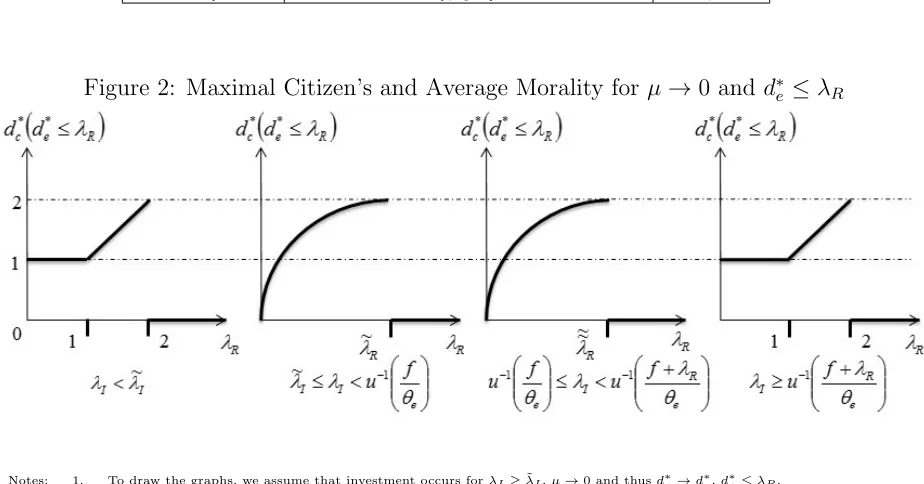
ranges (C), (D), and (E), and high values—i.e., range (B)—of λI (see figure 2).
The choices of culture have no bearing on investment and on one another in the polar
cases. In range (B), investment and so democracy are certain and both groups are better
off with spending λI entirely on pc. Thus, each group builds a culture maximizing at least
the investment payoff and possibly also the within-group cooperation in risk-sharing, e.g.,
Uc,D = µπI,c,D,e + (1−µ)πR,c,D,c −d2c/2. Then, d∗i equals ˜d for values of λR that are not
too high, and d∗
e = 1−µ and d∗c = µ at sufficiently high values of λR making cheating too
appealing. In range (A) instead, autocracy is inevitable beingλI too small to make constraint
(Ie) hold. Thus, everybody maximizes the risk-sharing payoff—e.g., Uc,A = µπR,c,A,e +
(1−µ)πR,c,A,c−d2c/2, d∗e = 1 andd∗c = ˜d for λR not too large, andd∗e =d∗c = 0 otherwise.
The choices of culture become strategic in the ranges (C), (D), and (E), where they are
strategic substitutes and affect the viability of investment by determining whether constraints
for λR large the elite is tempted to curtail d∗e to raise her stake in risk-sharing and thus
extract a larger payoff from investment. Choosing risk-sharing is a credible threat since the
citizen always prefers investment and so he cannot reciprocate with a small d∗
c. Formally,
as d∗
e goes down, RHS goes up, and thus s∗D falls. At this point, to satisfy constraint (Ic),
the citizen needs to accumulate a culture that is at least as large as the difference between
f and his sub-utility from the public good, i.e., db≡ f −u(s∗
DλI). This can well surpass
the otherwise optimal full-cooperative ˜d for f sufficiently large and θe not too small.12 If db
is not affordable, autocracy prevails. Culture then becomes an enforcement mechanism for
the elite and a commitment device for the citizen. As aforementioned, culture loses both
properties when the elite can completely exclude the citizenry from public good consumption
or if under autocracy (democracy) f ((1−sD)λI) can be fully expropriated or redistributed
since then the (Ic) ((Ie)) constraint holds even for dc∗ ≤ d˜(only for s∗D → 1). The Internet
appendix analysis of the order of events we consider further clarifies these points.13
To summarize, both groups benefit from building cooperation in risk-sharing as long as
λR is not too large, otherwise the temptation to cheat is too strong, and only the prospect
of democracy can produce some culture. This pattern is consistent with the diffusion of
Western monasticism in response to the population’s risk-sharing needs (see section 2). The
main effect of λI on culture instead is to boost d∗c as it decreases from range (B) to ranges
(C), (D), and (E) (see figure 2).14 Accordingly, as long-distance trades started to shift
toward West, the populations of Northern Italy found optimal to insure the
merchants-nobility partnerships against liquidity shocks by favoring the spread of the Franciscans and
in turn of the Monte. This over-accumulation of culture made credible future cooperation
and also delayed the rise of the Signoria (see section 2).15 We analyze this dynamics in the
12
Sinces∗
D<1 is implicitly defined by constraint (Ie), thend >b d˜↔(1−s∗D)λI+d∗e> λR+θed˜+ (1−θe)f. This inequality is true forθe→1 andf sufficiently large beingλI ≥u−1
f
−λ θe
in ranges (C), (D), and (E).
13
Other timings do not solve the credibility issues and so make democracy impossible in ranges (C), (D), and (E). Setting culture at the onset and the sharing rule before picking the activity indeed is necessary to permit commitment when needed since these choices define the elite’s payoff later on (see the Internet appendix).
14
In ranges (C), (D), and (E),d∗
c >0 is concave inλR—as in figure 2—if d2d∗
c
dλ2
R =−u ′d2s∗D
dλ2
RλI−u ′′ds∗D
dλR
2
λ2
I ≤0, which is the case forλI small. Note that
ds∗
D
dλR <0 and
d2s∗
D
dλ2
R >0 provided that u ′′′<0.
15
Internet appendix where we add to the basic timing a further period in which emerges from
the citizenry a group of “ennobled merchants” able to produce without up-front payment a
taxable surplus proportional to λI and to restore with the elite’s help autocracy. Since the
merchants prefer to be taxed by the elite because smaller in size, the latter decides whether
to seize power. She does so in ranges (A) and (E) since then autocracy assures her a
risk-sharing payoff equal to the investment one plus the revenues from taxing the merchants. In
the other ranges instead, the elite triggers a coup when levying duties on the merchants is
very appealing since they are sufficiently productive, and she tries to elicit the citizenry’s
cooperation under democracy otherwise. The citizen is now even more cooperative since
reverting to autocracy costs him the investment payoff and the taxes on the merchants.
Proposition 1 summarizes the first order relationships involving d∗
c since this is the only
level of culture we observe and on which we can focus in the empirical exercise:
Proposition 1: Under assumptions 1 and 2, the citizen’s cultured∗
c rises with the severity
of consumption risk λR at its moderate values, and then drops, and it may sharply grow as
the investment value λI falls from high to intermediate—relative to λR—values.
3.2.2 Democratization
All in all, a largerλI facilitates democratization by both fostering cultural accumulation—
and in turn cooperation—and making mutually beneficial investments more appealing than
risk-sharing. As seen in section 2, these mechanisms lie behind the 12th century rise of the
communes. On the contrary, λR has the second order effect of crippling democratization
when λI is not sufficiently large. Then indeed, the citizen needs to accumulate a very large
and possibly too expensive culture to induce the elite, which turns uncooperative, to pick
investment and democracy instead of risk-sharing and autocracy. Both strategic effects
threaten democratization. Proposition 2 recaps the first order implication of this section:
Proposition 2: Under assumptions 1 and 2, higher values of λI ease democratization.
The ability to identify both the separate and joint effects of the activity-specific factors
4
Empirical Implications
Propositions 1 and 2 provide us with two insights. First, a rise in the investment value
encourages the elite to introduce more inclusive political institutions to convince the citizenry
that a sufficient part of the returns on joint investments will be shared, and accumulation of
culture rises with the severity of consumption risk if this is not too large and thus cheating is
not too appealing. Second, the citizenry may over-accumulate culture to credibly commit to
cooperate in investment when its value is or becomes so low to endanger inclusive political
institutions (see also section 3.2). These patterns imply the following predictions:
Testable Predictions: (1) More inclusive political institutions are primarily and
posi-tively driven by the investment value; (2) The citizenry’s culture is reinforced by the severity
of consumption risk if this is not too large and may positively respond to the shocks reducing
the investment value to a level threatening more inclusive political institutions.
5
Evidence
To evaluate these testable predictions, we need proxies for the dependent and independent
variables and a suitable empirical strategy. To select them, we build on section 2.
5.1
Measuring Institutions and Geography
For what concerns the cross-sectional dimension, we look at 90 regions in 16 European
countries for which we have sufficient geographic and institutional data (see table 6 and
footnote 23). As Tabellini (2010), we define each regionr building on the Eurostat
adminis-trative classification. We consider NUTS 2 or 3 levels merging those neighboring units that,
according to Sellier and Sellier (2002), were part of the same political entity for most of the
1000-1600 period.16 In contrast to a grid approach, this sample design allows us to consider
as cross-section identifiers exactly the areas within which the inclusiveness of political
insti-tutions and culture were selected (see footnote 20). For what concerns the time dimension
t, we consider each half-century between 1000 and 1600 for a total of 13 periods. Although
16
our results are robust to the inclusion of data up to 1850, we concentrate on the first six
centuries of the second millennium for three reasons. First, the within-country variation
in political institutions almost disappears with the rise of the nation state during the 19th
century. Second, the Protestant Reformation deprived Western monasticism of its pivotal
role [Tobin 1995, p. 158]. Third, the 17th, 18th, and 19th centuries witnessed technological
innovations that made economic activities far more complex than those in the sample.
5.1.1 Measuring Inclusive Political Institutions and a Culture of Cooperation
Following Tabellini (2010), we capture the inclusiveness of political institutions through
the “constraints on the executive authority” score as defined in the POLITY IV dataset, i.e.,
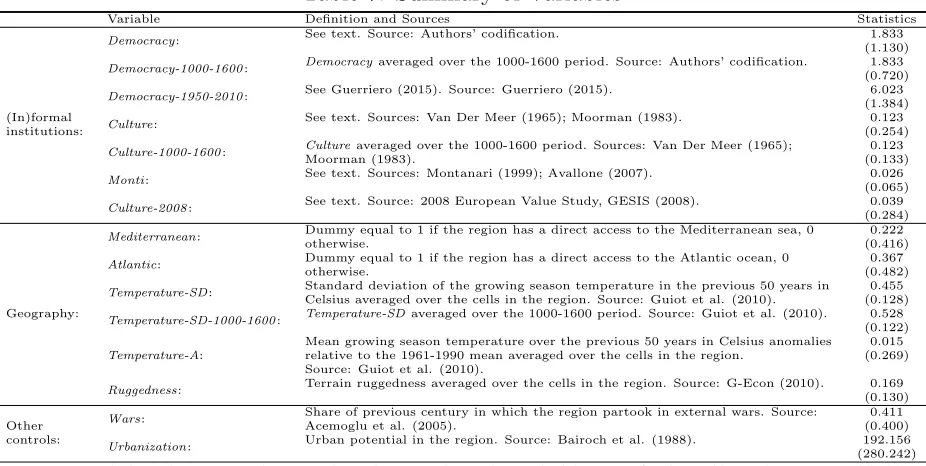
Democracy (see table 7 for the summary of all the variables we use). Over the sample then,
this variable gauges the institutionalized constraints on the decision making powers of the
elite. As Acemoglu et al. (2005), we base our measurement on the events within a 40-year
window around each date (see the Internet appendix).17 We observe over the sample first a
trend toward more inclusive political institutions with the mean of Democracy rising from
1 in 1000 to 2.28 in 1400 and then a comeback of autocracies with Democracy averaging
1.97 in 1600. This pattern is asymmetric across units whereby the Mediterranean regions of
Northern Italy, Southern France, and Eastern Spain witnessed the more robust
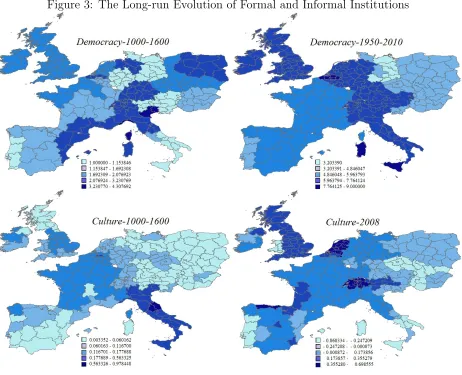
democratiza-tion process. The upper-left map of figure 3 illustrates these dissimilarities by displaying the
average ofDemocracy across administrative regions over the 1000-1600 period. We build the
maps by first dividing the range of each variable into five intervals whose break points are
chosen through the goodness of variance fit method and then displaying higher values with
darker colors.18 Differences in Democracy have persisted as the distribution of
Democracy-1950-2010 documents (upper-right map of figure 3). Democracy-1950-2010 is constructed
as the average over the 1950-2010 period of the sum of the Polity IV constraints on the
executive authority score and an index capturing the political autonomy from the central
government of the NUTS 2 regions in the sample (see Guerriero, [2015]).19 If regionrbelongs
17
The correlation betweenDemocracy and the constraints on the executive measure devised by Acemoglu et al. (2005) (developed by Tabellini (2010)) is over the common observations 0.49 (0.62).
18
This fit method minimizes the average deviation of the interval values from the interval mean, while maxi-mizing the average deviation of the interval values from the means of the other intervals.
19
to several administrative units, we assign it a figure equal to the average of
Democracy-1950-2010 across the NUTS 2 regions weighted by each unit relative contribution to regionr land
area. We follow the same procedure for the other variables measured at the regional level.
Our proxy for the citizenry’s culture is the discounted number of years Cistercian and
Franciscan houses were active in the region per square km, i.e., Culture. For each of the
729 (3000) Cistercian (Franciscan) houses, this figure equals in year tthe difference between
the number of years in which the house had operated and those elapsed from its possible
closure per square km if positive and zero otherwise. The discounting emphasizes the
im-portance of the monks’ presence but is immaterial to the main findings. The raw data are
directly collected from Van Der Meer (1965) and Moorman (1983). As discussed above, both
monastic orders assumed a key role in the accumulation of culture by organizing risk-sharing
activities together with the population, proposing norms of respect and trust, monitoring
their effective spread, and punishing the defectors by withdrawing their support.20 Given the
substantial homogeneity and the uniqueness of the action of the two orders (see section 2),21
Culture gauges the input to the technology that transformed the citizenry’s involvement with
culture into evolutionary stable norms, and thus higher values of this variable should detect
a stronger culture of cooperation in year t. It is worth to note here that, because of the two
orders’ will to keep a minimum distance between houses—e.g., 24 km in the Cistercian case
[Tobin 1995, p. 74]—and their focus on initially underdeveloped and thus underpopulated
areas, considering the houses’ activity per capita will grossly misrepresent their diffusion.
Focusing on the Cistercians, Andersen et al. (2016) propose a similar mechanism but
describe them as aimed at spreading values of hard work and thrift. Albeit consistent with
Baumol (1990), this vision is at odds with the more recent and substantial historical literature
discussed in section 2. In addition, the Carta Caritatis describes the order’s members as
“unprofitable [servants of] our Lord [who wish] to be of service to [our brothers,] avoid the
evil of avarice [and] retain the care of their souls for the sake of charity” warning at the same
20
Looking at one order at the time produces similar albeit more noisy estimates (see the Internet appendix). The decision to aggregate a new monastery was taken by the most prominent house within an administrative region, i.e., “province.” Since this often corresponded to one of the regionsr(Van Der Meer, 1965; Moorman, 1983), the empirical design is the most appropriate to match the decision units to the cross-section identifiers.
21
time the novices to abhor social competition and accumulation of capital [Berman 2000, p.
1-23 and 93-97]. Similar provisions guided the Franciscans’ activities (Daniel, 1992).
We observe over the sample a trend toward a stronger culture of cooperation whose
mean, indeed, climbs from 0 in 1100 to 0.43 in 1600. The two maps at the bottom of figure
3 visualize the close relationship between the average of Culture over the 1000-1600 period
and its present-day counterpart, i.e., Culture-2008. The latter is available for 89 regions
and represents the first principal component extracted from the generalized trust and the
importance of respect self-reported to the 2008 wave of the European Value Study.22 Both
values as well as Culture-2008 are higher where Western monasticism was more diffuse (see
the Internet appendix and section 5.5). This evidence together with the fact that Culture
strongly correlates with an outcome-based measure of past norms of cooperation discussed
below validates our measurement strategy. Crucially, Culture will continue to strongly
cor-relate with Culture-2008 should the latter also include either the strength of individualism
and the importance of obedience or norms of hard-work and thrift (see Guerriero, [2015]).
5.1.2 Measuring Investment- and Risk-sharing-specific Factors
In the basic regressions, we capture the investment value with the profitability of
long-distance trades by using time dummies interacted with either a binary for regions with a
direct access to the Mediterranean—i.e.,Mediterranean—or a binary for regions with a direct
access to the Atlantic, i.e.,Atlantic. Building on section 2, we expect Mediterranean to pick
a profitability of long-distance trades higher (lower) than that captured by Atlantic when
both binaries are interacted with 1000-1300 (1350-1600) dummies and thus to gauge a fall in
λI from high to intermediate values when interacted with 1350-1600 dummies. The gist of
the empirical exercise will be similar (see the Internet appendix), should we employ instead:
1. Trade-East, which is the average of the sea distances between the major region harbor
and Istanbul and the major region harbor and Alexandria if the region has a direct access to
the Mediterranean and 0 otherwise; 2. Trade-West, which is the average of the sea distances
between the major region harbor and Havana and the major region harbor and Cape Town
22
if the region has a direct access to the Atlantic or 0 otherwise. We consider major harbors
those with the highest population according to Bairoch et al. (1988). Since Trade-East and
Trade-West rise with the distance from the major trade hubs (Brady et al., 1994), they
measure the difficulty to observe long-distance trades (Fleck and Hanssen, 2006).
Turning to the severity of consumption risk, we follow Durante (2010), and we proxy it
with the standard deviation of the spring-summer temperature in the half-century before
each observation, i.e.,Temperature-SD. The raw data are collected from Guiot et al. (2010),
are in 5-degree grid format, and cover most of the European surface over the 600-2000
period.23 Each observation is “reconstructed” from a multiplicity of indirect proxies such as
tree-rings, ice cores, pollens, and indexed climate series based on historical documents. To
the best of our knowledge, this dataset is the only one estimating the European climate at
the within-country level before 1500. To computeTemperature-SD for regionrat timet, we
first calculate the standard deviation of the growing season temperature over the 50 years
before t for all the cells—even partially—part of region r. Next, we get the average across
the cells weighted by each cell relative contribution to region r land area. We follow the
same procedure for the other variables measured at the cell level. Temperature-SD was on
average significantly higher over the 1000-1600 period than it was between 600 and 950—i.e.,
0.45 versus 0.39—and does not show dependence over time according to the canonical serial
correlation tests. Thus, we do not correct the estimates for serial correlation in the residuals.
Even if substantial however, climate risk within the sample is smaller than outside it (see
figure 4). Indeed, not only the maximum value of Temperature-SD averaged over the
1000-1600 period—i.e.,Temperature-SD-1000-1600—in the cells part of the regions we consider is
much lower than the maximum value of Temperature-SD-1000-1600 in all the cells analyzed
by Guiot et al. (2010)—i.e., 0.72 versus 1.12, but also the mean value of
Temperature-SD-1000-1600 in the former cells is significantly—at 5%—lower than that in the latter cells,
i.e., 0.47 versus 0.52. Hence, λR was not too large in the sample, and thus we should
23
observe mainly the increasing part of the climate risk-culture link. Higher resolution gridded
data on temperature and rainfall have been devised for the post-1500 period building on
instrumental sources, but they are much less accurate than reconstructed data in describing
the pre-1800 variation since the number of climate stations declines exponentially going back
to the beginning of the 19th century (Guiot et al., 2010). Incorporating these data into our
test makes the estimates of the role of λR more noisy (see the Internet appendix).24
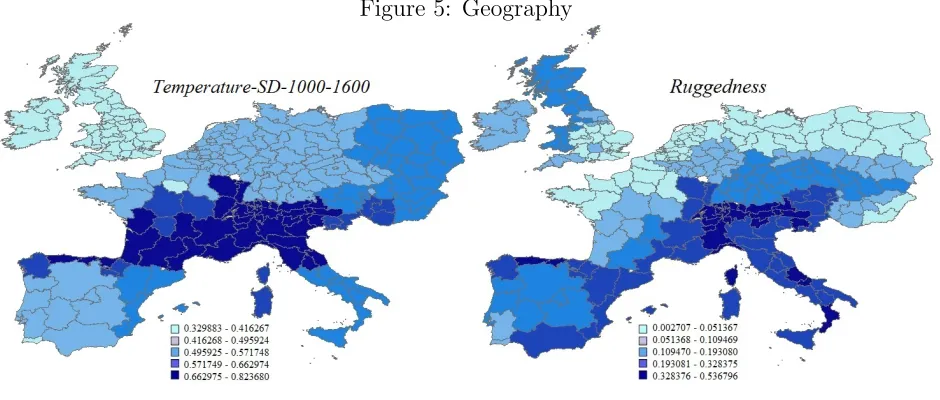
A glance at figure 3 and the left map of figure 5, which depicts the sizable variation in
Temperature-SD-1000-1600, reveals that the model testable predictions are confirmed by the
data. In the following, we verify this idea by turning to multivariate analysis.
5.2
Estimating Equation and Basic Results
We evaluate the model testable predictions by running panel regressions of the form
Yr,t =αr+βt+γ′xr,t +δ
′z
r,t+εr,t, (2)
where Yr,t is either Democracy or Culture in region r at time t. αr are region fixed effects
controlling for time-independent determinants of Yr,t as other geographic traits—e.g., the
regional farming sector dependence on irrigation, which has been linked to the elite’s
abil-ity to monopolize water and in turn power (Bentzen et al., 2015), the land suitabilabil-ity for
cultivation, which makes less salient public agricultural infrastructures and in turn might
discourage cooperation (Litina, 2016), other farming inputs, and the distance to either the
coast, navigable rivers, the nearest technological frontier, or the Cistercians’ and
Francis-cans’ mother houses—and pre-determined shocks like the out of Africa exodus of humankind
and the consecutive agricultural revolution. While indeed Ashraf and Galor (2013)
docu-ment that the prehistoric migratory distance from East Africa drove the genetic diversity
inherited by parental colonies and so their generalized trust, Olsson and Paik (2015) suggest
that societies that made an early transition to agriculture in the Neolithic display stronger
patriarchal values and so less inclusive political institutions. βtare time dummies picking up
regional macro-shocks as the Black Death, which modulated the population’s incentive to
24
trade and so escape the Malthusian trap (Voigtl¨ander and Voth, 2009). xr,t gathers
Mediter-ranean interacted with βt,Atlantic multiplied byβt,Temperature-SD, and, if Yr,t isCulture,
Temperature-SD squared. This last term reckons with the nonlinear relationship between
culture and risk-sharing needs proposed by proposition 1. Finally, zr,t possibly incorporates
the other covariates introduced below and, to exclude that a change in the average climate is
biasing our results, always the mean spring-summer temperature over the previous 50 years
in Celsius anomalies relative to the 1961-1990 mean (Guiot et al., 2010), i.e.,Temperature-A.
We do not estimate each pair of equations with dependent variablesDemocracy and
Cul-ture as a system since we cannot reject, never at a level lower than 0.23, the null hypothesis
of the Breusch-Pagan test that the residuals of each pair are uncorrelated. In addition,
Cul-ture (Democracy) is insignificant when included in the specifications with dependent variable
Democracy (Culture) (see the Internet appendix). This confirms the key model insight that
formal and informal institutions interact only through activity-specific factors. Finally, to
allow for the within-region correlation in εr,t possibly driven by the Western monasticism
diffusion patterns, we cluster the standard errors at the regional level. In addition, we
doc-ument that our results will be similar should we deal with the spatial dependence in εr,t
possibly produced by the relative coarse resolution of climate data by relying on either the
Driscoll-Kraay or the Conley (1999) standard errors (see the Internet appendix).
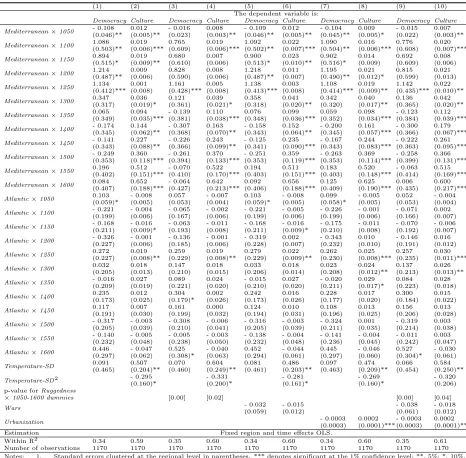
Columns (1) and (2) of table 8 display the estimates relative to the basic specifications
controlling forTemperature-A only. The estimated coefficients are consistent with the model
predictions, and the implied effects are large. In particular, regions having a direct access to
the Mediterranean and, in turn, to the Silk Road sustained before 1350 the fastest
democra-tization process, whereas bordering the coast had no statistically significant direct effect on
democratization thereafter. To illustrate, Mediterranean induced a significant—at 10% or
better—rise of roughly one-standard deviation in the inclusiveness of regional political
insti-tutions for each half-century between 1100 and 1250, whereas Atlantic interacted with time
dummies is insignificant in explaining Democracy (see column (1)). This evidence implies
a primacy of the Mediterranean over the Atlantic trades as institutional driver and is thus
at odds with Acemoglu et al. (2005) but consistent with the relevance of the commitment
of the Atlantic routes indeed, the Mediterranean polities were able to preserve political
in-stitutions, whose inclusiveness was not too different from that of the political process of the
rising Atlantic polities, by gaining a remarkable level of culture and so committing to future
cooperation. Having a direct access to the Mediterranean implied indeed a significant—at
5% or better—increase in Culture rising from 0.4-standard deviation in 1350 to 2.6-standard
deviation in 1600 (see column (2)). Finally, cultural accumulation had an inverted U-shaped
relationship with climate volatility, which however did not affect democratization.
Consis-tent with section 5.1.2 analysis, the coefficient onTemperature-SD is positive and significant
at 5%, whereas that onTemperature-SD2 is negative but only marginally significant.25
5.3
Identifying Causal Relationships
We pursue a three-step strategy to evaluate if the relationships we have uncovered so
far are causal. First, we control for relevant confounders. Second, we use selection on these
observables to assess the bias from unobservables. Finally, we perform a placebo test of the
link between medieval climate volatility and present-day culture in Turkey.
5.3.1 Controlling for Observables
We consider the observable factors that, according to the extant literature, are more likely
to affect institutional evolution in the sample and we excluded from the basic specifications.
The first one is the terrain ruggedness—i.e.,Ruggedness—interacted with the time dummies.
The raw data are retrieved from the G-Econ dataset, which is in 1-degree grid format and
covers the world surface. The right map of figure 5 exhibits the considerable dissimilarities
in Ruggedness across administrative regions. Ruggedness picks up the difficulty to observe
the investments in new farming technologies that flourished in Europe from the 11th century
on (see section 2). To elaborate, the central driver of the Medieval agriculture revolution
was the diffusion of the heavy plow, which required as many as eight oxen to pull it and
forced the peasants to combine their ox teams and split their lands into interspersed strips
to ensure a more fair plowing (Slocum, 2005). As a result, the elite’s returns on such
a complex investment were larger the more difficult were its monitoring and the plowing
itself. Next, we consider the share of previous century in which each region partook in
25
external wars (Acemoglu et al., 2005), i.e., Wars. According to Besley and Persson (2009),
common interest public goods, such as fighting external wars, contribute to institutional
development. Finally, we control for the “modernization” effect development can have on
(in)formal institutions by including the regional urban potential calculated using the cities
in the sample with more than 5,000 inhabitants for at least a t (Bairoch et al., 1988), i.e.,
Urbanization. The urban potential of cityc is the average of the population of all the other
cities in the sample weighted by each city distance from c (de Vries, 1984), whereas that of
regionradds up the urban potential of all the cities in the region. Assigning a weight zero to
the cities outside the region to which cbelongs or considering the population density, which
is available from the HYDE 3.1 dataset, delivers similar results (see the Internet appendix).
Estimating equation (2) when zr,t includes either one at the time or all together the
re-gressors just introduced delivers the results reported in columns (3) to (10) of table 8. The
model predictions continue to be supported by the data. In addition, Wars is never
signifi-cant, the coefficients attached to Ruggedness interacted with βt imply a positive significant
impact of the difficulty to observe farming investments on Democracy, and Urbanization is
significant only in columns (8) and (10). This last pattern is consistent with Andersen et al.
(2016) and a primacy of culture in promoting development (Guerriero, 2015).
5.3.2 Using Selection on Observables to Assess the Bias from Unobservables
Despite our attempts to control for the key drivers of (in)formal institutions discussed
by the extant literature, the estimates presented so far may still be biased by unobservable
factors. To evaluate this issue, we calculate the index proposed by Altonji et al. (2005) to
measure how much stronger selection on unobservables, relative to selection on observables,
must be to explain away the entire estimated effect.26 To see how the index is calculated,
consider a regression with a restricted set of control variables and one with a full set of
controls. Next, denote the estimate of the coefficient attached to the variable of interest from
the first regressionγR, where R stands for “restricted,” and that from the second regression
γF, whereF stands for “full.” Then, the index is the absolute value of γF/(γR−γF). The
intuition behind the formula is as follows. The lower the absolute value of (γR−γF) is, the
less the estimate of the coefficient attached to the variable of interest is affected by selection
26
on observables, and the stronger selection on unobservables needs to be to explain away the
entire effect. Moreover, the higher the absolute value of γF is, the greater is the effect that
needs to be explained away by selection on unobservables, and thus the higher is the index.
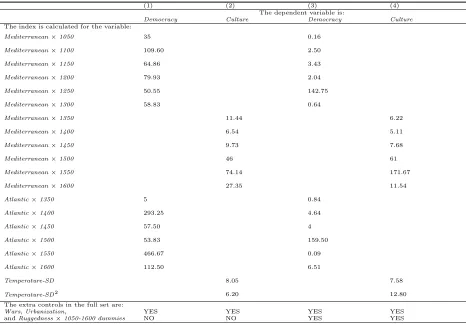
In columns (1) and (2) (columns (3) and (4)) of table 9, we consider the specification
including in zr,t only Temperature-A as the restricted regression and that including in zr,t
also Wars and Urbanization (Wars, Urbanization, and Ruggedness interacted with βt) as
the full regression. The indexes calculated from the specifications with dependent variable
Democracy (Culture) are listed in columns (1) and (3) (columns (2) and (4)). We focus on the
variables evaluating the model testable predictions, which also display the most significant
coefficients in table 8. The median and average indexes in column (3) (column (4)) of table
9 are 3 and 27.3 (11.5 and 35.5). Hence, to attribute the entire estimate to selection effects,
selection on unobservables would have to be on average almost 31 times greater than selection
on all observables. Given the high fit of the regressions, it is then unlikely that the effects
of geography on (in)formal institutions are driven by unobserved heterogeneity.
5.3.3 Falsification Test
Consistent with the persistence of a culture of cooperation documented above, there
is a positive and significant relationship between Temperature-SD-1000-1600 and
Culture-2008 in the sample and, conditional on Mediterranean, Atlantic, and a constant term, the
estimated OLS coefficient equals 0.646 with a t-statistic of 2.36 (see left graph of figure 6).
European populations that were more exposed to the risk of harvest destruction accumulated
a stronger culture of cooperation, and today their descendants are more cooperative. Our
identification strategy rests on the assumption that risk-sharing is the only channel through
which medieval climate volatility shaped past culture. If this is true, then a positive link
between the volatility of the medieval growing season temperature and present-day norms
of respect and trust should not exist where the cost of accumulating culture was prohibitive.
This was the case of Turkey, where first the 1058 East-West Schism and then the rise of the
Ottoman empire blocked both the Cistercian and the Franciscan penetration.27 While indeed
the Eastern Orthodox church required that monks shied away from any involvement with
27