Url: http://usnsj.com/index.php/JEE Email: [email protected]
The Applicability of the Eclectic Method on the Development of the
Oral Production
Suggestion for the Citation and Bibliography Citation in text:
Marcillo, & Palcios (2017) Bibliography:
Marcillo, M.A. & Palacios, G.A. (2017). The Applicability of the Eclectic Method on the Development of the Oral Production. Journal of English Education, 2(2, Dec.), 138-146.
Mayra Alejandra Marcillo Universidad Central del Ecuador [email protected] +593992723540
Galo Alejandro Palacios Universidad Central del Ecuador [email protected] +593999477195
o-ISSN: 2502-6909 p-ISSN: 2502-9207
Vol. 2, No. 2, December 2017
URL: http://usnsj.com/index.php/JEE/article/view/2.2.138-146
Received : 15 November 2017 Reviewed : 12 December 2017 Published : 13 December 2017
© 2017 JEE All rights reserved
Abstract
D
eveloping our students’ English oral expression in Public Institutions is a process that needs to be carefully analyzed by teachers. It is more than selected a method, it is more than following step by step what a theory says. It is going beyond our students’ needs. It is a deeply study of what a student really can do and needs to learn. Based on a post-method pedagogy which provides teachers the ability to break down barriers to the imposition of a specific method and make the teaching process more effective, this paper proposes the application of the eclectic method for the development of the oral expression of public high school students encouraging teachers to see the teaching process from a different and modern perspective. By analyzing the principles and features of this method, this paper describes the research made on a Public Institution with students in third year. With the goal of improving each one of the principal components of the English oral expression: range, accuracy, fluency, pronunciation and coherence, there were used selected methods, techniques and strategies based upon the students’ learning styles and needs. The observation and Interview techniques were used on data collection and the parameters of Inferential and descriptive statistic were applied in order to analyze the results achieved. They showed that even though not all of the group of the students could achieve the B1 level in reference to the Common European Framework and required by the Ministry of Education, a large number of them were able to increase their English oral expression. According to this data, this paper concludes that the selection of objectives, the modern teacher‘s and student’s role, the use of different but selected methods, the linguistic input activation and the contextualization had a significant impact on learners´ learning.Keywords: post-method pedagogy, oral expression components, eclectic method
AUTHORS INFO ARTICLE INFO
A. Introduction
A
fter several years of experience working in public Institutions, improving the students’ oral performance has been one of the greatest challenges an English as a Foreign Language (EFL) educator has to deal with. It is very common to hear expressions like “I cannot speak English” when students are being evaluated in English. Most students find it difficult to express feelings, emotions and ideas in a given situation; unconsciously, it becomes a feeling of powerless and frustration to produce the language for them. The idea of being criticized by others gets stronger than the idea of learning by mistakes blocking any intention of practicing the Foreign Language. It tends to be a deeply worrying fact when the results show a considerable percentage of students who fail in the oral evaluation. Considering that the linguistic expression is the most important communication tool, EFL teachers are expected to make each student being able to use the English oral language proficiently in a determined level. However, the choice of the appropriate method to reach this goal tends to be an infinite way due to the several options they have; so, the question arises as to whether the selected method will help all of the learners or just a particular group to increase their level in oral expression? At the end, most of the results show the deficiency of the method: students are not able to produce orally. It is for this purpose that an appropriate method to oral expression improvement has to be introduced and the eclectic method appears as the most recommendable and effective way to reach this goal for reasons, which will be substantiated in the discussion section. The application of the Eclectic method provides learners to be involved in the teaching process because one of the purposes of this method is to relate their life experiences with all the concepts presented in the teaching of the language, moreover, it allows them to have a clear vision of what they are learning. The eclectic method can help teachers go deeply in the teaching process, providing knowledge to form learners who are able to solve problems and face situations in real life. In other words, the idea of the eclectic method is to reinforce a meaningful learning.The current paper analyzes the application of the Eclectic Method to improve English oral Expression as a Foreign Language in a Public High School located in the South of Quito Ecuador. The discussion section of this article illustrates a practical way of implementing the eclectic method in a usual classroom of languages, selecting the best methods, strategies and techniques from all the existing conventional methods that could be really useful for students to make progress on issues concerning the oral expression such as: pronunciation, fluency, accuracy, range and coherence. To provide information about modern methodologies in EFL education, interrelating the Ecuadorian education reality of public institution, will become the aimed mission of this paper which will benefit not only the teachers but also the students. It would make teaching easier, and students will learn something really useful for now, and for the future.
B. Literature Review 1. The Eclectic Method
The word eclectic is derived from the Greek word EKLEKTÍKOS, ἐκλεκτικός which comes from the root of EKLÉGŌ = to choose. According to the dictionary (Real Academia de la Lengua Española, 2014), this word is defined as “Philosophical school that tries to bring together the best doctrines, even though they might come from different systems”. The relevance of this meaning is the reason that this method is used in the Teaching of Second Languages. As a movement, it allows us to use different methods and techniques to achieve the objectives, always considering the different ways of learning. (Beare, 2017) claims that in order to develop a planning, it is necessary to do a deeply study of the students’ problems concerned to their needs and styles. Planning based on students’ learning experiences, expectations and needs allows educators to make best use of their experiences and engage them into the learning process. Taking time to learn more about the students’ background, facilitates educators to establish the teaching and learning objectives as well as the strategies to be applied.
2. Principles and Features of the Eclectic Method
principal eclectic elements that the teachers must consider: selection, sequence, pertinence and coherence. They consider that the choice of the strategies must be based on a deeply diagnostic study of the individuals in order to identify the students’ pre-knowledge about not only their language level or contents, but also their learning style. It will definitely facilitate teachers to pedagogically select the methods or techniques from among other different teaching learning theories or approaches. In this process of selection, it is also important to consider the economic, technological and infrastructure resources to be used during the teaching process. As regards the sequence, the importance of structuring the planning by applying familiar strategies at the beginning of the lessons and eventually introducing the new ones is essential. It will contribute to create a comfortable environment during class. For them, it is necessary to organize the sequence of these strategies based on the learners’ diagnostic results rather than the contents or text books. The teaching process not always should be lineal since it could be cyclic because teachers can start developing a content and come back to reinforce it over a time. As for pertinence, these authors highlight the prominence of selecting the strategies in response to the educational setting. Even though one strategy were not part of the planning, it should be used in a class to facilitate the learning process if necessary. Finally, they use the term coherence to emphasize the significance of connecting the strategies to be used in classes with the real context of the student. The main idea is to help students finding ways to practice the “new knowledge” in a real context fostering the meaningful learning.
The applicability of the eclectic method to improve the oral expression is presented as a practical way to reach determined objectives because it has some salient features like: flexibility, high opportunity Interactions, accessibility to Multiple – Tasks, Active Learning Potential, and effectiveness to reach immediate results. In order to implement this method, (Brown, 2002 in Richards & Renandya, 2002, Eds.) proposes three phases: diagnosis, treatment and assessment. The first phase refers to all the diagnosis the teacher has to do considering all details related to the learning and teaching aspect. The second phase mentions the hard work teachers have to perform in order to design the teaching process based on the results found in the first phase. Finally, the last phase refers to the process of reflection, analysis and observation a teacher should apply to be aware of the students ‘progress. On the other hand, Batista and Salazar consider it is necessary to take into account the establishment of the objectives, the teacher’s role as well as the student’s role, strategies, linguistic input and contextualization in the use of the oral production; however, before implementing the objectives, it is mandatory to know the group of the students. Thus, teachers should use some certain techniques that ensure them the knowledge about their students’ background awareness of that their students’ learning style is as important as their English level.
3. Learning Styles
4. Methods Selection
The acquired teachers’ expertise allows them to identify the positive factors of each one of these methods to develop a specific skill of a Foreign Language, but the use of the eclectic method does not mean to mix up methods by chance. Billah (2015) stated “there must have some philosophical backgrounds and some systematic relation among different activities” (p.1). The idea is to mix operational approaches with those communicative language activities. As teachers, all the principles related to linguistic, cognition and affection need to be considered. According to Kumaravadivelu (2003) all the methods have similar characteristics, so they should be classified according to their features as follow: (a) language-centered methods, (b) learner-centered methods, and (c) learning-centered methods. He states that language – centered methods emphasize the grammatical structures. The learning, according to these methods, happens intentionality rather than incidentally. It means students, especially L2 adults, need to make a special effort to reach the goal. With these types of methods, teachers select some grammatical structures and vocabulary items carefully and are used from a simple to complex way. Most of the teaching process is based on “explicit introduction, analysis, and explanation of linguistic systems”. The learner –centered methods, on the other hand, impulse the use of meaningful activities through the practice of selected, sequenced grammatical structures and communicative functions. They give significance to the use of the language in a real context, encourage interaction and a fluent communication. And the learning- centered methods which are focused on the learning process. They impulse the problem-solving tasks and the use of communicative activities in order to facilitate interaction.
C. Methodology 1. Research Design
This research fulfills the requirements of mixed method research. It is to say that it is a qualitative research when the instruments for data collection are observations or descriptions, while the quantitative research uses statistic and numerical measurement for the data analysis and hypothesis testing. This research was completed in one partial of eight weeks with two groups of 80 students. One group was called as the experimental and the other one was known as the control. Both, the control and the experimental groups, were evaluated by a pre and post-test. Due to it was not a random sample, it was a quasi – experimental design with separate sample pretest/posttest control group.
2. Participants
The participants of this research were third year students from a public scholar Institution located at the South of Quito- Ecuador. They were distributed into two groups: the control and the experimental group. Each group enrolled 40 students between the ages of 17 and 19, males and females with similar conditions. They received three hours of English as a Foreign Language and were supposed to have a lower basic level regarding the English oral expression. The experimental group was intervened during eight weeks with the eclectic method while the control group received EFL classes in the regular way. At the end of this period of intervention, both groups were evaluated with the same instruments.
3. Technique of Data Collection
4. Instruments
Since there were applied two techniques, the instrument used in the observation was a rubric to evaluate the students’ oral expression level through an oral activity know as a sustained monologue. This instrument was applied at the beginning and at the end of the intervention with both groups: the control and the experimental. The rubric was an adaptation from the original provided by the Common European Framework that allows identifying the people’s language level. It evaluated four levels as follow: Very Basic=1; Basic = 2; Pre- Intermediate= 3; Intermediate= 4. With regard to the Interview technique, it was used a semi structured questionnaire as a data collection tool. This instrument was created by the researcher in order to evaluate the students’ opinions and attitudes towards the use of the eclectic method during EFL classes. Instruments, the rubric and the questionnaire were validated by three experts on EFL education.
5. Technique of Data Analysis
In order to analyze the results provided by the data collection instruments, there were used the parameters of Inferential and descriptive statistic. The figures presented as the results of the descriptive statistic analysis were pie graphs in the description of percentages and histograms in the frequency data, while the figures used were diagrams and the Gaussian bell curve. In order to analyze the relation between the two variables (the eclectic method and the oral expression), it was used the Pearson index correlation due to the sample comprises over 30 subjects and the z-core to analyze the hypothesis testing.
D. Findings and Discussion 1. Findings & Results
This part provides information about the results of this research. Thus, it will be included four figures to observe the degree of influence of the eclectic method in the English Oral expression. These findings will be essential to support the conclusions.
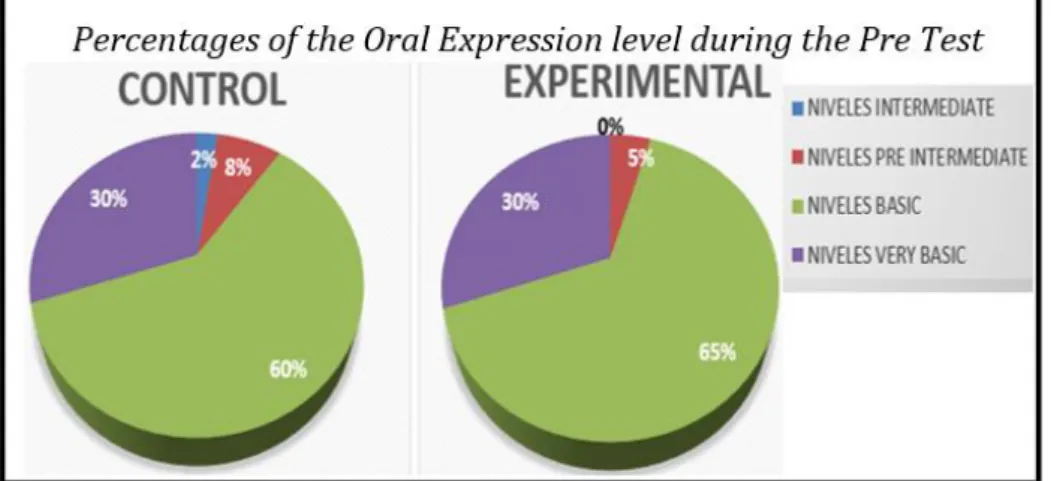
In figure 1, it is shown the Students’ English oral expression in both groups: the control and the experimental during the pre-test.
Figure 1 Students’ Oral Expression levels during the Pre Test
These results show that both, the control and experimental groups, had a very basic level regarding the English oral expression before implementing the Eclectic Method in the EFL classes. The highest percentages are located between “Very Basic” and “Basic”; however, the English Oral expression in the Control Group was higher than the Experimental.
0 5 10 15 20 25 30
RANGE ACCURACY FLUENCY PRONUNCIATION COHERENCE
Level of the Oral Expression Components during the
Pre Test and Post Test
NivelesIntermediate
Pre
Intermediate Basic
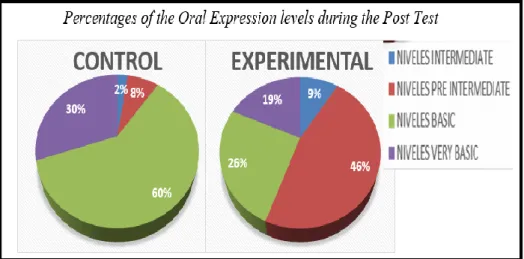
Figure 2 Students’ Oral Expression Level during the Posttest
In this graphic, the results show the difference raised between the levels of the English Oral Expression after implementing the Eclectic Method in the EFL classes. While the Control group kept similar percentages to those of the Pretest, these percentages changed widely in the Experimental Group. Most of the students from the experimental group could reach a Pre-intermediate and Intermediate level. It shows the positive influence of the Eclectic Method on the development of the Oral Expression.
In figure 3, it compares the level of the oral expression components evaluated during this research: range, accuracy, fluency, pronunciation and coherence during the pretest and post-test.
Figure 3 Level of the Oral Expression Components during the Pretest and the Posttest
These results show the Basic Level predominance in all the components of the Oral Expression before using the Eclectic Method. However, these English Oral Expression components reached a Pre Intermediate and Intermediate level after applying the Eclectic Method in EFL classes. This proves that the educator was able to increase students’ oral expression through the application of this Method.
Impact of the Eclectic Method on EFL Students
These findings show that the characteristics of the Eclectic Method developed in the EFL classes in order to increase the students’ oral expression had a positive approval by students. The results of this interview demonstrate that most of the students feel satisfied with the objectives planned for classes, the teacher’s role inside the classroom when building spaces and activities that allow them to use the language in a real context, the encouragement to build their independence and autonomy as well as the teamwork enjoyment, the use of an effective linguistic input and the importance of contextualization to develop the EFL classes.
2. Discussion
As EFL teachers, it is known that one of the main goals of teaching speaking is to make students communicate efficiently; however, the researcher’s experience classroom in public Institutions has shown how difficult is to master this skill for the majority of these learners. Since teaching speaking means to help learners use the language for interaction in the target language, an EFL teacher needs to go beyond the practice of classical methods, it is to explore our students’ learning abilities, students’ needs, students’ level, socio political conditions and teaching resources. The findings and results illustrated before present a modern way to achieve specific goals related to EFL oral expression teaching. The application of the eclectic method to develop the students’ oral expression is presented in this paper as an alternative way to help teachers go deeply in the teaching process, providing knowledge to form learners who are able to solve problems and face situations in real life.
Based on Kolb´s theory about the learning styles and its importance inside the teaching and learning process, it is essential that students are exposed to tests which allow them and the educator to identify the percentages of visual, auditory, kinesthetic and logic learning styles integrating the classroom as well as their current oral expression level. Following some of the principles of the Eclectic Method as it is selection, sequence and pertinence, the educator has to be able to select the methods and strategies to be applied during the program taking into account the students’ learning styles and needs.
When talking about oral expression, it is also essential to recognize the components of this skill and the objectives teachers need to reach. For instance, during this research, the educator looked for developing the range, the accuracy, the pronunciation, the fluency and the coherence
1. OBJECTIVES 1 2 RATING 3 4 5
1.1 Selective 0 0 0 3 40
1.2 Specific 0 0 2 4 37
2. TEACHER’S ROLE 1 2 RATING3 4 5
2.1 Creative 0 0 0 2 41
2.2 Flexible 0 0 0 4 39
2.3 Guide 0 0 0 1 42
3. STUDENT’S ROLE 1 2 RATING3 4 5
3.1 As Individual 0 0 4 6 23
3.2 As Member 0 0 2 3 38
4. LINGUISTIC INPUT 1 2 RATING3 4 5
4.1 Motivating 0 0 0 1 42
4.2 Meaningful 0 0 0 2 41
4.3 Comprehensible 0 0 0 7 36
5. STRATEGIES 1 2 RATING3 4 5
5.1 Diverse 0 0 1 3 39
5.2 Pertinent 0 0 0 4 39
components. Thus, it was necessary to use techniques that contribute to increase each one of these components.
In order to reinforce Range and Accuracy, the use of Content – based Instruction (CBI) is a method that teachers should consider into their planning. CBI is based on the theory that learning should be organized into contents that the student can assimilate, leaving aside the grammar aspect of the language. Priority is given to real communication and to the exchange of information. The learning of the language is integrated with other contents, which can be topics such as sports, technology, music, etc. (Larsen & Anderson, 2011) As this method encourages teachers the use of realia, visuals, exemplification and repetition, students can practice range and accuracy through the use of videos or graphic organizers. Some of the techniques based on this method that were practical in the developing of the components were dictogloss and language experience approach. Dictogloss is a technique that helps learners to promote the students’ discussion about the structural process between meaning and form. (Kowal & Swain, 1997 in Johnson, R. & Swain, M. 1997, Eds.) and language experience approach allows students to collaboratively create stories related to their life experiences.
To develop pronunciation, the use of Audio Lingual Method and Total Physical Respond present some benefits. The objective of the Audio Lingual method is to learn a language through the repetition of new words and to associate them with visual images. It is very common to imitate the native expressions and structures through the practice of technological resources such as recorders. Larsen & Anderson expressed that by listening to the instructor’s pronunciation, the students are able to learn the pronunciation of words or sentences. Some of the techniques applied by the educator during this intervention in order to develop this component based on this method were the chain drill, question and answer drill and use of minimal pairs. The chain drill and question and answer drill techniques facilitated communication among students. They were able to practice questions and answer related to familiar topics while the teacher had the opportunity to check their students’ pronunciation. The use of images to present the minimal pairs was successful, too. Students were prompted to analyze and compare. TPR or Total Physical Response is another method that should be considered when planning classes for developing pronunciation. In order to have a positive effect, it is necessary to use this method by combining with another one. This method works better with those kinaesthetic learners because it encourages the learning through actions instead of mechanical exercises. It makes the students enjoy the activities in class, which is essential because it helps to remember what was learned for a longer time. Certain benefits teachers find when applying this method are that while students do, they learn. Also, they are able to use the language in meaningful contexts without feeling pressure. (Vera, 2014) TPR contributes to keep a low affective filter of students in the classroom due to it encourages risk-taking in language production through the action and joy.
Through the use of the Communicative Language Teaching method (CLT), teachers can improve students’ coherence and fluency. Larsen & Anderson state that some of the principles of this method include the learning of the cohesion and coherence and identifying the intention of the speaker as part of the communicative competence. CLT facilitates teaching because teachers can use some games, role- plays and problem solving tasks. Some of the techniques applied during this research were the use of authentic material, scrambled sentences and language games. Students were supposed to use some menus in English when working on requests. In addition, they unscramble lyrics of songs and stories while listening to them. After, they practice these songs and read the stories aloud. The use of language games is useful to integrate the five components.
E. Conclusion
facilitating therefore the improving of the students’ oral production. The adoption of a method where the objectives need to be established by the learners rather than the teacher, where the educators creativity and flexibility encourage students’ independence and autonomy, where the use of linguistic input should be focused on motivating and inspiring learners’ learning and where the reality of the students plays an important role to design EFL classes are presented in this research as a practical and proved way to be used by EFL teachers from public Institutions in order to be able to response to the demands the Ecuadorian society requires.
F. References
Beare, K. (2017). Principled Eclecticism. Retrieved from https://www.thoughtco.com/what-is-principled-eclectisim-1210501, 2017
Billah, M. (2015). Eclectic Approach to Teaching Language. Retrieved from http://www.observerbd.com/201. 2016
Johnson, R. & Swain, M. (1997, Eds.) Immersion Education: International Perspectives. NY: Cambridge University Press.
Kolb, D. A. (1981). Learning styles and disciplinary differences. The modern American College, Vol. 18, 232-255
Kumaravadivelu, B. (2003) A postmethod perspective on English Language teaching. World Englishes, Vol. 22, 539-550
Larsen-Freeman, D & Anderson, M. (2011). Techniques and Principles in Language Teaching. Oxford: Oxford University Press.
McLeod, S. A. (2013). Kolb - Learning Styles. Retrieved from www.simplypsychology.org/ learning-kolb.html. 2017
Real Academia Española. (2014). Diccionario de la lengua española [Dictionary of the Spanish Language] (23nd Ed.). Madrid, Spain: Author.
Richards J.C & Renandya W.(2002, Eds.). Methodology in Language Teaching: An Anthology of Current Practice (Approaches and Methods in Language Teaching). Cambridge: Cambridge University Press.
Salazar, L. & Batista, J. (2005). Hacia la Consolidación De Un Enfoque Ecléctico en la Enseñanza de Idiomas Extranjeros. Paradígma, 26(1), 55-88.