Analysis of Microdisk/Microring’s Surface Roughness
Effect by Orthogonal Decomposition
Chengle Sui1, Qiangmin Wang2, Shilin Xiao1, Pingqing Li1
1State Key Lab of Advanced Optical Communication System and Networks, Shanghai Jiao Tong University, Shanghai, China 2School of Information Security Engineering Shanghai Jiao Tong University, Shanghai, China
Email: [email protected], [email protected]
Received 2013
ABSTRACT
Application of micro-resonator is limited by different types of surface inhomogeneity. The 1-th derivative of inho-mogeneity (i.e. r'( ) ) affects the wave transport as well as the height of inhomogeneity (i.e. r( ) ). A method
based on orthogonal decomposition is proposed to analysis both scattering mechanism respectively. Then surface roughness effect on Q-factor of micro-disk waveguide gallery mode (WGM) resonator is investigated with our method and the analysis fits well with FDTD simulation results.
Keywords: Orthogonal Decomposition; Micro-resonator; Surface Roughness Effect
1. Introduction
Micro-ring/micro-disk resonators are very elemental build- ing blocks of integrated photonic device for its compact size and especially for its high quality factor (Q-factor) [1]. High-Q micro resonators are more and more widely applied in lasers, modulators and bio-sensors [2-4]. How- ever, the Quality factor of the high-index-contrast system is still mainly constrained by scattering loss and absorp-tion loss due to surface roughness [5].
Surface roughness effect on Q-factor and mode split-ting are widely investigated in [5-9]. According to [10], wave transport along the waveguide can be affected by two scattering mechanisms: one is induced by the height of inhomogeneity (i.e. r( ) ), the other is due to the first-order derivative of inhomogeneity (i.e. r'( ) ). In related works, the surface roughness is modeled as a random variable, and the scattering loss is calculated stochastically. But all of these methods either fail to ob-serve the effect of or are too complex for calculation, because they cannot analyze independently the scattering loss due to both scattering mechanism. Therefore, if a simulation is needed to conduct for analysis, we cannot calculate the result accurately. For example, in [9], sev-eral Nano scale circular holes are carved evenly along the microdisk to make intentional surface roughness. In [6], random distributed inhomogeneity is approached by a number of randomly spaced rectangle asperities. All these approximation method is not very accurate, and cannot help us to further our understanding on the underlying scattering mechanism.
In this paper, a method based on orthogonal decompo-sition is proposed to simplify the calculation of surface roughness effect without losing accuracy. We try to ap-proach the inhomogeneity infinitely by a linear combina-tion of orthogonal basis we proposed, and then we can analyze the effect of r( ) and r'( ) independently
by carefully choosing proper orthogonal basis.
The paper is organized in the following way: in Sec-tion 2, the model of orthogonal basis is introduced, and then its correctness is proved by Fourier Transform. At the end of Section II, the utilization of the proposed or-thogonal basis is studied in detail. In Section 3, we ana-lyze the surface roughness effect on Q-factor of micro- disk resonator at first. Then we conduct the analysis and FDTD simulation based on our method, the result of which validates our derivation.
2. Model
2.1. NotationsThe side boundary of micro resonator is rough, and is shaped by closed contour S along the basis parallel to z basis, as depicted in Figure 1. The distance from center
point to each side boundary is given by ( ) ( ), [ , ]
r R r (1)
where R is the average radius and is a random variable with zero mean. The correlation function of is often fitted to Gauss distribution, i.e.
* 2 2
1 2 1 2
( ) ( ) exp[ ( ) / c]
r r L
where Lc is the correlation length and σ is the root mean square (rms) value of surface deviations. In addition, we have
expectation operator 2-norm
( ) F [ ( elementary function )]i k
f x i-th square of fk( )x
( )
i k
[image:2.595.90.237.336.469.2] [image:2.595.86.258.494.722.2]f x i-th order derivative of fk( )x
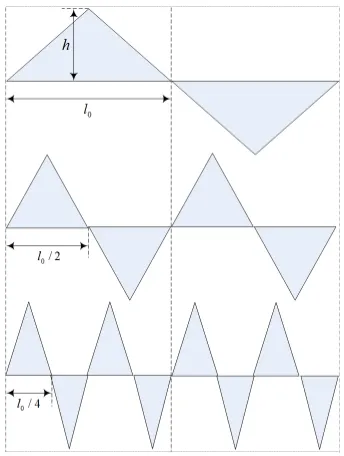
Figure 2 shows one period of a sequence of
orthogo-nal basis { ( )}f xi , which is orthogonal with each other,
i.e. 1 ( ) ( ) 0 i j i j f x f x dx
i j
(3)'( ) ( )' ( ) ( )'
1
0
i j i j
f x f x dx f x f x dx i j i j
(4)Finally, we define the period of orthogonal basis as L.
[image:2.595.336.539.595.682.2]Figure 1. SNR degradation as function of laser line width.
Figure 2. Schematic of orthogonal basis in one period.
2.2. Orthogonal Decomposition
Now we’ll prove the fact by Fourier Transform that side wall inhomogeneity can be approached by orthogonal basis
fi
through orthogonal decomposition. The FourierTransform of fk(x) is given by
2 1 0 0 2 0 2
( ) ( 1) exp[ 2 ( ) / ]
( / ) ( / ) k i k kn i n kn
f x j
sin n l L h n L
nx il L(5)
According to [12-13], there would always be a linear combination of
fi
that can approach r( )infi-nitely by meeting the condition
1
lim n k k( ) ( ) 0
n k
A f r
(6)Therefore, if the orthogonal basis and its weight are carefully chosen, the orthogonal basis we proposed can accurately approximate the transmittance of micro reso-nator with rough surface.
For a specific resonator, several modes may be propa-gated along the waveguide. As it is stated in [5],
2 0
2 3/ 2 2
* 1
( ) exp( )
2
( ) exp( )
2 ( )
exp 2 k k k c c k k
r a j k
a r j n d L kL a a R R
(7)Reference [5] shows that each micro resonator is matched with a sequence of ak , and each ak corresponds to the mode splitting for resonant mode with azimuthal order k.
Now the way of getting the parameter of orthogonal basis we proposed will be revealed. Comparing (5) with (7), if we simply look into one specific mode splitting with azimuthal order k, the surface roughness effect can be accurately approached by one specific orthogonal ba-sis fk
if only2 2 R L/ 2p pN (8)
2 2 1
0
0 2
0
2 3/ 2 2
0
( / )
( 1) exp( 2 / )
( / )
2 ( )
exp 2 k i i c c
sin n l L
h j n L L nL R R
il L(9)
doesn’t equal to 0, the value of 2R L/ won’t be an integer, which means we cannot evenly distribute every period of orthogonal basis around the circle. But if L is chosen to be a very large number, the approximate error can be neglected. According (9), if L is given, we can get a simple relationship between h and 0.
Phase shift due to rough surface should also be taken into consideration when we investigate the mode splitting in micro-disk. The phase shift is uniformly distributed in the interval
l
[0, 2 ) , so the orthogonal basis can be modi-fied to be { ( ) ef zi xp[ 2j N(0,1)]}. Here is a
random variable that uniformly distributes in the interval .
(0,1) N
[0,1)
If we have to analyze the effect of N modes with dif-ferent azimuthal orders, we can find N-dimensional or-thogonal basis from { ( )}f zi to approximate the effect
of inhomogeneity, according to the representation theo-rem in strictly normed linear space[13]. The weights for each orthogonal basis can be obtained by matrix trans-form.
Surface roughness effect caused by r( ) and r'( ) can be represented as an elementary function of r( ) and r'( ) , so we can easily obtain [12]:
[ ( )] [ '( )] i i i i k k f x f x [ ( )] [ '( )] k kF f x F
F f x F
(10)
Thus, if 20 0 | ( ) |
l k
f x dx
keeps static when the value of 0l changes, the value of [ ( )f xk ]i will be the same,
which means the ( )r nduced roughness effect will not change. Similarly by keeping 20
| '( ) |
l
i
0 fk x dx
static, we can keep the effect of r'( ) unchanged even though the value of l0 changes. In this way, we can analyze the effect of r( ) and r'( ) respectively.3. Simulation and Result Analysis
To confirm the theory above, we analysis the surface roughness effect on Q-factor of micro-disk as an example. Because we mainly concentrate on the power from the in/out port, the standard operator norm defined in [14] is carefully applied to estimate the transmittance of micro- disk. The operator norm is defined as:
2
, 0
( , ) sup
( , )
x S x
Ex Ex E
x x
(11)
According to [6], the height of inhomogeneity r( ) induced scattering for 2D micro-disk resonator can be written as 2 2 ( ) 2 2 ( ) (1 ) h K
E
(12) and if the surface is rather smooth, which means is
fairly small, it is the height of inhomogeneity r(), rather than its first derivative r'( ) , that is the -nant factor that leads to scattering loss.
To compare the deviation above wit
domi
orthogonal
is 3μm. h the
ba
-disk Th
sis method we proposed in Section 2, we conduct FDTD simulations with on Ge whisper gallery mode (WGM) micro-disk resonator. The simulation tool is FDTD solu-tion release 8.0. Micro-resonators based on Ge are more and more popular for the merit of especially high Q-factor and graft ability on Silicon based device [11]. It’s of great value to have a thoroughly research on the surface roughness effect of Ge micro-disk.
In our simulation, the diameter of micro
e waveguide coupled along the disk is made of SiO2 with 0.5μm width at 200nm distance from the disk. N = 1.42 is used as waveguide’s reflective index and a value of n = 4.2 for Ge micro disk. Surface roughness is ma-nipulated by orthogonal basis { ( )}f xi and details of
orthogonal basis are carefully calculated following the method described in Section 2. When we investigate the propagation of fundament TE/TM mode, the mode num-ber n in (9) is set to 1. Mean variance of roughness 2 is 1nm and correlation length Lc is 50 nm. Accord
to (8-9), if / 4
ing , we can obtain
2
0 2
/ (1 8
sin [0.01895(1 8 ) ]
0.0379(1 8 ) ] 1 8 / 52.8
0.4107 R p l p l p 0 16 ) L p 1 exp[ h j (13) from (1 e larger p is
3) that th It’s easy to observe
m
, the ore accurate we can calculate because we need to fix the value of L to make 2R L/ to be an integer. In our simulation, p is set to be 4, and the relationship between
0 ,
h l indicated in (17) can be further simplified. s it is stated above, by keeping 20
| ( ) |
l k
A
0 f x d
x static, according to (10), the scattering loss due to r'( ) changes with l0 increasing from 150nm to 400nm the effect of r( )while
will be the same. Similarly, if the value of 20
|
l
0 | fk'( )x dx
s static when l0 s varied, the scattering loss due to r( ) will chan e accordingly g and the effect of r'( ) kee static.Figure 3 show lectromagnetic
p e
s
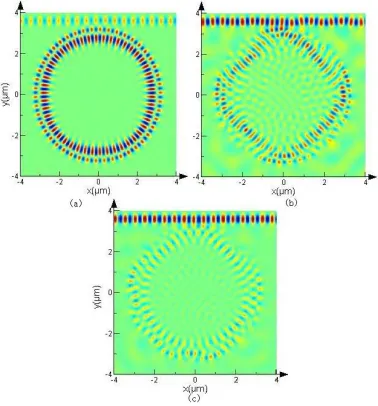
s the (EM) field distri-bution when the effect of r( ) varies with the in-crease of l0. Obviously, Q-f micro-disk resona-tor decreas ramatically as the height of inhomogeneity increases. On the contrary, if the value of 20
| ( ) |
l k
actor of e d
0 f x dx
Figure 3. Electromagnetic (EM) field distribution profile at the wavelength of 1548.39nm (a) flat surface (b) l0 is 200 nm (c) l0 is 400 nm.
Figure 4. Transmission characteristics as a function of wave- length.
is the dominator factor that leads to the degrading of mi-cro-disk resonator’s Q-factor, when side wall roughness is not fairly obvious, i.e. Lc. Results of the
simula-tion based on our method fit well with the analysis in [6].
4. Conclusions
In this paper, we proposed a novel method base on or- thogonal decomposition to analyze the surface roughness effect of micro-resonator. It becomes possible to calcu- late the scattering loss of r( ) and r'( ) respec- tively through our work, and so we can have a better un- derstanding of the inhomogeneity’s effect on micro resonator. Our theory is proved by Fourier Transform and matrix analysis. Finally, we investigated the surface roughness effect on Q-factor of micro-disk resonator, and a FDTD simulation based on orthogonal basis is con- ducted to validate our deviation.
REFERENCES
[1] R. Soref, “The of silicon
photon-ics,” IEEE Jo in Quantum
past, present, and future
urnal of Selected Topics tronics, Vol.12, No.6, 2006, pp.1678- 1687. doi:10.1109/JSTQE.2006.883151
[2] M. Soltani, S. Yegnanarayanan and A. Adibi, Q Planar Silicon Microdisk Reson
“Ultra-High ators for Chip-Scale Silicon Photonics,” Optics Express, Vol.15, No.8, 2007,
pp.4694-4704.
doi:10.1364/OE.15.004694 [3] L.Q. Ren, X. Wu, M. Li, X.
“Ultrasensitive Label-Free C
Zhang, L. Liu, and L. Xu, oupled Optofluidic Ring La-ser Sensor,” Optics Letters, Vol.37, No.18, 2012,
pp.3873-3875.
doi:10.1364/OL.37.003873 [4] Y. Hu, X. Xiao, H. Xu, X. Li,
Yu, and J. Yu, “High-spee
K. Xiong, Z. Li, T. Chu, Y. d silicon modulator based on cascaded microring resonators,” Optics Ex-press,Vol. 20,No.14, 2012, pp.15079-15085.
doi:10.1364/OE.20.015079
[5] Q. Li, A. A. Eftekhar, “Azimuthal-Order V Surface-Roughness-Induced
ariations of Mode Splitting and Scatter-ingloss in High-Q Microdisk Resonators,” Optics Letters,
Vol. 37, No.9, 2012, pp. 1586-1588. doi:10.1364/OL.37.001586
[6] E. Ganapolskii and Z. Eremenko, Surface Inhomogeneities on
“Effect of Random Spectral Properties of Di-electric-Disk Microresonators: Theory and Modeling at Millimeter Wave Range,” Physical Review E, Vol.79,
No.4, 2009, p. 041136.
doi:10.1103/PhysRevE.79.041136 [7] M. Borselli, T. J. Johnson and O. Painter
Rayleigh Scattering Limit in High-Q Silicon Mic, “Beyond the rodisks: Theory and Experiment,” Optics Express, Vol.13, No.5, 2005, p.1515.
[image:4.595.77.266.86.289.2]doi:10.1364/OPEX.13.001515 [8] X. Yi and Y. X
Figure 5. Q-factor as a function of the value of l0 in differ scattering mechanism.
ent
Whispering-Gallery-Mode Mode Splitting in A High-Q
Microresonator,” Physical Review A, Vol.83, No.2, 2011, p. 023803.
doi:10.1103/PhysRevA.83.023803 [9] S. Cho an
Q-Factor of Ge Whispering Gall
d S. Koo, “Surface Roughness Effect on ery Mode Microdisk
Channels: Resonator,” Optical Society of America, 2011.
[10] N. M. Makarov and Y. V. Tarasov, “Electron Localiza-tion in Narrow Surface-Corrugated Conducting
Manifestation of Competing Scattering Mechanisms,” Physical Review B, Vol. 64, No.23, 2001, p. 235306. doi:10.1103/PhysRevB.64.235306
[11] H.-Y. Yu, M. Ishibashi, J. -H. Park, M. Kobayashi, and K. C. Saraswat, "p-Channel Ge MOSFET by Selectively Heteroepitaxially Grown Geon Si,” IEEE Electron De-vice Letters, Vol. 30, No. 6, 2009, pp. 675-677.
doi:10.1109/LED.2009.2019847
[12] W. A. Gardener, “Introduction to Random Processes: With Applications to Signals and Systems,” New York, NY: McGraw-Hill 1990
[13] R. A. Horn and C. R. Johnson, “Matrix Analysis,” Cam-bridge University Press, CamCam-bridge, 1990.