Study on Requirements of Usability of Web Service-Based
Enterprise Information Systems
*
Shuangyuan Shi, Shuqin Cai, Zhonghui Li
Huazhong University of Science and Technology, Wuhan, China.
Email: [email protected], [email protected], [email protected]
Received September 14th, 2011; revised October 9th, 2011; accepted October 20th, 2011
Copyright © 2013 ShuangyuanShi et al. This is an open access article distributed under the Creative Commons Attribution License, which permits unrestricted use, distribution, and reproduction in any medium, provided the original work is properly cited.
ABSTRACT
With the trend of economic globalization and localization services, employees are distributed in different regions, the old enterprise information system in closed environment has been difficult to support all the business in enterprises, also cannot meet the need of information sharing between upstream and downstream enterprises and partners in the supply chain. The new business model requires companies to have distributed information systems, remote access and other characteristics. VPN (virtual private network) is high cost and lack of flexibility, Web services-based information sys- tem can achieve low-cost real-time collection to process and share distributed information, which is the ideal model of enterprise information system. However, there is a big gap in current usability between the Web services and old desk- top applications. This paper combines the usage patterns, business needs of enterprise information systems and techni- cal characteristics of Web services, proposes the usability requirements of enterprise information systems based on Web services from different views of internal users, external customers and strategic partners.
Keywords: Enterprise Development; Usability; Web Services; Enterprise Information System
1. Introduction
Web information systems can overcome the barriers of time and space, realize the integration of resources across sectors and achieve cross-regional, cross-enterprise in- formation delivery, resource sharing. Therefore, enter- prise information systems should be upgraded from the desktop-based applications to the Web service model. Under the support of Web 2.0 technology with the core of Ajax, the network is no longer confined to corporate information release, and has been widely used to handle customer transactions under the B2C model [1], it can better meet the needs of B2B business processing in sup- ply chain, the exchange of information and resource sharing between enterprises. With the expanding scale and increasing functionality of Web information systems, the users’ dependence on the Web services is growing and demands on the availability are increasing [2]. The usability of management information systems based on Web services has become the key to successful applica- tion of information systems [3].
The current research of usability is focused on the guidelines and evaluation of sites. Nielsen proposed five evaluations in 1993: interactive efficiency, ease of use, ease of memory, fault tolerance and user satisfaction [1]. After that, Nielsen further put forward ten usability heu- ristic evaluations [4]. Sherry Y. Chen and Robert D. Macredie (2005) studied applied heuristic evaluation to examine the usability of current electronic shopping, and this study is applied to develop a set of usability guide-lines to support the future design of effective interfaces for electronic shopping [5]. Jonathan W. Palmer studied the usability of B2C Web sites from five areas: down- loading delay, navigation settings, interactivity, respon- siveness, and information content, proposed that site de- sign should provide users with personalized services, and can interact with the site and the site should response to the users timely [6]. Alistair Sutcliffe considered usabil- ity from the perspective of aesthetics, which will change the variables attracting users into the operational vari- ables and do heuristic evaluation of the sites’ usability and attractiveness [7]. These are many analyses of the usa- bility of the portal and library information systems. In the usability of enterprise information systems, researchers carried on a survey on enterprise users based on usability *Humanities and Social Science Research Project of the Ministry of
Education of China (Item Number: 11YJA630098).
guidelines. Fethi Calisira, Ferah Calisirb [8] and others studied the usability, effectiveness and ease of use of user interface to make sure that they affect users’ satis- faction and influence the factors to ERP/IS systems. Through surveying the users’ background, the host or- ganization and the ERP system coverage the respon- dents’ satisfaction to systematically survey, including the six characteristics of interface usability: system capabili- ties, compatibility, adaptability, user guide, ease of learn- ing, memory minimum load, also the effectiveness of eva- luation and the ease of use. Ritu Agarwal and Viswanath Venkatesh [3] did a heuristic evaluation to the content, ease of use, promotional marketing, personalization, emo- tional factors of corporate Web sites in 4 different sectors with task-driven approach. In the evaluation, they use an expert evaluation method and a user survey to analyze the relative importance of all the content of usability guide to guide the interaction design of information sys- tems. Michael Pearson and Ann Pearson used a user sur- vey to do their research, they think that ease of use is the most important factor for users [9]. Fethi Calisir and Ferah Calisir’s research results show that the effective- ness and ease of learning are the determinants of end- user’s satisfaction with the ERP systems, while noting that a good user guide affects on the usefulness and ease of learning [8]. Michael Pearson and Ann Pearson be- lieve that ease of use is the most important factor for us- ers [9]. But Ritu Agarwal and Viswanath Venkatesh’s sur- vey show that content is most important to information system users, ease of use followed, emotional factors will be subject to the mutual influence of the task and prod- ucts [3]. As the survey methods and objects differ, the evaluation of the usability of information system does have some differences, indicating that the studies on usability of enterprise information system not only analyze site, or only study the users of enterprise websites, we need to analyze it from a more comprehensive perspective, to guide the design of Enterprises Web Information System.
On the other hand, although the companies understand the relevant knowledge of usability, in the process of designing information systems, the degree of related personnel’s attention to usability and the usability guide is not ideal. The reasons are: 1) The usability is not sub- ject to information system owners and developers’ atten- tion. 2) Neglecting the differences between information systems and websites, the existing usability guide of Web sites has its limitations, the guiding role to information systems is not enough. This paper argues that the usabil- ity of Web information systems is different from general Websites, the user community is more wide. Enterprise Web information systems not only need to meet the indi- vidual customers outside the enterprise and internal em- ployees, but also investors. Even strategic business part- ners (suppliers, distributors and other upstream and downstream enterprises) need to do the information tran-
sfer and business processes between enterprises through Web information systems. The different users’ usability requirements of Web information system are different. The study of its usability should be adjusted accordingly. This article considers different objectives of different enterprise information system user groups, analyzes the requirements for usability, and studies the differences and contacts in usability between desktop information systems and Web-based information systems. We want to provide guidance for the usability design from a more comprehensive perspective, and to make Web informa- tion systems meet the needs of all users.
2. The Usability and Content of Web
Services
The usability in International Standard ISO9241-11 is defined as the effectiveness, efficiency and subjective satisfaction when a particular user using a particular product with a specific task to complete in certain cir- cumstances. For Websites, usability refers to whether the users are easy to understand how to interact with the sites, whether they can more easily find the information they need or complete the task they want to do and get an en- joyable experience from it. Currently, the studies of Web services usability are mainly about websites and personal computing, Web service usability can be divided into 7 categories, which involves the following issues:
1) Content, including related degree of the information, the depth and breadth of the content, the multimedia and timeliness of using the content.
2) Ease of use, including the site’s organizational structure, as the navigation structure is easy to understand, the page-level is clear. Operation prompt is clear and convenient. Contribute to the completion of users’ goals.
3) Interaction, the two-way transmission of informa- tion between the Web and the browsers, including users’ feedback in usability (Feedback) and sites’ response to users’ questions (FAQ).
4) Personalized, the ability of meeting the needs of in- dividual users.
5) Fault tolerance, including error prevention and re- covery. Warning of error message before the IS release, as well as removing the impact caused by wrong opera- tion.
6) User’s guide, refer to whether the document can help the users and easy to find and use for users.
7) Emotional factors and the brand, which is a result of the usability design’ comprehensive affect, but it is an important factor of the usability of IS.
3. Usability Requirements of Enterprise Web
Services
direct effect of different user groups is the different de- signs of system. Enterprise information system users can be divided into external users, internal employees, strate- gic partners and system owner.
Web information system users with different purposes have different needs in availability, as shown in Table 1. Facing heterogeneous users, companies need to learn the behaviors of consumers by investigating and designing attractive websites [11]. In the personalized service, use the Web service to provide better service. IS’s internal users are corporate employees that growing under the same corporate culture and regulation. In the premise of meeting the functional requirements, it’s more conducive to the improvement of employees’ productivity. Investors will ignore emotional factors, looking forward to revenue from this investment. For the strategic partners, informa- tion transmission capacity between IS can bring the best interest to them.
3.1. Users outside the Enterprise
There are heterogeneous users with different life and cultural backgrounds outside the enterprises. What kinds of corporate Websites features are attractive to new users and how to maintain old customers by effective functions are the points of usability research.
Content is first noticed by users, it is the key factor to attract users in a short period of view. Content usability include: the relevance of the information, timeliness, layout, readability, use of media and so on.
Interactivity here refers to the interactive network, the feature of the direct two-way communication between the audience and the communicator or the audience and the audience in a certain extent called network interactiv- ity, including the timely feedback on user information, meeting the needs of individual users.
Ease of use. For ordinary users, they are not familiar with the operating specifications of corporate website, so designing clear navigation systems, specific language tips, simple operation and readable error pages all reflect the usability of websites.
Personalization, Google has done very well in meeting the individual needs, as providing users with lots of cus- tomized services, greatly enhancing the usability and user experience. In corporate websites, the same should be done as an important means to attract and micro clients.
3.2. Internal Staff
Network makes enterprises get rid of the restrictions of time and space, and brings changes to the staff work, for example, the change of orders. Receiving orders real- time from manufacturers’ collection to distributed ones in the network, staff also need to adapt to some new changes to face information systems in new model. Em- ployees are the recipients of information systems, they differ from consumers because consumers can choose any more attractive websites for different aesthetics. But there is sufficient evidence that computers in the work- place tend to increase the number of risk factors, such as repetitive stress injuries, stress-related physical and mental disorders, the negative impact of software tech- nology can not be ignored [10]. Therefore, high usability design of IS products is particularly important to staff.
In information system, the traditional desktop manage- ment information system based on C/S (Client/Server) mode has the advantages as system stability, rapid re- sponse business processing, data security and so on. B/S (Browser/Server) mode needn’t to install the terminal software, and can support remote application and multi- branch cross-platform application, database security is also considerably ensured. Especially in supply chain, such as procurement management, dynamic inventory management, customer relationship management, mar- keting systems, etc., the application of B/S mode can improve the information transmission, information shar- ing and the efficiency of transaction processing.
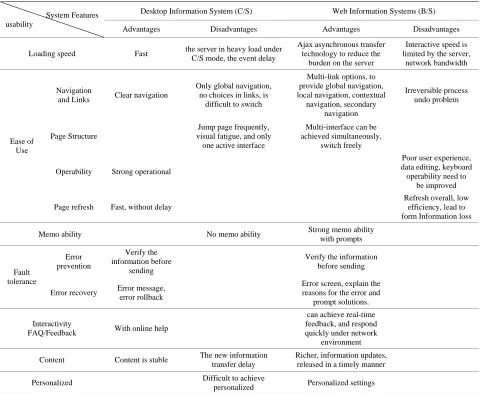
The internal staff’s requirements of usability can ex- clude some of the external and internal factors though optimizing business processes, training employees to understand the process of Web information systems op- erations, which means that major obstacles in employees operating IS do not exist. Table 2 Compares the advan- tages and disadvantages between desktop information systems and Web information systems in usability, hop- ing to provide guidance for the design in system devel- opment phase, make the usability of Web information systems better than desktop system.
[image:3.595.59.537.659.737.2]The representation of staff’s usability requirements is mission driven, they are more concerned about the sys- tem’s ease of use, the degree of difficulty accessing to information and the transaction efficiency. With the de- velopment of Ajax, Web-based IS has been greatly en-
Table 1. Web service usability requirements.
Role Demand (target)
Internal staff Information technology to improve efficiency, reduce errors, reduce the burden.
Strategic Partners Effective communication and resource sharing to reduce risk.
System Investors Attract the target groups, service users and maintain good customer relations. Establish a good corporate image.
Table 2. The comparison in usability between desktop application and Web application.
Desktop Information System (C/S) Web Information Systems (B/S)
System Features usability
Advantages Disadvantages Advantages Disadvantages
Loading speed Fast the server in heavy load under
C/S mode, the event delay
Ajax asynchronous transfer technology to reduce the
burden on the server
Interactive speed is limited by the server,
network bandwidth
Navigation
and Links Clear navigation
Only global navigation, no choices in links, is
difficult to switch
Multi-link options, to provide global navigation, local navigation, contextual
navigation, secondary navigation
Irreversible process undo problem
Page Structure
Jump page frequently, visual fatigue, and only
one active interface
Multi-interface can be achieved simultaneously,
switch freely
Operability Strong operational
Poor user experience, data editing, keyboard operability need to
be improved Ease of
Use
Page refresh Fast, without delay
Refresh overall, low efficiency, lead to form Information loss
Memo ability No memo ability Strong memo ability
with prompts
Error prevention
Verify the information before
sending
Verify the information before sending Fault
tolerance
Error recovery Error message, error rollback
Error screen, explain the reasons for the error and
prompt solutions.
Interactivity
FAQ/Feedback With online help
can achieve real-time feedback, and respond quickly under network
environment
Content Content is stable The new information
transfer delay
Richer, information updates, released in a timely manner
Personalized Difficult to achieve
personalized Personalized settings
hanced in usability. Asynchronous transfer technology reduced the burden of the server and user s’ waiting time, and improved the user experience. They make Web- based information system achieve the same effect as the desktop system.
3.3. Strategic Partners
Under supply chain environment, the information will inevitably be shared between enterprises, and JIT re- quires enterprises to keep delivering information timely and effectively. In the eyes of strategic business partners, IS standards, timely and effectively information transfer are important indicators reflecting the usability. There- fore, the users will concern about the quality and effec- tiveness of the content. Here, we put forward several proposals:
1) Use common industry terms and abbreviations in IS, help reduce barriers to information exchange, avoid am- biguity.
2) Provide effective interfaces, even the parties are using inconsistent data specification, can realize the automatic data entry and storage.
3) Strictly control the permissions, make users under- stand the security of system.
3.4. System Investors
gains obtained from it [3]. Web is not just attraction, it is their own best advertisement, and should be able to de- liver the brand culture to the users effectively in seconds and result in resonance.
4. Summary
An information system is defined as an organization, users achieve their goals by interacting with the IS. High usability brings pleasure to general users, makes em- ployees work smoothly and enables investors to obtain the satisfying potential benefits. On the basis of the scholars’ studies about the usability guide and usability evaluation, this article starts from the desired goal of user groups, and IS usability of different models is compared, but still lack the results of data supporting analysis from enterprises. Overall, this article provides comprehensive assist in usability design from multiple perspectives for usability experts and developers in the life cycle of sys- tems development, and can meet the usability needs of all users and lay the foundation for usability evaluation model in the next step.
REFERENCES
[1] J. Nielsen, “Usability Engineering,” Academic Press, Waltham, 1993.
[2] P.-Y. Wu, Q.-L. Tong and Z. Du, “Research and Imple- mentation of Usability Evaluation System of Web Busi- ness System,” Computer Engineering and Design, Vol. 30, No. 1-2, 2009, p. 338.
[3] R. Agarwal and V. Venkatesh, “Assessing a Firm’s Web Presence: A Heuristic Evaluation Procedure for the Mea- surement of Usability,” Information Systems Research,
Vol. 13, No. 2, 2002, pp. 168-186.
[4] J. Nielsen, Ten Usability Heuristics. http://www.useit.com/jakob/
[5] S. Y. Chen and R. D. Macredie, “The Assessment of Us- ability of Electronic Shopping: A Heuristic Evaluation,”
International Journal of Information Management, Vol. 25, No. 6, 2005, pp. 516-532.
doi:10.1016/j.ijinfomgt.2005.08.008
[6] J. W. Palmer, “Web Site Usability, Design, and Perform- ance Metrics,” Information Systems Research, Vol. 13, No. 2, 2002, pp. 151-167.
[7] S. M. Zabed Ahmed, C. McKnight and C. Oppenheim, “A User-Centered Design and Evaluation of IR Inter- faces,” Journal of Librarianship and Information Science, Vol. 38, No. 3, 2006, pp. 157-172.
doi:10.1177/0961000606063882
[8] F. Calisira and F. Calisir, “The Relation of Interface Us- ability Characteristics, Perceived Usefulness, and Per- ceived Ease of Use to End-User Satisfaction with Enter- prise Resource Planning (ERP) Systems,” Computers in Human Behavior, Vol. 20, No. 4, 2004, pp. 505-515. doi:10.1016/j.chb.2003.10.004
[9] J. M. Pearson and A. Pearson, “Determining the Impor- tance of Key Criteria in Web Usability,” Management Research News, Vol. 30, No. 11, 2007, pp. 816-828. doi:10.1108/01409170710832250
[10] J. Gulliksen, I. Boivie and B. Goransson, “Usability Pro- fessionals—Current Practices and Future Development,”
Interacting with Computers, Vol. 18, No. 4, 2006, pp. 568-600. doi:10.1016/j.intcom.2005.10.005