Munich Personal RePEc Archive
When A Factor Is Measured with Error:
The Role of Conditional
Heteroskedasticity in Identifying and
Estimating Linear Factor Models
Prono, Todd
Commodity Futures Trading Commission
19 September 2011
When A Factor Is Measured with Error: The Role of Conditional
Heteroskedasticity in Identifying and Estimating Linear Factor
Models
1Todd Prono
2Commodity Futures Trading Commission
September 2011
Abstract
A new method is proposed for estimating linear triangular models, where identi…ca-tion results from the structural errors following a bivariate and diagonal GARCH(1,1) process. The associated estimator is a GMM estimator shown to have the usual pT
-asymptotics. A Monte Carlo study of the estimator is provided as is an empirical application of estimating market betas from the CAPM. These market beta estimates are found to be statistically distinct from their OLS counterparts and to display ex-panded cross-sectional variation, the latter feature o¤ering promise for their ability to provide improved pricing of cross-sectional expected returns.
JEL Codes: C3, C13, C32. Keywords: Measurement error, triangular models, factor models, heteroskedasticity, identi…cation, many moments, GMM.
1I owe gratitude to Robin Lumsdaine, Arthur Lewbel, David Rei¤en, and seminar participants at
Bing-hamton University for helpful comments and discussions.
2Corresponding Author: Todd Prono, Commodity Futures Trading Commission, O¢ce of the Chief Economist, 1155 21st,
1. Introduction
This paper presents a new method for estimating linear triangular models where
mea-surement error or endogeneity e¤ects one of the regressors. Examples of these types of
models include (i) asset return factor models where one of the factors is either measured
inaccurately or an imperfect proxy for the true, latent, factor or (ii) restricted VAR models
from the empirical macro literature. The traditional approach to identifying these models
is through the use of exclusionary restrictions on parameters a¤ecting the conditional mean
or, equivalently, through the assumed existence of valid instruments. In contrast, this
pa-per demonstrates how a certain parametric speci…cation of the conditional heteroskedasticty
(CH) a¤ecting the structural errors to the triangular system allows for identi…cation in the
absence of traditional instruments. As such, this paper contributes to the literature on
iden-ti…cation through various forms of heteroskedasticity. Based on this ideniden-ti…cation result, a
continuous updating estimator (CUE) is proposed that is shown to be consistent and
asymp-totically normal. It is also robust to many moments bias. This estimator performs well in
Monte Carlo experiments under moment existence criteria that allow for varying fat-tailed
processes. The estimator is also applied to estimating market betas from the familiar CAPM,
o¤ering promising results for the ability of these estimates to price expected returns in the
cross-section.
Consider the model
Y1;t =Xt0 1+Y2;t 2+ 1;t;
Y2;t =Xt0 + 2;t;
where Yt=hY1;t Y2;t
i0
is a vector of endogenous variables, Xt a vector of observable
covari-ates than can include lags ofYt, and t=h 1;t; 2;t
i0
a vector of structural errors. Of course,
E Xt i;t = 0for i = 1;2 is insu¢cient for identifying the model. Rather than impose zero
restrictions on certain elements in 1, consider the following speci…cation for t:
E t jzt 1 = 0; Eh t 0t j zt 1i= hij;t ; (1)
where zt = Zt; Zt 1; : : : and Zt = Y0 t; X
0 t
0
. This speci…cation describes a bivariate,
diagonal GARCH(1,1) model. The univariate version was introduced by Bollerslev (1986),
the multivariate generalization by Bollerslev, Engle, and Wooldridge (1988). This model of
CH can be shown to support identi…cation of the triangular system in the same way as
tradi-tional zero restrictions imposed on 1; namely, through an examination of the reduced form
(see Prono 2010). Allowing for this result are the structural restrictions imposed by the
pa-rameterization in (2). This papa-rameterization imposes a structure onCov i;t j;t; i;t k j;t k
for k 2, and functions of these covariances can be paired with the moment conditions
E Xt i;t = 0 to grant identi…cation. A bene…t of this result is that identi…cation of the
triangular system is achieved without the need for considering all of the parameters in (2);
rather, only a subset of these parameters needs to be considered. Before proceeding to the
formal statement of identi…cation and the properties of the associated estimator, it is
in-structive to further consider the source of identi…cation in (1) and (2) as well as a factor
model that would bene…t from this result.
1.1 Identi…cation Source
The identi…cation problem confronting the triangular system can be recast in terms of
a control function as in Klein and Vella (2010). Doing so provides a heuristic basis for
understanding how (1) and (2) solve this problem. Consider the conditional regression
A zt 1 arg min
A
E 1;t A 2;t j zt 1 2 =Cov 1;t; 2;t j zt 1 =V ar 2;t j zt 1 :
In this case, Ut 1;t A zt 1 2;t is uncorrelated with 2;t conditional on zt 1 and forms
the basis for the controlled regression
Y1;t =X 0
t 1+Y2;t 2+A zt 1 2;t+Ut: (3)
Let Vt = X0
t; Y2;t; 2;t . Then, if t is homoskedastic so that A zt 1 is constant, we have the usual identi…cation problem, since (absent exclusionary restrictions for 1) E[V0
singular.3 Now suppose, instead, that
t is CH, and let Wt= X 0
t; Y2;t; A zt 1 2;t . Then, E W0
tWt is nonsingular, and the identi…cation problem is solved, provided that A zt 1 can be consistently estimated. This latter requirement necessitates (2) and illustrates why
CH alone is not su¢cient for identifying the triangular system.
One approach to make estimation ofA zt 1 feasible is to assume a constant conditional
covariance. Speci…cally, since A zt 1 = h12;t=h22;t, if h12;t = !12, then A zt 1 can be
consistently estimated because h22;t is parameterized as a univariate GARCH(1,1) model,
and 2;t is identi…ed provided that E[XtX0
t] is nonsingular. Sentana and Fiorentini (2001)
employ this precise covariance restriction to identify a latent factor model, where univariate
GARCH(1,1) processes characterize the conditional variances of the factors. Lewbel (2010)
also relies upon a constant conditional covariance restriction for identifying triangular and
simultaneous models. In a similar vein, Vella and Verbeek (1997) and Rummery et al.
(1999), too, rely on a covariance restriction for identi…cation by proposing rank order as an
instrumental variable.
A contribution of this paper is to allow h12;t to be time-varying, parameterizing it as an
ARMA(1,1) process, analogous to the speci…cation of each conditional variance. Doing so
complicates estimation of A zt 1 by requiring the control function to be treated
simulta-neously along with (3), since h12;t now depends on past values of 1;t. The functional form
in (2) allows for this simultaneous estimation. Rather than propose an estimator for the
controlled regression, however, this paper demonstrates how the moment conditions
E Xt i;t = 0; Cov i;t j;t; i;t k j;t k ijCov i;t j;t; i;t (k 1) j;t (k 1) = 0; (4)
8 i; j = 1;2 excluding i = j = 1 where ij = aij +bij identify the triangular system and how …nite sample analogs to these moment conditions combine to form an estimator for that
system. Since the parametric form of (2) implies this second set of moment conditions, the
source of identi…cation behind the controlled regression in (3) and the moment conditions in
(4) is equivalent.
Klein and Vella (2010) is a work closely related to this one. They show identi…cation
3Singularity follows from
of the triangular model given heteroskedastic errors of a semi-parametric functional form.
Their estimator is more complicated to implement than this one, owing to the generality of
the heteroskedastic speci…cation. In many applications of …nancial economics, however, the
more restrictive CH speci…cation of (6) and (7) proves warranted (see, for example, Hansen
and Lunde 2005). Moreover, the Klein and Vella approach links the conditional covariance
between errors directly to each conditional variance. In this paper, by contrast, h12;t is not
a direct function of either h11;t or h22;t.4
Other papers that exploit heteroskedasticity for identi…cation include Rigobon (2003) and
Rigobon and Sack (2003), where multiple unconditional variance regimes act as probabilistic
instruments, and the correlation between structural errors is sourced to common, unobserved,
shocks.
1.2 Measurement Error
Consider the CAPM of Sharpe (1964) and Lintner (1965), where Y1;t is a given excess
security return, Y2;t is the excess return on the true market return, which is unobservable,
and Y2;t is an observable proxy to the true excess market return. If the CAPM prices all
security returns including the proxy return, then
Y1;t = 1+Y2;t 2+U1;t; (5)
Y2;t= 1+Y2;t 2+U2;t;
where 1 = 1 = 0. If E Y2;t =E Y2;t , then
Y2;t=Y2;t+U2;t; (6)
which casts the relationship between the proxy return and the true market return as one of
measurement error, although not, necessarily, in the classical sense, since the theory does not
restrict U1;t to be orthogonal toU2;t or, equivalently, U1;t to be orthogonal toY1;t. Consider
4An example whereh
the projection equation Y2;t = +V2;t. Substituting (6) into this projection equation and
into (5) produces the triangular system
Y1;t = 1+Y2;t 2+ 1;t; 1;t=U1;t 2U2;t; (7)
Y2;t= + 2;t; 2;t =U2;t+V2;t:
Given a means for consistently estimating (7), one has a response to the Roll critique (1977),
since, in this case, b2 is a measure of the security return’s sensitivity to the true market
return. Notice, however, that OLIVE from Meng, Hu, and Bai (2011) cannot, necessarily,
provide this consistent estimate, since any additional excess security return, say, Y3;t, which
is priced according to Y3;t = 3+Y2;t 4+U3;t, is only a valid instrument for Y2;t if all Ui;t
are orthogonal.
This paper explores estimation of the triangular system using (1) and (2), a system
commonly employed on security returns. The associated estimator represents a response to
the Roll critique insofar as one is willing to assume certain higher moment existence criteria
for those security returns. A multi-factor generalization of the above example follows readily
if the non-market factors are not also measured with error.
2. Identi…cation
For the linear triangular model
Y1;t =Xt0 1;0+Y2;t 2;0+ 1;t (8)
Y2;t =Xt0 0+ 2;t (9)
together with the following bivariate GARCH(1,1) speci…cation for its structural errors t=
h
1;t; 2;t
i0
E t jzt 1 = 0; E
h
t 0
t j zt 1
i
= hij;t ; (10)
1;0 is the true value of 1 and similarly for the other parameters. Even if there are no zero restrictions for 1;0, which is equivalent to saying that there are no instruments available for
Y2;t, this section shows that (8) may still be identi…ed given the parametric form of CH in
(11).
ASSUMPTION A1: (i) E[XtX0
t] and E[XtYt] are …nite and identi…ed from the data.
(ii) E[XtX0
t] is nonsingular. (iii) E Xt i;t = 0.
Given A1, the secondary equation (9) is identi…ed, as is the reduced form of the primary
equation (8). Let the reduced form errors from (8) beR1;t =Y1;t X0
tE[XtX
0
t]
1
E XtY1;t .
The relationship between these reduced form errors and the structural errors is
R1;t = 1;t+ 2;t 2;0: (12)
ASSUMPTION A2: (i) Let Ht = hij;t . Ht is positive de…nite almost surely. (ii)
aij;0 >0,bij;0 0. (iii) Let ij;0 =aij;0+bij;0. 12;0 6= 22;0.
In practice, positive de…niteness under A2 can be satis…ed using the BEKK
parameteri-zation of (11) proposed by Engle and Kroner (1995).5 Allowingb
ij;0 = 0permitsHt to follow
a diagonal ARCH(1) process. Let Zij;t= i;t j;t. Then
Zij;t = hij;t+Wij;t
= !ij;0+ ij;0Zij;t 1 bij;0Wij;t 1+Wij;t;
where, E Wt j zt 1 = 0 and E WtWt s = 0 8 s 1.
ASSUMPTION A3: Zij;t is covariance stationary 8 i; j = 1;2 except i=j = 1.
An implication of A3 is that ij;0 <1, in which case E Zij;t = ij;0 = !ij;0
1 ij;0 (see
The-orem 1 in Bollerslev 1986). Note that while 2;t is required to be fourth moment stationary,
no such restriction is imposed on 1;t. In fact, 1;t need not even have a …nite variance (i.e.,
11;0 = 1 as in the IGARCH case is not ruled out). Given A3, if zij;0t =Zij;t ij;0, then
zij;0t= ij;0zij;0t 1 bij;0Wij;t 1 +Wij;t: (13)
Consider zlm;0t, where l; m = 1;2 excluding the case where l = m = 1. Multiplying both
sides of (13) by zlm;0t k for k 2 and taking expectations produces
E zij;0tzlm;0t k = ij;0E zij;0tzlm;0t (k 1) : (14)
This expression was derived in Bollerslev (1986, 1988) and He and Teräsvirta (1999) for the
case where i=j =l =m.
ASSUMPTION A4: Let Uij;t 2 = Zij;t 2; : : : ; Zij;t K 0. Given (12), the reduced from
of U12;t 2 is U (R)
12;t 2. The matrix R =
2
4 Cov R1;t 2;t; U
(R)
12;t 1 Cov 22;t; U
(R) 12;t 1
Cov R1;t 2;t; U22;t 1 Cov 2
2;t; U22;t 1
3 5
has full column rank.
SinceR1;tcan be estimated by regressingY1;tonXt, and 2;tcan be estimated by regressing
Y2;t onXt, the matrix rank test of Cragg and Donald (1996) can be applied to an estimate
of R, rendering A4 testable. Alternatively, one can simply test if the determinant of 0 R R
is zero, since A4 requires this matrix to be nonsingular.
THEOREM 1. Consider the model of (8)–(11). Let Assumptions A1–A4 hold. Then 1;0,
2;0, 12;0, and 22;0 are identi…ed.
Proofs are in the Appendix. The proof of Theorem 1 is based on the reduced form
of (14). As a consequence, only the conditional covariance function and the conditional
variance function for 2;t matter for identi…cation (see section 1.1). Structural parameters
can be retrieved from this reduced form because of the parametric speci…cation in (11). This
speci…cation omits lags of 2
1;t and 22;t from the conditional covariance function and lags of
2
1;t and 1;t 2;t from the conditional variance function of 2;t. These restrictions are analogous
to traditional zero restrictions that produce valid instruments. The diagonal GARCH(1,1)
3. Estimation
LetSt =fYt; XtgtT=1. De…ne 1;t =Y1;t X0
t 1 Y2;t 2, 2;t =Y2;t X 0
t ,zij;t= i;t j;t ij,
and uij;t 2 =h zij;t 2; : : : ; zij;t K
i0
8 i; j = 1;2 except i=j = 1, and K 2.
ASSUMPTION A5: = 1; 2; ; !ij; ij . 0 2 R7, located in the interior of ,
a compact parameter space de…ned such that 12= 22 excludes an open neighborhood of
one.
A5 is a standard regulatory condition. Its only nuance stems from the need to reconcile
compactness with A2(iii). Consider the vector valued functions
g1(St; ) =Xt 1;t; g2(St; ) =Xt 2;t;
g3(St; ) =zij;t
g4(St; ) =zij;t ulm;t 2 ijulm;t 1 ; 8 l; m= 1;2 excludingl =m= 1;
where g3(St; ) and g4(St; ) stack the vector valued functions 8 i; j; l; minto single column
vectors. Let gt( ) =h g1(St; ); g2(St; ); g3(St; )0; g4(St; )0
i0
. In addition, let
b
g( ) = T 1 T
P
t=K+1
gt( ); g( ) =E[gt( )];
b
G( ) = @bg( )
@ ; G( ) =E
@gt( )
@ ;
g t( ) =
@gt( )
@ ; b( ) =T
1 PT
t=K+1
gt( )g t( )
0
; ( ) =E gt( )g t( )
0
;
( ) =
s=(PL 1)
s= (L 1)
E gt s( )gt( )0
; L 1;
b( ) =
s=(PL 1)
s= (L 1)
T 1 T
P
t=K+s+1
gt s( )gt( )0;
and consider the estimator
b= arg min
2 b
g( )0
for some sequence of positive semi-de…nite T. For this estimator, the moment
condi-tions de…ned from g1(St; ) and g2(St; ) are standard for linear models and are, of course,
insu¢cient for identifying the associated triangular system. The moment conditions de…ned
from g3(St; ) and g4(St; ) produce the …nite sample version of (14) and are, therefore,
instrumental in enabling identi…cation given Theorem 1.
ASSUMPTION A6: (i) Xt i;t is an L1 mixingale (see Andrews 1988 for a
de…ni-tion). (ii) 9 an r > 1 such that E Xt i;t r < M. (iii) Let vt;k = zij;0tzlm;0t k
E zij;0tzlm;0t k for k = 1; : : : ; K. vt;k is uniformly integrable.
Mixingale properties for fgt( )g factor prominently into establishing consistency ofbin
Theorem 2 below. Also, notice that A6(ii) continues to allow 1;t to follow an IGARCH
process.
THEOREM 2 (Consistency). Consider the estimator in (15) for the model of (8)–(11).
Assume that T !p 0, a positive de…nite matrix. Let Assumptions A1–A6 hold. Then,
b p
! 0.
Consistency under Theorem 2 requires fourth moment existence for 2;t but no
corre-sponding requirement for 1;t. In fact, 1;t does not even need to be covariance stationary.
Depending upon the speci…cation of K, however, the estimator in (15) can involve many
moment conditions. Works by Stock and Wright (2000), Newey and Smith (2004), Han
and Phillips (2006), and Newey and Windmeijer (2009), for instance, highlight the bias
caused by many moment conditions in GMM estimators. Newey and Windmeijer (2009)
illustrate how the CUE of Hansen, Heaton, and Yaron (1996) is robust to this bias.
Theo-rem 2 nests the CUE, provided that su¢cient moment existence criteria are satis…ed so that
b b 1 p
! ( 0) 1.6 The bias-reducing feature of the CUE relative to GMM estimators
motivates the following discussion of asymptotic normality to only consider the case where
T = b( )
1 .
ASSUMPTION A7: (i) Xt i;t is an L2 mixingale. (ii) 9 a neighborhood N of 0
such that E sup
2Nk
gt( )k2 <1. (iii) gt s( 0; 2
0)gt( 0; 20)
0
satis…es the UWLLN
(see Wooldridge 1990, De…nition A.1.). (iv) G( 0)0
( 0) 1G( 0)is nonsingular. (v)
Assumption 1 of De Jong (1997) holds.
A7 is an extension of A6, since A7(i) implies A6(i), and A7(ii) implies both A6(ii) and
A6(iii). The stronger mixingale properties of A7 permit a CLT to apply to bg( 0) (see the
proof of Theorem 3 in the Appendix).
THEOREM 3 (Asymptotic Normality). Consider the estimator in (15) for the model
of (8)–(11), where T = b( ) 1. Assume that b( )!p ( ). Let Assumptions A1–A7
hold. Then,
p
T b 0 !d N 0; G( 0)0 ( 0) 1G( 0) 1 : (16)
Admittedly, the assumptions supporting asymptotic normality are strong. For instance,
(16) requires the eighth moment of 2;t to exist. This condition, however, is shared by
the estimators in Kristensen and Linton (2006) and Baillie and Chung (2001) by nature of
a shared reliance on the autocovariances of squared residuals for inference. The degree to
which this condition limits the applicability of (15) is explored in the simulation experiments
of the next section.
4. Monte Carlo
This section analyzes the …nite sample performance of (15) with T = b( ) 1
bench-marked against the OLS estimator and the controlled regression (CR) estimator of (3), where
A zt 1 =h221;t, under the following simulation design:
Y1;t = X1;t+Y2;t+ 1;t;
Y2;t = X1;t+ 2;t;
X1;t N(0; 1); t=Ht1=2 t;
where each i;t is distributed either as a N(0;1) or standardized (2;1) random variable.
In the speci…cation of (11),a11;0 =a12;0 = 0:10, a22;0 = 0:20, b11;0 = 0:80, and b12;0 =b22;0 =
1, and either Cov 1;t; 2;t = 0:20 (the low correlation state) or Cov 1;t; 2;t = 0:40 (the
high correlation state). Given this speci…cation, when i;t N(0; 1), the eighth moment of
2;t is …nite (see Theorem 2 of Bollerslev 1986). On the other hand, when i;t standardized
(2;1), the fourth moment of 2;tdoes not exist (see Corollary 6 of Carrasco and Chen 2002).
All simulations are conducted with 1,000 observations across 500 trials. When generating
observations for each trial, the …rst 200 are dropped to avoid initialization e¤ects. For each
trial using (15), the starting values are the true parameter values. In addition, (15) is
computed using either K = 10 or K = 20.7 Summary statistics for all of the estimators
include the mean and median bias, the standard deviation and decile range (de…ned as the
di¤erence between the 90th and the 10th percentiles), as well as the root mean squared
error (RMSE) and median absolute error (MDAE), where both the RMSE and MDAE are
measured with respect to the true parameter value. The median bias, decile range, and
MDAE are robust measures of central tendency, dispersion, and e¢ciency, respectively, that
are reported out of a concern over the existence of higher moments. For (15), the coverage
rate for 95% con…dence intervals as well as the rejection rate for the standard test for
overidenti…cation at a 5% level are also reported.
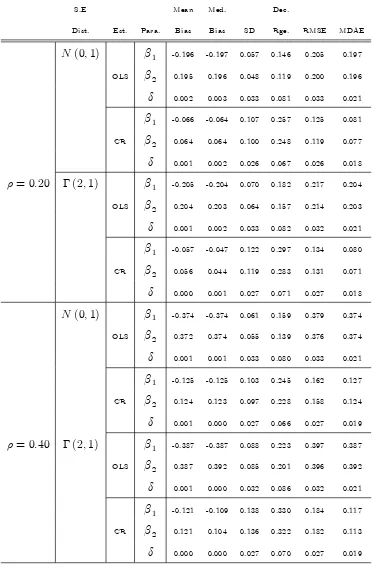
Table 1 summarizes the results for the OLS and CR estimators. As expected, the OLS
estimates of 10 and 20 are biased. The absolute value of this bias increases when
mov-ing from the low correlation to the high correlation state and is generally higher when
i;t standardized (2;1), the case re‡ecting a heavier-tailed process. In general, the
mag-nitude of this bias is large. The CR estimator displays notably less bias than its OLS
counterpart; however, the overall level of bias remains non-negligible, especially in the case
of fat-tailed errors.
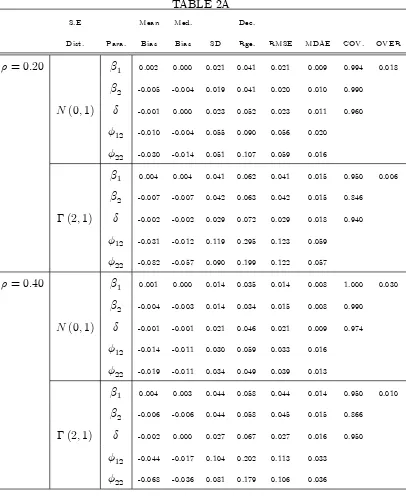
Table 2A summarizes the results for (15) whenK = 10. In the case where i;t N(0; 1),
the estimates of 10 and 20 are unbiased. The nuisance parameters are slightly biased, but
this tendency does not e¤ect the estimates from the conditional mean. The coverage rates
tend to be too high and the rejection rates too low; however, the latter improves when
moving to the high correlation state. Overall, the CUE in (15) o¤ers a marked improvement
7WhenK= 10, (15) contains40 moment conditions. WhenK= 20, the number of moment conditions
over both the OLS and CR estimators.
What is surprising in Table 2A is that (15) continues to produce unbiased estimates of 10
and 20 even when i;t standardized (2;1). Irrespective of the correlation state, biases in
the nuisance parameters increase signi…cantly relative to the case where i;t N(0; 1), but
this increase does not spill over onto the estimates from the conditional mean. Contrary to
what the theory predicts, therefore, it seems as if (15) remains consistent even if the fourth
moment of 2;t is not well de…ned. Also surprising is the …nding that coverage rates for b1
and b correspond to the chosen con…dence interval. The coverage rate for b2, however, is
too low. In addition, the overidenti…cation test is signi…cantly undersized.
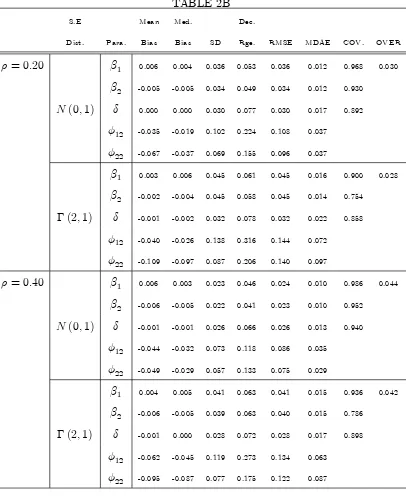
Table 2B summarizes results for the CUE when K = 20. In general, these results
(relative to those in Table 2A) con…rm the CUE as being robust to many moments bias.
For i;t N(0; 1)across both correlation states, moving from K = 10 to K = 20 results in
diminished e¢ciency according to either the RMSE or MDAE. Coverage rates are generally
improved, however, and the rejection rates are much closer to being appropriately sized.
When i;t standardized (2;1), the same results emerge as in the case where K = 10.
Speci…cally, parameter estimates from the conditional mean remain unbiased even though
the nuisance parameters display non-negligible bias, which, relative to the case whereK = 10,
is more severe. There is also a noticeable deterioration in coverage rates, counter-balanced
against a marked improvement in rejection rates.
5. CAPM Betas
This section uses the CUE from section 3 to estimate CAPM betas for size, B/M, and
momentum portfolios following the example in section 1.2. These portfolios are studied
because they re‡ect the size, value, and momentum "premiums" that empirical applications
of the CAPM struggle to explain. The returns are measured weekly (in percentage terms)
from 10/6/67 through 9/28/07. Test results consider 20- and 10-year subperiods of this
overall date range. The daily 25 size-B/M and 25 size-momentum return …les (each 5 5
the NYSE, AMEX, and NASDAQ exchanges are used to construct the weekly return series.8
The size portfolios considered are "Small," "Mid," and "Large." "Small" is the average of the
…ve low market-cap portfolios, "Mid" the average of the …ve medium market-cap portfolios,
and "Big" the average of the …ve large market-cap portfolios. The B/M portfolios considered
are "Value," Neutral," and "Growth." Value" is the average of the …ve high B/M portfolios,
"Neutral" the average of the …ve middle B/M portfolios, and "Growth" the average of the …ve
low B/M portfolios.9 Finally, the momentum portfolios considered are "Losers," "Draws,"
and "Winners." "Losers" is the average of the …ve low return-sorted portfolios, "Neutral"
the average of the …ve middle return-sorted portfolios, and "Winners" the average of the
…ve high return-sorted portfolios. The proxy return for the true market return is the CRSP
value-weighted index return formed from all securities traded on the NYSE, AMEX, and
NASDAQ exchanges. Excess returns are calculated using the one-month Treasury bill rate
from Ibbotson Associates.
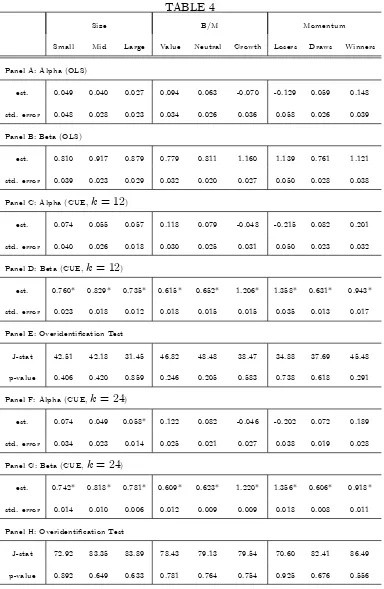
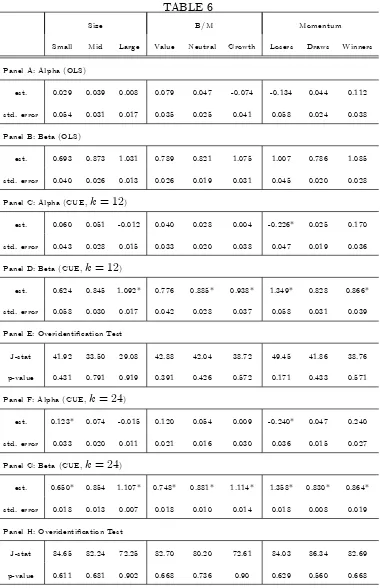
The most glaring take-away from Table 3, which summarizes estimation results for
re-turns measured between 10/6/67 and 9/25/87, is that di¤erences in beta estimates between
OLS and the CUE are large (i.e., of economic signi…cance) and statistically signi…cant.10
Moreover, this result is not impacted by the lag length chosen for the CUE. Since Theorem
1 nests the case of a zero covariance between structural errors–which, in the context of (7),
means that there is no measurement error in the market return–this …nding strongly suggests
that the standard approach to estimating beta is biased. This …nding is further supported by
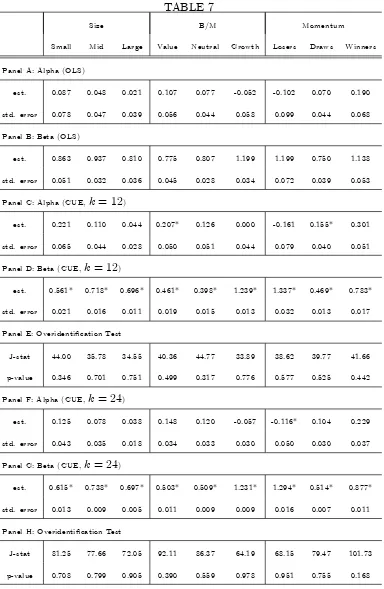
Table 4, which summarizes estimation results over the more-recent period 11/6/87 - 9/28/07,
and by Tables 5–7, which consider ten-year subperiods of the two date ranges considered in
Tables 3 and 4, respectively.11
Across the di¤erent portfolios, one can also observe an increase in the dispersion of the
8These return …les are available on Kenneth French’s website. Weekly returns are utilized because the
CUE, which is based on higher moments, bene…ts from many observations in terms of …nite sample per-formance. Weekly returns are selected over daily returns because the former reduces day-of-the-week and weekend e¤ects as well as the e¤ects of nonsynchronus trading and bid-ask bounce.
9De…nitions for the "Small," "Large," "Value," and "Growth" portfolios are taken from Lewellen and
Nagel (2006).
10Statistical signi…cance is determined using 95% con…dence intervals constructed from the standard errors
of the CUE, which are consistent given general forms of heteroskedasticity and autocorrelation of the …rst order (i.e.,L= 2).
beta estimates obtained using the CUE relative to OLS. Moreover, this increased dispersion
does not seem to link to imprecision in the individual beta estimates, since the standard
errors for the CUE are, at least, comparable in magnitude to their OLS counterparts. The
implication, therefore, is that the beta estimates obtained under the CUE display elevated
cross-sectional variation. In empirical asset pricing, betas obtained from time-series
regres-sions are important for their assumed role in pricing expected returns in the cross-section. A
well known empirical feature of cross-sectional expected returns is that (1) they tend to
ex-hibit substantial variation, and (2) their associated betas vary correspondingly little (minor
variations in betas cross-sectionally is evidenced in the …rst two panels of the Tables). This
second feature explains the poor empirical performance of the CAPM, which uses individual
asset sensitivities to the market return as its single pricing factor. Tables 3–7 suggest that
this poor performance may be overstated; using consistent beta estimates may improve the
ability of these estimates to explain variation in expected returns cross-sectionally.
Di¤erences in alpha estimates between the CUE and OLS appear decidedly more muted.
With minor exceptions, these estimates are statistically indistinguishable for the two
20-year time periods considered (see Tables 3 and 4). For the 10-20-year subperiods, however,
statistically distinct alpha estimates do arise, and, when they do, increases in their magnitude
(in absolute terms) under the CUE tend to explain the di¤erence, as opposed to reductions
in standard errors.
6. Conclusion
This paper presents a new method for estimating the linear triangular system, one which
does not rely upon the existence of outside instruments for identi…cation but, rather, a
particular parametric form for the CH in the structural errors. This parametric form is
common to empirical asset pricing speci…cations and tests. The estimator is shown to display
the usual pT-asymptotics and is robust to many (potentially weak) moments bias. It also
economizes on the number of nuisance parameters out of the CH process that need to be
estimated.
The estimator is applied to estimating market betas in a CAPM setting. The resulting
increased cross-sectional variation. The two-pass method of Fama and MacBeth (1973) for
testing asset pricing models relies upon time series beta estimates from the …rst pass. Works
reliant upon this method have found the risk premium associated with these …rst-pass betas
to be near zero or even negative (see, e.g., Jagannathan and Wang 1996 and Lettau and
Ludvigson 2001). Inconsistent beta estimates from the …rst pass will a¤ect the cross-sectional
results from the second pass and may explain these counter-intuitive results. Increased
cross-sectional variation in consistent beta estimates is a promising …nding that supports this
conjecture because of the empirical properties of cross-sectional expected returns.
Appendix
PROOF OF THEOREM 1: Given (14), …rst consider the case wherei=j =l =m = 2.
Then
Cov 22;t; U22;t 2 = 22;0Cov 22;t; U22;t 1 ; (17)
which identi…es 22;0 as
22;0 = Cov 22;t; U22;t 1
0
Cov 22;t; U22;t 1 1Cov 22;t; U22;t 1 0Cov 22;t; U22;t 2 :
Next leti= 1,j = 2, and l=m= 2. In this case,
Cov 1;t 2;t; U22;t 2 = 12;0Cov 1;t 2;t; U22;t 1 ;
the reduced form of which is
Cov R1;t 2;t; U22;t 2 = 12;0Cov R1;t 2;t; U22;t 1 + 2;0 22;0 12;0 Cov 22;t; U22;t 1 ;
(18)
given (12) and (17). Finally, leti=l = 1 and j =m= 2. Then
the reduced form of which simpli…es to
Cov R1;t 2;t; U12(R;t) 2 = 12;0Cov R1;t 2;t; U12(R;t) 1 + 2;0 22;0 12;0 Cov 22;t; U12(R;t) 1 ;
(19)
given (12), (17), (18), and the fact that
Cov 22;t; U12(R;t) 2 = 22;0Cov 22;t; U12(R;t) 1 :
Given (18) and (19), 2
4 Cov R1;t 2;t; U
(R) 12;t 2
Cov R1;t 2;t; U22;t 2
3
5= R ;
where =h 12;0 2;0 22;0 12;0 i
0
. Given A4, is identi…ed as
= 0R R 0R
2
4 Cov R1;t 2;t; U
(R) 12;t 2
Cov R1;t 2;t; U22;t 2
3 5;
from which 12;0 is identi…ed, and 2;0 is identi…ed conditional on the identi…cation
of both 22;0 and 12;0 and given A2. Finally, given A1, 1;0 is identi…ed as 1;0 =
E[XtX0
t]
1
E Xt Y1;t Y2;t 2;0 .
PROOF OF THEOREM 2: Given A6(ii), Xt i;t is uniformly integrable. A6(i) and
A6(ii), therefore, allow of an application of Theorem 1 in Andrews (1988), which
es-tablishes Result R1: T 1P
t
Xt i;t !p 0. Next, recursive substitution into (13) produces
zij;0t =
1
P
p=0 p
Wij;t p; (20)
where 0 = 1 and p = aij;0 ij;p 01 8 p 1. Since p 1p=0 is absolutely summable
given A2 and A3, and E Wij;t 2 is …nite given A3, fZij;tg is an L1 mixingale that is
uniformly integrable. As a consequence, Theorem 1 of Andrews (1988) applies again
to establish result R2: T 1PZ
ij;t p
vt;k is a L1 mixingale since Eh W
ij;t
2i
is …nite (see Hamilton 1994 p. 192-93 for
a closely related proof). This result together with A6(iii) and R2 establishes Result
R3: T 1P
t
zij;tzlm;t k !p E zij;0tzlm;0t k . Given results R1–R3, bg( ) !p g( ). Since
T p
! 0 by assumption,bg( )
0
T bg( ) p
!g( )0 0g( )by continuity of multiplication. Finally, given Theorem 1, g( )0 0g( ) is uniquely minimized at = 0.
PROOF OF THEOREM 3: Using well known results on derivatives of inverse matrices,
the …rst order conditions for (15) with T = b( ) 1 are
b
G b
0
b( ) 1 bg b
0
b b 1b b b b 1 bg b = 0:
Multiplying this expression by pT and expanding bg b around 0 produces
p
T b 0 = G( 0)0 ( 0) 1G( 0) 1G( 0)0 ( 0) 1pTbg( 0);
given A7(iv) and the following Results: (R4)bg b !p g( 0) = 0, b b !p ( 0), and
b
G b !p G( 0) given Theorem 2 (speci…cally, Gb b !p G( 0) from the mixingale
and uniform integrability properties of A6); (R5) b b 1 !p ( 0) 1 given Theorem
2, A7(ii), A7(iii), and Lemma 4.3 of Newey and McFadden (1994) applied toa(z; ) =
gt s( )gt( )0
, where A7(iii) replaces the reliance on Khintchine’s law of large numbers
within the proof of this Lemma. Next, given absolute summability of p 1p=0 (see the
proof of Theorem 2), fzij;0tg and vt;k are L2 mixingales, since E
h
Wij;t 4i is …nite
under A7(ii). This result together with A7(i) establishes theL2 mixingale property for
fgt( 0)g, which satis…es the …rst element of Assumption 1 in De Jong (1997). Since the remaining elements hold under A7(v), pTbg( 0)!d N(0; ( 0)) by Theorem 1 of
the aforementioned work, where ( 0) is …nite by A7(ii). The statement in (16) then
References
[1] Andrews, D.W.K., 1988, Laws of large numbers for dependent non-identically distrib-uted random variables, Econometric Theory, 4, 458-467.
[2] Baillie, R.T., and H. Chung, 2001, Estimation of GARCH models from the autocorre-lations of the squares of a process, Journal of Time Series Analysis, 22, 631-650.
[3] Bollerslev, T., 1986, Generalized autoregressive conditional heteroskedasticity, Journal of Econometrics, 31, 307–327.
[4] Bollerslev, T., 1988, On the correlation structure for the generalized autoregressive conditional heteroskedastic process, Journal of Time Series Analysis, 9, 121-131.
[5] Bollerslev, T., 1990, Modelling the coherence in short run nominal exchange rates: a multivariate generalized ARCH model, Review of Economics and Statistics, 72, 498-505.
[6] Bollerslev, T., R.F Engle and J.M. Wooldridge, 1988, A capital asset pricing model with time-varying covariances, Journal of the Political Economy, 96, 116-131.
[7] Carrasco, M. and X. Chen, 2002, Mixing and moment properties of various GARCH and stochastic volatility models, Econometric Theory, 18, 17-39.
[8] Cragg, J. and S. Donald, 1997, Inferring the rank of a matrix, Journal of Econometrics, 76, 223-250.
[9] Engle, R.F and K.F. Kroner, 1995, Multivariate simultaneous generalized GARCH, Econometric Theory, 11, 121-150.
[10] Fama, E.F. and J. MacBeth, 1973, Risk, return and equilibrium: empirical tests, Journal of Political Economy, 81, 607-636.
[11] Hamilton, J.D., 1994, Time series analysis, Princeton University Press.
[12] Han, C. and P.C.B. Phillips, 2006, GMM with many moment conditions, Econometrica, 74, 147-192.
[13] Hansen, L.P., J. Heaton and A. Yaron, 1996, Finite-sample properties of some alterna-tive GMM estimators, Journal of Business and Economic Statistics, 14, 262-280.
[14] Hansen, P.R. and A. Lunde, 2005, A forecast comparison of volatility models: does anything beat a GARCH(1,1)?, Journal of Applied Econometrics, 20, 873-889.
[15] He, C. and T. Teräsvirta, 1999, Properties of moments of a family of GARCH processes, Journal of Econometrics, 92, 173-192.
[17] Kristensen, D. and O. Linton, 2006, A closed-form estimator for the GARCH(1,1)-model, Econometric Theory, 22, 323-327.
[18] Klein, R. and F. Vella, 2010, Estimating a class of triangular simultaneous equations models without exclusion restrictions, Journal of Econometrics, 154, 154-164.
[19] Lettau, M. and S. Ludvigson, 2001, Resurrecting the (C)CAPM: a cross-sectional test with risk premia that are time varying, Journal of Political Economy, 109, 1238-1287.
[20] Lewbel, A., 2010, Using heteroskedasticity to identify and estimate mismeasured and endogenous regressor models, Journal of Business and Economic Statistics, forthcoming.
[21] Lewellen, J. and S. Nagel, 2006, The conditional CAPM does not explain asset-pricing anomalies, Journal of Financial Economics, 82, 289-314.
[22] Lintner, J., 1965, The valuation of risky assets and the selection of risky investments in stock portfolios and capital budgets," Review of Economics and Statistics, 47, 13–37.
[23] Meng, J.G., G. Hu and J. Bai, 2011, OLIVE: a simple method for estimating betas when feactors are measured with error, Journal of Financial Research, 34, 27-60.
[24] Newey, W.K. and D. McFadden, 1994, Large sample estimation and hypothesis testing, in R.F. Engle and D. McFadded, eds, Handbook of Econometrics, Vol. 4, Amsterdam North Holland, chapter 36, 2111-2245.
[25] Newey, W.K. and R.J. Smith, 2004, Higher order properties of GMM and generalized empirical likelihood estimators, Econometrica, 72, 219-255.
[26] Newey, W.K and F. Windmeijer, 2009, Generalized method of moments with many weak moment conditions, Econometrica, 77, 687-719.
[27] Prono, T., 2010, GARCH-based identi…cation and estimation of triangular systems, unpublished manuscript.
[28] Rigobon, R., 2003, Identi…cation through heteroskedasticity, Review of Economics and Statistics, 85, 777-792.
[29] Rigobon, R. and B. Sack, 2003, Measuring the response of monetary policy to the stock market, Quarterly Journal of Economics, 118, 639-669.
[30] Roll, R., 1977, A critique of the asset pricing theory’s tests: part I, Journal of Financial Economics, 4, 129–176.
[31] Rummery, S., F. Vella and M. Verbeek, 1999, Estimating the returns to education for Australian youth via rank-order instrumental variables, Labour Economics, 6, 491-507.
[33] Sharpe, W.F., 1964, Capital asset prices: a theory of market equilibrium under condi-tions of risk, Journal of Finance, 19, 425–442.
[34] Stock, J. and J. Wright, 2000, GMM with weak identi…cation, Econometrica, 68, 1055-1096.
[35] Vella, F. and M. Verbeek, 1997, Rank order as an instrumental variable, unpublished manuscript.
TABLE 1
S.E Mean Med. Dec.
Dist. Est. Para. Bias Bias SD Rge. RMSE MDAE
N(0;1) 1 -0.196 -0.197 0.057 0.146 0.205 0.197
OLS 2 0.195 0.196 0.048 0.119 0.200 0.196
0.002 0.003 0.033 0.081 0.033 0.021
1 -0.066 -0.064 0.107 0.257 0.125 0.081
CR 2 0.064 0.064 0.100 0.248 0.119 0.077
0.001 0.002 0.026 0.067 0.026 0.018
= 0:20 (2;1) 1 -0.205 -0.204 0.070 0.182 0.217 0.204
OLS 2 0.204 0.203 0.064 0.157 0.214 0.203
0.001 0.002 0.033 0.082 0.032 0.021
1 -0.057 -0.047 0.122 0.297 0.134 0.080
CR 2 0.056 0.044 0.119 0.283 0.131 0.071
0.000 0.001 0.027 0.071 0.027 0.018
N(0;1) 1 -0.374 -0.374 0.061 0.159 0.379 0.374
OLS 2 0.372 0.374 0.055 0.139 0.376 0.374
0.001 0.001 0.033 0.080 0.033 0.021
1 -0.125 -0.125 0.103 0.245 0.162 0.127
CR 2 0.124 0.123 0.097 0.228 0.158 0.124
0.001 0.000 0.027 0.066 0.027 0.019
= 0:40 (2;1) 1 -0.387 -0.387 0.088 0.223 0.397 0.387
OLS 2 0.387 0.392 0.085 0.201 0.396 0.392
0.001 0.000 0.032 0.086 0.032 0.021
1 -0.121 -0.109 0.138 0.330 0.184 0.117
CR 2 0.121 0.104 0.136 0.322 0.182 0.113
0.000 0.000 0.027 0.070 0.027 0.019
TABLE 2A
S.E Mean Med. Dec.
Dist. Para. Bias Bias SD Rge. RMSE MDAE COV. OVER
= 0:20 1 0.002 0.000 0.021 0.041 0.021 0.009 0.994 0.018
2 -0.005 -0.004 0.019 0.041 0.020 0.010 0.990
N(0;1) -0.001 0.000 0.023 0.052 0.023 0.011 0.960
12 -0.010 -0.004 0.055 0.090 0.056 0.020
22 -0.030 -0.014 0.051 0.107 0.059 0.016
1 0.004 0.004 0.041 0.062 0.041 0.015 0.950 0.006
2 -0.007 -0.007 0.042 0.063 0.042 0.015 0.846
(2;1) -0.002 -0.002 0.029 0.072 0.029 0.018 0.940
12 -0.031 -0.012 0.119 0.295 0.123 0.059
22 -0.082 -0.057 0.090 0.199 0.122 0.057
= 0:40 1 0.001 0.000 0.014 0.035 0.014 0.008 1.000 0.030
2 -0.004 -0.003 0.014 0.034 0.015 0.008 0.990
N(0;1) -0.001 -0.001 0.021 0.046 0.021 0.009 0.974
12 -0.014 -0.011 0.030 0.059 0.033 0.016
22 -0.019 -0.011 0.034 0.049 0.039 0.013
1 0.004 0.003 0.044 0.058 0.044 0.014 0.950 0.010
2 -0.006 -0.006 0.044 0.058 0.045 0.015 0.866
(2;1) -0.002 0.000 0.027 0.067 0.027 0.016 0.950
12 -0.044 -0.017 0.104 0.202 0.113 0.033
22 -0.068 -0.036 0.081 0.179 0.106 0.036
Notes: Simulations are conducted using 1,000 observations across 500 trials. For the CUE,k= 10, and
TABLE 2B
S.E Mean Med. Dec.
Dist. Para. Bias Bias SD Rge. RMSE MDAE COV. OVER
= 0:20 1 0.006 0.004 0.036 0.053 0.036 0.012 0.968 0.030
2 -0.005 -0.005 0.034 0.049 0.034 0.012 0.930
N(0;1) 0.000 0.000 0.030 0.077 0.030 0.017 0.892
12 -0.035 -0.019 0.102 0.224 0.108 0.037
22 -0.067 -0.037 0.069 0.155 0.096 0.037
1 0.003 0.006 0.045 0.061 0.045 0.016 0.900 0.028
2 -0.002 -0.004 0.045 0.058 0.045 0.014 0.754
(2;1) -0.001 -0.002 0.032 0.078 0.032 0.022 0.858
12 -0.040 -0.026 0.138 0.316 0.144 0.072
22 -0.109 -0.097 0.087 0.206 0.140 0.097
= 0:40 1 0.006 0.003 0.023 0.046 0.024 0.010 0.986 0.044
2 -0.006 -0.005 0.022 0.041 0.023 0.010 0.952
N(0;1) -0.001 -0.001 0.026 0.066 0.026 0.013 0.940
12 -0.044 -0.032 0.073 0.118 0.086 0.035
22 -0.049 -0.029 0.057 0.133 0.075 0.029
1 0.004 0.005 0.041 0.063 0.041 0.015 0.936 0.042
2 -0.006 -0.005 0.039 0.063 0.040 0.015 0.786
(2;1) -0.001 0.000 0.028 0.072 0.028 0.017 0.898
12 -0.062 -0.045 0.119 0.273 0.134 0.063
22 -0.095 -0.087 0.077 0.175 0.122 0.087
Notes: Simulations are conducted using 1,000 observations across 500 trials. For the CUE,k= 20, and
TABLE 3
Size B/M Momentum
Small Mid Large Value Neutral Growth Losers Draws Winners
Panel A: Alpha (OLS)
est. 0.045 0.060 0.016 0.113 0.053 -0.053 -0.106 0.045 0.132
std. error 0.045 0.026 0.013 0.033 0.023 0.028 0.043 0.022 0.033
Panel B: Beta (OLS)
est. 0.925 0.953 0.950 0.890 0.882 1.196 1.152 0.898 1.061
std. error 0.030 0.019 0.008 0.022 0.017 0.020 0.027 0.013 0.032
Panel C: Alpha (CUE,k = 12)
est. 0.069 0.075 0.021 0.130 0.069 -0.043 -0.186* 0.053 0.197
std. error 0.041 0.025 0.011 0.030 0.022 0.025 0.037 0.020 0.040
Panel D: Beta (CUE,k = 12)
est. 0.761* 0.817* 0.902* 0.724* 0.755* 1.117* 1.376* 0.860* 0.628*
std. error 0.024 0.013 0.007 0.016 0.011 0.016 0.021 0.012 0.017
Panel E: Overidenti…cation Test
J-stat 33.44 37.02 41.48 33.13 33.72 30.49 32.87 36.00 33.94
p-value 0.793 0.648 0.450 0.804 0.783 0.885 0.813 0.692 0.775
Panel F: Alpha (CUE,k= 24)
est. 0.086 0.084 0.018 0.138 0.074 -0.045 -0.195* 0.046 0.187
std. error 0.036 0.021 0.009 0.026 0.018 0.021 0.033 0.018 0.030
Panel G: Beta (CUE,k= 24)
est. 0.715* 0.753* 0.908* 0.694* 0.751* 1.110* 1.368* 0.846* 0.615*
std. error 0.014 0.008 0.004 0.010 0.018 0.009 0.012 0.007 0.011
Panel H: Overidenti…cation Test
J-stat 72.43 80.74 83.76 76.76 73.61 74.59 62.62 68.54 86.82
p-value 0.899 0.722 0.637 0.819 0.880 0.863 0.985 0.947 0.546
TABLE 4
Size B/M Momentum
Small Mid Large Value Neutral Growth Losers Draws Winners
Panel A: Alpha (OLS)
est. 0.049 0.040 0.027 0.094 0.063 -0.070 -0.129 0.059 0.148
std. error 0.048 0.028 0.023 0.034 0.026 0.036 0.058 0.026 0.039
Panel B: Beta (OLS)
est. 0.810 0.917 0.879 0.779 0.811 1.160 1.139 0.761 1.121
std. error 0.039 0.023 0.029 0.032 0.020 0.027 0.050 0.028 0.038
Panel C: Alpha (CUE,k= 12)
est. 0.074 0.055 0.057 0.118 0.079 -0.048 -0.215 0.082 0.201
std. error 0.040 0.026 0.018 0.030 0.025 0.031 0.050 0.023 0.032
Panel D: Beta (CUE,k= 12)
est. 0.760* 0.829* 0.735* 0.615* 0.652* 1.206* 1.358* 0.631* 0.943*
std. error 0.023 0.018 0.012 0.018 0.015 0.015 0.035 0.013 0.017
Panel E: Overidenti…cation Test
J-stat 42.51 42.18 31.45 46.82 48.48 38.47 34.88 37.69 45.48
p-value 0.406 0.420 0.859 0.246 0.205 0.583 0.738 0.618 0.291
Panel F: Alpha (CUE,k= 24)
est. 0.074 0.049 0.058* 0.122 0.082 -0.046 -0.202 0.072 0.189
std. error 0.034 0.023 0.014 0.025 0.021 0.027 0.038 0.019 0.028
Panel G: Beta (CUE,k = 24)
est. 0.742* 0.818* 0.781* 0.609* 0.623* 1.220* 1.356* 0.606* 0.918*
std. error 0.014 0.010 0.006 0.012 0.009 0.009 0.018 0.008 0.011
Panel H: Overidenti…cation Test
J-stat 72.92 83.35 83.89 78.43 79.13 79.54 70.60 82.41 86.49
p-value 0.892 0.649 0.633 0.781 0.764 0.754 0.925 0.676 0.556
TABLE 5
Size B/M Momentum
Small Mid Large Value Neutral Growth Losers Draws Winners
Panel A: Alpha (OLS)
est. 0.091 0.081 -0.002 0.130 0.068 -0.045 -0.081 0.048 0.141
std. error 0.053 0.031 0.016 0.039 0.025 0.036 0.052 0.026 0.046
Panel B: Beta (OLS)
est. 0.826 0.922 0.972 0.803 0.873 1.177 1.001 0.859 1.110
std. error 0.040 0.024 0.010 0.033 0.018 0.025 0.035 0.017 0.041
Panel C: Alpha (CUE,k = 12)
est. 0.096 0.069 0.023 0.207* 0.062 -0.086 -0.175* 0.037 0.178
std. error 0.040 0.026 0.016 0.033 0.020 0.032 0.046 0.021 0.037
Panel D: Beta (CUE,k = 12)
est. 0.947* 0.974* 0.816* 0.575* 0.886 1.421* 1.287* 0.874 1.107
std. error 0.027 0.019 0.008 0.020 0.015 0.019 0.021 0.014 0.026
Panel E: Overidenti…cation Test
J-stat 31.87 31.49 37.34 39.55 34.84 36.387 44.13 41.27 29.14
p-value 0.846 0.858 0.634 0.535 0.740 0.676 0.341 0.459 0.917
Panel F: Alpha (CUE,k= 24)
est. 0.061 0.069 0.027 0.184* 0.075 -0.131* -0.188* 0.041 0.185
std. error 0.033 0.019 0.014 0.027 0.016 0.026 0.036 0.016 0.031
Panel G: Beta (CUE,k= 24)
est. 0.959* 0.983* 0.794* 0.579* 0.890* 1.440* 1.205* 0.875* 1.137
std. error 0.017 0.010 0.004 0.012 0.008 0.012 0.012 0.007 0.016
Panel H: Overidenti…cation Test
J-stat 73.55 72.20 84.14 81.37 77.25 79.88 79.81 77.89 74.79
p-value 0.881 0.903 0.626 0.705 0.808 0.745 0.747 0.794 0.859
TABLE 6
Size B/M Momentum
Small Mid Large Value Neutral Growth Losers Draws Winners
Panel A: Alpha (OLS)
est. 0.029 0.039 0.008 0.079 0.047 -0.074 -0.134 0.044 0.112
std. error 0.054 0.031 0.017 0.035 0.025 0.041 0.058 0.024 0.038
Panel B: Beta (OLS)
est. 0.693 0.873 1.031 0.789 0.821 1.075 1.007 0.786 1.085
std. error 0.040 0.026 0.013 0.026 0.019 0.031 0.045 0.020 0.028
Panel C: Alpha (CUE,k= 12)
est. 0.060 0.051 -0.012 0.040 0.028 0.004 -0.226* 0.025 0.170
std. error 0.043 0.028 0.015 0.033 0.020 0.038 0.047 0.019 0.036
Panel D: Beta (CUE,k= 12)
est. 0.624 0.845 1.092* 0.776 0.885* 0.938* 1.349* 0.828 0.866*
std. error 0.058 0.030 0.017 0.042 0.028 0.037 0.058 0.031 0.039
Panel E: Overidenti…cation Test
J-stat 41.92 33.50 29.08 42.88 42.04 38.72 49.45 41.86 38.76
p-value 0.431 0.791 0.919 0.391 0.426 0.572 0.171 0.433 0.571
Panel F: Alpha (CUE,k= 24)
est. 0.123* 0.074 -0.015 0.120 0.054 0.009 -0.240* 0.047 0.240
std. error 0.033 0.020 0.011 0.021 0.016 0.030 0.036 0.015 0.027
Panel G: Beta (CUE,k = 24)
est. 0.650* 0.854 1.107* 0.748* 0.881* 1.114* 1.358* 0.830* 0.864*
std. error 0.018 0.013 0.007 0.018 0.010 0.014 0.018 0.008 0.019
Panel H: Overidenti…cation Test
J-stat 84.65 82.24 72.25 82.70 80.20 72.61 84.03 86.34 82.69
p-value 0.611 0.681 0.902 0.668 0.736 0.90 0.629 0.560 0.668
TABLE 7
Size B/M Momentum
Small Mid Large Value Neutral Growth Losers Draws Winners
Panel A: Alpha (OLS)
est. 0.087 0.048 0.021 0.107 0.077 -0.052 -0.102 0.070 0.190
std. error 0.078 0.047 0.039 0.056 0.044 0.058 0.099 0.044 0.068
Panel B: Beta (OLS)
est. 0.863 0.937 0.810 0.775 0.807 1.199 1.199 0.750 1.138
std. error 0.051 0.032 0.036 0.045 0.028 0.034 0.072 0.039 0.053
Panel C: Alpha (CUE,k = 12)
est. 0.221 0.110 0.044 0.207* 0.126 0.000 -0.161 0.155* 0.301
std. error 0.065 0.044 0.028 0.050 0.051 0.044 0.079 0.040 0.051
Panel D: Beta (CUE,k = 12)
est. 0.561* 0.718* 0.696* 0.461* 0.398* 1.239* 1.337* 0.469* 0.783*
std. error 0.021 0.016 0.011 0.019 0.015 0.013 0.032 0.013 0.017
Panel E: Overidenti…cation Test
J-stat 44.00 35.78 34.55 40.36 44.77 33.89 38.62 39.77 41.66
p-value 0.346 0.701 0.751 0.499 0.317 0.776 0.577 0.525 0.442
Panel F: Alpha (CUE,k= 24)
est. 0.125 0.078 0.038 0.148 0.120 -0.057 -0.116* 0.104 0.229
std. error 0.043 0.035 0.018 0.034 0.033 0.030 0.050 0.030 0.037
Panel G: Beta (CUE,k= 24)
est. 0.615* 0.738* 0.697* 0.503* 0.509* 1.231* 1.294* 0.514* 0.877*
std. error 0.013 0.009 0.005 0.011 0.009 0.009 0.016 0.007 0.011
Panel H: Overidenti…cation Test
J-stat 81.25 77.66 72.05 92.11 86.37 64.19 68.15 79.47 101.73
p-value 0.708 0.799 0.905 0.390 0.559 0.978 0.951 0.755 0.168