http://www.scirp.org/journal/jamp ISSN Online: 2327-4379
ISSN Print: 2327-4352
B-Spline Collocation Method for Solving Singularly
Perturbed Boundary Value Problems
Bin Lin
School of Mathematics and Computation Science, Lingnan Normal University, Zhanjiang, China
Abstract
We use fifth order B-spline functions to construct the numerical method for solving singularly perturbed boundary value problems. We use B-spline collocation method, which leads to a tri-diagonal linear system. The accuracy of the proposed method is demonstrated by test problems. The numerical results are found in good agreement with exact solutions.
Keywords
Fifth Order B-Spline Functions, B-Spline Collocation Method, Singularly Perturbed Boundary Value Problems
1. Introduction
Consider following singularly perturbed boundary value problem
( )
( )
( )
( )
,Ly x = −ε ′′y +p x y′+q x y= f x a< <x b (1)
with boundary conditions
( )
,( )
,( )
,( )
y a =A y b =B y a′ =γ y b′ =δ (2)
where 0< <ε 1, ε is a small positive parameter, p x
( )
and q x( )
are sufficientlysmooth real-valued functions. Typically, these problems arise very frequently in fluid dynamics, elasticity, quantum mechanics, chemical reactor theory and many other al-lied areas. Up to now, different numerical methods have been proposed by various au-thors [1]-[3] for this singularly perturbed problem arising in transport phenomena in chemistry and biology [4]. It is so attractive to mathematicians due to the fact that the solution exhibits a multi-scale character, i.e., there is a thin layer where the solution va-ries rapidly, while away from the layer the solution behaves regularly and vava-ries slowly. So the usual numerical treatment of singular perturbation problems gives rise to major
How to cite this paper: Lin, B. (2016) B-Spline Collocation Method for Solving Singularly Perturbed Boundary Value Prob-lems. Journal of Applied Mathematics and Physics, 4, 1699-1704.
http://dx.doi.org/10.4236/jamp.2016.49178
Received: July 18, 2016 Accepted: September 4, 2016 Published: September 7, 2016
Copyright © 2016 by author and Scientific Research Publishing Inc. This work is licensed under the Creative Commons Attribution International License (CC BY 4.0).
computational difficulties and fails to give accurate solutions.
B-spline functions are useful wavelet basis functions; the stiffness matrix is sparse when it is used as trial functions. B-splines were introduced by Schoenberg in 1946 [5]. Up to now, B-spline approximation method for numerical solutions has been re-searched by various researchers [6]-[8].
2. Description of the B-Spline Collocation Method
The expression of fifth order B-spline function is as follows:
( )
(
)
[
)
(
)
(
)
[
)
(
)
(
)
(
)
[
)
(
)
(
)
(
)
[
)
(
)
(
)
[
)
(
)
5 5 55 5 5
5 5 5 6 5 5 5
3 3, 2
3 6 2 2, 1
3 6 2 15 1 1, 0
3 ) 6 2 15 1 0,1
3 ) 6 2 1, 2
3 x
x x
x x x
N x x x x
x x x + − − + − + − − + − + + + − = − − − + − − − −
−
[
2, 3)
0 others
(3)
The fifth order B-spline function N6
( )
x is used to calculate in this work andpos-sesses the following characters: piecewise smooth, compact support, Symmetry, rapidly decaying, differentiability, linear combination.
The region [a,b] is partitioned into uniformly sized finite elements of length h by the knots xj such that a=x0<x1<x2< ⋅⋅⋅ <xN =b with h=xj−xj−1, xj = +a jh,
1, 2, ,
j= N. Let φm
( )
x be fifth order B-spline function with knots at the points xm,0,1, ,
m= N. The set of splines
{
φ φ φ φ−2, −1, 0, ,1,φ φN, N+1,φN+2}
forms a basis forfunctions defined over [a,b].
In the proposed algorithm, The fifth order B-spline function N6
( )
x is used as asingle mother wavelet, i.e. φ
( )
x =N6( )
x and dilation and translation of motherwavelet functions can construct any function of 2
( )
L R .
( )
( )
2(
)
6
2
2 2
2
J
J J J k
k k k k J k
k k k k
x x
x k
S x c x c x k a a N
h
φ φ φ −−− −
= = − = =
∑
∑
∑
∑
(4)where 1 2 , 2 , 2J J J2 .
k k k
h= x =k
a
= cSo the global approximation S x
( )
to the function y x( )
can be written in termsof the B-spline as follows
( )
2 6 2 N i i i x xS x a N
h + =− − =
∑
, (5)where h b a n
−
= , ai are unknown real coefficients.
Using the fifth order B-spline function and the approximate solution Equation (5), the nodal values S x
( )
j , S x′( )
j and S′′( )
xj at the node xj are given in terms of( )
(
2 1 1 2)
1
26 66 26
120
j j j j j j
S x = a− + a− + a + a+ +a+ (6)
( )
(
2 1 1 2)
1
10 10
24
j j j j j
S x a a a a
h − − + +
′ = − − + + (7)
( )
2(
2 1 1 2)
1
2 6 2
6
j j j j j j
S x a a a a a
h − − + +
′′ = + − + + (8)
where the symbols ' and '' denote first and second differentiation with respect to x,
respectively.
Substituting Equations (6)-(8) into Equation (1) and Equation (2), we can obtain following linear equations
Ba=r (9)
where
( )
( )
( )
( )
(
)
T2 2
0
120 , 24 , 120 , , 120 N , 24 ,120
r= y a hy a′ − h f ε − h f ε hy b′ y b
(
)
T2, 1, 0, 1, , N, N1, N 2
a= a− a− a a ⋅⋅⋅a a + a + , fi= f a
(
+ih)
Note 6
j i i j x x N B h − =
2,0 1,0 0,0 1,0 2,0
2, 1, , 1, 2,
1 26 66 26 1 0
1 10 0 10 1 0
1 10 0 10 1
1 26 66 26 1
N N N N N N N N N N
LB LB LB LB LB
B
LB LB LB LB LB
− − − − + + − − = − − where
(
)
(
)
2 2 2, 1, 2 2 , 1, 2 2,20 5 , 40 50 26
120 66 , 40 50 26
20 5 , ,
j j j j j j j j
j j j j j j j
j j j j j j
LB hp h q LB hp h q
LB h q LB h p h q
LB h p h q p p a jh q q a jh
ε ε ε ε
ε ε ε
ε ε − − + + = + − = + − = − − = − − = − − = + = +
It is easily seen that the matrix B is strictly diagonally dominant and hence nonsin-gular. Since B is nonsingular, we can solve the system Ba=r for
2, 1, 0, 1, , N, N 1, N 2
a− a− a a a a + a + . Hence the method of collocation using the fifth order
B-spline function N6
( )
x as a basis function applied to the singularly perturbedboundary value problem has a unique solution S x
( )
given by Equation (5).3. Numerical Results
In the section, we illustrate the numerical techniques discussed in the previous section by the following problems.
Example 1. Consider the convention-dominated equation:
(
)
1 0 1
y y y x
ε ′′ ′
with boundary conditions: y
( )
0 = y( )
1 =0,( )
(
2)
(
1) (
1 2)
1 2
0 e 1 1 e e e
y′ =λ λ − +λ − λ λ − λ ,
( )
(
2)
1(
1)
2(
1 2)
1 2
1 e 1 e 1 e e e e
y′ =λ λ − λ +λ − λ λ λ − λ .
The exact solution is given by
( )
(
e2 1 e)
1x(
e1 e2) (
1 e1)
e2x(
e1 e2)
1y x = λ − λ λ − λ + − λ λ λ − λ + (11)
where λ1= +
(
1 1 4+ ε)
( )
2ε λ, 12= −(
1 4+ ε)
( )
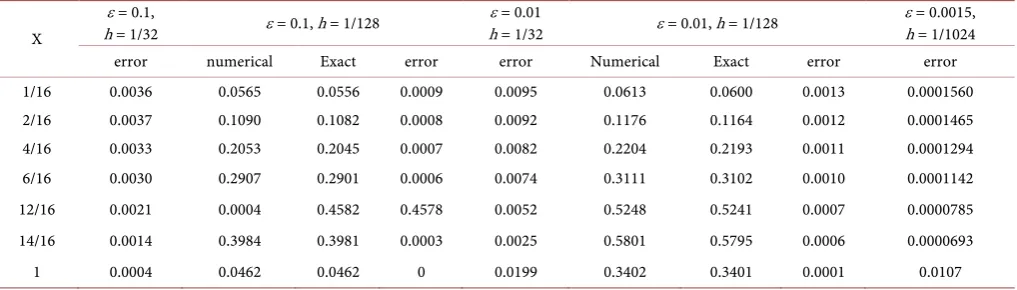
2ε .Comparison of the numerical results and point-wise errors is given in Table 1. It observed that
1) when h decreases (i.e. collocation number increases) for fixed ε the point-wise errors decrease;
2) when ε decreases for fixed h the point-wise errors increase; 3) when ε =0.0015, x→1 the errors are very large.
Example 2. Solve the following non-homogeneous equation:
(
)
cosπ 0 1
y py y x x
ε ′′ ′
− + + = < < (12)
with boundary conditions
( )
0( )
1 0y = y = ,
( )
21 2
0 π e
y′ =b +Aλ λ+ B −λ ,
( )
11 2
1 π e
y′ = − +b Aλ λ +λ B.
The analytical solution is given by
( )
cosπ sinπ exp( )
1 exp 2(
1)
y x =a x b+ x+A λx +B −λ −x (13)
where
(
)
(
)
2
2 2
2 2 2 2 2 2
π 1 π
,
π π 1 π π 1
p
a b
p p
ε
ε ε
+
= =
+ + + + ,
(
)
(
1 22)
(
1( )
1 2)
1 exp 1 exp
,
1 exp 1 exp
A a λ B a λ
λ λ λ λ
+ − +
= − =
− − − − .
And λ <1 0 and λ >2 0 are the real solutions of the characteristic equation 2
1 0
p
ελ λ
− + + = .
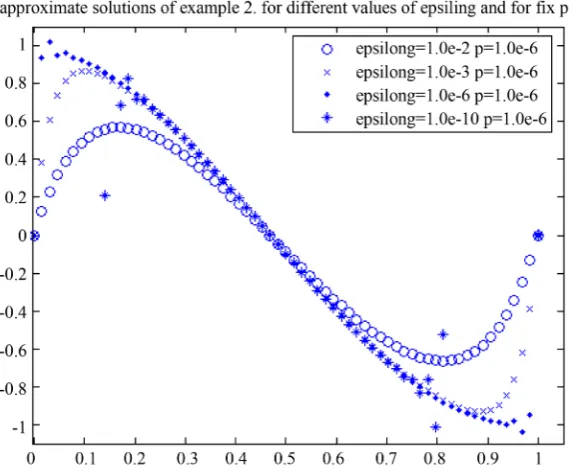
[image:4.595.45.554.562.707.2]Approximation solutions for different values of ε and for fixed p are given in Fig-ure 1. It observed that
Table 1. Example 1. Comparison of results and point-wise errors.
X
ε = 0.1,
h = 1/32 ε = 0.1, h = 1/128
ε = 0.01
h = 1/32 ε = 0.01, h = 1/128
ε = 0.0015,
h = 1/1024
error numerical Exact error error Numerical Exact error error
1/16 0.0036 0.0565 0.0556 0.0009 0.0095 0.0613 0.0600 0.0013 0.0001560
2/16 0.0037 0.1090 0.1082 0.0008 0.0092 0.1176 0.1164 0.0012 0.0001465
4/16 0.0033 0.2053 0.2045 0.0007 0.0082 0.2204 0.2193 0.0011 0.0001294
6/16 0.0030 0.2907 0.2901 0.0006 0.0074 0.3111 0.3102 0.0010 0.0001142
12/16 0.0021 0.0004 0.4582 0.4578 0.0052 0.5248 0.5241 0.0007 0.0000785
14/16 0.0014 0.3984 0.3981 0.0003 0.0025 0.5801 0.5795 0.0006 0.0000693
Figure 1. Approximation solutions of example 2 for different values of epsilon g and for fixed p.
1) when 2
10
ε= − and 3
10− , the approximation solutions are in good agreement
with exact solution; 2) when 6
10
ε = − and 10
10− , x→0 and x→1 the errors are
very large; 3) when ε decreases for fixed p the width of boundary layer becomes small and wave shape change more and more stiff at x=0 and x=1.
4. Conclusion
The numerical results show clearly the effect of ε on the boundary layer and the B-spline collocation method solving singular boundary value problems is relatively simple to collocate the solution at the mesh points. It is applicable technique and ap-proximates the exact solution very well.
Acknowledgements
The authors would like to thank the editor and the reviewers for their valuable com-ments and suggestions to improve the results of this paper. This work was supported by the Natural Science Foundation of Guangdong (No. 2015A030313827).
References
[1] Evrenosoglu, M. and Somali, S. (2008) Least Squares Methods for Solving Singularly Per-turbed Two-Point Boundary Value Problems Using Bezier Control Points. Applied
Ma-thematics Letters, 21, 1029-1032. http://dx.doi.org/10.1016/j.aml.2007.10.021
[2] Lin, B., Li, K.T. and Cheng, Z.X. (2009) B-Spline Solution of a Singularly Perturbed Boun-dary Value Problem Arising in Biology. Chaos, Solitons & Fractals, 42, 2934-2948.
http://dx.doi.org/10.1016/j.chaos.2009.04.036
mKdV-KS Equation. Chaos, Solitons & Fractals, 26, 1111-1118.
http://dx.doi.org/10.1016/j.chaos.2005.02.014
[4] Bigge, J. and Bohl, E. (1985) Deformations of the Bifurcation Diagram Due to Discretiza-tion. Mathematics of Computation, 45, 393-403.
http://dx.doi.org/10.1090/S0025-5718-1985-0804931-X
[5] De Boor, C. (1978) A Practical Guide to Splines. Springer-Verlag, Berlin.
http://dx.doi.org/10.1007/978-1-4612-6333-3
[6] Siddiqi, S.S. and Akram, G. (2007) Sextic Spline Solutions of Fifth Order Boundary Value Problems. Applied Mathematics Letters, 20, 591-597.
http://dx.doi.org/10.1016/j.aml.2006.06.012
[7] Caglar, H.N. and Caglar, S.H. (1997) The Numerical Solution of Fifth Order Boundary Value Problems with Sixth Degree B-Spline Functions. Applied Mathematics Letters, 12, 25-30. http://dx.doi.org/10.1016/S0893-9659(99)00052-X
[8] Cağlar, H., Özer, M. and Cağlar, N. (2008) The Numerical Solution of the One-Dimen- sional Heat Equation by Using Third Degree B-Spline Functions. Chaos, Solitons & Frac-tals, 38, 1197-1201.http://dx.doi.org/10.1016/j.chaos.2007.01.056
Submit or recommend next manuscript to SCIRP and we will provide best service for you:
Accepting pre-submission inquiries through Email, Facebook, LinkedIn, Twitter, etc. A wide selection of journals (inclusive of 9 subjects, more than 200 journals)
Providing 24-hour high-quality service User-friendly online submission system Fair and swift peer-review system
Efficient typesetting and proofreading procedure
Display of the result of downloads and visits, as well as the number of cited articles Maximum dissemination of your research work