en
t
re
v
ie
w
s
re
ports
de
p
o
si
te
d r
e
se
a
rch
refer
e
e
d
re
sear
ch
interacti
o
ns
inf
o
rmation
Pavla Gajduskova
*¶
, Antoine M Snijders
*
, Serena Kwek
*
,
Ritu Roydasgupta
†
, Jane Fridlyand
†‡
, Taku Tokuyasu
†
, Daniel Pinkel
†§
and
Donna G Albertson
*†§
Addresses: *Cancer Research Institute, University of California San Francisco, San Francisco, CA 94143-0808, USA. †Comprehensive Cancer
Center, University of California San Francisco, San Francisco, CA 94143-0808, USA. ‡Department of Epidemiology and Biostatistics, University
of California San Francisco, San Francisco, CA 94143-0808, USA. §Department of Laboratory Medicine, University of California San Francisco,
San Francisco, CA 94143-0808, USA. ¶Institute of Biophysics, Academy of Sciences of the Czech Republic, Královopolská, Brno, 612 65, Czech
Republic.
Correspondence: Donna G Albertson. Email: [email protected]
© 2007 Gajduskova et al.; licensee BioMed Central Ltd.
This is an open access article distributed under the terms of the Creative Commons Attribution License (http://creativecommons.org/licenses/by/2.0), which permits unrestricted use, distribution, and reproduction in any medium, provided the original work is properly cited.
Gene amplification in tumors
<p>Genomic analyses of human cells expressing dihydrofolate reductase provide insight into the effects of genome position on the propen-sity for a drug-resistance gene to amplify in human cells. </p>
Abstract
Background: Amplifications, regions of focal high-level copy number change, lead to overexpression of oncogenes or drug resistance genes in tumors. Their presence is often associated with poor prognosis; however, the use of amplification as a mechanism for overexpression of a particular gene in tumors varies. To investigate the influence of genome position on propensity to amplify, we integrated a mutant form of the gene encoding dihydrofolate reductase into different positions in the human genome, challenged cells with methotrexate and then studied the genomic alterations arising in drug resistant cells.
Results: We observed site-specific differences in methotrexate sensitivity, amplicon organization and amplification frequency. One site was uniquely associated with a significantly enhanced propensity to amplify and recurrent amplicon boundaries, possibly implicating a rare folate-sensitive fragile site in initiating amplification. Hierarchical clustering of gene expression patterns and subsequent gene enrichment analysis revealed two clusters differing significantly in expression of MYC target genes independent of integration site.
Conclusion: These studies suggest that genome context together with the particular challenges to genome stability experienced during the progression to cancer contribute to the propensity to amplify a specific oncogene or drug resistance gene, whereas the overall functional response to drug (or other) challenge may be independent of the genomic location of an oncogene.
Background
Genetic instability resulting in chromosomal level alterations is frequent in solid tumors, which display a wide variety of types and frequencies of these aberrations. Amplifications, regions of focal high level copy number change, are likely to
represent aberrations continuously under selection during tumor growth, since amplified DNA is unstable [1-4] and would otherwise disappear. They often harbor known onco-genes and thus are useful for identifying onco-genes or pathways
that foster tumor development. For ERBB2, amplification is
Published: 21 June 2007
Genome Biology 2007, 8:R120 (doi:10.1186/gb-2007-8-6-r120)
Received: 6 November 2006 Revised: 15 May 2007 Accepted: 21 June 2007 The electronic version of this article is the complete one and can be
the predominant method of its up-regulation and is the basis for FISH-based tests evaluating the ERBB2 status of breast tumors. On the other hand, change in DNA copy number is only one way to alter expression of a gene and expression of other oncogenes is much less tightly linked to DNA copy number or amplification. Other mechanisms for deregulation may be post-transcriptional, post-translational or involve alteration in expression of upstream genes. Tumor subtypes may also be distinguished by their propensity to amplify oncogenes, suggesting that the particular types of genomic instability present in a tumor are important determinants of how expression of an oncogene might be altered. Moreover, amplification is often associated with poor prognosis.
Amplification is a reiterative process, in which multiple cop-ies of a genome region are accumulated. Studcop-ies in model sys-tems indicate that amplification requires a DNA double strand break and progression through the cell cycle with this damaged DNA [5-9]. A role for genome context in promoting amplification has also been suggested, since introduction of a selectable gene into different genome positions in hamster and yeast cells resulted in site-dependent frequencies of resistant colonies following drug challenge [10,11]. Particular genome sequences prone to breakage have also been shown to set the boundaries of amplicons in rodent cells [6,12], further suggesting that genome position influences the propensity to amplify.
Common chromosomal fragile sites, of which there are approximately 90 in the human genome, have received the most attention as sites likely to promote amplification. Expression of fragile sites can be induced in cells in culture under conditions of replication stress and are visualized as gaps on metaphase chromosomes. Fragile sites can be divided into common sites (CFS), which are seen in all individuals and rare sites (RFS), which appear only in certain individuals. The sites are further distinguished by agents used to induce expression, which include aphidicolin, bromo-deoxyuridine (BrdU), 5-azacytidine and distamycin A. Folate stress caused by methotrexate exposure also induces a group of rare fragile sites. A small number of CFS have been molecularly identified and found to vary from hundreds of kilobases to over one megabase in size, to have some unusual sequence properties, but not to be conserved in sequence. Often they contain very large genes and are sites of viral integration in certain cancers [13]. Evidence supporting a role for fragile sites in promoting
amplification in human cancer is provided by the MET
onco-gene, which is amplified in esophageal adenocarcinoma. The gene lies within FRA7G, and the amplicon boundaries in tumors also lie within this site [14]. Nevertheless, for many amplicons there is no obvious involvement of common chro-mosomal fragile sites.
Gene amplification has been studied in vitro in a variety of
systems by selection for cells capable of growth in the pres-ence of antimetabolites. To investigate the role of genome
context on amplification in human cells, we chose methotrex-ate resistance as the model system, because clinical resistance to methotrexate targets a number of genes by a variety of mechanisms [15,16], thereby providing the opportunity to determine which types of aberration occur more frequently in different genetic backgrounds. We introduced a mutant copy
of DHFR, which confers greater resistance to methotrexate
than the endogenous wild-type DHFR, into random sites in
the genome of chromosomally stable HCT116+chr3 cells and precisely determined the site of single copy integrations in the human genome sequence. We isolated colonies resistant to folate deprivation caused by methotrexate and characterized these cells with respect to site specific response to drug chal-lenge. We used array comparative genomic hybridization (CGH) to identify and classify the types of genomic alterations
in the drug resistant cells, fluorescent in situ hybridization
(FISH) to study the organization and mechanism of amplicon formation, and expression profiling to investigate the func-tional consequences of amplification. These studies found site specific differences in the sensitivity to methotrexate, organi-zation of amplicons and propensity to amplify. On the other hand, gene expression patterns of drug resistant cells were independent of integration site, with two major clusters revealed by hierarchical clustering of the expression profiles.
The clusters differed significantly in expression of MYC target
genes. Translated to human disease, these studies suggest that genome context together with the particular challenges to genome stability experienced during the progression to cancer contribute to the propensity to amplify a specific onco-gene, whereas the overall functional response to drug (or other) challenge may be independent of the genomic location of an oncogene.
Results
Characteristics of clones with DHFR* integration
To study formation and structure of amplicons, we took advantage of the fact that resistance to methotrexate can be accomplished by a number of mechanisms, including copy
number gain or amplification of DHFR and loss or down
reg-ulation of the folate transporter, SLC19A1 on chromosome 21
[15,16]. We have shown previously that HCT116+chr3 cells have stable karyotypes and that methotrexate resistant
HCT116+chr3 cells frequently amplify DHFR on chromosome
5q [17]. The HCT116+chr3 cells are a variant of the mismatch repair deficient colorectal carcinoma cell line, HCT116; how-ever, they are mismatch repair proficient due to the wild-type
copy of MLH1 provided by an extra copy of chromosome 3p
and proximal 3q [17,18]. Because these cells carry two
wild-type copies of DHFR, we introduced a mutant form of DHFR
(L22F), which confers greater resistance to methotrexate than the wild-type (endogenous) gene, into HCT116+chr3
cells by retroviral infection. The DHFR (L22F) variant also
was fused to the gene encoding enhanced green fluorescence
protein (EGFP) and is referred to here as DHFR*. We isolated
comm
en
t
re
v
ie
w
s
re
ports
refer
e
e
d
re
sear
ch
de
p
o
si
te
d r
e
se
a
rch
interacti
o
ns
inf
o
rmation
positions in the genome and identified genome sequences
flanking the integration site of DHFR* using inverse PCR
(Additional data file 1). For further analysis, we selected only clones that were considered to have a single insertion of
DHFR* by inverse PCR (13 independent insertion sites, Table
1).
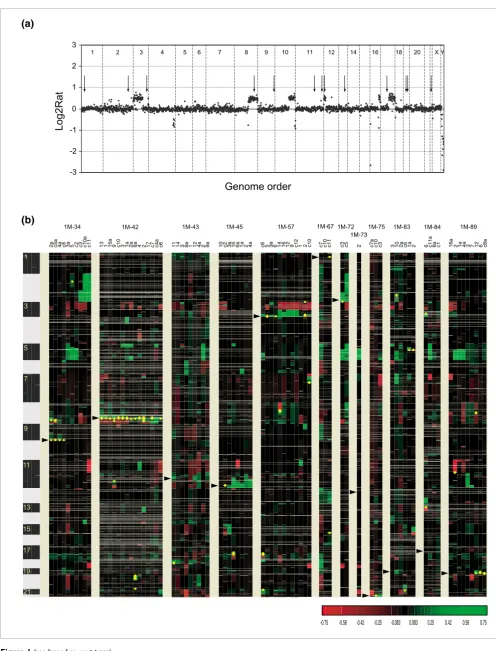
The individual insertion site clones were further character-ized with respect to genome copy number profiles and
expres-sion of DHFR*. All clones with the exception of two (1M-39
and 1M-43) showed the same chromosomal changes by array CGH as HCT116+chr3 cells (Figure 1a). Clone 1M-39 gained part of the q-arm of chromosome 4 (between RP11-18D7 and the q-telomere). Clone 1M-43 contained one additional copy of chromosome 22 and had lost the q-arm of chromosome 18.
We confirmed DHFR* expression in all clones by measuring
the expression level of the fused EGFP portion of the gene using quantitative RT-PCR. Expression levels, as percentage of GUSB expression, showed an approximately seven-fold variation (Table 1).
Frequency of DHFR* amplification at different genomic sites
Initially we measured the sensitivity of each clone to meth-otrexate by determining the methmeth-otrexate concentration that causes 50% reduction in cell number after six days exposure to varying concentrations of the drug (IC-50). The HCT116+chr3 cells showed the greatest sensitivity to the drug
(IC-50 = ~7.6 nM). Clones with DHFR* showed 1.9- to
9.2-fold increase in methotrexate resistance (IC-50 ranged from 14.1 to 70.1 nM; Table 1). To select methotrexate resistant col-onies, we exposed cells to a concentration of methotrexate that was three to four times the IC-50 for each integration
site. We note that because DHFR is the target of
methotrex-ate, exposure to the drug should inhibit synthesis of thymi-dylate and reduce levels of thymidine-based nucleotides. Such a reduction in nucleotide levels could cause DNA dam-age; however, the concentrations used here are not expected to do so [8]. Moreover, we determined that exposure of HCT116+chr3 cells to the range of concentrations used in these studies does not result in significant DNA damage as measured by the alkaline comet assay. The median number of resistant colonies obtained for each integration site is shown in Table 1.
Genomic copy number profiles were obtained for isolated resistant colonies that grew sufficiently well to be expanded to
5 × 10⁶ cells (Figure 1; Additional data file 2). The retention of
DHFR* at the original site of integration was confirmed in all
resistant colonies using inverse PCR, as shown for untreated clone 1M-89 and its resistant colonies in Additional data file 1. Clones from different integration sites could be separated into four groups: The first group contained only one clone, 1M-39, which did not form any resistant colonies. The second group (1M-73 and 1M-84) formed resistant colonies that did
not amplify DHFR*; however, partial gain of chromosome 5
and loss of chromosome 21 were among the copy number changes, suggesting that increased copies of the endogenous
DHFR locus and loss of SLC19A1 contributed to resistance. Clones in the third group (1M-43 and 1M-83) showed low level copy number changes (partial or whole chromosome
gains) of the region with DHFR* integration in at least one
[image:3.612.54.559.121.300.2]resistant colony. Finally, clones in the fourth group (1M-34, 1M-42, 1M-45, 1M-57, 1M-67 1M-72, 1M-75 and 1M-89) formed methotrexate resistant colonies with amplicons
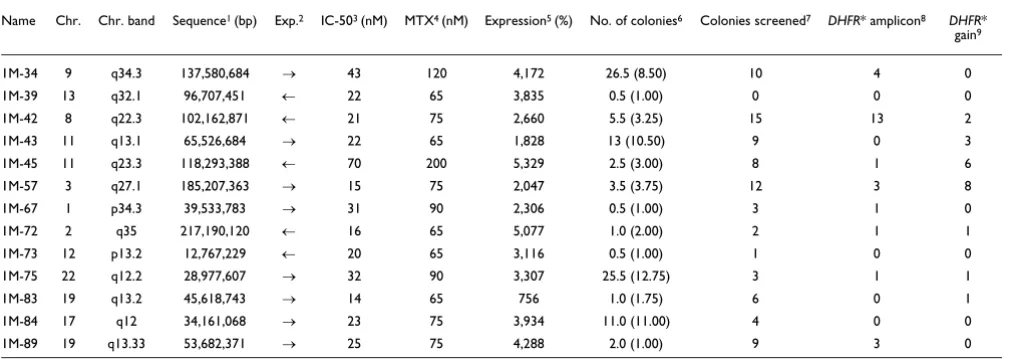
Table 1
Thirteen DHFR* insertion site clones and their response to methotrexate
Name Chr. Chr. band Sequence1 (bp) Exp.2 IC-503 (nM) MTX4 (nM) Expression5 (%) No. of colonies6 Colonies screened7 DHFR* amplicon8 DHFR*
gain9
1M-34 9 q34.3 137,580,684 → 43 120 4,172 26.5 (8.50) 10 4 0
1M-39 13 q32.1 96,707,451 ← 22 65 3,835 0.5 (1.00) 0 0 0
1M-42 8 q22.3 102,162,871 ← 21 75 2,660 5.5 (3.25) 15 13 2
1M-43 11 q13.1 65,526,684 → 22 65 1,828 13 (10.50) 9 0 3
1M-45 11 q23.3 118,293,388 ← 70 200 5,329 2.5 (3.00) 8 1 6
1M-57 3 q27.1 185,207,363 → 15 75 2,047 3.5 (3.75) 12 3 8
1M-67 1 p34.3 39,533,783 → 31 90 2,306 0.5 (1.00) 3 1 0
1M-72 2 q35 217,190,120 ← 16 65 5,077 1.0 (2.00) 2 1 1
1M-73 12 p13.2 12,767,229 ← 20 65 3,116 0.5 (1.00) 1 0 0
1M-75 22 q12.2 28,977,607 → 32 90 3,307 25.5 (12.75) 3 1 1
1M-83 19 q13.2 45,618,743 → 14 65 756 1.0 (1.75) 6 0 1
1M-84 17 q12 34,161,068 → 23 75 3,934 11.0 (11.00) 4 0 0
1M-89 19 q13.33 53,682,371 → 25 75 4,288 2.0 (1.00) 9 3 0
1Position in the human genome sequence (UCSC Genome Browser, May 2004 freeze). 2Exp., Direction of DHFR* integration in the genome; arrow to the right indicates that
the DHFR* coding sequence is integrated in the direction from the p-arm to the q-arm of the chromosome. 3Methotrexate concentration that causes 50% inhibition of the cell
growth after 6 days. 4Methotrexate (MTX) concentration used for selection of resistant colonies. 5Expression of DHFR* measured indirectly by quantitative RT-PCR (EGFP
expression normalized to GUSB expression, 2-(dCt) × 100). 6Median number (and interquartile range in parentheses) of resistant colonies per 10 cm plate after 28 days of
methotrexate treatment. 7Number of independent resistant colonies screened by array CGH. 8Resistant colonies with amplification of the DHFR* integration region. 9Resistant
Figure 1 (see legend on next page)
-3 -2 -1 0 1 2 3
3 4 5 6 7 8 9
2
1 10 11 12 14 16 18 20 XY
Genome order
Log2Rat
(b)
(a)
2a c5a 4a c8 3a 5 c2 c3 c10a c11
1M-34 1M-42 1M-43 1M-45 1M-57 1M-67 1M-72 1M-75 1M-83 1M-84 1M-89
1M-73
13 1 15a 9 c10 3 1a 2a 8a 4 2 17 c7 c4a c6 11 14 3 8a 1 12 4a 2 9a 10 c2 3a 16 6a 1a 2 4a c6 5 3a 6 14 16 12 9 c12 1 2 c10 c7 c10 c11 c3 c5 2 c7a c10 c3 3 10 2a c6 1a 2 6 c11a 8a c1 16a 2 1a 4a 3 7 12 6 c6a
-0.42 -0.25 -0.083 0.083 0.25 0.42 0.58 0.75 -0.58
-0.75 1
3
5
7
9
11
13
15
17
19
comm
en
t
re
v
ie
w
s
re
ports
refer
e
e
d
re
sear
ch
de
p
o
si
te
d r
e
se
a
rch
interacti
o
ns
inf
o
rmation
around the DHFR* integration site at varying frequencies
(Table 1).
Structure of amplicons and mechanisms of formation
Amplified DNA can be present in various forms, including double minutes, amplified regions on a chromosome, which may be cytogenetically visible as a homogeneously staining region (HSR), or distributed across the genome [19]. The organization of 13 amplicons from five integration sites was
investigated using FISH. All of the DHFR* amplicons in
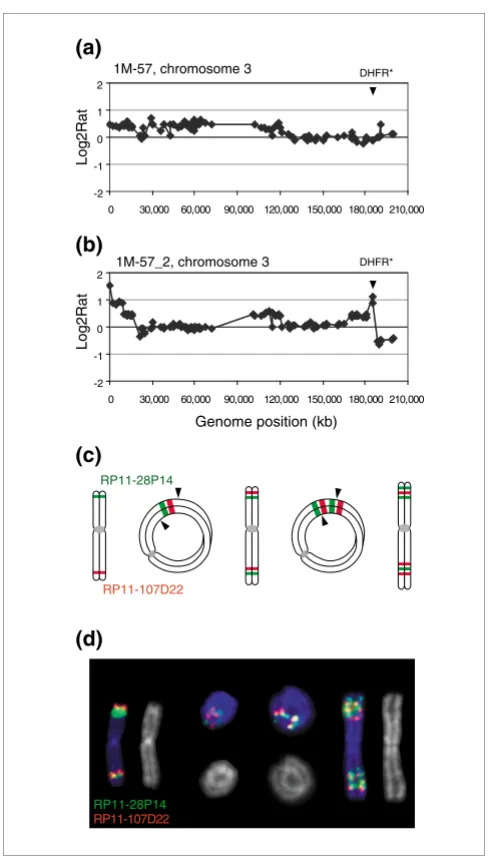
methotrexate resistant cells were present as amplified DNA on one or two chromosomes. In only one case (1M-89_6) was the amplified DNA present as double minutes in some cells rather than integrated into a chromosome. Hybridization of differentially labeled FISH probes from the amplicons revealed that eight of the chromosomal amplicons were organized as repeated units in inverted orientation (Figures 2 and 3). The organization of the remaining four was not deter-mined. In five cases there were also copy number losses distal
to DHFR* in the copy number profile. These observations are
consistent with amplification being initiated by a double
strand break distal to DHFR*, followed by
breakage-fusion-bridge cycles. In two independent methotrexate resistant
clones from 1M-57 in which DHFR* is integrated near the
chromosome 3q telomere, we observed amplicons containing
both the DHFR* integration site on 3q as well as
amplifica-tion of 3pter. Cytogenetic analysis revealed the presence of ring chromosomes and patterns of hybridization of FISH probes on linear and ring chromosomes consistent with amplification occurring by a breakage-fusion-bridge process involving fusion of 3pter and 3qter (Figure 2).
Translocation prior to amplification also appears to have occurred in four resistant colonies in which the amplicons were formed from two separate genomic regions that were co-amplified in inverted repeats. In the two examples shown in Figures 3a–f, hybridization of FISH probes is consistent with different regions of chromosome 8 being translocated onto
the chromosome carrying DHFR* followed by
co-amplifica-tion. In both cases distal parts of chromosome 8 were lost. Amplicons containing two or more separate regions of the same chromosome organized as inverted repeats were also observed (Figure 3g,h). On the other hand, the contiguous genomic region of amplified DNA on 8q in 1M-42_2 was
present on two different chromosomes (Figure 3i,j). In these cells ring chromosomes were also present.
Fragile sites and the propensity to amplify
The integration sites varied in the frequency with which
resistant clones amplified DHFR*. The 1M-42 integration site
was unique in that DHFR* was amplified in almost all
resist-ant clones (13/15), which was significresist-antly more frequent than any other site (test for homogeneity of binomial
propor-tion, p = 0.0002). Although the clones varied with respect to
the regions of chromosome 8 that were amplified together
with DHFR*, they all shared similar distal amplicon
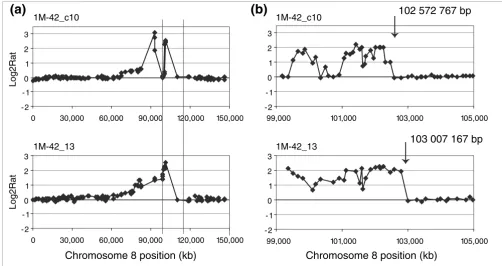
bounda-ries mapping between RP11-10G10 and CTD-2013D21. Higher resolution mapping on the 32K bacterial artificial chromosome (BAC) genome tiling path array [20] allowed the boundaries of five amplicons to be mapped more precisely (Figure 4). Four of the boundaries were positioned in a 1 Mb region between RP11-375I14 and RP11-97D1 (102322735 to 103386096 base-pairs (bp), May 2004 freeze, Additional data file 3).
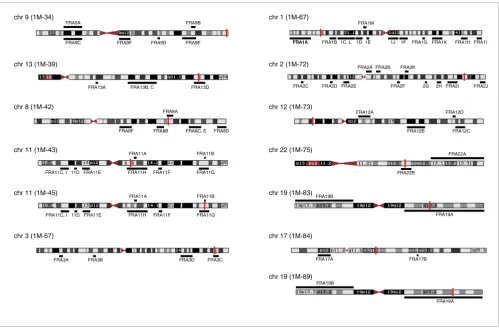
The consistent and recurrent location of amplicon boundaries to a limited region prompted us to investigate the possible involvement of fragile sites in initiating amplification. The
integration site of DHFR* at 102,162,871 bp on chromosome
8 is close to several fragile sites, including the aphidicolin sen-sitive sites FRA8B, FRA8C and FRA8D and the distamycin A inducible site, FRA8E. A rare folate sensitive site, FRA8A, has also been localized to 8q22.3 (101,600-106,200 kb). As cells are being deprived of folates by challenge with methotrexate, a potential role for the folate sensitive fragile site, FRA8A seemed possible. Therefore, we sought evidence of a meth-otrexate induced fragile site in the region of the recurrent boundary of the 1M-42 amplicons in HCT116+chr3 cells. Met-aphase spreads prepared from cells exposed to methotrexate for 24 hours were hybridized with FISH probes labeled with Cy3 (RP11-10G10) and fluoro-isothiocyanate (FITC; CTD-2013D21). Although rare metaphases were observed in which hybridization signals from these BACs appeared to bracket a fragile site, these experiments were inconclusive due to the very low frequency with which such patterns were seen.
Seven of the 1M-42 amplicons contained more than one peak, indicating that breakage does not occur exclusively at one site on chromosome 8. Another frequent site of copy number Parental DHFR* integration sites and copy number aberrations in methotrexate resistant colonies
Figure 1 (see previous page)
transition occurred in the 5.8 Mb region between RP11-27I15 and RP11-238H10, which is included within the cytogeneti-cally assigned position of the aphidicolin sensitive site FRA8B at 8q22.1. Nevertheless, we were unable to obtain evidence
that induction of aphidicolin fragile sites near DHFR* in
1M-42 cells promotes amplification, since exposure of 1M-1M-42 cells to aphidicolin for 24 hours prior to methotrexate challenge did not result in a statistically significant difference in the number of resistant clones compared to cells without aphidi-colin pretreatment.
Amplification and gene expression
A primary reason for amplification of a gene under perma-nent selection pressure is its increased expression resulting from the copy number increase. A question frequently asked about amplified genes is whether they are the driver gene for amplification or are they simply passengers. In our model
system, the presence of DHFR* significantly increases the
IC-50 for cells challenged with methotrexate, suggesting that it is the driver gene for its amplicons. Moreover, expression of
DHFR* as measured by quantitative RT-PCR is positively
correlated with copy number determined by array CGH (p <
0.05), providing further support for DHFR* as the driver
gene for amplification, regardless of site of integration. On the other hand, the amplicons always span regions much
larger than DHFR* and include other genes (Figure 5);
there-fore, we asked which neighboring genes in the amplicons are also up-regulated by copy number. Twelve methotrexate resistant colonies (four different integration sites) were selected for microarray analysis of gene expression at the mRNA level (Additional data file 4). All of the resistant clones
contained amplification of the region containing DHFR* and
some also co-amplified additional regions. Considering only genes located within the 12 regions of amplification and with measured expression levels in both amplified and
non-ampli-fied samples (n = 370; Additional data file 5), we found that
the mean expression levels of 139 were up-regulated when amplified compared to mean expression levels in samples
without amplification (log2 fold change > 0.8), with the
likeli-hood of up-regulation appearing to be independent of
prox-imity to DHFR*. An additional 13 genes were highly
expressed in methotrexate resistant samples without
amplifi-cation (log2 ratio > 0.8) and 9/13 also showed additional
modest increases in expression in samples with amplification. Although these genes could contribute to methotrexate resist-ance when amplified, we were unable to demonstrate any increase in IC-50 for methotrexate or growth advantage when two randomly selected amplified genes with positive
correla-tion of expression with copy number (POLR2K and
LOC157567) were overexpressed in HCT116+chr3 cells.
Simi-larly, overexpression of MYC, which was co-amplified with
DHFR* in a number of resistant cells from different
integra-tion sites, did not significantly alter the IC-50 for methotrex-ate or provide a proliferative advantage (data not shown).
Thus, DHFR* appears to be the major driver gene for
ampli-fication, although we cannot rule out that one or more of the Mechanism of DHFR* amplification involving a ring chromosome
[image:6.612.56.300.81.514.2]intermediate
Figure 2
Mechanism of DHFR* amplification involving a ring chromosome intermediate. (a) Chromosome 3 copy number profile in untreated 1M-57 cells. Shown are the log2 ratios ordered according to position on the May 2004 freeze of the human genome sequence. The copy number gain extending from 3pter to RP11-233L3 reflects the presence of the two normal copies of chromosome 3 and the additional piece of chromosome 3 in HCT116+chr3 cells. The DHFR* insertion site is indicated by the arrowhead. (b) Chromosome 3 copy number profile in methotrexate resistant colony 1M-57_2. Two regions of amplification are evident at 3pter and near the distal end of 3q. Copy number losses include material from 3p and 3qter distal to DHFR*. (c) Proposed mechanism leading to amplification of the region around DHFR*. The ends of chromosome 3 fuse to create a ring chromosome with loss of material distal to DHFR* on 3q. Breakage at positions indicated by the arrowheads at anaphase results in the metacentric chromosome that now carries duplication of juxtaposed 3p and 3q sequences. The process can be repeated to generate additional copies of the 3p and 3q sequences. (d) FISH with RP11-107D22 (red), which contains sequences flanking the DHFR* integration site on 3q and RP11-28P14 (green), which maps to 3p. Shown are pseudocolor images showing hybridization signals on the chromosomes and the corresponding DAPI image (gray).
-2 -1 0 1 2
0 30,000 60,000 90,000 120,000 150,000 180,000 210,000
(c)
(d)
(a)
(b)
Genome position (kb)
Log2Rat
1M-57, chromosome 3
Log2Rat
1M-57_2, chromosome 3
DHFR*
DHFR* -2
-1 0 1 2
0 30,000 60,000 90,000 120,000 150,000 180,000 210,000
RP11-28P14
RP11-28P14
RP11-107D22
comm
en
t
re
v
ie
w
s
re
ports
refer
e
e
d
re
sear
ch
de
p
o
si
te
d r
e
se
a
rch
interacti
o
ns
inf
o
rmation
genes included in the amplicon could also provide a signifi-cant contribution to methotrexate resistance.
Response to methotrexate is independent of site of integration and amplification
To investigate further the question of the contribution of co-amplified genes to the overall response of cells to methotrex-ate, we asked whether expression profiles of methotrexate resistant colonies varied with respect to integration site. Unsupervised hierarchical clustering of the 12 samples with amplification revealed two major clusters, indicating at least two responses to methotrexate. Samples did not separate
according to integration site, however, further suggesting that co-amplified genes do not contribute significantly to the over-all response to methotrexate.
One notable difference between clusters was the presence of
two samples with focal amplification of MYC in the right
clus-ter (1M-34_c5 and 1M-42_9; Figure 6a,b). In general,
sam-ples in the right cluster with or without amplification of MYC
showed higher MYC expression than those in the left cluster
(log2 ratio change between clusters = 1.42). Using the MYC
target gene database [21], we identified 380 human MYC
[image:7.612.56.557.88.419.2]tar-get genes among the 3,931 variably expressed genes used for Amplicons formed by two genomic regions, initially located on the different chromosomes
Figure 3
Amplicons formed by two genomic regions, initially located on the different chromosomes. Chromosome 8 and 9 copy number profiles showing amplification on (a) 9q and (b) 8q. (c) Organization of the amplicon. CTD-3145B15 (red) maps to the 9q telomere near the DHFR* insertion site and RP11-237F24 (green) to the region of amplification on chromosome 8 shown in (b). The chromosome 9 signals appear to flank the chromosome 8 material on this chromosome. Amplification of the region around DHFR* is indicated by the large hybridization signal from CTD-3145B15. The amplified DNA was determined to be located on chromosome 9 by hybridization of RP11-62H18 to 9pter (not shown). Thus, material from 9qter appears to be amplified in situ on chromosome 9 and additional copies of material from the chromosome 9 amplicon are present on a separate chromosome together with amplified DNA from chromosome 8. (d, e) Copy number profiles of chromosomes 19 (d) and 8 (e). (f) Organization of the amplicon. RP11-691H23 (red) maps near the DHFR* integration site on chromosome 19 and RP11-175H20 (green) is one of the clones from the amplicon on chromosome 8 shown in (e). The chromosome 19 signals appear to flank a number of copies of chromosome 8, which could be as many as eight copies, since the CGH log2 ratio = ~2. Two additional copies of RP11-691H23, mapping near DHFR* on chromosome 19, were also present on chromosome 19 (data not shown). Thus, amplified DNA near the DHFR* integration site is present and independently amplified on two chromosomes. (g, h) 1M-42_9 CGH profile (chromosome 8) showing the DHFR* amplicon and its organization as determined by FISH. BAC clone RP11-91O11 (red) maps near the DHFR* integration site and is co-amplified with the distal part of chromosome 8 (RP11-237F24, green). The chromosomal region between the two co-amplified regions was lost. (i, j) 1M-42_2 CGH profile (chromosome 8) and FISH analysis showing that the two regions of chromosome 8 were amplified as two independent amplicons on different chromosomes.
-2 -1 0 1 2
0 30,000 60,000 90,000 120,000 150,000 -2 -1 0 1 2
0 30,000 60,000 90,000 120,000 150,000 DHFR*
1M-34_c5a, chromosome 9 1M-34_c5a, chromosome 8
Log2Ratio
(c)
CTD-3145B15
CTD-3145B15 RP11-237F24
(b)
(a)
RP11-237F24
-2 -1 0 1 2
0 10,000 20,000 30,000 40,000 50,000 60,000 70,000 -2 -1 0 1 2 3
0 30,000 60,000 90,000 120,000 150,000 DHFR*
1M-89_12, chromosome 8
Genome position (kb)
Log2Ratio
Genome position (kb)
1M-89_12, chromosome 19
(d)
(e)
(f)
RP11-691H23 RP11-175H20
RP11-691H23 RP11-175H20
-2 -1 0 1 2 3
0 30,000 60,000 90,000 12,0000 150,000
-2 -1 0 1 2 3
0 30,000 60,000 90,000 120,000 150,000 RP11-91O11
RP11-237F24
RP11-91O11 RP11-237F24
RP11-91O11
RP11-237F24 RP11-91O11
RP11-237F24 DHFR*
DHFR*
Genome position (kb) Genome position (kb)
(g)
1M-42_9, chromosome 8(h)
(i)
1M-42_2, chromosome 8(j)
clustering. The median absolute log2 ratio change in expres-sion of these target genes in the right cluster compared to the left cluster was significantly higher than a similar comparison
using 1,000 sets of 380 randomly selected genes (p =
2.2e-16). Thus, differential expression of MYC and MYC target
genes is one of the distinguishing features of the overall
response of cells with amplified DHFR* to challenge with
methotrexate, irrespective of integration site.
Discussion
In order to investigate the effect of genome position on the propensity to amplify, we integrated a single copy of a mutant
form of DHFR fused to the gene encoding EGFP (DHFR*)
into different positions in the genome of HCT116+chr3 cells by retroviral transfer, challenged cells with methotrexate and then studied the genomic alterations arising in drug resistant
cells. Since DHFR* confers greater resistance to methotrexate
than the endogenous wild-type DHFR, we expected that
increased copy number of this gene would be found in the methotrexate resistant cells, rather than the endogenous gene. This expectation was met, as the majority of the resist-ant colonies contained either gains or amplifications of the
locus. Furthermore, DHFR* appeared to be the driver gene
for the copy number change, since DHFR* mRNA levels were
positively correlated with DHFR* copy number.
Neverthe-less, in this simple model system, we observed that at four
dif-ferent DHFR* insertion sites, approximately one-third of
neighboring genes were also up-regulated when amplified
along with DHFR*. It is unlikely that so many of these genes
mapping to four different random locations would also be driver genes for amplification. Moreover, expression profiling divided methotrexate resistant cells into two groups inde-pendent of integration site, suggesting that neighboring genes in the amplicons, even though up-regulated by copy number increases, did not play a major role in the drug resistant phe-notype. Taken together, these observations suggest that about one-third of genes can be regulated by copy number, which is consistent with global expression array profiling of tumors. If these four regions are representative of the genome as a whole, then a significant proportion of the amplified genes in tumors are also likely to be passengers. These observations have implications for studies of amplicons in tumors. Passen-ger genes will confound efforts to identify candidate onco-genes by expression analyses alone. For example, several candidate driver genes for amplification are thought to be present in amplicons in human cancers, including 8p11-p12 and 17q12 in breast cancer [22-24], 7p11.2 in glioblastoma [25] or 6p22 in bladder cancer [26], because gene expression is correlated with copy number. Further functional studies will be necessary to determine which overexpressed genes in the amplicons contribute to tumor development. On the other
hand, BIRC2 and YAP1, two genes present in a narrow
[image:8.612.55.557.86.352.2]ampli-con in oral squamous cell carcinomas [27], esophageal squa-Recurrent amplicon boundaries in 1M-42 methotrexate resistant clones and fragile sites
Figure 4
Recurrent amplicon boundaries in 1M-42 methotrexate resistant clones and fragile sites. (a) Chromosome 8 copy number profiles at approximately 1.4 Mb resolution. The vertical lines indicate the region from 99 to 105 Mb on chromosome 8 shown for (b) hybridization of these same DNAs to the 32K genome tiling array.
- 2 - 1 0 1 2 3
99,000 101,000 103,000 105,000 - 2
- 1 0 1 2 3
99,000 101,000 103,000 105,000 - 2
- 1 0 1 2 3
0 30,000 60,000 90,000 120,000 150,000
- 2 - 1 0 1 2 3
0 30,000 60,000 90,000 120,000 150,000
1M-42_c10 1M-42_c10
1M-42_13 1M-42_13
Chromosome 8 position (kb)
Chromosome 8 position (kb)
102 572 767 bp
103 007 167 bp
Log2Rat
Log2Rat
comm
en
t
re
v
ie
w
s
re
ports
refer
e
e
d
re
sear
ch
de
p
o
si
te
d r
e
se
a
rch
interacti
o
ns
inf
o
rmation
mous cell carcinoma [28], and lung [29], pancreatic [30], and hepatocellular carcinomas, have recently been shown to col-laboratively promote tumor formation in mice [31], indicat-ing that the extent of some tumor amplicons may be determined by selection for multiple neighboring collaborat-ing oncogenes.
A distinguishing feature of the expression profiles of
meth-otrexate resistant cells was the expression of MYC target
genes. Co-amplification of MYC irrespective of integration
site also suggests that it played a role in the response to
meth-otrexate; however, the exact mechanism whereby MYC
con-tributes to resistance is not known. It does not appear that
overexpression of MYC contributes to resistance simply by
promoting progression through the cell cycle or genome
instability, since overexpression of MYC prior to
methotrex-ate challenge did not enhance drug resistance or
prolifera-tion. On the other hand, up-regulation of MYC expression
may contribute to drug resistance by enhancing the capability of cells to evade checkpoints. For example, overexpression of
MYC abrogates a p53-dependent cell cycle arrest in REF52
cells exposed to N-(phosphonacetyl)-L-aspartate (PALA), an
inhibitor of pyrimidine nucleotide synthesis, allowing resist-ant cells to arise from these normally non-permissive cells [5].
[image:9.612.59.553.86.383.2]The numbers or types of genomic alterations in resistant cells varied among the integration sites; however, they were not related to either expression levels or sensitivity to methotrex-ate (Table 1). Previous studies in hamster cells, yeast and pro-tozoa have highlighted the association of genome position with the frequency of methotrexate resistant cells and repeated sequences have been implicated in promoting amplification in response to methotrexate challenge in yeast Expression of genes mapping to the amplicon from methotrexate resistant colony 1M-89_6
Figure 5
Expression of genes mapping to the amplicon from methotrexate resistant colony 1M-89_6. (a) Chromosome 19 copy number profile at approximately 1.4 Mb resolution (HumArray3.0) shows four discrete regions of amplification. (b) Chromosome 19 copy number profile from the 32K BAC genome tiling path array in the amplified region showing the four regions of amplification detected on the lower resolution array and an additional small region distal to the others. The regions, ranging in size from 0.2 to 1.2 Mb, were amplified together in some cells as double minutes, while in others the amplified DNA was integrated into different chromosomes and present as a homogeneously staining region. Both copies of chromosome 19 were retained without rearrangement. As all regions are included together on the double minutes, their formation may have occurred by joining of broken pieces of DNA subsequent to resolution of stalled replication forks [63]. (c) Expression levels of genes mapping to the five amplified regions plotted according to position on the human genome sequence. Expression levels are shown as the log2 ratios of the signal intensities after hybridization of Cy3 labeled cDNA from the methotrexate resistant colony and Cy5 labeled cDNA from the untreated parent 1M-89 as reference. Shown is the list of genes in genomic order that map to the amplified regions according to the RefSeq database [64]. Genes that are expressed in this cell line with or without exposure to methotrexate are labeled in black and expression levels denoted by black dots. Genes present on the array, but not expressed in untreated or resistant cells, are colored by dark gray and represented by dots of the same color with zero change in expression. Genes not present on the array are listed in the upper line in light gray. Genes with log2 fold change >0.8 are indicated with an asterisk.
- 2 - 1 0 1 2
47,000 49,000 51,000 53,000 55,000 57,000
-2 -1 0 1 2
0 10,000 20,000 30,000 40,000 50,000 60,000 70,000
47,600 47,800 48,000 48,200 48,400
-1 0 1 2 3 4
51,200 51,400 51,600 51,800
-1 0 1 2 3 4
57,200 57,400
-1 0 1 2 3 4
54,800 55,000 55,200 55,400
-1 0 1 2 3 4
52,800 53,000 53,200 53,400 53,600 53,800 54,000
-1 0 1 2 3 4
Chromosome 19
DHFR* Genome position (Kbp)
Copy number (Log2Rat)
(b) (a)
NAPAZNF541 GLTSCR1EHD2 GLTSCR2SEPW1 TPRX1CRX SULT2A1ELSPBP1 CABP5PLA2G4C LIG1 LOC374920 CARD8 ZNF114 FLJ32926EMP3 FLJ10922 SYNGR4KDELR1 GRIN2DGRWD1 KCNJ14PSCD2 DHFRSULT2B1 FAM83E SPACA4 RPL18SPHK2 DBPCA11 LOC126147FUT2 FLJ36070RASIP1 IZUMO1FUT1 FGF21BCAT2 DHRS10PLEKHA4
PGLYRP1 IGFL4 IGFL3 IGFL2 IGFL1 HIF3A PPP5C CCDC8 FLJ10781 LOC400707 CALM3 PTGIR GNG8 MGC15476 PRKD2
CEACAM1 CEACAM8 PSG3 PSG8 PSG1 PSG6 PSG7 PSG11 PSG2 PSG5 PSG4 PSG9 NOSIPPRRG2 RRASSR-A1IFR3 BCL2L12HRMT1L2 CPT1CTSKS AP2A1 FLJ22688MED25PT
OV1
PNKPAKT1S1TBC1D17IL4I1 NUP62ATF5SIGLEC1
1
VRK3 ZNF473 FLJ26850 SCRL ZNF615 ZNF614 ZNF432 ZNF616 (c)
Expression (Log2Rat)
Genome position (Kbp)
Copy number (Log2Rat)
Expression (Log2Rat) Expression (Log2Rat) Expression (Log2Rat) Expression (Log2Rat) DHFR*
and Leishmania [10,32,33]. Moreover, in Leishmania the response to methotrexate differs among species and it was possible to show that not only was position important, but also the nature of the gene under selection; that is, amplifica-tion of the gene conferring the higher level of resistance was observed more frequently in resistant cells regardless of
posi-tion [34] as observed here in human cells for DHFR*.
In spite of the fact that DHFR* confers greater resistance to
methotrexate, DHFR* was not altered in copy number in
resistant colonies from two integration sites, while no resist-ant colonies were recovered from a third integration site.
Expression levels of DHFR* in these integrants, measured
indirectly as EGFP expression, were in the middle of the range of expression levels for all integration sites as was sen-sitivity measured as IC-50. Furthermore, no variations in
DHFR* were detected by sequencing DNA amplified from
genomic DNA of the three clones. Thus, it appears that failure
to observe copy number changes of DHFR* in these
integration sites is related to genome position. We hypothe-size that these regions harbor genes that, if amplified, would cause cell cycle arrest or cell death. The 1M-73 integration site
is within <700 bp of CDKN1B (p27Kip1), a negative regulator
of the cell cycle [35]. Overexpression of CDKN1B due to copy
number increase of the locus could suppress growth and abrogate any advantage that might have been conferred by
increased copy number and expression of DHFR*. Similarly,
in 1M-84, DHFR* is integrated between PCGF2 (Mel-18) and
PSMB3, approximately 1 Mb proximal to ERBB2, a gene
fre-quently amplified in cancer. Nevertheless, PCGF2 and
PSMB3 are rarely amplified with ERBB2 [36] in tumors, and
PCGF2 has been reported to be a tumor suppressor [37,38]. Moreover, a recent report indicates that overexpression of
PCGF2 leads to down regulation of MYC and senescence in human fibroblasts [39]. Thus, it is likely that amplification of
DHFR* at the 1M-84 insertion site would be deleterious to
cells exposed to methotrexate due to proximity to, and thus
co-amplification with, PCGF2. These considerations suggest
that there may be selection pressure from neighboring growth inhibitory genes on the positions of amplicon boundaries.
Copy number changes involving DHFR* encompassed
regions much larger than the integrated DNA and, in most cases, the boundaries of the copy number changes were not recurrent as we had found previously for the endogenous locus on 5q13 [17]. At the 1M-42 integration site, however, we did observe a high frequency of amplification and recurrent copy number transitions or amplicon boundaries at RP11-238H10 and CTD-2013D21, which occurred in 50-70% of resistant colonies. A role for expression of fragile sites in promoting amplification and setting boundaries to the ampli-cons in tumor genomes was suggested more than 20 years ago [40,41]. Although several fragile sites, including the folate sensitive fragile site FRA8A, map near the 1M-42 integration site on 8q22 (Figure 7), we did not find that FRA8A was expressed at sufficiently high frequency in HCT116 cells for it to be mapped by FISH. Nevertheless, even low frequency expression of fragile sites in cells exposed to methotrexate leading to an increased rate of breakage in close proximity to
a DHFR* integration site could be sufficient to enhance the
probability of amplification and selection for cells with recur-rent amplicon boundaries. Thus, in the 1M-42 resistant colo-nies, induction of FRA8A by exposure to methotrexate could have provided a double-strand DNA break in close proximity
to DHFR*, which initiated amplification of this locus and
sub-sequent survival advantage of these cells in the presence of Expression profiling of 12 methotrexate resistant colonies with
amplification of DHFR*
Figure 6
Expression profiling of 12 methotrexate resistant colonies with
amplification of DHFR*. (a) Unsupervised hierarchical clustering (Pearson) of genes with variable expression across the data set (SD ≥ 0.3) and present in >75% of samples (3,931 genes). Methotrexate resistant colonies represent four different integration sites, indicated by the shaded boxes below the dendrogram. (b) Comparison of expression of MYC target genes in the two clusters. The median absolute log2 ratio change in expression of MYC target genes in the right cluster compared to the left cluster is significantly higher than a similar comparison using 1,000 sets of 380 randomly selected genes (p = 2.2e-16).
Random genes MYC genes
0
.0
0
.5
1
.0
1
.5
Abs
ol
ut
e l
og2 f
o
ld
c
hange
1M.42_1a
1M.42_2 1M.42_c
10
1M.34_2a
1M.57_2 1M.42_4 1M.34_4a 1M.34_c
5
a
1M.57_3a
1M.42_9
1M.89_6 1M.89_12
0.
2
0
.4
0.
6
0
.8
H
e
ig
h
t
Gr
o
u
p
comm
en
t
re
v
ie
w
s
re
ports
refer
e
e
d
re
sear
ch
de
p
o
si
te
d r
e
se
a
rch
interacti
o
ns
inf
o
rmation
methotrexate. Similarly, the association of folate deficiency with breast cancer suggests that in individuals who express folate sensitive fragile sites, breakage may occur at higher fre-quency at these loci, leading to chromosomal rearrangements promoting tumor development. We have, however, been una-ble to find evidence that fragile sites play a more general role in setting aberration boundaries in breast cancer (that is, using 1.5 Mb resolution array CGH data and looking over 5 Mb windows on chromosome arms, we found no evidence that fragile sites are associated with amplicon boundaries in breast tumors). We note that these analyses are currently hampered by the relatively low resolution mapping of both copy number aberration breakpoints and fragile sites. On the other hand, it is noteworthy that amplification was signifi-cantly more frequent at the 1M-42 integration site, suggesting that, if not fragile sites, then some, as yet undefined genomic features may have influenced the propensity to amplify. Sim-ilar genomic characteristics may also play a role in setting boundaries for amplicons in human tumors.
Conclusion
[image:11.612.56.555.85.416.2]Altered expression of genes can occur by a number of mecha-nisms, of which copy number change is only one. In the sim-ple system we have used to study genome position effects, cells are being challenged by a single agent and also offered a gene that can provide resistance, unlike the development of human tumors in which, as normal cells evolve to cancer cells, many barriers must be breached. There are many ways to alter signaling or checkpoint pathways, resulting in evasion of apoptosis and enhanced proliferation. Increasing expression of appropriate genes in these pathways by copy number changes is only one mechanism. The observations reported here on a model system translated to tumor development sug-gest that the nature of the gene under selection for growth advantage and genome context are, together, factors influenc-ing the propensity to amplify. In addition, it is likely that the nature of the challenges experienced by the nascent cancer cell (for example, folate deprivation), individual variation (for example, frequency of expression of various fragile sites), and the types of genomic instability that may be present also Positions of DHFR* integration sites and fragile sites
Figure 7
Positions of DHFR* integration sites and fragile sites. The DHFR* integration sites were mapped onto the genome using BLAT [46] and are shown as a red bar on the chromosome ideogram from the UCSC genome browser [45]. Common fragile sites are shown under the chromosome and are mapped according to positions reported in NCBI Entrez and the literature [65-77]. Rare folate sensitive fragile sites are shown above the chromosome. Note that the 1M-45DHFR* integration site mapped just proximal to FRA11B, another folate sensitive fragile site; however, no copy number transitions or amplicon boundaries mapped to this region. Since FRA11B is a RFS, it may not be expressed in HCT116.
chr 9 (1M-34)
chr 13 (1M-39)
FRA13A FRA13B, C FRA13D
chr 8 (1M-42)
FRA8A
FRA8B FRA8C, E FRA8D FRA8F
chr 11 (1M-43)
chr 11 (1M-45)
FRA11A
FRA11G FRA11B
FRA11H FRA11F FRA11E
FRA11C, I 11D
chr 3 (1M-57)
FRA3C FRA3D FRA3B
FRA3A
chr 1 (1M-67)
chr 2 (1M-72) FRA2A
FRA2I FRA2F
FRA2K
FRA2E FRA2C FRA2D
FRA2B
2G 2H FRA2J
chr 12 (1M-73)
FRA12A
FRA12C FRA12D
FRA12B
chr 22 (1M-75)
FRA22A
FRA22B
chr 19 (1M-83) FRA19B
FRA19A
chr 19 (1M-89) FRA19B
FRA19A chr 17 (1M-84)
FRA17A FRA17B FRA11A
FRA11G FRA11B
FRA11H FRA11F FRA11E
FRA11C, I 11D
1C, L FRA1A
FRA1A FRA1B
FRA1M
1D 1E 1J 1F FRA1G FRA1K FRA1HFRA1I FRA9C
FRA9A
FRA9D FRA9E FRA9F
influence which genes will be altered in expression by copy number changes.
Materials and methods
Cloning, cell culture, infectionThe human colorectal HCT116+chr3 cell line (gift from Dr CR Boland) was maintained in DME H-21 media supplemented with 10% fetal bovine serum, 1 × non-essential amino acids,
100 U/ml penicillin and 100 μg/ml Streptomycin, and 400
μg/ml G418 (Invitrogen, Carlsbad, CA, USA). The MMLV
vec-tor containing the double mutant dihydrofolate reductase gene (L22F, F31S) fused to the gene encoding EGFP was a generous gift from Dr J Bertino, Cancer Institute, New Jersey.
Using this vector, we prepared a DHFR variant with a single
mutation (L22F) fused to the EGFP gene, which we refer to as
DHFR*.
HCT116+chr3 genomic DNA was used as a template for
amplifying the DHFR promoter and 5' segment of the gene
(from -461 to +23 relative to the ATG translation initiation
codon [42]) with primers containing Esp3I restriction sites at
the 5' end. The 3'sequence of DHFR* (from +20 relative to the
ATG translation initiation codon) was PCR amplified from
the vector (primers also contained Esp3I restriction sites at
the 5' end). Both PCR products were cleaved with Esp3I
restriction enzyme, ligated together and cloned into pLPCX retroviral vector (Clontech, Mountain View, CA, USA), which
had been linearized by digestion with Nco and HindIII
restriction enzymes, resulting in removal of the CMV pro-moter from the vector.
To deliver DHFR* into HCT116+chr3 cells, we used the
Phoe-nix retroviral system (Orbigen, San Diego, CA, USA). HCT116+chr3 cells were sparsely seeded into 6-well plates
(103 cells per well) and infected with diluted viral particles the
following day (MOI < 0.1). Two days after infection, resistant
colonies were selected with puromycin (0.3 μg/ml media) for
seven days. Individual colonies were expanded as separate integration site clones (1M-XX) without puromycin.
To express POLR2K and LOC157567 in HCT116+chr3, cDNA
clones (MSH1010-74358 and MHS1010-9205152, respec-tively) were purchased from Open Biosystems (Huntsville, AL, USA). The coding sequence was amplified with primers
containing Esp3I restriction sites and cloned into the HindIII
site of the pLHCX vector (Clontech). To overexpress MYC, the
cDNA was cloned into the pBABE-hygro vector. The integrity of the constructs was verified by sequencing and the Phoenix retroviral system was used to deliver the genes into HCT116+chr3 cells. Two days after infection, cells were exposed to hygromycin (400 ng/ml media) for 7 days to select pools of cells with stable insertion.
Methotrexate sensitivity
Each clone was seeded into one 96-well plate (400 cells per well) leaving outer wells without cells, only with media. The next day different concentrations of methotrexate were added and cells were cultured for 72 hours. After three days, half of the media was replaced with fresh media with the same meth-otrexate concentration and cells cultured for another three days. Cells were washing gently with 1 × phosphate-buffered saline and plates were stored at 80°C prior to measuring cell proliferation using the CyQUANT Cell Proliferation Assay (Invitrogen, Carlsbad, CA, USA). The inhibition concentra-tion (IC-50) was calculated for each integraconcentra-tion site clone.
Selection of methotrexate resistant colonies
Individual clones were seeded into 6-well plates (103 cells per
well) and grown until the population reached approximately
5 × 10⁵ cells in each well. Then the cells from each well were
counted and seeded into 100 mm dishes (4 × 10⁵ cells per
dish). The next day different concentrations of methotrexate (3-4 × IC-50, depending on clone sensitivity to methotrexate) were added to the cells. The medium was replaced every third day and after four weeks one colony from each dish was picked into a 12-well plate and then expanded into T75 culture flasks. DNA was isolated from a quarter of the cells from each T75 flask, and another quarter of the cells was expanded for isolation of RNA, proteins and metaphase spreads. The remaining half of the cells was frozen in liquid nitrogen. In other experiments, colonies were selected as above and then fixed and stained with crystal violet after four weeks to determine the number of resistant colonies.
Induction of fragile sites
Individual clones were seeded into 6-well plates (103 cells per
well) and grown until the population reached approximately
106 cells in each well. Then the cells from each well were
counted and seeded into two 100 mm dishes (4 × 10⁵ cells per
dish). After six hours, fragile site expression was induced in one of the two dishes by adding aphidicolin (at a final
concen-tration of 0.15 μM). After 24 hours, aphidicolin was removed
and methotrexate was added to all dishes (same concentra-tion as used for selecconcentra-tion of methotrexate resistant colonies). Colonies were fixed and stained with crystal violet after four weeks. Folate sensitive fragile sites were induced by adding methotrexate to HCT116+chr3 cells (25 nM) or the 1M-42 clone (75 nM). After 24 hours, metaphase spreads were pre-pared according to standard protocols.
Inverse PCR
comm
en
t
re
v
ie
w
s
re
ports
refer
e
e
d
re
sear
ch
de
p
o
si
te
d r
e
se
a
rch
interacti
o
ns
inf
o
rmation
inversion PCR for each insertion site are provided in Addi-tional data file 1.
Array CGH
Array CGH was carried out as described previously [17]. Briefly, genomic DNA was isolated from one quarter of the cells from a T75 flask by incubation overnight at 55°C in 3 ml of 1 × TE buffer (pH 7.5) supplemented with 0.5 % SDS and
0.1 μg/μl proteinase K (Roche Diagnostics Corporation,
Roche Applied Science, Indianapolis, IN, USA), followed by ethanol precipitation after 24 hours. The DNA was dissolved
in 100 μl of H2O. Genomic DNA (600 ng) was labeled by
ran-dom priming to incorporate Cy3 or Cy5 dCTP in a 50 μl
reac-tion and the labeled test and reference DNAs together with
100 μg human Cot-1 DNA were hybridized for approximately
48 hours at 37°C to arrays of 2,464 BAC clones, each printed in triplicate (HumArray2.0, 3.1, UCSF Comprehensive Can-cer Center Microarray Core). Whole genome tiling path arrays containing 32,145 BAC clones [20] from the UCSF Comprehensive Cancer Center Microarray Core were used for more detailed analysis of some amplicons. A custom built CCD camera system was used to acquire 16 bit 1,024 × 1,024 pixel DAPI, Cy3 and Cy5 images [47,48]. Array data are avail-able in Additional data files 2 and 3 and at NCBI Gene Expres-sion Omnibus [49]. GSE6262 contains 95 CGH profiles of methotrexate resistant colonies and also untreated controls (HumArray2.0, 3.1). GSE6360 contains six CGH profiles (32K BAC tiling path array).
Expression microarrays
Test (20 μg) and reference (20 μg) RNA were reverse
tran-scribed in the presence of aminoallyl-dUTP followed by cou-pling with Cy3 or Cy5 dyes. The untreated integration site clone was used as the reference (Cy5 labeled cDNA) for each of the hybridizations with its respective resistant colonies (Cy3 labeled cDNA). Hybridizations were carried out on arrays of printed long oligonucleotides (70 mers) containing 21,000 elements (Operon V2.0 [50]). Array images were ana-lyzed using UCSF SPOT software [51]. Expression data were filtered to exclude all spots with foreground intensity below 500 units in the Cy3 or Cy5 channel and were subsequently
median normalized and log2 transformed. Data are available
in Additional data file 4 and at NCBI GEO (GSE6262).
Copy number analysis
Image and data analyses were carried out using UCSF SPOT [51] and SPROC software, as described previously [17]. We also made corrections for two well recognized sources of variation in ratios; the observed dependence on location of clones on the array (spatial or geometric variation) [52], and the dependence of ratios on GC content [53]. To correct for
geometrical dependence of the log2 ratios over the array, we
took advantage of the fact that neighboring loci in the genome are, for the most part, likely to have the same copy number [54]. We used backfitting [55] to iteratively obtain an
esti-mate of the systematic spatial variation of the log2 ratios over
the array, which was then subtracted from the original log2
ratios (Additional data file 6). The log2 ratios were corrected
for GC content using a loess method [56]. That these proce-dures result in a reduction in the apparent 'noise' in the ratio profiles, but do not alter the ratios, is clearly seen by a side-by-side comparison with the array data prior to correction (Figures B and C in Additional data file 6).
Elucidation of copy number changes specific to methotrexate resistant cells
Although the copy number differences between a methotrex-ate resistant and untremethotrex-ated HCT116 cell line are easily distin-guished by visible inspection of the copy number profiles, we developed an objective method to identify the copy number changes acquired by the drug resistant cells. Since the HCT116 cells have a small number of low level copy number changes (Figure 1a), it is necessary to exclude them from the analysis by 'subtracting out' aberrations that were present in the cell population prior to exposure to methotrexate. There-fore, to identify the copy number changes specific to meth-otrexate resistant cells, aberrations in the copy number
profile of the untreated cells for each DHFR* insertion site
After subtraction of the linear parent ratios, the array CGH
data were converted to log2 and analyzed as reported
previ-ously [58] using circular binary segmentation (CBS) [59] with default parameters to translate experimental intensity meas-urements into regions of equal copy number as implemented in the DNAcopy R/Bioconductor package [60]. Missing val-ues for BACs mapping within segmented regions of equal copy number were imputed by using the value of the corre-sponding segment. A few clones with missing values were located between segmented regions and their values were imputed using the maximum value of the two flanking seg-ments. Thus, each array clone was assigned a segment value referred to as its 'smoothed' value. The scaled median abso-lute deviation (MAD) of the difference between the observed and smoothed values was used to estimate the sample-spe-cific experimental variation. All the samples had MAD less than 0.15. Due to additional random noise introduced when subtracting the parent from the resistant colonies, the smoothed values from CBS were further 'merged' using the MergeLevels procedure [61]. In this process, segmental val-ues across the genome were merged to create a common set of copy number levels for each sample. The minimum and max-imum criteria used in MergeLevels were 0.05 and 0.5, respectively.
To identify single technical or biological outliers, such as high level amplifications, the presence of the outliers within a
seg-ment was allowed by assigning the original observed log2 ratio
to the clones for which the observed values were more than four tumor-specific MAD away from the smoothed values. The amplification status for a clone was then determined as described previously [58] by considering the width of the seg-ment to which that clone belonged (0, if an outlier) and a min-imum difference between the smoothed value of the clone (observed value, if an outlier) and the segment means of the neighboring segments. The clone was declared amplified if it belonged to the segment spanning less than 20 Mb and the minimum difference was greater than exp(-x3) where x is the final merged value for the clone.
Expression of genes in amplicons
For 12 samples the borders of the regions determined to have been amplified by array CGH were further refined by manu-ally incorporating additional data from the whole genome til-ing path arrays and FISH experiments. The border of each amplicon was set between the last not amplified BAC clone and the first amplified BAC clone. Expression probes were first filtered for ones with missing annotation, resulting in 19,777 probes, which were then mapped to the genome sequence. From these mapped probes, a list of expression probes included in all the amplicons within the samples was compiled manually, resulting in 685 expression probes, of which 370 provided measured expression in both amplified and non-amplified samples. To assess whether a gene was up-regulated when amplified, the mean expression levels were calculated in samples with and without amplification of the
gene. Mean expression levels with and without amplification
were compared and those with log2 fold change >0.8 were
considered to be up-regulated when amplified.
Analysis of clustering of gene expression driven by MYC target genes Genes with variable expression across the data set (standard
deviation (SD) ≥ 0.3) and present in >75% of samples were
identified and filtered for those with missing annotation. The samples were clustered based on the remaining clones (3,931) using the Pearson correlation distance metric and complete
linkage. Human 'MYC target' genes (1,287) were identified by
reference to the MYC database [21], and 380 were included in
the set of 3,931 variably expressed genes. The fold change in
expression of 380 MYC genes between the two sample
clus-ters was computed and compared to the median log2 fold
change for 1,000 selections of 380 random genes.
Quantitative RT-PCR
Real-time quantitative RT-PCR was performed on RNA iso-lated from methotrexate resistant colonies and untreated insertion site clones using Trizol reagent (Invitrogen) and treatment with DNase (Promega, Madison, WI, USA) as previously described [62] in the UCSF Comprehensive Cancer Center Genome Analysis Shared Resource Facility. Primers (forward, 5'CGTAAACGGCCACAAGTTCAG, reverse, 5'GGGTCAGCTTGCCGTAGGT) and probe (5'6FAM-CGCCCTCGCCCTCGC-BHQ_1) for EGFP were designed using GenScript Primer Design (GenScript Corp., Piscataway, NJ, USA). The ABI Assays-on-Demand were used to confirm
overexpression of MYC, POLR2K and LOC157567 genes (ABI,
Foster City, CA, USA).
Fluorescent in situ hybridization
Metaphase spreads were prepared from untreated insertion site clones and methotrexate resistant colonies at the time of RNA and protein isolation. Before hybridization slides were aged in 2 × SSC at 37°C for 30 minutes, dehydrated in an eth-anol series (70%, 80% and 96%) and incubated in 70% forma-mide, 2 × SSC at 72°C for 4 minutes to denature the DNA. Fluorescent probes were prepared by labeling 20 ng of BAC DNA by random priming to incorporate Cy3- or FITC-cou-pled dCTP. The labeled DNA was precipitated, pre-annealed
with 30 μg Cot-1 DNA and hybridized to metaphase spreads
for 48 hours at 37°C in a humid chamber. Slides were washed three times with 50% formamide, 2 × SSC at 45°C for 15 min-utes, 2 × SSC for 15 minmin-utes, 0.1 × SSC for 5 minmin-utes, coun-terstained with DAPI and mounted in Vectashield (Vector Labs, Burlingame, CA, USA).
Additional data files
The following additional data are available with the online version of this paper. Additional data file 1 shows the
map-ping and sequencing of DHFR* integration sites. Additional
data file 2 lists array CGH log2 ratio data on clones for