High-throughput sequencing to decipher the
genetic heterogeneity of deafness
Zippora Brownstein, Yoni Bhonker and Karen B Avraham
Brownstein et al. Genome Biology 2012, 13:245 http://genomebiology.com/2012/13/5/245 (29 May 2012)
CT CA GT GA TT AA CA CA GT TC CT GCAA GT AAA TC AG TA GT TC TC AA CA GGAA GT GAA G AGGT CA TC CT GA GGGGAA CA TT TA GCAA TA CC TA GA GA CA TT TC TGGAA CC AG GGGAA TG CT CC TA GT GGA TA GAA GGA GGC TA CAAA GAA TG AT CT CT CA GAA TG TC AG TG TG TGGA GA CA TC C TGCA GT AGA TG CT TG TGGCA GA GGGT AC TGGT TG TA CCCC AG TA TCC AT TC TT TC AT TC A CC TG TG TT AA TA CA TG CT CC AG TTTT GT ATTTTTTTTT AG CA TA AA GA TA AC ATTTT CC AT CT CC TT GT AT GT AAAAA TA GGA CT GT CA TG TGGGGC CA GT T TC TTTTTTTT CTT CC TC TG TC CT GC TG CTT GAAA CAAA GT GGA GCAA CAA GGA CG CC AT AA GCA CCA CA CC TG TC CTG AA TTG CTG TG AA TG AC AC CA GC TA AC TA CA ATG CA TTG TC TC AA CA TC CT A GA CA TA AT AAAAA GC CA TAAA TA TG TT TGA CC TT TGT AT CT TT G CC TTTT AT GTT GGGA TC TT AA TT AAAAA TT AC CT CT AC TG TC TC TG CA TG CT CAA CT TT TT ATAT TC GA CT TA AC CA TT AT TA AT CA GC AT CA TG CT G TGCA TT TCA CA TT AT AAAA GT TT AC AAA TC TC TT CT GC CT CT TT GT CT TT AG TA TGGT GT AC AC CA CAA CAA GAA CAAA CA GAA CA TT CA GGCA CA TT AT AT AT ACAAA GA TA G CA CA TA AG AG CT TG AT GT GT AAA CAA GGT GT GT AAA CAA GT TA GGAA GAA GT TT CC AA CT TT TT CT TGGC GA TC AA CT CC TT TC CT AAA TT TGA GC GAA G GA CA TA AT AAAAA GC CA TAAA TA TG TT TGA CC TT TGT AT CT TT G CC TTTT AT GTT GGGA TC TT AA TT AAAAA TT AC CT CT AC TG TC TC TG CA TG CT CAA CT TT TT ATAT TC GA CT TA AC CA TT AT TA AT CA GC AT CA TG CT G TGCA TT TCA CA TT AT AAAA GT TT AC AAA TC TC TT CT GC CT CT TT GT CT TT AG TA TGGT GT AC AC CA CAA CAA GAA CAAA CA GAA CA TT CA GGCA CA TT AT AT AT ACAAA GA TA G CA CA TA AG AG CT TG AT GT GT AAA CAA GGT GT GT AAA CAA GT TA GGAA GAA GT TT CC AA CT TT TT CT TGGC GA TC AA CT CC TT TC CT AAA TT TGA GC GAA G CT CA GT GA TT AA CA CA GT TC CT GCAA GT AAA TC AG TA GT TC TC AA CA GGAA GT GAA G AGGT CA TC CT GA GGGGAA CA TT TA GCAA TA CC TA GA GA CA TT TC TGGAA CC AG GGGAA TG CT CC TA GT GGA TA GAA GGA GGC TA CAAA GAA TG AT CT CT CA GAA TG TC AG TG TG TGGA GA CA TC C GGGAA TG CT CC TA GT GGA TA GAA GGA GGC TG TT AAA CC CA TT CCA CAA TGCA CA G GA CT GGAA CAAA GAA TG AT CT CT CA GAA TG TC AG TG TG TGGA GA CA TC C TGCA GT AGA TG CT TG TGGCA GA GGGT AC TGGT TG TA CCCC AG TA TCC AT TC TT TC AT TCC AA GG ACG CC AT AA GC CC TG TC CTG AA TTG CTG TG AA TG AC AC CA GC TA AC TA CA ATG CA TTG TC TC AA CA TC CT A GA CA TA AT AAAAA GC CA TAAA TA TG TT TGA CC TT TGT AT CT TT G CC TTTT AT GTT GGGA TC TT AA TT AAAAA TT AC CT CT AC TG TC TC TG CA TG CT CAA CT TT TT ATAT TC GA CT TA AC CA TT AT TA AT CA GC AT CA TG CT G TGCA TT TCA CA TT AT AAAA GT TT AC AAA TC TC TT CT GC CT CT TT GT CT TT AG TA TGGT GT AC AC CA CAA CAA GAA CAAA CA GAA CA TT CA GGCA CA TT AT AT AT ACAAA GA TA G CA CA TA AG AG CT TG AT GT GT AAA CAA GGT GT GT AAA CAA GT TA GGAA GAA GT TT CC AA CT TT TT CT TGGC GA TC AA CT CC TT TC CT AAA TT TGA GC GAA G CT CA GT GA TT AA CA CA GT TC CT GCAA GT AAA TC AG TA GT TC TC AA CA GGAA GT GAA G AGGT CA TC CT GA GGGGAA CA TT TA GCAA TA CC TA GA GA CA TT TC TGGAA CC AG GGGAA TG CT CC TA GT GGA TA GAA GGA GGC TA CAAA GAA TG AT CT CT CA GAA TG TC AG TG TG TGGA GA CA TC C TGCA GT AGA TG CT TG TGGCA GA GGGT AC TGGT TG TA CCCC AG TA TCC AT TC TT TC AT TC A CC TG TG TT AA TA CA TG CT CC AG TTTT GT ATTTTTTTTT AG CA TA AA GA TA AC ATTTT CC AT CT CC TT GT AT GT AAAAA TA GGA CT GT CA TG TGGGGC CA GT T TC TTTTTTTT CTT CC TC TG TC CT GC TG CTT GAAA CAAA GT GGA GCAA CAA GGA CG CC AT AA GCA CCA CA CC TG TC CTG AA TTG CTG TG AA TG AC AC CA GC TA AC TA CA ATG CA TTG TC TC AA CA TC CT A GA CA TA AT AAAAA GC CA TAAA TA TG TT TGA CC TT TGT AT CT TT G CC TTTT AT GTT GGGA TC TT AA TT AAAAA TT AC CT CT AC TG TC TC TG CA TG CT CAA CT TT TT ATAT TC GA CT TA AC CA TT AT TA AT CA GC AT CA TG CT G TGCA TT TCA CA TT AT AAAA GT TT AC AAA TC TC TT CT GC CT CT TT GT CT TT AG TA TGGT GT AC AC CA CAA CAA GAA CAAA CA GAA CA TT CA GGCA CA TT AT AT AT ACAAA GA TA G CA CA TA AG AG CT TG AT GT GT AAA CAA GGT GT GT AAA CAA GT TA GGAA GAA GT TT CC AA CT TT TT CT TGGC GA TC AA CT CC TT TC CT AAA TT TGA GC GAA G GA CA TA AT AAAAA GC CA TAAA TA TG TT TGA CC TT TGT AT CT TT G CC TTTT AT GTT GGGA TC TT AA TT AAAAA TT AC CT CT AC TG TC TC TG CA TG CT CAA CT TT TT ATAT TC GA CT TA AC CA TT AT TA AT CA GC AT CA TG CT G TGCA TT TCA CA TT AT AAAA GT TT AC AAA TC TC TT CT GC CT CT TT GT CT TT AG TA TGGT GT AC AC CA CAA CAA GAA CAAA CA GAA CA TT CA GGCA CA TT AT AT AT ACAAA GA TA G CA CA TA AG AG CT TG AT GT GT AAA CAA GGT GT GT AAA CAA GT TA GGAA GAA GT TT CC AA CT TT TT CT TGGC GA TC AA CT CC TT TC CT AAA TT TGA GC GAA G CT CA GT GA TT AA CA CA GT TC CT GCAA GT AAA TC AG TA GT TC TC AA CA GGAA GT GAA G AGGT CA TC CT GA GGGGAA CA TT TA GCAA TA CC TA GA GA CA TT TC TGGAA CC AG GGGAA TG CT CC TA GT GGA TA GAA GGA GGC TA CAAA GAA TG AT CT CT CA GAA TG TC AG TG TG TGGA GA CA TC C GGGAA TG CT CC TA GT GGA TA GAA GGA GGC TG TT AAA CC CA TT CCA CAA TGCA CA G GA CT GGAA CAAA GAA TG AT CT CT CA GAA TG TC AG TG TG TGGA GA CA TC C TGCA GT AGA TG CT TG TGGCA GA GGGT AC TGGT TG TA CCCC AG TA TCC AT TC TT TC AT TCC AA GG ACG CC AT AA GC CC TG TC CTG AA TTG CTG TG AA TG AC AC CA GC TA AC TA CA ATG CA TTG TC TC AA CA TC CT A GA CA TA AT AAAAA GC CA TAAA TA TG TT TGA CC TT TGT AT CT TT G CC TTTT AT GTT GGGA TC TT AA TT AAAAA TT AC CT CT AC TG TC TC TG CA TG CT CAA CT TT TT ATAT TC GA CT TA AC CA TT AT TA AT CA GC AT CA TG CT G TGCA TT TCA CA TT AT AAAA GT TT AC AAA TC TC TT CT GC CT CT TT GT CT TT AG TA TGGT GT AC AC CA CAA CAA GAA CAAA CA GAA CA TT CA GGCA CA TT AT AT AT ACAAA GA TA G CA CA TA AG AG CT TG AT GT GT AAA CAA GGT GT GT AAA CAA GT TA GGAA GAA GT TT CC AA CT TT TT CT TGGC GA TC AA CT CC TT TC CT AAA TT TGA GC GAA G CT CA GT GA TT AA CA CA GT TC CT GCAA GT AAA TC AG TA GT TC TC AA CA GGAA GT GAA G CT CA GT GA TT AA CA CA GT TC CT GCAA GT AAA TC AG TA GT TC TC AA CA GGAA GT GAA G GA CA TA AT AAAAA GC CA TAAA TA TG TT TGA CC TT TGT AT CT TT G GA CA TA AT AAAAA GC CA TAAA TA TG TT TGA CC TT TGT AT CT TT G GA CA TA AT AAAAA GC CA TAAA TA TG TT TGA CC TT TGT AT CT TT G GA CA TA AT AAAAA GC CA TAAA TA TG TT TGA CC TT TGT AT CT TT G GA CA TA AT AAAAA GC CA TAAA TA TG TT TGA CC TT TGT AT CT TT G GA CA TA AT AAAAA GC CA TAAA TA TG TT TGA CC TT TGT AT CT TT G AGGT CA TC CT GA GGGGAA CA TT TA GCAA TA CC TA GA GA CA TT TC TGGAA CC AG AGGT CA TC CT GA GGGGAA CA TT TA GCAA TA CC TA GA GA CA TT TC TGGAA CC AG CC TTTT AT GTT GGGA TC TT AA TT AAAAA TT AC CT CT AC TG TC TC TG CA TG CT CAA C CC TTTT AT GTT GGGA TC TT AA TT AAAAA TT AC CT CT AC TG TC TC TG CA TG CT CAA C CC TTTT AT GTT GGGA TC TT AA TT AAAAA TT AC CT CT AC TG TC TC TG CA TG CT CAA C CC TTTT AT GTT GGGA TC TT AA TT AAAAA TT AC CT CT AC TG TC TC TG CA TG CT CAA C CC TTTT AT GTT GGGA TC TT AA TT AAAAA TT AC CT CT AC TG TC TC TG CA TG CT CAA C CC TTTT AT GTT GGGA TC TT AA TT AAAAA TT AC CT CT AC TG TC TC TG CA TG CT CAA C GGGAA TG CT CC TA GT GGA TA GAA GGA GGC TA CAAA GAA TG AT CT CT CA GAA TG TC AG TG TG TGGA GA CA TC C GGGAA TG CT CC TA GT GGA TA GAA GGA GGC TA CAAA GAA TG AT CT CT CA GAA TG TC AG TG TG TGGA GA CA TC C TTTT AT ATT CG AC TT AA CC ATT ATT AA TC AG CA TC AT GC TG TTTT AT ATT CG AC TT AA CC ATT ATT AA TC AG CA TC AT GC TG TTTT AT ATT CG AC TT AA CC ATT ATT AA TC AG CA TC AT GC TG TTTT AT ATT CG AC TT AA CC ATT ATT AA TC AG CA TC AT GC TG TTTT AT ATT CG AC TT AA CC ATT ATT AA TC AG CA TC AT GC TG TTTT AT ATT CG AC TT AA CC ATT ATT AA TC AG CA TC AT GC TG TG CA GT AG AT GC TT GT GGCA GA GGGT AC TGGT TG TA CCCC AG TA TCC AT TC TT TC AT TC A TG CA GT AG AT GC TT GT GGCA GA GGGT AC TGGT TG TA CCCC AG TA TCC AT TC TT TC AT TC A TG CA TT TCA CA TT AT AAAA GT TT AC AAA TC TC TT CT GC CT CT TT GT CT TT AG TA TGGT GT TG CA TT TCA CA TT AT AAAA GT TT AC AAA TC TC TT CT GC CT CT TT GT CT TT AG TA TGGT GT TG CA TT TCA CA TT AT AAAA GT TT AC AAA TC TC TT CT GC CT CT TT GT CT TT AG TA TGGT GT TG CA TT TCA CA TT AT AAAA GT TT AC AAA TC TC TT CT GC CT CT TT GT CT TT AG TA TGGT GT TG CA TT TCA CA TT AT AAAA GT TT AC AAA TC TC TT CT GC CT CT TT GT CT TT AG TA TGGT GT TG CA TT TCA CA TT AT AAAA GT TT AC AAA TC TC TT CT GC CT CT TT GT CT TT AG TA TGGT GT CC TG TG TT AA TA CA TG CT CC AG TTTT GT ATTTTTTTTT AG CA TA AA CC TG TG TT AA TA CA TG CT CC AG TTTT GT ATTTTTTTTT AG CA TA AA AC AC CA CAA CAA GAA CAAA CA GAA CA TT CA GGCA CA TT AT AT AT A AC AC CA CAA CAA GAA CAAA CA GAA CA TT CA GGCA CA TT AT AT AT AC AC CA CAA CAA GAA CAAA CA GAA CA TT CA GGCA CA TT AT AT AT AC AC CA CAA CAA GAA CAAA CA GAA CA TT CA GGCA CA TT AT AT AT AC AC CA CAA CAA GAA CAAA CA GAA CA TT CA GGCA CA TT AT AT AT AC AC CA CAA CAA GAA CAAA CA GAA CA TT CA GGCA CA TT AT AT AT TAAAAA TA GGA CT GT CA TG TGGGGC CA GT T TAAAAA TA GGA CT GT CA TG TGGGGC CA GT T GA TA AC ATTTT CC AT CT CC TT GT AT GT GA TA AC ATTTT CC AT CT CC TT GT AT G CA CA TA AG AG CT TG AT GT GT AAA CAA GGT GT GT AAA CAA GT TA GGAA GAA GT TT C CA CA TA AG AG CT TG AT GT GT AAA CAA GGT GT GT AAA CAA GT TA GGAA GAA GT TT C CA CA TA AG AG CT TG AT GT GT AAA CAA GGT GT GT AAA CAA GT TA GGAA GAA GT TT C CA CA TA AG AG CT TG AT GT GT AAA CAA GGT GT GT AAA CAA GT TA GGAA GAA GT TT C CA CA TA AG AG CT TG AT GT GT AAA CAA GGT GT GT AAA CAA GT TA GGAA GAA GT TT C CA CA TA AG AG CT TG AT GT GT AAA CAA GGT GT GT AAA CAA GT TA GGAA GAA GT TT C AAA GT GGA GCAA CAA GGA CG CC AT AA GCA CCA CA AAA GT GGA GCAA CAA GGA CG CC AT AA GCA CCA CA GC GAA G CGAA G CGAA G CGAA G CGAA G CGAA G AAAAAAAAAAAA TG CTG TG CTG TTT CC T TTT CC TTT CC TTT CC TTT CC TTT CC TC TTTTTTTT C TC TTTTTTTT C TTTT CTT GG CG AT CA AC TC TTTT CTT GG CG AT CA AC TC TTTT CTT GG CG AT CA AC TC TTTT CTT GG CG AT CA AC TC TTTT CTT GG CG AT CA AC TC TTTT CTT GG CG AT CA AC TC GC G AAA GT CT CAA CA TC CT A GT CT CAA CA TC CT A AC AA TG CA TT G CA AT GC AT TG AGT TC TCAA CA GGAA GT GAA G AGT TC TCAA CA GGAA GT GAA G AGT TC TCAA CA GGAA GT GAA G AGT TC TCAA CA GGAA GT GAA G AGT TC TCAA CA GGAA GT GAA G AGT TC TCAA CA GGAA GT GAA G CA ACAAAAAAAAAAAA TC TTT G CTTT G GA CA TTT GA CA TTT GA CA TT GA CA TTT GA CA TT GA CA TT GCA TGC TC AA CT GCA TGC TC AA CT TC TC AG AA TG TC TC TC AG AA TG TC TC TC AG AA TG TC TC TC AG AA TG TC TC TC AG AA TG TC TC TC AG AA TG TC TC TC TC
TCATGA
T AT GA T AT GA AT GA T AT GA AT GA TTTT TG TC TT TA GT ATG GTG T TG TC TT TA GT ATG GTG T TAAATAAAAAATAAAAAAAAA T T AT AC AAA GA TA G AT AC AAA GA TA G TG TGGGGC CA GT T TG TGGGGC CA GT T GT GGGGC CA GT TG TGGGGC CA GT T GT GGGGC CA GT GT GGGGC CA GT AGGAA GAA GT TT CC AA CT AGGAA GAA GT TT CC AA CT GCAA CAA GGA CG CC AT AA GCAA CAA GGA CG CC AT AA GCAA CAA GGA CG CC AT AA GCAA CAA GGA CG CC AT AA GCAA CAA GGA CG CC AT AA GCAA CAA GGA CG CC AT AA T T GAA GT GAA G GAA GT GAA G GT AAA TCA GT AG TT CT CAA CA GG AAA TCA GT A GA CC TT TGT A AC CTTT GT CT CA GT G CT CA GT G GA TT AA CA CA GT TC C TT C GA CA TA AT GA CA TA AT GA CA TA A GA CA TA AT GA CA TA A GA CA TA AAT AAAAA GC CA TAA AC CAG AC CAG GGAA CT CA AC CT CA AC CT CA AC CT CA AC CT CA AC CT CA AC AT GC AGGT C AGGT C CA TC CT GA GGGGAA CA TT TA GCAA TA CC TA GA GA C AG GGGAA CA TT TA GCAA TA CC TA GA CC TTTT CC TTTT CC TTT CC TTTT CC TTT CC TTT TA TGT TGGGA TC TT AA TT AAAAA TT AC CT CT AC TG GA TC TT AA TT AAAAA TT AC CT CT AC GGGAA TG CT CC TA GT GGA TA GAA GGA GGC TA CAAA GAA TG AT CT CT CA GAA TG TC AG TG TG TGGA GA CA TC C GGGAA TG CT CC TA GT GGA TA GAA GGA GGC TA CAAA GAA TG AT CT CT CA GAA TG TC AG TG TG TGGA GA CA TC C GAA TGC TC CT AG TGGA TA GAA GGA GGC TA CAAA GAA TG AT CT CT CA CC TA GT GGA TA GAA GGA GGC TA CAAA ATA GA AG AAATTTTTA A G AGG CT AT AG AA GGA GGC TA CA ATA AA G C TTTT A TTTT A TTTT A TTTT A TTTT A TTTT ATATAT TC GA CT TA AC CAT TAT TA AT CA GC AT CAT GC TG AC TT AAC CA TT AT TA AT CAG CA TC AT G TAT TA TA TC CA TT CTTT CA TT CA TA TC CA TT CTTT CA TT CA TG C TG C AGT AGA TGC TT GT GGCA GA GGGT AC TGGT TGT AC CC CA GT AT AT GC TT GT GGCA GA GGGT AC TGGT TGT CT TG TG GC AG AG CCCCCCCCC TGC TT GT GGCA GA GGGT AC TGGT TG TA CC CC TC TT TA GT AT GGT GT CT TT AGT AT GGT GT CT TT AGT AT GGT GT CT TT AGT AT GGT GT CT TT AGT AT GGT GT CT TT AGT AT GGT GT TG C TG C TG C TG C TG C TG CA TT TCA CA TT AT AAAA GT TT AC AAA TC TC TT CT GC CT CT TT GT C CA TT AT AAAA GT TT AC AAA TC TC TT CT G TT AT AAAA GT TT AC CCCT TT AT AAAA GT TT AC AAA TC TC TT CT GC CT AA AA AA AA AA AA AG CA TAAA AG CA TAAA A A CC TG TG TT AA TA CA TG CT CC AG TTTT GT ATTTTTTTTT AG CA TA A CC TG TG TT AA TA CA TG CT CC AG TTTT GT ATTTTTTTTT AG CA TA A GT GTT AA TA CA TG CT CC AG TTTT GT ATTTTTTTTT AG C AT AC AT GC TC CA GTTTT GT ATT CT CC A TTTT TA TT TT AG TTTT GT ATTTTT TTT GT T GGGTGGGTT AA TA CA TG CT CC AG TTTT GT ATTTTTTTTT AG CA TA AA GGGT ATATAATATATATATATATATATATTTTATATAT TATATATATATATATATATATATAT TTTATATAATAA AC AC AC AC AC AC AC AC AC AC AC ACC CA CAA CAA GAA CAAA CA GAA CA TT CA GGCA CA TT AT AC AA GAA CAAA CA GAA CA TT CA G AA CAAA CA CCAAACAA CAA GAA CAAA CA GAA CA TT CA GGCA CA TT AT AT AC GT CA TG TGGGGC CA GT T GT CA TG TGGGGC CA GT T AAA TA GGA CT GT AAA TA GGA CT G GA TA AC ATTTT CC AT CT CC TT GT AT GT AAAAA TA GGA CT GT GA TA AC ATTTT CC AT CT CC TT GT AT GT AAAAA TA GGA CT G CAT TT TC CAT CT CC TT GT AT GT AA AA AT GGGGGGGGT AT CT CC TT GT AT GT AA AA ATA GG AC TG T TATAAT AC AA GT TA GGAA GAA GT TT C CAA GT TA GGAA GAA GT TT C CAA GT TA GGAA GAA GT TT C CAA GT TA GGAA GAA GT TT C CAA GT TA GGAA GAA GT TT C CAA GT TA GGAA GAA GT TT C TG TAAA CA TG TAAA CA GT AAA CA TG TAAA CA GT AAA CA GT AAA CAACACACCACC CA CA TA CA CA TA CA CA TA CA CA TA CA CA TA CA CA TAAA GA GC TT GA TGT GT AAA CAA GGT GT GT A CCAAA GA TG TG TA AA CAA GGT GT GT AAA CA AAAAT AA GA GC TT GA TGT GT AAA CAA GGT GT GT AAA CAA GT TA GG TC TTTTTTTT CTT CC TC TG TC CT GC TG CTT GAAA CAAA GT GGA GCAA CAA GGA CG CC AT AA GCA CCA CA TC TTTTTTTT CTT CC TC TG TC CT GC TG CTT GAAA CAAA GT GGA GCAA CAA GGA CG CC AT AA GCA CCA CA CT TC CT CT GT CC TGC TGC TT GAAA CAAA GT GGA G CT TC CT CT GT CC TGC TGC TT GAAA CAAA GT GGA TTTT CTT GG CG AT CA AC TC CTTT CC TA AA TTT GA GC GA AG TTTT CTT GG CG AT CA AC TC CTTT CC TA AA TTT GA GC GA AG TTTT CTT GG CG AT CA AC TC CTTT CC TA AA TTT GA GC GA AG TTTT CTT GG CG AT CA AC TC CTTT CC TA AA TTT GA GC GA AG TTTT CTT GG CG AT CA AC TC CTTT CC TA AA TTT GA GC GA AG TTTT CTT GG CG AT CA AC TC CTTT CC TA AA TTT GA GC GA AG AAAAAAGA CC TG TC CTG AA TTG CTG TG AA TG AC AC CA GC TA AC TA CA ATG CA TTG TC TC AA CA TC CT A CC TG TC CTG AA TTG CTG TG AA TG AC AC CA GC TA AC TA CA ATG CA TTG TC TC AA CA TC CT A CT CA GT GA TT AA CA CA GT TC CT GCAA GT AAA TC AG TA GT TC TC AA CA GGAA GT GAA G CT CA GT GA TT AA CA CA GT TC CT GCAA GT AAA TC AG TA GT TC TC AA CA GGAA GT GAA G CT CA GT GA TT AA CA CA GT TC CT GCAA GT AAA TC AG TA GT TC TC AA CA GGAA GT GAA G CT CA GT GA TT AA CA CA GT TC CT GCAA GT AAA TC AG TA GT TC TC AA CA GGAA GT GAA G CT CA GT GA TT AA CA CA GT TC CT GCAA GT AAA TC AG TA GT TC TC AA CA GGAA GT GAA G CT CA GT GA TT AA CA CA GT TC CT GCAA GT AAA TC AG TA GT TC TC AA CA GGAA GT GAA G GA CA TA AT AAAAA GC CA TAAA TA TG TT TGA CC TT TGT AT CT TT G GA CA TA AT AAAAA GC CA TAAA TA TG TT TGA CC TT TGT AT CT TT G AGGT CA TC CT GA GGGGAA CA TT TA GCAA TA CC TA GA GA CA TT T AGGT CA TC CT GA GGGGAA CA TT TA GCAA TA CC TA GA GA CA TT T AGGT CA TC CT GA GGGGAA CA TT TA GCAA TA CC TA GA GA CA TT AGGT CA TC CT GA GGGGAA CA TT TA GCAA TA CC TA GA GA CA TT T AGGT CA TC CT GA GGGGAA CA TT TA GCAA TA CC TA GA GA CA TT AGGT CA TC CT GA GGGGAA CA TT TA GCAA TA CC TA GA GA CA TT CC TTTT AT GTT GGGA TC TT AA TT AAAAA TT AC CT CT AC TG TC TC TG CA TG CT CAA CT CC TTTT AT GTT GGGA TC TT AA TT AAAAA TT AC CT CT AC TG TC TC TG CA TG CT CAA CT GGGAA TGC TC CT AGT GGA TA GAA GGA GGC TA CAAA GAA TGA TC TC TCA GAA TGT C GGGAA TGC TC CT AGT GGA TA GAA GGA GGC TA CAAA GAA TGA TC TC TCA GAA TGT C GGGAA TGC TC CT AGT GGA TA GAA GGA GGC TA CAAA GAA TGA TC TC TCA GAA TGT C GGGAA TGC TC CT AGT GGA TA GAA GGA GGC TA CAAA GAA TGA TC TC TCA GAA TGT C GGGAA TGC TC CT AGT GGA TA GAA GGA GGC TA CAAA GAA TGA TC TC TCA GAA TGT C GGGAA TGC TC CT AGT GGA TA GAA GGA GGC TA CAAA GAA TGA TC TC TCA GAA TGT C CA TT CC AC AA TG CA CA G CA TT CC AC AA TG CA CA G TTT G TTT G TT G TTT G TT G TT G CT GT TAA CT GTTT G CC TT GT GGA GA CA TC C GT GGA GA CA TC C GT CT CT GCA TGC T GT CT CT GCA TGC T GT CT CT GCA TGC GT CT CT GCA TGC T GT CT CT GCA TGC GT CT CT GCA TGC AG AA TG TC AG ATT AC CT CT T CCC AG TA TCC AT TC TT TC AT TCC AA GG ACG CC AT AA GC CCC AG TA TCC AT TC TT TC AT TCC AA GG ACG CC AT AA GC TGTGTGTGTGTG TA CT GGT TG CT GGT TA CT G CA AT C CA GCA T TTTT CA ATG CA TTG TC TC AA CA TC CT A CA ATG CA TTG TC TC AA CA TC CT A CT CT TT GT CT TT AGT AT GGT GT CT CT TT GT CT TT AGT AT GGT GT CT CT TT GT CT TT AGT AT GGT GT CT CT TT GT CT TT AGT AT GGT GT CT CT TT GT CT TT AGT AT GGT GT CT CT TT GT CT TT AGT AT GGT GT CC AG CT A AG CT A AT CT CT T CT CT T AT CTTT G AT CTTT G AT TATATA AT TATATA AT TATATA AT TATATA AT TATATA AT TATATA GA CC TT GA CC T TT CA GG TC AG TG TC TC TG CA TG CTC AA CT GT CT CT GCA TGC TC AA CT CAA GT TA GGAA GAA GT TT C CAA GT TA GGAA GAA GT TT C CAA GT TA GGAA GAA GT TT C CAA GT TA GGAA GAA GT TT C CAA GT TA GGAA GAA GT TT C CAA GT TA GGAA GAA GT TT C TA CC T TA CC GT GT GT TG TG C TG TG AA G AA GAG AA GAGAG GCA TC GCA TC TTT GA TTT G T TTT TC TT TGT CT TT AGT AT GGT GT TC TT TGT CT TT AGT AT GGT GT CC AT TC CA CAA TGCA CA G CC AT TC CA CAA TGCA CA G CC AT TC CA CAA TGCA CA G CC AT TC CA CAA TGCA CA G CC AT TC CA CAA TGCA CA G CC AT TC CA CAA TGCA CA G TC TTC TC
TTCTGT
Introduction
Th e identifi cation of genes responsible for medically important traits is a major challenge in human genetics. Th is is particularly so for a disease with heterogenic pathology, such as hearing loss (HL). Hearing impairment is the most common sensory defect, aff ecting approxi-mately one in 500 newborns and 4% of people younger than 45 years [1], reaching 50% by age 80 [2]. It is esti-mated that 278 million people worldwide suff er from HL [3,4], aff ecting child development, education, social inte-gra tion, and the quality of life of the aff ected individual, with a substantial impact on public health. Th is high preva lence, combined with the striking genetic hetero-geneity of deafness, has made this Mendelian disease a major challenge in terms of discovering its cause and deciphering the mechanisms underlying it. Sixty-three genes encoding proteins with a broad range of functions are known to be involved in HL. Many more are expected to be discovered, as over 100 loci have been mapped without the corresponding gene identifi ed. However, because of the technological limitations in clinical diag-nostics, mainly resulting from the large size of many genes and the high cost of Sanger sequencing, many
hearing-impaired individuals with familial HL do not know the genetic cause of their HL. Owing to the complexity of the auditory apparatus and the vast genetic heterogeneity of HL, high-throughput sequencing, also known as massively parallel sequencing or next-genera-tion sequencing (NGS), is the ideal tool to address this challenge (Box 1).
NGS has already had an important impact on both research and clinical diagnosis in other diseases, such as breast cancer [5], intractable infl ammatory bowel disease [6] and Kabuki syndrome [7], as it enables screening of a large number of genes in one test. In addition, this approach does not require the collection of DNA samples from large aff ected families that previous linkage-based approaches to disease gene identifi cation did. Th e recent advances in molecular biology and genomics have raised hopes of elucidating the complex network of auditory genes, which is the fi rst step toward implementing a cure for HL. Th ese advances highlight the need for additional discovery and characterization of all genes involved in HL. Here, we focus on the impact of genomics, and in particular NGS, on the progress in gene discovery for inherited deafness.
Unraveling the genetic complexity of HL by high-throughput strategies
At least 60% of HL is regarded as having a genetic cause, as many of the environmental causes, such as ototoxic drugs, mumps or rubella, have been eliminated by modern medicine. Most environmental causes, including exposure to ototoxic drugs, exposure to rubella during gestation, trauma and excessive noise, are considered to have a genetic basis as well, as both the onset and severity of acquired hearing impairment may depend on the genetic background of the individual. Approximately 70% of all genetic HL is non-syndromic (NSHL), with half predicted to be monogenic. NSHL is inherited in a recessive mode in approximately 80% of cases, in a dominant mode in approximately 20%, and is either X-linked or mitochondrial in origin in 2 to 3%.
Mutations in over 60 genes have been found to disrupt auditory function, resulting in similar or diff erent phenotypes, according to the function, location, pathway Abstract
Identifying genes causing non-syndromic hearing loss has been challenging using traditional approaches. We describe the impact that high-throughput sequencing approaches are having in discovery of genes related to hearing loss and the implications for clinical diagnosis.
KeywordsGenomics, deep sequencing, massive
parallel sequencing, next-generation sequencing, exome sequencing, homozygosity mapping, hearing loss
© 2010 BioMed Central Ltd
High-throughput sequencing to decipher the
genetic heterogeneity of deafness
Zippora Brownstein, Yoni Bhonker and Karen B Avraham*
R E V I E W
*Correspondence: [email protected]
Department of Human Molecular Genetics and Biochemistry, Sackler Faculty of Medicine, Tel Aviv University, Tel Aviv 69978, Israel
or network of proteins they encode [8]. Th ese genes encode a variety of proteins with a broad range of func-tions, including gap junctions (connexin 26 and connexin 32), transcription factors (POU4F3, POU3F4, TFCP2L3 and PAX3), ion channels (KCNQ1, KCNE1 and KCNQ4), molecular motors (myosin VI, myosin VIIA, SLC26A4 and prestin), extracellular proteins (alpha-tectorin, oto-ancorin and COL11A2) and structural proteins (otoferlin and diaphanous 1). Th eir expression pattern varies between proteins that are exclusively expressed in the mammalian inner ear (α-tectorin, cochlin and EYA4), to proteins that are expressed in several tissues (myosin VI, POU4F3 and whirlin), but surprisingly have mostly only been found to be involved in HL (reviewed in [9]). Th e many proteins required for proper functioning of the inner ear correlate with the complex structure of its six organs: the cochlea, responsible for hearing, and the saccule, utricle and the three semicircular canals, which control balance and spatial orientation. Th e development, diff erentiation and maintenance of this complex machinery explain the involvement of such a large number of genes with mutations leading to HL. Distinct proteins are responsible for the function of each compartment of the inner ear, as well as for the physiological and mechanistic aspects.
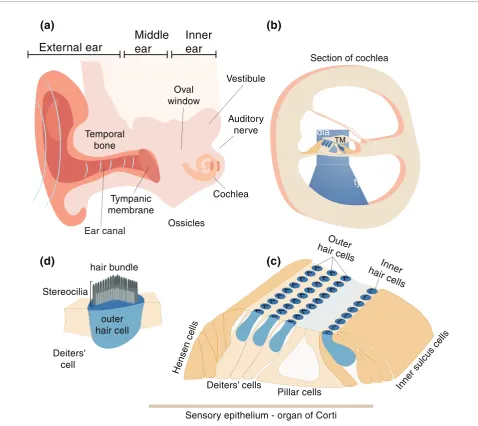
Th e ear itself is divided into three compartments: the outer, the middle and the inner ear (Figure 1; reviewed in [10]). Th e inner ear includes both the organ of hearing (cochlea) and the vestibular sense organs. Th e cochlea is a coiled snail-shaped organ in the temporal bone. Th e organ of Corti, containing hair cells and supporting cells, lies on the basilar membrane that separates the scala media from scala tympani. When sound strikes the tympanic membrane, the movement transferred by the footplate of the stapes presses it into the cochlear duct through the oval window, causing the fl uids to move through the cochlear duct, fl owing against the receptor cells (hair cells) of the organ of Corti. Th e hair cells in the organ of Corti are composed of an inner row and three outer rows of hair cells. Th e apical side of the hair cells facing the scala media contains the stereocilia, actin-rich projections with a typical staircase arrangement, con-nected with lateral and tip links. On top of the hair cells lies the tectorial membrane, a collagen-rich extracellular matrix. Th e vibrations caused by sound activate mechano-electrical transduction by triggering the hair cells via defl ection of the hair bundles and enabling potassium infl ux through the apical transduction channels that depolarizes the cells. A multitude of proteins are involved in every step of the hearing process, and a mutation in any one of the genes that encode these proteins can have dire consequences on hearing.
Th e gene most frequently involved in HL is GJB2, encoding the connexin 26 protein, with more than 100 dominant or recessive deafness-causing mutations detected in this small gene of only one coding exon of approxi-mately 1 kb. Other frequently mutated genes include SLC26A4, MYO15A, OTOF, CDH23 and TMC1, with over 20 mutations reported to be involved in HL for each of these genes. A comprehensive list of genes implicated in HL can be found at the deafness variation database [11]. Th e number of mutations in the other ‘deafness’ genes is lower and most of them have been reported in consanguineous families [12]. However, unlike GJB2, many of these genes are large, with dozens of exons, such as MYO15A and CDH23, which have 65 and 68 exons, respectively. Th e number of genes and mutations found are most likely underestimated as a result of the pre-NGS era strategies used for gene identifi cation. For example,
large genes are not routinely completely analyzed using Sanger sequencing, as it is too time- and cost-consuming to be performed as part of routine clinical genetic diagnosis. Even for research purposes, the number of large genes involved in HL has made complete sequen-cing on a regular basis impractical, unless there were strong reasons to expect a mutation because of shared ethnic origin or phenotype. For the same practical reasons, the methods used for detection of known mutations (mutation-specifi c assays) have also led to an
Box 1
The development of Sanger sequencing in 1977 [55] marked a turning point in the molecular genetics revolution, and this was followed by the implementation of the polymerase chain reaction 6 years later [56]. These landmarks paved the way for the Human Genome Project, completed in 2001 [57]. The fi eld of genomics and its technological capacity have evolved at an extremely rapid pace since, leading to the development of high-throughput methods, including next-generation sequencing (NGS), also called massively parallel sequencing or deep sequencing. These advanced technologies, besides enhancing the ability to identify human disease mutations, have yielded a fl ood of genomic data. The increased wealth of genomic information has accelerated our understanding of complex biological processes and has provided broad clinical implications, but it has also required the development of advanced
bioinformatics tools to deal with these massive amounts of data. NGS can produce over 10,000 times more data than the Sanger sequencing method. Whereas Sanger sequencing yields a 24-hour output of 120,000 bp for the cost of $4,000 per Mb sequenced [23], the output of a single NGS machine is larger than 30 Gb in 24 hours and costs less than $2 per Mb. The 3.2 Gb in a single human genome can therefore be sequenced in 1 day at a fairly low cost relative to what it would take with Sanger sequencing - up to 73 years at a cost of $200,000 [58]. We are rapidly reaching the long-held dream of the $1,000 genome in less than a day, although the subsequent bioinformatic analysis is becoming the new bottleneck for rapid genome-based diagnosis.
Brownstein et al. Genome Biology 2012, 13:245 http://genomebiology.com/2012/13/5/245
underestimation of the numbers of mutations in preva-lent deafness genes, such as GJB2 and SLC26A4. In addition, some genes have been found to be associated with deafness in a particular population or one family, discouraging others from searching for mutations in these genes (if mutations in a particular gene were only found infrequently, scientists were less inclined to want to screen for mutations in this gene).
Although families with HL with diff erent modes of inheritance are found all over the world, the majority of families reported with recessive deafness come from
countries where consanguineous families are common, including North Africa, through the Middle East to India and Pakistan. Th e deafness loci for these consanguineous families were easily mapped by linkage analysis and homozygosity mapping, allowing locus identifi cation using only a large single family. Dominant HL, in con-trast, was mainly identifi ed in families originating in Europe, North America and Australia [12].
[image:4.612.67.546.89.515.2]Before the high-throughput technology era, disease locus identifi cation was performed mainly by genome-wide linkage analysis using genetic markers, such as
Figure 1. Schematic diagram of the human ear. (a) The ear is composed of three major parts, the outer, middle and inner ear. Mutations in genes encoded by proteins functioning primarily in the cochlear of the inner ear are known to lead to sensorineural hearing loss. Mutations in these genes often are associated with balance defects because of their expression in the vestibule of the inner ear. (b) The scala media, scala tympani and scala vestibule are visible in a cross-section of the cochlear duct. TM, tympanic membrane. (c) The organ of Corti is contained within the cochlear duct, and includes sensory hair cells and supporting cells. (d) An outer hair cell showing the staircase pattern of the stereocilia bundle on its apical surface. Reproduced with permission from [47].
Outer hair cells
Inner hair cells
Pillar cells
Deiters’ cells Inner sulcus cells
Sensory epithelium - organ of Corti Cochlea
Ossicles Tympanic
membrane
Vestibule
Middle
ear
Inner
ear
External ear
(a)
(b)
(c)
(d)
Temporal bone
Auditory nerve Oval
window Scala
vestibuli
Scala tympani
Hensen cells
Scala media
TM
Section of cochlea
Ear canal
outer hair cell hair bundle
Stereocilia
micro satellites or single nucleotide polymorphisms, commonly known as SNPs. Th e genetic linkage data obtained could be analyzed by various methods, such as parametric multipoint linkage analysis and, when rele-vant, homozygosity mapping, used to detect disease loci for autosomal recessive disorders, particularly in consanguineous pedigrees [13]. Even though this approach led to the identifi cation of many deafness genes, parti cu-larly in populations with social preference for endo-gamous or consanguineous marriage and large family size [14], it has signifi cant limitations, including that it is suitable only for families with recessive diseases and needs at least two aff ected off spring, preferably with related parents. Th e limitations of linkage methods, the long time required and high cost of gene identifi cation left many cases unsolved and the list of unresolved human loci linked with HL remained longer than the list of cloned genes [8]. However, the linkage methods identi-fi ed only one gene in each experiment and thus, in many of these cases, mutations were found in only one family, and in many other cases the causative gene has remained unknown.
To overcome this obstacle, eff orts for large-scale screen-ing of deafness genes have emerged, for example, by genotyping 198 mutations with a primer extension across eight prevalent genes (GJB2, GJB6, GJB3, GJA1, SLC26A4, SLC26A5, MTRNR1 and MTTS1) in a single test [15]. Chromosomal imbalances have been identifi ed by array comparative genomic hybridization (array CGH). For example, an inverted genomic duplication of the TJP2 gene was identifi ed as the cause of progressive NSHL at the DFNA51 locus using this method [16]. However, this technique can detect only large deletions or duplications, and was used after failing to detect standard mutations by other methods. Moreover, a systematic study of un-solved deafness cases has not been undertaken using array CGH, so it is not known what proportion of deaf-ness is caused by large duplications or deletions. Clearly, there has been a need to develop techniques for large-scale screening of a larger number of genes in a reason-able amount of time and more cost-eff ective manner that can detect all types of mutations underlying deafness.
An example demonstrating the underestimated numbers of deafness genes in a given population is found in the Jewish Israeli population before the NGS era. In this population, the number of NSHL genes was estimated to be up to 22 across the Jewish ethnic groups [17]. Before using high-throughput methods, nine NSHL genes were found over a period of 15 years [18]. Th is number dramatically increased to 14, in a single experiment of targeted genomic capture followed by NGS, conducted on only fi ve unrelated deaf individuals [19], promising a much larger number if all unsolved deaf probands were to be enrolled in this type of experiment.
Deep sequencing for hearing loss - a milestone on the road to unraveling the auditory complex
Th ree commercial NGS technologies have been developed in recent years, each with its own advantages and dis-advantages. Th ese include pyrosequencing with the 454 sequencer (Roche Life Sciences) [20], cyclic reversible termination technology using the Illumina platform (Illumina) [21], and sequence-by-ligation technology using the SOLiD platform (Applied Biosystems) [22] (for a comprehensive review, see [23,24]). Th ese platforms have addressed the main problem of detecting causative mutations for heterogenic diseases, including those with dozens of genes involved, as is the case for deafness. Two of these platforms were compared in a targeted genomic capture and NGS experiment, in an eff ort to determine the most effi cient method for identifying deafness genes for screening towards clinical diagnosis [25]. Although both the SureSelect-Illumina and NimbleGen-454 plat-forms provided high specifi city and sensitivity, the authors [25] concluded that the former platform was preferable with regard to scale, sensitivity and cost under their conditions. Th is combined approach, targeted capture and sequencing, seems to be the ideal tool to address the challenges of deciphering the genetics under-lying HL: it enables the detection of all types of muta-tions; it allows the screening of large genes that have previously been largely untested; it can include all known deafness genes in a single test; and it can be used in cases of isolated deafness.
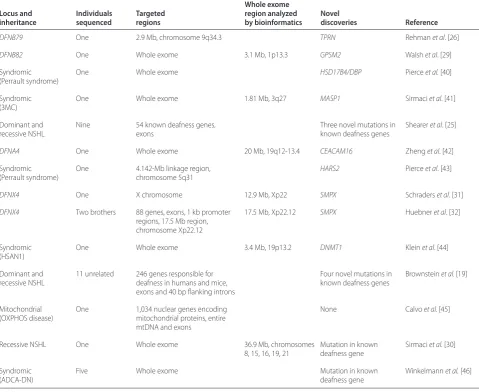
Several studies have used a combination of targeted capture and NGS technology to identify deafness genes. Th e fi rst study was used to isolate the HL-associated gene at the DFNB79 locus [26]. Targeted genomic capture was performed on the linked region identifi ed previously by genetic analysis, leading to the identifi cation of a muta-tion in the TPRN gene, encoding taperin. Subsequent capture and NGS experiments for both non-syndromic and syndromic HL were undertaken and are listed in Table 1. Both specifi c genomic regions and whole exomes were captured, leading to the successful identifi cation of the molecular basis of several forms of HL. Th e comparative NGS study described above also developed OtoSCOPE, a platform for providing a clinical test for 57 known deafness genes [25]. Another clinical assay, testing 84 human genes involved in both syndromic HL and NSHL, is also available from Otogenetics (reviewed in [27]).
In a further eff ort to develop clinical diagnosis plat-forms for identifying multiple mutations, a combined targeted genomic capture and NGS of 246 genes was conducted on a cohort of Middle Eastern hearing-im-paired probands [19]. In this study, screening additional families for alleles fi rst identifi ed by NGS in fi ve probands led to the identifi cation of causative alleles for deafness in
Brownstein et al. Genome Biology 2012, 13:245 http://genomebiology.com/2012/13/5/245
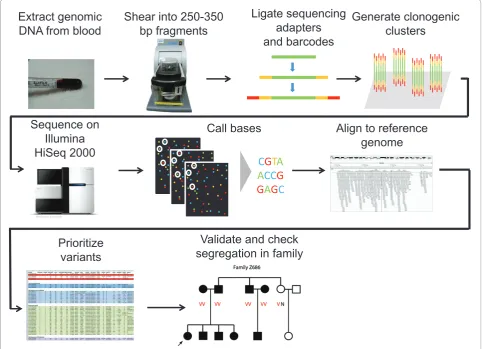
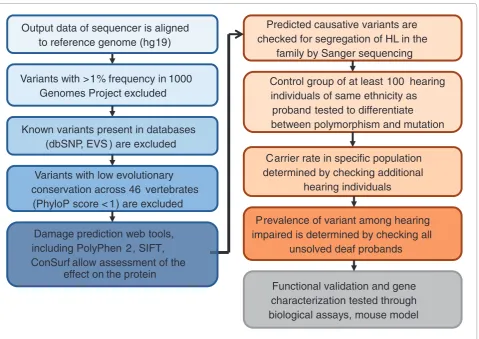
25 families. In addition, orthologs of mouse deafness genes were included on the platform, based on the premise that mutations in these genes may lead to human HL, because many of the human HL genes also cause HL in mice. Th is approach exploits the high-throughput nature of targeted NGS to make a single fully compre-hensive test for all known deafness genes and has the advantage of producing a signifi cantly reduced amount of data compared with exome sequencing or whole genome sequencing. Nevertheless, the data obtained from sequen cing of the exons of approximately 250 genes, with an additional 40 nucleotides on each end into the introns, required extensive bioinformatics analysis and fi ltering out of thousands of non-damaging variants. A schematic diagram of the strategy for generating such an experi-mental and computational pipeline can be seen in Figure 2. A summary of the strategy used for data analysis and for eliminating all irrelevant variants by evaluation of
putative causative mutations for validation is shown in Figure 3.
On a larger scale, whole exome sequencing is extremely promising, as it screens the exons of all genes in the human genome, enabling the discovery of novel deafness genes. It is estimated that approximately 60% of genes for Mendelian disease could be discovered using this technology [28]. Th e data analysis is rather complicated and strategies are being used to ease this. One conducts homozygosity mapping for recessive families to narrow down the regions to analyze. Th is was done, in parallel to exome sequencing, leading to the identifi cation of a GPSM2 mutation as the cause of HL associated with the DFNB82 locus [29] and a GIPC3 mutation in a family with consanguineous parents [30].
[image:6.612.66.546.103.495.2]In addition to clinical diagnostics, a major goal of gene discovery is to decipher the mechanisms involved in deafness. Exome sequencing, through the initial fi ndings
Table 1. The contribution of targeted capture and next-generation sequencing to hearing research
Whole exome
Locus and Individuals Targeted region analyzed Novel
inheritance sequenced regions by bioinformatics discoveries Reference
DFNB79 One 2.9 Mb, chromosome 9q34.3 TPRN Rehman et al. [26]
DFNB82 One Whole exome 3.1 Mb, 1p13.3 GPSM2 Walsh et al. [29]
Syndromic (Perrault syndrome)
One Whole exome HSD17B4/DBP Pierce et al. [40]
Syndromic (3MC)
One Whole exome 1.81 Mb, 3q27 MASP1 Sirmaci et al. [41]
Dominant and recessive NSHL
Nine 54 known deafness genes, exons
Three novel mutations in known deafness genes
Shearer et al. [25]
DFNA4 One Whole exome 20 Mb, 19q12-13.4 CEACAM16 Zheng et al. [42]
Syndromic (Perrault syndrome)
One 4.142-Mb linkage region, chromosome 5q31
HARS2 Pierce et al. [43]
DFNX4 One X chromosome 12.9 Mb, Xp22 SMPX Schraders et al. [31]
DFNX4 Two brothers 88 genes, exons, 1 kb promoter regions, 17.5 Mb region, chromosome Xp22.12
17.5 Mb, Xp22.12 SMPX Huebner et al. [32]
Syndromic (HSAN1)
One Whole exome 3.4 Mb, 19p13.2 DNMT1 Klein et al. [44]
Dominant and recessive NSHL
11 unrelated 246 genes responsible for deafness in humans and mice, exons and 40 bp fl anking introns
Four novel mutations in known deafness genes
Brownstein et al. [19]
Mitochondrial (OXPHOS disease)
One 1,034 nuclear genes encoding mitochondrial proteins, entire mtDNA and exons
None Calvo et al. [45]
Recessive NSHL One Whole exome 36.9 Mb, chromosomes
8, 15, 16, 19, 21
Mutation in known deafness gene
Sirmaci et al. [30]
Syndromic (ADCA-DN)
Five Whole exome Mutation in known
deafness gene
of new genes associated with deafness, has provided this entry point for new biological insights. For example, although exome sequencing indicated that SMPX is the most suitable candidate for progressive hearing impair-ment in a large Dutch family, it did not seem to be an obvious candidate from a biological perspective, because the protein encoded by this gene had been implicated in striated muscle [31,32]. Further investigations revealed that SMPX is indeed expressed in the cochlea and a role in development and/or maintenance of the sensory hair cells through integrin signaling and/or the insulin-like growth factor-1 pathway has been suggested. Th us, the next-generation sequencing approach has implicated new genes and pathways in deafness.
Conclusion
Th ere are several remaining questions with regard to deep sequencing for hereditary HL. Will this technique become routine for HL? Will it be adopted by clinical
[image:7.612.65.548.91.440.2]laboratories on a routine basis? What are the ethical considerations involved? Much of the eff ort invested in the fi eld of genomics aims to improve medical strategies in diagnostics, treatment, cure and prevention of dis-abilities. Although most disabled people welcome the new technologies, others might be ambivalent or even antagonistic towards genetic medicine [33]. For deafness in particular, there has been an ongoing debate whether deafness is a real disability or rather a diff erent culture [34]. Although some communities, particularly in religious communities in the Middle East, consider deafness to be an unwanted disability, at the other extreme, there are deaf parents who would prefer to have deaf children and are ready to go as far as terminating a pregnancy if the fetus does not have HL [35]. Even though the majority of deaf couples are not interested in prenatal diagnosis for HL, and tend to feel that termination of pregnancy on the basis of hearing status (either deaf or hearing) should be illegal [36], many hearing parents, after the birth of a deaf
Figure 2. Pipeline for identifi cation of pathogenic variants by targeted capture and high-throughput sequencing of deaf individuals. The major steps required to identify mutations responsible for deafness are outlined. The fi rst step begins with institutional review board or Helsinki Committee authorization to perform research on human subjects, followed by extraction of genomic DNA from blood. A series of experimental and computational steps follow, with variations according to the type of sequencing platform used.
Extract genomic
DNA from blood
Ligate sequencing
adapters
and barcodes
Generate clonogenic
clusters
Call bases
Align to reference
genome
Sequence on
Illumina
HiSeq 2000
Prioritize
variants
Validate and check
segregation in family
Shear into 250-350
bp fragments
A
CC
G
C
G
T
A
G
A
G
C
p
g
Brownstein et al. Genome Biology 2012, 13:245 http://genomebiology.com/2012/13/5/245
child, seek genetic counseling to prevent the reoccurrence of deafness in their family and some of them would consider termination of a hearing-impaired child [37].
From a wider point of view, HL has serious conse-quences for public health, with major economic and social implications, as it is estimated that at least 20% of the population develop a signifi cant HL at some time during their lives [36]. Because of the high heterogeneity of deafness, most deaf people are born to hearing parents, and most of this population has a strong desire for treatment or cure. Th erefore, a major challenge is to discover the cause and decipher the mechanisms of deafness. Recent advances in genomics have made it possible to perform large-scale population screening, as well as for individualized testing. However, high-through-put genomics in the clinical setting is still in its infancy and before implementing it in routine clinical use, there is a clear need for standard laboratory procedures and regu lations for quality control, data analysis and validation [38]. Eff orts in this direction have been initiated by the
Centers for Disease Control and Prevention that spon-sored a conference in 2011 on Next-Generation Sequen-cing, Standardization of Clinical Testing [27]. In addition, there are controversial ethical issues regarding the immense amount of high-throughput data obtained and their applications, because these data are usually much broader than the specifi c topic of research. Precise rules for the use, storage and sharing of NGS data among collaborative research groups are currently lacking. In many cases data are required to be deposited in publicly accessible databases by research funding sources before publication [39]. All these make informed consent for genomics diffi cult to defi ne.
[image:8.612.69.549.87.426.2]Nevertheless, initial fi ndings of these advanced tech-nologies for detection of deafness-causing mutations promise to solve the major portion of genetic deafness in the next few years, which will lead to improved genetic counseling and much more effi cient treatment, as phenotypes could be predicted by the solved genotypes. Characterization of the proteins encoded by these genes
Figure 3. Prioritization of variants to identify causative hearing loss mutations. A series of computational steps (blue background) are required to tackle the many variants that come out of the high-throughput sequencing. High-confi dence candidates will be further tested (orange background) in the proband’s family and ethnic group using Sanger sequencing or restriction enzyme assays. Confi rmed pathogenic mutations will be tested for biological function (gray background). Websites of the tools shown are at: 1000 Genomes Project [48]; dbSNP [49]; EVS [50]; PhyloP [51]; PolyPhen2 [52]; SIFT [53]; ConSurf [54].
Prevalence of variant among hearing impaired is determined by checking all
unsolved deaf probands
Control group of at least 100 hearing individuals of same ethnicity as
proband tested to differentiate
between polymorphism and mutation Known variants present in databases
(dbSNP, EVS ) are excluded
Damage prediction web tools, including PolyPhen 2, SIFT, ConSurf allow assessment of the
the protein
Variants with low evolutionary conservation across 46 vertebrates (PhyloP score < 1) are excluded
Carrier rate in speciÚC population
determined by checking additional hearing individuals
Functional validation and gene characterization tested through biological assays, mouse model Variants with >1% frequency in 1000
Genomes Projectexcluded
Output data of sequencer is aligned to reference genome (hg19)
Predicted causative variants are checked for segregation of HL in the
family by Sanger sequencing
will shed light on the biological mechanisms involved in the pathophysiology of HL, forming the basis for genetic-based therapeutics.
Acknowledgements
Research in the Avraham laboratory for human genomics research is funded by the National Institutes of Health (NIDCD) R01DC011835, I-CORE Center No. 41/11, and the Hedrich Charitable Trust.
Published: 29 May 2012
References
1. Estivill X, Fortina P, Surrey S, Rabionet R, Melchionda S, D’Agruma L, Mansfi eld E, Rappaport E, Govea N, Mila M, Zelante L, Gasparini P: Connexin-26 mutations in sporadic and inherited sensorineural deafness. Lancet 1998, 351:394-398.
2. Nadol JB Jr: Hearing loss. N Engl J Med1993, 329:1092-1102.
3. Morton CC, Nance WE: Newborn hearing screening-a silent revolution.
N Engl J Med 2006, 354:2151-2164.
4. Smith RJ, Bale JF Jr, White KR: Sensorineural hearing loss in children. Lancet
2005, 365:879-890.
5. Walsh T, Lee MK, Casadei S, Thornton AM, Stray SM, Pennil C, Nord AS, Mandell JB, Swisher EM, King MC: Detection of inherited mutations for breast and ovarian cancer using genomic capture and massively parallel sequencing. Proc Natl Acad Sci U S A 2010, 107:12629-12633.
6. Worthey EA, Mayer AN, Syverson GD, Helbling D, Bonacci BB, Decker B, Serpe JM, Dasu T, Tschannen MR, Veith RL, Basehore MJ, Broeckel U, Tomita-Mitchell A, Arca MJ, Casper JT, Margolis DA, Bick DP, Hessner MJ, Routes JM, Verbsky JW, Jacob HJ, Dimmock DP: Making a defi nitive diagnosis: successful clinical application of whole exome sequencing in a child with intractable infl ammatory bowel disease. Genet Med 2011, 13:255-262.
7. Ng SB, Bigham AW, Buckingham KJ, Hannibal MC, McMillin MJ, Gildersleeve HI, Beck AE, Tabor HK, Cooper GM, Meff ord HC, Lee C, Turner EH, Smith JD, Rieder MJ, Yoshiura K, Matsumoto N, Ohta T, Niikawa N, Nickerson DA, Bamshad MJ, Shendure J: Exome sequencing identifi es MLL2 mutations as a cause of Kabuki syndrome. Nat Genet 2010, 42:790-793.
8. Hereditary Hearing loss Homepage [http://hereditaryhearingloss.org/] 9. Richardson GP, de Monvel JB, Petit C: How the genetics of deafness
illuminates auditory physiology. Annu Rev Physiol 2011, 73:311-334. 10. Dror AA, Avraham KB: Hearing loss: mechanisms revealed by genetics and
cell biology. Annu Rev Genet 2009, 43:411-437.
11. Deafness Variation Database [http://deafnessvariationdatabase.com/] 12. Hilgert N, Smith RJ, Van Camp G: Forty-six genes causing nonsyndromic
hearing impairment: which ones should be analyzed in DNA diagnostics?
Mutat Res 2009, 681:189-196.
13. Lander ES, Botstein D: Homozygosity mapping: a way to map human recessive traits with the DNA of inbred children. Science 1987, 236:1567-1570.
14. Christianson A, Modell B: Medical genetics in developing countries. Annu Rev Genomics Hum Genet 2004, 5:219-265.
15. Rodriguez-Paris J, Pique L, Colen T, Roberson J, Gardner P, Schrijver I: Genotyping with a 198 mutation arrayed primer extension array for hereditary hearing loss: assessment of its diagnostic value for medical practice. PLoS One 2010, 5:e11804.
16. Walsh T, Pierce SB, Lenz DR, Brownstein Z, Dagan-Rosenfeld O, Shahin H, Roeb W, McCarthy S, Nord AS, Gordon CR, Ben-Neriah Z, Sebat J, Kanaan M, Lee MK, Frydman M, King MC, Avraham KB: Genomic duplication and overexpression of TJP2/ZO-2 leads to altered expression of apoptosis genes in progressive nonsyndromic hearing loss DFNA51.Am J Hum Genet
2010, 87:101-109.
17. Brownstein Z, Friedlander Y, Peritz E, Cohen T: Estimated number of loci for autosomal recessive severe nerve deafness within the Israeli Jewish population, with implications for genetic counseling. Am J Med Genet 1991, 41:306-312.
18. Brownstein Z, Avraham KB: Deafness genes in Israel: implications for diagnostics in the clinic. Pediatr Res 2009, 66:128-134.
19. Brownstein Z, Friedman LM, Shahin H, Oron-Karni V, Kol N, Rayyan AA, Parzefall T, Lev D, Shalev S, Frydman M, Davidov B, Shohat M, Rahile M, Lieberman S, Levy-Lahad E, Lee MK, Shomron N, King MC, Walsh T, Kanaan M, Avraham KB: Targeted genomic capture and massively parallel sequencing
to identify genes for hereditary hearing loss in middle eastern families.
Genome Biol 2011, 12:R89.
20. Margulies M, Egholm M, Altman WE, Attiya S, Bader JS, Bemben LA, Berka J, Braverman MS, Chen YJ, Chen Z, Dewell SB, Du L, Fierro JM, Gomes XV, Godwin BC, He W, Helgesen S, Ho CH, Irzyk GP, Jando SC, Alenquer ML, Jarvie TP, Jirage KB, Kim JB, Knight JR, Lanza JR, Leamon JH, Lefkowitz SM, Lei M, Li J,
et al.: Genome sequencing in microfabricated high-density picolitre reactors. Nature 2005, 437:376-380.
21. Ju J, Kim DH, Bi L, Meng Q, Bai X, Li Z, Li X, Marma MS, Shi S, Wu J, Edwards JR, Romu A, Turro NJ: Four-color DNA sequencing by synthesis using cleavable fl uorescent nucleotide reversible terminators. Proc Natl Acad Sci U S A 2006, 103:19635-19640.
22. Valouev A, Ichikawa J, Tonthat T, Stuart J, Ranade S, Peckham H, Zeng K, Malek JA, Costa G, McKernan K, Sidow A, Fire A, Johnson SM: A high-resolution, nucleosome position map of C. elegans reveals a lack of universal sequence-dictated positioning. Genome Res 2008, 18:1051-1063. 23. Metzker ML: Sequencing technologies - the next generation. Nat Rev Genet
2010, 11:31-46.
24. Shearer AE, Hildebrand MS, Sloan CM, Smith RJ: Deafness in the genomics era. Hear Res 2011, 282:1-9.
25. Shearer AE, DeLuca AP, Hildebrand MS, Taylor KR, Gurrola J, 2nd, Scherer S, Scheetz TE, Smith RJ: Comprehensive genetic testing for hereditary hearing loss using massively parallel sequencing. Proc Natl Acad Sci U S A
2010, 107:21104-21109.
26. Rehman AU, Morell RJ, Belyantseva IA, Khan SY, Boger ET, Shahzad M, Ahmed ZM, Riazuddin S, Khan SN, Friedman TB: Targeted capture and next-generation sequencing identifi es C9orf75, encoding taperin, as the mutated gene in nonsyndromic deafness DFNB79.Am J Hum Genet 2010, 86:378-388.
27. Lin X, Tang W, Ahmad S, Lu J, Colby CC, Zhu J, Yu Q: Applications of targeted gene capture and next-generation sequencing technologies in studies of human deafness and other genetic disabilities. Hear Res 2012, doi:10.1016/ j.heares.2012.01.004.
28. Gilissen C, Hoischen A, Brunner HG, Veltman JA: Disease gene identifi cation strategies for exome sequencing. Eur J Hum Genet 2012, 20:490-497. 29. Walsh T, Shahin H, Elkan-Miller T, Lee MK, Thornton AM, Roeb W, Abu Rayyan
A, Loulus S, Avraham KB, King MC, Kanaan M: Whole exome sequencing and homozygosity mapping identify mutation in the cell polarity protein GPSM2 as the cause of nonsyndromic hearing loss DFNB82.Am J Hum Genet 2010, 87:90-94.
30. Sirmaci A, Edwards YJ, Akay H, Tekin M: Challenges in whole exome sequencing: an example from hereditary deafness. PLoS One 2012, 7:e32000.
31. Schraders M, Haas SA, Weegerink NJ, Oostrik J, Hu H, Hoefsloot LH, Kannan S, Huygen PL, Pennings RJ, Admiraal RJ, Kalscheuer VM, Kunst HP, Kremer H: Next-generation sequencing identifi es mutations of SMPX, which encodes the small muscle protein, X-linked, as a cause of progressive hearing impairment. Am J Hum Genet 2011, 88:628-634.
32. Huebner AK, Gandia M, Frommolt P, Maak A, Wicklein EM, Thiele H, Altmuller J, Wagner F, Vinuela A, Aguirre LA, Moreno F, Maier H, Rau I, Giesselmann S, Nurnberg G, Gal A, Nurnberg P, Hubner CA, del Castillo I, Kurth I: Nonsense mutations in SMPX, encoding a protein responsive to physical force, result in X-chromosomal hearing loss. Am J Hum Genet 2011, 88:621-627. 33. Scully JL: Disability and genetics in the era of genomic medicine. Nat Rev
Genet 2008, 9:797-802.
34. Christiansen JB: Sociological implications of hearing loss. Ann NY Acad Sci
1991, 630:230-235.
35. Grundfast KM, Rosen J: Ethical and cultural considerations in research on hereditary deafness. Otolaryngol Clin North Am 1992, 25:973-978. 36. Stern SJ, Arnos KS, Murrelle L, Welch KO, Nance WE, Pandya A: Attitudes of
deaf and hard of hearing subjects towards genetic testing and prenatal diagnosis of hearing loss. J Med Genet 2002, 39:449-453.
37. Dagan O, Hochner H, Levi H, Raas-Rothschild A, Sagi M: Genetic testing for hearing loss: diff erent motivations for the same outcome. Am J Med Genet
2002, 113:137-143.
38. Bunnik EM, Schermer MH, Janssens AC: Personal genome testing: test characteristics to clarify the discourse on ethical, legal and societal issues.
BMC Med Ethics 2011, 12:11.
39. Kaye J, Heeney C, Hawkins N, de Vries J, Boddington P: Data sharing in genomics - re-shaping scientifi c practice. Nat Rev Genet 2009, 10:331-335. 40. Pierce SB, Walsh T, Chisholm KM, Lee MK, Thornton AM, Fiumara A, Opitz JM, Brownstein et al. Genome Biology 2012, 13:245
http://genomebiology.com/2012/13/5/245
Levy-Lahad E, Klevit RE, King MC: Mutations in the DBP-defi ciency protein HSD17B4 cause ovarian dysgenesis, hearing loss, and ataxia of Perrault Syndrome. Am J Hum Genet 2010, 87:282-288.
41. Sirmaci A, Walsh T, Akay H, Spiliopoulos M, Sakalar YB, Hasanefendioglu-Bayrak A, Duman D, Farooq A, King MC, Tekin M: MASP1 mutations in patients with facial, umbilical, coccygeal, and auditory fi ndings of Carnevale, Malpuech, OSA, and Michels syndromes. Am J Hum Genet 2010, 87:679-686.
42. Zheng J, Miller KK, Yang T, Hildebrand MS, Shearer AE, DeLuca AP, Scheetz TE, Drummond J, Scherer SE, Legan PK, Goodyear RJ, Richardson GP, Cheatham MA, Smith RJ, Dallos P: Carcinoembryonic antigen-related cell adhesion molecule 16 interacts with α-tectorin and is mutated in autosomal dominant hearing loss (DFNA4).Proc Natl Acad Sci U S A 2011, 108:4218-4223.
43. Pierce SB, Chisholm KM, Lynch ED, Lee MK, Walsh T, Opitz JM, Li W, Klevit RE, King MC: Mutations in mitochondrial histidyl tRNA synthetase HARS2
cause ovarian dysgenesis and sensorineural hearing loss of Perrault syndrome. Proc Natl Acad Sci U S A 2011, 108:6543-6548.
44. Klein CJ, Botuyan MV, Wu Y, Ward CJ, Nicholson GA, Hammans S, Hojo K, Yamanishi H, Karpf AR, Wallace DC, Simon M, Lander C, Boardman LA, Cunningham JM, Smith GE, Litchy WJ, Boes B, Atkinson EJ, Middha S, PJ BD, Parisi JE, Mer G, Smith DI, Dyck PJ: Mutations in DNMT1 cause hereditary sensory neuropathy with dementia and hearing loss. Nat Genet 2011, 43:595-600.
45. Calvo SE, Compton AG, Hershman SG, Lim SC, Lieber DS, Tucker EJ, Laskowski A, Garone C, Liu S, Jaff e DB, Christodoulou J, Fletcher JM, Bruno DL, Goldblatt J, Dimauro S, Thorburn DR, Mootha VK: Molecular diagnosis of infantile mitochondrial disease with targeted next-generation sequencing.
Sci Transl Med 2012, 4:118ra10.
46. Winkelmann J, Lin L, Schormair B, Kornum BR, Faraco J, Plazzi G, Melberg A, Cornelio F, Urban AE, Pizza F, Poli F, Grubert F, Wieland T, Graf E, Hallmayer J,
Strom TM, Mignot E: Mutations in DNMT1 cause autosomal dominant cerebellar ataxia, deafness and narcolepsy. Hum Mol Genet 2012, 21: 2205-2210.
47. Dror AA and Avraham KB: Hearing impairment: a panoply of genes and functions. Neuron 2010, 68:293-308.
48. 1000 Genomes [http://www.1000genomes.org/home] 49. NCBI dbSNP [http://www.ncbi.nlm.nih.gov/projects/SNP/]
50. NHLBI Exome Sequencing Project [http://evs.gs.washington.edu/EVS/] 51. UCSC - Genome Bioinformatics [http://genome.ucsc.edu]
52. PolyPhen-2 [http://genetics.bwh.harvard.edu/pph2/]
53. SIFT Human Protein [http://sift.jcvi.org/www/SIFT_enst_submit.html] 54. The ConSurf Server [http://consurf.tau.ac.il/]
55. Sanger F, Nicklen S, Coulson AR: DNA sequencing with chain-terminating inhibitors. Proc Natl Acad Sci U S A 1977, 74:5463-5467.
56. Bartlett JM, Stirling D: A short history of the polymerase chain reaction.
Methods Mol Biol 2003, 226:3-6.
57. Lander ES, Linton LM, Birren B, Nusbaum C, Zody MC, Baldwin J, Devon K, Dewar K, Doyle M, FitzHugh W, Funke R, Gage D, Harris K, Heaford A, Howland J, Kann L, Lehoczky J, LeVine R, McEwan P, McKernan K, Meldrim J, Mesirov JP, Miranda C, Morris W, Naylor J, Raymond C, Rosetti M, Santos R, Sheridan A, Sougnez C, et al.: Initial sequencing and analysis of the human genome.
Nature 2001, 409:860-921.
58. Shearer AE, Hildebrand MS, Sloan CM, Smith RJ: Deafness in the genomics era. Hear Res 2011. 282:1-9.
doi:10.1186/gb-2012-13-5-245