International Journal of Emerging Technology and Advanced Engineering
Website: www.ijetae.com (ISSN 2250-2459, ISO 9001:2008 Certified Journal, Volume 6, Issue 6, June 2016)
162
Network Security by Proposed DML and a New Data-Length
Authentication Algorithm (DLAA)
Kiran Kant Priya
1, Taraun Kumar
21,2Department of Computer Science Uttaranchal University Dehradun, Uttarakhand, India
Abstract- Nowadays network security is one of the imperative terms in computer science. Communication of users entirely depends on network (public, private or hybrid). Each and everyone know that this communication done in the form of data, for security and protection of network in this paper we are focusing on data, also we are going to update “Data Lifecycle Model”. Phases works under DLM which are important for data and its communication way, here we are updating these phases just for protection of network through one of the new authentication phase. For network security most of the authors always concentrates on network and some of the cryptosystem algorithms for security of system and his environment, although according to us data security is important in comparison to system security for the reason that at starting, system are secure when we communicate it with others then complexities comes. In this paper we introduce proposed DLM with authentication phase, and authentication done a novel methodology and algorithm. This proposed algorithm named as Data-Length Authentication Algorithm (DLAA).
Keyword-- Data Lifecycle Model (DML), Network Security, DLAA, Encryption, Decryption.
I. INTRODUCTION
In this field we are introducing network security and DLM, what is network? How to protect it? And phases of DLM or its working, computer network are a special field and as always security is mandatory for it. Network security make sure that users have enough access to the network and resources to work, usually handled by a system administrator or network administrator who works on network software, hardware and its security policies which are required to secure network and its resources accessed by the network from unconstitutional access (attacker, malware).
As a basic building block of computer security, cryptography becomes most important feature of communication security. Gradually more utilization of computer and communication system by all fields they has increased the risk of stealing of information while these threats might need a best solution and analysis of these problems. Encryption is an old and successful technique for security of network; it’s used for hide main information in the form of some special codes.
Before a long time modern cryptography consists several security algorithms that’s all based on keys (public, private) for encryption and decryption messages. Some steps in cryptography are follows:
Plain text: original message.
Cipher text: coded message.
Encryption: Conversion of plain text to cipher text.
Decryption: Get back the plain text from the cipher text.
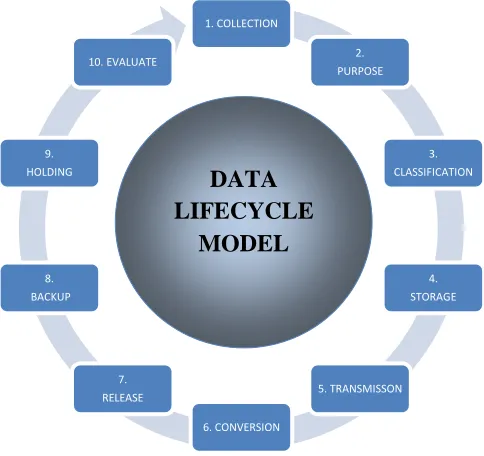
Data Lifecycle Model, data is a collection of alphabets, numbers, and symbols. Nowadays everyone knows data is one of most imperative thing because nothing was happened without data. Normally peoples doesn’t care about lifecycle of data but most of data management professionals would accepts that these is a data life cycle, problem is that there is no ordinary admiring of what it is. If you search about “Data Lifecycle” you will not find a clear description of it. In this paper we followed some of previous phases and working of “Data Lifecycle Model”.
Phases of “Data Lifecycle Model” are follows:
COLLECTION: First phase used for searching purpose of data, here we find the sources.
PURPOSE: In this phase we need to know about aim of data, means why data taken from this source.
CLASSIFICATION: Here we classified data and distribute it according to requirements.
STORAGE: Storage phase are used for handling the data.
TRANSMISSON: This phase shows steps of data communications, means how and where data communicate.
CONVERSION: Conversion means manipulation of data and it required as requirements of other person.
RELEASE: Release phase for leaving the data.
BACKUP: If we miss some of our data then this phase are useful.
HOLDING: We hold the data for ensure that data are important or not, it is useful for us or not.
International Journal of Emerging Technology and Advanced Engineering
Website: www.ijetae.com (ISSN 2250-2459, ISO 9001:2008 Certified Journal, Volume 6, Issue 6, June 2016)
[image:2.612.49.291.148.376.2]163
FIGURE 1: Data Lifecycle ModelEveryone needs data for communication but they never realize about requirement of data’s phases, these phases are necessary and discussed by data management professionals. Above 10 phases are final for a lifecycle of data in DLM.
II. LITERATURE SURVEY
Here we discuss some of the previous work related to network security as follows:
The Arvind Negi et al., [1] authors proposed a novel technique for digital signature certificate and proposed RSA signature algorithm. They illustrate results in a desktop application which is helpful to generate 2 class or 3 class digital signatures.
Kirti Raj Bhatele, et al., [2] authors combined both symmetric and asymmetric techniques and proposed hybrid security protocol for better security. In this paper they used MD5, AES and RSA algorithm for different requirements of hybrid cryptosystem.
Anchit et al., [3] proposed a technique for the forensics of Random-UDP flooding attack. They tried to get as close as possible to the source of such attacks. The proposed technique is capable to identify the source of Random-UDP flooding bot attack.
Arash Habibi Lashkari, et al., [4] in this paper authors just provide a survey of wireless security protocols (WEP, WPA and WPA2/802.11i).
Here they discussed about WEP, WPA and combine some of other wireless techniques later finally they explained third generation of wireless security protocol as WPA2/802.11i.
Gamal Selim, et al., [5] in this paper authors proposed a new mechanism called multiple slot system (MSS). And works on WEP, WEP2, WPA and WPA2 also provide a survey and explained various types of security attacks like modification, fabrication, interception, brute force, maintainability and static placement of MIC. In this approach MSS are helpful to use four encryption algorithms RC4, RSA, Blowfish and AES for a single system.
Swati Chaudhary et al., [6] proposed new DSA algorithm for increase security of cloud computing. In this paper authors providing multiple random numbers and generates multiple keys for a single users. This algorithm is helpful to secure users data for either cloud or network.
Hyung-Woo Lee, et al., [7] this paper is on WSN and here authors discussed some of the major attacks like denial of service attack, attacks on information in transit, sybil attack, hello flood attack, wormhole attack, blackhole/sinkhole attack.
Lifeng Sang, et al., [8] proposed shared secret free security infrastructure for wireless networks based on two physical primitives: cooperative jamming and spatial signal enforcement. Cooperative jamming is for confidential wireless communication and spatial signal enforcement is for message authenticity. Proposed infrastructure provides confidentiality, identity authentication, message authentication, integrity, sender non-repudiation, receiver non repudiation and anonymity.
Shefali Khatri et al., [9]this paper is based on MANET and Sybil attack in this paper authors proposed ElGamal signature algorithm for mitigation of Sybil attack.
Andrew Gin, et al., [10] this paper is compared based paper here authors compare the performance analysis of evolving wireless 802.11 security architecture. In this paper authors used some of the security algorithms and compare those algorithms for security layers. Discussed algorithms are WEP shared key authentication and 40 bit encryption; WEP shared key authentication and 104 bit encryption, WPA with PSK authentication and RC4 encryption, WPA with EAP-TLS authentication and RC4 encryption, WPA2 with PSK authentication and AES encryption and WPA2 with EAP-TLS authentication and AES encryption.
Aanusha Khan et al., [11] in this paper authors proposed unified botnet detection framework and also providing an idea about how Botnet performs the malicious activities and various techniques that are used for the revelation of the Botnet.
1. COLLECTION
2. PURPOSE
3. CLASSIFICATION
4. STORAGE
5. TRANSMISSON
6. CONVERSION 7.
RELEASE 8.
BACKUP 9. HOLDING
10. EVALUATE
DATA
LIFECYCLE
International Journal of Emerging Technology and Advanced Engineering
Website: www.ijetae.com (ISSN 2250-2459, ISO 9001:2008 Certified Journal, Volume 6, Issue 6, June 2016)
164
Eric Sabbah, et al., [12] in this paper authors explained attacker motivation, vulnerabilities and opportunities currently available to hackers. Paper based on energy of sensors and some of the basic attacks in WSN, authors explain that security supports in wireless network is challenging due to the limited energy, communication bandwidth and computational power.Sakshi Bansal et al., [13] in this paper authors identify different types of botnet and define the botnet architectures. We further propose a framework for detecting a botnet and stopping it to spread, affecting our system and breaching the security of the network.
Floriano De Rango et al., [14] this paper is based on 4 way handshaking, in this paper authors discussed DoS flooding attacks in IEEE 802.11i and proposed static and dynamic 4 - way handshake solutions to avoid denial of service attack in WPA and IEEE 802.11i.
III. PROPOSED WORK
Network protected by different techniques and always techniques concluded by system or network, for these best solutions are cryptographic algorithms applied in system or network and some physical protection devises. But still we are suffering, network system will be more secure and chances of vulnerability will be compact if we provide a better control in our data, for this purpose authors analyzed “Data Lifecycle Model” and collect some of the previous facts from data management professional’s assessments. In this work we are going to update “Data Lifecycle Model” by its phases.
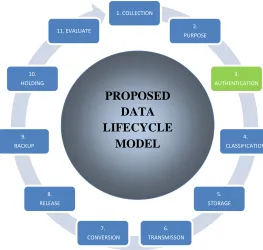
Data is data and it is same before or after its lifecycle exploration. So no one knows data is secure or not and it will be a problem if unsecure data communicated from your system to others, Meaning that your own data be harmful for your personal system or for network. This problem solved by only if authentication done before communicates it. Here we append a new phase in “Data Lifecycle Model” and updated lifecycle had a new authentication phase (figure 2).
For authentication cryptographic algorithms are significant so in proposed work authentication applied in third phase of DLM. Some of the best security algorithms are RSA, ElGamal, DSA, DES, AES, etc. Here we developed a new authentication algorithm, Data-Length
Authentication Algorithm (DLAA) for generating public
[image:3.612.327.590.157.407.2]and private key through input data or character.
FIGURE 2: Proposed Data Lifecycle Model
A.Proposed Algorithm DLAA
Authentication is one of the vital terms in network security; here we are going to authenticate our input text or message through itself and calculation of its length by proposed DLAA. Data-Length Authentication Algorithm (DLAA) is following:
1. Read and accept input data set.
2. Ignore gap between words, non-character entities and join this set as a single character.
3. Distribute it in 3 different classes first, mid and last. Also find length of current character.
4. Choose two distinct prime numbers a & b, a from first-class and b from mid or last-class value.
5. Compute n = a*b
6. Compute φ(n) = φ(a)*φ(b) =(a-1)*(b-1)
7. Choose an integer p from current character such that 1<p< φ(n), gcd (p, φ(n))=1, where p & φ(n) are co-prime; here p is a public key exponent.
8. Determine q as q = p-1(mod φ(n))
Here q is kept as the private key exponent. So, public key (p, n) and private key (q, n)
1. COLLECTION
2. PURPOSE
3. AUTHENTICATION
4. CLASSIFICATION
5. STORAGE
6. TRANSMISSON 7.
CONVERSION 8.
RELEASE 9.
BACKUP 10. HOLDING
11. EVALUATE
PROPOSED
DATA
LIFECYCLE
International Journal of Emerging Technology and Advanced Engineering
Website: www.ijetae.com (ISSN 2250-2459, ISO 9001:2008 Certified Journal, Volume 6, Issue 6, June 2016)
165
Encryption: Sender transmits his public key (p, n) to receiver and kept private key (q, n) secret and receiver send message m to sender. Cipher text, c = mp (mod n)Decryption: Sender can recover message m from cipher text c by using his private key exponent q by message, m = cq (mod n)
B.Proof of Proposed Algorithm as Implementation
Input data set – Uttaranchal University, Dehradun.
Step 1. Uttaranchal University, Dehradun. Step 2. UttaranchalUniversityDehradun Step 3. Uttarancha lUniversit yDehradun
First-class Mid-class Last-class Step 4. Length of character is 29
Step 5. a = t, b = l, so value of v(a) = 3, v(b) = 11 Step 6. Compute n = a*b, n = 3 * 11 = 33. Step 7. Compute φ(n) = φ(a). φ(b)
Now a represented as v(a) and b as v(b). So, φ(n) = (v(a)-1). (v(b)-1) = (3-1). (11-1) = 20. Step 8. Random integer p is value of n, v(n) = 7
So, gcd(p, φ(n)) = gcd(7, 20) = 1. Step 9. Now q = p-1(mod φ(n))
q = 7-1(mod 20) = 3
So, public key (p, n) = (7, 33) and private key (q, n) = (3,
33)
Encryption done by, Sender transmits his public key (p, n) to receiver and kept private key (q, n) secret and receiver send message to sender.
c = mp (mod n), if m=2 So, c = 27(mod 33) = 29
Decryption: Sender can recover message m from cipher text c by using his private key exponent q by message (m). m = cq (mod n)
m = 293(mod 33) = 24389 mod 33 m = 2
IV. CONCLUSION
This paper presented a novel mechanism and a proposed authentication algorithm, Data-Length Authentication Algorithm (DLAA) for network security with proposed “Data Lifecycle Model” and provides the specific method to secure data on network and cloud.
The security of the system or network is relatively enhanced using this approach considering as secure data. Our proposed mechanism is different from others because here we are using authentication step on data not in a host or any network device it is used in a lifecycle model of data and this model show in figure-2 as proposed DLM.
REFERENCES
[1] Arvind Negi, Punit Sharma, Prasant Chaudhary and Himanshu Gupta. “New Method for Obtaining Digital Signature Certificate using Proposed RSA Algorithm”, International Journal of Computer Applications 121(23):24-29, July 2015.
[2] K. Bhatele, A. Sinhal and M. Pathak, Editors, “A Novel
Approach to the Design of New Hybrid Security Protocol Architecture”, IEEE International Conference on Advanced Communication Control and Computing Technologies (ICACCCT), (2012) August 23-25, Ramanathapuram.
[3] Anchit Bijalwan, Mohammad Wazid, Emmanuel S. Pilli, R.C. Joshi. “Forensics of Random-UDP Flooding Attacks”, JOURNAL OF NETWORKS, VOL. 10, NO. 5, MAY 2015.
[4] A. H. Lashkari and M. M. S. Danesh, Editors, “A Survey on
Wireless Security Protocols WEP, WPA and WPA2/802.11i”, IEEE International Conference on Computer Science and Information Technology, (2009) August 8-11, Beijing.
[5] G. Selim, H. M. E. Badawy and M. A. Salam, Editors, “New
Protocol design for Wireless Networks security”, IEEE International Conference on Computer Science and Information Technology (ICACT), (2006) Feb 20-22.
[6] Swati Chudhary, Arvind Negi, Prashant Chaudhary, “Secure Data Communication in Cloud Computing using Proposed DSA”, International Journal of Advanced Research in Computer and Communication Engineering Vol. 4, Issue 8, August 2015.
[7] H.-W. Lee, A.-S. K. Pathan and C. S. Hong, Editors, “Security in Wireless Sensor Networks: issues and challenges”, International Conference on Advanced Communication Technology (ICACT), (2006) February 20-22, Phoenix Park.
[8] L. Sang and A. Arora, Editors, “A Shared Secret Free
Security Infrastructure for Wireless Networks”, ACM Transactions on Autonomous and Adaptive Systems (TAAS), (2012) July.
[9] Shefali Khatri, Punit Sharma, Arvind Negi, Himanshu Gupta, “Thwarting Sybil Attack using ElGamal Algorithm” International Journal of Computer Applications (0975 – 8887) Volume 121 – No.21, July 2015.
[10] A. Gin and R. Hunt, Editors, “Performance Analysis of
International Journal of Emerging Technology and Advanced Engineering
Website: www.ijetae.com (ISSN 2250-2459, ISO 9001:2008 Certified Journal, Volume 6, Issue 6, June 2016)
166
[11] Aanusha Khan, Chanchal Ahlawat, Anchit Bijalwan, “AUNIFIED BOTNET DETECTION FRAMEWORK”, International Journal of Advances in Electronics and Computer Science, ISSN: 2393-2835 Volume-2, Issue-5, May-2015
[12] E. Sabbah, A. Majeed, K. Y.-D. Kang, K. Liu and N. Abu-Ghazaleh, Editors, “An application-driven perspective on wireless sensor network security”, ACM international workshop on Quality of service & security for wireless and mobile networks, (2006).
[13] Sakshi Bansal, Mir Qaiser, Shefali Khatri, Anchit Bijalwan, “Botnet Forensics Framework: Is Your System a Bot”, IEEE, Advances in Computing and Communication Engineering (ICACCE), 2015.
[14] F. De Rango, D. C. Lentini and S. Marano, Editors, “Static