International Journal of Emerging Technology and Advanced Engineering
Website: www.ijetae.com (ISSN 2250-2459,ISO 9001:2008 Certified Journal, Volume 4, Issue 8, August 2014)
396
A Hierarchical Polling-based MAC Scheme for Wireless Body
Sensor Network
Shusaburo Motoyama
Master Program in Computer Science, Faculty of Campo Limpo Paulista (FACCAMP), Rua Guatemala, 170. Jardim America Campo Limpo Paulista, São Paulo, Brazil
Abstract—A hierarchical polling-based access scheme for Wireless Body Sensor Network (WBSN) is proposed in this paper. The proposed access scheme is structured in hierarchy to collect data from sensor nodes inserted in human body. In first level of hierarchy the sensor nodes are divided into groups and sensor nodes of each group communicate with a sink node which collects data by using polling technique. In second level, the sink nodes communicate with a master node which collects data by also using polling technique. To study the performance of proposed scheme, two cases are considered. In the first case, the sensor nodes from first level are provided with only single buffer to store data and the sink nodes have infinite size buffers. The master node in this case uses exhaustive polling technique. In the second case, the sensor nodes and sink nodes are provided with infinite size buffers and both first and second levels use exhaustive polling technique. The study is carried out using mathematical models known in the literature. The numerical analyses show that the proposed scheme can be efficient for WBSN application.
Keywords—body sensor network, MAC, mathematical modeling, polling, wireless.
I. INTRODUCTION
Wireless Body Sensor Network (WBSN) is composed of tiny electronic devices called sensors which are attached to the human body for remote monitoring of vital signs. A sensor with processing and communication capabilities is denoted sensor node.
Since the sensor nodes of a WBSN can be placed under the human skin of difficult accesses and due to the small size of the nodes and the limited energy storage capacity of battery, the sensor nodes must mainly save energy.
One of the tasks performed by sensor node that most spends energy is the communication. The sensor nodes must communicate externally with some device (sink node) for the transmission of collected data. Since many sensor nodes can be placed at human body, if more than a sensor node begins to transmit packets simultaneously, collisions will occur, and packets must be retransmitted. The packet retransmission can be an energy consuming process.
Thus, an efficient medium access control (MAC) mechanism for collision reduction or elimination is fundamental for good operation of a WBSN. Furthermore, the use of sink nodes as centralized nodes for data collection from sensor nodes is more convenient because it simplifies the communication protocol, and it is appropriate for the collision reduction.
A MAC scheme based on polling technique and using sink nodes in a hierarchical structure is proposed in this paper.
This paper is divided into five sections. In the second section, the related work to this paper is presented. The proposed hierarchical polling based MAC scheme and some operations of the sources for WBSN are described in section three. In the fourth section, the mathematical modeling and performance analyses of proposed MAC scheme are carried out. Finally, the main conclusions are presented in section five
.
II. RELATED WORK
International Journal of Emerging Technology and Advanced Engineering
Website: www.ijetae.com (ISSN 2250-2459,ISO 9001:2008 Certified Journal, Volume 4, Issue 8, August 2014)
397 Recently, the standard 802.15.6 has been proposed for the wireless body area network [17]. This standard has three modes of operation: beacon mode with beacon period superframe boundaries, non-beacon mode with superframe boundaries and non-beacon mode without superframe boundaries. The beacon mode is designed for medical and non-medical applications and has been the object of main standardization.
The non-beacon mode without superframe boundaries has been less explored. In [20] and [21] MAC schemes using this mode were proposed. Both proposals are based on polling access scheme that avoids the need for periodical synchronization. In [20] a flexible a scheme that exchanges the normal polling operation mode to the urgent polling operation mode in case of emergency needs is proposed. In [21] the polling scheme using realistic sensor node models for WBSN are investigated by simulation. In [14] a MAC scheme using hierarchical topology based on TDMA technique was proposed for WBSN. The MAC scheme proposed in this paper has also a hierarchical topology but instead the use of TDMA is based on polling technique. This paper unifies the two papers published in [23] and [24].
The main objective of this paper is to propose an efficient polling access scheme for WBSN with a hierarchical structure of sink nodes to cope with the fact that the human skin is not a good electrical conductor and a sensor node may not have a direct communication with a sink node.
III. WBSNAND PROPOSED MACSCHEME
A WSN composed by biological sensors designed to monitor vital signs of the human body is usually called Wireless Body Sensor Network (WBSN). This network, composed of many sensor nodes with processing, communications and limited energy capabilities, has the function of monitoring various activities of the human body, facilitating the assistance of patients who require remote medical attention.
Many sensors can be inserted into different regions of human body as the head, the thorax, the upper members, the abdomen and lower members.
Basically, there are two classes of MAC mechanisms: ordered and random access. In the former, a centralized node (or sink node) is used to organize the conflict for the access of output link. In the latter, each node transmits packets randomly to the physical medium and collisions may occur. A centralized node is more convenient for the WBSN because collisions can be avoided, thus saving energy.
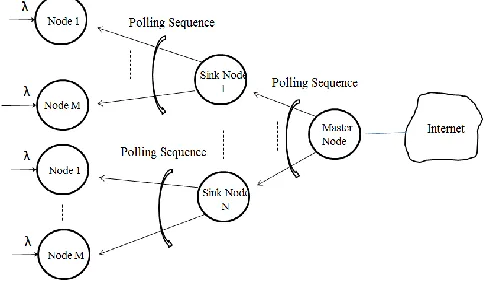
[image:2.612.324.567.329.473.2]It is known that human skin is not a good electric conductor so that some implanted sensor nodes may not have direct communication with sink node. For instance, the sensor nodes implanted at back of body may have some difficult to communicate to the sink node placed in a belt at front of human body. To cope with this problem we propose the use of two or more sink nodes placed in a belt at different locations, so that a group of sensor nodes at back can communicate with the sink node located at back and a group of sensor nodes in front can communicate with sink node placed at front. To collect the data from sink nodes it is provided another node denoted master node. To collect data, the sink nodes as well master node use the polling technique. This structure will be denoted hierarchical polling-based access scheme as shown in Fig. 1.
Figure 1. Hierarchical polling-based structure.
International Journal of Emerging Technology and Advanced Engineering
Website: www.ijetae.com (ISSN 2250-2459,ISO 9001:2008 Certified Journal, Volume 4, Issue 8, August 2014)
398 If the data packet from the polled sensor node doesn’t arrive, the sink node infers that the node doesn’t have packets to transmit and goes to other sensor node in sequence to poll. Thus, in this proposed protocol, the sink node does almost all of the communication functions, leaving the sensor node only the packet transmission function. This same communication protocol can be used in second level, that is, when the master node polls sink nodes to get the data. For WBSN, just two hierarchical levels may be enough.
A sensor node can save energy by keeping the transceiver in an off state when is not transmitting packets. Another way to save sensor node energy is to implement functions at the node in which the sensors send only relevant information to the event observer. For instance, a sensor monitoring body temperature sends only measurements which are above a certain value. The other criterion could be to transmit just the packets that are outside of a certain range.
Some different types of functions, as shown in Tab. 1, can be implemented. In a sensor node implemented with threshold function type, only packets carrying information above a threshold are sent. In the case of an out-range function type, the sensor nodes sends packets with information that is outside of a certain range. For example, in a sensor node responsible for the heart-beat monitoring, it is desirable that only the measurements representing risks for a patient’s life be sent. For instance, the normal heart beat for a particular patient is 100 beats per minute and it can vary between 80 and 120 beats per minute, then should be sent only measurements less than 80 or greater than 120 beats per minute.
In the above-mentioned criteria, it is possible that there may be a hiatus where the nodes do not transmit any packet because no measurement satisfies the specified criteria for the transmission. Thus, to avoid a long silence of the sources, the discarded packets are counted and when this counting reaches a certain value, the next packet is sent, regardless if the measurement satisfies the established criteria or not. These functions represent the controlled threshold and controlled out-range functions in Tab. I.
IV. PERFORMANCE EVALUATION
To analyze the proposed WBSN based on the hierarchical polling access control, the following assumptions are adopted.
Each sensor node is using some kind of function type described in Tab.1, so that only relevant packets containing measurements above a certain value or outside a certain range are randomly sent by sensor nodes. Using this approach, the Poisson distribution of rate λ packets/sec can be approximately adopted at output of each sensor node. A deterministic packet length distribution with average E{X} bits long is adopted and is the same for all nodes. The channel capacity from sensor nodes to the sink node (or vice versa) or sink nodes to the master node (or vice versa) is R bits/sec.
TABLEI FUNCTION TYPES
Function
type Description
Threshold Send packets carrying information above a threshold.
Controlled Threshold
Send packets containing information above a threshold or next packet when discarded packets reached a predefined number. Out-range Send packets carrying information outside a
certain range.
Controlled Out-range
Send packets satisfying Out-range criterion or next packet when discarded packets reached a predefined number.
The number of sensor nodes in each group will be considered M and the number of sink nodes is N.
The walk time, w, between two consecutive sensor nodes in the polling is constant and same for all nodes. The propagation time of a sensor node to the sink node is same for all nodes and is included in walk time.
International Journal of Emerging Technology and Advanced Engineering
Website: www.ijetae.com (ISSN 2250-2459,ISO 9001:2008 Certified Journal, Volume 4, Issue 8, August 2014)
[image:4.612.49.291.427.632.2]399
Figure 2. Second level performance model.
In the second case, both sensor nodes and sink nodes have infinite size buffers and exhaustive service will be provided in both first and second levels.
A. Single Buffer Case 1) First level performance
The use of a small buffer size in a WBSN is important because the energy can be saved. In this subsection the analysis of one size buffer for hierarchical WBSN is carried out.
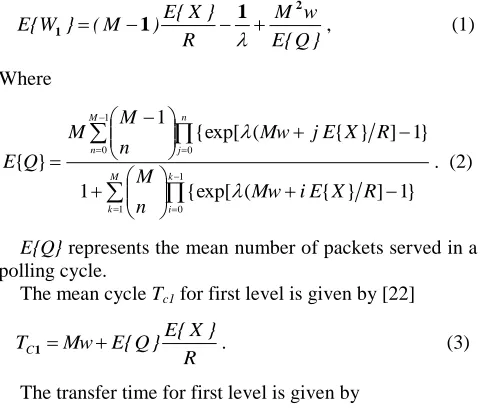
The expression of waiting time for the polling technique using single buffer case has been solved and the expression is given by [22]
} Q { E w M R } X { E ) M ( } W { E 2 1 1
1
, (1)
Where
1 0 1 1 0 0 } 1 ] } { ( {exp[ 1 } 1 ] } { ( {exp[ 1 } { k i M k M n n j R X E i Mw n M R X E j Mw n M M Q E . (2)
E{Q} represents the mean number of packets served in a polling cycle.
The mean cycle Tc1 for first level is given by [22]
R } X { E } Q { E Mw
TC1 . (3)
The transfer time for first level is given by
} W { E R } X { E } T {
E 1 1 . (4)
The packet loss probability for the blocked packets when the buffer has already stored a packet is given by [22]
1 1 1 } T { E } T { E
PL . (5)
For illustration of the above equations, a numerical example will be given. Let the packet length be E{X} = 900 bits, the number of sensors be M = 20, the channel capacity from nodes to sink node or vice-versa be R = 20 kbps and the authorization packet length be 10% of data packet E{X}. The above data packet length used is the average packet length obtained from [2], [18] and [19]. The transmission time of authorization packet is 90 / 20000 = 4.5 msec. Assuming the bit synchronism time at a node is equal to 2 msec, the walk time can be calculated as w = 4.5 + 2 = 6.5 msec.
Defining the first level input load as
R } X { E M =
S1 , (6)
Eqs. 1, 2 and 4 can be calculated numerically for each value of S1. For instance, for S1 = 0.5, the value of λ is
0.556, and using these values in Eq. 2 and solving numerically the value of E{Q} will be 2.411 packets and E{W1} = 133.25 msec. The transfer time is 178.25 msec
and the mean cycle time and packet loss probability are 238.51 msec and 9.01%, respectively.
The effective arrival rate λeff is given by
) 1
( L
eff
P
. (17)Thus λeff is 0.506 packets/sec and the number of packets
waiting in the buffer is by Little rule E{Nq} = λeff E{W1) =
0.0674245 pckts.
[image:4.612.322.571.562.704.2]To overcome high loss of packets and long transfer time, smaller values of input load can be used. Figs. 3 and 4 show the transfer time and loss probability for various values of input load and number of sensors nodes.
International Journal of Emerging Technology and Advanced Engineering
Website: www.ijetae.com (ISSN 2250-2459,ISO 9001:2008 Certified Journal, Volume 4, Issue 8, August 2014)
400
Figure 4. Loss probability of first level in function of input load.
As can be noticed, the packet loss is higher for M =10 than M =30 because the input rate λ is inversely proportional to M obeying Eq. 6. For total input rates about 0.1 and 0.2 the loss probabilities are less than 2% and 4%, respectively, regardless of the value of M, which could be a good operation of the WBSN whilst saving energy.
[image:5.612.320.571.114.449.2]The difference between input rate and effective input rate at each node becomes greater as the total input rate increases as shown in Fig. 5.
Figure 5. Input rates λ and λeff of first level in function of input load.
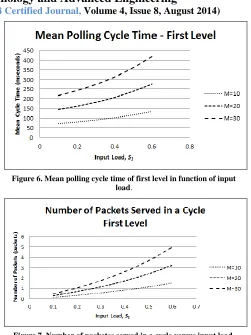
[image:5.612.50.292.136.289.2]On the other hand, the mean polling cycle time is directly proportional to the number of nodes and increases as the nodes grow as can be seen in Fig. 6. The cycle time also increases as the total input load is increasing.
Figure 6. Mean polling cycle time of first level in function of input load.
Figure 7. Number of packetes served in a cycle versus input load.
Figure 7 shows the number of packets served in a cycle. The mean number of packets served is small, ranging from 0.15 packets for S1=0.1 and M=10 to 5 packets for S1=0.6 and M=30
2) Second level performance - exhaustive service case By assuming an exhaustive polling service, i.e., when a sensor node is inspected all the packets are served including those arriving during the service time, the average cycle time is given by
, (7)
Where S2 is given by
(8)
Where S1 = MλE{X}/R is the load of each group of
[image:5.612.49.289.422.575.2]International Journal of Emerging Technology and Advanced Engineering
Website: www.ijetae.com (ISSN 2250-2459,ISO 9001:2008 Certified Journal, Volume 4, Issue 8, August 2014)
401 The stability condition is given by
. (9)
The stability condition means that the polling scheme can complete the cycles without any buffer at nodes having packets waiting for long (infinite) times.
The queuing time in a buffer in the second level is given by [22]
(10)
for deterministic packet length.
The assumption of constant walk time between two nodes adopted in Eq. 10 can be explained by the fact that the distances from sensor nodes to the sink node in a WBSN are very small and the authorization packet can simultaneously reach almost all the sensor nodes.
The packet transfer time for the second level is given by
} W { E R
} X { E } T {
E 2 2 . (11)
The propagation time is neglected in the above equation, assuming that the distance from a sink node to the master node is very short reaching only a few meters.
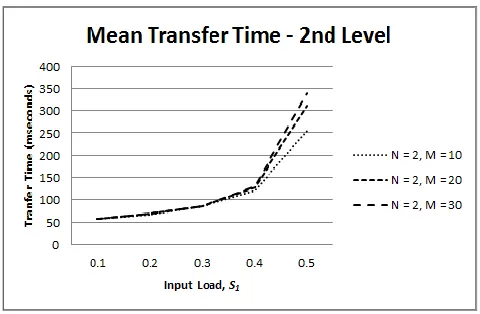
For illustration of the above equations, a numerical example will be given. Let the packet length be E{X} = 900 bits, the channel capacity from sink nodes to the master node or vice-versa be R = 20 kbps and the authorization packet length be 10% of data packet E{X}, as used in single buffer case, and the number of sink nodes be N = 2. Assuming the bit synchronism time at a node is equal to 2 msec, the walk time can be calculated as w = 4.5 + 2 = 6.5 msec. Assuming total input load of 10%, the numbers of sensor nodes of M = 10 and M = 20 and by using Eq. 5, it can find out that loss probabilities PL are 1,81% and 1.31%, respectively. Using these values in Eqs. 8, 10 and 11, the transfer times in a buffer are 57.79 msec and 57.83 msec, for M = 10 and M =20, respectively. For an input load of 50%, and M = 10 and M = 20, the transfer times are 254.00 msec and 311.53 msec, respectively. For a load of 50%, the mean polling cycle times using Eq. 7 are 115.23 msec and 144.27 msec for M = 10 and M = 20, respectively.
Figures 8 and 9 show the mean transfer time and mean polling cycle time for other values.
[image:6.612.324.564.132.289.2][image:6.612.324.565.495.650.2]
Figure 8. Mean transfer time of second level in function of first level input load of a group.
Figure 9. Mean polling cycle time in function of first level input load of a group.
International Journal of Emerging Technology and Advanced Engineering
Website: www.ijetae.com (ISSN 2250-2459,ISO 9001:2008 Certified Journal, Volume 4, Issue 8, August 2014)
402 Figure 10 shows the total transfer time adding first and second levels of hierarchical polling-based MAC scheme. The curves of Fig. 10 indicate that the transfer times still keep very small, less than 0.5 seconds for almost all input load so that the polling technique may be convenient for the application in WBSN.
B. Infinite Buffer Case
1) First Level – exhaustive service case
For the same assumptions adopted in single buffer case, that is, Poisson distribution of rate λ packets/sec at input of each sensor node, a deterministic packet length distribution with average E{X} bits long for all nodes, a channel capacity from sensor nodes to the sink node (or vice versa) or sink nodes to the master node (or vice versa) of R bits/sec, and numbers of sensor nodes M and N for each group and sink nodes, respectively, the following expressions can be written.
The average cycle time is given by
, (12)
Where S1 is given by Eq. 6.
The queuing time in a buffer in the first level is given by [22]
(15)
for deterministic packet length.
The packet transfer time for the first level is given by
} W { E R
} X { E } T {
E 3 3 . (16)
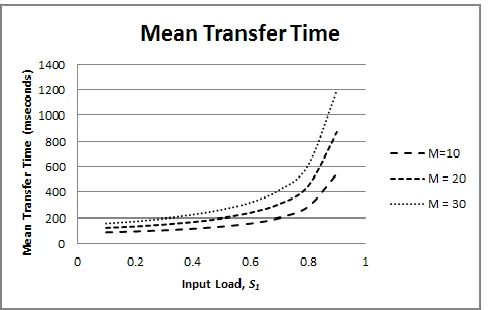
Figure 11 shows the packet transfer time for various values of M. For load up to 0.8 the transfer times are low keeping below 600 milliseconds for any value of M. For load greater than 0.8 the transfer times become prohibitive.
Figure 11. Mean transfer time for first level with infinite buffer.
[image:7.612.324.568.133.288.2]The mean cycle time is shown in Fig. 12 for various values of M. For load less than 0.7 the polling system is very stable, keeping the cycle time less than 700 ms for any value of M. However, for load greater than 0.8 the system is becoming unstable with very large cycle time.
Figure 12. Mean cycle time for first level with infinite buffer.
2) Second Level – exhaustive service case
[image:7.612.322.568.373.535.2]International Journal of Emerging Technology and Advanced Engineering
Website: www.ijetae.com (ISSN 2250-2459,ISO 9001:2008 Certified Journal, Volume 4, Issue 8, August 2014)
403
Figure 13. Second level performance model for infinite buffer case.
The mean cycle time for this case is given by
, (16)
Where S4 is given by
(17)
and S1 is the total load of a group of first level as defined in
Eq. 6.
The stability condition is given by
. (18)
The queuing time in a buffer in the second level is given by
(19)
for deterministic packet length.
The packet transfer time for the second level is given by
} W { E R
} X { E } T {
E 4 4 . (20)
Figures 14 and 15 show the mean transfer time and mean cycle time, respectively, for N =2 and various values of M. Since the load, S4, and the queuing time, E{W4}, as defined
[image:8.612.324.566.132.293.2]in Eqs. 17 and 19, are only in function of N, the curves in Figs. 14 and 15 are same for M = 10, 20 and 30. However, the meaning of values in Y axes is different for each input load. For instance, for an input load of S1 = 0.4, the value of transfer time for M = 10 is 154,5 milliseconds. This same value is found for M = 20 or 30, but the packet arrival rate, λ, is half or one third of M = 10, obeying the expression λ = S1R/ME{X}. The same meaning can be given to the mean cycle time of Fig. 15.
Figure 14. Second level mean transfer time versus first level input load of a group.
Figure 16 shows the total transfer time, including the first and second levels. It can be noticed that an input load up to 0.4 the polling system is stable, with total transfer time less than 400 msec, regardless the value of M. However, for input load greater than 0.4 the transfer time increases very fast, becoming unstable. Comparing Fig. 16 to Fig. 11, it can be observed that although the first level could accept a high load, this load is limited to the transfer times of the second level.
International Journal of Emerging Technology and Advanced Engineering
Website: www.ijetae.com (ISSN 2250-2459,ISO 9001:2008 Certified Journal, Volume 4, Issue 8, August 2014)
[image:9.612.49.293.129.298.2]404
Figure 16. Total mean transfer time including first and second levels in function of input load of a group.
V. CONCLUSION
A hierarchical polling-based access scheme for Wireless Body Sensor Network (WBSN) was proposed in this paper. The main technical advantage of the polling access mechanism is the non-necessity of periodical frame synchronization as the TDMA technique requires, and it has centralized control of sensors convenient for WBSN. The proposed access scheme uses the sink nodes in a hierarchical structure so that only sensor nodes having direct communication with a sink node are served. The proposed communication protocol is simple, giving to the sink node majority of controls and leaving with the sensor nodes only the function of packet transmission, thus saving energy.
The mathematical modeling of the proposed scheme was done using one and infinite size buffers at each sensor node in the first level of hierarchy and infinite size buffers for sink nodes in second level.
The analysis showed that for the first level using single buffer the transfer times can be kept very small. However, packet loss for high load (above 0.4) is prohibitive and must be avoided. For the infinite buffer case in the first level using exhaustive polling technique, the transfer time can be kept below 600 msec for load as high as 0.8, however, the load is limited in function of the performance of second level. The analysis for second level using exhaustive service is dependent of number of sink nodes and also the number of sensor nodes of first level. Considering only two sink nodes, which we consider appropriate for WBSN, for single buffer case considering any value of M (10, 20 and 30) and input load S1 of up to
0.5 the transfer times are less than 350 ms for all cases.
However, for values above 0.5 the operation is becoming unstable and the transfer times are very larger. The total transfer times considering the first and second levels for load up to 0.5 are less than 500 ms for all cases. For infinite buffer case the total transfer time including first and second levels is very sensitive to the number of sensor nodes of first level. The load up to 0.4 the transfer times are less than 400 msec and the polling system is stable. However, for load above 0.4 the system is becoming unstable and a small increment in the load a larger transfer times are obtained. These results show that the hierarchical polling scheme can be convenient for WBSN applications. It must be pointed out that used link capacity is not high, mainly in the case of communication between sink nodes and master node which was only 20 kbps. In this segment a higher transmission capacity can be provided so that a better network performance can be expected.
Acknowledgment
This work was supported by São Paulo Research Foundation (FAPESP) under grant No 2011/12463-0.
REFERENCES
[1] Latré B., Braem B., Moerman I., Blondia C. and Demeester P. 2011. A survey on wireless body area networks. Wireless Networks, Volume 17 Issue 1, January, Kluwer Academic Publishers Hingham, MA, USA.
[2] Otal B., Alonso L. and Verikoukis C. 2010. Towards energy saving wireless body sensor networks,” in Health Care Systems. In Proceedings of IEEE International Conference on Communications (ICC 2010), Second International Workshop on Medical Applications Networking (MAN 2010), Capetown, South Africa. [3] Yan Z. and Liu B. 2011. A context aware MAC protocol for medical
wireless body area network. In Wireless Communications and Mobile Computing Conference (IWCMC), 7th International, pp. 2133-2138.
[4] Liu B., Yan Z. and Chen C. W. 2011. CA-MAC: A Hybrid context-aware MAC protocol for wireless body area networks. In 13th IEEE International Conference on e-Health Networking Applications and Services (Healthcom), pp. 213-216.
[5] Zhu X., Han S., Huang P., Mok A.K. and Chen D. 2011. MBStar: a real-time communication protocol for wireless body area networks. In 23rd Euromicro Conference on Real-Time Systems (ECRTS), pp. 57-66.
[6] Layerle D. and Kwasinski A. 2011. A power efficient pulsed MAC protocol for body area networks. In IEEE 22nd International Symposium on Personal Indoor and Mobile Radio Communications (PIMRC), pp. 2244-2248.
[7] Tselishchev Y. 2011. Designing a medium access control protocol for body area networks. In IEEE International Symposium on a World of Wireless, Mobile and Multimedia Networks (WoWMoM). [8] Borges L.M., Velez F. J. and Lebres A.S. 2011. Performance
International Journal of Emerging Technology and Advanced Engineering
Website: www.ijetae.com (ISSN 2250-2459,ISO 9001:2008 Certified Journal, Volume 4, Issue 8, August 2014)
405
[9] Kutty S. and Laxminarayan J.A. 2010. Towards energy efficient protocols for wireless body area networks. In International Conference on Industrial and Information Systems (ICIIS). [10] Huaming L. and Jindong T. 2010. Heartbeat-driven medium-access
control for body sensor networks. IEEE Transactions on Information Technology in Biomedicine, Vol. 14, No. 1, January 2010, pp. 44-51.
[11] Ali K.A., Sarker J.H. and Mouftah H.T. 2010. Urgency-based MAC protocol for wireless sensor body area networks. In IEEE International Conference on Communications Workshops (ICC). [12] Khaled A. A., Jahangir H. S. and Mouftah T. H. 2010. QoS-based
MAC protocol for medical wireless body area sensor networks. In IEEE Symposium on Computers and Communications (ISCC), pp. 216-221.
[13] Zhang X., Jiang H., Chen X., Zhang L., Wang Z. 2009. An energy efficient implementation of on-demand MAC protocol. In Medical Wireless Body Sensor Networks IEEE International Symposium on Circuits and Systems. ISCAS 2009, pp. 3094-3097.
[14] Marinkovic S., Spagnol C. and Popovici E. 2009. Energy-efficient TDMA-based MAC protocol for wireless body area networks. In Third International Conference on Sensor Technologies and Applications. SENSORCOMM '09, pp. 604-609.
[15] Fang G.and Dutkiewicz E. 2009. BodyMAC: energy efficient TDMA-based MAC protocol for wireless body area networks. In 9th International Symposium on Communications and Information Technology. ISCIT 2009, pp. 1455-1459.
[16] Oliveira S. S. and Motoyama S. 2009. Applications oriented medium access control protocols for wireless sensor networks. IEEE Latin America Transactions, v. 7, Issue 5, 2009, pp. 586-593.
[17] Kwak K. S., Ullah S. and Ullah N. 2010. An overview of IEEE 802.15.6 standard. In ISABEL, 2010, Rome, Italy.
[18] Omeni O., Wong A., Burdett A.J. and Toumazou C. 2008. Energy efficient medium access protocol for wireless medical body area sensor networks. IEEE Transactions on Biomedical Circuits and Systems, Volume: 2 , Issue: 4, 2008, pp. 254-259.
[19] Gravina R., GuerrierI A. and Fortino A. Development of body sensor networks applications using SPINE. 2008. In IEEE International Conference on Systems, Man and Cybernetics. Singapore, 2008. [20] Motoyama S. 2012. Flexible polling-based scheduling with QoS
capability for Wireless Body Sensor Network. In Local Computer Networks Workshops (LCN Workshops), IEEE 37th Conference, pp. 745-752.
[21] Pazeto T.A., Refatti L. F. and Motoyama S. 2012. Polling-based Medium Access Control Scheme for Wireless Body Sensor Network. In International Conference on Wireless Networks - ICWN-12, Las Vegas. pp. 87-93.
[22] Takagi H. 1986. Analysis of Polling Systems. The MIT Press Cambridge, Massachusetts London, England.
[23] Motoyama, S. 2013. Hierarchical Polling-based MAC scheme for Wireless Body Sensor Network. The 2013 International Conference on Wireless Networks - ICWN’13, Las Vegas, USA. p. 103-109. [24] Motoyama, S. 2014. Performance of Hierarchical Polling-based