International Journal of Emerging Technology and Advanced Engineering
Website: www.ijetae.com (ISSN 2250-2459,ISO 9001:2008 Certified Journal, Volume 6, Issue 10, October 2016)
189
Influence of Different Methods on the Results of Unit Weight
Tests
for Asphalt Concrete: Part-I: Direct Measurement Method
Lin Ming-Chao
1, Kuo Fun-Min
2, Huang Li-Jeng
31
Lecturer, 2Master Student, 3Associate Professor, Department of Civil Engineering, National Kaohsiung University of Applied Sciences, 80778, Taiwan, Republic of China
Abstract— Asphalt concrete is usually employed for the
pavement material in highway engineering and many kinds of sustainable materials are attempted for waste reduction and environmental protection. According to the Chapter 02742 of Specification the thickness and compaction of the pavement are very important for the quality of construction but in reality only saturated-surface-dry weight method (SSDWM) other than wax sealing Method (WSM) was usually adopted in experiments. This research is proposed to adopt three experimental methods including direct measurement method (DMM), SSDWM and WSM, and two kinds of specimens:, the Marshall specimens and drilled specimens. Different contents and mixtures are tried and tested for investigating the difference. Experimental results show that DMM can only be used for measurement of Marshall specimen, submerge time has no obvious effect in SSDWM, the maximal difference of measured thickness and unit weight between WSM and SSDWM may reach 0.06cm and 0.85%, respectively. Finally overall grey correlation was employed and the results depict that volumetric specific weight and unit weight play the most important role among the content of specimen. This paper conducts the Part I, i.e. the direct measurement method.
Keywords—Asphalt Concrete, Unit Weight,
Basic-Oxygen-Furnace (BOF), Wax Sealing Method (WSM), Saturated-surface-dry weight Method (SSDWM).
I. INTRODUCTION
Asphalt concrete (AC) pavements, acting as one of flexible pavements applied in highway engineering, become important and commonly adopted pavements nowadays in Taiwan due to its relatively short working period, easy repair and construction [1, 2]. The mechanical behaviour of AC pavements are: relatively low stiffness, high ductility, good flexibility, nice vibration absorbing capacity, high bearing capacity and stability, high fatigue resistance, good skid resistance, high workability, good impermeability, easy backfilling and swelling and cracking sustainability, etc.
However, thickness and compaction of pavements are two representative indices for evaluation of the pavement quality.
Currently in Taiwan, according to the Chapter 02742 of Specification the thickness (e.g. CNS 8755) and compaction (e.g. CNS 12390) of the pavement are very important for the quality of construction but in reality only saturated-surface-dry weight method (SSDWM) other than wax sealing Method (WSM) was usually adopted in experiments [3]. Based on previous experience most of experts considered the unit weight obtained from WSM would be lower than those obtained from SSDWM. This leads to the WSMs were scarcely employed in practice.
Recently many research works are conducted on the application of recycling materials to pavement construction and repairs considering the waste reduction and environment protection. Among these the studies on the basic characteristics and engineering properties of basic oxygen furnace (BOF) steel slag used for replacement of natural aggregates for asphalt concretes [4-8].
On the other hands, many techniques were also investigated and attempted for the measurement of thickness of pavement structures, such as impact echo method [9], ground penetration radar techniques [10-12] and non-destructive method [13]. However, these approaches are relatively high costly.
In this research we employed the experimental approach. Preparing Marshall specimen and in-site drilling specimen, conducting three kinds of testing: (1) direct measurement method (DMM); (2) saturated-surface-dry weight method (SSDWM); and (3) wax sealing Method (WSM) and finally we compare the results obtained from three different testing methods. This paper present the Part I: direct measurement method (DMM).
II. EXPERIMENT PLAN
A. Testing Materials
The testing materials employed in this study include the following:
(1) Asphalt: Oil-soluble asphalt is adopted;
International Journal of Emerging Technology and Advanced Engineering
Website: www.ijetae.com (ISSN 2250-2459,ISO 9001:2008 Certified Journal, Volume 6, Issue 10, October 2016)
190
(3) Artificial aggregates: coming from industrial by-products, such as blast-furnace (BF) slag and basic-oxygen- furnace (BOF) slag and electric-arc-furnace (EAF) slag.
In the research we adopted BOF slags as the ingredients of aggregates of AC samples, the mixture is 1:1 (BOF) using 6% and 3% stones simultaneously. The physical properties of the aggregates are shown in Table I.
The physical properties of asphalt used in preparing experimental samples such as specific gravity and viscosities measured at different temperatures are shown in Table II.
TABLE I
PHYSICAL PROPERTIES OF BOF SLAGS AGGREGATES
Item Property Data
1 Specific Gravity 3.32
2 Abrasion and Impact of Los Angles Machine
10.3 %
3 Sand Equivalent 92.5 %
4 Liquid Limit (LL) NP
5 Plastic Index (PI) NP
6 Swelling Percentage 2.5 %
7 Unit Weight of Dry Soil 2.58
8 pH Value 12.5
9 Moisture Content 3.5 %
10 Fragile Percentage 100 %
11 Flatness Percentage 3.2 %
12 Sulphate Content 5.6 % ~ 8.5 %
TABLE II
PHYSICAL PROPERTIES OF ASPHALT
Item Property Data
1 Specific Gravity 1.036~1.039
2 Viscosity: 60 oC Viscosity:135 oC
1970 (P) 39 (P)
B. Testing Variables
Based on the specification of CNS8755 in the DMM of the research we adopted a way to measure the thickness of each sample at 4 different positions and take the averaged value [14]. Then we calculate the unit weight of the specimen. However, the effect of using 2- or 6-points thickness measurement on the Marshall and drilled samples remains to be studied.
C. Specimen Preparation
Totally 6 mixture combinations for Marshall specimen
were considered as follows:
(1) Natural material with 1/2 " dense grades; (2) Natural material with 3/4 " dense grades; (3) Natural material with 3/4 " coarse grades; (4) BOF slag with 1/2 " dense grades; (5) BOF slag with 3/4 " dense grades; (6) BOF slag with 3/4 " coarse grades;
On the other hands totally 3 mixture combinations for drilled specimen were considered as follows:
(1) Natural material with 1/2 " dense grades; (2) Natural material with 3/4 " dense grades; (3) BOF slag with 1/2 " dense grades;
The grade distributions for each combinations can be found in [15].
D. Mixture Preparation
[image:2.612.53.285.284.605.2]The procedures for preparing the mixture materials can be referred to [15] and during the process of mixture temperature should be kept and the asphalt mixture should be quickly dumped into steel boxes as shown in Fig. 1.
Figure 1 Prepared asphalt concrete mixtures
E. Marshall Testing Specimen Preparation
The specimen preparation for Marshall Testing are based on CNS 12395 specification and the detailed procedures can be followed as depicted in [16].
F. Experimental Methods
[image:2.612.330.558.403.572.2]International Journal of Emerging Technology and Advanced Engineering
Website: www.ijetae.com (ISSN 2250-2459,ISO 9001:2008 Certified Journal, Volume 6, Issue 10, October 2016)
191
(1) 2-points:
2
/
)
(
h
1h
2h
(1)(2) 4-points:
4
/
)
(
h
1h
2h
3h
4h
(2)(3) 6-points:
6
/
)
(
h
1h
2h
3h
4h
5h
6h
(3)Among the above three methods only 4-points measurement is recommended by the specification. And 2- and 6-points are additional studied measurement and attempt for comparison.
After the thickness is obtained the unit weight of a cylinder of specimen can be calculated from
4
/
2
h
D
W
V
W
(4)Equations (1)~(4) form the basic framework of DMM of this study.
When DMM is employed the following should be taken into consideration:
1)The two ends of specimen should be kept to be smoothly
flat without any flaws or cracks and the callipers should be kept to be exactly vertical to the top surface when thickness is to be measured.
2)The circumference of top surfaces of specimen can be
divided into 8 equal segments for 8 measurements to obtained averaged thickness.
3)If the specimens are absolutely flat on the top and
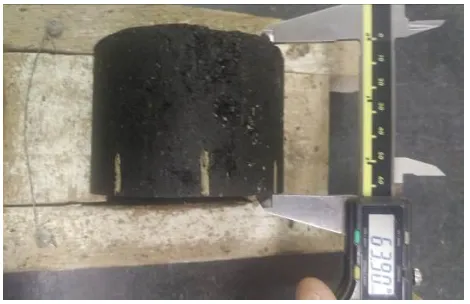
bottom surfaces the measurement of thickness can be conducted by the use of suspension plate and the actual values of specimen can be obtained by the measured values minus the plate thickness. (Fig. 2).
[image:3.612.327.562.133.285.2]4) When diameters are required top and bottom surfaces are measured 4 times, respectively, and then the averaged diameters are obtained. (Fig. 3).
[image:3.612.329.559.302.457.2]Figure 2 Direct measurement on thickness of a Marshall sample
Figure 3 Direct measurement on diameter of a Marshall sample
III. EXPERIMENTAL RESULTS
A. Natural material with 1/2" dense grades of Marshall Specimen
International Journal of Emerging Technology and Advanced Engineering
Website: www.ijetae.com (ISSN 2250-2459,ISO 9001:2008 Certified Journal, Volume 6, Issue 10, October 2016)
192
Different impact levels results in different thickness;
from 0.05cm~0.032cm difference in thickness for heavy
class pavement (75 impacts), 0.006cm~0.010cm difference in thickness for intermediate class pavement (50 impacts), to 0.002cm~0.018cm for light class pavement (35 impacts). However, among these data nearly no difference of thickness exists between those obtained from 4- and 6-points; while a little difference measured by 2-points measurement. This might lead to a thumb rule that more than 2 points are required in the direct measurement of thickness of Marshall specimen.
B. Natural material with 3/4" dense grades of Marshall Specimen
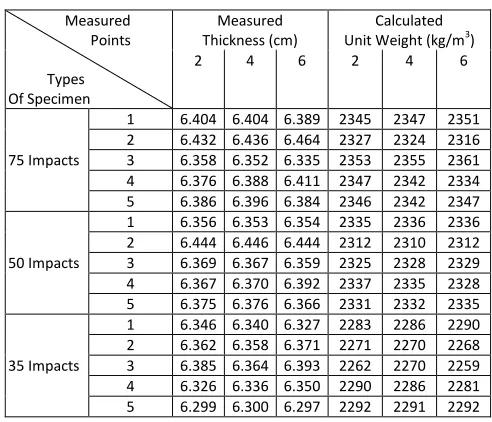
Table IV depicts the results of measured thicknesses and calculated unit weights, using 2-, 4- and 6-points measurement respectively, for Natural material with 3/4" dense grades of Marshall Specimen. CNS 12395 specification is satisfied for these specimen. Different impact levels results in different thickness; from 0.012cm~0.035cm difference in thickness for heavy class pavement (75 impacts), 0.002cm~0.025cm difference in thickness for intermediate class pavement (50 impacts), to 0.003cm~0.029cm for light class pavement (35 impacts). However, among these data nearly no difference of thickness exists between those obtained from 4- and 6-points; while a little difference measured by 2-points measurement. From this results 4-points measurements as recommended by specification seems to be the best one.
TABLE III
MEASURED THICKNESS AND CALCULATED UNIT WEIGHT OF NATURAL MATERIAL WITH 1/2 " DENSE GRADES OF MARSHALL SPECIMEN
Measured Points Types Of Specimen
Measured Thickness (cm)
Calculated Unit Weight (kg/m3)
2 4 6 2 4 6
75 Impacts
1 6.342 6.329 6.310 2318 2321 2330 2 6.341 6.346 6.325 2314 2314 2321 3 6.363 6.362 6.345 2314 2314 2320 4 6.364 6.366 6.369 2308 2310 2307 5 6.343 6.342 6.326 2320 2321 2326
50 Impacts
1 6.424 6.431 6.425 2278 2274 2278 2 6.430 6.429 6.423 2273 2274 2275 3 6.347 6.347 6.337 2305 2304 2309 4 6.389 6.386 6.393 2284 2285 2282 5 6.388 6.385 6.373 2288 2285 2293
35 Impacts
1 6.383 6.389 6.387 2244 2244 2242 2 6.395 6.394 6.376 2242 2244 2249 3 6.368 6.374 6.366 2246 2245 2247 4 6.346 6.358 6.351 2252 2249 2251 5 6.314 6.314 6.311 2271 2269 2272
TABLE IV
MEASURED THICKNESS AND CALCULATED UNIT WEIGHT OF NATURAL MATERIAL WITH 3/4 " DENSE GRADES OF MARSHALL SPECIMEN
Measured Points
Types Of Specimen
Measured Thickness (cm)
Calculated Unit Weight (kg/m3)
2 4 6 2 4 6
75 Impacts
1 6.404 6.404 6.389 2345 2347 2351 2 6.432 6.436 6.464 2327 2324 2316 3 6.358 6.352 6.335 2353 2355 2361 4 6.376 6.388 6.411 2347 2342 2334 5 6.386 6.396 6.384 2346 2342 2347
50 Impacts
1 6.356 6.353 6.354 2335 2336 2336 2 6.444 6.446 6.444 2312 2310 2312 3 6.369 6.367 6.359 2325 2328 2329 4 6.367 6.370 6.392 2337 2335 2328 5 6.375 6.376 6.366 2331 2332 2335
35 Impacts
1 6.346 6.340 6.327 2283 2286 2290 2 6.362 6.358 6.371 2271 2270 2268 3 6.385 6.364 6.393 2262 2270 2259 4 6.326 6.336 6.350 2290 2286 2281 5 6.299 6.300 6.297 2292 2291 2292
C. Natural material with 3/4" coarse grades of Marshall Specimen
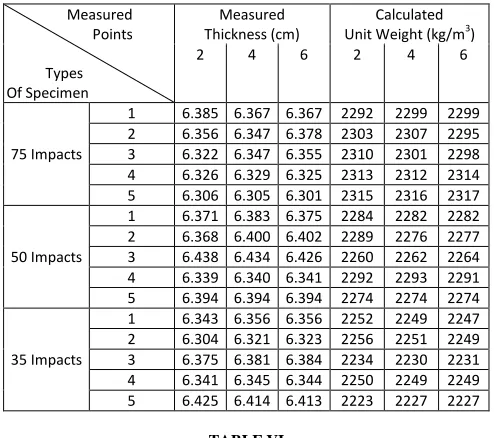
Table V presents the results of measured thicknesses and calculated unit weights, using 2-, 4- and 6-points measurement respectively, for Natural material with 3/4" coarse grades of Marshall Specimen. Different impact levels results in different calculated unit weights; from 7
kg/m3~13 kg/m3 difference in thickness for heavy class
pavement (75 impacts), 0 kg/m3~12 kg/m3 difference in
thickness for intermediate class pavement (50 impacts), to
1 kg/m3~7 kg/m3 for light class pavement (35 impacts).The
errors of 2-, 4-, and 6- points measurements on thicknesses are all within 1%.
D. BOF slag with 1/2" dense grades of Marshall Specimen
[image:4.612.320.566.164.375.2]International Journal of Emerging Technology and Advanced Engineering
Website: www.ijetae.com (ISSN 2250-2459,ISO 9001:2008 Certified Journal, Volume 6, Issue 10, October 2016)
193
TABLE V
MEASURED THICKNESS AND CALCULATED UNIT WEIGHT OF NATURAL MATERIAL WITH 3/4 " COARSE GRADES OF MARSHALL SPECIMEN
Measured Points
Types Of Specimen
Measured Thickness (cm)
Calculated Unit Weight (kg/m3)
2 4 6 2 4 6
75 Impacts
1 6.385 6.367 6.367 2292 2299 2299 2 6.356 6.347 6.378 2303 2307 2295 3 6.322 6.347 6.355 2310 2301 2298 4 6.326 6.329 6.325 2313 2312 2314 5 6.306 6.305 6.301 2315 2316 2317
50 Impacts
1 6.371 6.383 6.375 2284 2282 2282 2 6.368 6.400 6.402 2289 2276 2277 3 6.438 6.434 6.426 2260 2262 2264 4 6.339 6.340 6.341 2292 2293 2291 5 6.394 6.394 6.394 2274 2274 2274
35 Impacts
1 6.343 6.356 6.356 2252 2249 2247 2 6.304 6.321 6.323 2256 2251 2249 3 6.375 6.381 6.384 2234 2230 2231 4 6.341 6.345 6.344 2250 2249 2249 5 6.425 6.414 6.413 2223 2227 2227
TABLE VI
MEASURED THICKNESS AND CALCULATED UNIT WEIGHT OF BOF SLAG WITH 1/2 " DENSE GRADES OF MARSHALL SPECIMEN
Measured Points
Types Of Specimen
Measured Thickness (cm)
Calculated Unit Weight (kg/m3)
2 4 6 2 4 6
75 Impacts
1 6.221 6.235 6.237 2617 2611 2610 2 6.236 6.245 6.244 2609 2605 2606 3 6.233 6.251 6.257 2605 2598 2595 4 6.257 6.256 6.259 2599 2598 2598 5 6.284 6.276 6.274 2584 2587 2588
50 Impacts
1 6.363 6.379 6.385 2537 2527 2528 2 6.295 6.306 6.313 2563 2557 2556 3 6.354 6.330 6.343 2542 2554 2547 4 6.319 6.333 6.320 2554 2550 2554 5 6.305 6.315 6.315 2562 2556 2558
35 Impacts
1 6.284 6.285 6.288 2524 2523 2522 2 6.245 6.243 6.236 2542 2544 2545 3 6.263 6.272 6.273 2537 2532 2533 4 6.244 6.245 6.246 2540 2540 2539 5 6.293 6.290 6.287 2522 2525 2524
E. BOF slag with 3/4" dense grades of Marshall Specimen
It can be observed from Table VII the results of measured thicknesses and calculated unit weights, using 2-, 4- and 6-points measurement respectively, for BOF slags with 3/4" dense grades of Marshall Specimen.
There exists nearly no difference in the thickness measurement and unit weight calculation in these cases.
TABLE VII
MEASURED THICKNESS AND CALCULATED UNIT WEIGHT OF BOF SLAG WITH 3/4" DENSE GRADES OF MARSHALL SPECIMEN
Measured Points Types Of Specimen
Measured Thickness (cm)
Calculated Unit Weight (kg/m3)
2 4 6 2 4 6
75 Impacts
1 6.428 6.441 6.439 2645 2639 2640 2 6.450 6.412 6.403 2639 2653 2658 3 6.442 6.426 6.419 2646 2654 2656 4 6.432 6.461 6.464 2643 2629 2630 5 6.470 6.462 6.459 2632 2635 2637
50 Impacts
1 6.380 6.371 6.376 2599 2601 2600 2 6.348 6.366 6.372 2610 2603 2600 3 6.343 6.362 6.363 2606 2599 2598 4 6.303 6.312 6.313 2621 2618 2617 5 6.267 6.276 6.269 2635 2632 2635
35 Impacts
1 6.291 6.298 6.296 2563 2561 2560 2 6.299 6.290 6.290 2558 2561 2562 3 6.276 6.227 6.207 2563 2587 2592 4 6.245 6.257 6.262 2585 2579 2578 5 6.298 6.308 6.313 2557 2551 2551
F. BOF slag with 3/4" coarse grades of Marshall Specimen
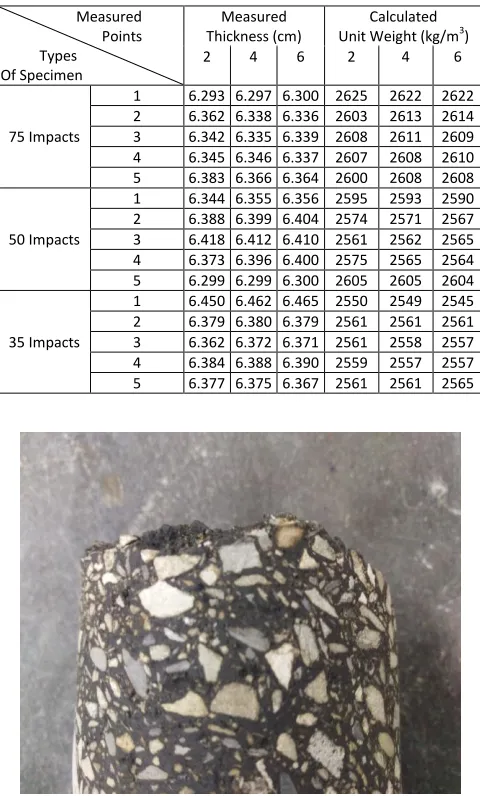
We can realize from Table VIII the results of measured thicknesses and calculated unit weights, using 2-, 4- and 6-points measurement respectively, for BOF slags with 3/4" coarse grades of Marshall Specimen. The differences in measured thicknesses and calculated unit weights are also coming from 2-points measurements. In practical application of using DMM 2-points measurements are not recommended for Marshall specimen even in CNS specification.
G. Natural material with 1/2", 3/4" dense grades and BOF slag with 1/2", 3/4" dense grades of drilled Specimen
The major difference between Marshall specimen and drilled specimen lies in the flatness of the top and bottom surfaces because drilled specimen are usually with cracks and holes after drilling.
[image:5.612.45.292.167.386.2] [image:5.612.320.566.191.402.2]International Journal of Emerging Technology and Advanced Engineering
Website: www.ijetae.com (ISSN 2250-2459,ISO 9001:2008 Certified Journal, Volume 6, Issue 10, October 2016)
194
TABLE VIII
MEASURED THICKNESS AND CALCULATED UNIT WEIGHT OF BOF SLAG WITH 3/4" COARSE GRADES OF MARSHALL SPECIMEN
Measured Points Types Of Specimen
Measured Thickness (cm)
Calculated Unit Weight (kg/m3)
2 4 6 2 4 6
75 Impacts
1 6.293 6.297 6.300 2625 2622 2622 2 6.362 6.338 6.336 2603 2613 2614 3 6.342 6.335 6.339 2608 2611 2609 4 6.345 6.346 6.337 2607 2608 2610 5 6.383 6.366 6.364 2600 2608 2608
50 Impacts
1 6.344 6.355 6.356 2595 2593 2590 2 6.388 6.399 6.404 2574 2571 2567 3 6.418 6.412 6.410 2561 2562 2565 4 6.373 6.396 6.400 2575 2565 2564 5 6.299 6.299 6.300 2605 2605 2604
35 Impacts
1 6.450 6.462 6.465 2550 2549 2545 2 6.379 6.380 6.379 2561 2561 2561 3 6.362 6.372 6.371 2561 2558 2557 4 6.384 6.388 6.390 2559 2557 2557 5 6.377 6.375 6.367 2561 2561 2565
Figure 4 The bottom surface of a typical drilled sample
We can identify from Table IX and Table X, respectively, the results of measured thicknesses and calculated unit weights, using 2-, 4- and 6-points measurement for Natural material with 1/2", 3/4" dense grades and BOF slag with 1/2", 3/4" dense grades of drilled Specimen considering the specimen non-cutting and cutting to be flat surfaces.
However, even after cutting the surfaces to be flat if there exist holes the measured results might be imprecise.
TABLE IX
MEASURED THICKNESS AND CALCULATED UNIT WEIGHT OF NATURAL MATERIAL WITH 1/2", 3/4" GRADES AND BOF SLAG WITH 3/4" DENSE
GRADES OF DRILLED SPECIMEN BEFORE CUTTING SURFACES
Measured Points Types
Of Specimen
Measured Thickness (cm)
Calculated Unit Weight
(kg/m3)
2 4 6 2 4 6
Natural material with 1/2" dense grades
1 5.317 5.435 5.547 2038 1993 1953 2 6.163 6.101 6.083 2053 2078 2080 3 5.657 5.805 5.867 2007 1956 1935 4 7.242 7.111 7.157 2035 2072 2060 5 5.123 5.126 5.031 2050 2048 2088
Natural material with 3/4" dense grades
1 5.112 5.445 5.423 2162 2031 2038 2 5.634 5.490 5.407 1940 1990 2021 3 5.423 5.533 5.481 2118 2075 2096 4 5.606 5.496 5.592 2071 2107 2077 5 5.094 5.174 5.197 2332 2288 2286
BOF slag with 1/2" dense grades
1 6.013 5.709 5.640 2101 2205 2240 2 4.798 4.599 4.593 1907 1988 1992 3 6.585 6.319 6.269 2489 2596 2615 4 7.761 8.097 8.144 2397 2303 2284 5 5.647 5.845 5.738 2557 2473 2516
TABLE X
MEASURED THICKNESS AND CALCULATED UNIT WEIGHT OF NATURAL MATERIAL WITH 1/2", 3/4" GRADES AND BOF SLAG WITH 3/4" DENSE
GRADES OF DRILLED SPECIMEN AFTER CUTTING SURFACES
Measured Points Types
Of Specimen
Measured Thickness (cm)
Calculated Unit Weight
(kg/m3)
2 4 6 2 4 6
Natural material with 1/2" dense grades
1 4.878 4.907 4.895 2221 2207 2214 2 5.825 5.666 5.690 2172 2237 2224 3 4.950 4.998 5.000 2294 2271 2271 4 6.815 6.783 6.790 2163 2173 2171 5 4.753 4.758 4.792 2210 2206 2192
Natural material with 3/4" dense grades
1 4.860 5.059 5.103 2274 2186 2166 2 4.965 4.880 4.838 2201 2239 2259 3 5.220 5.188 5.130 2201 2213 2239 4 5.095 5.206 5.275 2279 2224 2201 5 5.007 5.056 5.089 2373 2342 2334
BOF slag with 1/2" dense grades
1 4.609 4.757 4.803 2742 2645 2630 2 3.384 3.396 3.456 2704 2693 2648 3 6.066 5.900 5.894 2702 2780 2781 4 6.800 7.112 7.140 2736 2622 2606 5 5.058 5.063 4.981 2855 2855 2899
IV. CONCLUDING REMARKS
[image:6.612.48.288.166.564.2] [image:6.612.322.566.180.388.2]International Journal of Emerging Technology and Advanced Engineering
Website: www.ijetae.com (ISSN 2250-2459,ISO 9001:2008 Certified Journal, Volume 6, Issue 10, October 2016)
195
1. DMM offers the most easy and convenient way for
measurement of thickness of asphalt concrete specimen. The averaged results obtained from 2-, 4- and 6-
measurements on the Marshall samples are
approximately equal and thus the same unit weights are obtained.
2. The unit weights calculated from thicknesses measured
by DMM are based on the assumption that there exist no voids within the samples and this is not exactly true in actual condition. From the experiments the thicknesses measured from DMM are approximately higher than SSDWM about 0.06cm ~ 0.17cm, which leads to higher unit weights to 0.96%~2.46%.
3. Due to imperfection of bottom surface of drilled
samples, the DMM results from 4- and 8- measurements contain 0.01 ~ 0.2 cm errors which lead to unit weight errors to 0.1% ~ 3.45%. Using the skill of cutting the bottom surface to be flat one the thickness difference can be exceeds 0.06 cm which causes 0.01% ~ 0.87% difference in unit weight estimation.
REFERENCES
[1] J. D. Lin. 1983. Mix Design and Principle of Asphalt Concretes, Tech Publisher. (in Chinese).
[2] J. D. Lin. 1997,Material Testing and Mix Design of Asphalt Concretes, QC Center, Institute of Civil Engineering, National Central University. (in Chinese).
[3] Public Works Committee, 2012. Concise Specification of Constructions: Chapter 02742: Asphalt Concrete Pavement. (in Chinese).
[4] C. C. Wang, 2005. Engineering Characteristics of Basic Oxygen Furnace (BOF) Slag and Used as Base Layer Materials, Ph. D. Thesis, Institute of Civil Engineering, National Cheng Kung University. (in Chinese).
[5] C. W. Yuan, 2007. The Study of Using BOF Steel Slag to Improve Perpetual Pavement Performance, Master Thesis, Institute of Civil Engineering, National Central University. (in Chinese).
[6] Y. T. Chang, 2008. Study on Basic Oxygen Furnace (BOF) Slag Applying for Recycled Asphalt Concrete, Master Thesis, Institute of Civil Engineering, National Ping-Tung University of Technology. (in Chinese).
[7] D. Huang, 2008. The Investigation on Effects of VMA Characteristics of Hot Mix Asphalt Using BOF Steel Slag Replacement for Natural Aggregates, Master Thesis, Institute of Civil Engineering, National Central University, (in Chinese). [8] P. H. Wu, 2015. Effect of Basic Oxygen Furnace (BOF) Slag on
Dense Grade Asphalt Concrete, Master Thesis, Institute of Civil Engineering, National Cheng Kung University. (in Chinese). [9] W. C. Tsou, 2005. Feasibility of Measuring the Thickness of
Asphalt Concrete Structures in Road Engineering Using Impact Echo Method, Master Thesis, Institute of Construction Engineering, Chao-Yang University of Technology. (in Chinese).
[10] M. Y. Hung, 2004. Application of Ground Penetration Radar to Measurement of Pavement Thickness of Asphalt Concrete. Master Thesis, Institute of Civil Engineering, Chung-Hwa University. (in Chinese).
[11] C. M. Huang, 2008. Investigation of Pavement Thickness and Void Existence Using Short-Pulse Ground Penetration Radar, Master Thesis, Institute of Construction Engineering, Chao-Yang University of Technology. (in Chinese).
[12] W. D. Cheng, 2009. Study on the Pavement Layer Thickness Evaluation Using Ground Penetration Radar, Master Thesis, Institute of Construction Engineering, Fung-Chia University. (in Chinese). [13] L. S. Huang, and Y.V. Kang, 2010. Nondestructive Evaluation of
Thickness and Bearing Capacity of Roadway Pavement Structure, International Journal of Pavement Research and Technology, Vol. 3, No. 6, pp. 311-319.
[14] Bureau of Standards, Metrology and Inspection, M.O.E.A., 1987, CNS-8755, Testing Methods for Thickness or Height of Compact Specimen of Mixtures of Asphalt Pavements. (in Chinese). [15] F. M. Kuo, 2016. Effects of Different Methods on the Results of
Unit Weight Tests for Asphalt Concrete, Master Thesis, Institute of Civil Engineering and Disaster Mitigation Technology, National Kaohsiung University of Applied Sciences. (in Chinese)