ORIGINAL RESEARCH ARTICLE
STUDY ON NITRITE DETERMINATION BY
SPECTROPHOTOMETRIC METHOD AND ITS APPLICATION
IN ANALYSIS OF MEKOMG RIVER WATER IN LAOS
1
Dao Dinh Thuan,
2Sayco Sayyavongsa and
3,*Dao Van Bay
1
University of Mining and Geology (UMG)
2
Faculty of Chemistry, Hanoi National University of Education (HNUE)
3Graduate student at HNUE
ARTICLE INFO ABSTRACT
Spectrophotometric method using Griess – Ilosvay reagent was established for determination of nitrite in water samples. The standard equation was determined. It is A = (0,71 ± 0,03).CN + (0,02
± 0,01) with R2 = 0.99842. By this equation the values of LOD, LOQ of this method were calculated, where: LOD = 0.018 mg/L; LOQ = 0.062 mg/L. This method was used to determining nitrite concentration in Mekong river at Vientiane, Laos.
*Corresponding author
Copyright ©2017,Dao Dinh Thuan et al. This is an open access article distributed under the Creative Commons Attribution License, which permits unrestricted use, distribution, and reproduction in any medium, provided the original work is properly cited.
INTRODUCTION
Nitrite is known as a precursor in the formation of N-nitrosamines, many of which have been reported to carcinogenic agents (Lijinsky, 1970). So drinking water contaminated with elevated nitrite levels is known to be harmful to human health due to the role of nitrite in the formation of N-nitrosamines. Nitrite ion also plays a role in “blue baby” syndrome and gastric cancer (Kemper, 2010; Scaher et al., 2010; Dutt, 2002).This is particularly harmful for infants due to their limited physical size. On the other hand, the presence of nitrite is always indicating the level of organic pollution in water samples (Gabbay, 1977). The level of nitrite concentration in water depends on the sorts of water sources. In surface water, (NO2- - N) concentration is 0.01 mg/L
(QCVN 08:2008/BTNMT). From these reasons the study to establish a method determining exact concentration in water is always desirable and needed.
There are many methods for determination of nitrite in water (Abbas Afkhami, 2004; Kazemzadeha, 2001). The main methods determining nitrite consist of UV-Visible, fluorescence, chemiluminescence, and electrochemical techniques (Green et al., 1982; Pasquali et al., 2010). The most of these methods is based on the Griess reaction as following:
The mechanism shows there is the formation of azo dyes by the Griess reagent. Sulfanilic acid reacts with nitrous acid in the presence of another acid (CH3COOH) to produce the
diazonium salt and then diazo form and water. The diazo form
ISSN: 2230-9926
International Journal of Development Research
Vol. 07, Issue, 10, pp.16053-16057, October,2017
Article History:
Received 19th July, 2017
Received in revised form 24th August, 2017
Accepted 17th September, 2017
Published online 10th October, 2017
Available online at http://www.journalijdr.com
Key Words:
Nitrite Determination, Mekong Rỉver, Spectrophotometric Method, Griess Ilosvay.
Citation: Dao Dinh Thuan, Sayco Sayyavongsa and Dao Van Bay. 2017. “Study on nitrite determination by spectrophotometric method and its
application in analysis of mekomg river water in laos.”, International Journal of Development Research, 7, (10), 16053-16057.
is coupled with an amine (alpha- naphthylamine) for forming a red azo dye and the acid is regained. Besides, the diazon form resulting then may coupled to N- (1-naphthyl) ethylenediamine forming an azo dye that can be spectrophotometrically quantitated based on its absorbance. The overall reactions are following:
The Mekong is a trans-boundary river in Southeact Asi with the length of 4,350 km and with discharging 475 km3 of water annually (10). From the Tibetan Plateau the Mekong river runs through China's Yunnan Province, Myanmar, Laos, Thailand, Cambodia, and Vietnam, Fig.1.
The data in the Table 1 showed that the part of Mekong river in Laos is the biggest than other countries. Therefore the study to analyze the nitrite present of Mekong river here manifests definitely most practical significance. In this article the spectrophotometric method based on the reaction of nitrite ions with Griess- Ilosvay reagents would be studied in detail
including main factories influencing on the absorbance of azo dye resulting. The values of Limit of Detect (LOD), and Limit of Quantification (LOQ) were determined too. The obtained method was applied to determining nitrite present in Mekong river in Laos territory.
Experimental method
Chemicals
All chemicals used for this experiment were analytical reagent grade and listed in the Table 2. following.
Preparation of solutions
Stock solution of NaNO2 (100 mg NO2-/L): Dissolve 0.1493 g
of dried sodium nitrite in 500 mL of twice distilled water, then dilute to 1000 mL.
The solution would be used for three onths. From this solution, the working solution of sodium nitrite 1mg (NO2- - N/L) would
be already prepared.
Griess-Ilosvay reagent
[image:2.595.39.277.137.184.2]Sulfanilic acid solution (reagent A): Dissolve 0.5 g of dried sulfanilic acid in 150 mL of acetic acide (30 %).
Fig.1. The collected places of water samples in Mekong river Basic data on country share of Mekong Basin territory and water flows are listed in the table 1.
Table 1. Basic data of Mekong Basin (Mekong River Commission, 2005)
China Myanmar Lao PDR Thailand Cambodia Vietnam Total
Area in Basin (km2) 165,000 24,000 202,000 184,000 155,000 65,000 795,000
Catchment as % of MRB 21 3 25 23 20 8 100
[image:2.595.164.430.265.498.2]Flow as % of MRB 16 2 35 18 18 11 100
Table 2. The chemicals used for experiments
N0. Chemicals Sources
1 Sodium nitriet NaNO2 Germany
2 Acid acetic CH3COOH Germany
3 Acid boric H3BO3 Germany
4 Acid sulfanilic HO3S-C6H4-NH2 Germany
5 Alpha -naphtylamine C10H9N Germany
[image:2.595.194.399.641.722.2] Alpha naphthylamine solution (reagent B): Dissolve 0.2 g of alpha naphthylamine in 20 mL of distilled water and 150 mL of acetic acid (15 %).
Mixt reagent A with reagent B with the ratio of (1:1) to obtain Griess- Ilosvay reagent before using.
Universal buffer solution: Take 33,30 mL of H3PO4 0.04
M + 33.30 mL of CH3COOH 0,04 M + 33,30 mL of
H3BO3 0.04 M + 3.00 6.5 mL of NaOH 1M. The pH of
this buffer are from 1.81 to 2.09.
0.1 M H2SO4 solution: Take 0.02803 mL H2SO4 (98%)
to mix with 49.7197 mL of twice distilled water.
0.04 M acetic acid solution: Dilute 0.0761 mLof CH3COOH (30 %) in 33,239 mL of twice distilled water. 0.04 M H3BO3 solution: Dissolve tan 0.82358 g H3BO3
in 33.30 mLof twice distilled water.
0.2M approximate NaOH solution: Dissolve 0.2 NaOH in 25 mL of twice distilled water.
Apparatus
Spectrophotometer model of UV-Vis Biochrom S60 (2013) (USA) and others instruments available in the Lab.
Experimental procedure
Study on the absorption spectrum of azo dye compound
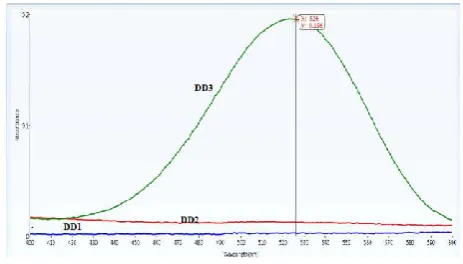
The azo dye compound formed under the reaction of nitrite ions with Griess- Ilosvay reagent is carried out as following Take three 50 mL volumetric flasks denoted DD1, DD2 and DD3.
DD1: Take 12 mL of nitrite working solution and 2 mL of universal buffer into a volumetric flask, then adding twice distilled water to reach 50 mL.
DD2: Take 2 mL of Griess- Ilosvay reagent solution and 2 mL of universal buffer flask, then adding twice distilled water to reach 50 mL.
DD3: Take 12 mL of nitrite working solution, 2 mL of Griess- Ilosvay reagent solution and 2 mL of universal buffer flask, then adding twice distilled water to reach 50 mL.
All flasks leave for 24 minutes before measuring absorbance at wavelength, λ from 400 to 600 nm to confirm again the formation of azo dye.
Experiments on factors influencing the formation of azo dye compound
Influence of pH: Take 12 volumetric flasks (50 mL) involving 15.00 mL of nitrite working solution, 2 mL of of Griess- Ilosvay reagent solution and twice distilled water. The pH of solutions were adjusted by H2SO4 0.1M
or NaOH 0.2M to reach from 1.75 to 4.50.
Influence of the ratio (v/v) of reagents of Griess-Ilosvay / NO2- :Take 9 volumetric flasks (50 mL) involving 15.00
mL of nitrite working solution, 2 mL of buffer to keep pH = 2.00 2.75 and twice distilled water. The volumes of reagent are taken such as 0.5; 1.0; 1.5; 2.0; 2.5; 3.0; 3.50; 4.00; 4.50 mL,
Influence of time: Take 15,00 mL of nitrite working solution, 2 mL of buffer, 2 mL of Griess-Ilosvay reagent
and twice distilled water into 50 mL volumetric flask. Leave the flask for a certain interval of time then measuring the absorbance.
Establishment of standard plot
Take 7 volumetric flasks (50 mL) involving in turn 6.00; 8.00; 10.00; 12.00; 16.00; 20.00; 30.00mL of NaNO2 solution, 2.0
mL of beffer 2.0 mL of of Griss-Ilosvay reagent, and twice distilled water to reach 50 m, wait for 24 minutes then measuring absorbance.
Water samples collected from Mekong river in Laos territory
[image:3.595.303.565.363.452.2]The spetrophotometric method determining nitrite using Griess –Ilosvay was applied to analyze nitrite in water samples collected from Mekong river in Laos territory. The samples were taken in two periods listed in Table 3. Before analyzing, all water samples were filtered to remove dirty and suspended particles. Take about from 30 to 45 mL of sample, 2 mL of griess- Ilosvay reagent, 2 mL buffer into 50 mL volumetric flask adding twice distilled water to reach mark, waiting for 24 minutes, then measuring repeated three times to have got average value. The nitrite concentration was determined basing standard plot.
Table 3. Water samples from Mekong river
No. Places Data Denoted Coodinates
1 Pump station Chinaimo, Khoknin, Sixattanark distreet, Vientiane city
Period 1: 18/07/2017
NMK1 17o54’18.7164”N
102o37’0.714”E
Period 2: 3/08/2017 2 Pump station Kaolieu
Kaolieu, Sikhot distreet, Vientiane city
Period 1: 18/07/2017
NMK2 17o97’25,18’’ N
102o55’23,42’’E
Period 2: 3/08/2017
RESULTS AND DISCUSSION
The Absorbance spectrum of azo dye compound
The samples DD3 indicated there is an absorbance spectrum of azo dye compound, whils DD1 and DD2 do not give any absorbance. The maximum wavelength of azo dye compound is 526 nm Fig. 2. which is close to the literature (12). The wavelength λ = 526 nm was chosen for determination of nitrite in the samples.
Fig. 2. Absorbance spectrum of azo dye compound
Factors influencing maximum absorbance of azo dye compound
pH – influence
The experimental data of pH –influence on maximum are presented in Fig.3.
[image:3.595.318.550.581.713.2]Fig. 3. Plot of pH influence on absorbance of azo dye
From this plot, the pH interval from 2.00 to 2.75 is chosen as optimal value used for experiments.
Influence of ratio of Griess- Ilosvay / NO2-
[image:4.595.321.552.115.252.2]The experimental data of influence of ratio of Griess NO2- on maximum absorbance are presented in Fig.
Fig.4. Influence of ratio Griess- Ilosvay / NO absorbance
From the obtained plot, the ratio of Griess
equals 2/15 (v/v), which can be used for experiment as optimal value.
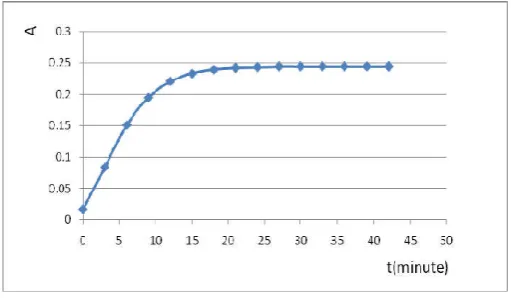
Fig. 5. Influence of the reaction time
Influence of time of azo dye formation
The reaction forming azo dye involves three
need an enough time, so that study on influence of the reaction time is necessary. The experimental data of the influence on the reaction time are presented in Fig. 5.
[image:4.595.43.287.305.425.2]From these data, reaction time from 24 to 42 minutes may be chosen for experiments.
Fig. 3. Plot of pH influence on absorbance of azo dye
to 2.75 is chosen as
The experimental data of influence of ratio of Griess- Ilosvay /
on maximum absorbance are presented in Fig. 4.
NO2-on maximum
From the obtained plot, the ratio of Griess- Ilosvay / NO2
equals 2/15 (v/v), which can be used for experiment as optimal
. Influence of the reaction time
The reaction forming azo dye involves three steps that must need an enough time, so that study on influence of the reaction time is necessary. The experimental data of the influence on
From these data, reaction time from 24 to 42 minutes may be
Standard plot
The nitrite concentrations in the samples were determined using the following standard plot, Fig.
Fig. 6. The standard plot for determination of (NO
The standard plot is corresponding the equation :
A = (0,71 ± 0,03).CN + (0,02 ± 0,01) with R
By this equation and standard derivation the values of LOD, LOQ were calculated, here:
[image:4.595.306.560.405.551.2]LOD = 0.018 mg/L; LOQ = 0.062 mg/L
Table 4. Nitrite concentration in Mekong river Vientiane Laos
Sampl Period Times measur.
NMK1 1 1 0.035
2 0.030 3 0.031
2 1 0.079
2 0.074 3 0.077
NMK2 1 1 0.036
2 0.030 3 0.033
2 1 0.070
2 0.071 3 0.072
Application in determination of nitrite in M Vientiane – Laos
The nitrite concentrations in the water samples collected from Mekong river presented in Table
The obtained results showed that the nitrite concentrations in Mekong river water are about from 0.017 ÷ 0.08 mg/L (NO N), higher than Vietnam standard (QCVN 08:2008/BTNMT). The Mekong river water in Vientiane Laos is polluted by nitrite, it must be treated before using for domestic purpose.
Conclusion
Nitrite is known as a precursor in the formation of N nitrosamines reported as carcinogenic agent. It must be analyzed and removed from water before use. The analysis of nitrite using Griess – Ilosvay
experimental condition of Azo dye formation, factors influencing its absorbance and finally a standard plot with the equation of A = (0.70556 ± 0.01147).
0.00378) with R2 = 0.99842 established. This method
0.0 0.1 0.2
0.0 0.1 0.2 0.3 0.4 0.5 A
Equation y = a + b*x
Weight No Weighting
Residual Sum of Squares
1.08885E-4
Pearson's r 0.99934
Adj. R-Square 0.99842
Value
B Intercept 0.01838
B Slope 0.70556
The nitrite concentrations in the samples were determined using the following standard plot, Fig. 6.
The standard plot for determination of (NO2- – N)
The standard plot is corresponding the equation :
+ (0,02 ± 0,01) with R2 = 0.99842. By this equation and standard derivation the values of LOD,
LOD = 0.018 mg/L; LOQ = 0.062 mg/L
Nitrite concentration in Mekong river Vientiane Laos
Ai Ci
(mg NO2
-N/L) (mg NO2-N/L)
0.035 0.0211 0.017±0,016 0.030 0.0141
0.031 0.0155
0.079 0.0831 0.080±0,015 0.074 0.0761
0.077 0.0803
0.036 0.0225 0.018±0,018 0.030 0.0141
0.033 0.0183
0.070 0.0704 0.0718±0,006 0.071 0.0718
0.072 0.0732
Application in determination of nitrite in Mekong River in
The nitrite concentrations in the water samples collected from Mekong river presented in Table 4.
The obtained results showed that the nitrite concentrations in Mekong river water are about from 0.017 ÷ 0.08 mg/L (NO2—
N), higher than Vietnam standard (QCVN 08:2008/BTNMT). The Mekong river water in Vientiane Laos is polluted by
ed before using for domestic purpose.
Nitrite is known as a precursor in the formation of N- nitrosamines reported as carcinogenic agent. It must be analyzed and removed from water before use. The analysis of was studied in detail including experimental condition of Azo dye formation, factors influencing its absorbance and finally a standard plot with the equation of A = (0.70556 ± 0.01147). CN + (0.01838 ±
= 0.99842 established. This method was
0.3 0.4 0.5 0.6
C(mg NO2 - N/L)
Standard Erro 0.00378 0.01147
N
[image:4.595.36.292.522.671.2]applied for analyzing nitrite concentration in Mekong river water in Vientiane city, Laos. The obtained nitrite in studied samples is higher than Vietnam standard (QCVN 08:2008/ BTNMT).
REFERENCES
Abbas Afkhami, Shokofeh Masahi, and Morteza Bahram, 2004. Spectrophotometric Determination of Nitrite Bull.
Korean Chem. Soc., Vol. 25, No. 7 1009
Dutt, J., Davis, J. 2002. Current Strategies in Nitrite Detection and Their Application to Field Analysis, Journal of
Environmental Monitoring, 4, 465-471
Gabbay, J., Almog, Y., Davidson, M. and Donagi, A. E. 1977. Rapid spectrophotometric microdeterminations of nitrites in water Analyst, 8, 102,371
Green, L., Wagner, D., Glogowshi, J., Skipper, P., Wishnok, J., Tannenbaum, S. 1982. Analysis of Nitrate, Nitrite, and Nitrate in Biological Fluids, Analytical Biochemistry, 126, 131-138.
Kazemzadeha, A., Ali, A. 2001. Ensafib, Sequential flow injection spectrophotometric determination of nitrite and nitrate in various samples, Analytica Chimica Acta 442 319–326
Kemper, J., Walse, S. 2010. Quaternary Amines As Nitrosamine Precursors: A Role for Consumer Products,
Environmental Science and Technology, 44, 1224-1231.
Lijinsky, W. and Epstein, S. S. 1970. Nitrosamines as environmental carcinogens. Nature. Jan 3; 225(5227):21-3.
Mekong River Commission 2005. "Overview of the Hydrology
of the Mekong Basin" (PDF). MRC, Vientiane, Laos.
Pasquali, C., Gallego-Pico, A., Hernando, P., Velasco, M., Alegria, J. 2010. Two Rapid and Sensitive Automated Methods for the Determination of Nitrite and Nitrate in Soil Samples, Microchemical Journal,9, 79-82
Scaher, A., Mitch, W., Walewijk, S., Munoz,A., Teuten,E., Reinhard, M. 2010. Micropollutants in Water Recycling: A Case Study ofN-Nitrosodimethylamine (NMDA) Exposure from Water versus Food, Sustainability Science and Engineering, 2, 203-228
Suksamran, Nauvarat 9 January 2017. "Locals slam Mekong
blasting plan". Bangkok Post. Retrieved 9 January 2017.
Szczepaniak, W. and others, "Spectrophotometric determination of trace amounts of nitrates and nitrites by the modified Griess-Ilosvay method - Application in analysis of hard cheese", CHEM ANAL, 46(3), 2001, pp. 337-350.
16057 International Journal of Development Research, Vol. 07, Issue, 10, pp.16053-16057, October, 2017