ORIGINAL RESEARCH ARTICLE
A TRAINING TOOL FOR INTERNATIONAL CLASSIFICATION OF
FUNCTIONING, DISABILITY AND HEALTH APPLICATION BY
PHYSICAL THERAPY STUDENTS
1
Karoleen Oswald Scharan,
1, *Rafaella Stradiotto Bernardelli,
1Katren Pedroso Corrêa,
2Tauane Gomes da Silva,
3Fernanda Cury Martins and
4Auristela Duarte de Lima Moser
1
PhD student in the Post-Graduation Program of Health Technology of Pontifical Catholic
University of Paraná, Curitiba, Paraná Brazil
2
Master student the Post-Graduation Program of Health Technology of Pontifical Catholic
University of Paraná, Curitiba, Paraná Brazil
3
Physiotherapist in the Socorro aos Necessitados Non-Governmental Organization Curitiba, Paraná Brazil
4Professor in the Post-Graduation Program of Health Technology of Pontifical Catholic
University of Paraná, Curitiba, Paraná Brazil
ARTICLE INFO ABSTRACT
Objective: To identify the potential contribution of an ICF-based tool in physical therapy academic training.
Method: A set of ICF diagram was analyzed where students from a clinical school at a private university in Curitiba, Paraná, expressed physiotherapeutic evaluations results.
Results: Body Functions and Body Structures categories were predominant. The anamnesis included categories of Activities and Participation and Environmental Factors, but they were not explored in detail by the students.
Conclusion: The diagram favors ICF application but a more comprehensive use of components needs to be done to standardize and systematize the language.
*Corresponding author
Copyright ©2017, Karoleen Oswald Scharan et al.This is an open access article distributed under the Creative Commons Attribution License, which permits unrestricted use, distribution, and reproduction in any medium, provided the original work is properly cited.
INTRODUCTION
The health of world population has been a key objective in the last decades due to the ageing population and the increase in prevalence of chronic health conditions (Stucki and Bickenbach, 2017; WHO, 2016). These characteristics have broadened vision beyond biological health and have come to integrate with how individuals experience health from the social point of view and the environment in which they live (Stucki and Bickenbach, 2017; Stucki, 2016). Thus, data relating to diseases constitute a part of the information on an
individual’s health (Bickenbach et al., 2017). In 2001, the
World Health Organization (WHO) created the International
Classification of Functioning, Disability and Health (ICF) to understand the functionality and repercussions of an individual's state of health from the components of Body Functions, Body Structures, Activities and Participation, and Environmental Factors (WHO, 2001). ICF allows any individual to be classified, whether or not they have a disease (OMS, 2015). Following its creation, WHO member countries were urged to use the classification (WHO, 2001; Brasil, 2012). One the objectives one the ICF, according to the National Policy of Functional Health (Brasil, 2011), is its use as an educational tool in the elaboration of educational programs for the awareness and accomplishment of social actions. The ICF represents a consensual model and has been
ISSN: 2230-9926
International Journal of Development Research
Vol. 07, Issue, 11, pp.17230-17235, November, 2017
Article History:
Received 17th August 2017
Received in revised form 28th September, 2017
Accepted 03rd October, 2017
Published online 30th November, 2017
Available online at http://www.journalijdr.com
Key Words:
ICF, Functioning,
Disability, Physical Therapy, Health Evaluation.
Citation: Karoleen Oswald Scharan, Rafaella Stradiotto Bernardelli, Katren Pedroso Corrêa, Tauane Gomes da Silva, Fernanda Cury Martins and
Auristela Duarte de Lima Moser, 2017. “A training tool for international classification of functioning, disability and health application by physical therapy
students”, International Journal of Development Research, 7, (11), 17230-17235.
increasingly used in different fields of study and work (OMS,
2015; Ruaro et al., 2012; Cerniauskaite et al., 2011). The
associated use of ICF in clinical assessments, for example, would allow the identification and qualification of health
conditions (Brochow et al., 2004; Cieza et al., 2002).
International and nationally educational institutions have also begun to make use of the operationalization of the classification as an object of professional training (Swiss
Paraplegic Research, 2016; Andrade, 2010; Maini et al, 2008;
Jelsma and Scott, 2011). Andrade (2010) incorporated the use of the ICF in education based on the Law of Guidelines and Bases of National Education and also in the National Curricular Guidelines to propose a strategy to evaluate students in the physical therapy course from the perspective of the ICF. However, these did not include the use of the ICF by students. Silva et al. (2016) discussed the characteristics of physical therapy training in relation to the process of adoption and functional application in the rehabilitation of orthopedic patients. After analyzing medical records of physical therapy students, the authors noticed reports and descriptions frequently related to deficiencies of body functions rather than activities, participation and the influence of environmental factors on patients' functionality. In 2009, the Federal Council of Physical Therapy and Occupational Therapy (COFFITO), through Resolution 370, decided that physiotherapists will adopt the ICF in their respective institutional competences as a statistical, research, clinical, social, and educational tool (COFFITO, 2009). In May 2012, Brazil was urged to use the ICF under Resolution 54.21, 2001, of the WHO (WHO, 2001; Brasil, 2012). However, there is still a lack of scientific research involving ICF in education and as a teaching/learning tool. The present study aimed to report how the ICF model has been operationalized in the educational context of a clinical school of physiotherapy.
METHODS
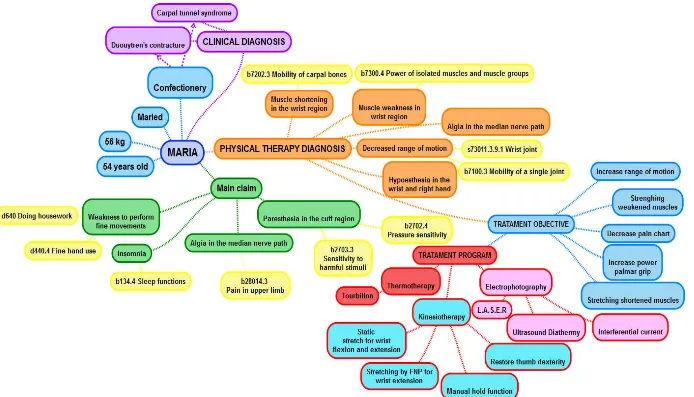
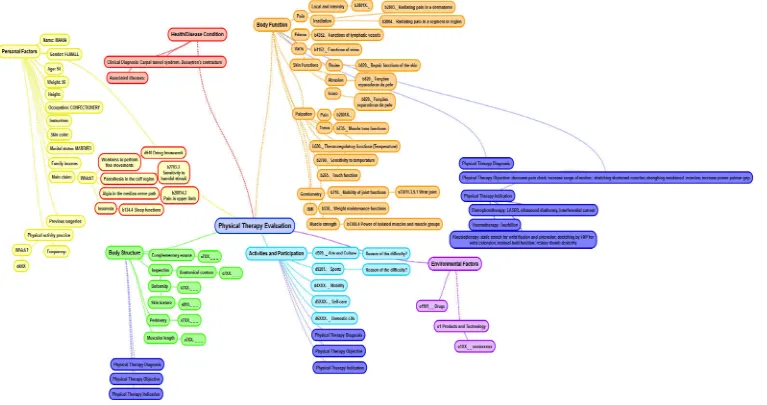
The study was approved by the local Ethics Committee under the number 2.081.225 and was carried out observing traumaorthopedic evaluation diagrams of students from the last year of phisiotherapy graduation. The study took place at a clinical school of physiotherapy of a private university in the city of Curitiba, Paraná. Clinical findings were routinely recorded through diagrams, which covered evaluation topics including identification, clinical diagnoses or complaints, anamnesis, and physical examination. The diagrams developed between March and May, 2017, were analyzed with regard to the structure, organization, clarity, and content of the categories of the ICF and the identification of the selection of qualifiers. A typical diagram chart was selected for this report (Figure 1). From this analysis, improvements were proposed with regard to the content and structure of the diagram (Figure 2).
RESULTS AND DISCUSSION
From this analysis, it was noticed that students selected representative categories of the ICF whenever they observed changes in or limitations to the physiotherapeutic evaluation items. This reflects the fact that the evaluation is influenced by the biomedical model, also reported by Silva et al. (2008). The biomedical model, known as linear model, seeks to classify health conditions from symptoms, thereby focusing more on the disease and less on the health potential (Araújo, 2013). From the results, it should be noted that the ICF records the
absence of difficulties (qualifier 0), allowing individuals to be followed throughout their life cycles. The records allow students to identify the moment of functional change with a qualifier change and allow the patient to visualize their functionalities and disabilities over a period of time. It was noticed that the students mostly selected the categories related to the Body Functions component. This was also found in other analyzed diagrams in which the Body Structures component was prevalent. This could be because the evaluation was heavily based on inspection, physical tests, and specific tests that led to a clinical physiotherapeutic diagnosis. Body Functions is also a component highly presented in instruments linked to ICF. The same finding was reported by Silva et al. (2008). This situation happens in studies that link clinical instruments, which were built based on a linear model,
to ICF (Philbois et al., 2016; Fréz et al., 2014; Nicol et al.,
2016; Forget and Higgins, 2014).
In the item on anamnesis, an open question accessed the difficulties and limitations of the patient's daily life. The students could better explore this question using all the categories of the classification, especially the components of Activities and Participation and Environmental Factors (Cieza and Stucki, 2005; Glässel et al, 2014). This could help to delineate the treatment and determine the patient's day-to-day actions. Although the present study has used classification in secondary and tertiary care, intervention and rehabilitation procedures respectively, it can also be used in primary care (prevention). At all levels of care, ICF can play a fundamental role as an educational tool in the training of health professionals, being in undergraduate and postgraduate
(Snyman et al., 2012). Thus, the biopsychosocial model can be
approached from various angles, and the information collected by the selected categories can guide the students and serve as targets for the follow up of the treatment and for the orientation of the activity execution or adjustments in the environment, avoiding painful relapse. By increasing the range of data collected, as recorded by Stallinga et al. (2012) in the evaluation of patients with multiple sclerosis, it is possible to identify more points that need intervention, when using the biopsychosocial, functional model, instead of the biomedical model.
With regard to the presentation of the selected diagram data, it was noticed that there was a sequential order of the evaluated events and that the selected categories interacted with the evaluation items. However, in others, the categories were presented separately and did not interact with the altered item. This finding demonstrates the difficulty of understanding the ICF in order to complement the evaluation and to standardize the language used. Although the ICF is focused on standardization, its use is not standardized in the context of the study.
(Cieza et al., 2002; Cieza e Stucki, 2005). In this way, a code is generated, which characterizes the patient's condition. In the selected diagram, it was not possible to identify how the diagram qualifiers were chosen. The literature suggests that one should record the form that was used to access the information. It is therefore important for students to appropriate the literature relevant to the ICF and to document the form of access to the
information to substantiate and record their findings (Cieza et al., 2016). By doing so, it
would also be possible to follow the data of the same patient evaluated by different students,
[image:3.842.83.777.145.542.2]since they would use the same framework. A proposal to arrange the data in the diagram is contained in the respective components of the classification: Body Functions, Body Structures, Activities and Participation, and Environmental Factors. This proposal is represented in two excluded in the present report (Figure 2). These templates contain the same information. They are merely arranged in different formats proposed by the diagram program called SimpleMind and could be the target of a pilot application for improvement.
Figure 1. Typical diagram chart operationalized in the educational context of a clinical school of physiotherapy
The new format needs to consider the goals and needs of the patient. The use of ICF as an educational tool for a clinical clinic adds a systematization of the collection of health information, regardless of health condition and life cycle, excluded; also facilitates the learning process and provides standardization of assessment and treatment proposal delineation. In addition, it favors an integration and the operationalization of the contents received during the academic formation, as well as for different areas we provide the possibility of integrating relative content as disciplines, as well as different health areas (Stephenson and Richardson, 2008). The use of the Classification model in order to address patient care can directly influence the process of remodeling
the education of health professionals (Geertzen et al., 2011) as
well as increasing the work of the multiprofessional team
(Allan et al., 2006), which can lead to in benefits to the health
systems and the health conditions of the population. The present study was performed without interfering with the usual functioning of the clinical school, observing only the trauma-orthopedic evaluation diagrams. If other assessments such as neurology were analyzed, perhaps other components of classification would be further explored, since social and environmental limitations are more easily identified.
Conclusion
The diagram favors ICF application but a more comprehensive use of components needs to be done to standardize and systematize the language. It is believed that the suggested adjustments will favor the application of the ICF benefiting students and teachers in the operationalization of all components of the classification. In addition, the proposed diagrams would allow the same patient, evaluated and accompanied by different students throughout a treatment period, to have his or her information collected in a systematized manner. This model can act as a pilot application to further improve the context of the study. The analysis resulted in considerations for the improvement of learning in the context of the present study, emphasizing the importance of using the ICF in a way that is complementary to the evaluation already made and that generates a systematized and standardized language.
REFERENCES
Allan CM, Campbell WN, Guptill CA, Stephenson FF,
Campbell KE. 2006. A conceptual model for
interprofessional education: The International
Classification of Functioning, Disability and Health. ICF. J
Interprof Care. 20(3):235-245.
Andrade PM. 2010. Avaliação do estágio da fisioterapia conforme as diretrizes curriculares e a perspectiva biopsicossocial da organização mundial de saúde. Avaliação. 15(2):121-130.
Araújo ESd. 2013. CIF: uma discussão sobre linearidade no
Modelo Biopsicossocial. Rev Fisioter S Fun. 22(1):6-13.
Bickenbach J, Cieza A, Sarabiego C. 2016. Disability and
Public Health. Int J Environ Res Public Health, 13(1):233.
Brasil. 2011. Política Nacional de Saúde Funcional. PNSF): Construindo mais saúde para a população brasileira. Ministério da Saúde. Brasília.
Brasil. 2012. Portaria Nº 835, de 25 de abril de 2012. Institui incentivos financeiros de investimento e de custeio para o Componente Atenção Especializada da Rede de Cuidados a
Pessoa com Deficiência no âmbito do Sistema Único de Saúde. Ministério da Saúde. Brasília.
Brockow T, Cieza A, Kuhlow H, Sigl T, Franke T, Harder M, Stucki G. 2004. Identifying the concepts contained in outcome measures of clinical trials on musculoskeletal disorders and chronic widespread pain using the International Classification of Functioning, Disability and
Health as a reference. J Rehabil Med. 44(suppl):30-36.
Cerniauskaite M, Quintas R, Boldt C, Raggi A, Cieza A, Bickenbach JE, Leonardi M. 2011. Systematic literature review on ICF from 2001 to 2009: its use, implementation and operationalisation. Disabil Rehabil. 33(4):281-309. Cieza A, Brockow T, Ewert T, Amman E, Kollerits B,
Chatterji S, Ustun TB, Stucki G. 2002. Linking health-status measurements to the international classification of
functioning, disability and health. J Rehabil Med.
34(5):205-210.
Cieza A, Fayed N, Bickenbach J, Prodinger B. 2016. Refinements of the ICF Linking Rules to strengthen their potential for establishing comparability of health information. Disabil Rehabil. Mar 17:1-10.
Cieza A, Stucki G. 2005. Content comparison of health-related quality of life. HRQOL) instruments based on the international classification of functioning, disability and health. ICF. Qal Life Res. 14(5):1225-37.
Conselho Federal de Fisioterapia e Terapia Ocupacional. 2009. Resolução Nº 370, de 6 de novembro de 2009. DOU nº. 225, Seção 1, em 25/11/2009, página 101.
Forget NJ, Higgins J. 2014. Comparison of generic patient-reported outcome measures used with upper extremity musculoskeletal disorders: linking process using the International Classification of Functioning, Disability, and
Health. ICF. J Rehabil Med. 46(4):327-34.
Fréz AR, Abdallah AA, Riedi C, Galindo J, Ruaro JA, Ribeiro SdC. 2014. Proposed use of the international classification of functioning, disability and health to evaluate quality of life after an amputation. Fisioter Mov. 27(1):49-56. Geertzen JHB, Rommers GM, Dekker R. 2011. An ICF-based
education programme in amputation rehabilitation for
medical residents in the Netherlands. Prosthet Orthot Int.
35:318-322.
Glassel A, Coenen M, Kollerits B, Cieza A. 2014. Content validation of the international classification of functioning, disability and health core set for stroke from gender
perspective using a qualitative approach. Eur J Phys Rehab
Med. 50(3):285-99.
Jelsma J. Scott D. 2011. Impact of using the ICF framework as an assessment tool for students in paediatric physiotherapy:
a preliminary study. Physiother. 97:47-54.
Maini M, Nocentini U, Prevedini A, Giardini A. Muscolo E. 2008. An Italian experience in the ICF implementation in rehabilitation: Preliminary theoretical and practical
considerations. Disabil Rehabil. 30(15):1146-1152
Nicol R, Robinson Nicol M, Hopfe M, Newell D. 2016. Linking the Bournemouth Questionnaire for low back pain to the International Classification of Functioning, Disability and Health. Disabil Rehabil. 38(11):1089-96. Organização Mundial da Saúde. 2015. Classificação
Internacional de Funcionalidade, Incapacidade e Saúde, CIF. 2 ed. Brasil: Edusp - Editora da Universidade de São Paulo.
Philbois SV, Martins J, Souza CS, Sampaio RF, Oliveira AS. 2016. Health professionals identify components of the International Classification of Functioning, Disability and
Health. ICF) in questionnaires for the upper limb. Braz J
Phys Ther. 20(1):15-25.
Ruaro JA, Ruaro MB, Souza DE, Fréz AR, Guerra RO. 2012. An overview and profile of the ICF's use in Brazil - a
decade of history. Braz J Phys Ther. 16(6):454-462.
Silva ACL, da Fonseca Neves R, Riberto M. 2008. A formação fisioterapêutica no campo da ortopedia: uma
visão critica sob a ótica da funcionalidade. Acta
Fisiat.15(1):18-23.
Snyman S, Goliath C, Clarke M, Conradie H, Van Zyl M.
2012. Transforming health professions education:
Applying the ICF framework to equip students to strengthen health systems in an interdependent world. Unpublished paper for the WHO-FIC Network Annual Meeting, Brasilia.
Stallinga H, Roodbol P, Annema C, Jansen G, Wynia K. 2012. Functioning assessment versus conventional medical assessment. Unpublished paper for the WHO-FIC Network Annual Meeting, Brasilia.
Stephenson R, Richardson B. 2008. Building an
interprofessional curriculum framework for health: A
paradigm for health function. Adv Health Sci Educ.
13:547–557.
1
Stucki G, Bickenbach J. 2017. Functioning: the third health indicator in the health system and the key indicator for
rehabilitation. European journal of physical and
rehabilitation medicine. Eur J Phys Rehabil Med. 53(1),
134-138.
Stucki, G.. 2016. Olle Hook Lectureship 2015: The World Health Organization's paradigm shift and implementation of the International Classification of Functioning,
Disability and Health in rehabilitation. J Rehabil Med.
48(6):486-493.
Swiss Paraplegic Research. 2007. Case studies. Avaleble to: www.icf-casestudies.org/.
World Health Organization. 2001. International classification of functioning, disability and health: ICF.
World Health Organization. 2001. International classification of functioning, disability and health. Fifty-Forth World Health Assembly, WHA 54.21. Ninth plenary meeting, 22 May 2001. A54/VR/9.
World Health Organization. 2016) World Health Statistics 2016: Monitoring Health for the SDGs, Sustainable Development Goals.