BASIC NETWORK DISPLACEMENT AND LACK OF KNOWLEDGE USERS IN SOUTHEAST BAHIA
*1
Lucimara da Silva Meira,
1Nathalia Luiza de Souza Leite,
1Lorrane Carvalho Santana,
4Beatriz
Rocha Sousa,
2Rafael Cerqueira Campos Luna,
3,4Jennifer Rodrigues Correia,
4Thalita Fernandes
Santos,
4Iaggo Raphael David,
5Rafael Luiz Araújo Rodrigues
and
6Stenio Fernando Pimentel Duarte
1
Graduanda de Farmácia pela Faculdade Independente do Nordeste, Vitória da Conquista - BA;
2MD. Professor in the St. Augustine School of Health – FASA
3
Studant of Medicine in the St. Augustine School of Health – FASA
4
Researcher at the Center for Teaching, Research and Extension in Chronic Diseases – NEPEdc
5Especialista em Perícias Criminais e Toxicológicas, Coordenador da Assistência Farmacêutica;
6Researcher at the Center for Teaching, Research and Extension in Chronic Diseases – NEPEdc
PhD Professor at Santo Agostinho School of Health; Independent College of the Northeast
ARTICLE INFO ABSTRACT
Pharmaceutical Care (PA) is a strong determinant for health care resolution, being an important indicator of the quality of care providedBut although it is a fundamental part of this assistance, it has rarely been considered as such and contemplated with initiatives to strengthen its management.This research aimed to evaluate users' knowledge about prescription and dispensation of medicines in the USF of a municipality in southwestern Bahia.Research with a descriptive, quantitative and exploratory cross-sectional approach conducted in the municipality of Tremedal (BA).Data collection was performed through structured interviews in the form of a questionnaire, prepared according to the needs of the study by the authors of the research. Interviews were conducted from January to June 2019 with patients seen atUSF, CAPS and the specialty health center. All participants signed the consent form regarding the research.The questionnaire sought information regarding sociodemographic data such as gender, education, skin color and income, as well as information on consultation time and medications used and assessment of patient knowledge regarding medical prescription, pathology and pharmacotherapeutic treatment.Regarding prescriptions, most contained only one prescription drug (58 - 44.62%), the presence of polypharmacy was identified in eight (6.15%) and antibiotics in seven (5.38%) prescriptions. It was also observed that from the total, 42 (32.31%) prescriptions were completely met by the pharmacies of the health units of the municipality.Drug shortage in the municipal basic network is a public health problem and one of the factors that make pharmacotherapy and the care process more difficult for users. Although the data presented here do not show the intensity of the health damage to the population assisted by the studied municipal network, they show that Pharmaceutical Assistance should better structure its actions, prioritizing the monitoring of the supply of essential medicines in primary care units so that scenarios such as: the studied does not become common.
Copyright © 2019, Marla Vieira Nascimento et al. This is an open access article distributed under the Creative Commons Attribution License, which permits
unrestricted use, distribution, and reproduction in any medium, provided the original work is properly cited.
INTRODUCTION
Pharmaceutical Care (PA) is a strong determinant for health care resolution, being an important indicator of the quality of
care provided (KALICHMAN; AYRES, 2016; MARIN et al.,
2003).
But although it is a fundamental part of this assistance, it has rarely been considered as such and contemplated with initiatives to strengthen its management. This shows that even though the Unified Health System (SUS) has organized itself to prioritize health actions and select the medicines used to
ISSN: 2230-9926
International Journal of Development Research
Vol. 09, Issue, 12, pp. 32439-32443, December, 2019
Article History:
Received xxxxxx, 2019 Received in revised form xxxxxxxx, 2019
Accepted xxxxxxxxx, 2019 Published online xxxxx, 2019
Article History:
Received 17th September, 2019
Received in revised form 11th October, 2019
Accepted 14th November, 2019
Published online 30th December, 2019
Key Words:
Epidemiology. Public health. Access to Health.
*Corresponding author: Lucimara da Silva Meira
RESEARCH ARTICLE
OPEN ACCESS
provide care, considering the efficacy, safety and cost-effectiveness of these products, there is still much to advance and structure. in order to guarantee access to medicines and the effectiveness of health actions through pharmaceutical
assistance (VIEIRA; ZUCCHI, 2014, BARRETO;
GUIMARÃES, 2010). According to the National Medicines Policy (PNM), pharmaceutical assistance has intrinsically drug-related activities to support health actions required by the community served and their distribution in Family Health Units (USF) is part of the healing, rehabilitation process. and disease prevention of the population. Medicines distributed at this level of care are called essential drugs, which, according to the World Health Organization (WHO), are those that meet the basic health care needs of the majority of the population and are selected according to health relevance. Evidence on efficacy and safety and comparative cost-effectiveness studies
(ARAÚJO; UCHÔA, 2011; BRAZIL, 2001). Drug
deficiencies in health facilities can range from stockpiles, financial and budgetary constraints, lack of infrastructure and human resources, to the attitude and conduct of governments at all levels, physicians during prescribing, dispensers at the time to fill prescriptions, consumers at the time of unreasonable use and the pharmaceutical industry itself. In addition to the impact on quality and safety, shortages tend to increase health care costs, as therapeutic alternatives are often more expensive or there is an increase in price, given the situation, by the productive or commercial sector due to the lack of competition in the environment. market (FONSECA; COSTA, 2015; FALEIROS; SILVA, 2014). In Brazil, spending on medicines has been increasing considerably due to the aging of the population, the constant entry of new pharmaceutical products in the market and the expansion of the coverage of pharmaceutical care components. However, although there is this expense in public management, the same would be greater if the pharmacist did not take care of the patient at the USF and Basic Pharmacy, because the patient's health problems would worsen and the treatment would fall in the medium and high complexity, which would result in much higher expenses (MONTEIRO; LACERDA, 2016; MENDES et al., 2013). One of the ways to reverse the lack of medicines and the influence of the pharmaceutical industries on prescriptions is the existence of a Municipal Relationship of Medicines (REMUME). This list informs which medicines are part of the list of basic medicines needed by the municipality and should be present in all units, being easily accessible to prescribers (doctors and nurses) and other health professionals
(OLIVEIRA, 2018; MONTEIRO; LACERDA, 2016).
Although medicines are indispensable tools in most situations for health recovery, they are not risk-free and can become extremely dangerous when used improperly, which makes them a major public health problem. Therefore, it is necessary to emphasize the importance of instructing the patient to have as much knowledge as possible about their health condition, about guidelines that favor their clinical evolution and, especially, about the prescribed medications to avoid possible complications (ENGEL et al., 2012). This research aimed to evaluate users' knowledge about prescription and dispensation of medicines in the USF of a municipality in southwestern Bahia.
METHODOLOGY
Research with a descriptive, quantitative and exploratory cross-sectional approach conducted in the municipality of Tremedal (BA). Tremedal is a Bahian municipality located in
the southwest region of Bahia and 601 km from Salvador (Bahian capital) with approximately 18.6 million inhabitants, whose Municipal Health Department has a primary care network composed of six USF, four of them located in rural and two in the urban area; a unit of the Psychosocial Care Center (CAPS); a Health Center of medical specialties and a Basic Pharmacy. Data collection was performed through structured interviews in the form of a questionnaire, prepared according to the needs of the study by the authors of the research. Interviews were conducted from January to June 2019 with patients seen at USF, CAPS and the specialty health center. All participants signed the consent form regarding the research. The questionnaire sought information regarding sociodemographic data such as gender, education, skin color and income, as well as information on consultation time and medications used and assessment of patient knowledge
regarding medical prescription, pathology and
pharmacotherapeutic treatment. Polypharmacy was considered as any prescription that contained four or more drugs of routine and concomitant use (WHO, 2017). The REMUME used is in Ordinance 004/2019 published on July 30, 2019 in the official journal of the municipality. The data acquired from this research were arranged and compiled into its own database using software Microsoft Excel® 365 (2018). The descriptive analysis of these data was based on the observation of the phenomenon throughout its development with subsequent calculation of frequencies of related responses and their arrangement in tables, using the software Stata 14.2. The project was approved by the Research Ethics Committee of the Independent College of the Northeast, under number 3,097,527 on December 20, 2018. All participants who agreed to participate in the study signed a consent form after being informed about the nature and objectives of the research.
RESULTS
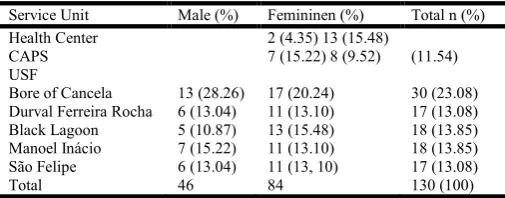
[image:2.595.307.560.547.646.2]Participated in the study users attended at the Health Center, CAPS and five FHU of the city. Of these, 64.54% were female and 35.38% male (Table 1).
Table 1. Distribution of study patients in primary care units of the municipality, according to gender (n = 130)
Service Unit Male (%) Femininen (%) Total n (%) Health Center 2 (4.35) 13 (15.48)
CAPS 7 (15.22) 8 (9.52) (11.54)
USF
Bore of Cancela 13 (28.26) 17 (20.24) 30 (23.08) Durval Ferreira Rocha 6 (13.04) 11 (13.10) 17 (13.08) Black Lagoon 5 (10.87) 13 (15.48) 18 (13.85) Manoel Inácio 7 (15.22) 11 (13.10) 18 (13.85) São Felipe 6 (13.04) 11 (13, 10) 17 (13.08)
Total 46 84 130 (100)
CAPS: Psychosocial Care Center. n: Absolute frequency. Source: data from the research itself.
Analyzing the knowledge of the study participants regarding the reason for prescribing the drugs, it was observed that 119 (91.54%) knew and 11 (8.46%) did not know the reason. Table 4 shows the knowledge relationship between those who knew and did not know the reason for the prescription with the knowledge of the dose and the duration of treatment.
DISCUSSION
Because Pharmaceutical Assistance is a set of procedures aimed at health promotion, prevention and recovery, its proper performance within a municipality is essential to achieve its objectives (MENDES et al, 2013). It is recommended that PA be understood as a clinical activity, with a central focus of action on the user, structured in care and technical-managerial actions, in which the drug should not be the central focus and neither the logistic actions should be. occupy the only effort of their organization in SUS (MATTOS et al., 2019; BRAZIL, 2012). Regardless of the decentralized management of the SUS and the municipal primary care network, all health units, whether located in the urban or rural area of the municipality, must contain minimum stock with the medicines that make up REMUME. However, only slightly more than a quarter of allprescriptions analyzed in the study were fully met in the municipal units. This was probably due to shortages in units or the entire municipal network. The low availability and / or lack of medicines can result from failures in the logistics and information of medicines, ranging from the delay in the transfer by the managing authorities of SUS to the lack of medical information about the availability or not of drugs and their possible substitutions.
[image:3.595.199.401.74.189.2]Deficiency in the national or international market (CHAVES et al., 2019; NASCIMENTO et al., 2017a). In many cases, when the prescription is not completely dispensed at the UBS, patients turn to the private network to purchase them. However, the economic situation is an important determinant in the use of health services, since there is a predominance of low income patients in SUS and when, after subsistence expenses, at least 40% of family income is compromised. in drug purchasing, the monthly impact on family income is significant (GERLACK et al., 2017). Considering the population aging process and the evidence on the relationship between increasing age and number of prescription drugs, it is important that, in the health care process, professionals ensure the quality of pharmacotherapy, avoiding the exacerbated use of drugs and drugs. Thus, avoiding all the harms that could be triggered by the use of multiple drugs, as studies on polypharmacy and their implications for the general population are scarce (NASCIMENTO et al., 2017b). Although there were few prescriptions containing polypharmacy in this study, health professionals should be aware that it has been associated with negative health outcomes with increased morbidity and mortality, reduced quality of life of individuals, especially in the elderly, and increased costs. individual and governmental care, with impact on people and health systems (NASCIMENTO et al., 2017b; SALES; SALES; CASOTTI, 2017). Only one of the polypharmacy prescriptions was fully met at the unit. However, it is no use just having the medicine at home for the therapy to be effective, it is also necessary to know what the medicine is for, how much should be given per day and for how long. As noted, most of the patients approached in the study knew the reason for the prescription,
Table 2. Sociodemographic characteristics of the study participants (n = 130)
Sociodemographic characteristics n (%) Schooling
No schooling 5 (3,85)
Incomplete Elementary School 63 (48,46) Complete primary education 23 (17,69) Incomplete high school 16 (12,31) Complete high school 20 (15,38) ) Higher Education Complete 3 (2,31) Income *
Up to 1 minimum wage 102 (78,46) 2 to 3 minimum wages 27 (20,77) 3 to 4 minimum wages 1 (0,77)
n: Absolute frequency. * Considering the national minimum wage of R $ 998.00. Source: data from the research itself.
Table 3. Number of prescription medications and percentage of prescriptions attended at the basic pharmacies of the municipality (n = 130)
Prescription Completely answered by the unit Number of medications per prescription
01 02 03 04 05 06
Yes 17 21 3 1 0 0
Not 41 23 17 5 1 1
Total 58 44 20 6 1 1
[image:3.595.83.519.354.416.2]Percentage by amount of medication (n = 130,%) 44.62 33.85 15.38 4.61 0.77 0.77 n: Absolute frequency. Source: data from the research itself.
Table 4. Study participants' knowledge regarding the reason for the prescription, the prescribed dose and the duration of treatment (n = 130)
Knowledge Patient
Reason for Prescription Prescribed dose of treatment Duration Total
Yes Not Yes Not
Yes 83 36 61 58 119
Not 2 9 0 11 11
and this number was much higher than the number of participants whose level of education was high school or higher. This data shows that when the multidisciplinary health team informsadequately the patient about their health condition, barriers related to low education can be carried. Analyzing only those who knew the reason for the prescription (119 users, 91.54%), a good part did not know the prescribed dose and almost half did not know the period of use of the drugs. Failure to know the prescribed dose may lead to treatment failure below the effective dose for treatment or to adverse and / or toxic effects in high-dose cases. Problems caused by the lack of knowledge of the dose and the treatment period could be solved with a pharmacist-guided dispensation. However, in the municipality there is only one pharmacist present and he is allocated to the coordination of PA, and his work is divided between management activities and dispensation, which is restricted to the Basic Pharmacy attached to the Health Center. The absence of pharmacist in USF It has a direct impact on users' health, since dispensing and guidance on the use of medicines is left to the technicians present at the time. These may not have the technical skills for such a function since the pharmacist is the most capable professional for this function and the only one who will identify prescription-related problems (AMARAL; BLATT, 2011; FREITAS; NOBRE, 2011). With the pharmacist present and directly linked to the dispensation, there is a greater concern to observe the technical aspects related to the dispensation that may compromise the success of therapy, such as information given to the patient about the dosage schedule, possible adverse reactions and interactions with other medicines and foods (AMARAL; BLATT, 2011). Thus, to avoid cases of shortage and / or lack of information to users about the prescribed drugs, the PA manager should institute improvements in drug prescription services, dispensing and
user guidance, through standardization of activities,
stimulation of use of REMUME and the provision of user support (OLIVEIRA, 2018).
Conclusion
Drug shortage in the municipal basic network is a public health problem and one of the factors that make pharmacotherapy and the care process more difficult for users. Although the data presented here do not show theintensity of the health damage to the population assisted by the studied municipal network, they show that Pharmaceutical Assistance should better structure its actions, prioritizing the monitoring of the supply of essential medicines in primary care units so that scenarios such as: the studied does not become common. In addition, the presence of pharmacists with the teams in the health facilities, in addition to contributing to the monitoring of the units 'inventory, would reverse patients' lack of knowledge about their therapy.
REFERENCES
AMARAL, S. M. S.; BLATT, C. R. Municipal consortia for medicine procurement: impact on the stock-out and budget. Rev Saúde Públ, São Paulo, v. 45, n. 4, p. 799-801, 2011.
ARAÚJO, P. T. B.; UCHÔA, S. A. C. Avaliação da qualidade da prescrição de medicamentos de um hospital de ensino. Cien Saude Colet, n.16, n. Supl. 1, p. 1107-1114, 2011. BARRETO, J. L.; GUIMARÃES, M. C. L. Avaliação da
gestão descentralizada da assistência farmacêutica básica
em municípios baianos, Cad. Saúde Pública, v.26, n.6, p.1207-1220, 2010.
BRASIL. Ministério da Saúde. Secretaria de Políticas de Saúde. Departamento de Atenção Básica. Política nacional de medicamentos 2001 – Brasília: Ministério da Saúde, 2001. 40 p.
BRASIL. Ministério da Saúde. Portaria MS/GM no 1.214, de 13 de junho de 2012. Institui o Programa Nacional de Qualificação da Assistência Farmacêutica no âmbito do Sistema Único de Saúde (QUALIFAR-SUS). Diário Oficial da União, Brasília, DF, 14 jun. 2016.
CHAVES, L. A. et al. Desabastecimento de medicamentos na literatura científica da saúde: uma revisão narrativa. Physis, Rio de Janeiro, v. 29, n.1, p. e290107, 2019. ENGEL, K. G. et al. Patient understanding of emergency
department discharge instructions: where are knowledge deficits greatest? Acad Emerg Med, v. 19, n. 9, p. 1035-44, 2012.
FALEIROS, D. R.; SILVA, G. D. Gestão racional da assistência farmacêutica: Farmácia de Minas. In: OSORIO-DE-CASTRO, C. G. S. et al. (Ed.). Assistência farmacêutica: gestão e prática para profissionais da saúde. Rio de Janeiro: Fiocruz, 2014. p. 69-78.
FONSECA, E. M.; COSTA, N. R. Federalism, the economic- industrial health care complex and high-
cost pharmaceutical assistance in Brazil. Cien Saude Colet, Rio de Janeiro, v. 20, n. 4, p. 1165-1176, 2015.
FREITAS, J. M. S. M; NOBRE, A. C. L. Avaliação da assistência farmacêutica do município de Mombaça-CE, R Bras Farm Hosp Rev Saúde, v. 2, n. 1, p. 15-20, 2011. GERLACK, L. F. et al. Gestão da assistência farmacêutica na
atenção primária no Brasil, Rev Saude Publica, v.51, Supl. 2, p.15s, 2017.
KALICHMAN, A. O.; AYRES, J. R. C. M. Integralidade e tecnologias de atenção à saúde: uma narrativa sobre contribuições conceituais à construção do princípio da integralidade no SUS. Cad Saude Publica, v. 32, n. 8, e00183415, 2016.
MARIN, N. (org.), et al. Assistência farmacêutica para gerentes municipais. Rio de Janeiro: OPAS/OMS, 373 p. 2003.
MATTOS, L et al. Assistência farmacêutica na atenção básica e Programa Farmácia Popular: a visão de gestores de esferas subnacionais do Sistema Único de Saúde. Saúde Soc. São Paulo, v. 28, n. 1, p. 287–298, 2019.
MENDES, S. J. et al. Gestão da assistência farmacêutica: avaliação de um município catarinense, Rev. Gestão & Saúde, v. 6, n. 1, p. 4- 29, 2013.
MONTEIRO, E. R.; LACERDA, J. T. Promoção do uso racional de medicamentos: uma proposta de modelo avaliativo da gestão municipal. Saúde Debate, v. 40, n. 111, p. 101–116, 2016.
NASCIMENTO, R. C. R. M. et al. Disponibilidade de medicamentos essenciais na atenção básica do Sistema Único de Saúde. Rev Saude Publica, v. 51, n. Supl 2, p. 10s, 2017a.
NASCIMENTO, R. C. R. M. et al. Polifarmácia: uma realidade na atenção primária do Sistema Único de Saúde. Rev Saude Publica, v. 51, n. Supl 2, p. 19s, 2017b. OLIVEIRA, W. R. Gestão da assistência farmacêutica em
regiões de saúde do Ceará: um recorte do Projeto QualiSUS-Rede, Rev. Gestão & Saúde, n. 9, v. 1, p. 95-109, jan 2018.
publicação da Relação Municipal de Medicamentos Essenciais - REMUME do Município de Tremedal. Diário Oficial do Município de Tremedal.
Tremedal, 30 jul. 2019. Nº 1769. Disponível em [www.tremedal.ba.io.org.br/diarioOficial/download/785/1 769/0]
SALES, A. S.; SALES, M. G. S.; CASOTTI, C. A. Perfil farmacoterapêutico e fatores associados à polifarmácia entre idosos de Aiquara, Bahia, em 2014. Epidemiol. Serv. Saúde, Brasília, v. 26, n. 1, p. 121-132, já-mar 2017.
VIEIRA, F. S.; ZUCCHI, P. Gestão da Assistência Farmacêutica: Análise da situação de alguns municípios, Tempus, actas de saúde colet, v. 8, n. 4, p. 11-29, dez, 2014.
WHO. World Health Organization. Medication Without Harm – Global Patient Safety Challenge on Medication Safety. Geneva: World Health Organization, 2017