3567
NON-PARAMETRIC TARGET DETECTION IN A PASSIVE
SEISMIC LOCATOR BASED ON SPECTRAL DATA
YURY MOROZOV,MIKHAIL RAJFELD, ALEKSANDR SPECTOR
Department of Theoretical Fundamentals of Radio Engineering, Novosibirsk State Technical University, Russia
E-mail: [email protected]
ABSTRACT
The present paper proposes the approach to the universal non-parametric detector of seismic signals based on the amplitude spectrum analysis. The decision statistics of spectral components exceeding over reference ones is proposed. The maximal amplitude spectrum mean value over several adjacent reference cycles is subtracted from each working cycle spectrum to stabilize false alarm probability. The range of frequency components has been selected. The threshold estimation procedure is stated with respect to spectrum averages fluctuation. It has been shown that the detection probability achieves 0.9 for signal-to-noise ratio about 3 dB when the number of working cycles is 5.
Keywords: Non-Parametric Method, Seismic Location, Detection, Amplitude Spectrum
1. INTRODUCTION
Passive seismic location (PSL) solves the complex of location observation problems in unattended ground sensors systems [1-5] including automatic target detection by its seismic action on the ground surface. Detection quality influences on classification and location quality. Seismic target detection is complicated by seismic noise waves which are generated by natural and anthropogenic wave sources. The oscillations caused by such sources are caused by random factors including multipath propagation. Therefore seismic wave receiver antennas accept seismic signals as normally distributed random processes. Seismic noise parameters are different in different points of the propagation medium and at different rime moments. Therefore it is necessary to use signal receiving methods overcoming the influence of signals spatial and time change.
Signal detection appears to be effective with help of non-parametric statistics. It is necessary to provide given false alarm probability and maximize true detection probability with respect to the Neiman-Pearson criterion [6]. Requirements on false alarm probability and true detection probability are important for seismic guard systems that are monitoring long perimeters of large factories, plants and private detached houses. Such systems are advantageous because of hidden sensors and capability of intruder early
detection. There are two wide-spread approaches to detection algorithm design in PSL systems. One of them is directed on certain targets signals detection. Such signals are often caused by person motion [2]. A person is one of the main seismic targets. The target class is found by an activated detector which is unique for a certain target class. The second approach can detect any target generating a seismic signal. Here the target classification after detection appears to be important.
The mentioned above approaches are implemented by various algorithms. The basic problem which is not still solved is how to create such seismic signal processing algorithms that meet the two following conditions. The first condition means getting high detection probability value for a real seismic object with universal signal properties for any object including person, vehicle, animal and etc. The second very important condition for automatic detection systems is the guaranteed detection probability value when there is really no seismic object but the false alarm can appear because of seisic noise. The combination of these two conditions is the Neyman-Pearson Criterion which is well-known in radiolocation.
As it follows from the analysis of previous paper the best solution of the automatic detection task is still unknown.
ISSN: 1992-8645 www.jatit.org E-ISSN: 1817-3195
3568 in [7], where human occurrence a-posterior probability is determined in passive location system observation zone by means of the Bayesian approach. The proposed approach provides true detection probability about 70% without taking into account false-alarm probability.
The algorithm of symbols dynamic filtration (SDF) based on signal Discrete Wavelet Transformation is stated in [8]. Object detection probability is determined by probabilities of finite-state machine status change. It is proposed to improve detection probability by adding infrared sensors witout solving the Neyman-Pearson problem. The seismic location system becomes more complicated and expensive with infrared sensors.
It is proposed in [9] to build a seismic signal detection algorithm based on autocorrelation functions in the time domain without the deep analysis of statistical aspects. The short-coming of such approach is the direct calculation time dependence on width of the interval where the autocorrelation function is calculated.
The procedure of seismic signal detection is proposed in [10] where wavelet spectrum coefficients are processed by the correlation analysis to separate the coefficients of an object signal from the coefficients of noise. The wavelet spectrum advantage is the capability of non-stationary signals properties analysis. However wavelet transformation practical application is complicated by enormous number of operations.
Seismic signals can be also detected and classified by neural networks [11,12]. The proposed in [11] neural network of perceptrons operating with seismic signal spectral components is able to provide false alarm probability about 1% with is too high for practically used passive seismic location systems.
Detection and classification of seismic signals is proposed to be implemented with a back propagation neural network united with a zero-cross counter and the power ratio integrated on higher frequencies and lower frequencies [12].
Neural networks have noticeable disadvantages. It is difficult to create a network architecture of a certain task and to interpret training results [13]. It is impossible to explain neural network parameter in terms of the subject area. Hence the neural network remains a “black box” both for researchers and users. Optimization methods application for root-mean-square error
minimization leads to neural network overtraining [14]. Network sensitivity to noise strongly depends on its architecture. True detection probability more than 90% demands enormous hierarchical architecture where the criterions vector is processed by a tough network and then obtained solution is corrected by more exact and slower network.
Therefore the mentioned above papers do not focus on the main problem of seismic signal detection with respect to the Neiman-Pearson statistical criterion.
The purpose of the paper is to develop and investigate a non-parametric detector of seismic signals under a-priori uncertainty providing true detection probability more than 90% at stable false alarm probability level. Automatic detection of seismic signals is significantly complicated by continuous change of seismic noise properties including correlation and dispersion. With respect to such conditions false alarm probability stabilization when true detection probability is maximized is strictly based on well-known concepts of statistical properties of signals and noise. Non-parametric tests are successfully used in radiolocation detection. However the non-parametric tests known from radiolocation cannot be used in seismic signals detection because signals and noise have different properties in radiolocation and seismic location.
The non-parametric detection based on zero-cross counter was considered in [15]. Such approach is simpler than mentioned above ones. The number of zero crossings decreases when a seismic target generated component appears in an observed signal. The detection is made after seismic signal correlation. The target signal after de-correlation remains correlated. Thus zero-crossings number becomes less than for only a seismic noise. Such detection has a short-coming because it requires high-quality de-correlation especially when seismic noise parameters change.
However it is often not clear how to efficiently analyze the output of the system in the time domain. A frequency domain or spectral analysis of the output is often more informative [16].
3569 When our purpose is target detectioniIt is most preferable to make FFT for a initial signal.
2. NON-PARAMETRIC SPECTRAL
DETECTION
The paper proposes a special approach to parametric detection design based on the non-parametric analysis of the received seismic signal amplitude spectrum. Non-parametric methods are useful when there is no enough a priori knowledge on investigated non-stationary signals [17, 18].
There is a lot of experimental data was analyzed to extract necessary properties from seismic signals. The seismic signals structure and sampling properties are described in details in [16]. A signal of some target has a certain structure. For example, the signal of a moving car or a scooter is continuously increasing when a vehicle approaches seismic sensors and then decreasing when it goes away from sensors. A signal of a person consists of three pulses corresponding to three steps per each time interval 1.7 s.
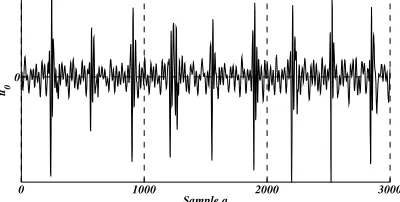
Examples of seismic signals are stated in figures from 1 to 4. Each signal has its special features. Signals of people and animals consist of pulses. Frequency of horse steps is twice of people steps. Establishing difference between a person and a group of people needs additional preprocessing and spectral analysis. The paper is focused of detection of a single person.
0 1000 2000 3000 0
Sample q
u0
Figure 1:Initial signal for the signal of a person
0 1000 2000 3000 0
Sample q
[image:3.612.312.523.85.200.2]u0
Figure 2: Initial signal for the signal of a group of people
0 1000 2000 3000 0
Sample q
[image:3.612.317.522.232.341.2]u0
Figure 3: Initial signal for the signal of a big animal like a horse
0 1000 2000 3000 0
Sample q
u0
Figure 4: Initial signal for the signal of vehicle like a car or a scooter
Sampled signals are divided into cycles of J samples. Then each cycle is transformed into the amplitude spectrum by the Fast Fourier Transformation (FFT). The seismic signal representation as a sequence of cycles is shown in figure 5, where Sxn, Syn, n1,N are J-element
[image:3.612.319.520.478.526.2]vectors in different observed cycles.
Figure 5: Structure of the detected seismic signal
The decision on useful signal presence is made in the detector for the vector Syn considered to be the work group of samples. The reference vector Sxn has the size and structure which are
similar to Syn
.
Both vectors Sxn and Syn are transformed by FFT into the corresponding amplitude spectrums, in the reference cycle( )
( )n n , 1, , 1, j
X x j J n N and work cycle
( ) ( )n n , 1,
j
[image:3.612.95.295.596.697.2]ISSN: 1992-8645 www.jatit.org E-ISSN: 1817-3195
3570
( ) ( ) ( )
1
1
( , ) ( , )
N
n n n
n
U X Y U X Y
N
(1)The decision rule for presence or absence of a seismic target has the form
0
0
detected ( , )
not detected U
U X Y U
(2)
The statistics U X Y( , ) is made of the separate cycle local statistics
2
( ) ( ) ( ) ( ) ( )
1
( , ) ( )
J
n n n n n
j j j
j
U X Y f u y x
(3)where ( ) 1 for 0 0 for 0
z u z
z
, f is the function of
target signal spectral distribution.
If the samplings X and Y are homogeneous and belong to seismic noise then
( )n ( ( )n ( )n ),
zj u yj xj j1,J 2, n1,N is
the binary sequence of independent zeros and ones with the uniform probability distribution
0 1 0.5
p p . The binary elements independence follows from the known property of spectral samples of stationary random processes [19]. Such samples are uncorrelated and normally distributed.
3. AMPLITUDE SPECTRUMS
CORRELATION PROPERTIES
ANALYSIS
Figure 6 shows the seismic noise amplitude spectrum autocorrelation function (ACF)
[image:4.612.300.520.65.259.2] with the correlation interval j obtained from the sampling of 1000 samples at seismic receiver bandwidth 120 Hz and analog-to-digital converter (ADC) sample frequency 600 Hz corresponding to the frequency resolution 0.6 Hz. The central part of the ACF is shown in the larger scale. The ACF resembles the Dirac function so there is no spectrum components correlation at different frequencies.
Figure 6: Seismic noise amplitude spectrum ACF
The amplitude spectrum shown in figure 7 is different from the real and imaginary components of the complex Fourier spectrum.
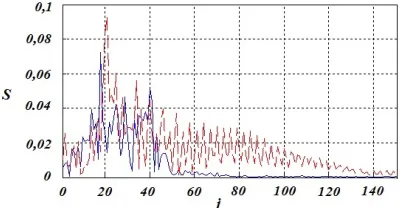
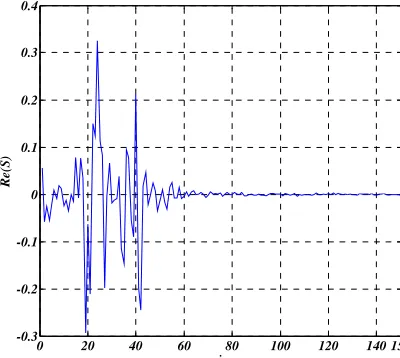
Real and imaginary parts of the seismic noise complex spectrum are stated in figure 8 and figure 9.
Figure 7 states an example of seismic noise non-stationary amplitude spectrum represented by the continuous line with varying samples mean and std values.
The non-stationary components simulating spectral fluctuation mean and intensity are slow correlated frequency functions. Thus they should be suppressed by Fourier spectrum normalization.
Figure 8 shows the noise spectrum averaged over 1000 cycles. This mean spectrum reflects the main features of seismic noise.
[image:4.612.318.518.484.588.2]3571
0 20 40 60 80 100 120 140 150 0
5 10 15 20 25
j
[image:5.612.92.315.72.295.2]S
Figure 8: Amplitude spectrums (S) examples: seismic noise (solid line) and person line (dashed line)
The real and imaginary parts of the spectrum in figure 9 and figure 10 have zero mean values. They are less correlated than the amplitude spectrum. The autocorrelation functions of the real and imaginary spectrums in figure 9 and figure 10 are correspondingly shown in figure 11 and figure 12.
0 20 40 60 80 100 120 140 150 -0.3
-0.2 -0.1 0 0.1 0.2 0.3 0.4
j
Re
(S
[image:5.612.319.528.77.281.2])
Figure 9: Real part of the noise complex spectrum
0 20 40 60 80 100 120 140 150 -0.3
-0.2 -0.1 0 0.1 0.2 0.3 0.4
j
Im
(S
)
Figure 10: Imaginary part of the noise complex spectrum
-50 -40 -30 -20 -10 0 10 20 30 40 50 -0.4
-0.2 0 0.2 0.4 0.6 0.8 1
j
[image:5.612.315.532.326.545.2]A C F
Figure 11: ACF of the real part of the noise complex spectrum
-50 -40 -30 -20 -10 0 10 20 30 40 50 -0.4
-0.2 0 0.2 0.4 0.6 0.8 1
j
A C F
Figure 12: ACF of the imaginary part of the noise complex spectrum
[image:5.612.97.297.428.607.2]ISSN: 1992-8645 www.jatit.org E-ISSN: 1817-3195
3572
4. NON-PARAMETRIC SPECTRAL
STATISTICS THRESHOLD FINDING The decision statistics U X Y( , ) with respect to spectrum normalization does not depend on initial data probabilistic properties. Therefore false alarm probability also does not dependent on them. The proposed detection algorithm stabilizes false alarm probability at any degree of seismic noise correlation.
When the amplitude spectrum form is known the procedure (3) appears to be the agreed filtration maximizing the signal-to-noise ratio (SNR). Otherwise it is reasonably to use general knowledge on noise spectrum properties and target signal spectrum properties. For instance, one of such properties is target high-frequency spectral components exceeding over corresponding noise spectral components. This property is explained by relatively small distances where targets are PSL detected. Therefore seismic wave propagation medium can be represented by relatively wideband filter which slightly attenuates seismic signal high-frequency components. Seismic noise is usually generated by sources situated at big distances when medium can be represented by narrowband low-frequency filter which suppresses high-low-frequency spectral components. Thus the rectangular window function
1, min max
0, otherwise
j j j
fj
can be selected where fj 1 in the frequency
range where target seismic signal spectral components are more than corresponding noise spectral components. As it follows from figure 7 the normalized boundary spectral components should by jmin 40 50, jmax 140 150.
With respect to (1)-(3) false alarm probability is controlled by the threshold U0
0 / 2 2
/ 2 1
2
J J
j
F j J
j U
P f C
, (4)
As the detection statistics (1) is a sum of many independent components its probability distribution can be approximated by the normal distribution law. Hence the false alarm probability approximation is
0
1
F
U
U U
P F
D
, (5)
where ( ) 1 exp 2 2 2
t
F t d
is the
probability integral, 0,5 2 1 J
U f j
j
is the mean
and 0, 25 2 2 1 J
DU fj
N j
is the variance of the
statistics (1) when there is no target detected. The detection threshold
1
0 U (1 F)
U U D F P
is found from (4).
Figure 13 shows the dependences of false alarm probability on threshold for the decision statistics (1) based on the binary distribution and its normal approximation (4) for N=1 and N=2. If false alarm probability is less than 10-5 then difference
between the curves for the dependences (4) and (5) are not noticeable. Therefore the approximation (5) is quite suitable for the further research.
5. AMPLITUDE SPECTRUM CORRECTION
FOR FALSE ALARM PROBABILITY AGREEMENT
Unfortunately amplitude spectrum seismic signal detection is complicated by spectral components mean values change from one cycle to another especially in the range jmin j jmax
.
[image:6.612.313.523.547.671.2]Difference between noise amplitude spectrum mean values in separate cycles is illustrated by figure 14 where the amplitude spectrums for five cycles of 1000 samples are shown. Such noise spectrum mean value fluctuations which are not very high make the Neiman-Pearson criterion not to be suitable.
Figure 13: False alarm probability decimal logarithm dependence on threshold: solid thin line is the approximation (5) of the function (4), N=1; thin dashed
line is the function (4), N=1; solid thick line is the approximation (5) of the dependence (4), N=2; dashed
3573
-2 0 2
S
-2 0 2
S
-2 0 2
S
-2 0 2
S
40 60 80 100 120 140
-2 0 2
j
[image:7.612.90.300.96.415.2]S
Figure 14: Seismic noise amplitude spectrums in five cycles
The noticeable difference between cycle amplitude spectrums means significantly effects on the probabilities p0 and p1as
( ) ( )
1
1 2
0
n n
x y
(n) (n)
p w(z )dz F
σ
, (6)
where x( )n and y( )n are correspondingly the amplitude spectrum mean values in the reference cycle and work cycle, σ is the x j( )n and y j( )n
spectral fluctuation std. p10.5 only if
( )n ( )n
x y
.
If x( )n y( )n 0 then p10.5 and the false alarm probability exceeds the given value in defiance of the Neiman-Pearson criterion requirements. Such effect influence is proposed to be compensated by M seismic noise reference cycles with spectrums mean values( )n 1
x , n , M in the spectral component range
min max
j j j . Then the maximal mean value
( )
max
max n
x x
n
is found. It is proposed replace
the measured values x j( )n and y j( )n with correspondingly the centered value
( )
( ) ( )
n
n n
j j
x x x and the pseudo-centered value
( ) ( )
max
n n j j
y y x
.
The pseudo-centering procedure increases the probability of the difference( )n ( )n
j j
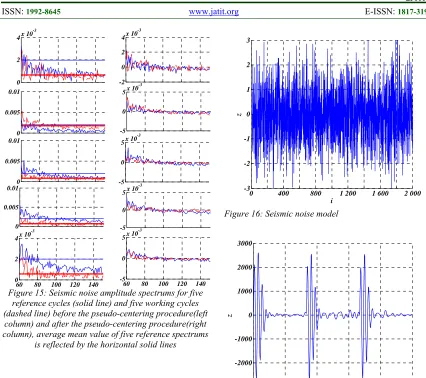
x y being negative and leads to p10,5. The pseudo-centering procedure is illustrated by Figure 15 where the seismic amplitude spectrums are presented for five reference cycles and five work cycles. When the maximal mean value over five reference cycle is subtracted the reference and working cycle spectrum become very close to each other. Therefore the false alarm probability obtained with the mentioned above approach is less than its calculated value. Hence the calculated value of the false alarm probability is considered to be its upper bound.
6. CORRECT DETECTION PROBABILITY
ESTIMATION
Correct detection probability calculation by analytical methods is difficult because of correlation between spectral samples of non-stationary signals such as seismic signals from targets making impulse actions of the ground. It is proposed to use the statistic simulation of the seismic target signal and seismic noise mix for correct detection probability estimation. Seismic noise is simulated by the linear prediction model with the parameters vector obtained from measured noise samples [20, 21].
The target signal for a walking person is described by the model
xi si i
where i is the normally distributed stationary process, si is quasi-periodic impulse train
2
( )
( ) exp
2 2 i kT k si a rk k
k
[image:7.612.322.515.658.700.2]ISSN: 1992-8645 www.jatit.org E-ISSN: 1817-3195
3574
0 2 4x 10
-3
-2 0 2 4x 10
-3
0 0.005 0.01
-5 0 5x 10
-3
0 0.005 0.01
-5 0 5x 10
-3
0 0.005 0.01
-5 0 5x 10
-3
60 80 100 120 140 0
2 4x 10
-3
60 80 100 120 140 -5
0 5x 10
-3
Figure 15: Seismic noise amplitude spectrums for five reference cycles (solid line) and five working cycles (dashed line) before the pseudo-centering procedure(left
column) and after the pseudo-centering procedure(right column), average mean value of five reference spectrums
is reflected by the horizontal solid lines
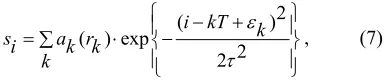
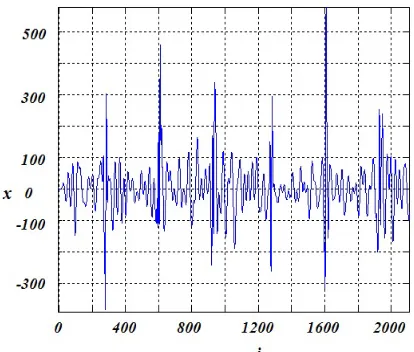
[image:8.612.89.515.67.445.2]where k is the pulse or step number, T is the mean step period, kis the random step fluctuation, τ is the parameter proportional to pulse width while total estimated width is 6τ, a rk k( )is the parameter proportional to signal amplitude depending on the distance rk between a person a seismic signal sensor. The proposed model is based on the properties of experimental records of a walking person seismic signal. Such signal is localized in the time domain and frequency domain like Berlage or Gabor pulse signals [22, 23]. The simulated seismic noise is shown in figure 16. Te simulated person signal variants are shown in figures 17-19. The simulated person seismic signal with the additive seismic noise is shown in figure 20. With respect to the mentioned above parameters the real-time signal duration is 3.5 s. The SNR q is determined as the ratio of the continuous fluctuations std values used as the base of the noise and signal model when a rk k( ) 1 . The curve in figure 20 is for q11dB.
0 400 800 1 200 1 600 2 000 -3
-2 -1 0 1 2 3
i
[image:8.612.92.308.73.366.2]z
Figure 16: Seismic noise model
0 400 800
-3000 -2000 -1000 0 1000 2000 3000
i
z
Figure 17: Seismic signal Berlage model
0 400 800
-400 -200 0 200 400 600
i
[image:8.612.319.504.307.466.2]z
[image:8.612.318.504.504.663.2]3575
0 400 800
-20 -15 -10 -5 0 5 10 15 20 25
i
[image:9.612.93.298.93.295.2]z
[image:9.612.316.528.158.326.2]Figure 19: Seismic signal model (7)
Figure 20: Seismic noise and person signal mix model
Seismic signals detection reliability is achieved by detection characteristics which are the true detection probability dependences on signal-to-noise ratio at fix false alarm probability values.
The detection characteristics obtained by means of the statistic simulation for 1000 cycles and three false alarm probability values and two working cycles numbers N1 and N5 are shown in figure 25. The working cycles number increase lead to significant growth of correct detection probability when the false alarm probability remains unchanged. At the same time detection characteristics family density also increases for different false alarm probabilities. If
5
N which is about 15 steps of a walking person or 8.3 s, then the detection probability PD0.9 is
achieved at q 3 4dB. Further increase of cycles number will lead to better correct detection probability but calculation time and memory buffer size will be greater.
Figure 25: Person detection characteristics
The proposed non-parametric detector of seismic signals is recommended for application in seismic guard systems operated in rough environment conditions.
If a target is detected with signals from several sensors then their number increase is similar to increase of the working cycles number N but time for taking a decision is reduced.
The proposed non-parametric detector of seismic signals provides true detection probability more than 90% at fixed false alarm probability 0.001 and signal-to-noise ratio 5 dB and more. These indicators are achieved by less hardware and software resources than it is proposed in [7-12]. Non-parametrical approach to object detection is free of overtraining taking place in neural networks especially if environment conditions are not stable. In addition, such non-parametrical detector is self-sufficient as there is no need to use any sensors besides seismic ones.
3. CONCLUSION
[image:9.612.94.301.326.502.2]ISSN: 1992-8645 www.jatit.org E-ISSN: 1817-3195
3576 The proposed non-parametric algorithm of seismic targets detection based on seismic signal and noise amplitude spectrums improve the PSL system detection characteristics when there is no enough a-priori information on statistical properties of measured data. Increase of work cycles or sensors number leads to increase of the correct detection probability. False alarm probability is stabilized by amplitude spectrum mean correction by the pseudo-centering procedure. The model of the seismic noise and walking person signal mix based on properties of experimental records is proposed for the correct detection probability investigation with respect to signal-to-noise ratio. Achievement of high enough correct detection probability values at small signal-to noise ratio is possible when false-alarm probability is not very high. The correct detection probability is improved at the same false alarm probability when the number of cycles is about five times increased. Correct detection probability achieves 0.9 at small signal-to-noise ratio values about 3-4 dB when the number of cycles is about 5.
Further research will be directed on investigation of the seismic signal amplitude spectrum frequency range influence on false alarm and correct detection probability values.
REFRENCES:
[1] 1. A. L. Marhakshinov, A. A. Spektor, “Estimating local characteristics of object motion in a seismic monitoring system”, Optoelectronics, Instrumentation and Data Processing, 2009, Vol. 45, No. 5, pp. 419–427. [2] M. A. Raifel’d, A. A. Spektor, “Nonparametric
method for detecting signals from seismically active objects”, Optoelectronics, Instrumentation and Data Processing, Optoelectronics, Instrumentation and Data Processing, 2005, Vol. 41, No. 6, pp. 73–80. [3] M. A. Grigor’ev, M. A. Rajfeld, “Detection of a
seismically activity object in the region of location of an observation system using a consistent Wald test”, Optoelectronics, Instrumentation and Data Processing, Optoelectronics, Instrumentation and Data Processing, 2016, Vol. 52, No. 4, pp. 360–366. [4] M. A. Raifel’d, “Increasing the power of
nonparametric tests of scale based on grouping data using order statistics”, Optoelectronics, Instrumentation and Data Processing, Optoelectronics, Instrumentation and Data Processing, 2012, Vol. 48, No. 5, pp. 529-535.
[5] D. O. Sokolova, A. A. Spektor, “Classification of moving objects based on spectral features of seismic signals”, 2012, Vol. 48, No. 5, pp. 522-528.
[6] P.S. Akimov, P.A. Bakut, V.A. Bogdanovich, “Signal detection theory”, Moscow, Radio i svyaz,1984, p. 440. (in Russian)
[7] T. Damarla, A. Mehmood, J. Sabatier, Detection of People and Animals Using Non-imaging Sensors, Proceedings of 14th International Conference on Information Fusion, Chicago, Illinois, USA, July 5-8, 2011, pp. 429-436. [8] X. Jin, S. Sarkar, A. Ray, S, Gupte, T. Damarla,
Target Detection and Classification Using Seismic and PIR Sensors, IEEE Sensors Journal, 2012, Vol. 12, No. 6, pp. 1709-1718. [9] S. A. Alyamkin, S. I. Eremenko, Pedestrian
Detection Algorithms Based on an Analysis of the Autocorrelation Function of a Seismic Signal, Optoelectronics, Instrumentation and Data Processing, 2011, Vol. 47, No. 2, pp. 124– 129.
[10] H.F. Xing, F. Li, Yu. L. Liu, “Wavelet Denoising and Feature Extraction of Seismic Signal for Footstep Detection”, Proceedings of the 2007 International Conference on Wavelet Analysis and Pattern Recognition, Beijing, China, 2-4 Nov, 2007, pp. 218-223.
[11] 11. A. E. Faghfouri, M.B. Frish, Robust discrimination of human footsteps using seismic signals, Proceedings of SPIE - The International Society for Optical Engineering, May 2011, https://www.researchgate.net/publication/24134 7660.
[12] Z. Peng, C. Cao, J. Huang, Q. Liu, “Seismic Signal Recognition Using Improved BP Neural Network and Confirmed Feature Extraction Method”, J. Cent. South Univ., 2014, Vol. 21, pp. 1898-1906.
[13] D.S. Korneyev, “Neural networks tool application in creating plant risks estimation and control model”, Upravleniye bolsimi sistemami, 2007, Vol. 14, pp. 81-102. (in Russian)
[14] A. V. Ivashko, A.I. Potapenko, “Image objects detection algorithms”. Vestnik Naz. Tech. Uni. “KhPI” : Automatika i proborostroyeniye. 2011. No. 57. – pp. 103-111. (In Russian) [15] D.O. Sokolova, A.A. Spector,
3577 [16] Y. V. Morozov, A. A. Spektor, Object
Classification Based on Analysis of Spectral Characteristics of Seismic Signal Envelopes // Optoelectronics, Instrumentation and Data Processing. 2017. Vol. 53. No. 6. pp. 49-56. [17] B. Babadi; E. N. Brown, ” A Review of
Multitaper Spectral Analysis”, IEEE Transactions on Biomedical Engineering, 2014, Vol. 61, No. 5, pp. 1555-1564.
[18] M. Woinsky, ” Nonparametric detection using spectral data”, IEEE Transactions on Information Theory, 1972, Vol. 18, No. 1, pp. 110-118.
[19] S.M. Rytov, “Statistical radiophysics”, Moscow, Nauka, 1976, part1, p. 494. (in Russian)
[20] S.L. Marple, “Digital Spectral Analisys”, Prentisce-Hall Inc., Englewood Cliffs, New Jersey, 1987, p. 584.
[21] G.E.P. Box, G.M. Jenkins, “Time Series Analysis”, Holden-Day, San Francisco, 1970, part 1, p. 406.
[22] S. Inaba; S. Arai, “Synthesis of Gabor filtered signal by convolving low-Q filtered signal with Gaussian function for efficient computation”, IEEE Global Conference on Signal and Information Processing,2013, pp. 646-649