2954
THE IMPORTANT OF SERVICE QUALITY AND THE TRUST
IN TECHNOLOGY ON USERS PERSPECTIVES TO
CONTINUES USE Of MOBILE SERVICES
Assistant Professor Dr. IBRAHIM ALMARASHDEH
Department of Management Information Systems, Imam Abdulrahman Bin Faisal University Email:[email protected]
ABSTRACT
Delivering government services through the mobile applications is popular in developed countries, which benefit the citizens and governments. However, the user’s acceptance of services via mobile applications still challenging for the government. The purpose of this research is to investigate the factors that influence citizens acceptance of mobile government services, based on the relative variables to help government to maintain the services and fulfill the citizen’s needs. A sample of 536 participants has shared their thought and participate in the online survey. Structural equation modeling (AMOS) implemented is conducted to validate the research model and test the research hypotheses. This research provides evidences to show that mobile governments can facilitate and assist citizens to access government services. In general, user acceptance can be viewed as the intention of user to use a new technology, together with an understanding of how to find it and how to use it. Citizens acceptance should be investigated based on major factors such as self-efficacy, trust in technology and service quality. The results of this research contribute to the user acceptance theory and to the marketing of mobile services by providing a clear picture and more understanding of the user perspective of using mobile services.
Keywords: Perceived Self-Efficacy, Perceived Ease Of Use, Perceived Usefulness, Service Quality, Trust In
Technology, Cost Of Service, Behavioral Intention.
1 INTRODUCTION
Today, the mobile phones and its applications become one of the most common technology in our daily life. With the development of new technologies and the demand for more efficient and more effective government, the governments needed mobile government initiatives to offer more services to reach more citizens [1]. But the Efficient and effective management is considered the crucial factor that decides the success or failure of any mobile service [2].
Mobile government aims to modernizing and enhancing service delivery by enhancing the accessibility, convenience, and interactions channels with the public and businesses sectors. Concurrently, it was expected to improve information flow and processes between the government and citizens, improve the quality and speed of policy development, and improve enforcement and coordination. This would enable the government to be more responsive to the needs of its citizens [3].
Mobile governments is an important issue for the future success of the government services because it has the potential to improve the user interaction with the government services and liberate users from the
constraints of traditional service of delivery. Mobile government would change the public services to a better way and to be accessible to users any time and anywhere to almost everyone [4]. As Mobile devices are significantly changing learning activities and communication, and play important rule in human– computer interaction, [5]. Also, mobile government increases the participations of the governments activities by reaching the citizens through a more friendly, personal and familiar device [6].
2955 changes such as fear of the unknown, security related concerns, habits and economic factors, which would be a reasons why people might resist accepting new approaches [8].
Although the success of some mobile governments stories, however, it is important highlighting some of the barriers that may hinder user acceptance of government services. Governments faced a huge risk by investing significant resources in providing services and technologies, while the users acceptance is not granted. Governments need to look into targeted users who will use mobile government services. The failure of those users to accept mobile government services, will lead to a failure of mobile government programs in the long term [8]
As one of the critical success factors of mobile government is the user acceptance [9], achieving high user acceptance is a big challenge. Improving the user acceptance is depends on the implementation and design services by giving the citizens appropriate and value services to become a part of their daily life [10]. In addition, the mobile devices is a perfect technology for enhancing the interaction between users and governments services. Hence, content should be relevant, targeted and short [11]. Also, support, resources and knowledge should be provided to various users in society. This would increase the users intention to use the provided services [12].
Government can propose many new services but should first understand the users perspective [13]. Thus, we to improve the mobile government services we need to know how to measure it. This study aim to measures the users acceptance of mobile governments based on the important factors that play main role in the citizens perspective. The main objective of this study was to answer the research question: which factor is the most predictor of citizens behavioral intention to use mobile governments services?
2 CURRENT ISSUES IN MOBILE
GOVERNMENT
Mobile government involve impotently in enhancing the interactions between users and government or the processes of government services [4]. Mobile government is using ICTs to improve the activities of public sector organizations and offer the anywhere, anytime functionality to citizens and public agencies [9]. The evolution of technology and using the mobile services to access online content has been increased rapidly. In 2014, the International Telecommunication Union (ITU) reported there were a 7 billion mobile users and this
number is equivalent to 95% of the world’s population [14] and still increasing [15].
Usability of mobile portal is one of the biggest challenged faced mobile government implementation[11]. The most important factor to predict the success if service implementation is measuring the user intention [16]. Therefore, to increase the user acceptance, it is important to satisfy their needs and provide them with advanced technology. Despite the availability of advanced technology for mobile devices previous research claimed that advanced mobile services which run on mobile devices have not been widely adopted [17]. The current publicity of mobile technologies is a great chance to encourage citizens to use mobile government services. However, government agencies should be aware that a user needs and requirements is the key success factors for a long-term of user’s acceptance of services [18].
The m-governments still have some important theoretical and practical limitations [19]. In term of practical limitation, mobile government must be compatible across many platform and fit into the user’s expectation and expertise. Government adopt new technology in order to improve the quality of services and meet users expectation and needs. Even though the mobile government has been used widely, however, some major issues remain uncleared, such as privacy, and lack of resources, risks and security [1].
2956 important issue which needs to draw great attention towards which is the end user behavior regarding adopting and using mobile government services [24].
3 TECHNOLOGY ADOPTION FACTORS
AMONG EMPIRICAL STUDIES
The user acceptance and adoption of mobile technology in empirical studies mostly applied models based on the use of, the Unified Theory of Acceptance and Use of Technology (UTAUT) [25] or the Technology Acceptance Model (TAM) [26]. Each of the above models has contributed to the literature on technology acceptance [17].
In UTAUT, the four key components that affect behavioral intention to use are effort expectancy, performance expectancy, facilitating conditions and social influence. This theory did not take into account the effect of important factors such as perceived risk, perceived trust in technology and more importantly didn’t pay intention to the cost of services which is one of the important factor of the mobile services. In another hand, this theory used voluntariness of use, gender, age, experience factors as moderating factors, but service quality is the main factor of the mobile services did not used as moderator. In another hand, experience used instate of self-efficacy, but it did not predict the user confidence of using the new technology while self-efficacy do.
In TAM, perceived ease of use and perceived usfuleness is the predictors of behavioural intention to use new technology. But today, because is many new technology has been developed and the users has many options, several factors chould be important to attract users or to hinder them from using the new technlogies such as perceived trust in technology and service quality.
Different researchers considers different factor to measure the users acceptance [27, 28]. For example, some researcher claimed that privacy, security, perceived ease of use and usefulness as important factors that influence users’ acceptance [29]. Were AlShihi (2007) indicated that trust has a wide impact on m-government acceptance [30]. Moreover, Lee et al. (2002) found that perceived usefulness and perceived ease of use significantly affected by self-efficacy and social influence [31]. Moreover, Kaasinen (2007), found that perceived trust, ease of
2957
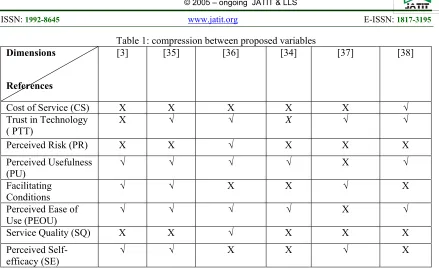
Table 1: compression between proposed variables
Dimensions
References
[3] [35] [36] [34] [37] [38]
Cost of Service (CS) X X X X X √
Trust in Technology
( PTT) X √ √ X √ √
Perceived Risk (PR) X X √ X X X
Perceived Usefulness
(PU) √ √ √ √ X √
Facilitating Conditions
√ √ X X √ X
Perceived Ease of
Use (PEOU) √ √ √ √ X √
Service Quality (SQ) X X √ X X X
Perceived
Self-efficacy (SE) √ √ X X √ X
3.1 Cost of Service (CS)
The cost of service has been missing from most of previous research models in user acceptance. Although, it’s very important variables in the in the citizen behaviour context. It’s not easy to compare cost of service between different service operators and providers, because doing that will require more information about services priced based on time, which will be depend on the amount of transferred data. The cost of service is not limited to price alone, it is also the based on the content provided by the mobile government services. There are a varies type of services and each service could deliver different type of content. In order to create and initiate belongingness to the mobile user, the content must be relevant to the language, region and culture [2]. In this assumption we assume that cost of service will have a correlation effect on the service quality of mobile services and its contents.
The behavioural decision theory claimed that perceived cost of service has a significant to effect on use of service. Furthermore, unsatisfying experiences, such as out-of-date content, slow connections, poor quality, errors and missing links have infuriated online users [39]. This shows that cost of service might have a significant impact on self-efficacy. Furthermore, researchers have suggested that mobile services cost should be reduced to give the opportunity to more citizens to use the service [40], [41].. Now, in many countries we can find the cost of mobile governments services is free of charge but the value of time using the
service still very costly. So, service providers should enhance the service quality to reduce the cost of time consuming in using the service. In this regard, we have suggested the following hypothesis:
Hypothesis 1a: Cost of services has a significant impact on user behavioural intention to use mobile government services.
Hypothesis 1b: Cost of services has a significant impact on perceived Self-efficiency of using mobile government services.
Hypothesis 1c: Cost of services has a significant impact on mobile government service quality
3.2 Trust in Technology (PTT)
Trust and belief have been used in the literature to illustrate how consumers can overcome perceived risk in online transactions. Because mobile governments still in the initial stage, many citizens still not clear about certain issues such as reliability, security and technical capability of the service provider that carry their government data [42].
2958 Perceived Trust in technology (PTT) is consistently identified as a key predictor of mobile service acceptance. Mobile government acceptance is contingent upon citizens’ belief that the mobile government services is a dependable medium, capable of providing secured transactions and accurate information. Trust has been known as a critical success factor of electronic and mobile services. In this regard, we have suggested the following hypothesis
Hypothesis 2a: Perceived trust in technology positively impacts user behavioural intention to use mobile government services.
Hypothesis 2b: Perceived trust in technology positively impacts perceived user’s Self-efficiency of using mobile government services.
Hypothesis 2c: Perceived trust in technology positively impacts perceived mobile government service quality.
3.3 Perceived Risk (PR)
The mobile governments not yet fully explored by citizens, perceiving risk of using the service would hinder the users from using the mobile government services [42]. Perceived risk is composed of behavioral and environmental uncertainty. Behavioral uncertainty exists because, online service providers may behave in an opportunistic manner by taking advantage of the impersonal nature of the electronic environment, while environmental uncertainty arises due to the unpredictable nature of Internet-based technology that is beyond the control of the consumer [43]. In mobile government, perceived risk reduces users’ intentions to use the services. Perceived risk will have a negative effect on consumers' behavioral intention to adopt mobile governments. Hence the following hypothesis is derived:
Hypothesis 3a: Perceived risk has a significant impact on behavioural intention to use of mobile government services.
Hypothesis 3b: Perceived risk has a significant impact on perceived Self-efficiency of using mobile government services.
Hypothesis 3c: Perceived risk has a significant impact on mobile government service quality.
3.4 Perceived Usefulness (PU)
Perceived usefulness concentrate on the unstableness and importance of the information [44, 45]. It is defined as the extent to which a person believes that the technology will enhance his/her job performance or productivity (Davis et al. 1989). It is primarily connected with perceptions of the outcome as a result of technology usage. A significant body of TAM research has provided evidence, that PU is a strong determinant of user acceptance, adoption, and usage behaviour[26, 46-48]. In fact, perceived usefulness has been found to be the most significant factor to predict the user behaviour in using new technology [26, 49, 50]. Hence, this research proposes the flowing hypotheses:
Hypothesis 4a: Perceived usefulness positively impacts user’s behavioural intention to use mobile government services.
Hypothesis 4b: Perceived usefulness positively impacts user’s perceived Self-efficiency of using mobile government services.
Hypothesis 4c: Perceived usefulness positively impacts user’s mobile government service quality
3.5 Facilitating Conditions
Facilitating conditions means that users have necessary resources such as money, knowledge and expertise, to accept the services. Mobile government as a new concept makes it necessary for users to have some basic knowledge on operation ability and mobile technology on service terminals. Furthermore, mobile government users will bear internet usage costs by themselves, including information and fees communication, which is can be effected by perceived cost of services. When these fees are high, it will abandon the users from accessing the mobile government services, even if the provided services van bring more benefit for the users.
Facilitating conditions refer to the range of support offered to individuals such as provision of support and availability of training, which effected the technology usage. Many technology acceptance studies has tested this variable, and found an effect on the user behavioural intention to use new technology [46, 51, 52]. Hence, we have proposed the following hypotheses:
2959 Hypothesis 5b: Facilitating Conditions positively impacts user’s perceived Self-efficiency of using mobile government services.
Hypothesis 5c: Facilitating Conditions positively impacts mobile government service quality.
3.6 Perceived Ease of Use (PEOU)
This construct is explained the individuals believes of the how simple is using the technology. PEOU give an advantage to early acceptance of an innovation and is necessary for subsequent diffusion of technological innovations and adoption [26]. PEOU has been used popularly in many studies regarding the acceptance of new technology [53, 54]. Yet, the effect of perceived ease of use on user acceptance not very clear. In some cases, perceived ease of use has shown to have a direct effect on technology use and in some most cases it shows indirect effect by using perceived usefulness as moderator to predict the user behavioural intention to use new technology [53, 55-57]. Since it not clear yet the amount of direct effect we will try in our study to measure the amount of direct and indirect effect of using perceived ease of use to predict the behavioural intention to use using different moderator such as self-efficacy and service quality. Thus, the following hypotheses are formulated:
Hypothesis 6a: Perceived ease of use positively impacts user’s behavioural intention to use mobile government services.
Hypothesis 6b: Perceived ease of use positively impacts user’s perceived Self-efficiency of using mobile government services.
Hypothesis 6c: Perceived ease of use positively impacts mobile government service quality.
3.7 Service Quality (SQ)
The mobile government should provide the basic set of requirements of service quality. The definition of service quality varies and depend on the use perspective. In term of mobile services user perspective, service quality refers to the degree of goodness of the mobile government services. Service quality is important especially in the context of information system (IS), that many people are similar in terms of reluctance to use the system when they experience frequent reduction in frequent disconnection, response, lack of reliability and accessibility [20, 50, 58, 59].
There is a need to measure the mobile service quality [60] and consensually, we need to keep measuring the service quality. The reason of the difficulty of measuring the service quality, because every service is different specially in the context of technology. For example, few years ago we measured the service quality of websites providing the government services, today we are measuring mobile services because its carrying the government services.
Service quality is a good predictor to measure the user acceptance of new technology, and it could be correlated by many other variables that effect the service quality such is how simple is the service, cost of service, trust in technology and perceived risk of using the new technology. In this study we will use perceived service quality as a mediator factor to predict the users behavioural intention to use mobile government services. In this regard, we have suggested the following hypothesis:
Hypothesis 7: Perceived service quality positively impacts user’s behavioural intention to use mobile government services.
3.8 Perceived Self-efficacy (SE)
Self-efficacy explain the user belief of how he/she capable to perform a particular function [61, 62]. In the mobile government context, we can define self-efficacy as the extent of how confidence the user belief when accessing and using the government services.
2960 Hypothesis 8: Perceived self-efficacy positively impacts user’s behavioural intention to use mobile government services
3.9 Behavioral Intention (BI)
Behavioural intention is defined as the user willingness to use the technology again in the future or could represent the user loyalty in some aspect. Its an important indicator of the ultimate user acceptance decision [64]. According to Ajzen
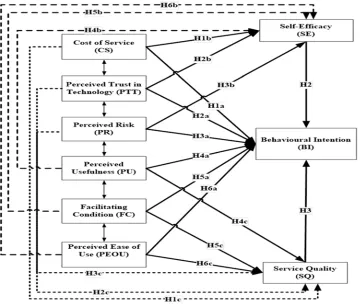
[image:7.612.129.489.234.538.2](1991), behavioural intention to use the technology is a predictor of the user preference of how actually the users use the system [65]. From psychological theories perspective, the individual behaviour is predictable by individual intention [25, 66]. However, in the context of mobile government, there is still a limitation and need for a complete framework to explore the factors influence the individual intention to use mobile government services [34]. Figure 1 below surmised the research framework and its hypothesis.
Figure 1: Proposed research model
4 DATA COLLECTION AND ITEMS
GENERATIONS
The data collection for this study started with a comprehensive literature review to identify all potential issues and variables that associate with mobile governments. After identifying the construct that considered to be important and has an influence in the user acceptance of mobile government, the items generation started. In the item generation process for the survey questionnaire we started by creating a list of items that would help to indicate the right response from the participants for each construct. Once the first draft of survey is ready, we
conducted a review panel to check the items and ensure the validity of each items along with checking if there is any errors or unclear information. The survey questionnaire contained 44 adopted items to measure 9 constructs for mobile government acceptance, as shown in Table 2 below.
Table 2: Items source used in this study
Construct No Reference
Perceived cost of services 3 [16, 38, 67]
[image:7.612.309.532.668.732.2]2961
Perceived risk 7 [68, 69]
Perceived ease of use 4 [16, 38, 70]
Perceived usefulness 4 [16, 38, 70]
Facilitating Condition 4 [3, 71]
Self-efficacy 3 [3, 71]
Services quality 8 [36, 69]
Behavioural Intention 4 [16, 38, 70]
4.1 SAMPLE INFORMATION
This study used convenience sampling comprised of 563 adults. Most of the sample age were between 25 - 29 years old (41%) and 26% from the age 30 - 39. A 55.2 % of the sample were males and 44.8 were females. Most of the Participants income were low, less than 4000 a month (48.5%) and the highest income were 6%. Table 3 below describe the sample information.
TABLE 3:DEMOGRAPHIC INFORMATION
N %
Age 18-24 51 9.1
25-29 235 41.7
30-39 148 26.3
40-49 101 17.9
Above 50 28 5.0
Gender Male 252 44.8
Female 311 55.2
Income/month Less than 4,000 273 48.5 5,000–9,000 152 27.0 10,000 - 14,000 104 18.5 15,000 and above 34 6.0
Total 563 100
[image:8.612.84.559.54.249.2]In figure 2 below the results shows that 62.7% of the participants used mobile phone to access online contents and 17.8% never used mobile phone to access online contents. This results in the line with the latest report of mobile usage over the globe which shows that 49.74% of the total browsing of online content come from mobile devices [15].
[image:8.612.316.557.349.490.2]Figure 2: Accessing mobile contents from mobile phone
Figure 3 describe how long the participants were using mobile government. Its clearly showing that 38.4% of the participants use it for less than 5 months and 1.6% use mobile government more than 2 years.
Figure 3: experience on using mobile governments.
4.2 RELIABILITY TEST
To Measure the internal reliability Cronbach’s coefficient alpha test is conducted. A Cronbach's Alpha value of 0.70 or more recommended to be an indicator for a good reliability [72]. All variables have passed the reliability test and all of them above α = 0.70 (Table 4) which indicate a good consistency and scales used in this study. The highest coefficient alpha value was service quality which is α = 0.801 and the lowest coefficient alpha value were Perceived usefulness which is α = 0.709.
[image:8.612.90.297.383.538.2]2962
Construct Cronbac
h alpha Mean SD
Cost of service .712 3.90 0.834
Perceived trust on technology
.734 3.49 0.893
Perceived risk .716 3.23 0.953
Perceived ease of use .742 3.68 0.904
Perceived usefulness .709 3.82 0.875
Facilitating conditions .710 3.78 0.826
Self-efficiency .749 3.29 0.955
Service quality .801 3.26 0.978
Behavioral intention to use
.753 3.42 0.822
4.3 VALIDITY TEST
[image:9.612.89.296.79.246.2]Structural equation model (SEM) used in this study to test the research hypothesis and validate the research model. The first step we take in data analysis is to validate the research model and ensure the data id fitted to the required measurement. The first measures in the model validation was testing the CMIN, normed chi-square (CMIN/DF) which can give the first indication if the model fit into the data or not [73-75] and the most reported measure [76]. The CMIN/DF value for the research model is 2.776 and P vale 0.96. This value means the sample data and the hypothetical model has an acceptable fit [77]. This result indicates the discrepancy of the research model not significant. Furthermore, the results indicated that the structural model had a reasonable error of approximation (value= 0.056) by measuring RMSEA (Root Mean-Square Error of Approximation) [78]. The TLI (Tucker-Lewis Index) value is 0.968 and CFI (Comparative Fit Index) value is 0.999 which indicate a fitted model as the values close to 1 indicate a very good fit [79, 80]. Table 5 conclude the validity of the research model.
Table 5: Fit Indices Summary
Fit Indices Values in
this study
Indicator
CMIN/DF 2.776 Pass
RMSEA 0.056 Pass
TLI 0.968 Pass
CFI 0.999 Pass
PCFI 0.28 Pass
5 RESULTS
In the date analysis we used different test to analyze the data. First we used correlation test to to check if the variables has a significant association together or not. Because this will give first indication about the scope of this study. In the second test we used regression analysis to test the research hypothesis. Using SEM Amos path diagram is the right way at this stage to give a clear picture on the direct and indirect effect.
5.1 CORRELATION TEST
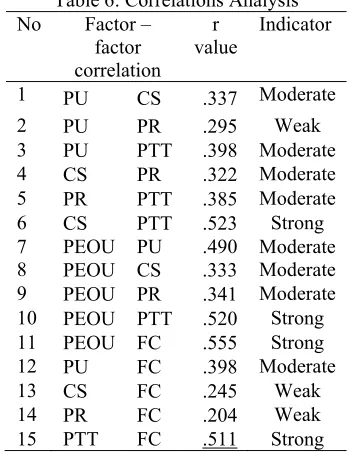
[image:9.612.330.505.509.740.2]Conducting a correlation test could be helpful to discover how the independent variables could associate together. According to Lee and Peters (2015), a correlation value (r) of -1.0 to -0.5 or 1.0 to 0.5 considered as a strong correlation, r value of -0.5 to -0.3 or 0.3 to -0.5 considered as moderate, and r value of -0.3 to -0.1 or 0.1 to 0.3 considered as weak, and r value of -0.1 to 0.1indicate a none or very weak relation [81]. In table 6 below, it can be seen clearly there are significant correlation between all independent variables. The weakest correlation is between PR and FC (r= 0.204). The strongest correlation were between PEOU and FC (r= 0.555). The correlation results show how one factor value can be affected positively or negatively if the associated factors are weak or strong. For example, FC explain what if the users have necessary resources such as expertise, knowledge and money to accept information technology and POEU explain how simple is the technology used to access the content, the correlation results show that if the users did not have enough resources to use the system he/she will perceived the system is not simple.
Table 6: Correlations Analysis No Factor –
factor correlation
r
value Indicator
1 PU CS .337 Moderate
2 PU PR .295 Weak
3 PU PTT .398 Moderate
4 CS PR .322 Moderate
5 PR PTT .385 Moderate
6 CS PTT .523 Strong
7 PEOU PU .490 Moderate 8 PEOU CS .333 Moderate 9 PEOU PR .341 Moderate 10 PEOU PTT .520 Strong 11 PEOU FC .555 Strong 12 PU FC .398 Moderate
13 CS FC .245 Weak
14 PR FC .204 Weak
2963 16 PTT SQ .565 Strong
17 SE PTT .518 Strong 18 SE SQ .437 Moderate
5.2 REGRESSION TEST
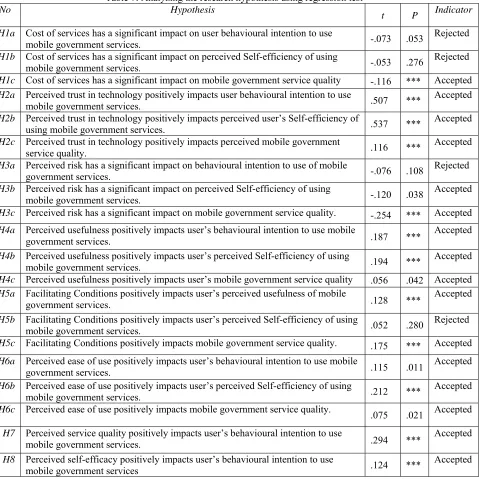
Using the path diagram to test the research hypothesis is the best way to give a clear idea on every interaction between the model variables using SEM. Table 7 describe the finding of the tested
[image:10.612.72.551.228.707.2]research hypothesis using SEM. Except hypothesis H1a, H1b, H3a and H5b all other hypothesis has significant effect. H1a indicate that cost of services and Perceived risk did not affect the user intention to use the service and did not service quality (H1c and H3a). Also, cost of services and facilitating condition did not have significant effect on perceived self-efficacy to use of m-government services (H1b and H5b).
Table 7: Analyzing the research hypothesis using regression test No
Hypothesis
t P Indicator
H1a Cost of services has a significant impact on user behavioural intention to use
mobile government services. -.073 .053 Rejected
H1b Cost of services has a significant impact on perceived Self-efficiency of using
mobile government services. -.053 .276
Rejected
H1c Cost of services has a significant impact on mobile government service quality -.116 *** Accepted H2a Perceived trust in technology positively impacts user behavioural intention to use
mobile government services. .507 ***
Accepted
H2b Perceived trust in technology positively impacts perceived user’s Self-efficiency of
using mobile government services. .537 *** Accepted
H2c Perceived trust in technology positively impacts perceived mobile government
service quality. .116 *** Accepted
H3a Perceived risk has a significant impact on behavioural intention to use of mobile
government services. -.076 .108 Rejected
H3b Perceived risk has a significant impact on perceived Self-efficiency of using
mobile government services. -.120 .038
Accepted
H3c Perceived risk has a significant impact on mobile government service quality. -.254 *** Accepted
H4a Perceived usefulness positively impacts user’s behavioural intention to use mobile
government services. .187 ***
Accepted
H4b Perceived usefulness positively impacts user’s perceived Self-efficiency of using
mobile government services. .194 ***
Accepted
H4c Perceived usefulness positively impacts user’s mobile government service quality .056 .042 Accepted H5a Facilitating Conditions positively impacts user’s perceived usefulness of mobile
government services. .128 ***
Accepted
H5b Facilitating Conditions positively impacts user’s perceived Self-efficiency of using
mobile government services. .052 .280 Rejected
H5c Facilitating Conditions positively impacts mobile government service quality. .175 *** Accepted
H6a Perceived ease of use positively impacts user’s behavioural intention to use mobile
government services. .115 .011 Accepted
H6b Perceived ease of use positively impacts user’s perceived Self-efficiency of using
mobile government services. .212 *** Accepted
H6c Perceived ease of use positively impacts mobile government service quality. .075 .021 Accepted
H7 Perceived service quality positively impacts user’s behavioural intention to use
mobile government services. .294 *** Accepted
H8 Perceived self-efficacy positively impacts user’s behavioural intention to use
mobile government services .124 ***
2964
6 DISCUSSION
With the rapid advancements of mobile network technologies, provision of various kinds of services by mobile government. Mobile technology is the most popular technology available in the market today, which covering every part in our daily life, including media, studying, mapping, scheduling, booking, podcasting, and even using a smart phone as a key or as cash card. From here, it's important to include every service the users need to be applicable and accessible by them through mobile technology. On the other hand, these services must be acceptable by the users. Investing significant resources in providing technologies and services whose acceptance is uncertain is a huge risk [8].
The main objective of this study was to answer the research question: which factor is the most predictor of citizens behavioral intention to use mobile governments? Taking a multi-dimensional approach with reference concepts from studies on mobile services and user behavior, a research model was proposed and empirically tested against data collected from over 563 mobile services users.
The results generally support the model and most of the hypotheses. Out of 20 hypotheses only 4 hypotheses found not having significant effect were rejected. The insignificant effect of cost of service on self-efficacy and behavioral intention because users can access all mobile government services free of charge which explain why cost of service did not has a significant effect. Also, perceived risk has insignificant effect on behavioral intention and that related to users maybe did not feel risky when accessing government services because the services is provided by the governments and not by commercial provider. On the other hand, measuring the correlation between cost of service and perceived risk indicate a moderate significant correlation (r= 0.322, p< .05) which shows that any change of both variables can change the other, for example if cost of services decreased the citizens perceived risk of using the services will be decreased as well. To answer the research question, we compared all supported hypothesis to find the highest effect on behavioral intention. The highest effect on citizens behavioral intention to use mobile government is perceived trust in technology (t = 0.507, p< .05) which considered to be high influence. This finding illustrates that trust in technology is effect the citizens intention 4 times more than the effect of perceived ease of use (t = 0.115, p< .05) which is the weakest significant effect on citizens intention to use mobile government. The second highest influencer
factor on the citizens intention is service quality (t= 0.294, p< .05). This indication illustrate that citizens looks deep inside the services and required high service quality and need to trust the technology provided by the government. Those two factors can change the citizens acceptance of mobile governments more than other factors. To ensure this effect, we conducted a correlation test and we find there is a strong significant correlation (r = 0.565, p< .05) between perceived trust in technology and service quality. This results in the line with the resent research on perceived trust in technology and service quality [82]. This indication can show that both factor are associate together and if any of them increased or decreased positively or negatively, can make a significant change on the user behavior. This indication illustrates that citizens perception did not effected much by the how simple or expensive the service or how experience is the user but its indicted that to attract citizens intention to use the services the first factors that government should take into account is perceived trust in technology and service quality. Trust in technology can be improved by training people on how to use technology and to show them the right way to differentiate between trusted and not trusted technology. On the other hand, perceived trust in technology can be improved if the citizens find justice fairness if they faced any issues during accessing the mobile government services. For example, if citizens find a good recovery plan that can safe them when system failure accrued that will increase their trust in technology and they will use it more and that will increase the citizens intention to use the services.
2965 service because if they feel the risk of using the service is high they will predict the service quality is bad. The second predictor of service quality is perceived trust in technology with t= 0.209. This result illustrates if citizens perceived trust on technology, that will increase their judgment of the quality of services provided by the governments. The weakest is cost of service (.053). As discussed before cost of services didn’t show strong effect because
most of the mobile governments services are free of charge so users behavior did not effected by the cost of service.
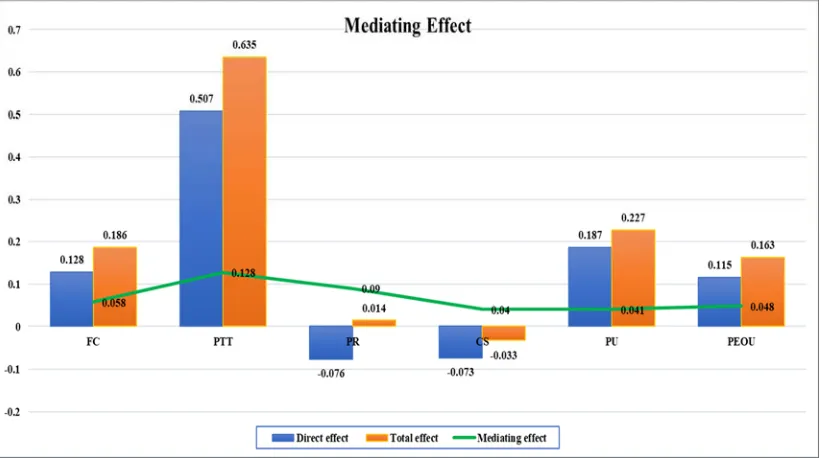
[image:12.612.93.504.207.436.2]To prove the important effect of mediation factor (Service quality and Self-efficacy) on the relation between the independent variables and behavioral intention to use, Figure 4 illustrate the different in effect with/without using the mediation variables.
Figure 4: Mediating Effect
Collecting the results on the indirect effect shown in the figure, indicate that a mediating variables Service quality and Self-efficacy has a significant mediating effect on the relation between the independent and dependent variables. All relation between the independent and dependents variables has been increased when this relation is mediated by the Service quality and Self-efficacy. This finding illustrates using the mediators would improve the value of the predictors effect on the citizens intention to use mobile government. The weakest mediation effect was cost of service effect on citizens intention to use mobile government which increased 0.04 and perceived risk increased 0.09. The highest mediation effect is perceived trust in technology which initially has a direct effect on citizens intention to use mobile government (t= 0.507), this effect has increased 0.128 after the mediators included to control this relation and the total effect of PTT on BI became 0.635. This finding illustrates using the mediators would improve the value of the predictors effect on the citizens intention to use mobile government. High service quality and high self-efficacy would
improve how users can perceive (risk, trust in technology, usefulness, ease of use, facilitating condition, cost of service) and that will lead to increase the citizens behavioral intention to use mobile government services.
2966 results include the influence of variables such as service quality, perceived trust in technology, self-efficacy and perceived risk, facilitating conditions and cost of services behavioral intention to use mobile government services.
The proposed research model aims to help on the governments understanding to measure and indicates the user behavioral intention to use mobile government services which will lead for better understating of the success of service implementation. In addition, based on the several variables used in this study, we recommend enhancing the user acceptance of mobile government services, providers should study the user acceptance jointly from many perspectives not only technological perspective including economic perspective, social perspective and psychological perspectives. In another hand, the services should be implemented and designed based on marketing, user behavior, and psychology and usability theories. Before developing a mobile services, governments need to realize that services provided by mobile applications are different from other technologies [83]. Designing a mobile governments services should provide recovery plans and 24/7 help disk in order to make the citizens perceived a trust in the services and reducing the feeling of risk when using such services. which we argued affect the behavioral intention to use the services.
According to the results, majority of participants interest to continuously use and recommends mobile government services to others in the future (Mean Value for BI = 3.42). Therefore, the mobile government services provide opportunities for citizens to access the government services based on their experience and needs. Additionally, governments can share their services with more citizens in any place at any time. Still, interesting opportunities can be seen with m-government [7, 80], but managers should understand how to evaluate the end user perspective first [13]. To understand the implied barriers that will frustrate users from adopting mobile government services, a deeper insight into factors influencing user acceptance of mobile government is vital. For example, taking a social networks as main topic to the future research is needed to reveal the interesting cultural differences. The proposed model might be used by future researcher to measure the user acceptance of the any new mobile services or applications in general. Furthermore, the finding will contribute to the existing knowledge by exploring the factors that significantly influenced the user acceptance of mobile services, by using the validated research model which summarize an important variable to
ensure the acceptance of mobile services. Moreover, this study recommends before measuring the effect between independent variables and dependent variables, the correlation between independent variables should tested. This indication will ensure the chosen variables are applicable to represent the research area or not.
7 LIMITATIONS
This study, like any empirical study has several limitations. Initially, the data were collected from online survey only. Therefore, the 25 to 39 age group (68%) is the primary group using reached on this survey, this sample could be extended to bigger and different user population. Second, as illustrated in previous literature, there are many other factors which might influencing citizens acceptance, such as social influence which we tested in previous study [16], value of time and money, expectation, information and content quality, customer care, trust in government that’s still need to be tested to bring us more clear picture an overall factors influencing user acceptance in general.
8 CONCLUSION
Initially, this study began with the premise that the successful practice of mobile government depends on the extent to which potential users adopt and use mobile technology to carry out various interact with the agency or government. Hence, finding the factors that might influence the citizens decisions to adopt the mobile government service. In order to enhance the user acceptance, this study recommends the system designers and government agencies to support the target citizens behavioral intention to use the services by improving perceived service quality, perceived risk, perceived trust in technology and perceived self-efficacy as the direct determinants of behavioral intention to use.
We find that the citizens behavioral intention to use the mobile government services not depends on level of simplicity or the usefulness of the services only, it is more based on the level of trust on technology and service quality provided by the government. Perceived trust in technology play important rule in mobile users behavior and the effect of this factor is more than three time than the effect of perceived ease of use. Also, service quality as a high significant effect on user behavior intention to use mobile governments.
2967 study findings imply that service quality and perceived trust in technology can increase intention to use mobile government more than any other factors. The technology itself is not enough for the successful implementation of the government's mobile service, instead, high quality service and reliable use of services with high trust and without risk of using the services must be presented in order to ensure the acceptance mobile government services.
REFERENCES
[1] M. J. Moon, From E-Government to M-Government? Emerging Practices in the Use of Mobile Technology by State Governments. IBM Center for The Business of Government: IBM, 2004.
[2] T. El-Kiki and E. Lawrence, "Mobile user satisfaction and usage analysis model of mgovernment services," in Second European Mobile Government Conference (Euro mGov 2006), Brighton, UK, 2006, pp. 1-9.
[3] N. M. Suki and T. Ramayah, "User Acceptance of the E-Government Services in Malaysia: Structural Equation Modelling Approach," Interdisciplinary Journal of Information, Knowledge, and Management, vol. 5, pp. 395-513, 2010.
[4] S. Raja, et al., "Making Government Mobile,"
in Information and Communications for
Development, W. Ban, Ed., ed. Washington D.C: The World Bank, 2012, pp. 87-100. [5] S.-S. Liaw, et al., "Investigating acceptance
toward mobile learning to assist individual knowledge management: Based on activity theory approach," Computers & Education, vol. 54, pp. 446-454, 2010.
[6] I. Kushchu and C. Borucki. (2004, 12 January). A Mobility Response Model for Government. Available:
http://www.mgovlab.org/library/mgovlab/mgo vlab_ikcb.pdf
[7] C. Huijnen, Mobile tourism and mobile Government: An inventory of European projects: European Centre for Digital Communication, 2006.
[8] OECD, M-Government: Mobile Technologies For Responsive governments And Connected Societies. International Telecommunication Union: OECD Publishing, 2011.
[9] G. A. Sandy and S. McMillan, "A Success Factors Model For M-Government'," in EURO mGOV, Brighton, UK, 2005, pp. 349-358.
[10] R. Rannu, et al., "Mobile Government: 2010 and Beyond," B. Koteles, Ed., ed: Mobi Solutions Ltd, 2010.
[11] N. V. Karadimas, et al., "M-Government Services in Greece," in 22nd European Conference on Modelling and Simulation Nicosia, Cyprus, 2008.
[12] S. AlAwadhi and A. Morris, "Factors Influencing the Adoption of E-government Services," Journal Of Software, vol. 5, pp. 584-590, 2009.
[13] A. Parasuraman, et al., "ES-QUAL: A multiple-item scale for assessing electronic service quality," Journal of service research, vol. 7, pp. 213-233, 2005.
[14] ITU. (2014, August, 23). International Telecommunication Union (ITU)). The world in 2014 ICT facts and figures. Available:
http://www.itu.int/en/ITU-D/Statistics/Documents/facts/ICTFactsFigures 2014-e.pdf
[15] Statista. (2017, July, 05). The Statistics Portal Statistics and facts on mobile Internet usage. Available:
http://www.statista.com/topics/779/mobile-internet/.
[16] I. Almarashdeh and M. K. Alsmadi, "How to make them use it? Citizens acceptance of M-government," Applied Computing and Informatics, vol. 13, pp. 194-199, 2017/07/01/ 2017.
[17] S. Rao and I. Troshani, "A Conceptual Framework and Propositions for the Acceptance of Mobile Services," Journal of Theoretical and Applied Electronic Commerce Research, vol. 2, pp. 61-73, 2007.
[18] Z. Thomas, "E-Government for Mobile Societies - Stocktaking of Current Trends and Initiatives," S. I. T. Center, Ed., 1 ed. Austria: Secure Information Technology Center Austria (A-SIT), 2011, p. 58.
[19] M. Koivisto, "Mobile information system adoption and use: beliefs and attitudes in mobile context," Doctoral Dissertation, Faculty of Electronics, Communications and Automation, Department of Communications and Networking, Helsinki University of Technology, Espoo, Finland, 2009.
[20] W. Delone and E. McLean, "The DeLone and McLean model of information systems success: A ten-year update," Journal of management information systems, vol. 19, pp. 9-30, 2003.
2968 systems: theory and results," Sloan School of Management, Massachusetts Institute of Technology, Massachusetts 1986.
[22] U. Löfstedt, "E-government-assessment of current research and some proposals for future directions," International journal of public information systems, vol. 1, pp. 39-52, 2005. [23] L. Carter and F. Belanger, "The influence of
perceived characteristics of innovating on e-government adoption," Electronic Journal of E-government, vol. 2, pp. 11-20, 2004.
[24] H. Abdelghaffar and Y. Magdy, "The Adoption of Mobile Government Services in Developing Countries: The Case of Egypt," International Journal of Information and Communication Technology Research, vol. 2, pp. 333-341, 2012.
[25] V. Venkatesh, et al., "User acceptance of information technology: Toward a unified view," Inform Management, vol. 27, pp. 425-478, 2003.
[26] F. Davis, "Perceived usefulness, perceived ease of use, and user acceptance of information technology," MIS quarterly, vol. 13, pp. 319-340, 1989.
[27] M. A. Shareef, et al., "e-Government Adoption Model (GAM): Differing service maturity levels," Government Information Quarterly, vol. 28, pp. 17-35, 2011.
[28] T. Alhussain and S. Drew, "Developing a Theoretical Framework for the Adoption of Biometrics in M-Government Applications Using Grounded Theory," in Security Enhanced Applications For Information Systems, C. Kalloniatis, Ed., ed: InTech, 2012, pp. 183-208.
[29] N. Jahangir and N. Begum, " 2008, The role of perceived usefulness, perceived ease of use, security and privacy, and customer attitude to engender customer adaptation in the context of electronic banking.," African Journal of Business Management, vol. 2, pp. 032-040, 2008.
[30] S. J. Naqvi and H. Al-Shihi, "M-Government Services Initiatives in Oman," Issues in Informing Science and Information Technology, vol. 6, p. 8, 2009.
[31] W. J. Lee, et al., "User acceptance of the mobile Internet," in IT Management Research Center, ed. Graduate School of Business, Sungkyunkwan University, Seoul, Korea, 2002, p. 9.
[32] E. Kaasinen, "User acceptance of mobile Internet services," presented at the Mobile
Internet User Experience, Mobile HCI, Singapore, 2007.
[33] R. Tassabehji and T. Elliman, "Generating citizen trust in e-government using a trust verification agent: a research note," presented at the European and Mediterranean Conference on Information Systems (EMCIS), Costa Blanca, Alicante, Spain, 2006.
[34] M. A. Shareef, et al., "Citizens’ Adoption Behavior of Mobile Government (mGov): A Cross-Cultural Study," Information Systems Management, vol. 33, pp. 268-283, 2016/07/02 2016.
[35] S.-Y. Hung, et al., "User acceptance of mobile e-government services: An empirical study," Government Information Quarterly, vol. 30, pp. 33-44, 2013.
[36] A. Aloudat, et al., "Social acceptance of location-based mobile government services for emergency management," Telematics and informatics, vol. 31, pp. 153-171, 2014.
[37] M. R. Sultana, et al., "A COMPREHENSIVE ADOPTION MODEL OF M-GOVERNMENT
SERVICES AMONG CITIZENS IN
DEVELOPING COUNTRIES," Journal of Theoretical and Applied Information Technology, vol. 90, p. 49, 2016.
[38] S. Z. Ahmad and K. Khalid, "The adoption of M-government services from the user’s perspectives: Empirical evidence from the United Arab Emirates," International Journal of Information Management, vol. 37, pp. 367-379, 2017.
[39] J.-H. Wu and S.-C. Wang, "What drives mobile commerce?: An empirical evaluation of the revised technology acceptance model," Information & management, vol. 42, pp. 719-729, 2005.
[40] C. Lopez-Nicolas and F. J. Molina-Castillo, "Customer Knowledge Management and E-commerce: The role of customer perceived risk," International Journal of Information Management, vol. 28, pp. 102-113, 2008. [41] Q. Sun, et al., "Factors influencing the adoption
of mobile service in China: An integration of TAM," Journal of computers, vol. 5, pp. 799-806, 2010.
[42] S. Anus, et al., "Trust and initial acceptance of Mobile Banking in Pakistan," International Journal of Scientific & Engineering Research, vol. 2, p. 14, 2011.
2969 [44] I. Zamzami and M. Mahmud, "Mobile
Interface for m-Government Services: A Framework for Information Quali-ty Evaluation," International Journal of Scientific & Engineering Research, vol. 3, p. 5, 2012. [45] I. A. Almarashdeh, et al., "Acceptance of
learning management system: A comparison between distance learners and instructors," Advances in Information Sciences and Service Sciences, vol. 3, pp. 1-9, 2011.
[46] S. Taylor and P. Todd, "Assessing IT usage: The role of prior experience," MIS quarterly, pp. 561-570, 1995.
[47] K. Mathieson, "Predicting user intentions: comparing the technology acceptance model with the theory of planned behavior," Information systems research, vol. 2, p. 173, 1991.
[48] I. Almarashdeh, et al., "Instructors acceptance of Distance Learning Management System," in International Symposium on Information Technology 2010 (ITSim 2010), Kuala Lumpur, 2010, pp. 1-6.
[49] P. Y. K. Chau and P. J. H. Hu, "Information Technology Acceptance by Individual Professionals: A Model Comparison Approach," Decision Sciences, vol. 32, pp. 699-719, 2001.
[50] I. A. Almarashdeh, et al., "The Success of Learning Management System Among Distance Learners in Malaysian Universitie," Journal of Theoretical and Applied Information Technology, vol. 21 pp. 80-91, 2010.
[51] S. T. Thompson, "Demographic and motivation variables associated with Internet usage activities," Internet Research, vol. 11, pp. 125-137, 2001.
[52] V. Venkatesh and F. Davis, "A theoretical extension of the technology acceptance model: Four longitudinal field studies," Management science, vol. 46, pp. 186-204, 2000.
[53] V. Venkatesh, "Determinants of perceived ease of use: Integrating control, intrinsic motivation, and emotion into the technology acceptance model," Information systems research, vol. 11, pp. 342-365, 2000.
[54] I. Almarashdeh and M. Alsmadi, "Investigating the acceptance of technology in distance learning program," in Information Science and Communications Technologies (ICISCT), International Conference on, Tashkent Uzbekistan 2016, pp. 1-5.
[55] F. Davis, et al., "User acceptance of computer technology: a comparison of two theoretical
models," Management science, vol. 35, pp. 982-1003, 1989.
[56] Y. S. Wang, et al., "Determinants of user acceptance of Internet banking: an empirical study," International Journal of Service Industry Management vol. 14, pp. 501-519, 2003.
[57] I. A. Almarashdeh, et al., "Distance learners acceptance of learning management system," in 2nd International Conference on Data Mining and Intelligent Information Technology Applications (ICMIA2010), Seoul, Korea, 2010, pp. 304-309.
[58] P. Seddon, "A respecification and extension of the DeLone and McLean model of IS success," Information systems research, vol. 8, pp. 240-253, 1997.
[59] W. DeLone and E. McLean, "Information systems success: the quest for the dependent variable," Information systems research, vol. 3, pp. 60-95, 1992.
[60] E. Y. Huang, et al., "MS-QUAL: mobile service quality measurement," Electronic Commerce Research and Applications, vol. 14, pp. 126-142, 2015.
[61] C.-S. Yu, "Factors Affecting Individuals to Adopt Mobile Banking: Empirical Evidence from the UTAUT Model," Journal of Electronic Commerce Research, vol. 13, pp. 104-121, 2012.
[62] A. Bandura, " Social foundations of thought and action. Englewood Cliffs, NJ: Prentice-Hall.," 1986.
[63] P. Luarn and H. H. Lin, "Toward an understanding of the behavioral intention to use mobile banking," Computers in Human Behavior, vol. 21, pp. 873-891, 2005.
[64] J. D. Mahadeo, "Towards an Understanding of the Factors Influencing the Acceptance and Diffusion of e-Government Services," Electronic Journal of E-government, vol. 7, 2009.
[65] I. Ajzen, "The theory of planned behavior," Organizational behavior and human decision processes, vol. 50, pp. 179-211, 1991.
[66] I. Almarashdeh, "Sharing instructors experience of learning management system: A technology perspective of user satisfaction in distance learning course," Computers in Human Behavior, vol. 63, pp. 249-255, 2016. [67] Y.-F. Kuo and S.-N. Yen, "Towards an
2970 [68] P. A. Pavlou, "Consumer acceptance of
electronic commerce: Integrating trust and risk with the technology acceptance model," International journal of electronic commerce, vol. 7, pp. 101-134, 2003.
[69] N. P. Rana, et al., "Investigating success of an e-government initiative: validation of an integrated IS success model," Information Systems Frontiers, vol. 17, pp. 127-142, 2015. [70] Y. Liu, et al., "An empirical investigation of
mobile government adoption in rural China: A case study in Zhejiang province," Government Information Quarterly, vol. 31, pp. 432-442, 2014.
[71] S. Saxena, "Enhancing ICT infrastructure in public services: Factors influencing mobile government (m-government) adoption in India," The Bottom Line, pp. 00-00, 2017. [72] J. F. Pallant, SPSS survival manual: a step by
step guide to data analysis using SPSS (version 12) vol. 2nd;2;. Crows Nest, N.S.W: Allen & Unwin, 2004.
[73] P. Holmes-Smith, Introduction to structural equation modelling using AMOS 4.0 and LISREL 8.30. Melbourne, Australia: School Research, Evaluation and Measurement Services, Canberra, 2000.
[74] T. A. Brown, Confirmatory factor analysis for applied research. New York: Guilford Press, 2006.
[75] L. Hatcher, A step-by-step approach to using the SAS system for factor analysis and structural equation modeling. Cary, NC: SAS Institute Inc, 1994.
[76] A. Davey and J. Savla, Statistical power analysis with missing data: A structural equation modeling approach: Taylor & Francis, 2009.
[77] B. Wheaton, et al., "Assessing reliability and stability in panel models," Sociological methodology, vol. 8, pp. 84-136, 1977. [78] M. W. Browne and R. Cudeck, "Alternative
ways of assessing model fit," Sage focus editions, vol. 154, pp. 136-136, 1993.
[79] J. Arbuckle, Amos 6.0 user's guide. Chicago, USA: SPSS, 2005.
[80] P. M. Bentler, "Comparative fit indexes in structural models," Psychological bulletin, vol. 107, p. 238, 1990.
[81] N. Lee and M. Peters, Business statistics using EXCEL and SPSS: Sage, 2015.
[82] J. Kim, et al., "Antecedents of application service continuance: A synthesis of satisfaction and trust," Expert Systems with Applications, vol. 38, pp. 9530-9542, 2011.
2971
Appendix A
Construct Item Question M SD
Cost of service CS1 I think the equipment (e.g., mobile device) for
M Government services cost is expensive. 3.95 .760 CS2 I think the access cost for M-Government
services is expensive. 3.89 .900
CS3 I think the transaction fee for M-Government
services is expensive. 3.87 .843
Perceived trust
on technology PTT1
I would not have to give away personal information to use the M-Government service.
3.58 .882
PTT2 I would be able to control the costs of
M-Government service. 3.64 .957
PTT3 I trust in the technology M-Government
services is using. 3.58 .876
PTT4 I trust in the ability of M-Government services
to protect my privacy. 3.49 .871
PTT5 Using M-Government services is financially
secure.
3.50 .896
PTT6 I would expect that the quality of the
M-Government service would be good. 3.31 .885
PTT7 I am not worried about the security of
M-Government services. 3.39 .887
Perceived risk PR1 The M-Government services might not perform well and create problems with my privacy information or money.
3.43 .978
PR2 The security systems built into the
M-Government services are not strong enough to protect my privacy information or money.
3.17 .993
PR3 Internet hackers (criminals) might take control of my personal information or money if I used M-Government services.
3.41 .945
PR4 The decision of whether to use a m-government
service is risky 3.36 .966
PR5 It would take me lots of time to learn how to use
M-Government services 3.12 .933
PR6 I’m sure that if I decided to use M-Government services and something went wrong with mobile transactions, my friends, family and colleagues would think less of me.
3.00 .907
PR7 In general, I believe using M-Government
services over the mobile network is risky 3.13 .950 Perceived ease of
use PEOU1 PEOU2 I found M-Government services easy to use. Learning to use M-Government services would 3.78 .803 be easy for me.
3.75 .825
PEOU3 M -Government services would be clear and
understandable to use. 3.59 .997
PEOU4 It would be easy for me to get services I need
from M-Government services 3.63 .994
Perceived
usefulness PU1 Using M-Government services would help me accomplish things more quickly. 3.93 .788 PU2 Using M-Government services would make my
life easier.
2972
PU3 I find M-Government services would be useful in my life.
3.69 .989
PU4 Using the M-Government services would
increase my productivity. 3.74 .958
Facilitating
conditions FC1 I have the resources necessary to use the M-Government services. 3.92 .771 FC2 I have the knowledge necessary to use the M
Government services.
3.77 .878
FC3 The M-Government services are compatible
with other e-government services I use 3.92 .845 FC4 A specific person (or group) is available for
assistance with M-Government services difficulties
3.87 .811
Self-efficiency SE1 I feel capable of using the M-Government
services for getting services 3.38 .952 SE2 I feel capable of doing transaction on the
M-Government services
3.17 .924
SE3 I feel comfortable using M-Government
services 3.34 .991
Service quality SQ1 For M-Government services to be effective it is important for the service to be accurate (error free).
3.47 .993
SQ2 For M-Government services to be effective it is important for the service to be reliable (always available).
3.34 .998
SQ3 For M-Government services to be effective it is important for the service to be adequately fast (fast download).
3.45 .994
SQ4 For M-Government services to be effective it is
important for the content to be easy to navigate. 3.36 .985 SQ5 For M-Government services to be effective it is
important for the content to be understandable. 3.24 .959 SQ6 For M-Government services to be effective it is
important for the content to be current (up to date).
3.03 .972
SQ7 It is important that M-Government services are personalized to understand my needs.
3.14 .951
SQ8 Overall, the service quality of the
M-Government services is high. 3.09 .976
Behavioral
intention to use BI 1 I intend to use M-Government services to do my work 3.54 .807 BI2 I will return to M-Government services often 3.41 .814 BI3 I intent to use M-Government services
frequently to get services from government. 3.36 .852 BI4 Given the opportunity, I will use M-government
services