ISSN: 1992-8645 www.jatit.org E-ISSN: 1817-3195
3075
INFORMATION SEARCH AND INTENTIONS TO
PURCHASE: THE ROLE OF COUNTRY OF ORIGIN IMAGE,
PRODUCT KNOWLEDGE, AND PRODUCT INVOLVEMENT
¹ YOSSIE ROSSANTY, ² MUHAMMAD DHARMA TUAH PUTRA NASUTION
¹ ²Department of Management Faculty of Social Sciences
Universitas Pembangunan Panca Budi, Indonesia
Email: ¹ [email protected], ² [email protected]
ABSTRACT
This research purpose is to examine the effect of the country of origin image, product knowledge and product involvement in information search and intentions to purchase. Analysis of data used Structural Equation Modeling which operated by Lisrel version 8.5. Data obtained by 180 respondents from three cities in North Sumatera, Indonesia. The result of the research demonstrates that the country of origin image has a positive and significant effect on information search and intentions to purchase. Furthermore, Product involvement has a positive and significant effect on information search and intentions to purchase. However, product knowledge does not affect information search and intentions to purchase. The selection of media and technology are accurate to deliver information the launch of a product, and it will increase consumer's knowledge.
Keywords: Information Search, Intentions to Purchase, Country of Origin Image, Product Knowledge,
Product Involvement
1. INTRODUCTION
Indonesia agreed to carry out the agreement of ASEAN-China Free Trade Area (ACFTA) in early January 2010 and ASEAN Economic Community in January 2016. AEC is a form of integrated economic among of ASEAN member countries. The key features of AEC illustrated on the existence of a single market and production base; the commercial area with the high competitiveness; economic development area with the principles of justice, and the global economy area integrated. The policy of AEC has an impact to create a free market from the variety of sectors such as capital, goods, services, and labor. AEC have consequences on the free flow of goods or services, and capital investments, include the expertise of human resources. Apart from that, ASEAN and China have an agreement to realize a free trade area with reducing barriers trade of tariffs, and non-tariffs for goods or services, and increase the access to market services, regulations and terms of investment, increasing the relationship economic cooperation between ASEAN and China which close relation.This agreement has the direct impact on
3076 caused the consumers receive the information is limited to evaluating the product. In the purchasing process, consumers will follow the stage on the need recognition, information search, and alternative evaluation. The need recognition will arise when the consumer recognizes a problem, and there is a difference between expectations and reality. Information search begins when a problem occurs, then resolved by fulfilling what the customer needs. Meanwhile, the alternative evaluation is a process of selecting the appropriate product when consumers want to buy or use it. Consumers prefer to rely on their knowledge in making purchases. Knowledge is related to the product as extrinsic cues, and considered in making decisions [4].Consumer knowledge is useful for information retrieval, and affects decision-making procedures, and purchasing intentions. Consumer Behavior in purchases will base on a systematic process of acquiring, evaluating, and integrating various product information or purchasing cues. In this case, the process of product involvement for an individual is the starting point of a stage in the purchase or use of the product. Consumer involvement of the product takes a short time or a long time. This issue is the spotlight because there are differences in consumer characteristics to solve their problems. In an extended problem-solving process the consumer will consider several brands, visit multiple stores, consult with friends. In the usual decision process, the consumer only considers one brand and product attribute. Many consumers have low involvement and involve the external parties in the purchase decision process. Involvement and information searching is between the usual decision-making process and the expanded problem. The role of involvement in the consumer decision-making process will shape the initial perception of products, attitudes, and intentions about alternative availability. Product involvement will lead to a higher perception of attribute differences, higher importance, and higher commitment. Consumers with low engagement conditions will achieve deeper levels of information processing, as long as they know the product [5]. Meanwhile, other scholars [6] believe that consumers with high involvement will gain more positive information than low involvement products.
The study by [7] suggests that country of origin is important when consumers assess the low-involvement products, but it is accompanied by other extrinsic information cues such as prices
and brands. Prior research has found that most consumers are unaware of the home country of various well-known brands, so it seems that consumers know the limited origins of brands and have limited access to relatively important information [3]. The product's country of origin will establish a particular perception in consumer's mind, and affect the purchase decision-making process [8]. Country of origin formed the consumer's perception that influenced by the "halo effect" especially for products derived from countries have not recognized [9]. Country of origin produces a particular image in customer's perception. The customers evaluate the country's image from the characteristics of the population in a country [10]. Consumers evaluate the country's image from the aspect of country's advantages and weakness in the past [11]. During consumers evaluate the country of origin image as a positive, that will affect the purchase decision-making process [8]. Moreover, this condition is a psychological-driven that showed on consumer's attitude and behavior on the product or brand [12]. Country of origin image influences consumer behavior; as an extrinsic cue that consumers believe to justify about product quality When consumers have a positive image of the origin of a product, this can be a factor driving the intention to buy. Prior study [13] categorize product characteristics into intrinsic and extrinsic cues. During the consumer does not have much knowledge or experience about the product or does not have the intrinsic source to evaluate the product, the most important signal for assessing the product is the brand image, price, image of the retail outlet and country of origin [14]. However, in the survey found by [3], it was only a small percentage of respondents using information cues from the country of origin at the time of product selection. Consumers will use cues from the country of origin along with price and brand as other cues. Consumers who are not familiar with the product of a country, the country of origin image will directly affect consumer confidence in the product. Conversely, when consumers are familiar with the country's products, consumers conclude the country's image of product-related information.
Based on the exposure presented, there are several research questions posed as follows: RQ1: Does the country of origin image affect the search for product information.
ISSN: 1992-8645 www.jatit.org E-ISSN: 1817-3195
3077 RQ3: Does the consumer's knowledge of a product affect the search for product information. RQ4: Does the consumer's knowledge of a product affect the intention to purchase the product.
RQ5: Does the consumer's involvement with the product affect the search for product information RQ6: Does the consumer's involvement in the product affect the intention to purchase.
2. LITERATURE REVIEW
2.1 Information Search and Intentions to Purchase
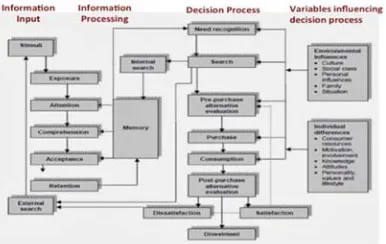
The intention is a motif to particular morality. Intentions to purchase as the motif to act for specific brand or product. Intentions to purchase is "what you think; you will buy." Another definition declares that intentions to purchase are an awareness of a person to purchase the goods. Intentions to buy is the decision to make psychological actions that demonstrated the consumer's behavior on the product or brand [12]. The decision is to choose one or two alternatives to select real actions. Decisions as predictions for making decisions that can be influenced by the amount of information received. Consumers are decision makers in the process of purchasing products. Viewed from that perspective, the results of purchases occur through the initial stages of the emergence of awareness of the existence of consumers to problem-solving a rational. The decision-making perspective illustrates that consumers go through several stages before reaching the stage of making a purchase. According to Fill (1999) cited [13] explain that the stages of purchase decision-making process which include: problem recognition, information search, evaluation alternative, evaluate to purchase decisions and post-purchase. The stage of the purchasing decision process is the order of events where the consumer tries to overcome the perceived problem through the purchase action. In the information search stage, individuals try to find information products or services needed to solve existing problems. Search information can be active or passive, internal or external. The search for information that is active can include visits to multiple stores to make price and product quality comparisons. The search for passive information by merely reading advertisements in various media without having a specific purpose about the desired product picture. Information search process is divided into three main categories,
[image:3.612.328.521.210.332.2]namely content, direction and searches order. Search levels describe the total number of searches, reflected by the number of brands, attributes, and sources of information considered during the search and also the time it takes to do. Direction describes the specific content of the search, its emphasis on the brand, and the attributes being considered. The search order is the stage in the search process.
Figure 1. EBM Decision-Making Model Of Engel, Blackwell And Miniard (1995)
3078 increase attention. At a later stage, consumers become more accepting of information about the product, paying attention to its product advertising, observe and discuss the products used by their friends. At this stage, consumers may work on the collection of information actively, where consumers seek written information, they seek referrals from relatives, and they collect information in other ways. The number of searches that consumers work depends on the strength of the impulses on the consumers. The amount of initial information they have, the ease of finding additional information, the value they provide on additional information, and the satisfaction that is generated after the search. This search can occur either on an active or limited basis depend on the level of consumer involvement.
Figure.2. Information Search In Consumer Decision By Neal, Quester,Hawkins (2007)
When the consumers have the little information related to the product, will make the product of country of origin as an instruction indirectly. The product knowledge is not only useful for information search, but knowledge influences to purchase decision-making process.
2.2 Country of Origin Image
The definition of the country of origin is the place where the goods produced or assembled in the countries. The country of origin is identical with the existence of the label "made in" or "manufactured in." However, the emergence of the hybrid products resulted in the accuracy or the validity of the information related to the origin of the product due to the material and components from the different countries [7].The study conducted by [15] declare that the country of origin has the other pronunciation as
ISSN: 1992-8645 www.jatit.org E-ISSN: 1817-3195
3079 country of origin has a positive result, the condition affects the product derived from the country. This case indicates the image of the country of origin affects intentions to purchase the products from the particular country. The explanation refers to the finding by [11] indicate that country of origin image affects the purchase decision-making process. Based on the previous research and explanation, the authors propose the hypothesis as follows:
H1: Country of Origin Image has a positive effect on information search
H2: Country of Origin Image has a positive effect on intentions to purchase
2.3 Product Knowledge
According to the Brucks (1985) cited [13] mentions that product knowledge is the product result of memory and knowledge existing in the mind of an individual. Product knowledge divided into the primary categories: (1) Based on subjective (2) Based on objective (3) Based on the experience. In the study by [20] indicate that product knowledge has a relationship with recognition and consumers believe in the product. The starting point for users to evaluate products are related to the level of knowledge. Product knowledge is the information obtained by an individual from the products. The information has accumulated consumers with the high subjective knowledge, and the impact on the more significant consumer attention on the country of origin in evaluating the quality of the product [21]. Product knowledge is the knowledge individual from an internal factor. Knowledge leads consumers in selecting the products to make the purchase decision or reject the product. The higher level of product knowledge is the less chance for failure in evaluating the product [20]. The relationship of product knowledge has an impact on directly in the form of intentions to purchase. Moreover, the purchase intentions are due to the extent of the product knowledge of the customer. Knowledge does not use only for information search. Knowledge influences the purchase decision-making process. The relationship between the knowledge and the substance of information received has the positive relations. The study by [11] found that consumer knowledge on the product has a positive and significant effect on the consumer's purchasing decisions process. Based on the explanation above, the authors proposed the hypothesis as follows:
H3: product knowledge has a positive effect on information search
H4: product knowledge has a positive effect on intentions to purchase
2.4 Product Involvement
The involvement originates from the science of social psychology and recognition about "ego involvement," refers to the relationship between the individual, problem or object [22]. In the report of Zaichkowsky, (1985) cited [13] that the level of consumer involvement in a particular object is determined the degree for the product viewed as a relevant person. Involvement also related to the other concepts such as the perceived risk, information search, identification attribute, loyalty, retails brand context, leadership, and opinions. Product involvement is defined as customer perception is immortal on the importance of product categories based on the needs of the attached, values and interests [13]. Product involvement affects consumers in the decision-making process to purchase the products. The degree of consumers performs in search of information the product, period in adopting, the level of the attitude and preferences about the product may lead, and how the customer perception on the various alternative in the same product category and brand loyalty [23]. It depends on the perceived of the needs, values and consumer interest. It is necessary to know how deeply consumers were doing the process of information searching on the product and the period during the process of adoption until the product evaluation [23]. Friedman (1993) cited [13] proposed when the consumer selects the product with the high-involvement, it indicates the information that consumer obtains more deeply associated with the product purchase. There are two types of product involvement; high-involvement and low-involvement. The difference is related to the attitude of consumers in information search and purchase. The high product involvement requires an extended period in the process of search information compared with low product involvement. The results of research by [11] revealed that the product involvement has a positive and significant effect on consumer purchasing behavior. Based on the explanations, researchers proposed the hypothesis as follows: H5: Product involvement has a positive effect on information search
3080
3. MATERIAL & METHOD
The research used cross-sectional design and the authors use quantitative data to obtain the primary data. The selection of respondents using the judgmental sampling technique which selected based on the evaluation of the authors which represent a population [24]. Minimize data sample for analysis multivariate is five times from the number of indicators, the number of samples uses 180 respondents. The research analysis method using Structural Equation Model which operated by Lisrel version 8.5. The level of pre-test the questionnaires were distributed to 30 respondents. The test aims to check for all aspects of the survey such as the content of questions, wording; the form and layout, the level of difficulty, and the instructions to fill the questionnaires. The reliability test showed reliable when the limit of Cronbach's Alpha value ≥ 0.6. The validity test declares valid, when the limit value is required KMO values between 0.50 until 1, MSA values ≥ 0.50 [24], and the factor loading value ≥ 0.50 [25].
4. RESULT
4.1 Pretest
The results pre-testing from the variables of the country of origin image, product knowledge, product involvement, information search and intentions to purchase have the Cronbach's Alpha value is above of 0.6. That means the questionnaires research have good reliability level. The value of Keiser-Meyer Olkin (KMO) shows that the number of Measure of Sampling Adequacy is higher than 0.5. That means, it overall fit is fulfilled requirements. In the table of the component matrix, each item of the factor loading value is higher than 0.5. The pretest results of reliability and validity showed in Table 1a & 1b below:
Table 1a: Results of Cronbach’s Alpha
Code Variable Cronbach’s Alpha
COI Country of Origin Image 0.935
PK Product Knowledge 0.975
PI Product Involvement 0.977
IS Information Search 0.957
[image:6.612.321.518.90.389.2]ITP Intentions to purchase 0.936
Table 1b: Results of KMO and Factor Loading
Code Indicators KMO
Factor Loading (Compone nt Matrix) COI Country of Origin Image 0.656 0.955
Country of Origin Image 0.656 0.664 Country of Origin Image 0.656 0.863 Country of Origin Image 0,656 0.773 Country of Origin Image 0,656 0.825 Country of Origin Image 0,656 0.870 Country of Origin Image 0,656 0.900 Country of Origin Image 0,656 0.816 PK Product Knowledge 0.928 0.943 Product Knowledge 0.928 0.967 Product Knowledge 0.928 0.948 Product Knowledge 0.928 0.948 Product Knowledge 0.928 0.967 PI Product Involvement 0.956 0.972 Product Involvement 0.956 0.920 Product Involvement 0.956 0.972 Product Involvement 0.956 0.869 Product Involvement 0.956 0.899 Product Involvement 0.956 0.957 Product Involvement 0.956 0.972 IS Information Search 0.903 0.955 Information Search 0.903 0.950 Information Search 0.903 0.875 Information Search 0.903 0.864 Information Search 0.903 0.875 ITP Intentions to purchase 0.846 0.889 Intentions to purchase 0.846 0.883 Intentions to purchase 0.846 0.934 Intentions to purchase 0.846 0.955
4.2 Measurement Model
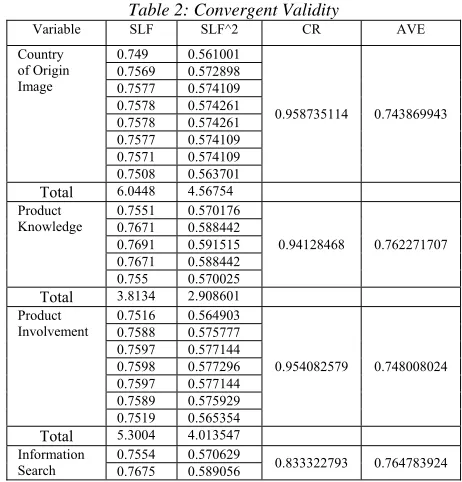
CR value for each latent variable ≥ 0.7 that including good reliability. While AVE value for each latent variable ≥ 0.5, that shows adequate convergence if SLF, CR, and AVE fulfill the good rule of thumb [25]. Measurement model analysis is convergent validity; it showed in table 2 below:
Table 2: Convergent Validity
Variable SLF SLF^2 CR AVE
Country of Origin Image
0.749 0.561001
0.958735114 0.743869943 0.7569 0.572898
0.7577 0.574109 0.7578 0.574261 0.7578 0.574261 0.7577 0.574109 0.7571 0.574109 0.7508 0.563701
Total 6.0448 4.56754
Product
Knowledge 0.7551 0.570176
0.94128468 0.762271707 0.7671 0.588442
0.7691 0.591515 0.7671 0.588442 0.755 0.570025
Total 3.8134 2.908601
Product
Involvement 0.7516 0.564903
0.954082579 0.748008024 0.7588 0.575777
0.7597 0.577144 0.7598 0.577296 0.7597 0.577144 0.7589 0.575929 0.7519 0.565354
Total 5.3004 4.013547
Information
[image:6.612.306.537.489.730.2]ISSN: 1992-8645 www.jatit.org E-ISSN: 1817-3195
3081
0.7696 0.592284 0.7673 0.588749 0.754 0.568516
Total 3.8138 2.909235
Intentions to
Purchase 0.7602 0.577904
0.928586486 0.764783924 0.7811 0.610117
0.7757 0.60171 0.754 0.568516
Total 3.071 2.358248
4.3 Structural Model
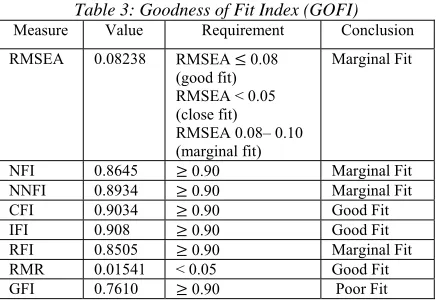
[image:7.612.81.299.275.426.2]Generally, on various types of a fit index is used to measure the degree of match between the hypotheses model with the data presented. The following are the results of the index testing compliance used can be seen in Table 3 below:
Table 3: Goodness of Fit Index (GOFI)
Measure Value Requirement Conclusion
RMSEA 0.08238 RMSEA 0.08
(good fit) RMSEA < 0.05 (close fit) RMSEA 0.08– 0.10 (marginal fit)
Marginal Fit
NFI 0.8645 0.90 Marginal Fit
NNFI 0.8934 0.90 Marginal Fit
CFI 0.9034 0.90 Good Fit
IFI 0.908 0.90 Good Fit
RFI 0.8505 0.90 Marginal Fit
RMR 0.01541 < 0.05 Good Fit
GFI 0.7610 0.90 Poor Fit
RMSEA is an index which used to compensate for the chi-square statistic in a large sample. RMSEA value shows a good of fit expected if the model estimated in population. The calculation results demonstrate the value of RMSEA is 0.08238. That means a model is accepted and include marginal fit. Furthermore, GFI value is 0.7610. That indicates the model is a poor fit. The level of acceptance model recommended if the value is higher than 0.9. RMR index represents the average value of all residual standards has a range from 0-1. The model has a compatibility value if that is smaller than 0.05. In this research, RMR value shows of 0.01541, that including good fit. CFI value is recommended to be accepted if that is above 0.9. Based on the results indicate CFI index is 0.9034. It means, it is a good fit. This research shows the calculation of NNFI is 0.8934. It includes a marginal fit. NFI value is 0.8645. That means a marginal fit. IFIS value is 0.908, and it means a good fit and RFI value is 0.8505, including a marginal fit.
4.4 Hypothesis Testing
The cause and effect relationship analysis by measuring the t-value and structural equation coefficient and t-test values are higher than 1.96. The result shows in Table 4
Table 4: Result of Hypothesis Testing
Path t-value Conclusion
COI → IS 2.3396 > 1.96 Accepted COI → ITP 2.2417 > 1.96 Accepted PK → IS 1.2870 < 1.96 Rejected PK →ITP 1.2544< 1.96 Rejected PI → IS 2.5981> 1.96 Accepted PI → ITP 2.0595> 1.96 Accepted
5. DISCUSSION
3082 in the minds of an international audience weakly, clearly or vaguely. Consumers in Indonesia consider the brand symbolic of the product's home country to improve their social status, in addition to displaying the overall quality of the product. There are many explanations, why the image of the country of origin into consideration in the search for product information. Using imported products such as Lenovo brand notebooks is relatively expensive and prestigious than local products. Consumers try to imitate consumption and lifestyle practices by purchasing foreign brands symbolizing status, representing wealth, and modernity. The second hypothesis (H2) indicates the effect of the country of origin image on intentions to purchase is accepted. This case shows the t-test value is 2.2417 > t-table value 1.96. That means there is a significant effect of the country of origin image on intentions to purchase. This results in line with the previous research were done by [11] that demonstrates country of origin image affects intentions to purchase. The country of origin image is often used as an external consumer cue and the basis of consideration for purchase decision making. Consumers will conclude the country's image is based on information about the product. When the country of origin image has the negative perception, consumers will have a negative image on a product originated from that country. The results of the study found how the image of the country of origin affects the intention of individuals to purchase. A logical explanation is that differences in the manufacturing process of different countries do not result in the bias of product information for consumers. A brand may come from country A, but is designed in country B, produced in country C, and assembled in country D. Consumer behavior is currently showing the influence of the country of origin mage affecting their purchase intention. This case is an evaluation result after collecting various information related to the country of origin of the product. Consumer confidence over the product's home country does not discourage consumers from purchasing Lenovo notebook. The emerging behavior is a response to an object, which stimulates the consumer to acquire Lenovo notebook brand. Consumers in Indonesia realize there are several brands of notebooks that dominate the market and apparently derived from countries that produce the inferior products. Therefore, the image of the country of origin of the products has an important role during the purchase
ISSN: 1992-8645 www.jatit.org E-ISSN: 1817-3195
3083 significant effect of the product involvement in information search. In line with the results of research [11] that found the product involvement has a positive and significant effect on information search. When consumers have involvement in the product increases, the consumers will search for more information on products. These findings reflect consumer perceptions of the personal relevance of an observed object. This case means that consumers have seen the product have relevant consequences personally. The consumer's past experiences on this product include intrinsically relevant. However, when involvement is due to existing physical and social environments, this case means the level of consumer relevance including situational [26]. Motivation to drive consumers tends to influence their behavior during the decision-making process. Consumers tend to experience stronger influence responses such as emotions and intense feelings when high product involvement. It is possible that individuals are different in their engagement with the product. During the information and evaluation search stage, consumers work with processes designed to provide some notebook brands that represent a viable alternative purchase [27]. Usually, consumers first perform an internal search by scanning memory for the appropriate brand. A set of stored memory is reactivated to describe a series of brands that consumers have acquired, e.g., 3 to 5 alternatives. Furthermore, consumers tend to perform external searches such as the internet, product manufacturer's website reviews and references from colleagues. The sixth hypothesis (H6): the effect of product involvement on intentions to purchase indicated accepted. This case shows the t-test value is 2.0595 > t-table value is 1.96. There is a significant effect on the product involvement on intentions to purchase. In line with the results of research by [11] that revealed the product involvement has a positive and significant effect on intentions to purchase. This finding explains that the evaluation process is inseparable from the level of consumer involvement with the product. A stimulus evokes the level of personal interest of the consumer in a specific situation. Consumer involvement in products affects purchasing intentions may be due to an immediate or temporary situation factor. Another factor is possible due to consumers tend to provide recognition to acceptable social risks. In this case, consumers collect as much alternative information as
possible until evaluating alternative brand choices that match their needs and wants. The product evaluation results present to specific attitudes and beliefs. Purchase intentions are made up of attitudes and beliefs and consumer behavior. The tendency of consumers looking for product information or intentions for exploration leads them to tend to have transactional motives. Therefore, consumers with the high product involvement, the correlation between attitudes and intentions to purchase the product have significantly higher than the low-involvement products.
6. CONCLUSION
3084 purchase. The authors also concluded that the effect of product knowledge has no significance in the search for information and intentions to purchase. The consumer's knowledge of Lenovo brand-related notebooks has been thorough or complete the internal and external information. Therefore, Consumers evaluate the additional information as a stimulus to have intentions to purchase tend to be unnecessary. In this case, consumers assume they have had prior experience related to the characteristics of notebooks that priority is required. Another conclusion explains, actually, consumers that have not product knowledge, and the information search process tends to be irrelevant to consumers need. The influence of product involvement has a positive and significant meaning in information search and intentions to purchase. The authors concluded that motivation to drive consumers tends to influence their behavior during the decision-making process. Consumers tend to experience stronger influence responses such as emotions and powerful feelings when the products have the high involvement. Consumers involvement with the product during the information retrieval and evaluation phase through a process designed to produce some notebook brands representing a viable alternative purchase. There is a set of memory storage and reactivated to describe the collection of brands that consumers have chosen. Similarly, messages communicated by companies tend to change their attitudes and beliefs about the intentions to purchase the notebook.
7. LIMITATIONS OF THIS STUDY
Although this study provides insight into consumer behavior in search of information and intentions to buy, the authors acknowledge there are limitations in interpreting the requirements and discussion of research findings. First, this study involves products that belong to high involvement of products. Second, the researcher acknowledges that the definition of Country of Origin Image (COI) can be seen from Product of Origin Image (POI), the limitations of researchers to distinguish Country of manufacture (COM), Country of Brand (COB), Country of Design (COD). Therefore, For further research, the authors recommend to the researcher should use the comparison of the high involvement and low involvement product categorized. The authors suggest that Lenovo can
provide all information regarding the products featured in the proper media which increase the consumer knowledge of the product will be released. The company can embrace the customers to facilitate the media to exchange the information in social media and formed the user's community The company can take advantage the Exhibition of Information and Communication Technology to make simple communicate directly with Lenovo company.
ACKNOWLEDGMENT
We gratefully acknowledge the financial support from Universitas Pembangunan Panca Budi, and we gratefully thanks to peer reviewer for help and guidance.
REFERENCES:
[1]http://industri.bisnis.com/read/20160115/105/ 510085/javascript accessed Jan 25, 2016 [2]http://www.solopos.com/2015/10/06/indonesi
a-best-brand-award-2015-lenovo-sabet-best-brand-award-kategori-notebook-649377 accessed Jan 21, 2016
[3]Diamantopoulos, A., Schlegelmilch, B., & Palihawadana, D. "The relationship between country-of-origin image and brand image as drivers of purchase intentions: a test of alternative perspectives." International Marketing Review, Vol. 28, No.5, 2011, pp. 508-524.
[4]Chiou, J. "The impact of country of origin on pretrial and posttrial product evaluations: The moderating effect of consumer expertise." Psychology and Marketing, Vol.20, No.10, 2003, pp. 935-954.
[5] Martin, I. M., & Eroglu, S. "Measuring a multi-dimensional construct: Country image." Journal of business research, Vol. 28, No.3, 1993, pp. 191-210.
[6] Neese, W.T.,& Taylor, R.D."Verbal strategies for indirect comparative advertising." Journal of Advertising Research, Vol.34, No.2, 1994, pp.56-70. [7] Ahmed, Z. U., Johnson, J. P., Yang, X.,
ISSN: 1992-8645 www.jatit.org E-ISSN: 1817-3195
3085 [8] Wang, C. L., Li, D., Barnes, B. R., & Ahn, J.
"Country image, product image and consumer purchase intention: Evidence from an emerging economy." International Business Review, Vol.21, No.6, 2012, pp.1041-1051.
[9] Zeugner-Roth, K., & Diamantopoulos, A. "Advancing the country image construct." Journal of Business Research, Vol. 62, No.7, 2009, pp.726-740.
[10] Maher, A. A., & Carter, L. L. "The affective and cognitive components of country image: Perceptions of American products in Kuwait." International Marketing Review, Vol. 28, No.6, 2011, pp.559-580.
[11] Lin, L. Y., & Chen, C. S. "The influence of the country-of-origin image, product knowledge and product involvement on consumer purchase decisions: an empirical study of insurance and catering services in Taiwan." Journal of Consumer Marketing, Vol. 23, No.5, 2006, pp. 248-265.
[12] Wang, X., & Yang, Z. "Does country-of-origin matter in the relationship between brand personality and purchase intention in emerging economies? Evidence from China's auto industry." International Marketing Review, Vol. 25, No.4, 2008, pp. 458-474.
[13] Shirin, K., & Kambiz, H. H. "The Effect of the Country-of-Origin Image, Product Knowledge and Product Involvement on Consumer Purchase Decisions." Chinese Business Review, Vol.10, No.8, 2011, pp. 601-615.
[14] Kardes, F. R., Cronley, M. L., Kellaris, J. J., & Posavac, S.S."The role of selective information processing in price-quality inference." Journal of Consumer Research. Vol.31, No.2, 2004, pp. 368-374.
[15]Mohd Yasin, N., Nasser Noor, M., & Mohamad, O. "Does image of country-of-origin matter to brand equity?" Journal of Product & brand management, Vol.16, No.1, 2007, pp. 38-48.
[16] Nagashima, A."A comparative" made in" product image survey among Japanese businessmen." The Journal of Marketing, 1977, pp. 95-100.
[17] Hong, S. T., & Wyer, R. S. "Effects of country-of-origin and product-attribute information on product evaluation: An information processing perspective." Journal
of Consumer Research, Vol. 16, No.2, 1989, pp. 175-187.
[18] Roth, M. S., & Romeo, J. B. "Matching product category and country image perceptions: A framework for managing country-of-origin effects." Journal of international business studies, Vol. 23, No.3, 1992, pp. 477-497.
[19] Jiménez Torres, N. H., & San Martín Gutiérrez, S. "The purchase of foreign products: The role of firm's country-of-origin reputation, consumer ethnocentrism, animosity, and trust." Vol.13, 2007, pp. 1-34.
[20] Lin, L. Y., & Zhen, J. H. "Extrinsic product performance signaling, product knowledge, and customer satisfaction: an integrated analysis–an example of notebook consumer behavior in Taipei city." Fu Jen Management Review, Vol. 12, No. 1, 2005, pp.65-91.
[21] Lee, J. K., & Lee, W. N. "Country-of-origin effects on consumer product evaluation and purchase intention: The role of objective versus subjective knowledge." Journal of International Consumer Marketing, Vol.21, No.2, 2009, pp. 137-151.
[22]Michaelidou, N., & Dibb, S. "Product involvement: an application in clothing." Journal of Consumer Behaviour, Vol.5, No.5, 2006, pp. 442-453.
[23] Bauer, H. H., Sauer, N. E., & Becker, C. "Investigating the relationship between product involvement and consumer decision‐making styles." Journal of Consumer Behaviour, Vol.5, No.4, 2006, pp.342-354.
[24] Malhotra, Naresh K. Marketing Research: An Applied Orientation 5th ed. 2010 New Jersey: Pearson/Prentice Hall.
[25] Hair, J. F., Black, W. C., Babin, B. J., Anderson, R. E., & Tatham, R. L. "Multivariate data analysis." Upper Saddle River, NJ: Prentice Hall. Vol. 5, No. 3, 1998, pp. 207-219.
[26] Engel, J. F., Blackwell, R. D., & Miniard, P. W. Consumer behavior, eighth. 1995 New York: Dryder.