ORIGINAL RESEARCH ARTICLE
KNOWLEDGE AND SKILLS OF NURSING SCHOLARS ON BASIC LIFE SUPPORT
1
Maria Girlane Sousa Albuquerque Brandão,
1Natália Ângela Oliveira Fontenele,
1
Magda Milleyde de Sousa Lima,
2Nelson Miguel Galindo Neto,
3Joselany Áfio Caetano
and
4Lívia Moreira Barros
1
Graduation of the Undergraduate Nursing Course of the Vale do Acaraú State University. Sobral- CE-Brazil
2
Nurse. Doctor of Nursing.Teacher of the Nursing Department of the Federal Institute of Education,
Science and Technology of Pernambuco.Caruaru-PE-Brazil
3
Nurse. PhD in Nursing.Teacher of the Nursing Department of the Federal University of Ceará,
Fortaleza-CE-Brasil
4
Nurse. PhD in Nursing.Teacher at the Nursing Department of the Vale do Acaraú State University,
Sobral- CE-Brazil
ARTICLE INFO ABSTRACT
To evaluate the theoretical knowledge and skills of nursing interns on cardiopulmonary arrest.A descriptive study has been performed with 28 nursing students from a public institution in the north of Ceará. To collect data, a questionnaire has been applied with 24 objective questions about basic life support and simulated cardiorespiratory arrest situation. In the data analysis, descriptive statistics and binomial testing were used. Academic skills deficit was evidenced especially in the depth (p = <0,000) and correct speed (p = <0,000) of the compressions. This University needs to provide a higher level of knowledge and skills in order to improve undergraduate nursing students in emergency procedures such as chest compressions.
Copyright © 2018,Maria Girlane Sousa Albuquerque Brandão et al. This is an open access article distributed under the Creative Commons Attribution License, which permits unrestricted use, distribution, and reproduction in any medium, provided the original work is properly cited.
INTRODUCTION
In the world scenario, CPA, defined as the cessation of cardiac mechanical activity and confirmed by the absence of signs of circulation, is considered a public health problem, especially when it occurs out of a hospital environment where the most important determinant for survival is early onset of the cardiopulmonary resuscitation (CPR) maneuvers performed by the health professional or the layman trained in BLS actions
(Grasner et al., 2016). Cardiac and respiratory impairment is
severely incompatible with life, requiring rapid and effective intervention.
*Corresponding author: Maria Girlane Sousa Albuquerque Brandão
Graduation of the Undergraduate Nursing Course of the Vale do Acaraú State University. Sobral- CE-Brazil
That race against time occurs so intensely that 7 to 10% chance of survival is lost every minute without assistance after
the involvement by CRA (Gonzalez et al., 2013). Numerous
studies show that survival rates and patient outcomes after CRA are directly related to the speed with which CPR is
initiated and the quality of its performance (Pettersen, et al.,
2018).Thus, early and quality care through standardized actions has a greater probability of intervention effectiveness, avoiding mortality, brain lesions and irreversible sequels
(Ferreira et al., 2014). However, even nowadays, knowledge
and skills about CPR among health professionals and students remain scarce, causing harm to patients. Because of this, constant updating and investment in training and skills are indispensable for the improvement of team performance in supporting the life of many individuals (Ferreira et al., 2012).
ISSN: 2230-9926
International Journal of Development Research
Vol. 08, Issue, 07, pp.21698-21702, July, 2018
Article History: Received 25th April, 2018
Received in revised form 10th May, 2018
Accepted 06th June, 2018
Published online 30th July, 2018
Key Words:
Nursing, Basiclife support, Cardiopulmonary resuscitation, Knowledge, Motor Skills.
Citation: Maria Girlane Sousa Albuquerque Brandão, Natália Ângela Oliveira Fontenele, Magda Milleyde de Sousa Lima, Nelson Miguel Galindo Neto, Joselany Áfio Caetano and Lívia Moreira Barros. 2018. “Knowledge and skills of nursing scholars on basic life support”, International Journal of
Development Research, 8, (07), 21698-21702.
It is imperative that during an undergraduate nursing course the student has the possibility to develop competencies to act in an emergency situation with scientific knowledge and adequate abilities considering that, with the evolution of the care of victims of CRA, nurses have become active participants in the care team, taking responsibility for the care provided to these victims. Although, during nurses training, the theoretical and practical contents related to CRA and CPR maneuvers have been given superficially, limited, and often do
not meet the needs of students (Kumar et al., 2008). This
situation is considered of concern facing the fact that these students will be inserted in the labor market, becoming responsible for attending to the individual in a CRA situation in an effective way, which will contribute to reduce the number of deaths and complications resulting from this clinical
situation (Oliveira et al., 2014). In this perspective, it is
evident the importance of nursing scholars to have a mastery in the management of necessary care when facing an emergency situation such as CRA, since adequate knowledge about quality CPR care may have a positive impact on the outcome of patients' lives. Contributing to the training of the nursing student in order to perform effectively in CPR is fundamental to improve the assistance provided to the population in emergency situations. Given the relevance of the correct execution of CPR, it is pertinent that more nursing students are able to offer better quality CPR and, therefore, there is a greater chance of survival for the individual affected by the CPR. From this perspective, these questions arise: what is the knowledge of nursing acholars through the theory learned in the classroom, regarding PCR and Basic Life Support? Are there differences in knowledge and skills in cardiopulmonary resuscitation?. Thus, the objective of this study is to evaluate the theoretical knowledge and the abilities of nursing interns on CRA.
MATERIALS AND METHODS
This is a descriptive/exploratory study, with a quantitative approach, developed in a Higher Education Institution (HEI) of public character, located in the northern region of the state of Ceará. This HEI offers a full-time Nursing course, organized in a modular manner, in 10 semesters, with a conclusive regime in five years and a workload of 5060 hours. Data collection took place in May 2018, after the authorization of the Coordination of the Nursing Course and the approval of the Ethics Committee in Research of the mentioned University under protocol numbered 2.529.077/2018. Population of this study was composed by nursing students of the 7th semester, which refers to the module "The person in critical condition", which counts with 180 hours of theoretical and practical contents on urgency and emergency. The choice of students in the 7th semester is justified because it is assumed that the research topic was approached in a comprehensive and recent way, thus enabling a better exploration of the theme. The sample was defined by convenience, according to the students' willingness to participate in the study, according to the following inclusion criteria: age equal to or greater than 18 years, being duly enrolled in the course and module and agreeing to voluntarily participate in the study. Students who had some technical course or preparation for the subject as firefighters and nursing technicians were excluded from the sample. Thus, the sample consisted of 28 students. Initially, one of the researchers requested permission to approach the students to the coordinator of the module. Following this, students were approached in the classroom during the break
between classes so as not to hinder the development of academic activities. Students were informed about the objectives of the study and invited to participate voluntarily in the research. After the agreement and signing of the Written Informed Consent Form (WICF), data were collected. A questionnaire was used as a data collection technique, containing variables of interest, organized in two parts: profile of the students - age, gender, training courses in BLS after admission to graduation and participation in academic leagues of (Consorti et al., 2010), adapted by the researchers based on the guidelines of the American Heart Association (AHA, 2015). After completing the knowledge test, participants were asked to respond to a simulated CPR situation and individually conducted to a room where two monitors were present and to evaluate the teaching-learning process of students' ability to practice CPR maneuvers, presenting a case of an irresponsive patient. Practice was performed on a Prestan® adult CPR manikin, which is a doll with anatomical proportions and human-like thoracic resistance, with a click sound that signals the correct depth of compression. A standard model for evaluating the practice of cardiopulmonary resuscitation was used as a checklist that allows the evaluation of the execution of 15 items that compose it (Neto, 2018), which was filled during the time of collection by a practitioner nurse and expertise on the theme. Data obtained were tabulated in the Excel 2016 program and analyzed in the statistical program Statistical Package for the Social Sciences (SPSS) version 20 for Windows. Binomial test was used to verify the percentage of correctness of the items related to the knowledge and ability
on CRA, in which p values higher than 0.05 indicated that
there were a number of correct answers among the students, statistically not inferior to 85%, rejecting null hypothesis.
RESULTS
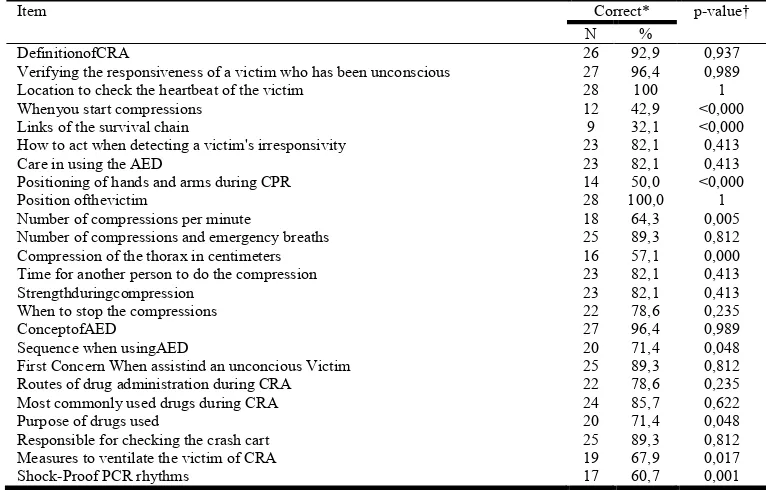
Regarding the correct sequence to use the Automatic External Defibrillator (AED), 71.4% (p = 0,048) correctly reported the follow-up to the shock. However, 39,2% among scholars did not know what the shockable rhythms were during CRA. In the evaluation of students' ability, 55,2% placed their hands on the victim's shoulder and moved them. Among 28 academic students, 65,5% (p = 0,017) emitted sound to call the victim and called for help and 75,9% (p = 0,235) initiated chest compressions. Regarding chest compressions, 24,1% (p = 0,000) performed chest compressions at a minimum depth of five centimeters, 27,6% performed chest compressions at the correct speed (100 to 120/min) and allowed the return of the chest to the anatomical resting position between compressions.
DISCUSSION
The victim in CRA needs prompt and effective care, increasing their chances of survival. Thus, early recognition of CRA followed by the establishment of BLSare essential strategies for survival.
Thus, it is understood that the preparation of future health professionals should be based on methodologies and practices that subsidize actions and effectively serve the general
population (Silva et al., 2017). The objective of the initial
[image:3.595.102.485.82.327.2]evaluation of the victim of CRA is the immediate detection of clinical signs suggestive for CRA. In this sense, the first course to be taken by the rescuer is the assessment of the patient's level of consciousness and carotid pulse, which will present unconsciousness and absence of pulse (Oliveira et al., 2014). In that study, most participants (96,4%) correctly answered this question, indicating compliance in the recognition of the individual in CRA. After this step, chest compressions should be started immediately when the victim has no pulse (AHA, 2015). AHA However, less than half of the participants (p<0,000) correctly answered this question, which points out the need for theoretical reinforcement on the basic procedures of the BLS. Regarding students' knowledge about the chain of survival recommended by the AHA guideline of 2015, it was observed that only 32,1% of the students were absent from a study carried out in a public university in the state of Bahia,
Table 1. Distribution of students' responses in knowledge assessment - Sobral, Ceará, Brazil, 2018
Item Correct* p-value†
N %
DefinitionofCRA 26 92,9 0,937
Verifying the responsiveness of a victim who has been unconscious 27 96,4 0,989
Location to check the heartbeat of the victim 28 100 1
Whenyou start compressions 12 42,9 <0,000
Links of the survival chain 9 32,1 <0,000
How to act when detecting a victim's irresponsivity 23 82,1 0,413
Care in using the AED 23 82,1 0,413
Positioning of hands and arms during CPR 14 50,0 <0,000
Position ofthevictim 28 100,0 1
Number of compressions per minute 18 64,3 0,005
Number of compressions and emergency breaths 25 89,3 0,812
Compression of the thorax in centimeters 16 57,1 0,000
Time for another person to do the compression 23 82,1 0,413
Strengthduringcompression 23 82,1 0,413
When to stop the compressions 22 78,6 0,235
ConceptofAED 27 96,4 0,989
Sequence when usingAED 20 71,4 0,048
First Concern When assistind an unconcious Victim 25 89,3 0,812
Routes of drug administration during CRA 22 78,6 0,235
Most commonly used drugs during CRA 24 85,7 0,622
Purpose of drugs used 20 71,4 0,048
Responsible for checking the crash cart 25 89,3 0,812
Measures to ventilate the victim of CRA 19 67,9 0,017
Shock-Proof PCR rhythms 17 60,7 0,001
*Frequency and percentage of correct answers out of the total ofassessed scholars; † Binomial Test.
Table 2. Aspects of the skill assessment procedure (practice) - Sobral, Ceará, Brazil, 2018
Hability Correct* p-value†
N %
1. Places the hands on the shoulders of the victim and move them 16 55,2 0,000
2. Emits sound to call for victim 19 65,5 0,017
3. Called for help 19 65,5 0,017
4. Observe the victim's chest and abdomen for respiratory movements 15 51,7 <0,000 5. Positioned next to / near the shoulder of the victim 18 62,1 0,005
6. Overlappedhis/herhands 20 69,0 0,048
7. Positioned the hypothenar region of the lower hand on the center of the victim's chest 17 58,6 0,001 8. Positioned his/her shoulders at 90 ° to the victim's chest 18 62,1 0,005
9. Startedchestcompressions 22 75,9 0,235
10. Maintained straight arms (without flexing elbows) during chest compressions 17 58,6 0,001 11. Moved his torso for application of force in the compressions 15 51,7 <0,000 12. Performed chest compressions at a minimum depth of five cm 7 24,1 <0,000 13. Performed chest compressions at the correct speed (100 to 120 / min) 8 27,6 <0,000 14. Allowed the return of the chest to the anatomical resting position between compressions 8 27,6 <0,000
15. Did not interrupt the compressions 14 48,3 <0,000
[image:3.595.64.523.374.548.2]where 84,4% of the nursing students answered correctly about
the chain of survival (Silva et al., 2015). Concerning the
positioning of hands and arms during CPR, it was noticed that only half of students describe the sequence for correct positioning during the chest compression maneuvers. Research performed in a hospital in MinasGerais identified that only 56,2% of nurses knew the positioning of hands and arms
(Alves et al., 2013). Following AHA guidelines, cardiac
rhythms that are shocking in CRA are ventricular fibrillation and tachycardia. The majority of CRA victims are in the heart rhythm of ventricular fibrillation or pulseless ventricular tachycardia. For these victims, the initial elements of BLS are chest compressions and early defibrillation (AHA, 2010). In this study, 60,7% of undergraduates knew these rhythms. Regarding the relationship between the performance tests, the results lead us to infer that there was a difference between the theoretical and practical performance of the students, corroborating with several national studies carried out in public and private universities (Silva et al., 2017; Silva et al.,
2015; Caveião et al., 2017; Gomes and Braz, 2012). An
international study, conducted in India, also identified that nursing students performed well on the theoretical test of CPR, however, resuscitation skills were deficient (Sangamesh et al., 2017). In general, it has been observed that undergraduates have skill deficits in several aspects, such as positioning the hands correctly and keeping arms straight, moving their torso to apply force, performing chest compressions at the correct depth and speed, allowing the return of the to the anatomical resting position between the compressions. A study carried out with 8th semester nursing students at a University in Rio de Janeiro found that 75% of the students did not have the ability to correctly perform chest compressions maneuvers (Gomes and Braz, 2012).
AHA emphasizes that 100 to 120 chest compressions per minute should be performed, with a minimum depth of five centimeters, so that CPR is considered of good quality, guaranteeing the maintenance of circulation and oxygenation of the body, responsible for conducting oxygen to vital organs (AHA, 2015). AHA In this study, it was observed that the minority of the undergraduates (27,6%) performed the correct compressions per minute, while only 24,1% made the compressions at the depth recommended by the AHA. The importance of compressing the chest to a depth of at least five centimeters is justified by the fact that this will create a greater blood flow, mainly by increasing intrathoracic pressure and directly compressing the heart (AHA, 2015). Another component for quality CPR comprises achieving full chest return after each compression. However, only 27,6% of students allowed the return of the thorax to the anatomical resting position when performing the compressions. The total return of the chest wall creates a relative negative intrathoracic pressure that promotes venous return and blood flow (AHA, 2015). The level of knowledge and skill of prospective nurses about CRA is something that needs to be considered and improved through continuing education policies to ensure that the health team has up-to-date knowledge and is prepared in theory and practice to avoid complications and outcomes
fatalities in emergency situations (Alegría et al., 2017). In this
sense, we value the adoption of methods that stimulate effective student participation through active methodologies in all stages of the teaching-learning process of CRA, such as the
simulation method (Costa et al., 2015), and the Objective
Clinical Examination (OSCE), which has been introduced with an assessment tool in the nursing scenario and has gained
space as an evaluation tool, since it facilitates the identification of clinical acumen in students, as well as being an excellent opportunity for scholars to reflect on their performance and clinical skills / abilities (Medeiros et al., 2014).
Conclusion
From the findings of this study, it is inferred that nursing scholars have theoretical knowledge about CPR, however, they present a skill deficit in chest compression maneuvers recommended by the American Heart Association. The points identified as deficient were the links of survival chain, moment of compression onset, positioning of hands and arms, shockable rhythms, speed and depth of compression and return of the chest between compressions. In view of the observed aspects, the relevance of the training to strengthen the teaching of scholars is verified, from a perspective of continuing education in order to stimulate them about the basic steps necessary for the care of victims of CRA. Thus, this study may favor reflective discussions about the reformulation and intensification in the nursing students' education, in theoretical and practical knowledge related to the subject. Universities need to provide a higher level of knowledge and skills regarding the attendance of CRA, with a view to improving undergraduate nursing students in relation to emergency procedures such as chest compressions. Although the study presents limitations because it presents only the knowledge and abilities of a group, it was possible to identify their level of skills, evidencing a deficit in the attendance to the CRA. In order to improve students' knowledge and skills in patient care in CRA, new studies must be carried out, with a larger number of students and different classes, in order to list and compare new data and evidence on this subject.
REFERENCES
Alegría, G.A.; Díaz, A.V.; Laveriano, D.M.Q.; Mendoza,
L.Y.Q.; Cornejo, J.V.; Espejo, C.B.; et al. Factors
influencing the level of knowledge of cardiopulmonary resuscitation in hospitals in Peru. RevistaColombiana de Anestesiología. [Internet] 2017 [cited 2018 Jun 04]; 45 (2): 114-121. Available from: https://doi.org/10.1016/ j.rcae.2017.01.001.
Alves, C.A.; Barbosa, C.N.S.; Faria, H.T.G. Parada cardiorrespiratória e enfermagem: o conhecimento acerca
do suporte básico de vida. CogitareEnfermagem
[Internet]2013 [cited 2018 Jun 04]; 18 (2): 296-301. Available from: https://revistas.ufpr.br/cogitare/article/ view/32579
American Heart Association (AHA). Destaques das Diretrizes da American Heart Associatin 2010 para RCP e ACE. Guidelines CPR ECC; 2010.
American Heart Association (AHA).Guidelines for
Cardiopulmonary Resuscitation and Emergency
Cardiovascular Care. Destaques da atualização das Diretrizes da AHA 2015 para RCP e ACE. Texas (EUA): American Heart Association; 2015.
Caveião, C.; Sales, W.B.; Brey, C.; Scussiato, L.A.; Carneiro, G.M.B.; Oliveira, A.C. Conhecimento de acadêmicos de
enfermagem acerca das diretrizes de reanimação
Consorti, B.M.;Muglia, A.I.I.; Sebastião, A. Capacitação teórica do enfermeiro para o atendimento da parada cardiorrespiratória. Rev. bras. enferm. [Internet]. 2010 [cited 2018 June 08]; 63 (6): 1019-1027. Availablefrom: http://www.scielo.br/scielo.php?script=sci_arttext&pid=S0 03471672010000600023&lng=en.
Costa, R.R.O.; Medeiros, S.M.; Martins, J.C.A.; Menezes, R.M.P.; Araújo, M.S. O uso da simulação no contexto da educação e formação em saúde e enfermagem: uma reflexão acadêmica. Revista Espaço para a Saúde. Londrina. 16 (1): 59-65. 2015.
Ferreira, J.V.B.; Ferreira, S.M.;Casseb, G.B. Perfil e conhecimento teórico de médicos e enfermeiros em parada
cardiorrespiratória, município de Rio Branco.
RevBrasCardiol. 25(6): 464-70. 2012.
Ferreira, L.; Leite, A.C.; Costa, M.J.; Pinto, M.K.; Fernandes, S.Capacitação em suporte básico de vida para vigilantes:
uma atividade extensionista. Revista Extendere.
[Internet]2014 [cited 2018 May 31]; 2 (1): 123-134.
Available from: http://periodicos.uern.br/index.php/
extendere/article/view/1263/718
Gomes, J.A.P.; Braz, M.R. Conhecimento de acadêmicos de
Enfermagem frente à parada cardiorrespiratória.
CadUniFOA. [Internet] 2012 [cited 2018 Jun 04]; 18: 1-7. Available from: http://revistas.unifoa.edu.br/index.php/ cadernos/article/view/1094
Gonzalez, M.M.;Timerman, S.; Oliveira, R.G.;Polastri,
T.F.;Canesin, M.F.;Schimidt, A.; et al. I Diretriz de
Ressuscitação Cardiopulmonar e Cuidados
Cardiovasculares de Emergência da Sociedade Brasileira de Cardiologia. ArqBrasCardiol. [Internet] 2013 [cited 2018 Jun 02]. Available from: http://www.scielo.br/ pdf/abc/v101n2s3/ v101n2s3.pdf
Grasner, J.T.;Lefering, R.;Kosterd, W.R.;Mastersone,
S.;Böttigerf, B.W.;Herlitzg, J.; et al. EuReCa ONE - 27
Nations, ONE Europe, ONE Registry: a prospective one monthanalysis of out-of-hospital cardiac arrest outcomes in 27 countries in Europe. Resuscitation.Epub. [Internet] 2016
[cited 2018 May 29]; 105:188-95. Available
from:https://www.ncbi.nlm.nih.gov/pubmed/27750053 Kumar, V.; Abbas, A.; Fausto, N.; Mitchell, R.N. Robins:
patologia básica. 8ª ed. Rio de Janeiro: Elsevier; 2008.
Medeiros, S.B.; Pereira, C.D.F.D.; Tourinho, S.V.; Fernandes, L.G.G.; Santos, V.E.P. Exame clínico objetivo estruturado: reflexões sob um olhar da enfermagem. CogitareEnferm. 19(1):170-173. 2014.
Neto, N.M.G. Efetividade de vídeo educativo no conhecimento
e habilidade de surdos acerca da ressuscitação
cardiopulmonar: ensaio randomizado controlado [Tese de doutorado]. Fortaleza: Universidade federal do Ceará faculdade de farmácia, odontologia e enfermagem departamento de enfermagem programa de pós-graduação em enfermagem doutorado em enfermagem; 2018.
Oliveira, S.S.; Santos, J.O.;Zeitoun, S.S. Suporte Básico de Vida: avaliação do conhecimento dos graduandos de enfermagem. J HealthSci Inst. [Internet]2014 [cited 2018
May 31]; 32(1):53-58. Available from:
https://www.unip.br/presencial/comunicacao/publicacoes/i cs/edicoes/2014/01_jan-mar/V32_n1_2014_p53a58.pdf Pettersen, T.R.;Martensson, J.;Axelsson, A.; Jorgensen, M.;
Stromberg, A.; Thompson, D.R.; et al. European
cardiovascular nurses’ and allied professionals’ knowledge
and practical skills regarding cardiopulmonary
resuscitation. European Journal of Cardiovascular
Nursing. [Internet] 2018 [cited 2018 Jun 02]; 17(4): 336–
344. Available from: https://www.ncbi.nlm.nih.gov/
pubmed/ 29172687
Sangamesh, N.C.;Vidya, K.C., Singh, A. Awareness, Attitude, and Knowledge of Basic LifeSupportamong Medical, Dental, and NursingFaculties and Students in theUniversity Hospital.J IntSocPrevCommunityDent. [Internet] 2017 [cited 2018 Jun 06]; 7(4): 161–167. Available from: https://www.ncbi.nlm.nih.gov/pmc/articles/PMC5558248/ Silva, D.V.; Jesus, A.P.S.; Lima, A.A.; Santos, M.A.S.; Alves,
S.L. Conhecimento de graduandos em enfermagem sobre suporte básico de vida. Revista Baiana de Enfermagem. [Internet]2015 [cited 2018 Jun 04]; 29 (2): 125-134.
Available from: https://portalseer.ufba.br/index.php/
enfermagem/article/view/12648
Silva, K.R.; Araújo, S.A.S.T.; Almeida, W.S.; Pereira, I.V.D.S.; Carvalho, E.A.P.; Abreu, M.N.S. Parada cardiorrespiratória e o suporte básico de vida no ambiente pré-hospitalar: O Saber Acadêmico. Saúde Santa Maria. [Internet]2017 [cited 2018 Jun 02]; 43 (1): 53-59. Available from: https://periodicos.ufsm.br/revistasaude/ article/view/22160/pdf