A SPEECH-LANGUAGE THERAPY TOOL USING
INTERACTIVE BOOK APP IN BAHASA MALAYSIA FOR
SPECIAL NEEDS CHILDREN
1BAO XIN GANG, 2SUHAILA ZAINUDIN, 3HASHERAH MOHD IBRAHIM, 4LAM MENG
CHUN
1
Faculty of Information Sciences and Technology, UKM, Bangi, Malaysia
2
Faculty of Information Sciences and Technology, UKM, Bangi, Malaysia
3
Faculty of Health Sciences, UKM, Kuala Lumpur, Malaysia
4
Faculty of Information Sciences and Technology, UKM, Bangi, Malaysia
E-mail: [email protected], [email protected], [email protected],
4
ABSTRACT
Interactive story books (ISB) mobile application is an app designed for children to practice their speech, language and literacy skills. ISB has the potential to be used to support education and learning for individuals with cognitive disabilities. These apps include visual and auditory artifacts that demonstrate language and can be an incredible aid for children with different kinds of speech-language symptoms. In the context of Malaysia, the development of ISB suffers from a lack of practical experience with children, especially for the children who have special needs in speech-language impairments. This research focused on Malaysian children with special needs and their parents. The ISB was developed using the Android platform. The ISB includes three parts: ISB, speech exercise and animated songs. There is a media player to record and play the children’s voices as a way for them to practice their pronunciation. There is also an embedded media player to control the videos to stop or play. The experts with experience in speech-language therapy are gathered to answer a survey about the evaluation on the app. After that, the parents and the children who have special needs are also gathered to answer another survey to get the evaluation on the app as well. These surveys are targeted for collecting the evaluation on the prototype of ISB (content and usability). Based on the result of the survey, the respondents (the experts, parents and children) have the qualifications to take part in the survey, the respondents agree with the content (pictures, music, color and quiz) of the ISB and the respondents also agree with the usability (usefulness, ease of use, ease of learning and satisfaction) of the ISB. Some respondents also give their ideas to improve the app. The main contribution of this study is the developed ISB for speech-language therapy that allows the therapy to be performed by the parents of the special needs children at home without the help of the Speech and Language Pathologists(SLPs). Other than that, the app is also developed by involving the experts, parents and children with special needs to ensure that the app fulfills the requirement for speech -language therapy.
Keywords: Interactive Book App, Children, Bahasa Malaysia, Speech -language Therapy, Evaluation
1. INTRODUCTION
ISB is designed to enable users to interact with the storyline by using sight, sound and touch. For the past few years, many ISBs have appeared with complete range of products for children. It has been recorded that the earliest theory about language development assumed children acquire language by the use of imitation (Bigge and Shermis, 1998). While research also has shown that children who imitate the actions of those around them in their first year of life are generally those
who also learn to talk more quickly, there is also evidence that imitation alone cannot explain how children become talkers (Gleason and Ratner, 2009).
However, public demands and the availability of developer tools drove rapid expansion into other categories (Paredes et al, 2013).
ISBs combine the development technology of the mobile apps with the language development theory, the apps are designed to enable children to interact with the storyline in sight, sound, and touch, which make ISB much more interesting and colorful than the normal books, these apps use words, images, and objects to represent both concrete and abstract concepts (Donner, 2008).
The methods to help children with special needs in speech-language impairments often include the use of visual and auditory supports, which are cognitive tools to enable learning and the production of language, visual and auditory supports are effective in helping to diminish many of the challenges of different kinds of speech-language impairments, such as the autism, speech language delay and down syndrome (Edwards, 1991).Use of these ISBs has been shown to reduce the symptoms related with cognitive, social disabilities and communication(Oliver and Goerke, 2007).
For the past few years, many ISBs have appeared with complete range of solutions for children, for example, “Don’t Let the Pigeon Run This App” (common sense media, 2011), children can use this app either to listen to a new, randomly generated Pigeon story, or even to make their own story (Scharff et al,2011). These developments, however, suffer from a lack of practical experience with children, especially for the children who have special needs in listening and speaking problem, thus, by getting access to these children with speech-language impairments and collect detailed information with the help of those children’s parents, a proper ISB for the special children is developed (Smyth et al,2010).
Based on the situation above, in this study, two surveys are separately conducted among the experts and the parents with special needs children, the result of the surveys will be analyzed appropriately to get the evaluation on the developed app.
2. BACKGROUND
Speech-language impairments are defined as the communication disorders that affect the children's abilities to read, understand, read, and talk, which can be divided into two groups: speech impairments and language impairments. Speech impairments are described as stuttering, lisps and so on (Rainforth, 1993). Language impairments are
mainly characterized by the problems in understanding basic concepts, questions, and directions, difficulty in learning new words, saying words in the right order, having conversations and telling stories (Russell, 2001).
For the people who have the speech and language impairments, SLPs have tried to use various methods to approach the impairments. The traditional methods of the speech and speech-language therapy rely on the direct contact between patient and SLP (Gleason and Ratner, 2009). But this way of working would need a quite high number of SLPs to help all the possible patients. Besides, this interaction is entirely based on the subjective evaluation of the SLP, hence, this evaluation might differ along time as the SLPs get used to the patient’s speech (Herron et al, 1999).
The development of Computer-aided Speech and Language Therapy (CASLT) systems overcome these two shortcomings and help professional SLPs by providing a semi-automated way for speech-language therapy (several patients can undergo therapy at the same time) and with an evaluation whose change over time will reflect the improvements in the patient’s speech and language abilities (Hodge, 2007).
Considering pronunciation skills in young children, technological advances made possible the analysis of features such as pitch or formants in real time applications for home computers. IBM’s SpeechViewer was a very popular commercial approach for the training of speech skills. This application used a very simple speech interface of games, in which the ability of the user was tested in producing speech with varying intensity, pitch or formants. (Pratt et al, 1993)
Several research projects have explored the possibilities of providing this level of speech-language therapy about speech-language training. All these approaches deal with important issues in the development of CASLT applications like the user interface or the feedback provided to the user. The approach of works like Optical-Logo-Therapy (Hodge, 2007) and its successor Orto-Logo-Paideia (Hall et al., 2013) was to give the user a visual feedback in the correct positioning of the articulate elements (tongue, palate, teeth) to produce correctly the different sounds.
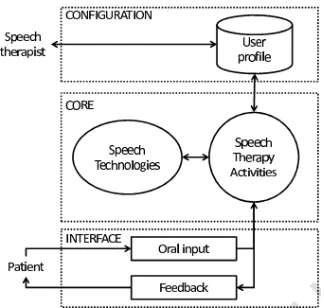
the different users of the application. These profiles contain all the information regarding the work of every patient with “Vocaliza” (words to practice, acoustic information and interface requirements of every child). Below this structure, the user interface just requires the speech input from the patient; while the output of the system (text, audio and images) will appear automatically as the patient completes the activities, not requiring any supervision by the SLP.
Figure 1: “Vocaliza” Operation Diagram
[image:3.612.114.276.220.374.2]Otherwise, a JavaScript program with a graphical user interface in HTML was developed for SLPs to use the talking head as a tool in speech-language therapy (Figure 2). The virtual talking head was adapted to show articulate movements of the lips, jaw, tongue, and velum. In an initial study children’s productions of words containing the sounds were recorded and evaluated before and after short learning lessons with an experimenter using the virtual head to explain the correct pronunciation of these sounds. The software tool was developed for SLPs to show and explain articulate processes to patients with phonetic disorders. The software is written in HTML/JavaScript and hence is platform independent and can be run from the program’s CD-ROM without installation. The software requires a standard web browser equipped with 3-D plug-in for the display of VRML animations. No persistent internet connection is needed (Lewis, 2010).
Figure 2: Screenshot Of Graphical User Interface: Settings Are Made In The Left Column Of The Screen;
The Articulation Is Displayed On The Right Side.
The speech technology in computer assisted language learning is also widely used in Malaysia (Kim et al, 2008). Methods are carried out to assess the teaching and learning principles and interface design guidelines in computer assisted Malay language for children. Especially, Malay speech-language therapy assistance tools (MSTAT) is developed to assists the SLP to diagnose children for language disorder and to train children with stuttering problem. The main engine behind it is the speech technologies which consist of speech recognition system, Malay text-to-speech system and Malay talking head by Tan, T.S. (2003). In this project, speech recognition system utilizes the hidden Markov model (HMM) technique for evaluating speech problem for children such as stuttering. The voice pattern of the normal and speech-language disorder children is used to train the HMM model for classifying the problem of speech-language disorder.
ISB is a new type of digital entertainment. ISB is defined by Crawford (2004) as a form of interactive entertainment, in which the player can explore, learn and practice by themselves (Gleason and Ratner, 2009). Those apps are installed in the mobile devices. The main operating system for the current mobile devices are Android and IOS, as is known to all, IOS is mainly used for Apple products such as iphoneipads and iPod touches.
Android is designed primarily for touch screen mobile devices such as Smartphone and tablet computers. Android has the largest installed base of all operating systems (Buttussi et al, 2010).
speech-language therapy apps were used less often than other apps (Beier and Spelke, 2012). The analysis found that the App Store offered 881 speech-language therapy apps while Google Play had 642 speech-language therapy apps available for downloading (many of the same apps were available in both stores).
Speech-language therapy authorities in Malaysia utilized advanced information system such as: radio, television, websites, and variable message signs to deliver speech-language therapy information to the patients (Saz et al, 2006). Research efforts were carried out to investigate the patients’ evaluation on these speech-language therapy tools and its effectiveness in speech-language therapy. The questionnaire included questions on whether the respondents had ever used apps related to speech-language impairments, for what purposes they had used the apps, what they found most useful or helpful about these apps and whether they had checked the credibility of information provided by the app developers. An open question was included as the final questionnaire item, in which the respondents were asked to identify the features they would ideally like to see in an ISB. These results reveal that conventional ISB as the speech-language therapy tools are not practical enough for the patients (Yin et al, 2009).
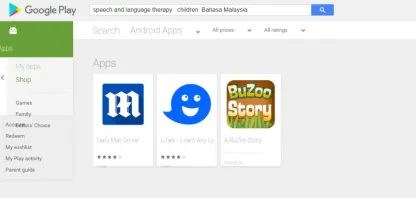
[image:4.612.91.300.508.607.2]Besides, some ISBs are difficult for a child to operate, some are expensive and difficult to get. And the ISB for children with special needs in Bahasa Malaysia is also limited online. The screenshot from the Google Play store is shown below (Figure 3).
Figure 3. The Screenshot From The Google Play Store
After discussion with SLPs in the Klinik Audiologi dan Sains Pertuturan in Fakulti Sains Kesihatan, the SLPs proposed an app which can satisfy the requirements of the speech-language therapy work. After the development work, we have gathered the experts, parents and children to give the evaluation on the ISB for children who have speech-language impairments.
According to the introduction above, the research question in this study is: what are experts, parents and children’s evaluation on this ISB for children who have speech-language impairments?
3. METHODS AND MATERIALS
The work of evaluation on the ISB includes two parts: the first part, the experts in speech-language therapy area in Klinik Audiologi dan Sais Pertuturan will take part in a survey to gain their evaluation on the app that has been developed. The second part, the parents and the children in the clinic will take part in another survey to gain their evaluation on the app from the parents and children. Both the surveys are large scale population based study to get the evaluation on the ISB. Every survey will be a questionnaire with some specific questions about the respondents ‘information, the evaluation on the content of the app and the evaluation on the usability (usefulness, ease of use, ease of learning and satisfaction) of the app. Those questionnaires are designed in 2 phases: phase 1 is the validation of the questionnaires, phase 2 is the development of the questionnaires.
3.1 Explanation of the Validity of the
Questionnaires
The questionnaire used for the experts in this study is adapted from the questionnaires by Johnson (2007), Debaryshe and Binder (1994) and Lund (2001). The questionnaire used for the parents and children in this study is adapted from the questionnaires by Johnson (2007), Debaryshe and Binder (1994), Lund (2001) and Tengku et al. (2013). The questionnaires which are originally in English will be adapted and changes will be made through consultation with supervisors, SLPs and teachers.
3.2 Development of the Questionnaires
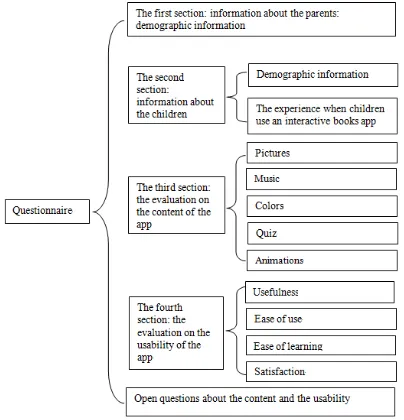
Based on the questionnaires above, the questionnaire for the experts is divided in 3 sections and the questionnaire for the parents and children in 4 sections.
For the questionnaire for the experts, the design is as follows: The first section acquires basic information about experts including the demographic information such as age, gender, email address, telephone number, and highest academic qualification and working experience.
pictures, music, colors, quiz and animations. Some open questions will be included if necessary such as listing the most important features of interactive story book app for the children who have special needs, recommendations to make this app better for the children who have special needs and the items they do not require seeing in the app for the children who have special needs.
The third section collects information about the usability evaluation of the app. The evaluation covers usefulness, ease of use, ease of learning, and satisfaction.
Finally, open questions will be included if necessary for the respondents to comment on the content and usability of the app.
[image:5.612.91.302.305.479.2]Figure 4 shows the structure of the questionnaire for the experts:
Figure 4: The Structure of the Questionnaire for Experts
For the questionnaire for the parents and children, the design is as follows: The first section requires information about the parents, which is mainly about the demographic information. The demographic information will contain some questions about age, highest academic qualification, current occupational status and the daily conversational language to see their qualifications in the survey. Some open questions will be included if necessary.
The second section requires information about the children, including the demographic information and their experience of using an ISB. The demographic information will contain some questions about the date of birth, gender and age to see their qualifications in the survey. Their experience of using an ISB will be via questions if they have used the ISB before, how long in general
the children spent on the ISB and so on. Some open questions will be included if necessary.
The third section requires information about the evaluation on the content of the app. The evaluation can be classified as evaluation on pictures, music, colors, quiz and animations. Some open questions will be included if necessary such as recommendations to make this app better for the children who have special needs and the items they do not require seeing in the app for the children who have special needs.
The fourth section requires information about the evaluation on the usability of the app. The evaluation can be classified as the evaluation on the usefulness, the evaluation on the ease of use, the evaluation on the ease of learning, the evaluation on the satisfaction. Since the respondents are the completely different groups, the questions for the four aspects are different accordingly, please refer to Table 3 and Table 7 about the difference of the two questionnaires.
Finally, open questions will be included if necessary for the respondents to comment on the content and usability of the app.
[image:5.612.315.517.406.616.2]The structure of the questionnaire for the parents and children is shown as follows in Figure 5:
Figure 5: The Structure of the Questionnaire for Parents and Children
4. EXPERIMENT DESIGN
speech-language impairments in Klinik Audiologi dan Sains Pertuturan will separately take part in two survives. After finishing the surveys, the data and the answers will be analyzed from each survey to get the evaluation on the interactive story book app from the experts and parents with special children separately. The survey will be conducted in 2 phases, phase 1 is the inclusion and exclusion criteria of participants, and phase 2 is the data collection.
4.1 The Inclusion and Exclusion Criteria of
Participants
The children who have speech-language impairments will take part in the survey with their parents. The inclusion criteria will be:
The children and their parents who registered in Klinik Audiologi dan Sains Pertuturan.
The children and their parents who are recommended by the SLPs in the clinic. The exclusion criteria will be:
The children who have unaided hearing and vision issues.
Illiterate parents.
Parents who have no android Smartphone or tablet or other mobile devices. Parents who don’t consent to take part in
the survey.
4.2 Data Collection
The experts and the parents with children who have speech-language impairments will be provided with information sheet and written consent form before the distribution of the questionnaires separately. Both of the two groups will be given one day to answer the questionnaires after being informed about the research. In this research, the 20 questionnaires for the experts and the 60 questionnaires for the parents and children are distributed equally to respondents. In the questionnaire survey, the respondents are asked to browse the developed ISB and answer the questionnaire based on the app. A researcher can be present to provide guidance to the respondents along the survey sessions if necessary.
The collected data will be analyzed by using the Statistical Package for Social Sciences (SPSS, version 22.0). For all the sections, descriptive statistics will be used to analyze demographic information. The basic information and open questions will be recorded for the possible usage. For the single choices, frequencies and percentages will be recorded based on the number of respondents. For the multiple choices,
frequencies and percentages will be recorded based on the number of answers. For the question based on a 5-point Likert scale, Likert scale that rates from “Strongly Disagree (1.00)” to “Strongly Agree (5.00)” has been developed to identify the related opinion. Frequencies and percentages will be recorded based on the number of respondents. Average evaluation will be calculated to determine which components of the evaluation ideas are accepted by the respondents.
5. RESULTS AND DISCUSSIONS
5.1 The Evaluation on the App from the
Experts
The questionnaire focuses on getting the evaluation on the interactive book app for the children who have special needs. In this research, 20 questionnaires were distributed equally to respondents by operating a survey. From the 20 questionnaires, a total of 4 responses were returned. Likert scale that rates from “Strongly Disagree (1.00)” to “Strongly Agree (5.00)” has been developed to identify experts’ perception towards the content of the app and the usability of the app. The respondents had to answer the questions which consist of 3 sections which are respondents’ basic information, evaluation on the content and evaluation on the usability. From the analysis by using the Statistical Package for Social Sciences (SPSS, version 22.0), we compile the result in Table 1.
Table 1: Experts’ Basic Information (at the end of this paper)
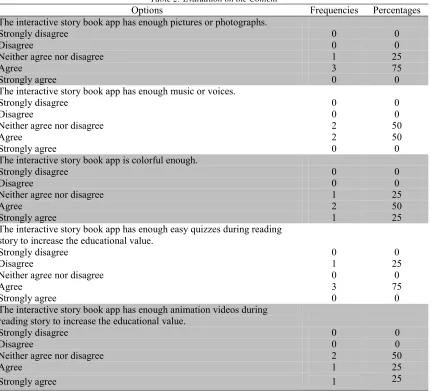
From Table 1, most of the experts are female and all of them has at least the tertiary education (STPM, Matriculation, Foundation) or above. Therefore, they have professional knowledge about the speech-language therapy. All of them have the working experience of more than 5 year so they have the rich experience of clinical speech-language therapy. Based on the results from the questionnaire it shows that they have the suitable qualifications (highest academic qualification and working experience) to take part in the survey.
agree that the interactive story book app is colorful enough (4.00). Regarding quiz, the experts agree that the interactive story book app has enough quizzes to increase the educational value (3.50). The experts also agree that the interactive story book app has enough animation videos during reading story to increase the educational value (3.75). Overall, the experts agree that the content design of pictures, music, colors, quiz and animations in our app is suitable for the language therapy for children who have the speech-language impairments.
Table 2: Evaluation on the Content (at the end of this paper)
Besides, some open questions are also prepared for the experts to answer as our references to improve the app for the children who have speech-language impairments. The records of answers are as follows (all the contents are recorded according to the handwriting):
The three most important features of interactive story book app for the children who have speech-language impairments:
more pictures/more animations/clear color interactivity/soothing colors/animation picture/word/sound
Repetition of the same words in written and verbal forms/interactivity and fun/helping children read the whole word.
Any recommendations to make this app better for the children who have speech-language impairments:
Use a brighter and bigger font, put more animation.
Answers icons are not too near, add more visual feedback and audio feedback. Sentences can be colorful and font can be improved (darker or different fonts) eg. Kucing Adik
The title of the book. A little bit bigger for the words.
the font.
Things I don’t require in the app for the children who have speech-language impairments:
Too bright colors/small fonts
Something that makes the children only plays but not learn.
Based on the answers to the open questions the experts emphasized on the sound, the picture and the colors of the ISB. The app can be improved according to these suggestions.
Table 3 contains the evaluation that was done for the usability of the app.
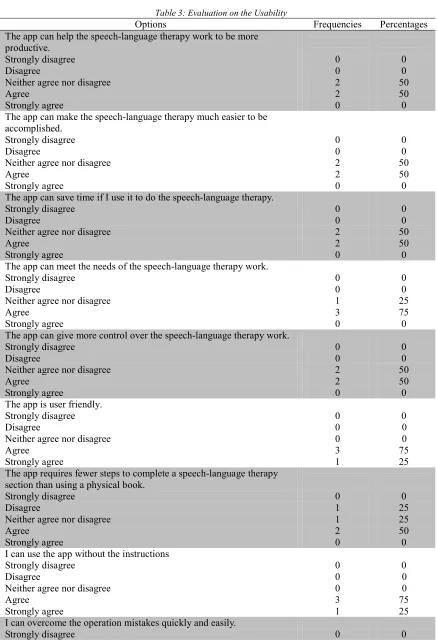
Table 3: Evaluation on the Usability (at the end of this paper)
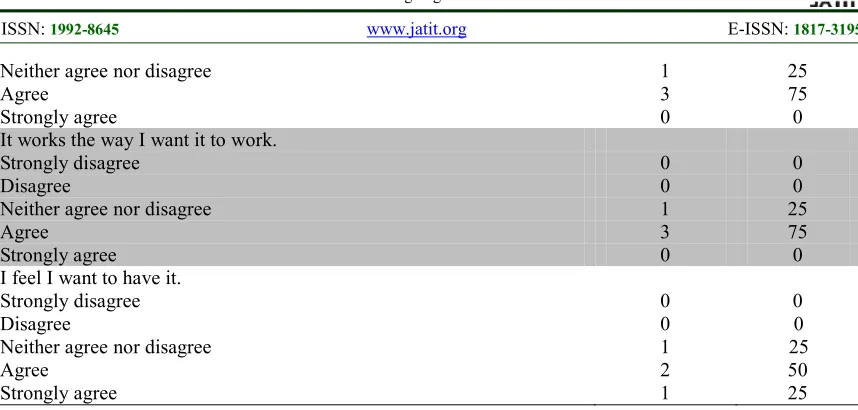
Based on the question that uses the Likert scale that rates from “Strongly Disagree” to “Strongly Agree” to identify experts’ perception towards the usability of the app, from the results which has been classified as the evaluation on the usefulness, the evaluation on the ease of use, the evaluation on the ease of learning and the evaluation on the satisfaction, the results are as follows:
Usefulness: The experts agree that the app can help the speech-language therapy work to be more productive (3.50). The experts agree that the app can make the speech-language therapy much easier to be accomplished (3.50). The experts agree that the app can save time if I use it to do the speech-language therapy (3.50). The experts agree that the app can meet the needs of the speech-language therapy work (3.75). The experts agree that the app can give more control over the speech-language therapy work (3.75). The average evaluation on the usefulness by all the 30 respondents give a positive assessment (average evaluation≥3), which means the experts who take part in the survey believe that the app meets the requirement for “usefulness”. Ease of use: The experts agree that the app
Ease of learning: The experts agree that the pictures are clear to recognize (4.25). The experts agree that the words are clear to recognize (4.00). The experts agree that the pronunciations of the words are professional and clear to follow (4.25). The experts agree that the pronunciations of the sentences are professional and clear to follow (4.25). The experts agree that they quickly become skillful with the app (4.25). The average evaluation on the usefulness by all the 30 respondents gives a positive assessment (average evaluation≥3), which means the experts who take part in the survey believe that the app meets the requirement for “ease of learning”. Satisfaction: The experts agree that they
are satisfied with the app (3.50). The experts agree that they would recommend using the app to do the speech-language therapy (3.75). The experts agree that the app is flexible to use (3.75). The experts agree that the app works the way they want it to work (3.75). The experts agree that they feel they want to have it (3.75). The average evaluation on the usefulness by all the 30 respondents gives a positive assessment (average evaluation≥3), which means the experts who take part in the survey believe that the app meets the requirement for “satisfaction”. Besides, the open questions are prepared for the experts to comment on the content and usability of the app as our references to improve the app for the children who have speech-language impairments. The records of answers are as follows (all the contents are recorded according to the handwriting):
Your comment on the content and usability of the app
The content and the sentences are appropriate. Need to put more background animation and more colorful background.
Can be used as an interactive story book for therapy/can improve with reading skills/can improve auditory memory/can improve auditory and reading comprehension.
Improve with long and complex sentences including the funny text.
According to the answers to the open questions the experts want more color pictures and
animations and the funny texts, the app can be improved according to these suggestions.
Based on the results and discussions from Table 1, Table 2 and Table 3, the experts are satisfied with the contents and the usability of the ISB for children who have speech-language impairments.
5.2 The Evaluation on the App from the
Parents and Children
The questionnaire focuses on getting the evaluation on the interactive book app for the children who have special needs. In this research, 60 questionnaires were distributed equally to respondents by operating a survey. From the 60 questionnaires, a total of 30 responses were returned. Likert scale that rates from “Strongly Disagree (1.00)” to “Strongly Agree (5.00) “has been developed to identify parents and their children’s perception towards the content of the app and the usability of the app. The respondents had to answer the questions which consist of 4 sections which are parents’ basic information, children’s basic information, evaluation on the content and evaluation on the usability.
From the analysis by using the Statistical Package for Social Sciences (SPSS, version 22.0), the result is shown in Table 4.
Table 4: Parents’ Basic Information (at the end of this paper)
From the results above, according to the result of the several questions about the parents’ demographic information, all the parents are more than 20 years old and most of them are 31-40-year-old, all of them has the primary education or above so they have the basic knowledge about the words in the app. Most of them have job, most of them use Bahasa Malaysia as their main conversational language. They have the suitable qualifications (age, highest academic qualification and current occupational status) to take part in the survey.
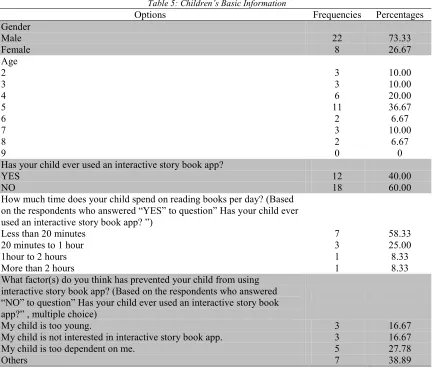
Table 5 contains the children’s basic information such as gender, date of birth and age. According to the results, all the children are suitable to take part in the survey.
Table 5: Children’s Basic Information (at the end of this paper)
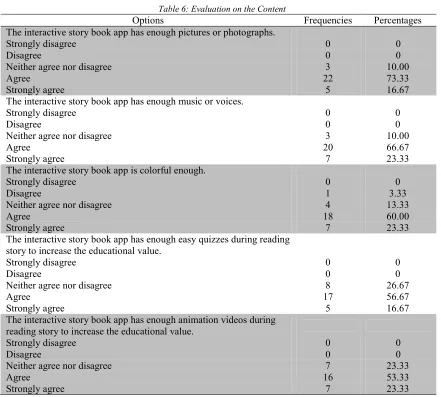
These inputs remind us that the app should be simple, colorful and attractive for the children. And among the children who never used an ISB, 38.89% of the respondents offered some other reasons and the reasons are as follows (the reasons are recorded according to the handwriting):
My child cannot behave himself very well. The apps are too complex.
I didn’t find a suitable app.
He doesn’t know how to use a story book app.
I can’t find a suitable and easy one. I don’t have so much time with my child,
he is not so familiar with the rules From the answers to the open questions most of the respondents require that the app should be interesting, attractive, simple, and easy and so on. The app can be improved by using the colorful pictures, simple words and enjoyable music according to these suggestions.
Based on the result of the question that uses the Likert scale that rates from “Strongly Disagree (1.00)” to “Strongly Agree (5.00)” to identify the respondents’ perception towards the content (Table 6) all respondents agree that the interactive story book app has enough pictures or photographs (4.07). Regarding music, the respondents agree that the interactive story book app has enough music or voices (4.13). The respondents agree that the interactive story book app has enough color elements (4.03). The respondents also agree that the interactive story book app has adequate quiz content to test the children’s comprehension (3.90). The respondents agree that the interactive story book app contained sufficient animation videos as edutainment element in the app (4.00). Overall, the respondents agree that the content, design of pictures, music, colors, quiz and animations in the app is suitable as speech-language therapy aid for children with speech-language impairments.
Table 6: Evaluation on the Content (at the end of this paper)
There were also some open questions for the respondents so as to improve the app for the children who have speech-language impairments. The answers are as follows (all the contents are recorded according to the handwriting):
more colorful pictures
larger words and brighter color More specific for specific disability. exciting story
more interactive correct pronunciation
Things I don’t want to see in the app for the children who have speech-language impairments:
words are not clear too complicated pictures Sound is too loudly. difficult words scary icons too sharp voice
From the answers to the open questions it is seen clearly that the respondents emphasized the sound, the picture and the colors of the ISB. The app can be improved according to these suggestions.
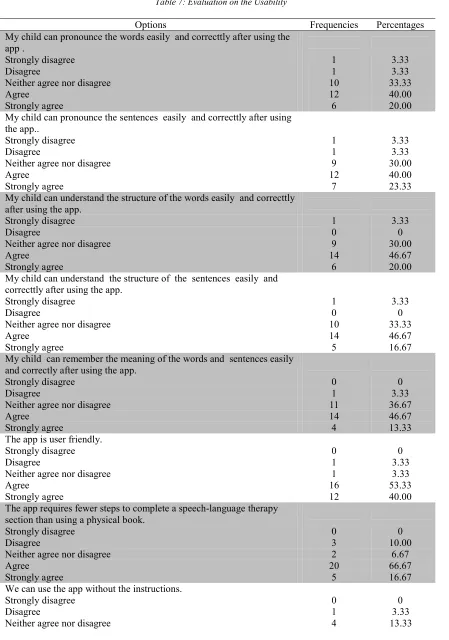
Table 7 contains the evaluation about the usability of the app as follows:
Table 7: Evaluation on the Usability (at the end of this paper)
Based on the question that uses the Likert scale that rates from “Strongly Disagree (1.00)” to “Strongly Agree (5.00)” to identify experts’ perception towards the usability of the app, from the results which has been classified as the evaluation on the usefulness, the evaluation on the ease of use, the evaluation on the ease of learning and the evaluation on the satisfaction, the results are as follows:
Usefulness: The parents and children agree that the child can pronounce the words easily and correctly after using the app (3.70). The parents and children agree that the child can pronounce the sentences easily and correctly after using the app (3.77). The parents and children agree that the child can understand the structure of the words easily and correctly after using the app (3.80). The parents and children agree that the child can understand the structure of the sentences easily and correctly after using the app (3.73). The parents and children agree that the child can remember the meaning of the words and sentences easily and correctly after using the app (3.67). The average evaluation on the usefulness by all the 30 respondents give a positive assessment (average evaluation≥3), which means the experts who take part in the survey believe that the app meets the requirement for “usefulness”. Ease of use: The parents and children
app requires fewer steps to complete a speech-language therapy section than using a physical book (3.80). The parents and children agree that they can use the app without the instructions (4.13). The parents and children agree that they can overcome the operation mistakes easily (3.97). The parents and children agree that they can use it to do the speech-language therapy work easily and correctly (4.07). The average evaluation on the usefulness by all the 30 respondents gives a positive assessment (average evaluation≥3), which means the experts who take part in the survey believe that the app meets the requirement for “ease of use”. Ease of learning: The parents and children
agree that the pictures are clear to recognize (4.43). The parents and children agree that the words are clear to recognize (4.13). The parents and children agree that the pronunciations of the words and sentences are professional (4.00). The parents and children agree that the pronunciations of the words and sentences are clear to follow (4.06). The parents and children agree that they quickly become skillful with the app (4.20). The average evaluation on the usefulness by all the 30 respondents gives a positive assessment (average evaluation≥3), which means the experts who take part in the survey believe that the app meets the requirement for “ease of learning”.
Satisfaction: The parents and children agree that they are satisfied with the app (4.17). The parents and children agree that they would recommend using the app to do the speech-language therapy (3.97). The parents and children agree that the app is flexible to use (4.00). The parents and children agree that the app works the way they want it to work (3.97). The parents and children agree that they feel they want to have it (4.06). The average evaluation on the usefulness by all the 30 respondents gives a positive assessment (average evaluation≥3), which means the experts who take part in the survey believe that the app meets the requirement for “satisfaction”.
Besides, the open questions are also prepared for the parents and children to comment on the content and usability of the app as our references to improve the app for the children who have speech-language impairments. The records of answers are as follows (all the contents are recorded according to the handwriting):
Your comment on the content and usability of the app
It is a brilliant design for the children who have speech-language impairments. The app is simple and good.
some sentences are a little long
It is good and easy to use, can help my child learn more.
good, simple, attract children’s attention It has friendly user interface, good work. From the answers to the open questions the parents and children are quite satisfied with our app.
According to the results and discussions from Table 4, Table 5, Table 6 and Table 7, the parents and children are quite satisfied with the content and the usability of the interactive book app as a speech-language therapy tool for the children who have speech-language impairments by using this questionnaire.
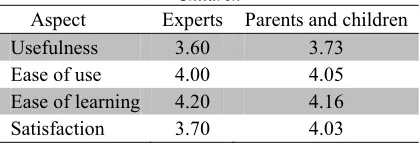
[image:10.612.313.523.543.615.2]Based on the analysis above, by calculating the average value based on Likert scale that rates from “Strongly Disagree (1.00)” to “Strongly Agree (5.00), the four aspects (usefulness, ease of use, ease of learning and satisfaction) of evaluation from different groups of respondents (the first group is experts, the second group is parents and children) are shown as the table below (Table 8):
Table 8: Analysis of Result from Experts, Parents and Children
Aspect Experts Parents and children
Usefulness 3.60 3.73
Ease of use 4.00 4.05
Ease of learning 4.20 4.16
Satisfaction 3.70 4.03
experts. Besides, the other three aspects of the app are quite similar.
6. CONCLUSION
In the study, two surveys were separately conducted for the experts and the parents with children who have special needs in speech-language impairments. Both surveys aim at getting the evaluation on the ISB developed for the special needs children whose first language is Bahasa Malaysia. The surveys are carried out in the form of questionnaires. Both questionnaires are divided into three parts (the respondents’ information, the evaluation on the content and the evaluation on the usability, especially in the survey for the parents and children, the respondents’ information is divided into the parents’ information and the children’s information). According to the collected data, the respondents (the experts, the parents and the children) have the suitable qualifications to take part in the survey. Some of the respondents also give the ideas to improve the ISB. In the part of the evaluation on the content of the app, the respondents agree the content design of the app in pictures, music, colors and quiz. The experts and the parents also share their ideas about content design of the app. In the part of the evaluation on the usability of the app, the respondents are asked to evaluate from the four aspects: usefulness, ease of use, ease of learning and satisfaction. Through the average evaluation calculated based on the Likert scale that rates from “Strongly Disagree (1.00)” to “Strongly Agree (5.00)” the experts, the children and the parents are all quite satisfied with the usability of the ISB. Based on the data analysis result, the respondents are satisfied with the app as a speech-language therapy tool for the children who have speech-language impairments. This app is a good example to combine the development technology of the mobile apps with the language development theory. It is also good app development experience when dealing with similar problems in other fields. It creates an opportunity for linguists and speech-language therapist to develop more specific books that can be turned into an interactive book app that is specifically targeted for different speech, language and literacy skills. However, as the respondents were selected only from Klinik Audiologi dan Sains Pertuturan in Fakulti Sains Kesihatan, they might be not good representatives of the experts and patients from other places in Malaysia. Hence, it is suggested that future studies on the subject be conducted with a sample of respondents who are chosen to represent
the experts and patients in Malaysia in order to further refine the findings of this study.
7. ACKNOWLEDGEMENT
This research was supported by Dr. Suhaila Zainudin and Dr. Lam Meng Chun in Fakulti Sains Maklumat dan Teknologi,Universiti Kebangsaan Malaysia, Dr.Hasherah Mohd Ibrahim and Dr. Badrulzaman Abdul Hamid in Fakulti Sains Kesihatan,Universiti Kebangsaan Malaysia. A lot of thanks for the teachers’ help from Fakulti Sains Kesihatan who provided insight and expertise that greatly assisted the research. And also, many thanks for the help from the staffs and students in Klinik Audiologi dan Sains Pertuturan in Fakulti Sains Kesihatan. I would also like to show my gratitude to the children and parents for sharing their experience and ideas with us during the course of this research. They really offered a lot of help.
REFRENCES:
[1] Bigge. M and Shermi.S, “Learning Theories for Teachers”, London: Longman, 1998.
[2] Gleason, J.B. and Ratner, N.B. The Development of Language, 7th Ed. Boston, MA: Pearson Education, Inc. 2009.
[3] Paredes, H., Fonseca, B., Cabo, M., Pereira, T. and Fernandes, F. Sousaphone: a mobile application for emergency calls. Universal Access in the Information Society. Berlin: Springer Berlin Heidelberg,2013.
[4] Donner, J. Research, Approaches to Mobile Use in the Developing World: A Review of the Literature. The Information Society, 2008, pp.140-159.
[5] Edwards, A.D. Speech Synthesis: Technology for Disabled People. London: Paul Chapman Publishing Ltd,.1991, pp. 12- 40.
[6] B. Oliver, B. and Goerke, V. Australian undergraduates’ use and ownership of emerging technologies: Implications and opportunities for creating engaging learning experiences for the Next Generation. Australasian Journal of
Educational Technology, 23(2), 2007, pp.
171-186.
[7] Scharff, C., Preira, J.M., Kay, R. and Su, S. H..Teaching Mobile Solution Development in a Global Context: Comparing Solutions Proposed by Students in the Developed and Developing World. Proceedings of the 2011 Frontiers in
Education Conference (FIE ’11)
[8] Smyth, T. N., Kumar, S., Medhi, I and Toyama, K. Where There's a Will There's a Way: Mobile Media Sharing in Urban India. Proceedings of the ACM SIGCHI Conference on Human Factors in Computing Systems (CHI '10),
Atlanta: GA, 2010, pp. 753-762.
[9] Rainforth, B., York J. and MacDonald C. Collaborative Teams for Students with Severe Disabilities, Baltimore: Paul Brookes, 1993. [10] Russell,T. The No Signi can’t Diference
Phenomenon: A Comparative Research Annotated Bibliography on Technology for Distance Education. Washington, DC: IDECC.2001.
[11] Hodge,S. “Why is the potential of augmentative and alternative communication not being realized? Exploring the experiences of people who use communication aids”. New York City: Disability and Society,2007.
[12] Herron, D., Menzel, W.,Atwell, E., Bisiani, R., Dane-luzzi, F., Morton, R., and Schmidt, J. A.. Automatic localization and diagnosis of pronunciation errors for second-language learners of English. Proceedings of the Euro
speech. Budapest: ISCA,1999, pp. 855-858.
[13] Pratt, S.R., Heintzelman, A.T.and Deming, S.E.. The efficacy of using the IBM Speech Viewer vowel accuracy module to treat young children with hearing impairment. Journal of
Speech and Hearing Research ,1993, pp. 1063–
1074.
[14] Hall, S., Fouh, A ,Breakiron,D.and Elshehaly, M.. Education innovation for data structures and algorithms courses. Proceedings of ASEE
Annual Conference, Atlanta:GA,2013, pp. 88–
100.
[15]Witt, S. M. and Young, Phone-level pronunciation scoring and assessment for interactive language learning, Speech
Communication, 30 (2-3),2002., pp. 95-108.
[16] Lewis, S.E. How Do Children Learn Language? London: Routledge,2010.
[17] Kim, H., Hasegawa, M., Perlman, A, Gunderson J., Huang T., Watkin K.and Frame S. Dysarthric Speech Database for Universal Access Research. Proceedings of the 2008 International Conference on Spoken Language
Processing (ICSLP - Interspeech). Australia:
Brisbane,2008, pp. 1741-1744.
[18] Buttussi, F., Chittaro, L., Carchietti, E. and Coppo, M. Using mobile devices to support communication between emergency medical responders and deaf people. Proceedings of the 12th International Conference on Human
computer interaction with mobile devices and
services. New York City:ACM,2010, pp. 7–16.
[19] Beier, J. S., and Spelke, E. S. Infants’ developing understanding of social gaze. Child
Development, 83(2),2012, pp. 486-496.
[20] Saz, O., Miguel, A., Lleida, E., Ortega, A. and Buera, L. Study of time and frequency variability in pathological speech and error reduction methods for Automatic Speech Recognition. Proceedings of the 2006 International Conference on Spoken Language
Processing (ICSLP - Inter-speech). Pittsburgh:
University of Pittsburgh Press, 2006, pp.933– 996.
[21] Yin S.C., Rose, R.C., Saz, O. and Lleida, E. A study of pronunciation verification in a speech-language therapy application. Proceedings of the 2009 International Conference on Acoustics Speech and Signal Processing (ICASSP).
California: IEEE Computer Society,2009, pp. 96-233.
[22] Johnson, A. Parents’ perceptions of their children’s participation in home reading activities. Master thesis, University of Pretoria.2007.
[23] Debaryshe, B., and Binder,J. C.. Development of an Instrument for Measuring Parental Beliefs about Reading Aloud to Young Children. Sage
Journals, 1994, pp. 157-170.
[24] Lund, A.M..Measuring Usability with the USE Questionnaire. STC Usability SIG Newsletter. Master thesis, University of New York,2001. [25] Tengku, N. T. M.and Nur, A. M. A.. An
Table 1: Experts’ Basic Information
Options Frequencies Percentages
Gender
Male 1 25
Female 3 75
Highest academic qualification
Primary education 0 0
Secondary education (STPM, Matriculation, Foundation) 0 0
Tertiary education (Diploma, Degree) 1 25
Post-degree qualification (Master, PHD) 3 75
Others 0 0
Working experience
Less than 1 year 0 0
1-3 years 0 0
3-5 years 0 0
More than 5 years 4 100
Table 2: Evaluation on the Content
Options Frequencies Percentages
The interactive story book app has enough pictures or photographs.
Strongly disagree 0 0
Disagree 0 0
Neither agree nor disagree 1 25
Agree 3 75
Strongly agree 0 0
The interactive story book app has enough music or voices.
Strongly disagree 0 0
Disagree 0 0
Neither agree nor disagree 2 50
Agree 2 50
Strongly agree 0 0
The interactive story book app is colorful enough.
Strongly disagree 0 0
Disagree 0 0
Neither agree nor disagree 1 25
Agree 2 50
Strongly agree 1 25
The interactive story book app has enough easy quizzes during reading story to increase the educational value.
Strongly disagree 0 0
Disagree 1 25
Neither agree nor disagree 0 0
Agree 3 75
Strongly agree 0 0
The interactive story book app has enough animation videos during reading story to increase the educational value.
Strongly disagree 0 0
Disagree 0 0
Neither agree nor disagree 2 50
Agree 1 25
Strongly agree 1 25
[image:13.612.92.523.319.710.2]Table 3: Evaluation on the Usability
Options Frequencies Percentages
The app can help the speech-language therapy work to be more productive.
Strongly disagree 0 0
Disagree 0 0
Neither agree nor disagree 2 50
Agree 2 50
Strongly agree 0 0
The app can make the speech-language therapy much easier to be accomplished.
Strongly disagree 0 0
Disagree 0 0
Neither agree nor disagree 2 50
Agree 2 50
Strongly agree 0 0
The app can save time if I use it to do the speech-language therapy.
Strongly disagree 0 0
Disagree 0 0
Neither agree nor disagree 2 50
Agree 2 50
Strongly agree 0 0
The app can meet the needs of the speech-language therapy work.
Strongly disagree 0 0
Disagree 0 0
Neither agree nor disagree 1 25
Agree 3 75
Strongly agree 0 0
The app can give more control over the speech-language therapy work.
Strongly disagree 0 0
Disagree 0 0
Neither agree nor disagree 2 50
Agree 2 50
Strongly agree 0 0
The app is user friendly.
Strongly disagree 0 0
Disagree 0 0
Neither agree nor disagree 0 0
Agree 3 75
Strongly agree 1 25
The app requires fewer steps to complete a speech-language therapy section than using a physical book.
Strongly disagree 0 0
Disagree 1 25
Neither agree nor disagree 1 25
Agree 2 50
Strongly agree 0 0
I can use the app without the instructions
Strongly disagree 0 0
Disagree 0 0
Neither agree nor disagree 0 0
Agree 3 75
Strongly agree 1 25
I can overcome the operation mistakes quickly and easily.
Disagree 0 0
Neither agree nor disagree 0 0
Agree 3 75
Strongly agree 1 25
I can use it successfully every time.
Strongly disagree 0 0
Disagree 0 0
Neither agree nor disagree 0 0
Agree 3 75
Strongly agree 1 25
The pictures are clear to recognize.
Strongly disagree 0 0
Disagree 0 0
Neither agree nor disagree 1 25
Agree 1 25
Strongly agree 2 50
The words are clear to recognize.
Strongly disagree 0 0
Disagree 0 0
Neither agree nor disagree 1 25
Agree 2 50
Strongly agree 1 25
The pronunciations of the words are professional and clear to follow.
Strongly disagree 0 0
Disagree 0 0
Neither agree nor disagree 0 0
Agree 3 75
Strongly agree 1 25
The pronunciations of the sentences are professional and clear to follow.
Strongly disagree 0 0
Disagree 0 0
Neither agree nor disagree 0 0
Agree 3 75
Strongly agree 1 25
I quickly become skillful with the app.
Strongly disagree 0 0
Disagree 0 0
Neither agree nor disagree 1 25
Agree 1 25
Strongly agree 2 50
I am satisfied with the app.
Strongly disagree 0 0
Disagree 0 0
Neither agree nor disagree 2 50
Agree 2 50
Strongly agree 0 0
I would recommend using the app to do the speech-language therapy.
Strongly disagree 0 0
Disagree 0 0
Neither agree nor disagree 1 25
Agree 3 75
Strongly agree 0 0
It is flexible to use.
Strongly disagree 0 0
Neither agree nor disagree 1 25
Agree 3 75
Strongly agree 0 0
It works the way I want it to work.
Strongly disagree 0 0
Disagree 0 0
Neither agree nor disagree 1 25
Agree 3 75
Strongly agree 0 0
I feel I want to have it.
Strongly disagree 0 0
Disagree 0 0
Neither agree nor disagree 1 25
Agree 2 50
[image:16.612.90.519.64.269.2]Strongly agree 1 25
Table 4: Experts’ Basic Information
Options Frequencies Percentages
Age
20-30years old 1 3.33
31-40years old 24 80.00
41-50years old 3 10.00
Above 50years old 2 6.67
Highest academic qualification
Primary education 2 6.67
Secondary education (STPM, Matriculation, Foundation) 3 10.00
Tertiary education (Diploma, Degree) 17 56.67
Post-degree qualification (Master, PHD) 8 26.67
Others 0 0
Current occupational status
Unemployed /housewife 5 16.67
Full time: Government 10 33.33
Full time: Private 11 36.67
Full time: Working from home 3 10.00
Part time: Government 1 3.33
Part time: Private 0 0
Part time: Working from home 0 0
What is the main language you use in DAILY CONVERSATION with your child? (multiple choice)
Malay 18 54.55
English 10 30.30
Mandarin 5 15.15
Dialect/Others 0 0
Table 5: Children’s Basic Information
Options Frequencies Percentages
Gender
Male 22 73.33
Female 8 26.67
Age
2 3 10.00
3 3 10.00
4 6 20.00
5 11 36.67
6 2 6.67
7 3 10.00
8 2 6.67
9 0 0
Has your child ever used an interactive story book app?
YES 12 40.00
NO 18 60.00
How much time does your child spend on reading books per day? (Based on the respondents who answered “YES” to question” Has your child ever used an interactive story book app? ”)
Less than 20 minutes 7 58.33
20 minutes to 1 hour 3 25.00
1hour to 2 hours 1 8.33
More than 2 hours 1 8.33
What factor(s) do you think has prevented your child from using interactive story book app? (Based on the respondents who answered “NO” to question” Has your child ever used an interactive story book app?” , multiple choice)
My child is too young. 3 16.67
My child is not interested in interactive story book app. 3 16.67
My child is too dependent on me. 5 27.78
Others 7 38.89
Table 6: Evaluation on the Content
Options Frequencies Percentages
The interactive story book app has enough pictures or photographs.
Strongly disagree 0 0
Disagree 0 0
Neither agree nor disagree 3 10.00
Agree 22 73.33
Strongly agree 5 16.67
The interactive story book app has enough music or voices.
Strongly disagree 0 0
Disagree 0 0
Neither agree nor disagree 3 10.00
Agree 20 66.67
Strongly agree 7 23.33
The interactive story book app is colorful enough.
Strongly disagree 0 0
Disagree 1 3.33
Neither agree nor disagree 4 13.33
Agree 18 60.00
Strongly agree 7 23.33
The interactive story book app has enough easy quizzes during reading story to increase the educational value.
Strongly disagree 0 0
Disagree 0 0
Neither agree nor disagree 8 26.67
Agree 17 56.67
Strongly agree 5 16.67
The interactive story book app has enough animation videos during reading story to increase the educational value.
Strongly disagree 0 0
Disagree 0 0
Neither agree nor disagree 7 23.33
Agree 16 53.33
Strongly agree 7 23.33
Table 7: Evaluation on the Usability
Options Frequencies Percentages
My child can pronounce the words easily and correcttly after using the app .
Strongly disagree 1 3.33
Disagree 1 3.33
Neither agree nor disagree 10 33.33
Agree 12 40.00
Strongly agree 6 20.00
My child can pronounce the sentences easily and correcttly after using the app..
Strongly disagree 1 3.33
Disagree 1 3.33
Neither agree nor disagree 9 30.00
Agree 12 40.00
Strongly agree 7 23.33
My child can understand the structure of the words easily and correcttly after using the app.
Strongly disagree 1 3.33
Disagree 0 0
Neither agree nor disagree 9 30.00
Agree 14 46.67
Strongly agree 6 20.00
My child can understand the structure of the sentences easily and correcttly after using the app.
Strongly disagree 1 3.33
Disagree 0 0
Neither agree nor disagree 10 33.33
Agree 14 46.67
Strongly agree 5 16.67
My child can remember the meaning of the words and sentences easily and correctly after using the app.
Strongly disagree 0 0
Disagree 1 3.33
Neither agree nor disagree 11 36.67
Agree 14 46.67
Strongly agree 4 13.33
The app is user friendly.
Strongly disagree 0 0
Disagree 1 3.33
Neither agree nor disagree 1 3.33
Agree 16 53.33
Strongly agree 12 40.00
The app requires fewer steps to complete a speech-language therapy section than using a physical book.
Strongly disagree 0 0
Disagree 3 10.00
Neither agree nor disagree 2 6.67
Agree 20 66.67
Strongly agree 5 16.67
We can use the app without the instructions.
Strongly disagree 0 0
Disagree 1 3.33
Agree 15 50.00
Strongly agree 10 33.33
We can overcome the operation mistakes quickly and easily.
Strongly disagree 0 0
Disagree 1 3.33
Neither agree nor disagree 6 20.00
Agree 16 53.33
Strongly agree 7 23.33
We can use it to do the speech-language therapy work easily and correctly.
Strongly disagree 0 0
Disagree 1 3.33
Neither agree nor disagree 5 16.67
Agree 15 50.00
Strongly agree 9 30.00
The pictures are clear to recognize.
Strongly disagree 0 0
Disagree 0 0
Neither agree nor disagree 0 0
Agree 17 56.67
Strongly agree 13 43.33
The words are clear to recognize.
Strongly disagree 0 0
Disagree 0 0
Neither agree nor disagree 4 13.33
Agree 18 60.00
Strongly agree 8 26.67
The pronunciations of the words and sentences are professional.
Strongly disagree 1 3.33
Disagree 0 0
Neither agree nor disagree 6 20.00
Agree 14 46.67
Strongly agree 9 30.00
The pronunciations of the words and sentences are clear to follow.
Strongly disagree 1 3.33
Disagree 0 0
Neither agree nor disagree 2 6.67
Agree 20 66.67
Strongly agree 7 23.33
We quickly become skillful with the app.
Strongly disagree 0 0
Disagree 0 0
Neither agree nor disagree 4 13.33
Agree 16 53.33
Strongly agree 10 33.33
I am satisfied with the app.
Strongly disagree 0 0
Disagree 1 3.33
Neither agree nor disagree 1 3.33
Agree 20 66.67
Strongly agree 8 26.67
I would recommend using the app to do the speech-language therapy.
Strongly disagree 0 0
Disagree 1 3.33
Agree 14 46.67
Strongly agree 8 26.67
It is flexible to use.
Strongly disagree 0 0
Disagree 0 0
Neither agree nor disagree 5 16.67
Agree 18 60.00
Strongly agree 7 23.33
It works the way I want it to work.
Strongly disagree 0 0
Disagree 0 0
Neither agree nor disagree 7 23.33
Agree 17 56.67
Strongly agree 6 20.00
I feel I want to have it.
Strongly disagree 0 0
Disagree 1 3.33
Neither agree nor disagree 4 13.33
Agree 19 63.33
Strongly agree 6 20.00