3597
MEASURING THE ACCEPTANCE OF USING UTMS IN
JORDAN UNIVERSITIES
1BASSAM M. AL-MAHADEEN, 2AHMAD ALTHUNIBAT, 3SAEED M.Z A. TARABIEH,
1Assoc. Prof., Department of Computer Science, Mu’tah University, Al Karak, Jordan
E-mail: [email protected], [email protected]
2Department of software Engineering, Alzaytoonah University of Jordan, Amman, Jordan
E-mail: [email protected]
3Marketing Department, School of Business, Mu’tah University, Al Karak, Jordan
Email: [email protected]
ABSTRACT
University Timetable management system (UTMS) are used to schedule courses, lecturers and rooms in university by considering some constraints. Although UTMS is a widely studied topic, the use of automated timetabling systems is not widespread among large universities. Therefore, it is important to investigate the factors that influence the intention to use university timetable management system (UTMS) among Higher education lecturers. This study proposed a model for determining the factors that affect the acceptance of using UTMS. The study was conducted by surveying different groups of university’s’ lecturer community. A structured questionnaire was used to collect data from 120 respondents. Results of the study prove that the proposed model is comprehensive to study the acceptance of UTMS in higher education institution. Overall, the results indicated the appropriateness of fundamental elements of TAM in the UTMS context.
Keywords: Acceptance, Timetable management system, university timetable, TAM model.
1. INTRODUCTION
Course timetabling is one of three important educational timetabling categories and processes (School, examination, and course timetabling) in the academic institution administration [1].
Burke [2] defined the university course timetabling problem as a process of assigning a number of events to a fixed number of time slots in a week and rooms which the session will take place. Taking into consideration; the complexity of the timetabling process caused by the hard and soft constraints. Hard constraints are to be completely satisfied under any circumstances. Soft constraints are to be satisfied as much as possible through minimizing the violation of a constraint. Problems of time based planning and combinational optimizations, tend to be solved with cooperation of search and heuristics to get optimal or near optimal solutions [3]. This problem need to be solved to ensure the requirements and constraints are fulfilled within a limited time.
The manual processing of producing a course timetable is very time consuming, and don't satisfy all desires and preferences of students and lecturers. These two issues disturb Mu’tah University
personnel recently. Therefore, many researches concerned with this sort of timetabling problem and have been dedicated to investigate the capabilities of the automated timetabler in the last two decades in which to produce a feasible course timetable that satisfies students' and lecturers' desires.
According to Murray and M¨uller [4] although university course timetabling is a commonly considered issue, the usage of automated timetabling systems is not common among universities. University timetabling is a complex problem because of high number of constraints needed to satisfy the requirements of students and lecturers. The development of UTMS that satisfy all users it is very difficult. The system should be easy for everyone involved in the process to use and understand, and for them to be satisfied with the results.
3598 implementation. However, the introduction of new technologies and/ or systems leads to the emergence of new practices and, consequently, new requirements for more technological support.
User acceptance can be described as a product of user behaviour in relation to the available technology and a given environment. Davis [5] has described, perceived usefulness and perceived ease of use as the main influences on user acceptance of information technology (p. 320). As a consequence thereof, to achieve user acceptance the development of these perceptions need to be dealt with. Methods in this field range from standard quantitative approaches such as simply asking about how services would be or are perceived to explorative approaches of shadowing users. The latter are able to find out more about actual usage patterns and social shaping factors (see [6] [7]).
Hence, the objective of this research is to investigate the factors that influence the acceptance of using UTMS in Mu’tah University based on students and lecturers preferences.
2. UNIVERSITY TIMETABLE
MANAGEMENT SYSTEM (UTMS)
Course timetabling involves assigning a number of students, lecturers, and rooms into a fixed set of periods. A good schedule would be one where no lecturer, student or room is used more than once in any given period. This can be obtained by satisfying hard and soft constraints.
According to many researchers such as Daskalaki et al [18], Socha et al. [19], Alvarez-Valdes et al.[20],
Burke and Petrovic [21], and Schaerf [22]; the most tackled common hard and soft constraints in the university course timetabling problems are listed down as follows:
a. Hard constraints:
Students can only attend one lecture at a time.
Lecturers can only teach one lecture at a time.
A lecturer can only deliver one lecture at a time.
Lecturer's unavailability is considered.
Each lecturer must deliver a specified number of lectures per week.
A lecture cannot have the same course for more than two periods a day.
A lecture for a particular course must be scheduled once a day.
A room must be scheduled for one lecture at a time.
Specific room requirements are taken into consideration.
Allocated rooms must be sufficient to accommodate students of a particular course.
Lectures can be prescheduled to a preferred time.
Double lectures must include two consecutive periods.
b. Soft constraints:
The number of spare periods in students’ timetables should be minimized.
Lecturers’ timetables should avoid gaps.
Some lecturers require special facilities.
Lectures should be spread uniformly over the whole week.
Some lectures should not take place late in the evening.
An hour lunch break must be scheduled.
Students should have consecutive lectures in the same building or close to the host department.
One course may need to be scheduled before/after another.
Conflicts between elective courses chosen by students should be avoided.
Some classes may be split into smaller groups.
Lectures for the same course should be scheduled in the same room or at the same time of day.
3. TECHNOLOGY ACCEPTANCE MODEL
(TAM)
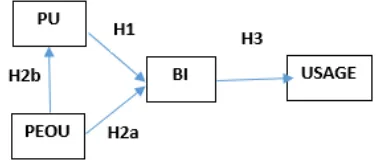
3599 Figure 1: Research Model
In This study we have chosen TAM model for two main reasons. First, TAM is based on its predictive power which makes it easy to apply in different information system devices [9][10][11][12][13]; Second, TAM helps to better understand the relationship between four important constructs of the study; perceived usefulness, perceived ease of use, attitude and behavioural intention.
3.1 Perceived Usefulness (PU)
Perceived Usefulness (PU) is defined as “the extent to which a person believes that the technology under investigation will enhance his/her productivity or job performance” [5](Davis et al. 1989). In the context of UTMS, it is perceived as the likelihood that the UTMS will benefit the user in the performance of some task. It is primarily connected with perceptions of the outcome as a result of technology usage. A significant body of TAM research has provided evidence, that PU is a strong determinant of user acceptance, adoption, and usage behaviour [5]. In fact, PU has been found to be the most significant factor in acceptance of technology in the workplace, even better than PEOU ([5][14]). Hence, this research proposes the flowing hypotheses:
Hypothesis1: the perceived usefulness of the
UTMS has a significant effect on behavioural
intention to use of UTMS.
3.2Perceived Ease of Use (PEOU)
PEOU is defined as “the extent to which a person believes that using a technology will be simple” [5]. This construct is linked to an individual’s estimation of the effort he or she will have to put in order to learn and use a technology. PEOU is advantageous for the early acceptance of an innovation and is necessary for adoption and subsequent diffusion of technological innovations [5]. PEOU has been employed widely in
understanding user acceptance of technology [14]. Like PU, the PEOU also has empirical support as a critical component of the acceptance process. However the influence of PEOU over TAM is not clear. Occasionally, PEOU has shown to have a direct effect on attitude and in some other cases has shown an indirect effect (via PU) ([5] [14]). The direct effect suggests that PEOU could improve attitude towards acceptance regardless of the product’s usefulness. In contrast, the indirect effect stems from the situation where, other things being equal, the easier a technology is to use, the more useful it is perceived to be, thus, the more positive one’s attitude and intention toward using the technology[5]. Both direct and indirect effects have been tested and found positive and significant in the workplace context ([5][13]). Thus, the following hypotheses are formulated:
Hypothesis 2a: the perceived ease of use of the
UTMS has a significant effect on behavioural
intention to use of UTMS.
Hypothesis 2b: the perceived ease of use of the
UTMS has a significant effect on perceived
usefulness of UTMS.
3.3 Behavioural Intention (BI) and usage
behaviour
BI is defined as “the strength of the prospective user’s intention to make or to support the acceptance of m-Government innovation”. BI to accept a new technology is an important indicator of the ultimate acceptance decision and is hypothesised to be determined by attitude towards adopting the technology. It is predicted that behavioural intention will have a positive influence on usage behaviour. A user’s stated preference to use the m-Government service will be closely related to the fact that, they actually use the system; this assumption only applies when the behaviour is under a person’s volitional control [6].
Hypothesis3: the behavioural intention to use of
UTMS has a significant effect on UTMS usage.
4. RESEARCH DESIGN
The questionnaire was adapted from earlier studies [5][10][11][12][13]. One of the advantages in using the TAM was that it had a well-validated measurement inventory [13] [15] [16].
3600 due to incomplete data. The data was analyzed using SPSS.
The size of the sample of the studies depends on the type of research. Since this research is exploratory, the sample size is sufficient to collect the UTMS requirements.
The demographic distribution shows that 76.6 percent of the respondents were male and the remaining 23.4 percent were female. Most of the respondents (63.3 percent) were between 30 to 50 years. With regards to educational attainment, 71.3 percent had PhD, 20.6 had master’s degree, and 8.1 percent had bachelor degree. A total of 150 lecturers responded to the questionnaire survey and 25 were invalid due to incomplete data. The data analyzed, using SPSS 16 software.
5.FINDINGSANDRESULT
Since the items making up the instruments scales, were tested to ensure that they formed strong unities and demonstrate good measurement properties (construct validity and reliability), the constructs in the model testing is acceptable [17]. The research model involves more than one dependent variable therefore multiple regression analysis is used to test the hypotheses. In addition, linear regression cannot test all relationships in a single statistical test; therefore, it is necessary to use three separate regressions to fully test the model [17].
The first regression analysis was run to test the hypotheses H1and H2a. BI is the dependent variable while PU and PEOU are the independent variables. The coefficient of determination (R²) measures the proportion of the variance of the dependent variable about its mean that is explained by the independent or predictor variables (Hair et al. 1998). The higher the value of R², the greater the explanatory power of the regression model. The regression model (R²) value for the dependent variable behaviour intention (BI) is 0.844, meaning that 84.4% of the variance in behaviour intention is explained by the regression model. This value is considered high and thus the power of the regression model is very good. The model is statistically significant (F=324.182, p<.001). The values of the regression coefficients and their significance, determine the variables included in Table 1.
Table 2 presents these second regression variables. The results show that perceived ease of use (PEOU) were found to be significant in predicting of PU.. The regression model’s (R²) value for the dependent
variable usefulness (PU) is 0.145, meaning that 14.5% of the variance in usefulness is explained by the regression model. The model is statistically significant (F=24.859, p<.001). The second regression model supports hypothesis H2b:
The third regression analysis was carried out for the hypotheses H3. Usage is the dependant variable while BI is the independent variable.
Table 3 presents the third regression model variable. Results show that the BI were found to be significant in predicating usage of UTMS. The regression model (R²) value for the dependent variable usage is 0.348, meaning that 34.8% of the variance in usage is explained by the regression model. The model is statistically significant (F=146.018, p<.001). Thus, the third regression model supports hypothesis 3.
6. DISCUSSIONS
Although UTMS is a widely studied topic, the use of automated timetabling systems is not widespread among large universities. This is particularly true in Jordan universities, where the state of the art is typically to roll forward the last like semester’s timetable and make adjustments to room assignments. UTMS is a hard problem because of its size and the complexity of constraints needed to satisfy the demands of students and instructors. The problem is made harder yet by the need to develop a system that is easy for everyone involved in the process to use and understand, and for them to be satisfied with the results.
Some technical challenges faces the development of UTMS, such as: accuracy and security. A successful UTMS implementation also needs users who have the skills to use the UTMS system functions and who are willing to use those functions.
In order to increase the usage of new UTMS, Developer must followed the requirements and needs of users in details to ensure a fruitful outcome, the designers must satisfy the needs and wants of the user when the development is complete. The UTMS should help the university in generating timetable that satisfy the students and lecturers.
3601 This study was designed to explore the factors that influence the acceptance of using UTMS in Mu’tah University based on students and lecturers preferences. A research framework based on TAM model was proposed and empirically tested. The results from a survey of 120 lecturers indicated that the framework was able to explain the factors that determine lecturers’ acceptance of UTMS system. The research framework not only offered new theoretical grounds for future research in UTMS system but also provided UTMS developers with a list of the factors that needed to take into account when they develop the UTMS.
One specific interesting avenue for future work would be to explore further into the antecedents to lecturers acceptance of UTMS system found in this study, namely PU, PEOU, BI and USAGE.
Hence this study conducted in Mu’tah University. Similar user acceptance research efforts can be applied to different universities.
REFRENCES:
[1] Melicio, F., Caldeira, J. P. and Ruso, A. 2004. Two neighbourhood approaches to the timetabling problem. PATAT 2004 Proceedings of the 5th International Conference on the Practice and Theory of Automated Timetabling. [2] Burke, E.K., MacCarthy, B.L., Petrovic, S., Qu,
R. 2002. Knowledge Discovery in a Hyper-Heuristic for Course Timetabling Using Case-Based Reasoning. Selected Papers from the PATAT'02, LNCS 2740. Also available in the Proceedings of PATAT'02, 90-103. Aug, 2002. [3] Fang, H. L. 1992. Investigating Genetic
Algorithms for Scheduling. Unpublished Thesis: MSc. University of Edinburgh.
[4] Keith Murray, Tomáš Müller, "Automated System for University Timetabling". Proceedings of the 6th International Conference on the Practice and Theory of Automated Timetabling. ISBN 80-210-3726-1, pp. 536-541, 2006.
[5] Davis, F. D. 1989a. Perceived usefulness, perceived ease of use, and user acceptance of information technology. MIS quarterly 319-340. [6] Haddon, L. 2005. Research questions for the evolving communications landscape. Mobile Communications 7-22.
[7] Vincent, J. and Harris, L. 2009. ‘Early Adopter’case Studies Of Effective Mobile Communications Between Citizens And Government. e-Governance: managing or governing? 99.
[8] Ajzen, I. and Madden, T. J. 1986. Prediction of goal-directed behavior: Attitudes, intentions, and perceived behavioral control. Journal of experimental social psychology 22(5): 453-474. [9] Kleijnen, M., Wetzels, M. and De Ruyter, K.
2004. Consumer acceptance of wireless finance. Journal of Financial Services Marketing 8(3): 206-217.
[10] Luarn, P. and Lin, H. H. 2005. Toward an understanding of the behavioral intention to use mobile banking. Computers in Human Behavior 21(6): 873-891.
[11] Nysveen, H., Pedersen, P. E. and Thorbjornsen, H. 2005. Explaining intention to use mobile chat services: moderating effects of gender. Journal of Consumer Marketing 22(5): 247-256.
[12] Pikkarainen, T., Pikkarainen, K., Karjaluoto, H. and Pahnila, S. 2004. Consumer acceptance of online banking: an extension of the technology acceptance model. Internet Research 14(3): 224-235.
[13] Wang, Y. S., Wang, Y. M., Lin, H. H. and Tang, T. I. 2003. Determinants of user acceptance of Internet banking: an empirical study. International Journal of Service Industry Management 14(5): 501-519.
[14] Venkatesh, V. and Davis, F. D. 2000b. A theoretical extension of the technology acceptance model: Four longitudinal field studies. Management Science 46(2): 186-204 [15] . Guriting, P. and Ndubisi, N. O. 2006. Borneo
online banking: evaluating customer perceptions and behavioural intention. Management Research News 29(1/2): 6-15. [16] Sharma, C. 2008a. Mobile Services Evolution
2008-2018 Making the eHealth Connection: Global Partnerships, Local Solutions. Bellagio, Italy 13 .
[17] Gefen, D., Straub, D. W., and Boudreau, M.-C. 2000. “Structural Equation Modeling and Regression: Guidelines for Research Practice,” Communications of the Association for Information Systems (4:7), pp. 1-70.
3602 [19]Alvarez-Valdes R., Crespo E. and Tamarit J.M.
(2002). Design and implementation of a course scheduling systems using tabu search: Production, manufacturing and logistics. European Journal of Operational Research, 137, pp 512-523.
[20]Socha K., Samples M. and Manfrin M. (2003). Ant algorithm for the university course timetabling problem with regard to the state-of-the-art. The Proceedings of the 3 European Workshop on Evolutionary Computation in Combinatorial Optimisation, Essex, UK, Lecture Notes in Computer science 2611, Springer-Verlag, pp 334-345.
[21]Burke E.K., MacCarthy B.L., Petrovic S., Qu R. (2002). Knowledge Discovery in a Hyper- Heuristic for Course Timetabling Using
Case-Based Reasoning. Selected Papers from [22]Schaerf A. (1999). A survey of automated