PRESENTING STRUCTURED EVALUATION FRAMEWORK
TOWARDS E-LEARNING ADAPTION IN JORDANIAN
UNIVERSITIES – THE USE OF CBAM-SOC FRAMEWORK
1NASIM MATAR
1
Asstt Prof., Faculty of Administrative and Financial Sciences, E-Business, JORDAN
E-mail: [email protected]
ABSTRACT
This paper presents a continuous work related to defining the concern of adopting e-learning system by faculty members in Jordanian universities. The previous research (Evaluating E-Learning System Use by CBAM-Stages of Concern Methodology in Jordanian Universities, 2015) has managed to outline the stages of concern using CBAM framework for faculty members in 12 Jordanian Universities with a total participation of 138-faculty members. After an engagement with e-learning systems for almost a year, this research continued the investigation for the use of CBAM-SoC in order to define and measure the change in stages of concern with respect to the defined challenges of adapting e-learning practices in the Jordanian higher educational system. Jordanian Universities can adopt the output of this research in order to provide an evaluation strategy for measuring the concern towards e-learning, which will reflect positively on universities practices and policies towards e-learning.
Keywords: CBAM, Evaluation, E-learning, Jordanian Universities, Stages of Concern
1. INTRODUCTION
The need for evaluating teacher practices and concern towards teaching has always been a necessity for providing better activities and pedagogy that resulted in supporting students learning and educational achievements. The use of e-learning in Jordanian Universities started in late 2003 in limited number of universities and escalated to reach most of the 29 universities. Different research studies have investigated the adaptation of e-learning in Jordan and defined the strategies, benefits and obstacles [1]. However, less attention has been oriented by research studies toward investigating the level of concern towards e-learning practices and activities by faculty members in Jordan. The concern towards practice or technology is believed to be the driving force for adoption, adaptation, effective or ineffective engagement. Thus, it was important to investigate and measure the concern of faculty members in order to have a better understanding of their current perception and practices towards educational technologies [2]. Different tools and strategies are available for investigating the use of technology; however, the use of CBAM has been referred to in many research works as a framework that is capable of providing different tools for assessment of using educational tools and their effect and impact on
dedication and planning for inclusion of such practices. Thus, it is important to measure the concern towards these technological practices, as the concern is the driving force for using these technological innovations [4]. Having those results will help to shape the future use and interaction with e-learning in Jordan. Moreover, it will provide a benchmark and bridge the gap between Jordanian higher education institutions and other countries towards e-learning evaluation, as the use of CBAM-SoC are being widely used in the west and foreign countries like (USA, CANADA, UK and Australia) [2][5]. The following section will present the adaptation challenges as presented in research studies that are related to Jordan.
2. E-LEARNING ADAPTATION
CHALLENGES IN JORDAN
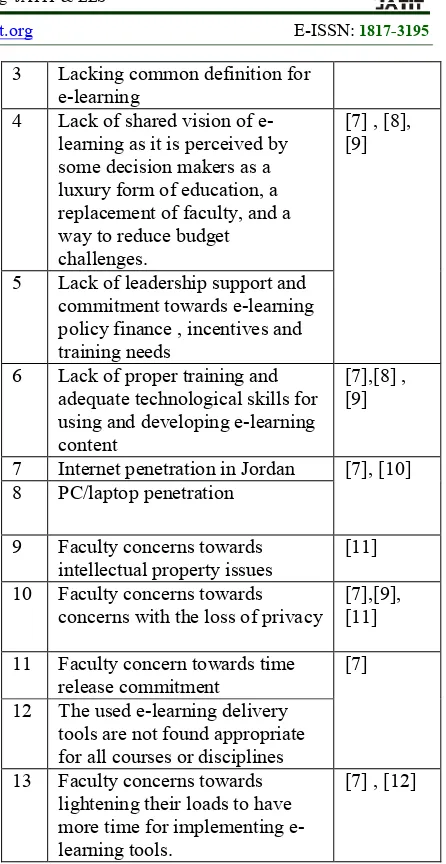
[image:2.612.307.530.63.495.2]In many cases, the adaptation towards new practices or technology is faced with challenges, and the use of e-learning is not an exception [4]. Within the same context, Al-Shboul [5] , assured that the same challenge is found within Jordanian faculty members approach towards adaptation to e-learning practices. Moreover, there are major factors that act as barriers for faster adaptation and understanding those factors can ease and enhance the process, especially that the demand for e-learning within educational practices in Jordan is expected to rise in the next upcoming years [5]. Regarding the case of Jordan, it is important to understand that Jordanian Ministry of Higher Education and educational establishments have sufficient awareness towards the importance of e-learning, the success factors and the challenges [6]. Moreover, different barriers have been identified by the Ministry of Higher Education in Jordan and by many researchers that investigated the e-learning case. According to [7], researchers pointed out that the adaptation of e-learning in Jordan and the expectations towards using e-learning in higher education institutions are below the international level. This research made a comparison between the different published barriers and outlined the major similarities found in Jordanian case. The following table shows the defined barriers.
Table 1. E-Learning Barriers In Jordanian Universities
No Barriers Reference
1 Immaturity of e-learning experience in Jordanian universities
[8] , [9]
2 Inconsistency of e-learning adaptation between faculties and colleges
3 Lacking common definition for e-learning
4 Lack of shared vision of e-learning as it is perceived by some decision makers as a luxury form of education, a replacement of faculty, and a way to reduce budget challenges.
[7] , [8], [9]
5 Lack of leadership support and commitment towards e-learning policy finance , incentives and training needs
6 Lack of proper training and adequate technological skills for using and developing e-learning content
[7],[8] , [9]
7 Internet penetration in Jordan [7], [10] 8 PC/laptop penetration
9 Faculty concerns towards intellectual property issues
[11]
10 Faculty concerns towards concerns with the loss of privacy
[7],[9], [11]
11 Faculty concern towards time release commitment
[7]
12 The used e-learning delivery tools are not found appropriate for all courses or disciplines 13 Faculty concerns towards
lightening their loads to have more time for implementing e-learning tools.
[7] , [12]
3. THE CBAM’S STAGES OF CONCERN
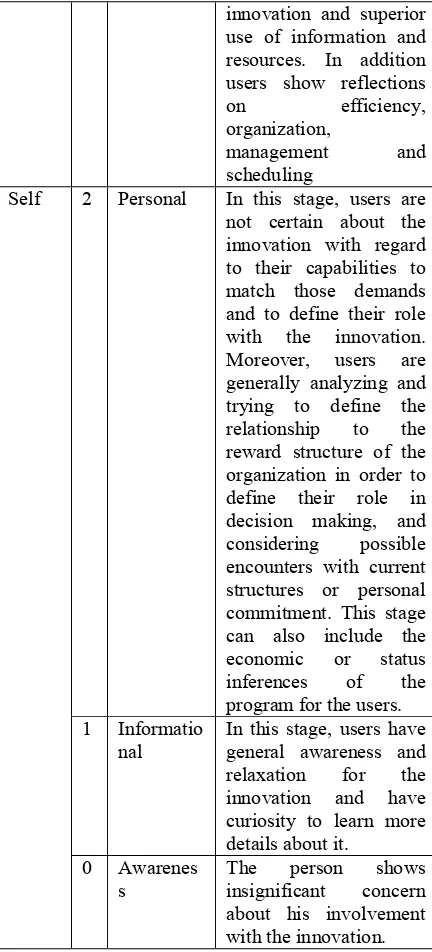
[image:3.612.309.525.93.569.2]CBAM framework has three different tools that can be used separately or sequentially for assessing the use of innovation within educational settings. The recommendation for using CBAM tools are sequentially by using (SoC, LoU, IC) in order to have complete understanding for the use, engagement and effect of the innovation [1],[13]. This research has focused on the first tool (SoC) in order to bring the attention on individual approaches and concerns in responses to e-learning use. The SoC is structured into seven different stages that grows gradually from self-focused, task focused and impact focused concerns. The evaluation of participants SoC can result in having classification distributed among different stages based on the derived results. The following table shows the categories and stages that are defined by CBAM-SoC tool [1],[13],[14].
Table 2: CBAM - Stages of Concern
Cat N
O
Stage Definition
Impac t
6 Refocusin g
In this stage, users mainly focus on discovering new ways to have more benefits of using the innovation. This process can include
making major
modifications or replacement for the innovation with more prevailing substitutions. 5 Collaborat
ion
In this stage, users drive their attention to establish and form collaborations with others with regard to the used innovation. 4 Conseque
nce
In this stage, users’ attention is on the innovations influence on students. The influence includes students’ assessment, outcomes, performance and the needed changes to advance students achievements.
Task 3 Managem
ent
In this stage, users’ attention is oriented towards processes and tasks related to
innovation and superior use of information and resources. In addition users show reflections
on efficiency,
organization,
management and
scheduling
Self 2 Personal In this stage, users are not certain about the innovation with regard to their capabilities to match those demands and to define their role with the innovation. Moreover, users are generally analyzing and trying to define the relationship to the reward structure of the organization in order to define their role in decision making, and considering possible encounters with current structures or personal commitment. This stage can also include the economic or status inferences of the program for the users. 1 Informatio
nal
In this stage, users have general awareness and relaxation for the innovation and have curiosity to learn more details about it.
0 Awarenes s
The person shows insignificant concern about his involvement with the innovation.
• The tool can be used for detection purposes and is not suitable for monitoring or judging.
• The used questions cannot be altered or changed
• The derived results and their meaning needs to be confirmed with respondents • The tool assumes feedback
• It needs to connect critiques of SoC on suitable sample and appropriate research methodology.
With that previous introduction to the use of CBAM-SoC and defining the categories and stages, the following section will discuss the research methodology that has been adopted in this research study.
4. RESEARCH METHODOLOGY
The used approach and measures in this research are based on using CBAM’s stages of concern questionnaire. The used tool is quantitative in nature and it has been used in different research studies that proved reliability, internal consistency and validity by diverse samples and more than 11 innovations [1],[14],[15]. Other measures were based on a previous research study that included 12 public and private Jordanian Universities that showed interest in this research and used the same tool to have preliminary results regarding the stages of concern. The same universities and faculty members were approached to extend their participation in this research. The previous research study [4], used a questionnaire that was distributed to approximately 400-faculty member and the response came from 138. The data was grouped and analysed and the results showed that majority of participants are classified within Stage 1: Informational. This research approached the same sample in the previous research study, in order to further investigate SoC after the use of e-learning system and services for one year. The response came from 116 that participated in filling the questionnaire for the second time. The approach in this research is to define if there are changes in SoC with respect to the presented challenges within Jordanian educational context. Such understanding can help in better managing and considering the effects of barriers that are hindering e-learning adaptation process. Statistical Package of Social Sciences (SPSS) was used to analyze the data, the Mean, Standard Deviations and the Paired Sample test was used to provide the needed analysis and information for this evaluation process [17]. The following section will present the results of the
previous study and compare it with the results defined in this study.
5. CBAM’S STAGES OF CONCERN
RESULTS
The following table shows the results that are derived from the current and previous study. The results are distributed with respect to the defined stages in CBAM-SoC. Moreover, the questions that have changes in results larger than 10% have been made (Bold).
TABLE 5:–CBAMSTAGES OF CONCERN RESULTS OF STUDY1
AND STUDY 2 Study1 SoC
Results
Study 2 SoC Results Stages
M Std
D % M StdD %
Stage 0 – Awareness
I am more concerned about another innovation.
1.9 0
0.90 5
38
% 1.7 0.403 34 %
I am not concerned about e-learning at this time.
2.0 0
0.81 6
40
% 1.75 0.612 35 %
I am
preoccupied with things other than e-learning.
2.2 7
1.00 4
45
% 1.42 0.834 28 %
I spend little time thinking about e-learning.
3.5 0
0.57 6
70
% 2.3 1.004 46 %
Currently, other priorities prevent me from focusing my attention e-learning
3.9 0
0.75 5
78
% 2.5 1.171 50 %
Group- s0 2.7
1 0.82
2 54
% 1.93
4
0.804 8
39 %
Stage 1- Informational
I have a very limited knowledge about e-learning
4.0 0
1.00 7
80
% 1.52 0.82 30 %
I would like to discuss the
3.5 4
0.78 1
71
possibility of using e-learning I would like to know what resources are available if we decide to adopt e-learning 4.1 8 0.88 2 84
% 4.62 0.746 92 %
I would like to know what the use of e-learning will require in the immediate future. 4.6 0 0.44 5 92
% 4.2 0.682 84 %
I would like to know how e-learning is better than what we have now. 4.5 3 0.45 5 91
% 4.7 0.495 94 % Group- s1 4.1 7 0.71 4 83 % 3.76
0.680 8
75 %
Stage- 2 Personal
I would like to know the effect of e-learning on my professional status 3.6 6 0.71 7 73
% 4.52 0.616 90 %
I would like to know who will make the decisions in the new system 2.3 7 0.78 5 47
% 3.24 0.952 65 %
I would like to know how my teaching or administratio n is supposed to change 2.9 0 1.24 2 58
% 2.89 0.93 58 %
I would like to have more information on time and energy commitment s required by the use of e-learning. 3.1 9 0.49 9 64
% 3.62 0.787 72 %
I would like to know how
2.7 9
0.81 5
56
% 3.86 0.97 77 %
my role would change when I am using e-learning Group- s2 2.9 8 0.81 1 60 % 3.62
6 0.851 73 %
Stage- 3 Management
I am concerned about not having enough time to organize myself each day. 3.1 2 1.21 1 62
% 4.5 0.638 90 % I am concerned about conflict between my interests in using e-learning and my responsibiliti es. 4.1 2 0.80 7 82
% 1.89 0.912 38 % I am concerned about my inability to manage all the e-learning requires. 4.1 0 1.28 8 82
% 1.84 1.027 37 % I am concerned about time spent working with non-academic problems related to e-learning. 4.2 2 0.96 8 84
% 3.29 0.698 66 %
Coordination of tasks and people is taking too much of my time. 2.6 0 1.04 7 52
% 1.59 0.588 32 % Group- s3 3.6 3 1.06 4 73 % 2.62
2 0.772 52 %
Stage – 4 Consequence
I am concerned about students‘ attitudes toward e-learning 2.8 0 0.73 7 56
I am concerned about how the e-learning affects students. 3.2 2 0.45 7 64
% 4.35 0.75 87 % I am concerned about evaluating my impact on students. 2.5 6 1.06 6 51
% 4.2 0.795 84 %
I would like to excite my students about their part in this approach of using e-learning. 3.1 1 0.51 0 62
% 3.98 0.638 80 %
I would like to use feedback from students to change the e-learning practices and activities. 2.9 6 0.92 1 59
% 4.2 0.782 84 % Group- s4 2.9 3 0.73 8 59 % 4.14
2 0.794 83 %
Stage -5 Collaboration
I would like to help other faculty in their use of e-learning. 2.6 0 0.70 2 52
% 3.5 1.055 70 %
I would like to develop working relationships with both our faculty and outside faculty using e-learning 2.9 0 0.71 5 58
% 3.1 0.472 62 %
I would like to familiarize other departments or people with the progress of this new approach. 2.8 5 0.40 3 57
% 3.59 1.12 72 %
I would like to coordinate my effort with others 2.9 1 0.80 5 58
% 4 0.875
80 %
to maximize e-learning’s effects. I would like to know what other Teachers are doing in this area. 2.8 4 0.74 8 57
% 3.64 0.753 73 % Group- s5 2.8 2 0.67 5 56 % 3.56
6 0.855 71 %
Stage – 6 Refocusing
I now know some other approaches that might work better when using e-learning 1.5 4 0.70 3 31
% 1.84 0.804 37 % I am concerned about revising my use of e-learning 3.1 0 0.74 2 62
% 4.22 0.768 84 %
I would like to revise e-learning’s instructional approach. 2.5 6 0.41 0 51
% 4.39 0.882 88 %
I would like to modify our use of e-learning based on the experiences of our students. 3.6 0 0.43 1 72
% 3.54 0.855 71 %
I would like to determine how to supplement, enhance e-learning 2.8 4 0.41 5 57
% 3.38 0.781 68 % Group- s6 2.7 3 0.54 0 55 % 3.47
4 0.818 69 %
Table 6: Stages of Concerns Category Results for Study 1 and Study 2
Cat Sections M Std. D %
Study 1
Self 0,1,2 3.29 0.78 66%
Task 3 3.63 1.064 73%
Impact 4,5,6 2.83 0.65 57%
Study 2
Self 0,1,2 3.11 0.78 62%
Task 3 2.622 0.7726 52%
Impact 4,5,6 3.73 0.82 74%
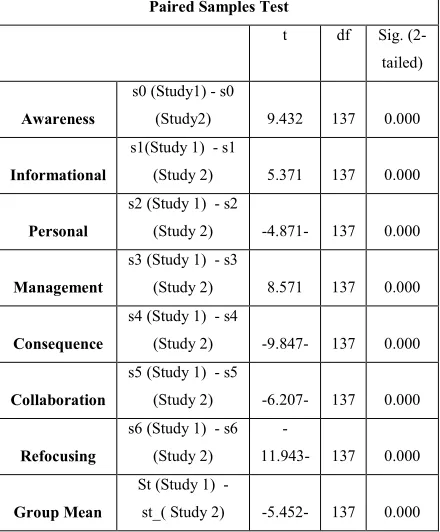
Table 7: Comparisons for Sample T-Test for Study 1 and Study 2
Paired Samples Test
t df Sig.
(2-tailed)
Awareness
s0 (Study1) - s0
(Study2) 9.432 137 0.000
Informational
s1(Study 1) - s1
(Study 2) 5.371 137 0.000
Personal
s2 (Study 1) - s2
(Study 2) -4.871- 137 0.000
Management
s3 (Study 1) - s3
(Study 2) 8.571 137 0.000
Consequence
s4 (Study 1) - s4
(Study 2) -9.847- 137 0.000
Collaboration
s5 (Study 1) - s5
(Study 2) -6.207- 137 0.000
Refocusing
s6 (Study 1) - s6
(Study 2)
-11.943- 137 0.000
Group Mean
St (Study 1) -
st_( Study 2) -5.452- 137 0.000
6. CBAM’S STAGES OF CONCERN
RESULTS DISCUSSION
The following section will discuss the results and will outline the major differences in each stage. The questions that are going to be highlighted are the once with 10% difference.
• Stage 0 Awareness
The results in this stage shows that there is a difference in the overall percent defined for this stage. The percent in study 2 has dropped to be 39% and it shows that 15% of participants have shifted to other higher stages of concern. In terms of the question results defined in each stage that has significant difference of 10% are:
a)I am preoccupied with things other than e-learning: This question had a drop in of 17%, and it shows that users are more focus towards using e-learning.
b) I spend little time thinking about e-learning: This question had a drop of 24), and it shows that users spend more time thinking about e-learning use and its features.
c)Currently, other priorities prevent me from focusing my attention e-learning: This question had a drop of 28%, and it shows that users are more focused on the use of e-learning
All the previous results shows that there is a major positive shift in (Awareness) stage, as less users are defined to be in this stage compared with the results of Study 1.
• Stage 1 Informational
The results in this stage shows that there is a difference in the overall percent defined for this stage. However, it is not defined as a major difference as the change in percent is less than 10%. The major change for the questions in this stage come from one question that is:
a)I have a very limited knowledge about e-learning: This question had a drop of 50%, and it shows that users have gained more knowledge in using and interacting with e-learning.
The results in this stage shows that many users have shifted from this page that had a percent of 83% and they are becoming more concerned about the use of e-learning in their daily teaching activities.
• Stage 2 Personal
The results in this stage shows that there is a major difference of 13% in the overall percent defined for this stage. The major change for the questions in this stage come from three questions that are:
b) I would like to know the effect of e-learning on my professional status: This question had a increase of 17% for the second study, and it shows that users are having more attention towards the effect of e-learning practices on their teaching activities.
having more concerns towards decision that are used within the e-learning system, which reflect a positive interaction level.
d) I would like to know how my role would change when I am using e-learning: This question had a increase of 21% for the second study, and it shows that users are more engaged on personal level and they are more oriented towards defining their exact role while using e-learning.
All the pervious results for the questions defined in this stage are showing that users are having more growing concern towards their personal understanding and use of e-learning within their teaching activities and responsibilities.
• Stage 3 Management
The results in this stages shows that there is a major difference of 21% in the overall percent defined for this stage. The major change for the questions in this stage come from all used question that are:
a)I am concerned about not having enough time to organize myself each day: This question had a increase of 28% for the second study, and it shows that users are having more concerns towards the responsibilities of organizing their time to be able to effectively and constantly use e-learning system. The result are interpreted positively as the users are having more understanding of their engagement requirements with e-learning system and the efforts needed to manage and produce learning materials using such systems.
b) I am concerned about conflict between my interests in using e-learning and my responsibilities: This question had a drop of 44% for the second study, and it shows that users are having more understanding of e-learning and that it is a complementary tool that can be used effectively and causes little or no conflict with instructors responsibilities.
c)I am concerned about my inability to manage all the e-learning requires: This question had a drop of 45% for the second study, and it shows that users are becoming more capable of managing the e-learning requirements.
d) I am concerned about time spent working with non-academic problems related to e-learning: This question had a drop of 18% for the second study, and it shows that users are having less concerns towards time spent on non-academic problems related to e-learning. This results shows that users are having better understanding of e-learning requirements, and academic and non-academic requirements.
e)Coordination of tasks and people is taking too much of my time: This question had a drop of 21% for the second study, and it shows that users gained better managerial skills in terms of coordinating tasks and people and it is becoming less concern.
The results for the questions used in this stage are showing that there is a positive shift for users’ attention and their relation to the processes, tasks, efficiency, organization, management and scheduling.
• Stage 4 Consequence
The results in this stages shows that there is a major difference of 24% in the overall percent defined for this stage. The major change for the questions in this stage come from all used question that are:
a)I am concerned about students’ attitudes toward e-learning: This question had a increase of 24% and it shows a positive shift in teachers resulting attitude of using e-learning and its relation with more focus on students.
b) I am concerned about how the e-learning affects students: This question had a increase of 23% and it shows that more instructors are concerned about the results of using this technology on students.
c)I am concerned about evaluating my impact on students: This question had a increase of 33%, and it shows a positive attitude of instructors’ development in using e-learning, which made their concern shift towards students practices and evaluation.
thinking of innovative approaches of engaging students with this educational tool.
e)I would like to use feedback from students to change the e-learning practises and activities: This question had a increase of 25% and it shows that instructors are becoming more engaged with students through the use of e-learning as their concern is more on receiving feedbacks from students to enable them to enhance their practices.
All the previous results shows positive shift towards consequences of using e-learning and their growing attention is on the practices related to students’ assessment, outcomes, performances and the needed changes to advance students achievements.
Stage 5 Collaboration
The results in this stage shows that there is a major difference of 15% in the overall percentage defined for this stage. The major change for the questions in this stage come from four question that are:
a)I would like to help other faculty in their use of e-learning: This question had a increase of 18% and it shows that more instructors are becoming confident in their level of using e-learning.
b) I would like to familiarize other departments or people with the progress of this new approach: This question had a increase of 15% and it shows that more teacher are becoming confident in using e-learning to a level of sharing the knowledge and use of e-learning among other departments’ and instructors.
c)I would like to coordinate my effort with others to maximize e-learning’s effects: This question had a increase of 22% and it shows that more teachers are considering the necessity to coordinate their efforts in using this technology to have more benefits and overcome the obstacles that have been defined in this research study related to Jordan.
d) I would like to know what other Teachers are doing in this area: This question had a increase of 16% and it shows that teachers are becoming more concerned with other teachers’ practices in this field.
The previous results from all the questions shows that instructors’ attention is becoming more oriented towards establishing collaborations with others if compared with results of Study 1. This shift is considered positive towards instructor practices and their collaboration with e-learning that is growing positively despite the defined challenges.
• Stage 6 Refocusing
The results in this stage shows that there is a major difference of 14% in the overall percent defined for this stage. The major change for the questions in this stage come from three questions that are:
a)I am concerned about revising my use of e-learning: This question had a increase of 22% and it shows that more instructors are becoming engaged with e-learning through revising their use for e-learning in order to explore the full benefits and capabilities of using such technology within educational settings.
b) I would like to revise e-learning’s instructional approach: This question had a increase of 37% and it shows that more users are more confident in using e-learning since they are more confident in revising their instructional approach.
c)I would like to determine how to supplement, enhance e-learning: This question had a increase of 11% and it shows that users are more engaged to the level of enhancing their e-learning by supplementary methods and techniques that are available with such technology.
The results from this stage shows that more users are focusing on discovering new ways to interact and use e-learning. The process includes having major modifications and support for e-learning with more compatible solutions and tools that can be found on the web.
•
Discussing the general resultsT-Test for Study1 and Study 2. This research study formed two different hypothesis that are:
a) (Ho) there is no difference between the achievements in Study1 and Study 2.
b) (Ha) there is difference between the achievements in Study1 and Study2.
The results in the (Table 7) for all stages shows that the Sig value is (0.000) that is smaller than (0.05), which indicates a difference between the results in Study 1 and 2, thus we accept (Ha) that states that there are differences between Study 1 and 2. Moreover, to identify the exact change we can compare the mean values or percent in the previous tables with respect for each stage result. In addition, CBAM-SoC classify the stages to three groups that are (Self, Task, Impact). According to that classification, the results in Study1 shows that users are defined within (Task) category as it had the highest percentage of 73%, and in Study 2 they are classified in (Impact) category with a percentage of 74%.
7. RESEARCH LIMITATIONS AND
FUTURE WORK
In the light of the previous presented information and discussion, this research study have some limitations that are related to:
• Sample size: Jordan has more than 30 public and private universities, the universities that showed interest are 12, and it is hoped that in the future more universities will participate in such research studies, which will help to generalize the output and benefits in a wider scale.
• Faculty member specialization: This research study strained to define SoC generally and based on faculty members' specialization if possible. The general results for all the participants were defined. On the other hand the comparison between specializations in order to define the differences and the effect of specialization on stages of concern towards e-learning was not possible due to large variation in specialization groups' size which will affect the statistical accuracy in the obtained results. Thus a future research study is planned to harness the specializations of faculty members, through using different methodologies in
approaching faculty members and their participations.
• Lack of research: Most of the previous studies related to evaluating e-learning in Jordan are focusing on evaluating the use and interaction with e-learning. No previous research study by other researchers used CBAM-Framework or evaluated the motives and concerns for using e-learning as a driving force in Jordan. Thus this research study serves in providing better understanding for the motives and level of interaction with e-learning in general with respect to Jordanian case. However, it is hope that in the future more research studies will focus on using CBAM-Framework which will provide a richer literature towards the use and interaction with e-learning in Jordan.
8. CONCLUSION
REFERENCES:
[1] Almarabeh, T. (2014). Students' perceptions of e-learning at The University of Jordan”, International Journal of Emerging Technologies in Learning (iJET), 9(3), 31-35. [2] Matar, Nasim.(2015), "Evaluating E-Learning
System Use by CBAM-Stages of Concern Methodology in Jordanian Universities." ,World of Computer Science & Information Technology Journal 5, no. 5 (2015).
[3] Gundy, M. S., & Berger, M. J. (2016), “Towards a model supporting educational change”, International Journal of Information and Education Technology, 6(3), 232.
[4] Kim, M. R. (2008), “Factors influencing the acceptance of e-learning courses for mainstream faculty in higher institutions”, International Journal of Instructional Technology and Distance Learning, 5(2), 29-44.
[5] Al-Shboul, M. (2007), “Faculty attitudes and perceptions concerning the use of course management systems in higher education”. Unpublished Doctoral Dissertation, Northern Illinois University, DeKalb, Illinois.
[6] Hinnawi, I. (2011), “Demand for e-learning projected to soar”, [online]. Available at http://www.menafn.com/qn news story s.asp?storyid=1 093461074 (Accessed 26th Jan 2016)
[7] Almarabeh, T., & Mohammad, H. (2013), “E-learning in the Jordanian higher education system: Strengths, weakness, opportunities, and threats”, . Journal of American Science, 9(3), 281-287
[8] Al-Shboul, M., & Alsmadi, I. (2010), “Challenges of utilizing e-Learning systems in public universities in Jordan”, International Journal of Emerging Technologies in Learning (iJET), 5(2), 4-10.
[9] Obeidallah, R., Ghazal, G., & Shdaifat, A. (2016), “The experience of using Moodle and Elluminate Live! as learning tools in the Hashemite University case study: computer skills course”, International Journal of Business Information Systems, 23(1), 44-53. [10] Al-Adwan, A., & Smedley, J. (2012),
“Implementing e-Learning in the Jordanian higher education system: Factors affecting impact”, International Journal of Education
and Development Using Information and Communication Technology, 8(1), 121-135. [11] Al-Wehaibi, K., Al-Wabil, A., Alshawi, A. &
Alshankity, Z. (2008), “Barriers to internet adoption among faculty in Saudi Arabian universities”, In J. Luca & E. Weippl (Eds.), Proceedings of World Conference on Educational Multimedia, Hypermedia and Telecommunications, 2008(1), (pp. 24-33). Vienna, Austria.
[12] Diabat, B. (2011), “The Extent of Acquiring E-Learning Competencies by Faculty Members in Jordan Universities”, . European Journal of Social Sciences, 27(1), PP.71-81.
[13] Kim, S., & Paik, S. (2016), “An Analysis of Science Teachers’ Stages of Concern and Levels of Use on Descriptive Assessment”, Journal of the Korean Chemical Society, 60(5). [14] Phillips, P., & Toth-Cohen, P. (2016), “A Multi-Dimensional Framework for Exploring Effective Technology Integration into the Learning Environment”.
[15] George, A. A., Hall. G. E., & Stiegelbauer, S. M. (2008), “Measuring implementation in schools: The Stages of Concern Questionnaire”, Austin, TX: SEDL
[16] Dryfoos, J. (2005), “Full‐service community schools: A strategy—not a program”, New directions for youth development, 2005(107), 7-14.