R E S E A R C H A R T I C L E
Open Access
Building flexibility and managing
complexity in community mental health:
lessons learned in a large urban centre
Vicky Stergiopoulos
1,2,3*, Dima Saab
1, Kate Francombe Pridham
1, Anjana Aery
1and Arash Nakhost
3,4Abstract
Background:Across many jurisdictions, adults with complex mental health and social needs face challenges accessing appropriate supports due to system fragmentation and strict eligibility criteria of existing services. To support
this underserviced population, Toronto’s local health authority launched two novel community mental health
models in 2014, inspired by Flexible Assertive Community Team principles. This study explores service user and provider perspectives on the acceptability of these services, and lessons learned during early
implementation.
Methods: We purposively sampled 49 stakeholders (staff, physicians, service users, health systems stakeholders) and conducted 17 semi-structured qualitative interviews and 5 focus groups between October 23, 2014 and March 2, 2015, exploring stakeholder perspectives on the newly launched team based models, as well as activities and strategies employed to support early implementation. Interviews and focus groups were audio recorded, transcribed verbatim and analyzed using thematic analysis.
Results:Findings revealed wide-ranging endorsement for the two team-based models’success in engaging the target population of adults with complex service needs. Implementation strengths included the broad recognition of existing service gaps, the use of interdisciplinary teams and experienced service providers, broad partnerships and collaboration among various service sectors, training and team building activities. Emerging challenges included lack of complementary support services such as suitable housing, organizational contexts reluctant to embrace change and risk associated with complexity, as well as limited service provider and organizational capacity to deliver evidence-based interventions.
Conclusions:Findings identified implementation drivers at the practitioner, program, and system levels, specific to the implementation of community mental health interventions for adults with complex health and social needs. These can inform future efforts to address the health and support needs of this vulnerable population.
Keywords:Mental health, Complex needs, Qualitative evaluation, Community mental health, Implementation, Flexible assertive community treatment
Background
Across jurisdictions, individuals with complex health, mental health and social needs face multiple barriers to accessing appropriate, integrated services and supports due to system fragmentation, strict eligibility criteria of existing services, stigma and discrimination.
In western countries, individuals with serious mental ill-ness (SMI) can access Assertive Community Treatment (ACT) or Intensive Case Management (ICM) services. Both ACT and ICM models have been studied in a wide range of contexts and for various subpopulations of adults with SMI [1–6]. ACT is a well-defined, team-based ap-proach to care, with strong evidence in its favour [3, 5]. Its strict eligibility criteria, however, may exclude a subset of individuals with mental disorders and high support needs (e.g. individuals with primary substance use, or personality disorders) [7]. Furthermore, with few options for seamless * Correspondence:[email protected]
1
Centre for Urban Health Solutions, Li Ka Shing Knowledge Institute, St. Michael’s Hospital, 209 Victoria Street, Toronto, ON M5B 1W8, Canada 2Centre for Addiction and Mental Health, 100 Stokes Street, Toronto, ON M6J
1H4, Canada
Full list of author information is available at the end of the article
participant transitions to lower levels of support during periods of stability, there are long waitlists for ACT ser-vices in several jurisdictions [8]. In contrast to ACT, with its well-developed fidelity criteria, ICM tends to be more variable in nature and implementation, yielding mixed findings in the evaluative literature [9, 10]. While ACT teams directly provide needed services to adults with SMI and high service utilization, ICM interventions deliver these same services in collaboration with other local service-providers [9], and generally provide a lower level of support to a broader group of adults with SMI.
To address some of these challenges, Flexible Assertive Community Treatment (FACT), a model that blends aspects of ACT and ICM services within a single team, emerged in the Netherlands in the past 10- years, and has been well described and adopted elsewhere [11–14]. Within a FACT team, service users retain the relationships with their care manager (nurse/social worker), their psychiatrist and other team members such as the peer expert, while stepping-up or down to higher (ACT-like) or lower (enriched ICM) levels of support as needed over time. As FACT eligibility criteria are more flexible than those of traditional ACT team criteria, ACT-ineligible individuals may access high levels of support services if needed. Early evaluations of the FACT model, relying primarily on obser-vational studies and administrative data, have been promis-ing, suggesting improvements in adherence rates, reduction in unmet needs and improved quality of life [12, 15–19].
This study describes the early implementation of two local community mental health teams, inspired by FACT principles, to address the needs of adults with complex health, mental health and social needs in Toronto, Canada’s largest urban centre. The local service delivery context, and guidelines from the local health authority necessitated departures from full replication of FACT.
Service delivery context
Assertive Community Treatment (ACT) teams in the province of Ontario, Canada have been systematically im-plemented since 1998, with 79 ACT teams currently in operation [20]. Though Toronto has a high concentration of services, including ACT, individuals with complex health and social needs such as intellectual and develop-mental disabilities, traumatic brain injury, co-morbid sub-stance use conditions, and co-morbid personality disorders, continue to face barriers in accessing community supports of high intensity. Similar to other jurisdictions, Ontario ACT standards prioritize adults with schizophrenia and bi-polar affective disorder, creating access challenges for those not meeting diagnostic eligibility criteria or not having re-peated and lengthy hospitalizations [21]. With ACT team wait lists averaging more than a year [22], local ICM ser-vices are often asked to step in while they are not resourced
to serve individuals with complex health and social needs requiring more intensive interventions.
To address these challenges, Toronto’s local health au-thority launched two“Integrated Service (IS) Teams”, draw-ing from elements of FACT, in 2014. Although previous reviews have synthesized the factors that affect implemen-tation of programs in general into a conceptual model [23, 24], and Fixsen et al. (2005) have developed the National Implementation Research Network (NIRN) framework for active implementation [25], these models are still evolving. Furthermore, research on how implementation unfolds in community based mental health services and systems at various stages of implementation is scant [26–28], including research on implementing ACT, or FACT [17, 18, 29, 30].
Study aims
This study aims to explore service user and provider per-spectives on the acceptability of the IS team models, and to identify early implementation drivers. This information may be useful for future efforts to address the needs of adults with complex health, mental health and social needs in other jurisdictions facing similar challenges.
Methods
The integrated service teams: introducing team and organizational flexibility
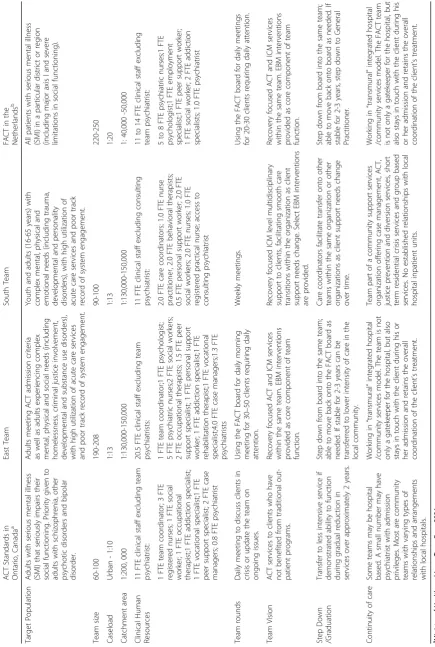
Both Integrated Service (IS) teams, referred to throughout this paper as the“East”and“South”team, for their respect-ive geographical areas in the city, were multidisciplinary, recovery oriented, and targeted individuals with complex needs (Table 1). Eligibility criteria focused on the social cir-cumstances of service users, such as homelessness, crim-inal justice involvement, and service engagement, rather than strict diagnostic or past health service use criteria.
care coordinators, the South team has access to a psychi-atric consultant, and provides enhanced ICM support through multidisciplinary assessment and individual case management to service users with complex yet more mod-erate needs, while facilitating care transitions within the organization’s various programs, including ACT, as sup-port needs change over time.
Both IS teams accept referrals for adults aged 18-65 years (with the South Team additionally accepting youth older than 16 as appropriate) with a variety of health and social needs, including challenges in performing activities of daily living and functioning in the community, housing needs, criminal justice involvement, substance use, and acute or chronic medical illness, including developmental disabil-ities. The majority of early referrals to the East team were 25-54 years of age (74%), male (57%), had a history of vio-lence/aggression (66%) and a substance use disorder (52%). Approximately 48% had no fixed address. Similarly, the majority of referrals to the South team were 25-54 years of age (73%), male (62%), with a history of self-harm/suicide attempts and psychotic disorders (56%). Approximately 17% had no fixed address.
Design and data collection
The evaluation included review of program documents (e.g. meeting minutes, program descriptions and policies), and qualitative data collection with a total of 49 stakeholders. We conducted two staff focus groups, three service user focus groups, and seventeen key informant interviews with program and system-level stakeholders. Data collection took place between October 23, 2014 and March 2, 2015.
All staff of the East and South IS teams were invited by the study coordinator to participate in a focus group, ex-ploring staff (n= 25) perceptions of the new team based models and the early implementation process, including key program components and staff perspectives on what worked well and what were the challenges during early implementation [see Additional file 1]. Service user partic-ipants (n= 17) were recruited through convenience sam-pling. IS staff offered information on the study and directed potential participants to the study coordinator. One service user focus group was conducted with individ-uals who transitioned from the ACT team to the East team, while the other two focus groups engaged service users newly served by the two IS teams. Service user focus groups elicited information on the services and supports received by their respective teams and their experiences of these services [see Additional file 2]. Key informant inter-views (n= 17) focused on key program ingredients and program and system-level factors influencing implementa-tion [see Addiimplementa-tional file 3]. Key informants were recruited through snowball sampling and included program man-agers, team leaders, psychiatrists, primary health care pro-viders and relevant decision-makers.
Research staff, not involved in care provision, obtained written informed consent from all participants. Focus groups with staff and program participants lasted approxi-mately 75 min; key informant interviews were approxiapproxi-mately one hour in duration. All focus groups and interviews were audio recorded and transcribed verbatim; names and places were anonymized. The study was approved by the Research Ethics Board at St. Michael’s Hospital.
Analysis
Interview and focus group transcripts were analyzed using thematic analysis, which involves the identification of com-mon themes that span multiple interviews and focus groups [32, 33]. Two researchers independently examined a subset of the transcripts line-by-line, and grouped this qualitative data into codes or threads. They compared their approaches and resolved differences in coding strategies, arriving at a preliminary coding framework with the team’s lead researcher. This coding framework was applied to an additional subset of transcripts and further expanded to ac-commodate new data. The final coding framework was used by research staff to code all transcripts and program documents. The research team met regularly to review coding categories and reduce them to a smaller number of higher level themes that were internally coherent, consist-ent and distinctive [32]. Research staff organized member-checking workshops with staff and management from both IS teams to establish the trustworthiness of the data. Ana-lysis was facilitated by Nvivo 10.0 version software.
Results
Our findings of early implementation drivers are organized using Durlak and DuPre’s conceptual framework [34], in-cluding the external context, provider characteristics, model characteristics, program delivery factors and sup-port system factors. Findings supsup-port the two team-based models’success in engaging the target population. Imple-mentation strengths included the broad recognition of existing service gaps, the use of interdisciplinary teams, experienced service providers, partnerships and collabor-ation across sectors and levels of care, training and team building activities. Emerging challenges included lack of complementary support services such as suitable housing, organizational contexts reluctant to embrace change and risk, and limited service provider and organizational capacity to deliver evidence-based interventions. Some challenges were shared, and others were unique to one or the other IS team as described below.
External context: system and community factors
Facilitator: an identified need for change to address the needs of underserviced populations
were poorly served by available services. As one key in-formant said,“[Ontario] ACT teams have shied away from people that are homeless or have had criminal justice in-volvement, or developmental disabilities”(KI 16). This ser-vice user, in describing his situation, summarized the challenges facing many individuals prior to their referral to an IS team:
“My health was poor. I was sleeping on the street a lot. I was going through starvation periods, where I had no food…I was getting in trouble with the law, assaulting people…hearing voices and seeing things.”
Recognition of the service gaps for this vulnerable popu-lation led to dedicated funding and incentives for provider organizations to work across services and sectors, helping launch new partnerships and collaborations: “I think we have to keep pushing our entire care system, to the point where we can really work together on [more] teams that cross organizations”(KI 15).
Challenge: Lack of complementary resources and supports As several study participants identified, the complex chal-lenges in service users’ lives have deep, structural roots that community mental health services cannot address alone. Stakeholders recognized the limitations inherent in challenging the broader factors related to the social deter-minants of health:“Things like housing, things like a safe neighbourhood, access to quality food – there’s a lot of food insecurity…We’re dealing with issues of poverty… we’re operating within a context of a macro system that doesn’t promote recovery.” Key informant participants further reflected on the implications of this context:
My anxieties were, you know, we are going to be only one team in a fairly hard-to-serve environment…I think there are a lot of systemic problems, that, you know, exist here ... it’s good to have one flexible piece, but I think all pieces need to become flexible. (KI 1).
Team members identified the need for additional flexible resources in the community and systemic change, such as integrated primary care services, direct access to housing and rent supplements for those experiencing homelessness, or interim housing options for those referred upon exit from the criminal justice system.
Provider characteristics: a collaboration of the willing
Facilitator: commitment to learning and improvement The organizations involved in IS team implementation had prior experience in serving adults with complex health and social needs, in service innovation and inter-sectoral part-nerships, and were among few providers interested in ex-ploring new approaches to service provision for this population. Stakeholders and managers at the organizational level were optimistic about the IS teams’potential for influ-encing systemic change, and were keen to evaluate their im-plementation and outcomes: “I do believe that we need
more of this type of interventions …than just more case management.”(KI 4).
As implementation progressed, both teams encoun-tered the need for process and practice improvements. Early on, the South team enlisted an external program consultant to engage staff in the development of team processes and protocols. Staff team members appreci-ated the opportunity to give feedback:
[The program consultant] would then be able to make those adjustments on whether–be it charts of how things would flow through, or whose role was going to be what, or what our care plan was going to look like, or our refer-ral forms…he was able to kind of put that in place.
An East team key informant, similarly noted:
If we’re successful or learn from the process and the system, we can influence the system … we would have, then, a community partner and a hospital who have gained knowledge about how that [hospital community integration] works and could replicate. (KI 5).
Challenge: negotiating organizational shifts and change management
The East team transformed a pre-existing hospital based ACT team to develop a flexible approach to service deliv-ery in partnership with a community agency, bringing to-gether hospital and community expertise and resources. In doing so, they encountered challenges and tensions in inte-grating divergent operational and human resource policies between the partner organizations, including reporting structures, and staff compensation. A key informant reflected,“I think we needed to talk about it from the be-ginning, I think, and do more things in partnership”(KI 2). Stakeholders also discussed the need to offer adequate time and support for frontline staff during transitions of such scale. Summarizing the views of many frontline providers, one East team staff member said,“Things went so quickly and nobody slowed down…it was so top-down and no-body came to talk to us.”
Another key informant noted the benefits of having staff with a mix of clinical expertise and community knowledge in the hospital led East team:
We brought case managers [from a community mental health organization] who have a really good knowledge of the community, and they bring a different perspective to client care…I’m seeing a really nice blend, because [these case managers] are learning something about the medical model, which is important because our clients do have a lot of medical co-morbidities. (KI 14).
we’re all the way there.”Some frontline staff members had difficulty adapting to the changes, and this contributed to high staff turnover in the East team during the early phases of implementation.
Model characteristics: compatibility with local contexts
Facilitator: non-diagnostic eligibility criteria and flexible level of support
The IS team’s eligibility criteria enabled many service users to access care that has previously been denied to them. In the words of a service user: “I’ve been in the healthcare and mental healthcare system for many years… I just was continually falling through the cracks. [The IS team] was instant in getting me connected.”Staff felt that the new teams allowed for the possibility of “fitting the model to the patient”rather than“fitting the patient to the model”, thus reducing barriers to access and allowing for more timely and appropriate care. The teams aimed to work with adults who had,“not necessarily the diagnosis, but just [the] presentation”(KI 12). One provider stated:
I think as time passes we’re looking less and less about you’ve got to meet A, B, C, D criteria... It’s more, “Okay, you’re very difficult to serve. Nobody else has been able to provide the services that you need. Maybe you‘re appropri-ate for an IS team.
The ability to titrate the level of support over time was seen as necessary and valuable:“Not everyone needs that [ACT team] level of intensity, but at some point, most people do” (KI 4). A stakeholder with the East team de-scribed the potential for movement within the team, while noting this movement was still in its early stages:
We now have to start to see the flow and the movement on the other end…They are, you know, ACT clients we’ve seen every day, sometimes multiple times a day…and then, hopefully, they experience that period of stability. They move over to ICM case management. They are seen once a week…and now, you know, we are actively looking at the discharge planning for people and we’re moving them through that program and that system. (KI 3).
Challenge: balancing support needs with a recovery focus Particularly in the initial stages of implementation, the ex-clusive focus on adults with complex needs resulted in a caseload with a large number of service users requiring high-intensity services. Staff suggested that “one client from the IS team would probably be equivalent to maybe three on an ACT team, in terms of management”. Some staff felt this workload was not conducive to the recovery-focused service they wanted to provide:
We are supposed to be challenging discrimination in a recovery model but oftentimes what happens is that we just don’t have the time to do that, so we just move on.
As another staff member described, “you are running around with your little garden hose trying to put out a
forest fire.” A key informant with the East team said, “I would have hoped to have a true FACT team, where… you have a mix of, you know, high needs, moderate needs, and low needs.”Instead, this person felt the model, at least in its early stage, was more of a“super-ACT team…many too-complex clients, which makes it difficult for staff”(KI 16). Similarly, South team members explained the chal-lenges with their case management approach: “Speaking on behalf of the nurses, we have other responsibilities for all the clients, not just our own caseload”; and, “I may have an entire caseload of people who require med ob-serves, whereas somebody else doesn’t have any”(KI 11). Despite having access to other ICM and ACT services within the organization, staff and stakeholders of this team recommended moving towards a“more ACT-like model”, with more shared caseloads, similar to the East team, to distribute the work more equitably and facilitate recovery focused and evidence based care.
Program delivery system: organizational capacity
Facilitator: early and ongoing communication with key partner organizations
Both teams invested in relationship building and regular communication with key hospital and community organi-zations to ensure input, transparency and accountability. The hospital led East team described“a couple of meetings with all service organizations” in the geographical area, where the team would report on, “Here’s where we are, here’s the draft [eligibility] criteria at this point” (KI 7). This ensured that the program adaptations would address local service gaps, as well as “build positive relationships for the referral process” (KI 14). Likewise, community organization led South team staff described“working really diligently at making these connections”. As a result,“they see us as being a really clean sort of resource and referral point” (South team staff ). Stakeholders also noted that with more community outreach, working collaboratively with other agencies, the easier it would be for the teams to coordinate care for those receiving services from multiple agencies. One key informant emphasized that creating col-laborative service user care plans with other agencies “pro-vides an opportunity to engage with a range of other healthcare providers…which then helps to create a cul-ture spread around coordinated care planning to primary care, to community mental health, etc.”(KI7).
Challenge: coordination with acute care resources
and creating appropriate discharge plans could be challen-ging, especially for the South team, where the local hospital was not a direct partner in service delivery. One South team staff member summarized,“It’s hard as a community team who services this clientele with these complexities to not have any type of say or privileges for admitting in, in hospi-tals.”As one key informant explained,“What you don’t want happening, and what happens sometimes is,‘We’re going to discharge Tom on Thursday.’ On Friday you get a call – ‘Oh, well, actually we discharged him on Wednesday’”(KI 15). The South team saw opportunities for better communi-cation when service users required hospitalization:
It would be really interesting to have a community person in the hospital that would kind of filter and con-trol the information within the hospital system. Some-body consistent we could actually go to, to provide the information and feedback to. Almost like a back door. (South team staff ).
Program support system: training and technical assistance
Facilitator: staff training and team building
Training on evidence-based practices such as Motivational Interviewing was provided to team members prior to ser-vice launch. This was perceived as helpful not only for sup-porting service users, but for building team cohesion. Speaking of their experience with full-team, intensive train-ing on Dialectical Behavioural Therapy (DBT), a South team staff member noted,
I think it might contribute to the functioning of the team, because every single week we’re reminded to be thinking dialectically. We are reminded to be working in this kind of approach…and so, I can’t help but think that is influencing how we don’t just engage with our clients, but how engage with ourselves.
Challenge: supporting delivery of evidence-based approaches
Participants from both teams noted the need for ongoing training and supervision to ensure consistent delivery of evidence-based practices. As one key informant said,
I think we do need, as a team, to get much more train-ing in terms of how do we support clients in their recov-ery. I mean, I think theoretically we all know it, but I’m not so sure that we know it that much–how does it really play out in real life? How do we actually do that? (KI 14).
Stakeholders identified that training for all staff may be difficult to provide when simultaneously caring for an active caseload, but stressed the importance of building in time and resources for individual and team training and supervision, facilitated in the East team by team based psychiatrists and a clinical psychologist.
Discussion
Our findings suggest that it is possible to increase diag-nostic and service flexibility of community mental health teams in response to service access barriers for individ-uals with complex health and social needs. In Toronto, Canada’s largest urban centre, the implementation of novel approaches to serving this population was facili-tated by recognition of the need for program adaptations and improvements to address existing service gaps, of the need for effective change management, as well as commitment and capacity to deliver flexible, multidiscip-linary approaches to care. Although participating organi-zations were early champions of the need for improvement, our findings exposed significant provider, team and organizational challenges that need to be over-come in transformational efforts of this magnitude.
Community and political contexts can have large im-pacts on the implementation of health services [34–36]: our findings suggest that recognition of service gaps by both local health authorities and provider organizations fa-cilitated the introduction and acceptability of the new teams. In supporting change and innovation, participants echoed concerns raised in many jurisdictions regarding service user tenure within high intensity teams, leading to services that quickly reach capacity and may not facilitate the provision of appropriate levels of care [8, 37]. Service providers and key informants also stressed the limitations of these services within inadequately resourced mental health service delivery systems, or without broader sys-temic change addressing lack of housing and adequate in-come supports for adults experiencing severe disabilities. These findings emphasize the importance of stakeholder engagement and of local needs assessment to assess readi-ness for change and implementation of new service ap-proaches for this population.
within the IS teams, such as bringing in an external con-sultant to engage staff in service design, and providing full team training in evidence-based practices. The study also identified places in need of further attention, including the balancing of case management caseloads, revisiting oper-ational policies and reporting structures in multi-agency service teams, providing ongoing training opportunities in team-building formats, and, for services delivered by com-munity organizations, developing stronger partnerships with acute care facilities. Our findings have parallels with those in other contexts, and highlight the importance of ef-fective team function and clinical leadership [29, 30].
Dedicating time and resources to these aspects of imple-mentation may also improve staff capacity and comfort with delivering care to adults with complex needs, poten-tially preventing turnover and encouraging a work climate more open to change and innovation, mitigating the risk of burn out and emotional exhaustion that might result from inadequate training or resources [29]. Organizational support and leadership may be particularly critical when a new team is developed by transforming a previous pro-gram, such as the East team’s transition from ACT. Posi-tive service user outcomes from a similar ACT-to-FACT process in the UK suggest that growing pains and higher staff to service user ratios have not had a negative effect on service provision [12, 17], and a recent study highlighted positive mental health professional experi-ences of the FACT model [38], though, as others have noted, further evaluation of these approaches is needed [39–41]. As staff from the South team noted, adopting more “ACT-like” approaches by ICM teams by broader adoption of team based approaches to care and assump-tion of clinical responsibility across hospital and commu-nity settings may well be key ingredients of successfully engaging and supporting the target population.
Despite the use of rigorous qualitative methods, this research is limited in its generalizability due to the local service context in Toronto, Canada. Additionally, this study was completed during the early phase of program implementation, suggesting that examination of later phases of implementation and sustainability may be war-ranted, including purposive sampling of service user par-ticipants to increase trustworthiness of the data. In these early phases of program implementation, service user participation was limited to a convenience sample, intro-ducing selection bias for this stakeholder group, and par-ticipant check in was not pursued with service user participants, given the focus of the study at this stage. Despite the limitations above, and the limitations of qualitative research in general, including researcher sub-jectivity in analysis and interpretation of data, our find-ings are relevant to many jurisdictions facing similar challenges, and may be helpful in efforts to innovate within existing community mental health models.
Conclusions
Stakeholders with a range of expertise and experiences offer important perspectives on the acceptability and im-plementation drivers of flexible models of service delivery for adults with complex health and social needs. Lessons learned can guide continued improvement in community mental health services and call for rigorous research to es-tablish the effectiveness of novel interventions.
Additional files
Additional file 1:Appendix X_Guide_Staff Focus Group Discussion
Guide. (DOC 48 kb)
Additional file 2:Appendix Y_Guide_Client Focus Group Discussion
Guide. (DOC 49 kb)
Additional file 3:Appendix W_Guide_Key Informant Interview Guide.
(DOC 47 kb)
Abbreviations
ACT:Assertive Community Treatment; FACT: Flexible Assertive Community Treatment; ICM: Intensive Case Management; IS: Integrated Service; SMI: Serious Mental Illness
Acknowledgements
The authors would like to acknowledge the support of the service users, providers, and managers of the two IS teams in conducting this research.
Funding
Funding for this study was provided by the Ontario Ministry of Health and Long Term Care through“Building Bridges to Integrate Care”, University of Toronto, Toronto, Canada. The funder was not involved in the design, collection, analysis or interpretation of data, or in writing of this manuscript.
Availability of data and materials
The datasets generated and analysed during the current study are available from the corresponding author on request, pending permission from the St. Michael’s Hospital Research Ethics Board due to privacy concerns.
Authors’contributions
KFP analyzed study data and contributed to manuscript preparation. DS assisted in study design, lead data collection and analysis, and contributed to manuscript preparation. AA assisted in data collection and analysis. AN guided interpretation of data and contributed to manuscript preparation. VS led study design, analysis, and interpretation of results, and oversaw the direction of this manuscript. All authors read and approved the final manuscript.
Ethics approval and consent to participate
This study was approved by the St. Michael’s Hospital Research Ethics Board, REB 14-080, in Toronto, Canada. All study participants provided written informed consent.
Consent for publication
All participants quoted in this article consented to the publication of anonymized quotations from their interviews in writing.
Competing interests
The authors declare that they have no competing interests.
Publisher’s Note
Springer Nature remains neutral with regard to jurisdictional claims in published maps and institutional affiliations.
Author details
1Centre for Urban Health Solutions, Li Ka Shing Knowledge Institute, St.
2Centre for Addiction and Mental Health, 100 Stokes Street, Toronto, ON M6J
1H4, Canada.3Department of Psychiatry, University of Toronto, 250 College Street, 8th Floor, Toronto, ON M5T 1R8, Canada.4Mental Health Services, St. Michael’s Hospital, 30 Bond Street, Toronto, ON M5B 1W8, Canada.
Received: 28 July 2017 Accepted: 8 January 2018
References
1. Coldwell CM, Bender WS. The effectiveness of assertive community treatment for homeless populations with severe mental illness: a meta-analysis. Am J Psychiatr. 2007;164(3):393–9.
2. Killaspy H, Bebbington P, Blizard R, Johnson S, Nolan F, Pilling S, et al. The REACT study: randomised evaluation of assertive community treatment in North London. BMJ. 2006;332(7545):815–20.
3. Marshall M, Locjwood A. Assertive community treatment for people with severe mental disorders. Cochrane Database Syst Rev. 2011,Issuea. art. No.: CD001089. https://doi.org/10.1002/14651858.CD001089.pub2.
4. Morrissey J, Meyer P, Cuddeback G. Extending assertive community treatment to criminal justice settings: origins, current evidence, and future directions. Community Ment Health J. 2007;43(5):527–44.
5. Bond GR, Drake RE, Muser KT, Latimer E. Assertive community treatment for people with severe mental illness. Dis Manage Health Outcomes. 2001;9(3):141–59. 6. Nelson G, Aubry T, Lafrance A. A review of the literature on the
effectiveness of housing and support, assertive community treatment, and intensive case management interventions for persons with mental illness who have been homeless. Am J Orthopsychiatry. 2007;77(3):350–61. https:// doi.org/10.1037/0002-9432.77.3.350.
7. Reynolds SK, Wolbert R, Abney-Cunningham G, Patterson K. Dialectical behavior therapy for assertive community treatment teams. In: Dimeff LA, Koerner K, editors. Dialectical Behavior Therapy in Clinical Practice: Applications Across Disorders and Settings. New York: Guilford Press; 2007. p. 298-325.
8. Rosenheck R, Neale M, Mohamed S. Transition to low intensity case management in a VA assertive community treatment model program. Psychiatr Rehabilitaion J. 2010;33(4):288–96.
9. Dieterich M, Irving CB, Park B, Marshall M. Intensive case management for severe mental illness. Cochrane Database Syst Rev. 2010;(ID):CD007906. https://doi.org/10.1002/14651858.CD007906.pub2.
10. Ziguras SJ, Stuart GW. A meta-analysis of the effectiveness of mental health management over 20 years. Psychiatr Serv. 2000;51(11):1410–21. 11. van Veldhuizen JR. FACT: a Dutch version of ACT. Community Ment Health J.
2007;43(4):421–33.
12. Firn M, Hindhaugh K, Hubbeling D, Davies G, Jones B, White SJ. A dismantling study of assertive outreach services: comparing activity and outcomes following replacement with the FACT model. Soc Psychiatry Psychiatr Epidemiol. 2013;48(6):997–1003. https://doi.org/10.1007/s00127-012-0602-x.
13. van Veldhuizen JR, Bähler M. Flexible Assertive Community Treatment. Vision , model, practice and organization. Groningen, the Netherlands. 2013. Available from: https://www.eaof.org/factmanual.pdf, https://doi.org/10. 13140/RG.2.1.3925.1683.
14. The CCAF: Certification Centre for ACT and Flexible ACT. Available from: https://ccaf.nl/international. Accessed 14 Jan 2018.
15. Nugter MA, Engelsbel F, Bähler M, Keet R, van Veldhuizen R. Outcomes of FLEXIBLE assertive community treatment (FACT) implementation: a prospective real life study. Community Ment Health J. 2016;52(8):898–907. https://doi.org/10.1007/s10597-015-9831-2.
16. Drukker M, Visser E, Sytema S, van Os J. Flexible assertive community treatment, severity of symptoms and psychiatric health service use, a real life observational study. Clin Pract Epidemiol Ment Health. 2013;9:202–9. https://doi.org/10.2174/1745017901309010202.
17. Firn M, White S, Hubbeling D, Jones B. The replacement of assertive outreach services by reinforcing local community teams: a four year observational study. J Ment Health. 2016;5:1–6.
18. Svensson B, Hansson L, Markstrom U, Lexen A. What matters when impementing flexible assertive community treatment in a Swedish healthcare context: a two-year implementation study. Int J Ment Health 2017. https://doi.org/10.1080/00207411.2017.1345041.
19. Bak M, van Os J, Delespaul P, de Bie A, á Campo J, Poddighe G, et al. An observational,“real life”trial of the introduction of assertive community
treatment in a geographically defined area using clinical rather than service use outcome criteria. Soc Psychiatry Psychiatr Epidemiol. 2007;42(2):125–30. https://doi.org/10.1007/s00127-006-0147-y.
20. George L, Kidd S, Wong M, Harvey R, Browne G. ACT fidelity in Ontario: measuring adherence to the model. Can J Community Ment Health. 2010; 29(S5):87–96. https://doi.org/10.7870/cjcmh-2010-0036.
21. Ontario ACT Association. Ontario program standards for ACT teams. Ontario, Canada: Ontario Ministry of Health and Long Term Care; 2004.
22. Access Point. Frequently asked questions. 2015. http://theaccesspoint.ca/ frequently-asked-questions/. Accessed 14 Jan 2018.
23. Damschroder LJ, Aron DC, Keith RE, Kirsh SR, Alexander JA, Lowery JC. Fostering implementation of health services research findings into practice: a consolidated framework for advancing implementation science. Implement Sci. 2009;4(1):50. https://doi.org/10.1186/1748-5908-4-50. 24. Greenhalgh T, Robert G, Macfarlane F, Bate P, Kyriakidou O. Diffusion of
innovations in service organizations: systematic review and
recommendations. Milbank Q. 2004;82(4):581–629. https://doi.org/10.1111/j. 0887-378X.2004.00325.x.
25. Fixsen DL, Naoom SF, Blase KA, Friedman RM, Wallace F. Implementation research: a synthesis of the literature. Tampa: National Implementation Research Network, Louis de la Parte Florida Mental Health Institute, University of South Florida; 2005.
26. Torrey WC, Bond GR, McHugo GJ, Swain K. Evidence-based practice implementation in community mental health settings: the relative importance of key domains of implementation activity. Admin Pol Ment Health. 2012;39(5):353–64. https://doi.org/10.1007/s10488-011-0357-9. 27. Kimberly J, Cook JM. Organizational measurement and the implementation of
innovations in mental health services. Adm Policy Ment Health Ment Health Serv Res. 2008;35(1):11–20. https://doi.org/10.1007/s10488-007-0143-x. 28. Aarons GA, Hurlburt M, Horwitz SM. Advancing a conceptual model of
evidence-based practice implementation in public service sectors. Adm Policy Ment Health Ment Health Serv Res. 2011;38(1):4–23. https://doi.org/ 10.1007/s10488-010-0327-7.
29. Billings J, Johnson S, Bebbington P, Greaves A, Priebe S, Muijen M, Ryrie I, Watts J, White I, Wright C. Assertive outreach teams in London: staff experiences and perceptions. Br J Psychiatry. 2003;183:139–47. 30. Harvey C, Killaspy H, Martino S, Johnson S. Implementation of assertive
community treatment in Australia: model fidelity, patient characteristics and staff experiences. Community Ment Health J. 2012;48(5):652–61.
31. Nakhost A, Law SF, KMF P, Stergiopoulos V. Addressing complexity and improving access in community mental health services: an inner city adaptation of flexible ACT. Psychiatr Serv. 2017;68:867–9. https://doi.org/10. 1176/appi.ps.201700195.
32. Braun V, Clarke V. Using thematic analysis in psychology. Qual Res Psychol. 2006;3(2):77–101.
33. Morse J, Field P. Qualitative research methods for health professions. 2 ed. 1995. 34. Durlack JA, DuPre EP. Implementation matters: a review of research on the
influence of implementation on program outcomes and the factors affecting implementation. Am J Community Psychol. 2008;41(3-4):327–50. 35. Mancini AD, Moser LL, Whitley R, McHugo GJ, Bond GR, Finnerty MT, et al.
Assertive community treatment: facilitators and barriers to implementation in routine mental health settings. Psychiatr Serv. 2009;60(2):189–95. https:// doi.org/10.1176/appi.ps.60.2.189.
36. Rosenheck RA. Organizational process: a missing link between research and practice. Psychiatr Serv. 2001;52(12):1607-1612.
37. Donahue S, Manuel J, Herman D, Fraser L, Chen H, Essock S. Development and use of a transition readiness scale to help manage ACT team capacity. Psychiatr Serv. 2012;63(3):223–9. https://doi.org/10.1176/appi.ps.201100041. 38. Lexen A, Svensson B. Mental health professional experiences of the flexible assertive community treatment model: a grounded theory study. J Ment Health. 2016;25(4):379–84. https://doi.org/10.1080/09638237.2016.1207236. 39. Bond G, Drake R. Should we adopt the Dutch version of ACT? Commentary on
“FACT: a Dutch version of ACT”. Community Ment Health J. 2007;43(4):435–7. 40. Norden T, Norlander T. Absence of positive results for flexible assertive
community treatment. What is the next approach? Clin Pract Epidemiol Ment Health. 2014;10(September):87–91.