2016 International Conference on Electronic Information Technology and Intellectualization (ICEITI 2016) ISBN: 978-1-60595-364-9
A Dynamic Adaptive Algorithm Based on
HTTP Streaming Media Technology
Zhufeng Qiao, Jichun Zhao and Jianxin Guo
ABSTRACT
With the Internet video traffic is getting bigger and bigger proportion. In this paper, through the research of the HTTP adaptive streaming, using EWMA (Weighted Moving-Average Exponentially) thinking, put forward a rate switching algorithm based on network throughput and buffer length. Through the practical application show that, the algorithm can better adapt to the network bandwidth, effectively enhance the user experience.
INTRODUCTION
With the rapid development of the Internet and smart phone technology, the use of people streaming media service is becoming more and more widely. At present, multimedia services, especially video services in the Internet data flow is occupied more and more proportion. Studies have shown that, by December 2014, China's online video users use rate was 66.7%.
RTSP (real time streaming protocol) and RTP (real time Transport Protocol) is the use of traditional streaming media technology. When there is network address translation network address translation (NAT) and firewall and need for additional
_________________________
Zhufeng Qiao, Jichun Zhao, Jianxin Guo, Institute of Information on Science and Technology of Agriculture, Beijing Academy of Agriculture and Forestry Sciences, Beijing, China, 10097; The Research Center of Beijing Engineering Technology for Rural Remote Information Services, Beijing, China, 10097
RTSP signaling processing. In addition, RTP / RTSP need to deploy a dedicated server, can only use a dedicated CDN (content delivery network), and can't use existing for other content of the construction of the CDN, it also brings additional construction cost.
Streaming media technology based on HTTP uses TCP protocol and the reliability of the TCP. TCP packets can easily through the firewall and NAT traversing network and system installation configuration is simple, can be used in the mobile Internet, has become the flow media technology development trends in recent years. At present, apple, Microsoft, Adobe have launched their own dynamic adaptive streaming media (dynamic adaptive streaming over HTTP (DASH) scheme.
In this paper, we adopt EWMA (Weighted Moving-Average Exponentially) with exponential weighted moving average, and propose a rate switching algorithm based on network throughput prediction and buffer length. The main idea of EWMA is to give the weighted values of the data and the exponential decline with time migration, the more recent data weighted values, but the old data also give a certain weight. Algorithm calculates bit rate switching sliding window, a sliding window is divided into several levels, set the levels for each sliding window, set the rate adjustment limit. If the sliding window changes to a lesser extent, no flow rate switch; if the sliding window changes greatly, choose a rate corresponding to the sliding window flow switch; if the sliding window changes greatly, then choose a high rate corresponding to the sliding window flow switch. So the change of bandwidth is small, does not cause the change rate; bandwidth changed rapidly, is shown as the change rate is moderate, the video quality is more smooth. When the sliding window level changes, is adjusted according to the conditions of new level buffer to decide whether to adjust rate.
ADAPTIVE ALGORITHM
System Model
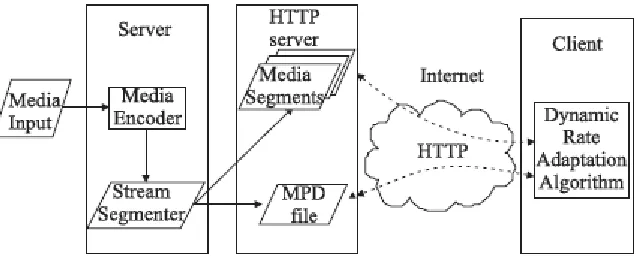
Dynamic adaptive streaming media system architecture as shown in figure 1.
Figure 1. Dynamic adaptive streaming media system architecture.
Algorithm Purpose
The purpose of rate adjustment is to allow users in the network bandwidth is limited, the network environment is constantly fluctuating, to provide users with better video playback effect. To this end, the algorithm can set the following goals:
1) Play the process is not stagnant.
2) as far as possible to improve the average rate of video playback, and make full use of bandwidth.
3) as far as possible to reduce the number of switching, in particular, avoid too frequent switching.
4) Try to shorten the start time of video playback.
The above goal, first of all, should ensure that the first, buffer level will not be too low, when the data in the buffer is not large, using conservative bandwidth utilization strategy as soon as possible so that the cached data increase. The last one and rate switch has nothing to do, depending on the algorithm to the fastest access to the first video clip. Second one and third one by rate switching algorithm decision,, there are some conflicts between the two. By setting the bandwidth variation in the same time constraints, and reducing the code rate adjustment, to avoid the frequent rate adjustment. And buffer level is higher, the bandwidth amplification effect, reduce the rate adjustment is limited, make full use of the bandwidth.
Algorithm Description
THROUGHPUT ESTIMATION
EWMA(t) = aY(t) + (1-a)EWMA(t-1),t = 1,2,...,n (1)
Among them, the EWMA (t)is t time estimates, The Y (t) is measured value of the t time; n is the total of the time. The a (0 < a < 1) is weight coefficient according to the historical measurement. The reason is called the index weighted, because the weighted coefficient a is exponential decline, that is, each index with time and exponential decline. With n is expressed as a = 2 / (n + 1).
RATE SWITCHING STRATEGY
Suppose R(i) is rate of the video slice I, and a video slice has n kind of rate. That, the every time selection of code and the network throughput must be satisfied:
R(i)<= EWMA(t), R(i) (R(1), R(3),……R(n)) (2)
That is, the rate R (i) of the video slice is less than estimated value of network throughput at t time.
Assume that the arrival time of the video slice i is T(R(i)), estimated time of arrival is T(E(i)), the time difference is S(i)= T(E(i))- T(R(i)), the arrival time of the video slice i+1 is T(E(i+1)), time surplus that is generated at time i is S(i).So the network capacity is increased S(i)* E(i+1), among, E(i+1) is estimated network throughput at time i+1, thus, available network capacity at time i+1 is S(i)* E(i+1)+(T(E(i+1))- T(E(i)))* E(i+1). Therefore, According to the relationship between network throughput and rate, the rate of the i+1 video slice is selected is:
R(i+1)* (T(E(i+1))- T(E(i)))<= [S(i)+(T(E(i+1))- T(E(i)))]* E(i+1) (3)
R(i+1)∈(R(1), R(3),……R(n))
CONCLUSIONS
ensure the smoothness of the media rate switching flow. Finally, through experiment and practical application, verify the algorithm in dynamic media rate selection good performance.
The algorithm always choose a low bit rate when the video is not downloaded, the next step work can improvement is dynamically updated video level set, better achieve rapid promotion video quality; when there are multiple clients in the same network, how to adjust the bandwidth utilization strategy, the multiple clients can achieve a better balance.
REFERENCES
1. Shen Subin, Zhu Xiaochen. 2014. A Survey of Dynamic Adaptive Streaming over HTTP (DASH), NDCC2012, Dec. 72012. In Chinese
2. Xia Bo, Lin Hu, Li Hong-bin, Du Wei. 2015. A Dynamic Adaptive Bitrate Switching Algorithm for HTTP Streaming, Journal of Chinese Computer Systems, Vol. 36 No. 22015. In Chinese 3. Zhang Huishuai, Wang Jinlin, Zhu Xiaoyong, Sun Peng. 2013. A Real-time Adaptive Bit stream
Switching Algorithm for HTTP Streaming, Computer Engineering, Vol. 39 No. 2 2013. In Chinese
4. Chen Zhong⁃hua, YaoWei, Hui Yawen,2014. Research on muti⁃rate adaptive processing system of streaming media files, Modern Electronics Technique, Vol. 37 No. 2 2014. In Chinese 5. Li Yunfei, Xie Weikai, Lu Chenping, et al. 2012, Optimization on behavior of HTTP cache