2016 International Conference on Wireless Communication and Network Engineering (WCNE 2016) ISBN: 978-1-60595-403-5
Design of an Anti-saturation System for GNSS Receiver
Run-dong ZHENG
1, Jin-dong LI
2, Jian-feng TAN
1, Ge GAO
1and Ji-bin LIU
11College of Electronic Science and Engineering, National University of Defense Technology, Changsha, Hunan province, China
2Navy Navigation Support Factory, Qingdao, Shandong province, China
Keywords: Anti-saturation, Two-stage anti-interference, DLMS, GNSS receiver.
Abstract. In order to solve the problem of interference in satellite navigation receiver, this paper proposes a two-stage cancellation anti-jamming implementation for GNSS system. Interference cancellation of the RF front-end can improve the saturation power point of the first-stage by more than 25dB, and two-stage cancellation can drop the interference signal power by 60dB. Practical tests shows that the anti-jamming performance of the receiver board increased by about 44dB. The system uses four-channel design and adopts power inversion (PI) and delayed least mean squares (DLMS) algorithms to calculate weights. The eventual system response time isproved inmagnitude of us.
Introduction
With the development of navigation technology, the anti-jamming performance of satellite navigation system has been paid much attention. Since the satellite signal is weak, high-power devices will seriously disturb the normal operation of satellite navigation systems. As an effective anti-jamming method, adaptive antenna array technology can suppress both narrowband interference and wideband interference.
Array anti-jamming technology distinguishes signals in airspace according to their spatial characteristics. By using digital beam forming (DBF) technology, it suppresses different types of interference effectively at the direction distinct from the desired signal. There have been a large number of studies about array anti-jamming and a series of algorithms have been proposed which already proved effective[1,2,3,4]. However, due to the high sensitivity of the GNSS receiver, the RF front-end will be easily saturated. But merely adopting DBF technique can not avoid signal distortion caused by front-end saturation, thus requiring further processing at front-end.
To prevent saturation at RF front-end and improve the anti-interference performance of system, the method of multi-channel RF cancellation is used at first to make the jamming signal power fall to the dynamic range of the receiver; and then the anti-jamming performance is further improved through IF spatial filtering algorithms. This paper designs and tests a two-stage anti-jamming system. The key multistage anti-jamming algorithms and hardware design are described.
Anti-jamming Algorithm
Since the GNSS signal power is small, usually take Linearly Constrained Minimum Variance (LCMV) criterion to conduct beam optimization under strong interference, also known as power inversion (PI) criterion. Goal of the criterion is the minimizing power of output signal by adjusting the weights. When the interference signal power is much greater than the desired signal and comes from different direction, it can minimize the desired signal distortion and suppress the interference as much as possible.
The target function of LCMV criterion is [5],
2
min E[ ] H
out
P y xx
W w R w (1)
0
, under the constraint condition of W aH (0)1, namely that the useful signal is not distorted, the optimal weights of the LCMV criterion can be obtained through the classical Lagrange multiplier method,
1 opt=Pout,min xx (0)
W R a
(2) In order to implement the PI criterion, select the least mean squares (LMS) algorithm for beam forming to make the error rapidly converge along the gradient direction. It has been proved that LMS algorithm can not operate on high-speed platform due to its own defects. To ensure the normal FPGA sequence, use DLMS algorithm to obtain the amplitude-phase weights and align the null of synthesized pattern to the direction of the jamming signal.
Adopt DLMS algorithm to simulate any two channels at the first stage by MATLAB. Assume the distance between two antenna elements is0.5, the interference signal direction is -50° and the desired signal direction is 15°. The synthetic radiation patterns under different SNR are compared as shown in Figure 1. It can be seen that, with the interference signal power greater, the beam nulling is getting deeper, which is consistent with PI criterion. OnceSNR 30, the nulling depth will remain almost unchanged.
Using CST to simulate microstrip patch antenna array and substituting the weights calculated from MATLAB, the synthetic directivity diagrams of two-element array is given in Figure 2. It shows a pretty deep nulling at -50°,which can suppress the interference effectively.
[image:2.595.77.275.351.494.2]
Figure 1. The synthetic radiation patterns under different SNR through MATLAB.
Figure 2. The synthetic radiation pattern through CST.
System Hardware Design
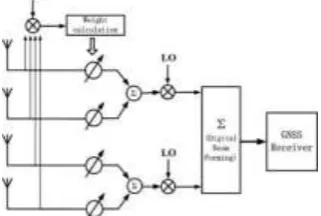
[image:2.595.218.379.657.765.2]As shown in Figure 3, the system adopts two-stage cancellation process. The first stage is the RF anti-saturation front-end. A part of RF signal coupled through the bypass of the antenna channels downconverts to IF, and weights can be calculated to control vector modulator to produce nulling in the radiation diagram. The signal power will fall to the dynamic range of the second-stage channel thus achieving anti-saturation. The second stage is IF space-time anti-jamming part. RF signal of each channel downconverts to IF and space-time filtering algorithm is adopted to further improve the system anti-interference performance.
The eventual anti-saturation system is composed of several modules, such as vector modulator, signal conditioning, signal generator, downconverter, etc. The main hardware components used are as follows:
—LNA: WHM20R, low noise coefficient, 1dB power compression point> 15dBm
—Analog Phase Shifter: HMC934, broad frequency range 1GHz to 2GHz, phase adjustable within 400 degrees, low insertion loss is 3.5 dB
—Mixer: RMS-30, conversion loss is about 7dB —IF amplifier: MAR-8SM +
[image:3.595.91.249.251.378.2]—Local Oscillator: ADF4350, the maximum output power is
5dBm, adjustable with step of 1MHz. Six local oscillators are required (as downconverters for four coupling channels and two main channels). To satisfy the demand for signal power, use SBB-5089Z to amplify 20dB, and then divide into six channels.Figure 4. The RF front-end of two channels. Figure 5. The relationship between channel phase shift and control voltage.
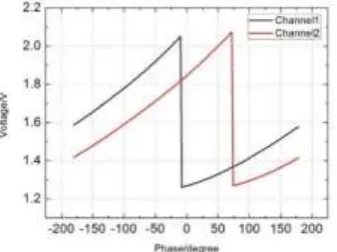
Figure 4 shows the vector modulation and superstition circuits in the RF front-end of Channel 1 and Channel 2. The amplitude and phase adjusted by vector modulator is under the control of DC voltage which is generated by DA. Because the relationship between the control voltage and the controlled quantity is nonlinear, it is necessary to correct the error. Taking one channel for example, the actual relationship between control voltage and phase shift is shown in Figure 5.
As can be seen from Figure 5, the relationship between control voltage and phase shift is non-linear. If not calibrated, phase error under the same voltage can reach 20° maximally, which will seriously affect the cancellation effects. We come up with three correcting methods, look-up table, sectional approximation and high-order fitting. In practical operation, the sectional approximation method is used, which can limit the error to a small range and be realized easily. The same goes for amplitude calibration process. The entire link is corrected from RF front-end to power synthesizer and thus both non-linear error and channel inconsistency error can be effectively eliminated.
Experimental Results
[image:3.595.340.509.252.378.2]Figure 6. Anti-saturation performance of the first stage. Figure 7. Anti-jamming performance of the two stages at -20dBm signal input.
The anti-saturation performance in RF front-end is obtained by observing 1dB power compression point. The front end without processing will be saturated when input signal power is above -35dBm. While after anti-saturation process the saturation power point of system will improve as shown in Figure 6. It can be seen that, in the range of 1570 ~ 1580MHz, the anti-saturation capacity improvement is greater than 25dB.
[image:4.595.351.493.71.180.2]To test the anti-interference, firstly set the input jamming signal power to -20dBm and test the signal output in IF terminal. Without the two-stage anti-jamming process, the front end is already saturated with the output of around 15dBm. It demonstrates that the system anti-jamming performance in the working band is greater than about 60dB as shown in Figure 7.
[image:4.595.94.508.343.506.2]Figure 8. Anti-jamming performance under different input power at 1575MHz.
Figure 9. System response time under different input power.
Due to the adoption of PI algorithm, anti-jamming capacity is related to the interference signal power. Therefore the system anti-jamming performance under different input power is also tested at 1575MHz.The results are given in Figure 8. With the interference signal power increasing, the system anti-interference performance enhances.
The system response time under different input power at 1573MHz, 1575MHz, 1578MHz are tested. Figure 9 indicates that the greater the input signal power is, the faster the DLMS algorithm converges. Therefore we can adjust the step of DLMS algorithm appropriately according to different input power.
[image:4.595.337.509.621.751.2]Figure 10. Board localization withoutanti-jamming. process.
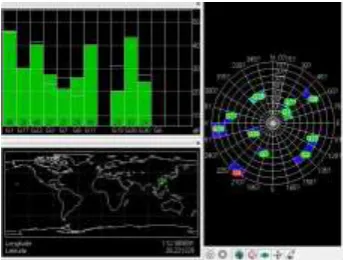
[image:4.595.81.264.623.758.2]Use UBlox NEO-M8N board to carry examination. Loss of lock phenomenon begins to appear when the input interference is greater than -50dBm. Interference signal of -6dBm after two-stage process becomes less than -53dBm. Since the eventual IF output signal of the system need upconverting to the receiver board, the conversion loss deteriorates the overall performance. The final anti-interference performance in practical application is improved about 44dB. With the entire system integrated into the GNSS receiver board, the performance will be improved greater. Figure 10 and Figure 11 represent the board localization when the input interference signal power is -10 dBm.
Conclusion
This paper designs a two-stage joint anti-interference systems. It can not only prevent the saturation of RF front-end effectively, but also has a good suppression of interference. Tests shows that the system RF front-end saturation power point improves more than 25dB, the elimination to interference signal of the two-stage array is greater than around 60dB and the power of strong interference signal is suppressed below -50dBm. The anti-jamming performance of GNSS receiver has been greatly upgraded with response time confined within 20µs, which can basically meet the demand of engineering applications.
References
[1]G. Dimos, Low-cost Solution to Narrowband GPS Interference Problem, Aerospace and Electronics Conference, 1995.
[2]D. Michael, Zoltowsk, Advanced Adaptive Null Steering Concepts for GPS, IEEE Navigation: Journal of the Institute Navigation, 1995.
[3]L. Gargouri1, R. Ghayoula1, N. Fadlallah, A. Gharsallah1, M. Rammal, Steering an Adaptive Antenna Array by LMS Algorithm, 16th IEEE ICECS, 2009.
[4]S.A. Aghdam, J. Bagby, R.J. Pla, Adaptive Antenna Array Beamforming Using Variable-Step-Size Normalized Least Mean Square, 17th ANTEM, 2016.