2016 International Conference on Artificial Intelligence: Techniques and Applications (AITA 2016) ISBN: 978-1-60595-389-2
Design of Fire Control Information Transmission
System Based on Internet of Things
Jian-guo LUO
1and Ze-hao BU
21Mechanical and Electrical Engineering Department, North China Institute of Science and
Technology, East Suburb of Beijing, China, 101601
2Graduate School, North China Institute of Science and Technology, East Suburb of Beijing, China,
101601
Keywords: Internet of things, Fire monitoring, PLC, GPRS, System design.
Abstract. Based on the Internet of Things technology, taking full account of fire situation, weather conditions, surrounding environment, as well as firefighting effects and other impacts on embedded scalable fire rescue equipment, and then make the design of fire monitoring information transmission system. Constructing the sensor network lines, using GPRS technology to realize remote transmission of information and timely transfer fire monitoring information to remote monitoring center, with location information of the flame being passed to the gun by the action of PLC and GPRS,so as to choose the better firefighting method. In the design, manual control panel and automatic control panel work together to improve the efficiency of firefighting equipment, reducing the probability of failure due to the equipment failure.
Introduction
It is difficult to put out a fire from outside of the high-rise building, so early inside automatic fire alarm, timely linkage control and effective evacuation is particularly important [1]. To solve these problems, many institutions at home and abroad have carried out some study, such as the US NIST proposed fire emergency PAD based on wireless LAN technology [2], University of London designed simulation system based on disaster model [3]. USTC Fire Sciences Laboratory designed the fire evacuation model and model-based development area fire simulation [4-5]. With scientific and technological progressing, especially the semiconductor technology, the development of computer network and information technology, and practical of artificial intelligence have provided strong support [6] for the development of a new generation of intelligent fire monitoring system. Internet of Things is a new generational information technology which is developed on the basis of Internet, sensors and other technology. Internet of Things integrates computer, network, sensor technology and software, so as to making techniques and life closer. The rapid development of the Internet of Things, also led to the rapid development of the Internet and the realization of remote communication [7]. Remote transmission makes the transmission of fire monitoring information more efficient, so as to take prompt security measures. For prevention, firefighting and rescue issues on high-rise buildings, the design combined with IOT, PLC, GPRS wireless transmission technology, embedded scalable monitoring information transmission system improved the efficiency in the use of equipment and provided a strong guarantee for people's lives and property [9].
The Overall Structure and Function of System
observe indoor fire timely, the outdoor sensors and position modules are used for accurate firefighting, cameras can observe fire situation. The mobile network is used for remote data transmission, which avoids the negative impact of excessive and complicated wireline brought. The monitoring center set in an isolated room or the ground remote central control room, connecting the firefighting device through the mobile network and the remote sensor networks. The system is mainly used for monitoring and transmission of information, by reading the information stored in the node processing module from PLC to distinguish the corresponding sensor, timely alarming and starting fire extinguishing equipment. When (the) fire occurred, the wireless signal sent by node open the communication function in mobile data and warning timely, when the size of fire deviation from the preset value, timely initiate the firefighting equipment. Sensor network is an organic combination of a number of sensor nodes through the wireless network. Positioning is combined with satellite positioning module and inertial navigation positioning module, which would make it more precise. Mobile data communications section transfer the location data to the remote node monitoring host through GPRS. The control section is the center of all nodes, co-ordinates the functional parts together, makes it work better.
Figure 1. IOT node diagram.
Hardware Design
Model "JTGB-UH-YC 102/IR2" flame detector was applied, which consists of multi-sensor technology of infrared (MIR) and the composite detection technology, with a proof function, and having three channels, one of which is installed with UV flame sensor, one of the other two channels a sensor work on a specific flame radiation center frequency band infrared sensor monitoring, it can detected the infrared emitted by flame more clearly; other infrared flame sensor is used to eliminate outside influence to make the probe's identify ability more accurate.
Model 6ES7 231-7PD22-0XA0CEM231 temperature sensor module was used, when (the) fire occurred, the temperature will greatly increase in a short period time, the device will cause the internal level increased rapidly, so that the temperature detector can sense temperature changes timely, according to the degree of severe temperature changes can speculate the size of the fire, when the signal changes to a certain level range, fire information transmitted via the PLC.
Using model JTY-GD-HA801 smoke detector module, it uses intelligent micro-processor, not only can effectively detect smoke, but also have a variety of fire model algorithms to reduce false alarm.
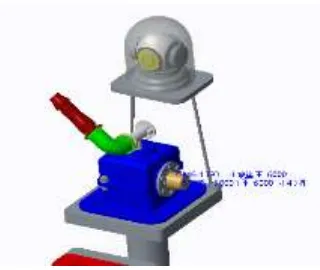
Figure 2. Camera.
Software Design
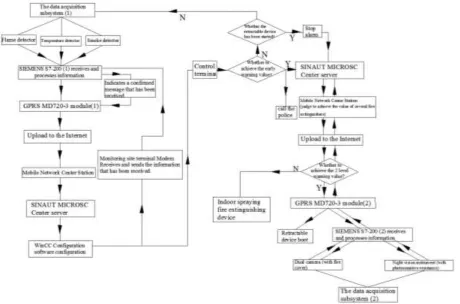
GPRS wireless transmission needs GPRS mobile phone SIM card, inserting in the Siemens MD720-3 GPRS module, PIN code in SIM card will be used for subsequent programming. Connecting MD720-3’s GPRS module and s7-200 PLC Port1 communication interface via PPI cable. After the hardware connected, add GPRS communication library to the fire monitoring device. Subroutine library file contains four modules: WDC-INIT (initialization), WDC-SEND (send), WDC-RECEIVE (received), and WDC-CONTROL (control).Control center requires the information must be uploaded to the Internet. Installing the communication routing software SINAUT MICRO SC and configuration software Win CC. After SINAUT MICRO SC configured, remote monitoring could connect network. After achieving remote data communication, data uploaded to a remote monitoring center, Win CC software read the fire scene data and displayed it. Monitoring center mainly consists of two parts, namely, Win CC (OPC Client) and SINAUT MICRO SC (OPC Server).OPC communication is to achieve OPC Client communicate with the OPC Server (Figure 3).
Figure 3. GPRS communication mode.
[image:3.595.128.466.430.579.2]Figure 4. Flow Chart of data transfer.
[image:4.595.264.528.491.712.2]When GPRS network doesn’t need to transfer data for a long time, it will automatically disconnect network. To keep the network always online, it is necessary to make heartbeat package design for GPRS networks (Figure 5), which is to add a program in the transmission link software, enabling the device to automatically send a set of data at intervals via GPRS so as to achieve a long time link. In addition, in order to enhance GPRS signal, isolation chamber will be equipped with a small base station.
Figure 5. Design of heartbeat packet. Figure 6. Manual control panel.
[image:4.595.68.276.494.722.2]Conclusion
(1) High-rise buildings have their own detection devices; considering the principle of applying and combining with actual conditions, the sensor network is wired transmission. Choosing GPRS technology to make the data wireless transmission stable and reduce the limitations of the transmission distance.
(2) The OPC technology made MD720-3 GPRS module and the PLC realize real-time information transmission, software can easier and faster access to the monitoring center information, handle these data timely, not only save system resources, but also improve the efficiency of data collection and transmission, making transmission more accurate and easy to control.
(3) Design the manual control panel and automatic control panel; users can control the system simply and conveniently.
Acknowledgement
This research was financially supported by the Hebei Province Science and Technology Foundation (No.Z2015072, No.15275508) and NCIST Foundation (No. 3142015023).
References
[1] Y. H. Chen, W. Y. Geng, Ultra-high-rise building fire alarm system designs [J]. Modern buildings Electrical. 2014 (02).
[2] NIST. Improving First Responder Communications [C] .NIST Projects, New York.2004.1-33.
[3] Jones, Lane M. Alternative Risk Strategies [M] .London.2002: 1-205.
[4] R. Huo, H. B. Wang, Fire computing modeling and personnel fire evacuation process [J]. Fire Science and Technology, 2003 (2).
[5] Z. L. Yang, Z. F. Guo, J. J. Ji etc. Fire simulation model based on regional development [J]. Chinese Science Bulletin, 2005 (12).
[6] W. Q. Pu, C. M. Xi, Analysis on the development of intelligent building fire monitoring system [J]. Fire safety. 2004 (12).
[7] L. Yu, H. K. Xu, X. Hu. Remote video monitoring system design based on IOT [J].Computer technology and development .2016 (04).
[8] M. J. Fan, Internet of Things and Sensor Technology [M]. Machinery Industry Press, 2012.