2016 International Conference on Computer, Mechatronics and Electronic Engineering (CMEE 2016) ISBN: 978-1-60595-406-6
Non-structural Fracture Blasting Technique and Case
Analysis of Open Pit Coal Mine in the Arid Area
Ya-jun CHEN*, Zhi-guo CHANG and Fei ZHAO
Xinjiang Institute of Engineering, Urumqi, Xinjiang, 830091, China *Corresponding author
Keywords: Non-Structure, Fracture, Open Pit Coal Mine, Blasting.
Abstract. Rock breaking mechanism and optimization of blasting design of non-structural fracture are the core problems in the mining process of the open pit mine in the arid area. It is of great importance to explore effects of non-structural fracture blasting technique on the enhancement of the economic benefit of blasting, the reduction of the bulk rate, and the decrease in accidents of blasting, which is the hotspot research for the blasting at open pit coal mine in the arid area. By analyzing the non-structural fractured lithologic characteristics, plane of fracture of rock mass, attitude of fracture and blasting process in the typical open pit coal mine, we discussed the effect of non-structural jointed rock mass on blasting. Based on such results, we analyzed the key links of the blasting operation, such as detonating position, charge structure, initiation pattern etc., then we optimized the blasting design and evaluated the blasting effects. The results showed that for the mining area in the arid area with non-structural fractured rock mass development and large rock bulk after blasting, symmetric or asymmetric hole-by-hole millisecond minute difference initiation network along V-shaped oblique line was recommended according the incline of the rock mass. As for the non-structural fractured rock mass affected by shear joints and tension joints, we suggest the adoption of zoning and subsection-based interline millisecond minute difference initiation network among multiple lines as well as deep-hole blasting with non-coupling column charge.
Analysis of the Effect of Non-structural Fractured Rock on the Blasting
Analysis of Lithologic Characteristics of Non-structural Fracture
Non-structural fracture is jointly created by non-structural factors such as diagenesis, external forces, gravity etc., among which weathering fracture will be of general meaning. In the arid region of northwest China, the open pit coal mine with non-structural fracture development has been long exposed to a special environment, such as arid climate, less rainfall, and large temperature difference. The weathering denudation effect is very intense[1]. The rock mass affected by non-structure is mainly distributed at the depth of 15-20m below ground. The main features include:
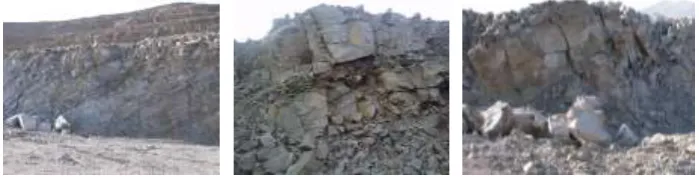
Affected by oblique bedding effect, rock mass was composed of one set or several sets of lamina that were obliquely crossed with the main plane, most of which were one-way oblique bedding (Figure 1-a).
The fracture was distributed in disorder, with irregular features. The structure of the rock along the fissure surface has been changed dramatically, with the continuity and integrity being destroyed[2]. It showed that non-structural fractured rock mass had non-directional rock development (Figure 1-b) or the rock mass was cut and broken by non-structural fracture (Figure 1-c).
[image:1.595.123.473.680.769.2]
Analysis of the Plane of Fracture of Heterogeneous Rock Mass and Attitude of Fracture
Affected by bedding cutting and non-structural fracture, the structure plane of rock mass influenced the bursting strength and bursting mode, which exerted impact on the formation of blasting crater, the quality of rock breaking and much-pile shape[3]. The effects of plane of fracture and attitude of fracture on the rock mass blasting are listed as follows:
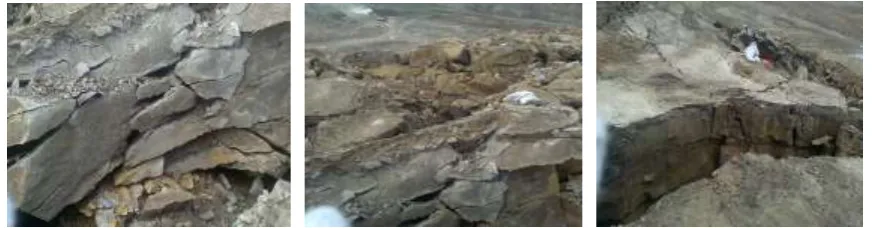
As for the rock mass affected by oblique bedding, blasting would be influenced by attitude plane of fracture in a fixed direction. When bedding blast, towards blasting would take place and bedding rock would be produced (Figure 2-a).
As for non-directional non-structural fractured rock mass, under the effect of explosive shock wave at short range, the dynamic stress field in the rock mass changed, leading to differences in their dynamic strength of extension, compressive strength and shear strength. Density of fracture, attitude of fracture and length of the extension of fracture were all changed. In general, along the direction of low strength of rock mass, the breaking would be more serious, leading to irregular much pile of rock bulk (Figure 2-b).
Affected by the cutting effect of non-structural fracture, the integrity of the rock has been seriously destroyed, with the strength of rock mass lower than that of rock block[4]. The existence of fracture led to decrease in the shear strength along the fissure surface and the strength of extension perpendicular to the direction of fracture. Thus the rock was subject to dislocation or stretch along the pre-existing fracture. Consequently, the detonation gas would easily escape from the extended fissures, thus reduced the effective pressure and pressure action time of the normal breaking. Affected by tensile stress, rock block was produced in the vertical direction (Figure 2-c).
Figure 2. (a) Occurrence of bedding rock; (b) Irregular rock bulk blasting muck pile; (c) Rock along vertical direction.
Case Study and Design Optimization of Non-structural Fractured Rock Mass Blasting
When the open pit coal mine, featured with non-structural development in the arid, was blasted, three occasions would occur: 1) during blasting process, disqualified bulk and medium had something to do with the pre-blasting joint fissures. The results showed that if the rock mass was broken into bulk before the blasting, the block rate after blasting would be high. It would be due to the small contact surface between the explosive and the medium, which led to relatively asymmetric energy distribution[5]. All these resulted in big stock (Figure 3-a). 2) When the fissure surface was large enough or there were fissure surfaces that were parallel to the holes, the shock waves could be reflected on the surface. The rock breaking between the surface and the blasting cartridge would be relatively thorough. While the rock mass beyond the surfaces would be cut on the surface due to the stress reduction and newly formed fracture. Thus, the rock mass could not be thoroughly broken or rock block would not be broken and large scale bulk came into being (Figure 3-b). 3) As for weak interbed and rock mass with existing fracture, fissure surface and structural surface were both the weak part as well as the place with concentrated stress. When explosive charges blast, the damage radius along the fissure surface would be way longer than along other directions (Figure 3-c).
[image:2.595.80.517.381.495.2]Figure 3. (a) Large bulk; (b) Large-scale rock block; (c) Rock block ejected far away.
Xinjiang Heishan Open Pit Coal Mine
Lithologic Character. Xinjiang Heishan open pit coal mine lies within the Toksun county, and the average elevation level of the quarry ranges from 2400~2800m. The mining lot, belonging to typical inland sub-arid desert climate zone, is featured with arid weather, being windy and less rain. The main lithology includes graywacke and medium sandstone. At the shallow bedrock which is 30m below the earth’s surface, there is serious rock weathering denudation and obvious oblique bedding. Among these, at Quarry #2, the dip angle of the stratum was approximately 25º, most joints and fractures extended and distributed along the direction of dip, and obvious cutting effect was observed for non-structural fracture (Figure 1-a). At Quarry #3, the dip angle of the stratum was approximately 16~19º,the oblique bedding effect was relatively weakened, the tension joint effect was enhanced, and many cracked small rocks were observed in the rock block. The fissure surface seemed rough and the width of the breach never remained, with irregular features. Fractures could exert impact on the depth of 9-12m below ground (Figure 1-b).
Blasting Problems. During the blasting process, there are many problems such as too many large bulks, huge consumption of explosive charges, etc. At Quarry #2, which had obvious oblique bedding effect, only a small part of the rock block was directly produced due to the blasting effect. Most rock blocks were produced due to the blasting stress wave, which caused the dislocation and expansion of pre-existing joint fissures of the rock mass. The rock bulk produced during the blasting process would be subject to bedding ejection along the direction of dip (forward free surface). At Quarry #3, jointly affected by shear joints and tension joints, secondary vertical small fissure development was formed at upper terrace with small fracture frequency. The rock blocks after blasting were not of uniform size.
Analysis of Rock Breaking Mechanism. Based on bursting test data, when one more free surface is added to the rock mass, the rock block rate of corresponding size will be decreased by 12-20%. The design adopted symmetric or asymmetric hole-by-hole millisecond minute difference initiation network along V-shaped oblique line. It could provide lateral free surfaces in the rock mass for the after-blasting holes. It means that two free surfaces would be added to after-blasting hole along the direction of exploding wire, and three free surfaces would be added to the other after-blasting holes. Due to the increase in the number of free surfaces due to the blasting inside rock mass, the reflected tension wave effect was enhanced, radial tensile stresses from different directions would be concentrated on the rock mass of the after-blasting hole. The block rate decreased to less than 25% and the breaking effect was enhanced.
Blasting Scheme Optimization:
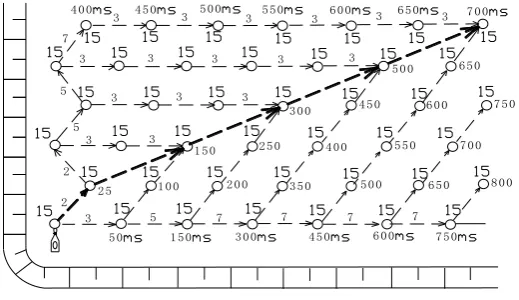
initiation network adopted the anti-parallel of nonel detonator and hole-by-hole millisecond minute difference blasting at small dan grading; a 15-dan nonel detonator had been adopted to set a delay of 350 ms in the blast holes; along the forward free surface direction, the holes in each row detonated hole-by-hole with a 50ms difference; along the V-aped direction, the holes detonated hole-by-hole with a 100ms difference.
1 0 0 5
1 5 0
3 3
5
侧 向 自 由 面
3 3 3 5 5 5 5 5 5 5 5 5 5 5 5 0 1 0 0
1 5 0 2 0 0
5 5 5 5 5 5
7 0 0 6 5 0 7 0 0
4 0 0
3 0 0 5 5 0
1 5 0 3 0 0
2 0 0 2 5 0
3 5 0 4 5 0
5 5 0
2 0 0 2 5 0 3 0 0
4 0 0 3 5 0
5 0 0 4 5 0 5 0 0
6 0 0 6 0 0
7 5 0
4 0 0 6 5 0
4 5 0 35 5 5
5 5 0 3
6 5 0 7 0 0
7 5 0 8 0 0
5
侧 向 自 由 面
正 向 自 由 面 5
3 2 0 0
3 0 0 3 4 5 0
5 5 0 3 8 0 0
7 0 0
[image:4.595.158.438.148.292.2]5 5 5 5 5 5 5 5 5 5
Figure 4. Double lateral free surfaces-based symmetric hole-by-hole millisecond minute difference initiation network along V-shaped oblique line.
Quarry #3. Firing area should have at least one lateral free surface, with more firing holes along the forward free surface direction compared with that along the lateral free surface. The design adopted unilateral free surface-based asymmetric hole-by-hole millisecond minute difference initiation network along V-shaped oblique line (Figure 5), and deep-hole blasting with non-coupling column deck charge)[7]. Initiation point lied at the intersection of slope crests of the two free surfaces. Detonation was propagated from outside to inside, along the oblique line. More than 6 rows of holes should be initiated at a time, with more than 7 holes in each row. Within the blasting hole, a 15-dan nonel detonator had been adopted to set a delay of 350 ms in the blast holes. Ground initiation network ensured that the holes in each row detonated hole-by-hole with a 50ms difference along the oblique line direction. Below the burst area of oblique line, the holes in the first row detonated hole-by-hole with a150ms difference along the forward free surface direction. At the top burst area, the holes detonated hole-by-hole with a 100ms difference.
5 0 1 5 0 3 0 0 4 5 0
4 5 0 5 0 0 5 5 0
2 0 0 1 0 0
2 5 5 0 0 6 5 0
5 5 0 4 0 0
3 7 0 0
6 0 0
5 0 0 6 5 0
6 0 0 6 5 0
侧 向 自 由 面
正 向 自 由 面 3
3
6 0 0 1 5 0
3 2
5 7
5 7 7 7 7
4 5 0
7 0 0
7 5 0 2 5 0
3 0 0
3 3 3
2 5
3 5 0 4 0 0
3 3 3
3 3 3 3 3 3
3
7 5 0
8 0 0
Figure 5. Unilateral free surface-based asymmetric hole-by-hole millisecond minute difference initiation network along V-shaped oblique line.
[image:4.595.166.426.508.658.2]block decreased dramatically, with rock size reduced to less than 1.5m×1.2m×0.7m (Figure 6-b).
Figure 6. (a) Quarry #2 muck pile; (b) Quarry #3 muck pile.
Kumishi Open Pit Coal Mine
Lithologic Character. Kumishi open pit coal mine is 78km southeast of the Kumishi town in the Toksun county. The main lithology includes graywacke and medium sandstone, with the dip angle of the stratum of approximately 8-11° and f=7-8. The mining lot is featured with arid weather, less rain and being windy. The rock surface suffers serious weathering and denudation. Non-structural fissure is well developed at the shallow bedrock layer 20m below the ground. Many non-structural fractures usually form conjugate X type, joint fissure effect is non-directional, and tension joint is subject to the major fracture structure.
Blasting Problems. The joint effect of oblique layer weakened, the tension joints on rock mass was obvious, the muck pile bedding ejection reduced, and direct crazing of the rock mass led to large fractured ditch, with some fractured ditch crazing directly to the bottom of the step. The maximum size of the rock was 2.5×2.2×1.8m. And the secondary blasting volume increased.
Rock Breaking Mechanism Analysis. The rock mass included many non-directional fracture groups. If small blasting cartridge is adopted to implement hole-by-hole initiation of explosion, the effect of structural plane will be more obvious due to small amount of explosive materials. The muck pile is subject to fracture and became irregular in size, thus influencing the blasting effect. However, if we increase the amount of priming charge to implement interline difference initiation of explosion, the shock wave will have long wavelength, and the minor joint will be closed soon. Thus the same blasting effect can be obtained as that of rock with low strength. The effect of joint fissure on blasting effect will be decreased.
Blasting Scheme Optimization. We will adopt interline milli-second minute difference safe twin type initiation network with zoning or subsection for multiple-line holes and deep-hole blasting with non-coupling column deck charge (Figure 7).
5 5 5
5 5
1 3 5
5 5 5 5
3 3 3
3 3
0 100ms
200ms 300ms 400ms 500ms
50ms 150ms
250ms 350ms 450ms 550ms
100ms 200ms 300ms 400ms 500ms 600ms
5 5 5
5 5
5 5 5 5 5
3 3 3
3 3
3
A爆 区 B爆 区
[image:5.595.187.409.91.167.2]C爆 区
Figure 7. Zoning and subsection interline milli-second minute difference initiation network at Kushimi open pit coal mine.
We divided the entire firing area into blasting areas, with each less than 100 holes and each line with less than 11 holes. Initiation point lied between firing area A and firing area B, and then propagated to firing area C, thus realizing oblique blasting of area-based propagation from area A to areas B and C.
[image:5.595.95.501.561.693.2]minute difference initiation. The holes in each line adopted detonating cord to consequently connect the nonel detonator and explosive material to trigger immediate initiation. Three sections of nonel detonators were adopted to horizontally overlap between blasting areas, so as to achieve safe compound initiation of explosion.
For each firing area, the holes of the first five lines achieved detonation with 100ms minute difference between lines. Then the holes of every two lines achieved interline minute different detonation with 100ms minute difference. Detonation with 50ms minute difference with firing range was realized for the holes in the same line.
Blasting Effect Evaluation. First, due to increasing amount of each charge mass of detonation, the breaking effect of detonation gas on rock has been greatly enhanced, and radial pressure stress and circular tensile stress have been improved. Second, as for the interline milli-second minute difference initiation, the rocks between the holes of the two lines lies within both the springback displacement area of the holes of the front line, and the initiative displacement area of the holes of the back line. The holes of the first line will blast first and then form an active displacement area along the free surface direction, which will provide blasting free surface for the holes of the back line. Additionally, the holes of each line in firing areas B and C are all affected by the detonation in multiple directions of pre-blasting holes from the upper firing area and the firing area itself. Explosive stress waves overlap with each other to enhance the effect, the effect of non-structural major fracture on rock mass weakens, and the rock is broken into uniform size, with the largest size being 1.5×1.2×0.8m. According to on-site data, block rate has been reduced to <18%.
Conclusion and Discussion
As for open pit quarry that features great influence by geological effect such as weathering, denudation and external forces, non-structural fractured rock development, and rock bulk after blasting, we recommend the following blasting design scheme:
As for the non-structural fractured rock that has obvious oblique bedding, dip angle≥25º, their cracking and breaking and size and shape subject to the control and impact of larger bedding surface, we recommend the double free surfaces symmetric hole-by-hole millisecond minute difference initiation network along V-shaped oblique line and deep-hole blasting with non-coupling column continuous concentrated charge. Initiation point lies in the middle of the first row on the forward free surface, and detonation starts from initiation point along the stratum and goes against the direction of dip in V-shaped path to propagate explosion. Since the direction of blasting propagation is fixed, hole-by-hole milli-second minute difference time interval along forward free surface can be 25-50ms less than that along the oblique line, so that the propagation of explosion of the muck pile produced by blasting will be concentrated, which is convenient for mining and loading.
As for non-structural fractured rock that is affected by shear joints and tension joints, and with dip angle approximately 16~19º, we recommend to adopt the unilateral and asymmetric hole-by-hole millisecond minute difference initiation network along V-shaped oblique line and deep-hole blasting with non-coupling deck charge. To enhance propagation of explosion along oblique line from outside to inside and make sure that the blasting effect is directional, hole-by-hole milli-second minute difference time interval along the oblique line can be 25-50 ms less than that along forward free surfaces or lateral free surfaces. The purpose is to guarantee that such blasting effect can be superior to the propagation along the rock or the incline.
The control effect is weakened. Under the stress wave overlapping effect, the size of rock block has been reduced by approximately 29%, and the blasting effect improved.
Acknowledgments
This work was financially supported by the National Natural Science Foundation (51464043).
References
[1] Wang G. T, Guo Y. C. and Ma L. “Study on drillhole pattern of hole-by-hole blasting technology”, Opencast Mining Technology, No.1(2012), p 21-23.
[2] Shao P, Zhang Y. and He Y. N, et al “Experimental Study on Fatigue Failure of Intermittent Jointed Rock Masses Subjected to Repeated Stress Wave”, Chinese Journal of Rock Mechanics and Engineering, Vol. 24, No.22 (2005), p 4180-4184.
[3] Li J. J ,Duan Z. P “Experimental Study on the Effect of Jointed andFractured Rock Masses on Blasting”, Mining and Metallurgical Engineering, No.10 (2005), p 1-3.
[4] Chen Y. J. “Optimization of Blasting Design on Anistrope Rock Body”, Coal Technology,Vol. 31, No.5 (2012), p 71-72.
[5] Liu G. X, Mu Y. Q. and Yang R. Y “Application of hole-by-hole blasting technology in Sandaozhuang open-pit mine”, China Mining Magazine, Vol. 21, No.8 (2012), p 495-498.